Horse Gut Sounds: What's Normal and How to Listen
By Dr. Zubair Khalid, DVM, MS, PhD ·
A healthy adult horse produces soft gurgles, rumbles, and occasional bubbly growls in every quadrant of the abdomen, roughly one to four audible events per minute at each listening spot. Total silence in all four quadrants, or loud fluid-sloshing and gas-pinging sounds paired with signs of pain, are the findings that should put you on the phone with your veterinarian.
Learning how to listen to your horse's gut sounds is one of the most useful skills an owner can develop. Horses cannot tell you where it hurts. Their digestive tract is a long, convoluted system prone to spasms, displacements, impactions, and gas buildup, and gut sounds give you a running commentary on whether the intestines are moving contents along or have slowed to a standstill. This guide walks you through what you are hearing, how to auscultate properly, what normal and abnormal patterns sound like, and how to fold this skill into a weekly horse care checklist and a simple health record.
This article is educational and is not a substitute for veterinary diagnosis or treatment.
At a Glance: Daily Gut Sound Check
| Step | What to do | What normal looks like |
|---|---|---|
| 1 | Pick a quiet moment, horse calm and standing square | No feed noise, no barn commotion |
| 2 | Listen upper right, lower right, upper left, lower left | Soft gurgles and rumbles in each spot |
| 3 | Count roughly one minute per quadrant | Roughly 1 to 4 gentle sound events per spot per minute |
| 4 | Note the character (soft gurgle, long rumble, fluid trickle, metallic ping) | Mixed gurgles and rumbles, not silence, not constant sloshing |
| 5 | Log findings with date, time, and recent feed or exercise changes | Trend stays consistent for your horse |
| 6 | Escalate if gut sounds are absent in all quadrants, violently loud, or paired with pawing, flank-watching, rolling, or no manure | Call your veterinarian |
What Gut Sounds Actually Are
The noises you hear are called borborygmi. They are produced when gas and fluid move through the intestines as waves of muscular contraction push contents forward. Every gurgle is evidence that the smooth muscle of the gut wall is doing its job.
This is why veterinarians treat gut sounds as a real-time readout of intestinal motility. Research on equine gut function has used gut sound scores as an objective measurement of digestive tract activity. In a controlled crossover study of six healthy Freiberger horses, researchers scored gut sounds alongside gastrointestinal transit of barium-filled spheres and found that when a motility-stimulating drug accelerated transit and increased defecation, gut sound scores rose with it [1]. The takeaway for owners is straightforward: gut sounds track how actively the intestines are contracting, and that activity level is one of the most valuable vital signs you can monitor at home.
The horse's gastrointestinal tract is roughly 20 to 25 meters long and includes large fermentation reservoirs (the cecum and colon) that make equine digestion far more acoustically active than the gut of a dog or cat. Most of what you hear comes from the large intestine churning ingesta and fermenting fiber.
Why Gut Sounds Matter in Equine Health
Colic remains one of the leading causes of emergency veterinary calls in horses, and intestinal motility is central to most colic episodes. An impaction, a gas distension, a displacement, or post-surgical ileus (paralyzed gut) all change the sound picture before many other signs appear. The Merck Veterinary Manual lists abdominal auscultation among the core parameters of a colic examination, alongside heart rate, mucous membrane color, and intestinal sounds assessed over four abdominal quadrants.
Vets also use motility as a marker of recovery. After an intestinal illness or surgery, the return of normal gut sounds is one of the early signs a horse is coming back online. Prokinetic drugs, medications designed to restore gut movement, are an active area of equine research for exactly this reason. Tegaserod, a selective serotonin 5-HT4 receptor agonist, significantly accelerated gastrointestinal transit and increased gut sound scores and defecation frequency in healthy horses in the study cited above, and the authors noted its potential value in impaction and paralytic ileus [1]. Drugs in this category are prescription-only veterinary decisions, not owner-administered remedies, but the research illustrates the principle: when motility returns, gut sounds return.
The American Association of Equine Practitioners encourages owners to learn basic monitoring parameters for their horses, including temperature, pulse, and gut sounds, so that changes are caught early and reported accurately to a veterinarian. You do not need to diagnose anything. You need to detect a change and describe it.
What Normal Horse Gut Sounds Sound Like
Normal gut sounds vary from horse to horse and hour to hour. That variation is expected. What you are listening for is the overall pattern for your individual horse.
Typical normal findings:
- Soft bubbling gurgles, like water moving through a pipe
- Longer, low rumbles that roll for several seconds
- Occasional sharper pops or crackles as gas moves through liquid ingesta
- Sounds present in all four quadrants, though not continuously
- Roughly 1 to 4 audible events per minute at any given listening spot, in the experience of most equine practitioners
Sound character varies by quadrant. The upper quadrants tend to carry more gas-associated gurgling from the large colon and cecum. The lower quadrants, closer to the ventral colon, often give a wetter, more fluid-sloshing quality. Many horses are quieter on one side than the other as a matter of individual normal, which is why establishing your horse's baseline matters more than memorizing an absolute standard.
Context changes sounds legitimately. A horse that has just finished hard exercise, has been trailered, or has gone a few hours without forage may be temporarily quieter. A horse actively eating hay produces near-constant gut noise. Horses on fresh spring grass often sound louder and more fluid than they do on dry hay in winter. None of these are emergencies by themselves.
How to Listen to Your Horse's Gut Sounds Step by Step
Step 1. Choose the right moment. Pick a time when your horse is calm, has not just eaten a large meal, and the environment is quiet. Turn off the radio, step away from running water, and ask barn mates to hold conversation briefly. Sound travels and you want to hear the abdomen, not the wash stall.
Step 2. Position the horse. Stand the horse square on level ground. Stand beside the barrel of the ribcage, never directly behind the hind legs and never in a crouch where a kick could do maximum damage. Keep a hand on the horse as you work so you feel movement before you hear it.
Step 3. Start in the upper right quadrant. Place the stethoscope (or your bare ear pressed firmly against the coat) in the flank area behind the last rib, high up toward the spine. This region sits over the base of the cecum and right dorsal colon. Listen for a full 60 seconds. Count the number of distinct sound events, not seconds of noise.
Step 4. Move to the lower right quadrant. Place the stethoscope lower on the belly, just behind and slightly below the point of the elbow area near the ribcage floor. You are now over the ventral cecum and right ventral colon, where fluid sounds are often loudest. Listen for another minute.
Step 5. Move to the upper left quadrant. Behind the last rib on the left side, high near the spine. This covers the left dorsal and ventral colon and the spleen sits just beneath. Listen for a minute.
Step 6. Finish in the lower left quadrant. Low on the left belly, mirroring step 4. Listen for a minute.
Step 7. Score and record. For each quadrant, jot down three things: frequency (none, occasional, frequent), character (soft, rumbling, fluid, metallic or pinging), and anything unusual. A simple 0 to 3 scale (0 = absent, 1 = decreased, 2 = normal, 3 = increased) works well and matches how researchers score gut sounds in clinical studies [1].
Step 8. Correlate with the whole horse. Gut sounds never get interpreted alone. Check attitude, appetite, water intake, manure output and consistency, posture, and whether the horse is comfortable. A horse with a quiet right side who is bright, eating, and passing normal manure is a different situation from a horse with silent gut and rolling eyes.
Total time for a complete check is about five minutes once you are practiced.
Equipment and Supplies
Stethoscope. Any functional dual-head stethoscope works. You do not need a cardiology-grade instrument for gut sounds, which are low-frequency and fairly loud. Selection criteria that matter:
- A chest piece large enough (adult size, roughly 1.75 to 2 inches) to pick up low frequencies
- A diaphragm side for general auscultation
- Ear tips that seal comfortably in your ears
- A tube long enough (at least 22 to 28 inches) that you can stand beside the horse rather than leaning under the belly
A single-head stethoscope from a pharmacy is adequate. veterinarians often use the diaphragm for gut sounds and light pressure for higher-frequency detail.
No stethoscope option. In a pinch, a bare ear pressed flat against the coat works, and generations of horse people have done exactly this. It is less precise, less hygienic, and puts your head closer to a kicking zone, so reserve it for situations where no stethoscope is available.
A log. A notebook, a printed horse health record template, or a notes app. Consistency matters more than format.
Treats and a handler. Reward cooperation. If your horse learns that gut sound checks come with a scratch and a mint, the behavior will stay calm and repeatable.
Horse Gut Sounds Normal Tips
These practical tips will sharpen your technique and your interpretation.
- Build the baseline first. Listen on ten ordinary days before you attach meaning to any single reading. Every horse has a signature pattern.
- Listen before feeding, and again two hours after. Pairing the two readings teaches you how your horse's gut responds to a meal and gives you two reference points instead of one.
- Use the same four spots every time. Consistency converts your notes into a usable trend line.
- Press firmly and keep still. A drifting or tapping stethoscope creates artifact noise that masks real sounds.
- Listen through the coat, or wet it slightly. On winter coats, dampening the hair with a little water or rubbing alcohol improves contact dramatically. Do not shave or clip just for this.
- Count events, not seconds of sound. One long 10-second rumble counts as one event. Frequency of distinct contractions is the meaningful number.
- Check manure at the same time. Manure output is the other half of the motility picture. Manure amount, form, and frequency belong in the same log entry.
- Teach a second person. If you travel or board out, someone else should be able to run the same check the same way.
- Use your hands as well as your ears. Placing a palm flat on the flank lets you feel gas rumbling under the skin and detect a tight, drum-like abdomen, a finding worth reporting.
Common Mistakes When Checking Gut Sounds
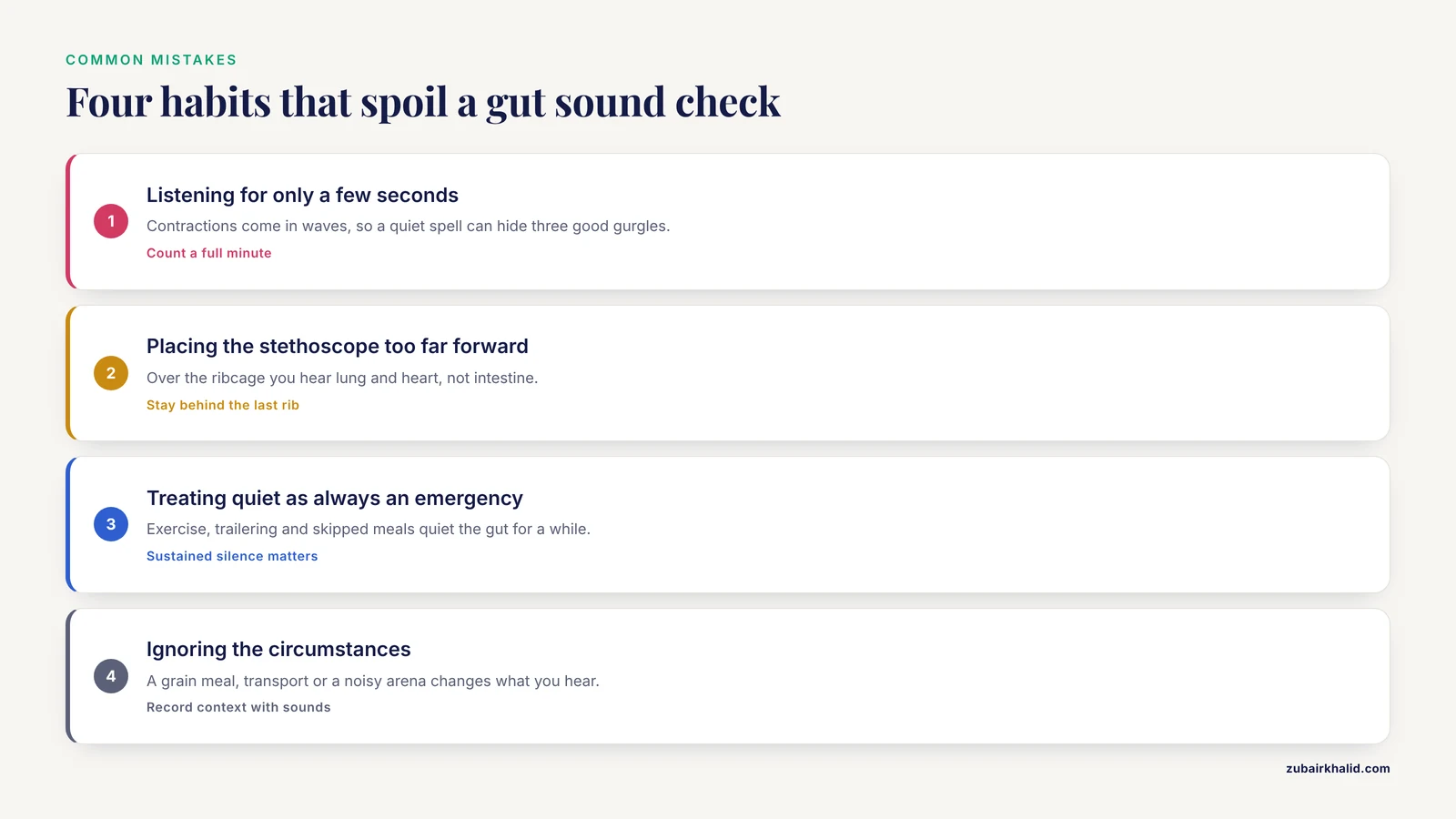
Mistake 1. Listening for too short a time. Five seconds tells you almost nothing. Intestinal contractions come in waves. A quadrant that is quiet for twenty seconds may produce three good gurgles in the next forty. Count a full minute per quadrant.
Mistake 2. Listening in the wrong place. Sounds over the ribcage too far forward are lung and heart sounds, not gut. Stay behind the last rib and low toward the flank.
Mistake 3. Assuming quiet always means disaster. Transient quiet gut happens in normal horses, especially after intense exercise, during trailering, or between meals. The finding that demands action is sustained, complete silence in all four quadrants, especially with other signs.
Mistake 4. Assuming loud always means healthy. Excessive, high-pitched fluid sounds and metallic pinging can indicate gas moving through liquid ingesta, spasmodic contractions, or the early phase of diarrhea. Loud is not automatically good.
Mistake 5. Interpreting one quadrant in isolation. The pattern across four quadrants is the information. One quiet quadrant is common. All four silent is not.
Mistake 6. Ignoring context. A horse checked immediately after a grain meal, mid-transport, or in a noisy arena will sound different. Record the circumstances with the sounds.
Mistake 7. Letting the check replace the exam. Gut sounds are one vital sign. They do not replace hydration assessment, manure monitoring, dental care, deworming programs designed with your veterinarian, or annual wellness exams.
Mistake 8. Delaying the call to "see if it improves." Colic can progress from subtle to surgical within hours. If gut sounds are absent everywhere and the horse shows pain, calling immediately is always the right move.
Troubleshooting: What Different Patterns Can Mean
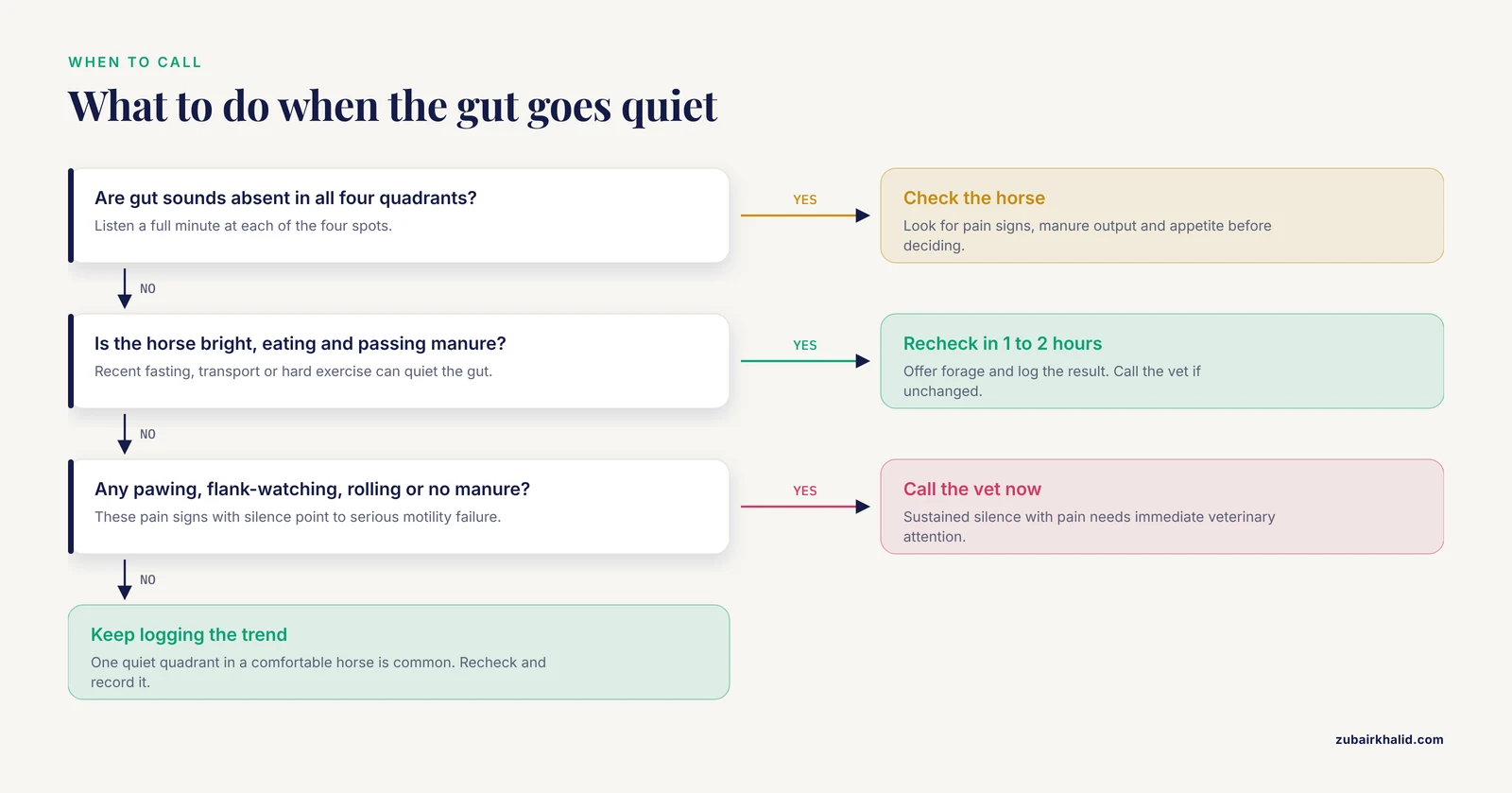
The table below is a decision aid, not a diagnosis. Discuss any persistent pattern with your veterinarian.
| Pattern | Possible interpretations | Typical owner action |
|---|---|---|
| Soft mixed gurgles in all four quadrants | Normal motility | Log and continue routine care |
| One quiet quadrant, horse normal | Individual variation, recent feed or exercise timing | Recheck in a few hours, log it |
| All quadrants silent, horse bright and eating | Possible transient slowing, recent fasting or transport | Recheck in 1 to 2 hours, offer forage, call vet if unchanged |
| All quadrants silent, horse in pain | Possible serious motility failure such as impaction or ileus | Call your veterinarian immediately |
| Violent fluid sloshing and gurgling | Hypermotility, possible spasmodic discomfort or impending diarrhea | Monitor closely, call vet if pain or loose manure develops |
| Metallic, high-pitched pinging sounds | Gas under tension moving through fluid-filled bowel | Call your veterinarian, especially with any pain signs |
| Gurgling accompanied by loose, very wet manure | Fermentative upset, possible dietary change or lush pasture | Review recent diet changes with your veterinarian |
Building a Horse Care Checklist Around Gut Sounds
Gut sound monitoring works best as one line on a broader routine. The American Association of Equine Practitioners encourages owners to track basic vital parameters at home so that a veterinarian can be given accurate information during a call. A practical weekly horse care checklist looks like this:
Daily
- Manure output and consistency
- Water intake
- Appetite and attitude
- Visual once-over for injury, heat, or swelling
Weekly
- Full four-quadrant gut sound check with a log entry
- Digital pulse check on all four hooves
- Body condition score by look and feel over ribs, neck, and tailhead
- TPR snapshot (temperature, pulse, respiratory rate) in a calm moment
Monthly and seasonal
- Weight tape measurement
- Deworming and vaccination schedule per your veterinarian's plan
- Dental check timing per your veterinarian's plan
- Feed and forage inventory review
The Health Record Template: What to Write Down
A horse health record template turns scattered observations into clinical gold. Whether you use paper or a spreadsheet, include these columns:
- Date and time of the check
- All four quadrant scores (the 0 to 3 scale)
- Sound character notes (one or two words per quadrant)
- Manure: amount, form, frequency
- Temperature, pulse, and respiratory rate if taken
- Feed changes in the previous 48 hours
- Exercise and travel in the previous 24 hours
- Behavior notes (eating speed, posture, lying down pattern)
- Any medication or supplement given, with dose and time
When you call your veterinarian about a colic concern, this record lets you answer the questions that will actually be asked: When was the horse last normal? What did gut sounds sound like and when? When was the last manure? Has anything changed in the diet? Accurate answers save time, and time matters with intestinal disease.
Researchers scoring gut sounds in motility studies use standardized observation windows and scales for the same reason. In the tegaserod transit study, gut sound scores rose measurably and consistently when intestinal activity increased [1]. Structure in your records is what makes a number meaningful.
Safety and Welfare Points
- Never crouch, kneel, or sit beside or under a horse while auscultating. Stand upright beside the ribcage with your feet positioned to step away.
- Keep a hand on the horse's body so you feel a shift in weight or a flank tightening before it becomes a move.
- Do not perform gut sound checks on a horse that is actively violent, thrashing, or rolling. Protect yourself and call for help. A horse in severe pain is dangerous to be near.
- Never administer human medications, mineral oil, or any motility-altering substance without veterinary direction. Giving oil by mouth to a horse with a compromised swallowing reflex or damaged bowel can cause serious harm.
- Introducing prokinetic or motility drugs is a veterinary decision. Even compounds studied for gut motility in horses, such as tegaserod, remain research-stage or prescription-level tools requiring veterinary oversight, not over-the-counter fixes [1].
- Handle every quiet-gut episode with the assumption it could be early colic until proven otherwise. Early calls are cheap. Late calls are expensive and sometimes tragic.
Limitations and When to Contact a Veterinarian
Every horse is an individual, and only a veterinarian performing a hands-on exam can determine what is actually happening inside a horse's abdomen. Home auscultation is a screening and trend-monitoring skill, not a diagnostic one.
Contact your veterinarian promptly, the same day, when you observe:
- Gut sounds absent in all four quadrants on repeated checks over more than two hours
- Gut sounds absent together with any sign of pain: pawing, flank-watching, repeated lying down, getting up and down, stretching out as if to urinate, or grinding teeth
- Violent or metallic sounds combined with discomfort
- No manure production for a period that is abnormal for that individual horse
- A tight, distended, or drum-tight abdomen
- Diarrhea with lethargy, especially in any age of horse but treated as urgent in foals and seniors
- Colic signs that persist or recur over multiple days, even if they resolve between episodes
Call for emergency assistance immediately when:
- The horse is down and cannot or will not get up, or is rolling violently
- The horse is sweating heavily, breathing rapidly, or has rapidly worsening pain
- You see gravel or sand in large quantities in the manure in a horse showing any discomfort
Bring your health record to the conversation. Report your quadrant scores, when sounds changed, manure status, and feed changes. That information directly shapes the speed and accuracy of the workup that follows.
Frequently Asked Questions
What do normal horse gut sounds sound like?
Normal gut sounds are soft gurgles, low rumbles, and occasional bubbly pops, present in all four quadrants of the abdomen, typically about 1 to 4 distinct events per minute at each spot. The pattern varies between horses, so your own horse's baseline is the standard that matters.
How often should I check my horse's gut sounds?
Once a week is enough for routine trend monitoring in a healthy, stable horse. Check daily whenever diet, exercise, or weather changes, and immediately any time the horse goes off feed, stops passing manure, or acts uncomfortable.
Where exactly do I place the stethoscope on a horse?
Use four spots: high and low on the right flank area behind the last rib, and high and low on the left flank area behind the last rib. Keep the chest piece behind the ribs and toward the flank so you hear intestine rather than lung or heart.
Can I hear gut sounds without a stethoscope?
Yes. Press your bare ear flat against the coat in each quadrant. It works, but a basic stethoscope is safer, cleaner, and more reliable, and it keeps your head out of the kick zone.
Are quiet gut sounds always an emergency?
No. Transient quietness is normal after hard exercise, trailering, or a skipped meal. The concerning pattern is sustained silence in all four quadrants, especially when the horse also shows pain, stops passing manure, or refuses food. That combination warrants an immediate veterinary call.
Why would a horse have excessively loud gut sounds?
Excessively loud, fluid, or high-pitched sounds can reflect increased gas and fluid movement, intestinal spasms, or the early stage of diarrhea. Loud is not automatically healthy. Pair the sound picture with the horse's attitude, manure, and comfort level, and call your veterinarian if pain or loose manure appears.
Does every horse have the same normal gut sound pattern?
No. Horses differ markedly in baseline sound frequency and character, and the pattern shifts with meals, forage type, exercise, and season. This is why the most valuable thing you can record is your own horse's typical pattern over multiple ordinary days.
What information should I give my veterinarian about gut sounds?
Report when the sounds changed, your four-quadrant scores on your usual scale, how they compare to your horse's baseline, manure output and consistency, feed or exercise changes in the previous 24 to 48 hours, and all pain signs you have observed. A written record makes this fast and accurate.