Horse Feeding Schedule: Template and How to Build One
By Dr. Zubair Khalid, DVM, MS, PhD ·
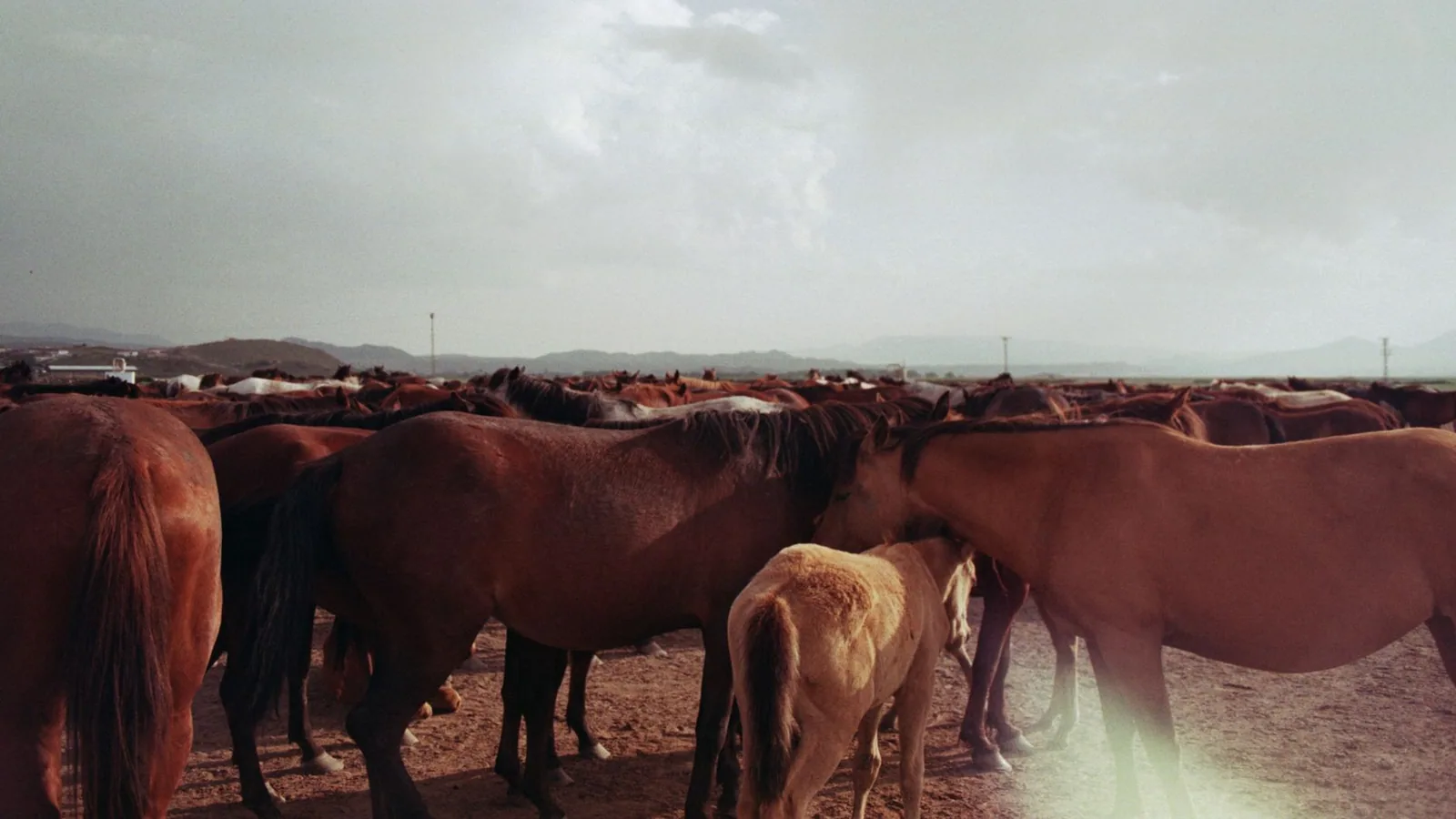
A horse feeding schedule template is a single written page that records what each horse eats, how much, at what times, and who is responsible for each feeding. You build one by listing every feed and supplement your horse receives, setting fixed meal times that repeat every day, weighing portions instead of scooping by eye, and posting the finished schedule where everyone who handles the horse can read it. Research on stabled horses shows why the fixed times matter. When meals arrive later than usual, horses paw, kick, and watch the door more often, and they consume less hay, which means unpredictable feeding times measurably stress horses and disrupt their sense of routine [1].
This article walks through how to build a feeding schedule for your horse step by step, gives a horse feeding schedule template example you can copy today, and explains the related tools every barn should keep, including a horse care checklist and a horse health record template. This article is educational and is not a substitute for veterinary diagnosis or treatment.
At a Glance: Build Your Schedule in One Afternoon
Follow this sequence and you will have a working schedule posted on the stall door by dinnertime.
- List every feed, forage, supplement, and medication the horse currently receives, with amounts.
- Record the horse's basics, including age, breed, body weight or body condition score, workload, and life stage.
- Ask your veterinarian or an equine nutritionist to confirm total forage and concentrate amounts for your horse's situation.
- Choose fixed feeding times and commit to them every day, including weekends.
- Weigh each ration with a kitchen or feed scale rather than a scoop.
- Note any feeds that must be given before, with, or after meals because of medications.
- Fill in the template format below and post a copy at the stall and in the feed room.
- Review the schedule monthly and after any change in workload, body condition, or health.
Why a Fixed Feeding Schedule Matters for Horse Health
Horses are creatures of routine, and controlled research backs what good barn managers have always observed. In a ten week observation study, researchers deliberately shifted one daily concentrate meal earlier on Thursdays and later on Saturdays while keeping it regular on other days. During delayed feedings, horses performed more pawing, more kicking, more comfort behaviors, and more looking toward the door than they did at regular feeding times. During earlier feedings, they spent less time eating hay and more time resting [1]. The study authors concluded that deviations from the regular schedule compromised the horses' temporal predictability, meaning the animals could no longer anticipate a basic daily event they had learned to expect [1].
That predictability has practical consequences beyond behavior. A horse that paws and kicks at the stall door while waiting for a late meal burns energy, risks injury, and may leave hay uneaten, which complicates any owner's effort to monitor appetite. A written schedule protects the horse from the accumulated small delays that happen when several people share feeding duties and no one agrees on the plan.
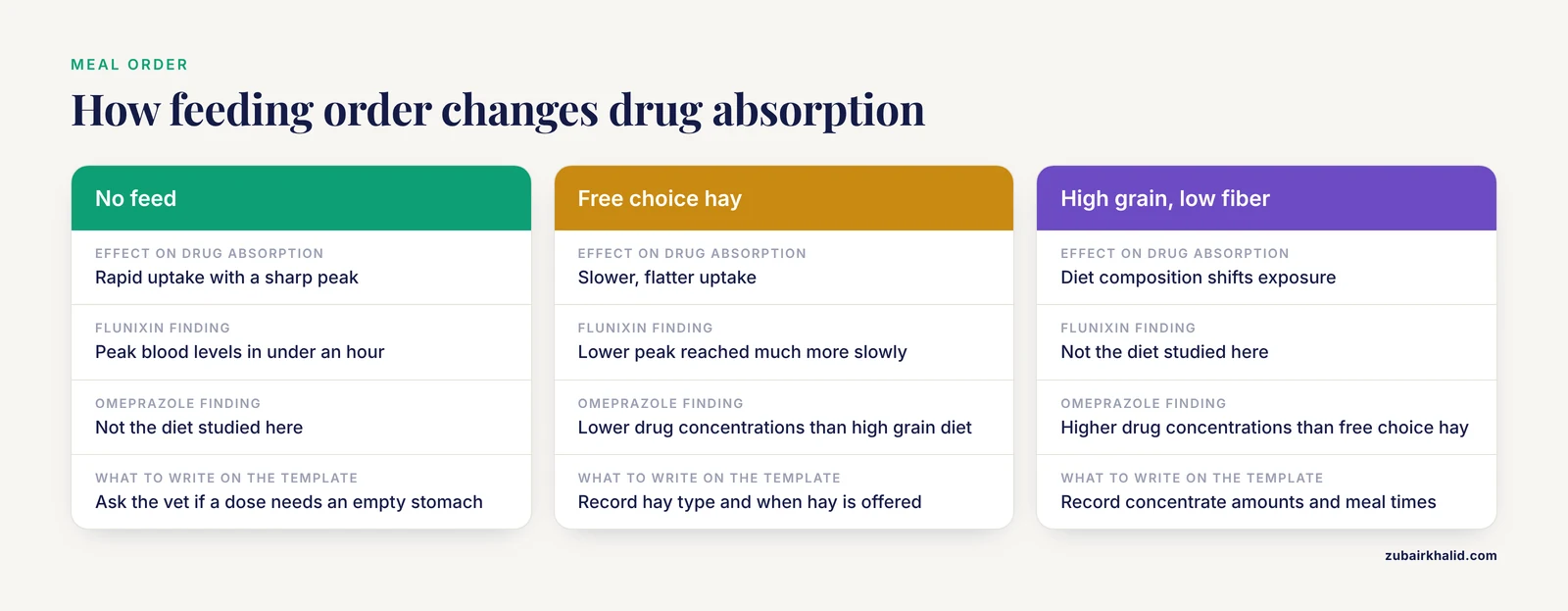
Timing also matters for medical reasons. Feeding changes how orally administered drugs behave in the horse's body. In ponies given the nonsteroidal anti-inflammatory drug flunixin by mouth, animals with no access to feed for a few hours before and after dosing absorbed the drug rapidly, reaching peak blood concentrations in under an hour. Ponies with free access to hay reached a lower peak much more slowly, and some showed two or three separate absorption peaks [2]. Total drug exposure was similar between the two feeding patterns, but the speed and shape of absorption differed dramatically [2]. The same principle applies to the ulcer drug omeprazole, where both the dose and the type of diet changed plasma concentrations in a crossover study of horses [3]. The lesson for your template is simple. The schedule is not only about nutrition. It is also part of the medication plan, and it should record when drugs are given relative to meals.
What Goes Into a Horse Feeding Schedule Template
A useful template format has a header block, a daily meal grid, and a notes column. Keep it to one page so it stays on the stall front rather than in a drawer.
Header Block
| Field | Example Entry |
|---|---|
| Horse name and ID | "Dusty, 12 yr QH gelding" |
| Body weight and date weighed | "1,150 lb, weighed 11/01" |
| Body condition score | "5/9, recheck monthly" |
| Workload | "Light, 3 rides per week" |
| Owner and emergency vet contact | Phone numbers on file |
| Special instructions | "Slow feeder for hay, no treats" |
Daily Meal Grid
| Time | Feed or Forage | Amount (weighed) | Given By | Notes |
|---|---|---|---|---|
| 6:00 AM | Grass hay | 4 lb | Staff | Soaked pellets added for senior horse |
| 6:15 AM | Concentrate | 2 lb | Staff | Joint supplement top-dressed |
| 12:00 PM | Hay check and water refill | As needed | Staff | Note if hay remains |
| 5:00 PM | Grass hay | 4 lb | Owner | |
| 5:15 PM | Concentrate | 2 lb | Owner | Medication at this meal per vet |
| 9:00 PM | Late hay (optional) | 2 lb | Night check | Per vet plan |
This horse feeding schedule template example is deliberately generic. The correct forage and concentrate amounts depend on the individual horse, so the amounts column is filled in with your veterinarian or an equine nutritionist rather than copied from a friend's barn. Kentucky Equine Research and the Merck Veterinary Manual both emphasize that rations are calculated from the horse's body weight, workload, and life stage, which is why those entries sit in the header block.
How to Build a Feeding Schedule for Your Horse, Step by Step
Step 1. Inventory the Horse
Write down age, breed, body weight or estimated weight from a weight tape, body condition score, workload, life stage, and any diagnosed conditions such as gastric ulcer risk or allergies. Breed and life stage matter because a growing youngster, an aged horse with worn teeth, and an athlete in hard training have very different nutritional demands. If you are unsure how to body condition score, your veterinarian can teach you during a routine visit and record a baseline in your health records.
Step 2. Inventory the Feed
List every item that enters the bucket or hay net, including pasture access, hay type and cutting, concentrates, complete feeds, oil, salt, and supplements. Record lot numbers and purchase dates where bags allow. Lot numbers become invaluable if a feed recall or contamination problem ever affects your supplier.
Step 3. Set Fixed Times and Hold Them
Pick times you can genuinely keep seven days a week. A schedule you honor ninety percent of the time beats an ambitious schedule nobody follows. Remember that horses notice delay. The behavior study discussed above found that a two hour deviation from the normal meal time was enough to increase pawing, kicking, and attention toward the feed source [1]. Build the schedule around realistic morning, midday, and evening windows, and assign a named person to each slot.
Step 4. Put Forage First
Forage should form the base of the plan, with concentrate meals layered on top. Resources for horse owners from the AAEP, the Merck Veterinary Manual, and Kentucky Equine Research consistently frame hay and pasture as the foundation of the equine ration, with concentrates added only to meet energy needs that forage cannot cover. If you do not know how many pounds of hay your horse needs, this is the question to bring to your veterinarian or an equine nutritionist rather than guessing.
Step 5. Keep Concentrate Meals Small
If your horse requires grain or a complete feed, divide the daily amount into the smallest number of pounds per meal that is practical for your routine. Large single concentrate meals are the pattern owners fall into when they try to feed the whole day's grain at once, and they are a frequent topic in guidance from Kentucky Equine Research and The Horse because of the digestive load they place on the hindgut. Splitting the ration across the scheduled meal times is the standard correction.
Step 6. Build in Medication and Supplement Timing
For each medication, write down whether it is given with feed, before feed, or after feed, and follow the product label or your veterinarian's instruction. The evidence for why this matters is strong. Hay in the gut slowed and flattened the absorption of oral flunixin, delaying peak blood levels by hours compared with fasting administration [2]. Diet composition also changed omeprazole exposure, with higher drug concentrations in horses on a high grain, low fiber diet than in horses on free choice hay [3]. Even feed ingredients can interact with drug testing. Standardbreds fed alfalfa hay showed elevated salicylic acid in plasma and urine, and the elimination of that compound followed a daily pattern tied to the type of feed and the feeding schedule [4]. If your horse competes under medication rules, record feed types and timing in your template so any question about a test result can be answered with documents rather than memory.
Step 7. Schedule Water, Salt, and Checks
Add water refill checks, salt availability, and a standing offer of forage overnight to the grid. Dehydration risk rises whenever hay intake drops, and a scheduled water check catches blocked or frozen buckets before they become an emergency.
Step 8. Post, Train, and Review
Post the schedule at the stall and a master copy in the feed room. Walk every helper through it once. Review it monthly, and rewrite it after any change in body weight, workload, medication, or health status.
Feed Quality, Storage, and Contamination Risks
A schedule is only as good as the feed it delivers. Contamination of grain is a documented, real world problem rather than a theoretical one. In a controlled trial, researchers fed exercised mares concentrates made from grains naturally contaminated with Fusarium mycotoxins, at measured levels of roughly 11 parts per million deoxynivalenol and 0.8 parts per million zearalenone, alongside mixed timothy and alfalfa hay [5]. The researchers monitored feed intake, body weight, blood variables, and performance on a treadmill step test, and they also tested whether a glucomannan mycotoxin adsorbent could prevent ill effects [5]. The practical takeaway for owners is that contaminated grain is a recognized hazard serious enough to design entire studies around.
Protect your schedule with three habits. Buy concentrates and hay from suppliers who can tell you where the feed came from. Inspect every load for musty smell, heat, discoloration, or insect activity before it enters the barn. Store feed off the ground, sealed against moisture and rodents, and use oldest bags first. If a batch smells wrong or horses suddenly leave their grain, stop feeding that batch and contact the supplier and your veterinarian.
Feeding Around Medications and Competition
Two sections of your template deserve special care if your horse takes any daily medication or competes under drug rules.
First, record the timing of every dose relative to meals. As the flunixin and omeprazole studies show, the same dose can produce very different blood concentrations depending on whether the gut is full of hay and what the diet consists of [2] [3]. When your veterinarian prescribes a new medication, ask directly whether it should be given on an empty stomach, with a small feed, or with a full meal, and write the answer into the schedule.
Second, record everything the horse eats, including forage type. The salicylic acid work in Standardbreds showed that ordinary alfalfa hay raised urinary and plasma salicylic acid levels, that elimination followed a daily rhythm linked to feed type and feeding schedule, and that even a topical product containing methyl salicylate elevated urinary levels for hours [4]. For competitors, that means the feeding record is part of the medication record. A free horse feeding schedule template that captures feed type, lot number, and timing can make the difference between a defensible explanation and an unexplainable positive test.
Monitoring Intake, Weight, and Condition
A schedule tells you what was offered. Records tell you what was actually eaten, and the difference between the two is where health problems first appear. Modern livestock research illustrates the point. In a study of rotationally grazed beef cattle using electronic feeders and walk-over weighing, individual daily supplement intake varied enormously from day to day and was strongly influenced by forage quantity and quality on offer, which is why the researchers argued that real time intake data improves nutritional management [6]. Horse owners rarely have electronic feeders, but the principle transfers. Weigh hay before feeding and weigh or estimate what is refused at the next check. Use a weight tape weekly. Body condition score monthly. Note every skipped meal in the log, because inappetence is often the first visible sign of illness, colic risk, or a feed quality problem.
Pair the schedule with a simple incident log so patterns become visible. Two consecutive refused meals, a sudden drop in water consumption, or a change in manure consistency each warrants a call to your veterinarian the same day.
The Horse Care Checklist
A horse care checklist is the daily companion to the feeding schedule. It confirms that the non-feed essentials happened, which matters because a horse can be fed perfectly and still be in trouble if water froze overnight.
| Frequency | Checklist Items |
|---|---|
| Every feeding | Fresh water available, correct feed and amount per template, supplements and medications given, hay refusal noted |
| Twice daily | Manure passed and normal consistency, horse bright and interested in feed, no swelling or heat in legs at evening check |
| Weekly | Weight tape measurement, feed room inventory and rotation check, water trough scrub |
| Monthly | Body condition score, fence and bucket inspection, feed lot number audit |
| Per veterinary plan | Dental exam, vaccination, parasite control, and hoof care scheduled with your veterinarian |
The dental line deserves emphasis. Feed schedules assume the horse can chew what you provide. Aged horses and horses with sharp dental points may drop feed, quid hay, or lose weight despite an adequate ration, and only an examination resolves the question.
The Horse Health Record Template
The feeding schedule captures today. A horse health record template captures history, and the two documents work together. Keep one page per horse, updated at every vet visit, with these columns or fields.
- Identification, including name, age, breed, sex, and microchip number.
- Body weight and body condition score, dated, in a running list.
- Current diet, including forage type, concentrate, and supplements with amounts.
- Feeding schedule version and the date it was last revised.
- Vaccination dates and products, per AAEP guidance discussed with your veterinarian.
- Parasite control history, including fecal egg count results if performed.
- Dental exam dates and findings.
- All medications, with dose, duration, and timing relative to meals.
- Lameness or illness episodes, diagnosis, treatment, and follow-up dates.
- Laboratory results, including any drug testing documentation.
The medication timing entries matter more than most owners expect. The omeprazole work showed diet and dose interacted to change drug exposure [3], and the flunixin work showed meal timing could shift peak absorption from under an hour to more than seven hours [2]. A record that shows what the horse ate and when makes every future prescribing decision better informed.
Common Mistakes to Avoid
- Feeding by scoop instead of by weight. A "scoop" of one feed can weigh half again as much as a scoop of another.
- Letting weekends slide. Delayed meals increase pawing, kicking, and agitation in stabled horses [1], and weekend inconsistency is the most common source of delay.
- Changing feeds abruptly. Any concentrate change should be stepped over days to a week, a transition your veterinarian or an equine nutritionist can help you plan.
- Ignoring refusals. Uneaten feed is data. Record it, investigate it, and call your veterinarian if it persists.
- Feeding medications without asking about timing. Hay and diet type measurably change absorption of at least some oral drugs [2] [3].
- Trusting feed appearance alone. Contaminated grain in published research looked like ordinary concentrate, and contamination was only established through testing [5].
- Keeping the schedule in a notebook nobody opens. A template only works if it is posted where feeding happens.
- Skipping the water and manure checks because they feel routine. Both are early warning systems.
Welfare and Safety Points
Fixed, predictable feeding is a welfare measure, not a convenience. The behavior study showed that unpredictability itself disturbed stabled horses [1], and consistent routines are among the simplest enrichment tools an owner controls. Feed room safety belongs in the same category. Secure storage prevents binge access to grain, which is a genuine emergency in horses. Handle hay with dust awareness for your own lungs and the horse's. Keep the schedule and checklist visible so a substitute caretaker can maintain the routine during your absence, because a stranger feeding "roughly on time" is still a deviation the horse will register [1].
Limitations and When to Contact a Veterinarian
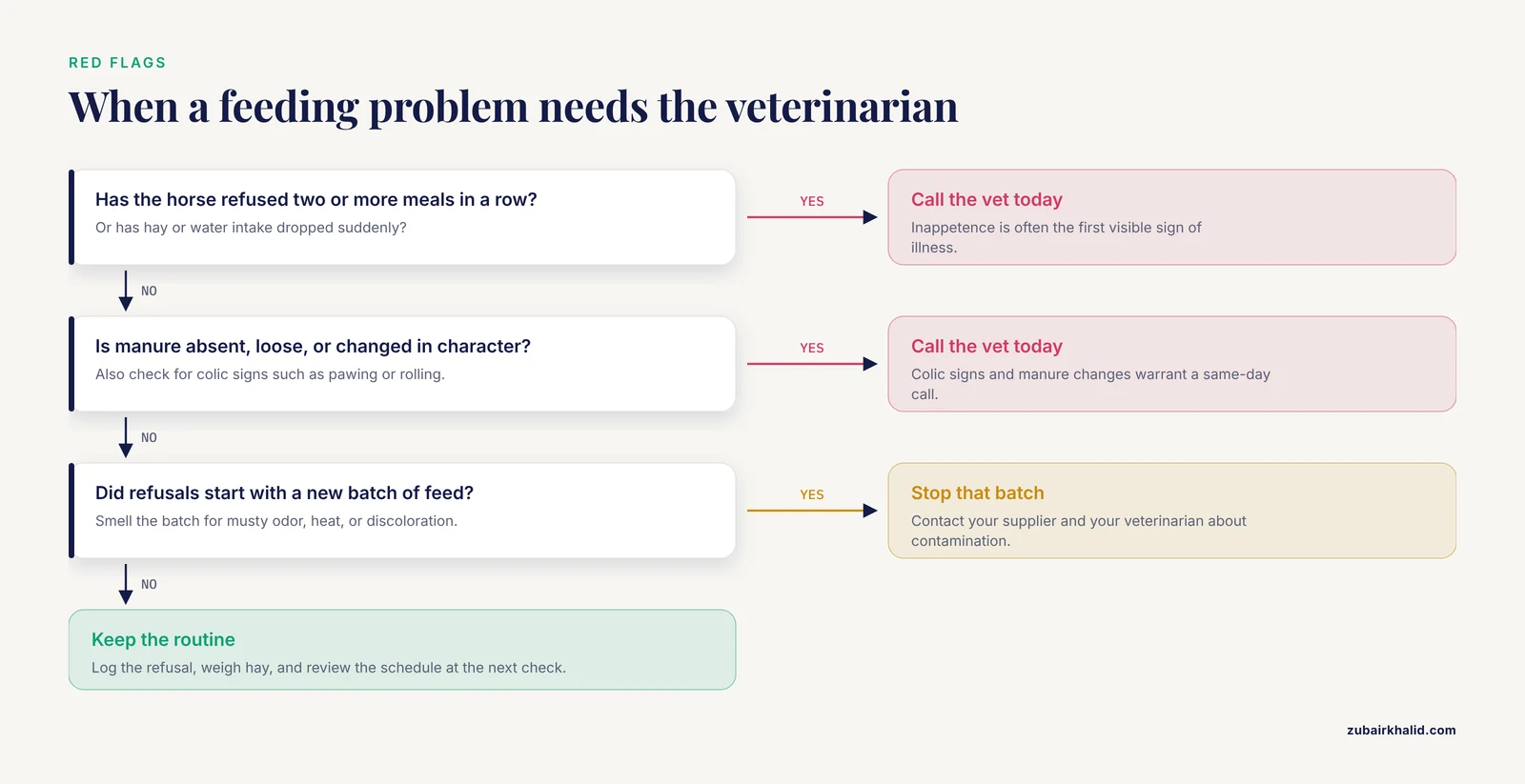
Every feeding schedule in this article is a framework for organizing an individual plan, and the numbers in the example tables are placeholders. Your horse's correct ration depends on body weight, workload, life stage, dental status, and diagnosed conditions, and only a veterinarian working with you, ideally with an equine nutritionist, can set those values. Contact your veterinarian promptly if you observe any of the following.
- Two or more consecutive refused meals, or a sudden drop in hay or water intake.
- No manure production, diarrhea, or a marked change in manure character.
- Colic signs, including pawing, flank watching, rolling, or repeated lying down.
- Rapid weight loss or gain, or a change of more than one body condition score between monthly checks.
- Feed refusal that coincides with a new batch of feed, which raises a contamination question for your supplier as well as your vet.
- Any uncertainty about whether, when, or how to give a medication relative to meals, since feeding status alters drug absorption in horses [2] [3].
Frequently Asked Questions
How many times a day should I feed my horse?
Most stabled horses do well on forage available continuously with one to three scheduled concentrate or medication meals per day, but the right number depends on your horse's weight, workload, and health. Ask your veterinarian to help you set the number of meals and their sizes before you finalize the template.
What times should horse meals be?
Choose times you can hold within a narrow window every single day, such as 6:00 AM and 5:00 PM, because even a delay of a couple of hours changes horse behavior and reduces hay consumption. Consistency across weekdays and weekends is more valuable than any particular clock time.
What is a horse feeding schedule template format?
A practical format has a header block with the horse's identification, weight, body condition score, and workload, a daily grid listing time, feed, weighed amount, responsible person, and notes, and a section for medications with their timing relative to meals. The example grid earlier in this article can be copied directly.
Where can I find a free horse feeding schedule template?
You can build one free in minutes using the blank grid in this article, a spreadsheet, or a printed barn chart, and the structure matters more than the source. Any free horse feeding schedule template should include weighed amounts, fixed times, named responsibility, and medication timing to be genuinely useful.
Should hay be fed before or after grain?
There is no single rule for every horse, and the answer can change with the medication involved. Research shows hay in the gut slows the absorption of some oral drugs substantially, so ask your veterinarian how to sequence hay, concentrate, and any medication, then write the sequence into your template.
How do I switch my horse to a new feeding schedule?
Make the change gradually, shifting meal times by small increments over days and transitioning any new feed over a week or more while monitoring intake and manure. Horses notice schedule deviations quickly, so a stepped transition protects both their digestive system and their sense of routine.
What should go in a horse health record template?
Include identification, dated body weights and condition scores, the current diet and schedule version, vaccinations, parasite control, dental exams, medications with meal timing, illness episodes, and lab or drug testing results. Update it at every veterinary visit and every feed change.
When should I call the veterinarian about my horse's feeding?
Call the same day for refused meals lasting more than one feeding, absent manure, diarrhea, colic signs, or a sudden drop in water intake, and call whenever a new medication raises questions about meal timing. Any feed batch that smells moldy or triggers refusals also warrants both a vet call and a conversation with your supplier.
Sources
- The Effect of an Irregular Feeding Schedule on Equine Behavior.
- Influence of feeding schedule on the absorption of orally administered flunixin in the horse.
- The effects of dose and diet on the pharmacokinetics of omeprazole in the horse.
- Presence of salicylic acid in standardbred horse urine and plasma after various feed and drug administrations.
- Effects of feeding a blend of grains naturally contaminated with Fusarium mycotoxins on feed intake, metabolism, and indices of athletic performance of exercised horses.
- Real-Time Monitoring of Self-Fed Supplement Intake, Feeding Behaviour, and Growth Rate as Affected by Forage Quantity and Quality of Rotationally Grazed Beef Cattle.