Horse Feeding Schedule Checklist: Planning Daily Meals
By Dr. Zubair Khalid, DVM, MS, PhD ·
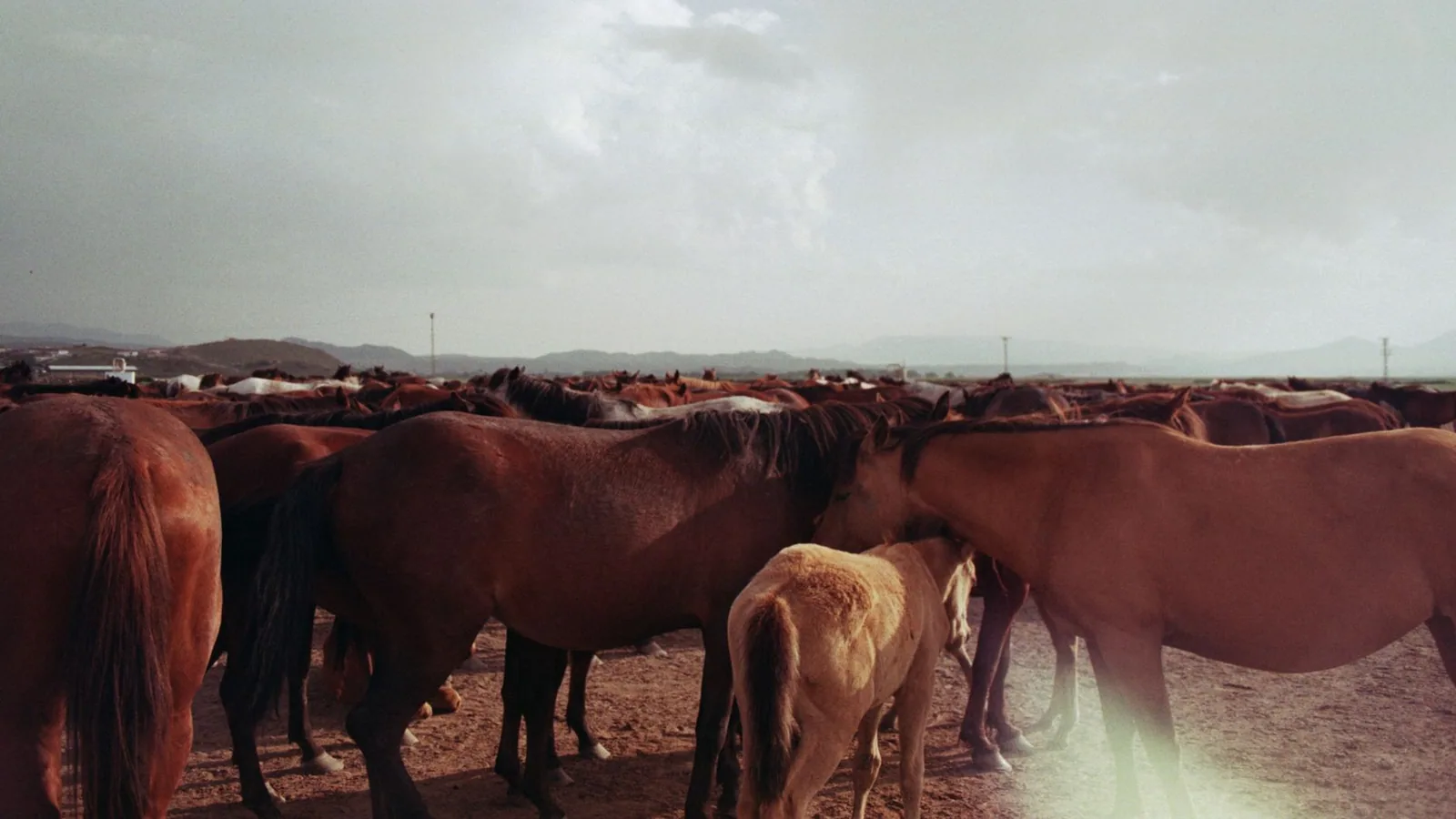
The core difference between feeding schedule options is who controls meal timing, and that choice determines how predictable your horse's day is, how stable their metabolism stays, and how reliably oral medications get absorbed. The rule of thumb for choosing: if your horse is healthy, a good doer, and turned out on pasture, free-choice or frequent forage works well, while if your horse is stalled, on medication, or prone to bolting concentrate, a fixed checklist with set meal times gives you the most control.
This article is educational and is not a substitute for veterinary diagnosis or treatment.
Why a Feeding Schedule Checklist Matters
Horses are creatures of temporal predictability. In a controlled study of eight stalled horses fed hay freely but concentrate at set times, researchers deliberately shifted the morning concentrate delivery earlier on Thursdays, later on Saturdays, and kept it regular on other weekdays. During delayed feeding days, horses pawed the ground more, kicked more, performed more comfort behaviors, and looked toward the feed door more often compared with regular feeding days. During earlier feeding days they spent less time eating hay and more time resting. The authors concluded that deviations from the regular feeding schedule compromised the horses' sense of temporal predictability [1].
That finding is the entire reason a horse feeding schedule checklist exists. Horses learn the clock. When the clock slips, behavior changes, and in some horses those changes are the first visible signs of stress. A written checklist converts an intention ("feed around seven") into a commitment ("concentrate at 6:45, hay at 7:00, water topped and recorded"), which protects your horse from the small daily deviations that research shows they notice.
A checklist also protects you. Feeding mistakes in barns are rarely dramatic. They are cumulative small errors, a skipped supplement here, a doubled grain scoop there, a medication given on a full stomach when it needed an empty one. Writing the plan down and checking it off turns feeding from memory work into verification work.
The Core Checklist: Planning Daily Meals
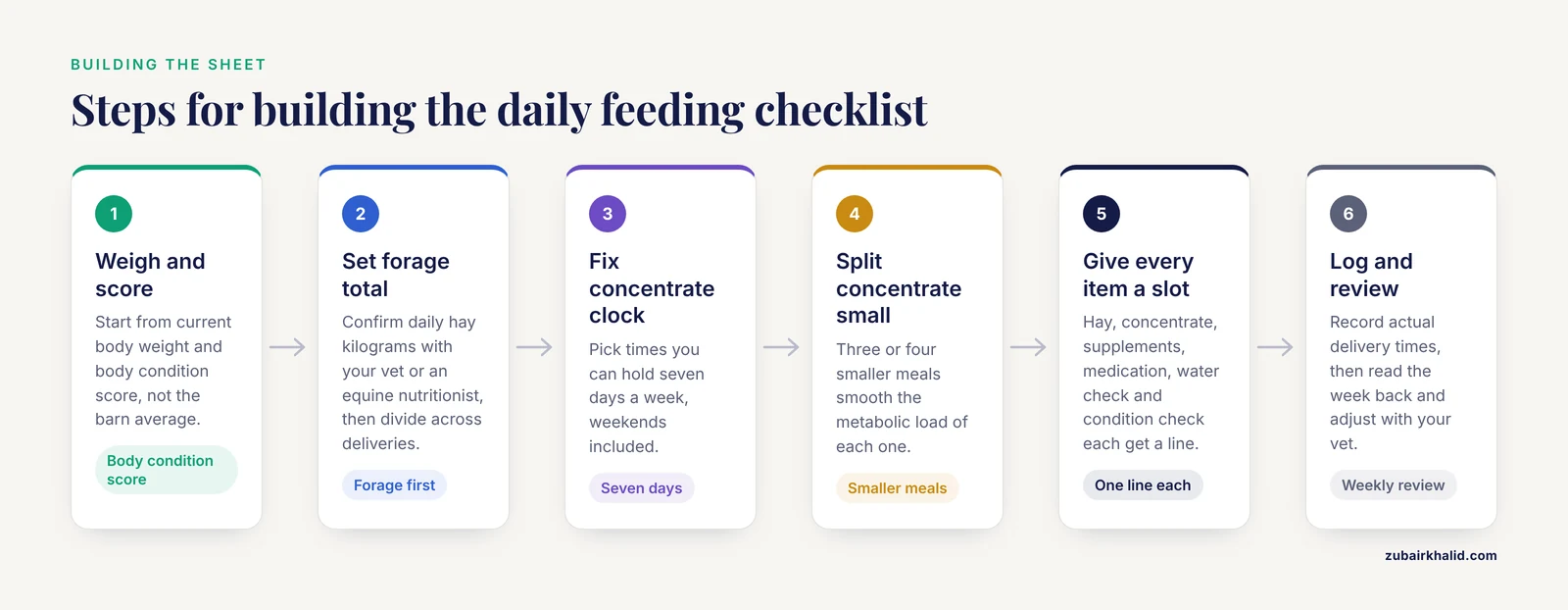
Before you compare schedule options, build the checklist itself. These steps apply regardless of which feeding pattern you choose.
- Weigh the horse and assign a body condition score. Every feeding decision starts from current body weight and condition, because meal sizes are scaled to the individual, not to the barn average.
- Calculate forage first. Forage should form the base of the daily ration. Confirm with your veterinarian or an equine nutritionist how many kilograms of hay your horse needs per day, then divide that total across the day's deliveries.
- Set fixed clock times for concentrate. Pick times you can hold seven days a week, including weekends. Research on irregular feeding times shows horses detect and react to delays, so a schedule you cannot keep is worse than a less ambitious one you can [1].
- Divide concentrate into the smallest practical meals. A yearling feeding trial compared two, three, and four meals per day with total daily feed held constant, and found that the two-meal group had higher mean and peak plasma glucose and elevated serum leptin, while horses fed three or four times daily did not show that leptin rise [2]. Spreading concentrate across more meals smooths the metabolic load of each meal.
- Assign every item a slot. Hay, concentrate, supplements, medication, water check, and a visual body condition check each get their own line and their own time on the checklist.
- Note feeding status relative to medication. For each oral medication, record whether it should be given on an empty stomach or with feed, because feeding status changes absorption, as covered below.
- Record actual delivery times. The checklist is only honest if it logs what happened, not what was planned. Log the time each meal was actually delivered, even when it slipped.
- Check feed quality at every meal. Look and smell each batch of hay and concentrate before it goes in the bucket. A contaminated-grain study in exercised horses documented that feeds naturally contaminated with Fusarium mycotoxins were fed at measured concentrations, including deoxynivalenol at 11.0 ppm in the concentrate, and tracked the effects on feed intake and performance [3]. Your practical job is simpler but just as real, reject dusty, moldy, or off-smelling feed and quarantine the batch.
- Plan water, salt, and turnout around the same clock. Feeding, exercise, and water checks interact, so they belong on one checklist.
- Review weekly. Once a week, read back through the recorded times and intake notes and adjust with your veterinarian's input.
Horse Feeding Schedule Checklist Options
There is no single best horse feeding schedule checklist for every horse. There are four main options, and the right one depends on housing, temperament, workload, and medication needs.
Option 1: Fixed Two-Meal Schedule
The classic barn pattern, concentrate and hay delivered morning and evening at set times.
Pros:
- Simplest to execute and to delegate to barn staff or a weekend helper.
- Fixed times match the predictability horses show they prefer [1].
- Easy to pair with once- or twice-daily oral medication timing.
- Fewest deliveries means fewer chances for feeding errors.
Cons:
- Long gaps between concentrate meals produce the largest single meal sizes. In the yearling trial, horses fed twice daily had higher mean and peak glucose and a leptin rise that horses fed three or four times daily did not show [2].
- Long gaps between forage deliveries, if hay is only delivered twice, mean stretches with nothing to chew.
- Less flexibility for hard keepers or high-performance horses that need intake spread across the day.
Option 2: Three or More Fixed Meals
The same fixed-clock approach, split across three or four deliveries.
Pros:
- Smaller concentrate meals per delivery, which in the feeding-frequency trial avoided the glucose peaks and leptin elevation seen with two-meal feeding while total daily feed stayed constant [2].
- Still fully predictable, so it keeps the behavioral benefit of fixed times [1].
- More natural spread of forage across the day when hay is delivered at each meal.
- More slots for timed supplements and medications.
Cons:
- Demands more barn visits, which is a real constraint for owners who board or commute.
- More deliveries mean more chances for a scoop error, so each delivery needs its own checklist line.
- Some boarding barns charge for extra feedings or simply cannot accommodate them.
Option 3: Free-Choice Forage With Fixed Concentrate
Hay available continuously or near-continuously, with concentrate delivered at fixed times. This is the pattern used in the irregular-feeding study, where stalled horses had hay ad libitum and a barley-oat mixture at set times [1].
Pros:
- Closest match to continuous forage intake, keeping the gut working between concentrate meals.
- The concentrate meals stay predictable, which is the component horses appear most sensitive to, since in the behavior study the behavioral disruption followed changes in concentrate timing while hay remained available [1].
- Reduces the long empty-stomach stretches that matter for medication absorption, discussed below.
- Often the easiest option for horses that tie up or that food-guard, because there is always forage to settle onto.
Cons:
- Free-choice hay makes intake monitoring harder for easy keepers, and overweight horses may need weighed, restricted forage instead.
- Requires enough storage and enough hay delivered per day to genuinely last between refills.
- Waste is higher without a slow-feed arrangement, and netted or otherwise slowed delivery changes eating rate, which should be noted on the checklist.
Option 4: Automatic Feeding Device Schedules
Programmed devices that deliver hay on open-and-closed cycles. A recent evaluation of a novel automatic feeding device for hay provision tested it in both group-housed and individually housed horses. In group-housed mares, exploratory behaviors increased significantly when the device alternated between open and closed periods compared with when it stayed continuously open, and device delivery left residual hay averaging 3.98 kg compared with none under ground hay feeding. In individually housed horses, the study compared long, medium, and short opening schedules [4].
Pros:
- Delivers forage in multiple small programmed portions across a 24-hour day, including overnight when no human is present.
- Open-and-closed cycling increased exploratory behavior in group-housed horses, suggesting engagement rather than constant passive access [4].
- Programmable openings allow you to design a schedule that mimics many small forage meals without additional labor.
- Residual hay at any given moment means the horse is rarely staring at an empty floor [4].
Cons:
- Individual horses vary. In the group-housing phase, researchers observed individual differences in foraging activity and agonistic behavior, so a device schedule that suits one horse may not suit its neighbor [4].
- Hardware depends on power, programming, and mechanical function, so the checklist must include daily device checks and a manual fallback plan.
- Opening schedule selection matters. The study compared long, medium, and short opening periods in individually housed horses rather than endorsing one setting, so the right program is a question to work through with your veterinarian and to evaluate against your own horse's behavior [4].
- Cost and maintenance are real, and a device is not a substitute for daily in-person observation.
Horse Feeding Schedule Checklist Options Compared
This table is the decision core of the article. Score each option against the criteria that actually decide the choice for most owners.
| Criterion | Fixed two meals | Three or more meals | Free-choice forage with fixed concentrate | Automatic feeding device |
|---|---|---|---|---|
| Predictability for the horse | High, fully fixed times [1] | High, fully fixed times [1] | High for concentrate, continuous for hay [1] | High if the program is consistent [4] |
| Metabolic smoothness of concentrate load | Lowest, largest single meals [2] | Highest of the manual options [2] | High, small concentrate meals with forage buffer | High, small programmed forage portions [4] |
| Labor requirement | Lowest | Moderate to high | Moderate, frequent hay refills | Low daily labor, but device checks required |
| Suitability for easy keepers | Moderate, portions easy to weigh | Moderate, portions easy to weigh | Low, unrestricted intake is hard to limit | Moderate, openings can be restricted [4] |
| Suitability for hard keepers or performance horses | Low, intake is compressed | High | High | High |
| Medication timing control | Excellent | Excellent | Moderate, forage is always present, which affects empty-stomach dosing | Moderate, forage timing is programmed rather than observed |
| Error risk | Low, few deliveries | Higher, more deliveries to log | Low, concentrate is the only measured component | Low daily, but a device failure affects the whole day |
| Group housing fit | Poor to moderate | Moderate | Good with adequate space | Variable, individual differences in behavior were observed [4] |
A practical reading of the table: manual fixed schedules win on control and medication timing, free-choice forage wins on gut continuity, and automatic devices win on overnight coverage and portioning, at the price of hardware dependence.
How Meal Timing Interacts With Health and Medication
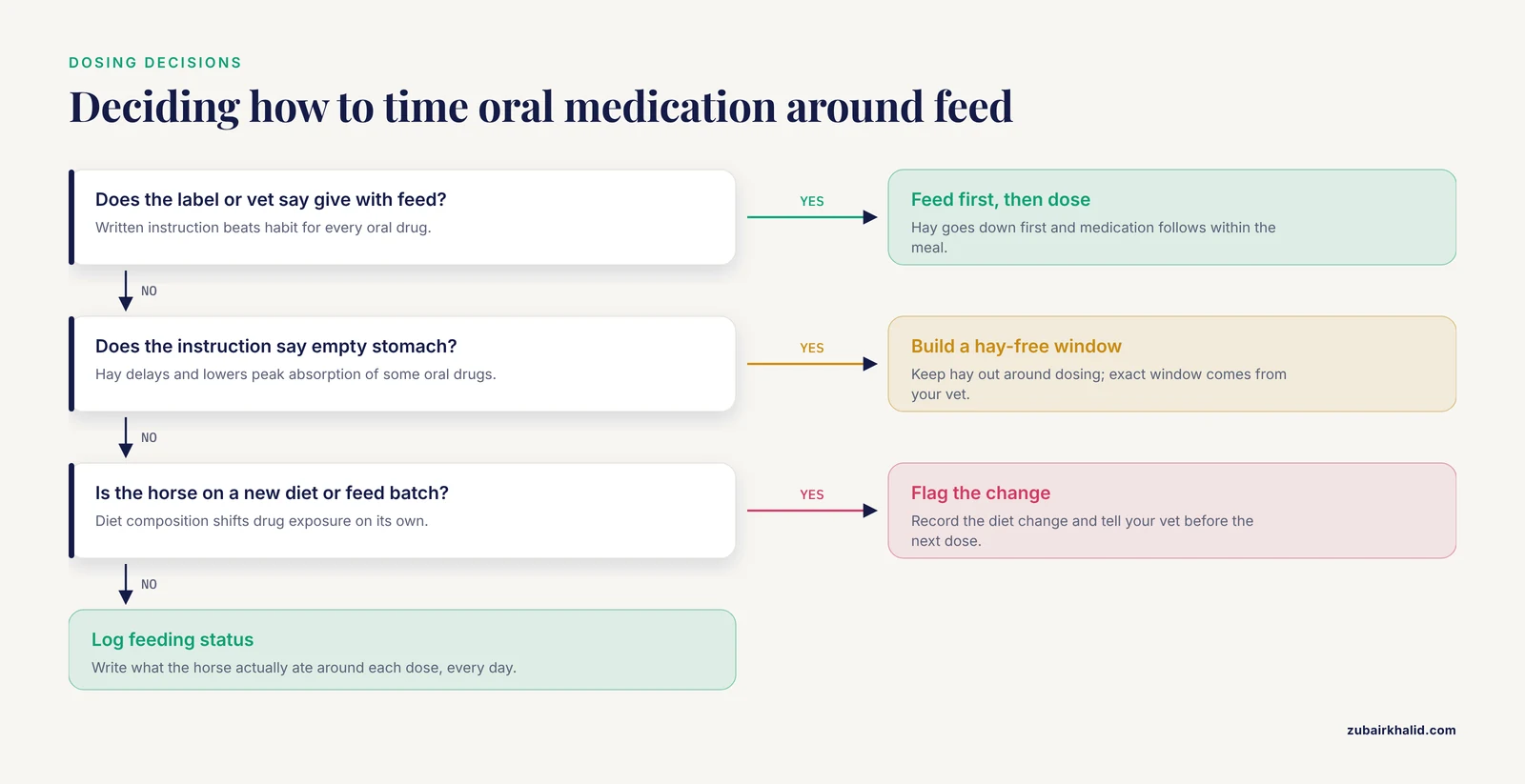
This is where a feeding schedule stops being a convenience issue and becomes a medical one. The composition and timing of the meal surrounding an oral drug changes how much of that drug reaches the bloodstream and how fast.
Hay delays and lowers absorption of some oral drugs. In a crossover study in ponies, flunixin given orally with no access to feed for a few hours before and after dosing was absorbed rapidly, reaching a mean peak plasma concentration of 2.84 micrograms per milliliter at a mean time of 0.76 hours. With free access to hay before and after dosing, the peak fell to 1.30 micrograms per milliliter and was delayed to a mean of 7.66 hours, with some ponies showing two or three separate concentration peaks. Total absorption over time, the area under the curve, was not significantly different between the two regimens [5]. The same pattern appears with fenoprofen, where free access to hay significantly reduced peak plasma concentration and bioavailability compared with fasted horses, and in fed horses a second plasma peak appeared around 9 hours after dosing [6].
Diet composition changes drug exposure independently of timing. In an omeprazole pharmacokinetic study, horses fed a high-grain, low-fiber diet had higher area under the curve and maximal plasma concentration than horses on ad libitum hay, and with the 4 mg/kg dose the area under the curve rose further by day five on the high-grain diet [7]. For owners, the practical point is that a change in diet, not just a change in meal timing, can change how a horse handles its medication, and any diet change during treatment is worth flagging to your veterinarian.
Feeding status matters for anti-inflammatory dosing decisions. The nimesulide pharmacokinetic work determined feeding status effects on bioavailability and concluded that a dose of 1.5 mg/kg may produce adequate clinical effects with a 12 to 24 hour dosing interval depending on condition severity, while also cautioning that at that dose selectivity between COX isoforms is lost and side effects from COX-1 inhibition are possible, so the drug should be used with caution in equine practice [8]. Phenylbutazone, the most familiar equine NSAID, is more than 98 percent bound to plasma protein, has an elimination half-life of 3 to 10 hours after intravenous injection, and shows dose-dependent kinetics in which the half-life lengthens as dose increases, with repeated dosing producing accumulation of residual blood levels [9]. None of these numbers tells an owner how to dose anything. What they establish is that your veterinarian's dosing instructions are entangled with your feeding schedule, and that the instruction "give with food" or "give on an empty stomach" belongs on the checklist in writing, next to the drug name.
Forage type can produce detectable drug-like residues. Horses fed lucerne hay showed elevated salicylic acid in plasma and urine, with elimination following a diurnal pattern related to the type of feed and the feeding schedule, and a half-life between 5 and 7 hours [10]. For competition horses under medication rules, this means what you feed and when you feed it can appear in testing contexts, so any regulatory questions about forage and declared residues belong in a conversation with your veterinarian and governing body before competition day.
Feed deprivation and refeeding shift hormones and metabolites measurably. In mares and stallions deprived of feed for 19 hours and then given a noon meal, feeding produced increases in plasma prolactin, cortisol, insulin, glucagon, glucose, urea nitrogen, and nearly all measured indispensable amino acids, while nonesterified fatty acids decreased [11]. Extended gaps between meals are not metabolically silent. They move the horse through a fasting physiology and then a refeeding response, which is one more argument against long unplanned gaps and for the fixed, frequently repeated forage delivery that a good checklist enforces.
Feed quality is part of the schedule. The Fusarium mycotoxin study showed that contaminated concentrate affected feed intake and performance variables in exercised horses, and tested a glucomannan adsorbent alongside [3]. The checklist translation is direct, inspect and log feed quality daily, store feed to prevent moisture and mold, and treat any suspect batch as a call-your-veterinarian event rather than a finish-the-bag event.
Worked Scenarios
Scenario 1, the stalled easy keeper. A 15-year-old idle Quarter Horse kept in a box stall, overweight, no medications. The fixed two-meal schedule is the worst fit here because it compresses intake and then leaves long gaps. The best fit is weighed, restricted forage delivered in multiple small portions, either through three manual deliveries or an automatic device with a restricted opening schedule [4], plus fixed concentrate or a ration balancer at a set morning time. The checklist emphasizes exact forage weights and a weekly body condition score line.
Scenario 2, the performance horse on omeprazole. A 7-year-old eventer in work, treated for equine gastric ulcer syndrome, on once-daily oral omeprazole. Because diet composition changes omeprazole exposure [7], the checklist records the diet as fed each day and flags any deviation. The medication is given at the same time daily relative to the same meal, so day-to-day absorption conditions stay comparable. Concentrate is split across three meals to keep individual meals small [2]. Any barn-scheduled diet change during the treatment course is marked as a call-the-vet trigger.
Scenario 3, the group-housed pasture herd. Six horses on pasture with once-daily concentrate delivery. Free-choice forage is already in place, so the schedule reduces to a fixed concentrate time, a daily hay supplement in winter, and a daily head count and water check. The checklist stays short on purpose, because a checklist that does not match real barn traffic does not get followed. If a group automatic feeder is added later, individual differences in foraging and agonistic behavior [4] mean the herd needs watching during the transition, and the checklist gains a line for that observation.
Scenario 4, the senior horse on twice-daily medication. A 24-year-old gelding on an oral anti-inflammatory. The feeding schedule is built backward from the drug. If the veterinarian's instruction is to give the medication with feed, hay goes down first and the medication follows within the meal. If the instruction is empty-stomach dosing, the checklist builds a deliberate hay-free window around dosing, because hay access demonstrably delays and lowers peak absorption of oral nonsteroidal anti-inflammatory drugs in horses [5],[6]. Exact windows come from your veterinarian, not from this article.
Common Mix-Ups
- Treating hay as schedule-free. Concentrate timing gets planned while hay timing is left to chance. Horses respond to the predictability of the scheduled component of their diet [1], and forage gaps carry their own metabolic consequences [11]. Hay belongs on the checklist with times attached.
- Changing the schedule on weekends. Saturday's delayed concentrate delivery was precisely the condition that increased pawing, kicking, and door-watching in the irregular-feeding study [1]. Weekends are when schedules drift. Write the weekend times down and hold them.
- Assuming more meals means more calories. In the yearling trial, total daily feed was held constant across the two, three, and four meal schedules [2]. Frequency changes how the same ration lands metabolically, not how many calories go in. Do not increase the ration to "fill" extra meals unless weight and body condition say you should.
- Giving oral medication without recording feeding status. Hay reduces and delays peak absorption of some oral drugs [5],[6], and diet type shifts exposure for others [7]. If you do not record what the horse ate around each dose, you cannot help your veterinarian interpret a poor response.
- Buying a feeder and skipping the behavior check. An automatic device is a schedule change, and the device study showed individual variation in response and a real difference between continuously open and alternating access [4]. Any new feeding program deserves observation and checklist notes in the first weeks.
- Confusing the checklist with the health record. The checklist is the daily operational sheet, what was fed and when. The health record is the longitudinal file, weights, body condition scores, medication courses, and veterinary findings. Owners who merge them lose both.
Pairing the Schedule With a Horse Care Checklist and Health Record Template
The feeding schedule works best as one module inside a broader daily horse care checklist. A practical full-day checklist contains, in order, a morning visual health check before feed goes down, water trough or bucket check, morning forage and concentrate at recorded times, supplement and medication lines with feeding status noted, turnout or exercise, midday forage delivery if the schedule calls for one, afternoon water recheck, evening forage and concentrate, overnight forage arrangement or device verification, and a final walk-through. Each line gets a check mark and, where relevant, an actual time rather than a planned time.
The horse health record template sits behind the checklist and holds the data that changes slowly. Its core fields are identification and signalment, current body weight and body condition score with dates, the full ration with forage types and concentrate amounts, the written feeding schedule with actual delivery logs, medication courses with start and end dates and feeding-status instructions, dental and vaccination dates, and veterinary examination findings. Once a week, carry the week's checklist summaries into the record. Once a year, or at any change of horse, barn, or workload, review the whole template with your veterinarian. This structure keeps the daily sheet disposable and the long-term record durable, which is exactly the division of labor each document does best.
Limitations and When to Contact a Veterinarian
Every horse is an individual, and the studies summarized here describe groups, not your horse. Meal frequencies, feeder settings, and medication timing decisions all need to be made with your veterinarian, who knows your horse's weight, condition, workload, and medical history.
Contact your veterinarian promptly if any of the following occur:
- Your horse goes off feed for more than one meal, or shows colic signs such as pawing, flank watching, rolling, or loss of gut sounds, which is an emergency requiring an immediate call.
- Feed intake drops or body condition score changes in either direction across consecutive weekly checks.
- A treated condition is not responding as expected, or an oral medication seems inconsistent in effect, since feeding patterns measurably alter absorption of several common equine oral drugs [5],[7],[6].
- You discover moldy, dusty, or otherwise suspect feed, stop feeding that batch, and call your veterinarian, because mycotoxin-contaminated feed affected intake and performance in studied horses [3].
- Behavioral changes appear after a schedule change, particularly increased pawing, kicking, or door-watching around mealtimes, which research links to deviations from regular feeding times [1].
- You compete under medication rules and have questions about forage-associated residues such as those documented with lucerne hay and salicylic acid [10].
Frequently Asked Questions
How many times a day should I feed my horse?
Most stalled horses do best with forage available in several portions across the day and concentrate divided into three or four smaller meals rather than one or two large ones, since larger two-meal concentrate feeding produced higher glucose peaks and a leptin rise in a yearling feeding trial while three or four meals did not. The exact number for your horse depends on weight, workload, and housing, so confirm the plan with your veterinarian.
What are the best times of day to feed a horse?
The best times are the times you can hold exactly, every day, because horses show measurable behavioral disruption when scheduled feed times shift earlier or later. Pick clock times that survive weekends, barn staffing, and your commute, then protect them.
Does hay affect oral medication absorption?
Yes, for several drugs. Free access to hay lowered and delayed peak plasma concentrations of orally administered flunixin and reduced the bioavailability of fenoprofen compared with fasting, even though total absorption of flunixin over time was similar. Always follow your veterinarian's written instruction on whether each medication is given with feed or on an empty stomach, and record what your horse actually ate around each dose.
What is the best feeding schedule checklist for a stalled horse?
For a stalled horse with no special needs, the strongest option is free-choice or frequently delivered forage paired with fixed concentrate times, because it keeps concentrate delivery predictable while avoiding long forage gaps. Hard keepers, easy keepers, and medicated horses each shift the calculation, which is why the option comparison table above exists.
How does an automatic hay feeder fit into a schedule?
An automatic feeding device delivers programmed forage portions on open-and-closed cycles, including overnight, and one study found exploratory behavior increased with alternating open and closed access compared with continuously open access, along with residual hay present throughout delivery. Build a daily device check and a manual fallback into your checklist, and watch your horse closely during the first weeks, since individual responses varied in the research.
What should go in a horse health record template?
A useful template holds identification details, dated body weights and body condition scores, the complete ration, the written feeding schedule with actual delivery logs, medication courses with feeding-status instructions, dental and vaccination dates, and veterinary findings. Update it weekly from the daily checklist and review the whole file with your veterinarian at least yearly or whenever the horse's circumstances change.
Sources
- The Effect of an Irregular Feeding Schedule on Equine Behavior.
- Meal size and feeding frequency influence serum leptin concentration in yearling horses.
- Effects of feeding a blend of grains naturally contaminated with Fusarium mycotoxins on feed intake, metabolism, and indices of athletic performance of exercised horses.
- Evaluating a novel automatic feeding device for hay provision in horses: behavioral outcomes in group and individual housing.
- Influence of feeding schedule on the absorption of orally administered flunixin in the horse.
- Disposition of human drug preparations in the horse. IV. Orally administered fenoprofen.
- The effects of dose and diet on the pharmacokinetics of omeprazole in the horse.
- Oral and intravenous administration of nimesulide in the horse: rational dosage regimen from pharmacokinetic and pharmacodynamic data.
- Phenylbutazone in the horse: a review.
- Presence of salicylic acid in standardbred horse urine and plasma after various feed and drug administrations.
- Changes in concentrations of hormones, metabolites, and amino acids in plasma of adult horses relative to overnight feed deprivation followed by a pellet-hay meal fed at noon.