How to Fix a Muddy Horse Pasture
By Dr. Zubair Khalid, DVM, MS, PhD ·
To fix a muddy horse pasture, you must break the cycle that creates the mud. Hooves churn saturated soil into a wet paste, the paste holds more water, and the churned area grows wider every time it rains. The fix has three parts. First, move horses off the wettest ground with a sacrifice paddock or dry lot. Second, control water before it reaches the pasture with roof gutters, grading, and drainage. Third, rebuild high-traffic zones with a stable footing base so hooves cannot pump water out of the soil. Manure management and vegetation cover complete the picture.
This article walks through every stage of that process, explains why each step matters, and connects the fixes to the health problems that chronic mud causes in horses, including thrush, scratches, and skin infections.
This article is educational and is not a substitute for veterinary diagnosis or treatment.
At a Glance: Your Mud-Fix Action Plan
| Priority | Action | Where It Applies |
|---|---|---|
| Do today | Relocate water, hay, and shelter out of low, wet areas | Whole property |
| Do today | Pick up or harrow manure in high-traffic zones | Paddocks, gateways |
| This week | Install or plan a sacrifice paddock on high, well-drained ground | One small dry lot |
| This week | Clean existing roof gutters or order gutter and downspout parts | Barns and sheds |
| This month | Grade or regrade paths so water runs away, not through | Gateways, lanes |
| This season | Rebuild gateways and lanes with compacted rock base and footing | High-traffic areas |
| Ongoing | Weekly hoof checks for thrush and daily leg checks for scratches | Individual horses |
| Ongoing | Log every skin or hoof problem in a horse health record template | Barn office or phone |
Why Horse Pastures Turn Muddy in the First Place
Understanding the causes of a muddy horse pasture changes how you fix it. Mud is not simply rain plus dirt. It is the result of four factors acting together, and horses themselves are one of them.
Soil saturation and hoof churn
When soil is completely saturated, it loses its structure. A thousand-pound animal stepping onto that soil squeezes water out of the pore spaces and shears the soil apart. Hooves act like pumps. Every step pushes water upward and works the soil into finer and finer particles until you have paste. Once paste forms, it drains slower than the original soil, so it stays wet longer, which invites more churning. The problem compounds itself.
Horses concentrate this damage because of how they use space. They are not evenly distributed across a pasture. They travel the same routes between the gate, the water trough, the shelter, and the hay feeder, thousands of times per season. They stand at the fence line staring at the neighbor's horses. They paw at the gate. These repeatedly traveled lines are where mud starts, and the mud line then widens because horses detour around the worst spots and churn fresh ground beside it.
Water inputs from roofs and slopes
Rain that falls on a barn roof does not disappear. A single shed roof concentrates the runoff of an entire roof surface into a narrow drip line along the ground. Many mud problems around barns are roof problems in disguise. Water also arrives as surface flow from adjacent ground, from uphill fields, driveways, or neighboring properties. If water is flowing into your pasture from somewhere else, fencing horses off the wet zone will not fix the cause.
Manure, organic matter, and vegetation loss
Manure in wet areas adds organic matter that holds water and creates a slick, anaerobic layer. Heavy use kills grass and other vegetation. Bare soil has no roots to hold it together and no leaf canopy to intercept rain, so it seals at the surface, sheds water instead of absorbing it, and erodes faster. The result is a pasture that gets muddier each year even if the weather is the same.
Poor original layout
Many farms were laid out with gates at the bottom of slopes, water troughs in natural drainageways, or paddocks in low corners. If your mud always starts in the same place, that place is probably the lowest point of the paddock or the end point of a drainage path. Fixing a muddy horse pasture often means fixing a layout, not just a surface.
How to Fix a Muddy Horse Pasture, Step by Step
These fix muddy horse pasture solutions are ordered from least to most involved. Most owners need several of them together, because mud has more than one cause.
Step 1: Map your water and your traffic before you spend anything
Walk your property during or immediately after a heavy rain. Note three things on a sketch or in your phone.
- Where surface water enters the paddocks and where it exits. Follow the flow.
- Where roof runoff lands on the ground at every barn, shed, and run-in shelter.
- Where horses have created worn paths. Mark the gate-to-water route, the gate-to-hay route, and the fence lines they lean on.
This map is the plan for every later step. Most failed mud fixes fail because the owner added gravel to a spot where water was still flowing through at speed, or because they stabilized the lane but left the water trough sitting in a drainageway.
Step 2: Move the things horses stand at
Water troughs, hay feeders, mineral feeders, and shelters all attract standing. Standing is what churns soil. Wherever it is practical, move these features to high, well-drained ground, ideally on the opposite side of the paddock from where water flows through. A trough on a rise with a few feet of gravel around it will never churn the way a trough in a hollow does. If a trough cannot be moved, regrade the ground around it so water drains away, and add a stable footing pad under and around it.
Rotating feeding locations, where your setup allows, spreads the wear instead of concentrating it.
Step 3: Build and use a sacrifice paddock
A sacrifice paddock, also called a dry lot, is a small enclosure that you deliberately allow to be worn down so the main pasture stays intact. It is the single most effective tool for how to fix a muddy horse pasture in wet seasons.
The principle is simple. During wet months, horses live in the sacrifice paddock. All the churning happens in one small, designated area that you manage for drainage and footing, rather than across the whole pasture. The main pasture stays vegetated and recovers.
Choose the location for a sacrifice paddock on the highest, most naturally well-drained ground you have, with easy access from the barn. Slope it if possible so surface water runs off. Do not place it in a low corner or over a septic or well area.
A sacrifice paddock needs the following features.
- Secure fencing, at least as strong as your main paddock fencing, because a small space intensifies horse-to-horse and horse-to-fence interaction.
- Shade or a run-in shelter, because horses confined to a small area cannot browse for their own microclimate.
- Fresh water placed on high ground within the lot.
- A footing surface, discussed in Step 5.
- Enough space that horses can move freely and separated groups are not forced together. Discuss stocking density for your specific herd with an equine veterinarian or an extension specialist, because the right answer depends on your herd, your soil, and your management.
Keep the sacrifice paddock manure-free. In a small lot, manure accumulates fast, brings flies, holds moisture, and creates parasite re-infection risk on the ground your horses stand on. Pick it or harrow it as often as your schedule allows, at minimum several times per week in wet weather.
Step 4: Control water before it arrives
This is the step most owners skip, and it is why their mud comes back.
Roof gutters and downspouts. Fit gutters and downspouts on every barn, shed, and shelter, and direct the downspout outlets away from paddocks and high-traffic areas, out into vegetated ground or a drainage path that leaves the horse area. A roof without gutters delivers a concentrated stream that will carve a mud zone along the entire drip line. Clean the gutters at least twice a year. A clogged gutter overflows and can be worse than no gutter at all, because the overflow concentrates in one spot.
Cutting off uphill water. Where surface water flows in from neighboring ground or a driveway, intercept it. A shallow diversion ditch or swale along the uphill fence line, graded to carry water to an outlet, keeps that flow out of the paddock. In some cases a grassed waterway is enough. The goal is always the same: move clean runoff around or past the horse area rather than through it.
Regrading problem spots. Small low spots at gates and troughs can be filled and crowned so water sheets off in all directions instead of pooling. Work with the natural slope of your land. Water will always win against a grade that fights it.
Subsurface drainage in chronic spots. Where a specific low area stays wet no matter what, a buried drain line wrapped in gravel can carry water away to an outlet at lower elevation. This is real work and usually involves some equipment or a contractor, but it is the right tool for a gateway or stall-door area that sits below the surrounding grade. Because drain design depends on your soil type and the volume of water involved, have a local agricultural extension office, drainage contractor, or experienced excavation contractor look at the site before you dig.
Step 5: Rebuild high-traffic areas with stable footing
Footing work belongs only on the routes and standing areas your map identified: gates, lanes, watering points, feed areas, and shelter entrances. You do not need to surface the whole pasture. You need to make the worn lines and standing zones impassable to water and immune to hoof churn.
The general build for a heavy-use area follows the same logic everywhere.
- Strip off the organic topsoil and the existing mud paste down to firm mineral soil. This is the step people skip, and skipping it dooms the project. New gravel laid over mud becomes new mud.
- Establish a grade so the finished surface sheds water to the sides rather than holding it.
- Lay a compacted base of crushed rock or road base. The base is what actually carries the load and stops pumping. Your local quarry or contractor can size the stone and depth for your soil and climate.
- Top with a footing layer suited to the use. Common choices include crushed stone fines, coarse sand blends, or manufactured paddock panels or geotextile grid systems that separate the footing from the base and prevent the two from mixing. Grids and geotextile fabric are worth serious consideration in clay soils, because without a separator layer, rock slowly sinks into soft clay and disappears.
- Keep the finished surface crowned or sloped and maintain it. Harrow or rake it periodically, and refill the places it settles.
Ask what local facilities with good year-round lanes use, and buy the same material from a local quarry. Local stone that is locally available is almost always the right answer, because your neighbors are dealing with your same soil and climate.
Step 6: Manage manure as part of the drainage plan
Manure management is a drainage and health issue, not just a housekeeping issue. Manure piles hold moisture, attract insects, and in wet conditions smear into the soil surface and seal it.
- Pick stalls and small paddocks daily or as close to it as your routine allows.
- Harrow or drag larger pastures in dry weather to break up manure and expose parasite eggs to sun and drying. Do not harrow wet pasture, because dragging wet manure smears it and spreads it further.
- Store accumulated manure on a pad with a roof or at least a cover, located downslope and away from watercourses, wells, and the barn, and compost it if you have the volume and space. Never let a manure pile sit where its leachate can run back into a paddock or a waterway.
- Follow a parasite control plan designed with your veterinarian, based on fecal egg counts rather than a fixed calendar. Mud and manure are exactly where parasite transmission happens, so pasture hygiene and deworming strategy belong in the same conversation.
Step 7: Rest, reseed, and protect the vegetation
Vegetation is free drainage infrastructure. Grass roots open the soil, take up water, and hold the surface together. Everything you have done so far exists to give vegetation a chance.
- Rest pastures through the wet season using the sacrifice paddock. Return horses only when the ground is firm enough that hooves leave marks no deeper than a fingernail and do not tear out turf.
- Reseed worn and bare areas during your region's appropriate seeding window for the species you are planting. Again, your local agricultural extension office is the best source for which forage species and seeding timing suit your soil and climate.
- Where horses must access pasture in the shoulder seasons, use temporary fencing to rotate them and give grazed sections recovery time rather than letting the herd re-churn the same gate and water routes.
Equipment and Supplies: Selection Criteria
You do not need a long shopping list to fix a muddy horse pasture, but the items you buy should meet these criteria.
- Gutters and downspouts. Metal gutters sized for your roof area, with downspout extensions long enough to discharge well away from paddocks, foundations, and walkways. Include leaf guards if you have trees over the barn.
- Base rock. Crushed, angular stone with fines, from a local quarry. Angular stone locks together. Rounded river rock does not compact and shifts under hoof.
- Geotextile fabric or grid panels. A heavy-duty separation fabric or interlocking grid designed for equine or light vehicle traffic. Check that the manufacturer specifies the intended load and that the grid material is safe for horses to stand on with or without footing cover.
- Footing material. Coarse, well-draining material rather than fine sand that packs or fine stone dust that can be picked up in hooves. Whatever you choose, avoid material that is sharp, slippery when wet, or dusty when dry.
- Manure tools. A wheelbarrow or cart that works on wet ground, a manure fork or scoop, and if you have acreage, a ground-driven or PTO harrow rated for your tractor.
- Temporary fencing. Portable electric fence posts and tape or rope sufficient to build and move grazing rotations. Buy enough for at least two divisions of your main pasture.
No brand is recommended here. Match the specifications to your soil, your traffic, and your climate, and favor suppliers who will talk through your specific site.
Common Mistakes That Make Mud Worse
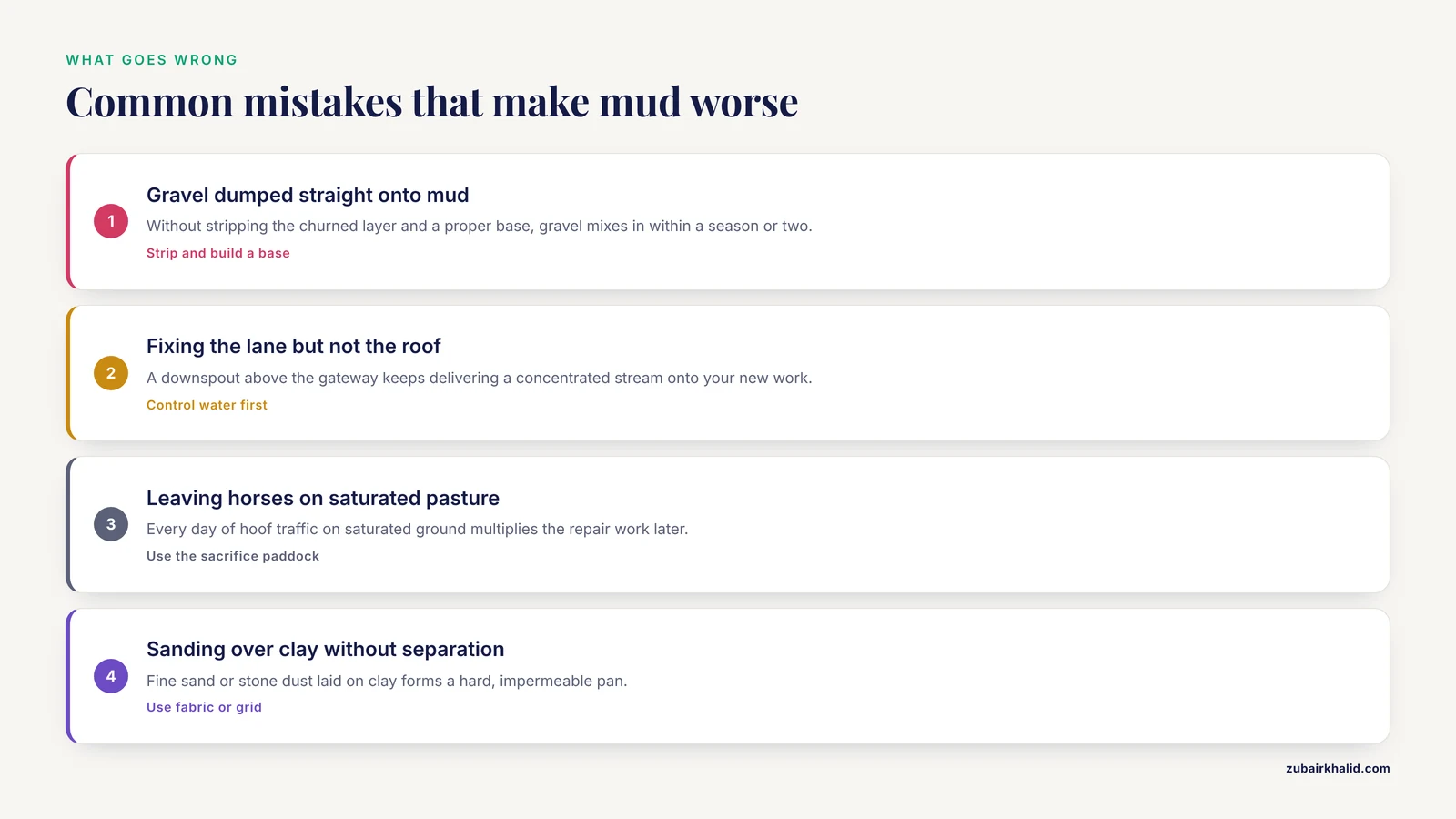
- Dumping gravel on top of mud. Without stripping the churned layer and building a proper base, gravel mixes into the mud within a season or two and you have bought gravel, not a fix.
- Fixing the lane but not the roof. Owners stabilize the gateway while the downspout above it keeps delivering a concentrated stream. Control water first or at minimum at the same time.
- Leaving horses on saturated pasture. Every day of hoof traffic on saturated ground multiplies the repair work. A sacrifice paddock only works if you actually use it when the ground is wet.
- Locating the sacrifice paddock in the wettest corner. A dry lot in a low spot becomes a pond, and then you have a new welfare and drainage problem to solve.
- Ignoring manure. Harrowing wet manure spreads it. Piles near watercourses move nutrients and pathogens into drainage. Storage location matters as much as pickup frequency.
- Sanding over clay without separation. Fine sand or stone dust laid directly on clay mixes with the clay and forms a hard, impermeable pan.
- Fighting the slope. Regrading against the natural fall of the land creates maintenance headaches forever. Work with the water, always.
Mud-Related Health Problems to Watch For
Chronic wet footing is a welfare and veterinary issue, not just an aesthetic one. Modern welfare thinking emphasizes that animals should not merely have negative states minimized but should also have the opportunity for positive experiences and comfortable living conditions [1]. Prolonged standing in deep mud and manure works directly against that standard. Two conditions deserve particular vigilance.
Thrush
Thrush is a bacterial infection of the frog, the V-shaped structure on the underside of the hoof. It thrives in the exact environment a muddy paddock provides: persistent moisture, lack of air circulation, and contact with manure and urine. Early signs include a foul odor from the frog, dark discharge in the central sulcus, and in more advanced cases sensitivity when the frog is pressed. The Merck Veterinary Manual's horse-owner resources describe thrush as a common condition associated with unsanitary, wet footing, and treatment centers on removing the horse from that environment, keeping the feet clean and dry, and having your farrier or veterinarian trim away damaged tissue and apply an appropriate topical treatment.
Mud prevention is thrush prevention. If you are fighting recurring thrush in one or more horses, the footing in your paddocks is part of the diagnosis. Discuss a specific treatment product and schedule with your veterinarian or farrier rather than starting a topical product on your own, because the correct choice depends on how deep the infection runs and whether the horse is lame.
Scratches and pastern dermatitis
Scratches, also called mud fever in some regions, is an inflammation and infection of the skin at the back of the pastern and fetlock. Constant wetness softens the skin barrier, and mud, manure, and bedding then allow bacteria and, in some cases, fungus or mites to establish. Early signs are scabs, matted hair, heat, and swelling at the pastern. As it progresses the leg swells, the skin cracks, and the horse becomes lame.
Management rests on keeping the legs dry and clean, removing the horse from chronic wet conditions, gently removing scabs as advised by your veterinarian, and treating with whatever topical or systemic therapy your veterinarian prescribes based on what is actually present. Horses with heavy feathering on the lower legs are often more affected, because the feather holds moisture against the skin. Ask your veterinarian whether clipping the pasterns is appropriate for your horse.
Other consequences of deep mud
Wet, churned ground also contributes to loose shoes and pulled shoes, abscesses when bruised soles go unattended, slipping injuries on slick surfaces, and weight loss when horses burn energy moving through deep footing or when owners reduce hay because paddocks are ungrazable. If your horse spends a wet season in a sacrifice paddock, plan for full forage provision there, because a dry lot has no grass. Kentucky Equine Research's nutrition resources emphasize consistent forage as the base of the equine diet, and that applies to horses on dry lots as much as horses on pasture.
A Horse Care Checklist for Wet-Season Mud Management
A written routine prevents the slow slide back into mud problems. Use this horse care checklist as your wet-season standard.
Daily
- Walk the paddocks and note new pooling, new churn, or broken fencing.
- Check each horse's legs for scabs, heat, swelling, or mud packed in the pasterns.
- Check hooves and pick them out. Note any foul odor or dark frog discharge.
- Pick or harrow manure in the sacrifice paddock and small paddocks.
- Confirm water troughs are full, clean, and not surrounded by churn.
Weekly
- Score your high-traffic areas. Is the footing holding, settling, or eroding.
- Clean troughs fully and scrub algae.
- Inspect gutters and downspout outlets for clogs and overflow.
- Check and adjust temporary fencing used for grazing rotations.
- Photograph any skin or hoof problem and update your horse health record template.
Monthly and seasonally
- Review body condition scores of all horses, since wet-season weight loss is easy to miss under winter coats.
- Schedule farrier visits at the interval your farrier recommends for your horse's feet and your footing.
- Plan reseeding for the coming dry window.
- Review your parasite control plan with your veterinarian using current fecal egg count results.
- Assess whether the sacrifice paddock stocking density is still appropriate for your herd.
A Simple Horse Health Record Template for Mud-Season Problems
Tracking lets you see patterns that a memory will not. Build your horse health record template with these columns and keep it in the barn or on a shared spreadsheet.
| Field | What to Record |
|---|---|
| Date | When you observed the problem |
| Horse | Name and identifying details |
| Body system | Hoof, skin, leg, other |
| Finding | What you saw, for example foul frog odor, pastern scabs, heat, swelling |
| Severity | Mild, moderate, severe, or lame/non-lame |
| Environment | Paddock conditions that day, wet, churned, dry |
| Action taken | Cleaning, product applied, veterinary call, farrier call |
| Professional involved | Veterinarian or farrier and their instructions |
| Follow-up date | When to reassess |
| Outcome | Resolved, improving, unchanged, worse |
Two or three seasons of this record will tell you which paddocks produce which problems, whether a footing project actually reduced veterinary issues, and whether a horse has a recurring weakness in the same hoof or the same pastern. Bring the record to veterinary visits. It shortens the history-taking and improves the decisions.
Welfare and Safety Points
Environment is a welfare input, not a backdrop. The framework that succeeded the traditional Five Freedoms in modern welfare thinking treats the avoidance of negative experiences such as discomfort as a baseline, and pushes further toward providing animals a life with positive experiences and meaningful comfort [1]. Deep, wet, manure-laden footing denies both. It imposes physical discomfort, restricts normal movement and resting behavior, and creates disease risk.
Safety points that follow directly.
- Wet footing is slick footing. Horses slip at gates, corners, and anywhere they move fast. Stabilize the areas where horses accelerate and turn.
- Standing water draws mosquitoes and supports pathogens. Eliminate pooled water rather than treating around it.
- Deep mud is an injury mechanism in itself. Tendon and joint strains from pulling legs out of sticky ground are common in wet seasons. Reduce depth early rather than late.
- Monitor horses confined to sacrifice paddocks for stereotypic behavior and friction between herd members, since reduced space changes social dynamics. If you see persistent conflict or new unwanted behaviors, discuss herd composition and space needs with an equine veterinarian or an equine behavior professional.
Limitations and When to Contact a Veterinarian
Every property, soil, herd, and horse is different, and the right combination of drainage, footing, and management for your farm needs to be worked out on your site, with input where needed from an equine veterinarian, a local agricultural extension office, or a qualified excavation contractor. Individual cases require a veterinarian, and the steps in this article do not replace that.
Contact your veterinarian promptly in any of the following situations.
- Your horse is lame, or reluctant to move, or you see heat or a strong pulse in a hoof. Hoof abscesses are painful and need diagnosis and drainage rather than observation.
- A pastern or lower leg is swollen, hot, painful, or cracked, or scabs are spreading despite dry management. Cellulitis and deep skin infection need prescription treatment.
- Thrush is advanced, causing sensitivity or bleeding, or is not improving after the environment is corrected and basic care.
- A wound of any kind occurs in muddy conditions, because contamination risk is high.
- Any horse shows fever, depression, off feed, or signs of illness during a period when manure and standing water have accumulated, since several infections spread in exactly these conditions.
- A horse on a dry lot is losing weight, or you are unsure how to meet forage requirements without pasture.
- You are planning significant earthwork or drainage construction and want a veterinary perspective on health implications for the herd, such as parasite transmission and fly control.
Frequently Asked Questions
How do I fix a muddy horse pasture without spending a lot of money?
Start with the no-cost levers. Move troughs and hay feeders to high ground, pick up manure frequently, install or clear roof gutters, and build a sacrifice paddock from fencing you already own. Gravel and drainage work can then be staged one high-traffic area at a time, beginning with the gateway you use most.
What are the main causes of a muddy horse pasture?
Four factors combine: saturated soil, concentrated hoof traffic along repeated paths, excess water from roof runoff and uphill flow, and loss of vegetation cover that would otherwise absorb water and hold soil. Manure in wet areas makes all four worse.
Will gravel fix a muddy gateway?
Only if it is installed correctly. Gravel dumped over existing mud sinks into it within a season or two. A lasting fix requires stripping the churned layer, grading for runoff, laying a compacted angular stone base, and often separating it from clay soil with geotextile fabric or grid panels.
What is a sacrifice paddock and why do I need one?
A sacrifice paddock is a small, intentionally worn enclosure on your best-drained ground where horses live during wet weather. It concentrates the churning in one managed area so your main pasture keeps its vegetation and recovers. It is the most effective single tool for protecting pasture through a wet season.
How does mud affect my horse's health?
Chronic wet footing contributes to thrush, a bacterial infection of the hoof frog, and to scratches, an inflammatory skin infection of the pastern. Deep mud also causes slips, strains, and pulled shoes, and wet manure-covered ground supports parasite transmission and insect breeding.
How often should I clean manure out of a small paddock?
In wet weather, pick manure from a sacrifice paddock or small paddock as often as your schedule allows, ideally daily, and at minimum several times per week. Manure in a confined space accumulates quickly and holds moisture, attracts flies, and reinfects the ground your horses stand on.
What should go in a horse health record template for mud season?
Record the date, horse, body system affected, what you observed, severity, paddock conditions that day, actions taken, which professional was involved and their instructions, a follow-up date, and the outcome. Kept over several seasons, the record reveals which paddocks and which horses produce recurring problems.
Can I reseed my pasture while horses are still on it?
No. New seedlings and young sod are destroyed by hoof traffic and grazing, and reseeding while horses remain on the area wastes the seed. Rest the section completely using your sacrifice paddock or temporary fencing, reseed during the right window for your region, and return horses only when the stand is established.
Further Reading
- Designing accessible and independent living spaces for visually impaired individuals: a barrier-free approach to interior design.
- The Vernacular Landscape of Assisted Living.