Choosing Hay for Horses: Options Compared
By Dr. Zubair Khalid, DVM, MS, PhD ·
Grass hay and legume hay differ mainly in protein, mineral content, and sugar levels, while soaked, steamed, and wrapped forages are the same forages altered for hygiene or sugar control. The rule of thumb for choosing hay for horses is simple: start with long-stem grass hay matched to your horse's body condition and workload, then adjust upward in protein with legume, or adjust hygiene with soaking or steaming, based on the individual horse's needs and your veterinarian's guidance.
This guide walks through the main hay options, compares them on the criteria that actually decide a purchase, and works through realistic scenarios so you can match forage to the horse in front of you.
Hay Options Compared at a Glance
| Option | Best suited for | Pros | Cons | Key caveat |
|---|---|---|---|---|
| Grass or meadow hay | Most horses at maintenance and light work | Familiar long-stem format, supports chewing, moderate energy | Quality varies widely between cuts and batches | Hygiene quality must be checked batch by batch |
| Alfalfa (legume) hay | Hard keepers, horses needing more protein and minerals | High protein, calcium, and magnesium, positive fermentation profile in the hindgut | Energy and mineral density can exceed the needs of easy keepers | Often better used as part of a mixed ration than as the sole forage |
| Alfalfa or grass haylage (wrapped forage) | Horses with respiratory sensitivity, forage shortages | Dust-free feeding, minimal leaf loss, good voluntary intake | Requires disciplined storage and wrap integrity | Once opened, spoiled feed must be discarded promptly |
| Soaked hay | Horses needing lower sugar intake or dust reduction | Cuts water soluble carbohydrates, improves lung function in severe asthma | Soaking increases bacterial load on the hay | Feed soaked hay soon after soaking, discard leftovers |
| Steamed hay | Respiratory-sensitive horses needing nutrient preservation | Large reductions in bacteria and mold, better protein retention than soaking | Steaming alone does not lower sugar content | Protein and amino acid digestibility drop slightly and should be considered in ration math |
| Forage cubes (alfalfa-based) | Convenience, travel, forage shortages | Consistent analysis, compact storage | Shorter eating time and fewer chews than long hay | Some increase in inhalable dust during feeding compared with long hay |
| Round bales (free choice) | Group-housed horses with higher needs | Continuous forage access mimics natural foraging budgets | Higher intake and waste, risk of unwanted weight gain | Monitor body condition closely on free choice access |
What Makes Hay "Good" for a Horse
Three dimensions decide whether a hay is suitable for a specific horse:
Nutritional content. This includes protein, minerals such as calcium and magnesium, and water soluble carbohydrates (WSC), the sugars and fructans that matter most for easy keepers and horses with metabolic concerns. Alfalfa stands out nutritionally because it provides high levels of protein and minerals like calcium and magnesium, which makes it a valuable forage during drought or shortage periods when grass forage is scarce [1].
Physical form. Long-stem hay requires more chewing than chopped or cubed forage. In a crossover study, horses fed the same weight of alfalfa-based cubes overnight ate 24% faster and performed 26% fewer total chews than when fed long hay [2]. Chewing matters because it drives saliva production and particle size reduction, the first steps of digestion [3].
Hygiene. Dust, mold, and bacterial contamination determine whether a hay is safe for the respiratory tract. Organic dust from hay is a primary trigger of equine asthma, and researchers have now standardized dust measurement with a hay-shaker device that measures particles across size fractions, from coarse inhalable dust down to fine respirable particles [4].
A hay that excels on one dimension can fail on another, which is why the best hay for your horse is rarely the best hay for your neighbor's horse.
The Main Hay Options Explained
Grass and Meadow Hay
Grass and meadow hay is the default forage for most stabled horses. Perennial ryegrass hay and mixed meadow hays are the types most often studied in equine research [5]. Long-stem grass hay supports natural chewing behavior, and research on gastric digestion shows that hay diets allow meaningful fructan degradation within the stomach, with roughly half of fructan concentration cleared during gastric digestion in hay-fed horses [6]. This suggests the horse's digestive tract handles the sugars in grass hay efficiently when the ration is forage-based.
The main challenge with meadow hay is variability. Species composition, cut timing, and weather at baling all shift the nutrient profile, so a batch that suited your horse last year may not match this year's bales. This is why batch-by-batch evaluation belongs on every serious horse care checklist.
Alfalfa and Other Legume Hays
Alfalfa is the most studied legume forage for horses. Beyond its high protein and mineral content, alfalfa hay appears to positively influence the fermentation profile in the large intestine, and voluntary intake, nutrient values, and fecal quality all support alfalfa forage as suitable for equids [1]. For horses that struggle to hold weight, alfalfa provides a forage-only way to raise protein and energy density without adding grain starch.
The trade-off is density. The same traits that help a hard keeper can push an easy keeper over the edge on body condition. Many owners use alfalfa as a proportion of the ration rather than the entire forage supply, blending it with grass hay to hit a middle ground.
Haylage and Wrapped Forage
Haylage is forage preserved at higher moisture inside sealed wrapping. Research on wrapped alfalfa found it provides dust-free feeding, which may benefit horses suffering from equine asthma, and that preservation as haylage minimizes leaf losses compared with alfalfa hay [1]. Leaf retention matters because alfalfa leaves carry most of the protein and minerals, so a haylage bale can deliver more nutrition per kilogram than a hay bale that has shattered its leaves during baling and handling.
The management burden shifts rather than disappears. Wrapped forage depends on intact wrapping and hygienic fermentation, and any bale with damaged wrap or off odors should be discarded rather than risk-fed.
Soaked Hay
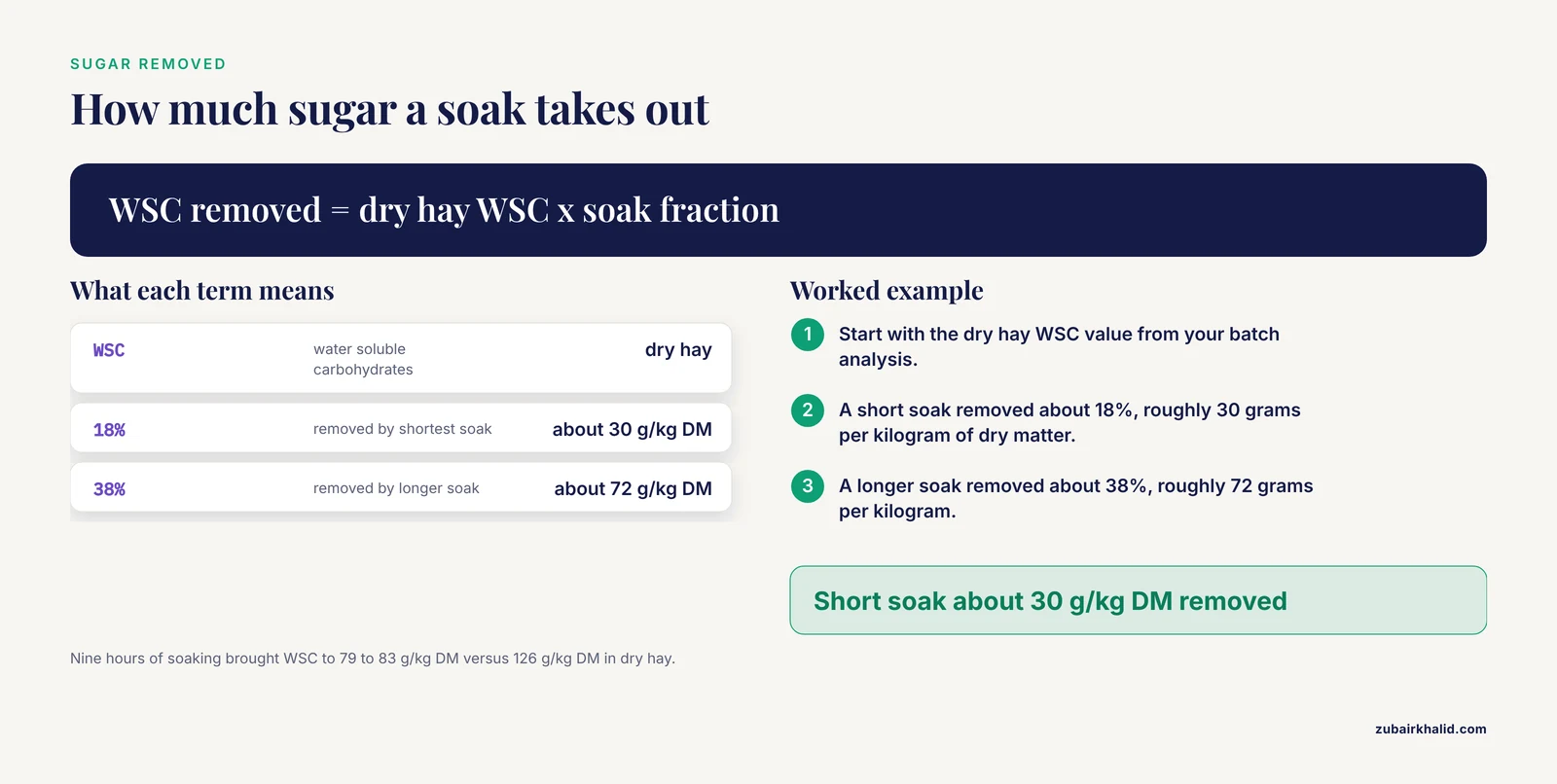
Soaking is the traditional method for lowering both dust and sugar content. The effects on both are real but come with a hygiene cost.
On sugar, soaking reduces water soluble carbohydrates progressively. In one study of three hays, soaking for the shortest period tested removed about 18% of the WSC, roughly 30 grams per kilogram of dry matter, while a longer soak removed about 38%, roughly 72 grams per kilogram [5]. A separate comparison found that nine hours of soaking reduced WSC to 79 to 83 grams per kilogram of dry matter, versus 126 grams per kilogram in dry hay [7].
On respiratory health, soaking delivered measurable clinical benefit. In a controlled trial of horses with severe asthma, hay soaked for 45 minutes and fed fresh at each meal significantly reduced lung resistance over six weeks, from a median of 1.89 down to 0.61 cmH2O/L/s [8].
The catch is bacteria. Soaking increased total aerobic bacterial counts on hay roughly six-fold in one comparison, from 6.0 × 10⁴ CFU/g in dry hay up to 3.5 × 10⁵ CFU/g after soaking [7]. Genomic profiling of soaked hays confirms that soaking substantially alters the bacterial family profile on the hay, which could introduce foreign bacteria into the gastrointestinal tract and shift the normal gut microbial picture [5]. The practical rule that follows from this research is to soak for the shortest effective time, drain thoroughly, and feed soon after soaking rather than leaving wet hay sitting for hours.
Steamed Hay
Steaming targets hygiene while leaving the nutrient matrix more intact than soaking. In the five-treatment comparison, steaming for 50 minutes reduced bacterial counts to about 1.04 × 10³ CFU/g and cut mold counts to near zero, dramatically lower than the mold levels in dry hay [7]. Combining soaking then steaming performed best overall for bacteria and mold.
However, steaming is not nutritionally neutral. Steaming triggers Maillard reactions between proteins and sugars, and these reaction products decreased the estimated precaecal digestibility of crude protein and several amino acids. The researchers concluded that these digestibility losses should be considered in ration calculation for horses receiving steam-treated hay [9].
Two practical takeaways follow. First, steaming does not lower sugar content, since steamed hay retained WSC levels close to dry hay in the comparison above [7]. Second, if your horse relies on hay as its main protein source and you steam that hay, your veterinarian or nutritionist may need to account for the reduced protein value in the total ration.
Forage Cubes and Pellets
Cubes compress forage into a dense, consistent form. They solve real problems, including storage footprint, batch consistency, and feeding during forage shortages. In horses with severe asthma, alfalfa pellets fed as the forage source over six weeks reduced lung resistance, though the average improvement did not reach statistical significance after correction in that small trial [8].
The behavioral trade-off is documented. Horses eating alfalfa-based cubes spent 24% less time eating and chewed 26% less than when eating the same weight of long hay [2]. Cube feeding also produced a higher concentration of inhalable dust during feeding than long hay, although average dust levels were low for both feeds when hygiene was sound [2]. For horses that need maximum chewing time, cubes work best as a supplement to long-stem forage rather than a full replacement.
Round Bales and Free Choice Access
Free choice round bale feeding is a housing strategy as much as a hay choice. Polo horses with free choice access consumed and wasted more hay daily, 16.6 kg on average, and gained significantly more weight than horses eating from slow feeders or automatic box feeders [10]. Free choice and slow feeder groups both spent more than half of their daily time budget foraging, similar to grazing horses, while horses on automatic box feeders spent less time eating and more time standing, sniffing the ground, and practicing coprophagy [10].
Free choice access suits horses with high forage needs but requires active body condition monitoring for easy keepers.
Comparing the Options on the Criteria That Matter
Respiratory Health and Dust Control
For horses with equine asthma, forage hygiene is medical management. Soaked hay fed fresh at each meal produced significant improvement in lung function in severe asthma cases over six weeks [8], and wrapped alfalfa haylage provides inherently dust-free forage [1]. Steaming achieves similar hygiene benefits with strong reductions in bacteria and mold [7].
One underappreciated finding comes from dust research using a standardized hay-shaker device. Measurements of dust shaken from hay only weakly predicted the dust in the horse's actual breathing zone, and the horse's own hay contact behavior, scored by how directly the horse buried its nose in the hay, had the strongest association with inhaled dust exposure [4]. Two horses eating the same bale can inhale very different dust loads depending on how they eat it. This supports treating forage hygiene as one layer of a broader dust reduction plan that also includes feeding environment, rather than assuming a low-dust hay alone solves the problem.
Sugar and Starch Control
For easy keepers and horses with metabolic concerns, WSC content is the number to watch. Soaking reduces WSC in a time-dependent way, with longer soaks removing more sugar [5]. Steaming does not. Grass hay diets also allow gastric fructan degradation, whereas fructan degradation did not occur in horses on a high-starch grain diet [6], which reinforces the value of keeping the ration forage-based when sugar control is the goal.
Protein and Mineral Delivery
When a horse needs more protein, calcium, or magnesium from forage, alfalfa is the evidence-supported option, whether as hay or haylage, and haylage form additionally minimizes leaf losses that would otherwise cost nutrients [1]. Owners feeding steamed hay should remember that protein digestibility drops somewhat with steaming and adjust the ration accordingly [9].
Eating Time, Chewing, and Gut Function
Horses are trickle feeders, and how long forage takes to eat shapes both gut health and behavior. Long-stem hay maximizes eating time and chewing [2]. Slow feeder hay nets with small mesh extended total chew duration compared with loose hay, although chew frequency per kilogram was unchanged, and a bottom-hole net design led to faster consumption in the first four hours than small mesh [3]. Forage cubes shorten eating time substantially and are best used where that trade-off is acceptable [2].
Feeder choice also affects weight and behavior. Free choice hay led to more weight gain, slow feeders moderated intake while preserving natural foraging time budgets, and automatic box feeders reduced eating time enough to increase abnormal behaviors like coprophagy [10].
Hay Nets, Feeders, and Handling
If you use hay nets, hanging position matters. Horses pulled harder on nets hung low compared with high, with maximum pull forces of 144 versus 109 Newtons, and double-layered nets demanded the highest forces of all, up to 156 Newtons. Neck angles also grew more extreme with double-layered nets, reaching a mean maximum nose-poll-withers angle of 127 degrees [11]. Haylage in nets required roughly three times the pull force of hay, so forage type changes the physical effort of net feeding too [11].
Over a full two-year crossover, hay nets reduced body weight, body condition score, and hay usage without any differences in incisor length, incisor bevels, oral cavity scores, or dental abnormalities [12]. Owners worried that nets harm teeth can take reassurance from that result, and owners trying to slow weight gain have data supporting nets as an intake tool.
For group housing with automated hay racks, spacing matters. Horses showed less aggression, especially high-risk behaviors like biting and kicking, when racks provided three feeding openings per horse rather than fewer [13].
Worked Scenarios
Easy keeper with metabolic concerns. Start with a grass hay analyzed for WSC. Soak the portion the horse eats to reduce sugar, timing the soak so hay is fed promptly and bacteria-rich runoff water is discarded [5] [7]. Add a small-mesh hay net to extend eating time, since small mesh lengthened chew duration and nets reduced body condition in a two-year trial [3] [12]. Review the plan with your veterinarian before making the change.
Hard keeper in moderate work. Build the base on long-stem grass hay, then raise protein and mineral density with alfalfa hay or haylage, which supports intake and hindgut fermentation quality [1]. Skip soaking or steaming unless hygiene demands it, since both treatments cost either bacteria control or protein value [7] [9]. Free choice access may be appropriate, with weight monitored because free choice feeding measurably increases intake and weight gain [10].
Horse with severe equine asthma. Prioritize hygiene above all other criteria. Soaked hay fed immediately after a 45-minute soak significantly improved lung function in severe asthma cases [8], steamed hay dramatically cuts bacteria and mold [7], and wrapped haylage is dust-free by design [1]. Remember that the horse's own eating posture drives breathing-zone dust exposure, so low, nose-buried feeding arrangements deserve scrutiny alongside the hay itself [4].
Group-housed horses. Free choice round bales preserve natural foraging behavior but expect higher intake and waste [10]. If using time-controlled racks, provide roughly three openings per horse to reduce biting and kicking at the feed line [13]. Monitor body condition across the group, since dominant horses on free choice access can gain weight quickly.
Buying, Storage, and Record Keeping
Smart hay buying rewards documentation. When choosing hay for horses, request a nutrient analysis for each batch and file the results. A horse health record template is the natural home for this information, with a forage section listing batch dates, supplier, analysis values, and any treatments applied, such as soaking or steaming. If your veterinarian adjusts the ration because of steamed hay's protein digestibility losses or a soaked hay's sugar reduction, that calculation belongs in the same record so future feeding decisions build on it [9] [7].
A practical horse care checklist for hay management looks like this:
- Inspect each delivery for odor, color, mold, dust, and foreign material before acceptance.
- Match the batch to the horse, keeping high-sugar bales away from easy keepers and setting aside the cleanest hay for respiratory-sensitive horses.
- Store hay off the ground, dry, and protected from weather.
- Apply soaking or steaming protocols with consistent timing, and feed treated hay promptly.
- Weigh or estimate hay usage per horse per day, especially with nets or free choice bales, since intake changes are invisible without measurement [12] [10].
- Log body condition scores monthly alongside hay batch changes in your horse health record template.
- Transition between hay types gradually rather than switching overnight.
Common Mix-Ups
Assuming soaking and steaming do the same job. They do not. Soaking lowers sugar and increases bacterial load, steaming kills bacteria and mold but leaves sugar largely untouched and slightly reduces protein digestibility [7] [9]. Choose the treatment that matches the problem.
Soaking too long and feeding too late. Extended soaks add bacterial burden to the hay [7], and soaked hay left sitting continues to change microbiologically [5]. Longer is not better beyond the point where you hit your sugar target.
Judging dust by the hay alone. Breathing-zone dust depends heavily on how the horse eats, not just what it eats [4].
Replacing long hay with cubes to save time. Cubes cut eating time by about a quarter and total chews by a similar margin [2]. That trade-off is acceptable in some situations and counterproductive when chewing time is the goal.
Blaming hay nets for dental wear. A two-year study found no dental differences between horses fed with or without nets [12].
Feeding haylage like dry hay. Wrapped forage demands wrap integrity checks and prompt consumption once opened, or hygiene benefits evaporate [1].
Limitations and When to Contact a Veterinarian
Every hay decision ultimately serves an individual horse whose age, dental status, workload, and medical history only your veterinarian can assess in person. The studies summarized here describe groups of horses under research conditions, and individual responses vary.
Contact your veterinarian promptly if you observe any of the following after a hay change:
- Coughing, nasal discharge, increased breathing effort, or flared nostrils at rest, which may indicate equine asthma requiring diagnosis and a dust-reduction plan.
- Sudden weight loss or failure to maintain condition on an unchanged ration.
- Loose manure, colic signs such as pawing, rolling, or loss of appetite, or any change in fecal consistency after switching forage.
- Refusal to eat hay, quidding, or dropping partially chewed wads, which can signal dental problems needing oral examination.
- Muscle loss, abnormal fat deposits, or excessive cresty neck fat, which warrant metabolic evaluation before ration changes.
- Signs of moldy hay exposure in a group, including multiple horses coughing or going off feed from the same batch.
For ration formulation, especially when combining soaked, steamed, or cubed forages with concentrates, ask your veterinarian or an equine nutritionist to calculate the complete diet rather than adjusting one component in isolation.
Frequently Asked Questions
Is alfalfa hay too rich for most horses?
Alfalfa is nutrient-dense rather than dangerous. It provides high protein, calcium, and magnesium and supports good hindgut fermentation [1], so it suits hard keepers and horses with elevated needs. Easy keepers often do better with alfalfa as a fraction of the ration blended into grass hay rather than the sole forage.
Should I soak or steam my horse's hay?
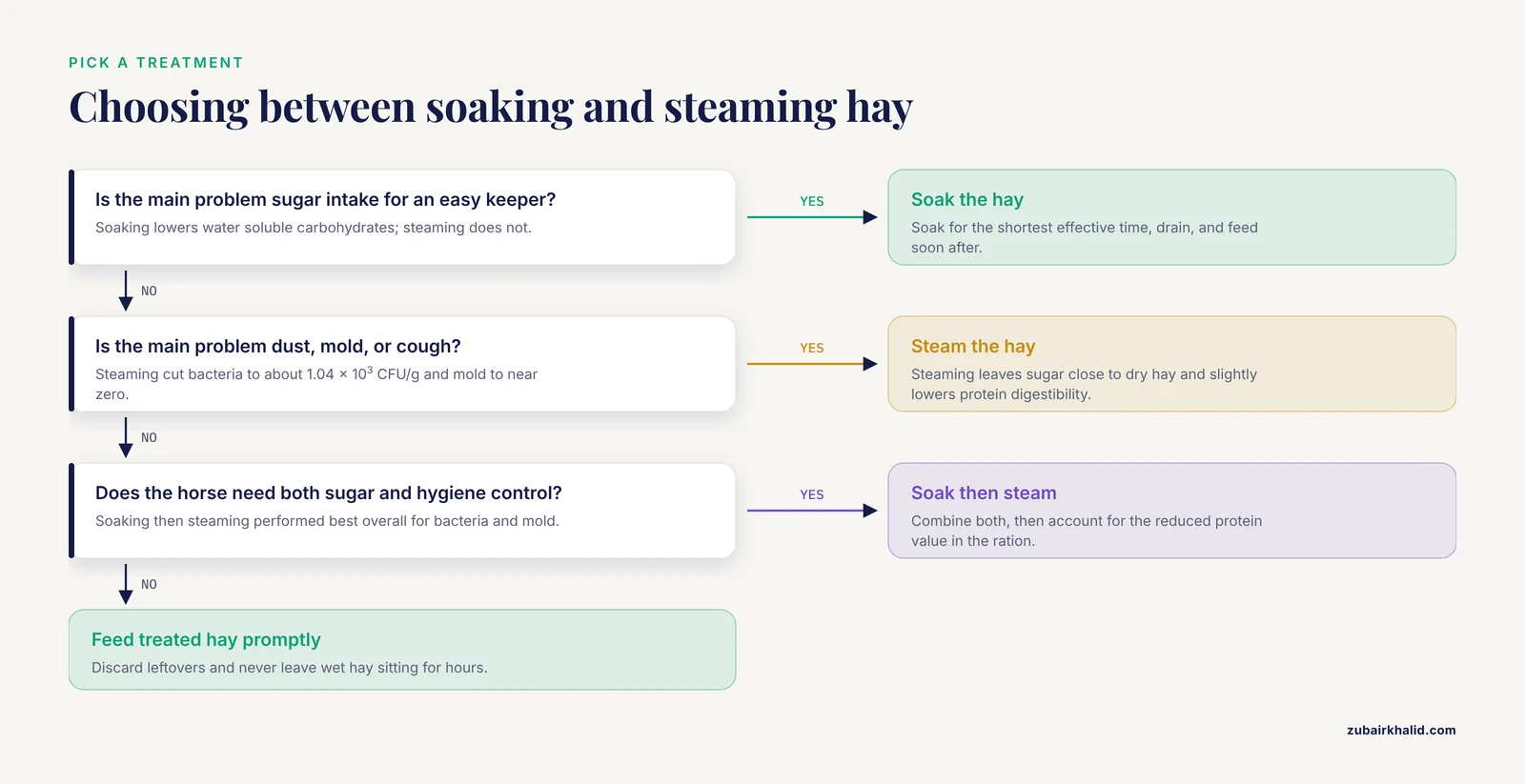
Soak to lower sugar content and steam to lower bacteria and mold. Soaking reduces water soluble carbohydrates but raises bacterial counts on the hay, while steaming dramatically cuts bacteria and mold without lowering sugar [7]. Some owners combine both, soaking then steaming, which performed well for hygiene in comparisons [7].
How long should hay be soaked?
It depends on your goal. Short soaks of around 45 minutes have been used successfully for respiratory cases, while longer soaks remove more sugar. Discuss the target duration with your veterinarian, because the right answer depends on whether you are managing lungs, sugar, or both.
Can haylage fully replace hay?
Yes, for many horses. Wrapped alfalfa haylage supported voluntary intake, nutrient supply, and fecal quality comparable to conventional forages in controlled comparison, with the added benefit of dust-free feeding [1]. The requirement is disciplined storage and discarding any bale with compromised wrap.
Do slow feeder hay nets damage a horse's teeth?
Research does not support that concern. A two-year crossover study found no differences in incisor length, dental abnormalities, or oral cavity scores between horses fed with and without hay nets [12]. Nets did reduce hay usage and body condition, so they function as an intake-management tool.
How do I know if my horse's hay quality is good enough?
Combine your own inspection for mold, dust, and odor with a laboratory nutrient analysis of each batch, and treat hygiene as the deciding factor for horses with respiratory disease [4] [7]. If your horse coughs, loses weight, or changes manure consistency on a given batch, stop feeding that hay and call your veterinarian.
This article is educational and is not a substitute for veterinary diagnosis or treatment.
Sources
- Nutrient Composition and Feed Hygiene of Alfalfa, Comparison of Feed Intake and Selected Metabolic Parameters in Horses Fed Alfalfa Haylage, Alfalfa Hay or Meadow Hay
- Changes in eating time, chewing activity and dust concentration in horses fed either alfalfa cubes or long-stem hay
- Chewing analysis of horses consuming bermudagrass hay in different styles of slow feeders as compared to loose hay.
- Minimising feeding behaviour interference: A hay-shaker device to assess dust exposure in horses
- Mapping the bacterial ecology on the phyllosphere of dry and post soaked grass hay for horses
- Carbohydrate digestion in the stomach of horses grazed on pasture, fed hay or hay and oats.
- The Effect of Five Different Wetting Treatments on the Nutrient Content and Microbial Concentration in Hay for Horses
- Effects of soaked hay on lung function and airway inflammation in horses with severe asthma
- Effect of Hay Steaming on the Estimated Precaecal Digestibility of Crude Protein and Selected Amino Acids in Horses
- Effects of different hay feeders, availability of roughage on abnormal behaviors and cortisol circadian rhythm in horses kept in dry lots.
- Posture and Pull Pressure by Horses When Eating Hay or Haylage from a Hay Net Hung at Various Positions
- Effect of hay nets on horse bodyweight, body condition score, hay usage, and dental health in mature adult horses.
- Which animal-to-feeding-place ratio at time-controlled hay racks is animal appropriate? Preliminary analysis of stress responses of horses