Best Horse Stall Flooring Options
By Dr. Zubair Khalid, DVM, MS, PhD ·
The difference between good and bad stall flooring comes down to three things working together: a stable base, a surface that gives safe footing, and bedding that absorbs urine. The rule of thumb for choosing is simple. Pick the option your site's drainage can support, your budget can maintain, and your horse can stand and lie down on comfortably for the 16 or more hours a day many stabled horses spend inside.
This guide covers the best horse stall flooring options in detail, with a side-by-side comparison, the pros and cons of each material, drainage and base preparation, hygiene and fly control, worked scenarios for common situations, and the daily habits that keep any floor performing well.
Why Stall Flooring Matters More Than Most Owners Realize
A horse in a stall stands on that floor for most of the day. Flooring affects joint and hoof comfort, respiratory health through ammonia and dust, injury risk from slipping, and how much labor and bedding the stall consumes each day.
Modern welfare thinking supports this focus on the physical environment. Mellor's updated framework for animal welfare moved beyond the classic Five Freedoms toward the concept of "a life worth living," emphasizing that animals should experience positive states, not merely the absence of suffering. Comfortable lying surfaces, dry footing, and clean air are exactly the kind of positive physical states a well-chosen floor supports [1]. In practical terms, a stall floor is not just a construction detail. It is part of daily comfort and welfare.
Poor flooring also multiplies work. A floor that drains badly or traps urine keeps bedding wet, increases ammonia, attracts flies, and forces you to use more bedding and more cleaning time. The best flooring choice is often the one that reduces those recurring costs, not the one with the lowest upfront price.
Side-by-Side Comparison of Horse Stall Flooring Options
The table below compares the main options on the criteria that decide real-world choices: comfort, drainage, traction, bedding use, durability, and maintenance burden.
| Flooring Option | Comfort for Standing/Lying | Drainage Behavior | Traction | Bedding Needed | Durability | Maintenance |
|---|---|---|---|---|---|---|
| Compacted clay or packed limestone base, topped with bedding | Good with adequate bedding | Moderate, slows drainage, self-tightens over time | Good, slightly forgiving | Yes, generous | Very high if installed well | Periodic re-compaction, spot cleaning |
| Concrete slab with rubber mats | Very good with mats, poor bare | Excellent, impervious | Excellent with mats, poor bare | Yes | Very long | Low structural, daily cleaning |
| Rubber mats over dirt or clay base | Very good | Depends on base, mats trap moisture underneath | Good | Yes | Very long mat life | Lift and clean periodically |
| Interlocking rubber pavers or poured rubber | Very good, cushioned | Moderate to good if on drained base | Good | Yes | Long | Low |
| Native soil or dirt floor | Moderate, hard when dry, soggy when wet | Poor unless designed with drain | Variable | Yes | Digs, pits, and shifts | Frequent leveling and filling |
| Stall grid or geotextile system over drained base | Good | Excellent, drains through | Good | Yes | Long | Low once established |
| Asphalt or paved base with mats and deep bedding | Good with thick bedding | Excellent | Good with bedding cover | Yes, thick | Very long | Low structural |
| Wood plank floor | Moderate, can rot and splinter | Poor, traps moisture underneath | Fair | Yes | Moderate, rots over time | Regular inspection and board replacement |
No single option wins every column. The right choice depends on whether your barn sits on well-draining ground, whether you are building new or retrofitting, and how many stalls you maintain.
Horse Stall Flooring Pros and Cons, Option by Option
Compacted Clay or Packed Limestone Base
A properly installed clay or fine limestone pack, sometimes called a base of road pack or screenings, is the traditional gold standard. Installed in layers and compacted, it forms a firm, slightly forgiving surface with a subtle give under the hoof.
Pros include good traction, natural comfort, moderate cost in most regions, and a floor that tightens rather than loosens over years of use. Horses can lie down on it comfortably with adequate bedding, and a well-crowned base sheds or drains water rather than pooling it.
Cons include the skill required. Compaction must happen in lifts with the right moisture content, or the floor will rut and pit within a season. Clay floors are also semi-permeable, so urine eventually works through, and the floor should be designed with either a sloped subsurface or a drain path so moisture does not sit under the stall. Expect to re-tamp and fill dug areas along the walls a few times per year.
Concrete Slab with Rubber Stall Mats
Concrete is impervious, permanent, and easy to clean, which is why it is common in hospitals, breeding barns, and high-traffic facilities. Bare concrete, however, is hard, slick when wet, and unforgiving on joints and the points of the hock and elbow when a horse lies down. Nearly every veterinary and barn-management resource treats concrete as a base, not a finished floor.
Adding rubber stall mats over concrete solves most of the problems. The combination gives you an impervious, sanitizable base with cushioned, high-traction footing on top. Cons are real but manageable: concrete is the most expensive base to install, mats must be fitted tightly so bedding and urine do not work underneath, and because nothing drains through, urine either soaks into bedding or needs to flow to a drain at the stall's edge. Ammonia buildup is the risk to watch. Daily removal of wet spots and periodic lifting and washing of mats keeps it controlled.
Rubber Mats over Dirt or Clay
Many existing barns have a dirt or clay floor and the owner's first upgrade is heavy rubber mats laid directly on it. This is a reasonable retrofit. Mats add cushion, traction, and a consistent surface, and they cut bedding use noticeably because bedding stays drier on top of an impermeable layer.
The cons come from what is underneath. If the ground is uneven, mats will rock and create dips that hold moisture and become a chore to clean. Urine seeps under mat seams and can create an anaerobic, smelly layer between mat and ground. The fix is preparation: level and compact the base as well as you can, and plan to pull mats and clean beneath them on a routine schedule. Skilled owners and most barn-management writing recommend treating the area under mats as part of the cleaning calendar, not an afterthought.
Interlocking Rubber Pavers and Poured Rubber Surfaces
Vulcanized rubber pavers and poured-in-place rubber surfaces offer cushioning similar to mats with fewer seams for urine to infiltrate. They are popular in aisles, wash stalls, and high-end stalls. Traction is excellent wet or dry, and the surface is kind to horses that paw or stall-walk.
Cons are cost, which is among the highest of any option, and the need for a well-drained, well-prepared base underneath. Rubber does not solve a bad base. It reveals it, settling into every dip and hollow over time.
Native Soil or Dirt Floors
A dirt floor is the original stall floor and it still works in dry climates and well-drained soil. It is inexpensive, naturally forgiving, and easy to refresh by hauling in more of the same material.
The cons are why many owners move away from dirt. Soil floors dig out at the doorway and along the walls where horses paw and stand. They become soupy in wet seasons and rock hard in drought. They drain poorly in most native soils, which keeps bedding damp and raises ammonia and fly pressure. If you keep a dirt floor, plan on periodic leveling, a supply of compatible fill material, and strict attention to bedding depth so the horse never contacts a wet or uneven patch.
Stall Grid and Geotextile Drainage Systems
A stall grid is a rigid, interlocking plastic honeycomb installed over compacted subgrade, filled with fine stone dust or packed material, and topped with bedding or a thin dust layer. The grid separates the footing from the ground below, so water drains vertically instead of pooling, and the horse cannot dig through to mud.
Pros include outstanding drainage, no digging or pitting, excellent long-term value in wet climates, and a firm, even surface. Cons are the upfront cost and the need for correct installation, including subgrade slope and, in some designs, a drainage outlet. A grid installed over clay with nowhere for water to go simply becomes a buried swimming pool.
Asphalt or Paved Bases with Deep Bedding
Asphalt and other paved bases appear in older barns and some masonry constructions. Like concrete, they are best treated as a base. With a thick bedding pack on top, they provide a dry, easy-to-clean surface and excellent durability. Without generous bedding, they share concrete's drawbacks of hardness and slipperiness. Cons include cost and the fact that, like concrete, they direct all moisture to the surface, so drainage design at the stall edge matters.
Wood Plank Floors
Wood floors feel warm and look traditional, and old oak plank floors in historic barns have survived a century. But wood in a wet stall environment rots, splinters, harbors bacteria in cracks, and blocks drainage. Boards warp and create ledges that catch hooves. Most modern building guidance positions wood as acceptable only in well-drained designs with access to replace boards, and most new construction avoids it in favor of clay, concrete, or grid systems under mats.
The Criteria That Actually Decide the Choice
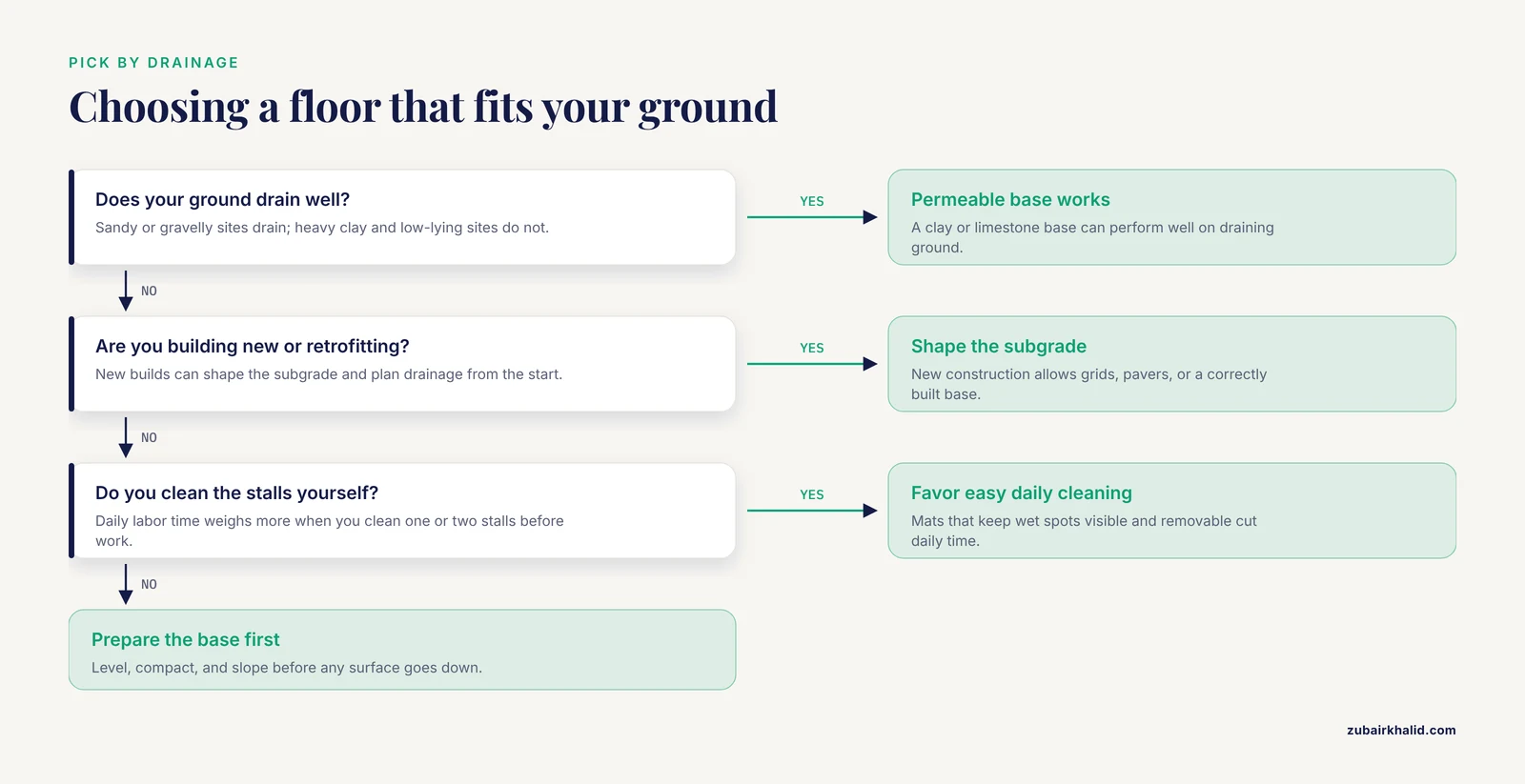
Side-by-side lists are useful, but real decisions come down to four questions.
How Well Does Your Ground Drain?
This is the single biggest factor. On a naturally draining gravel or sandy site, a clay base or even a well-maintained dirt floor can perform well. On heavy clay soil or a low-lying site, every impermeable option, including mats over dirt, will trap moisture unless you design an exit for water. Grid systems and properly sloped concrete with edge drains handle wet sites best. If you are unsure, dig a test hole, fill it with water, and see how long it takes to drain before you commit to a floor system.
Are You Building New or Retrofitting?
New construction lets you shape the subgrade, install a base correctly, and plan drainage from the start. Retrofitting usually means working with an existing slab or dirt floor, where rubber mats over a leveled and compacted base deliver the most improvement per dollar. Interlocking pavers and grids are more common in new builds because their performance depends on what is underneath.
How Much Bedding Are You Willing to Use?
Impermeable floors, especially mats over concrete, cut bedding needs substantially because urine stays on top where it can be removed. Permeable floors like dirt and clay soak urine into the floor, which means more bedding to keep the surface dry and a floor that eventually needs refreshing. Bedding choice interacts with the floor too. Research comparing the four most common bedding materials, wood shavings, pelletized wood, long straw, and pelletized straw, found that bedding type changes both the volume and the properties of stall waste, which matters for farms that store or compost manure and bedding [2]. A floor-and-bedding pairing that produces drier, lighter waste is easier to manage at any scale.
Who Does the Cleaning?
A floor is only as good as its daily maintenance. If a professional stall cleaner handles the barn, labor efficiency may weigh less. If you clean one or two stalls before work, features that cut daily time, like mats that keep wet spots visible and removable, will matter more than marginal differences in cushioning.
Base Preparation, Slope, and Drainage Principles
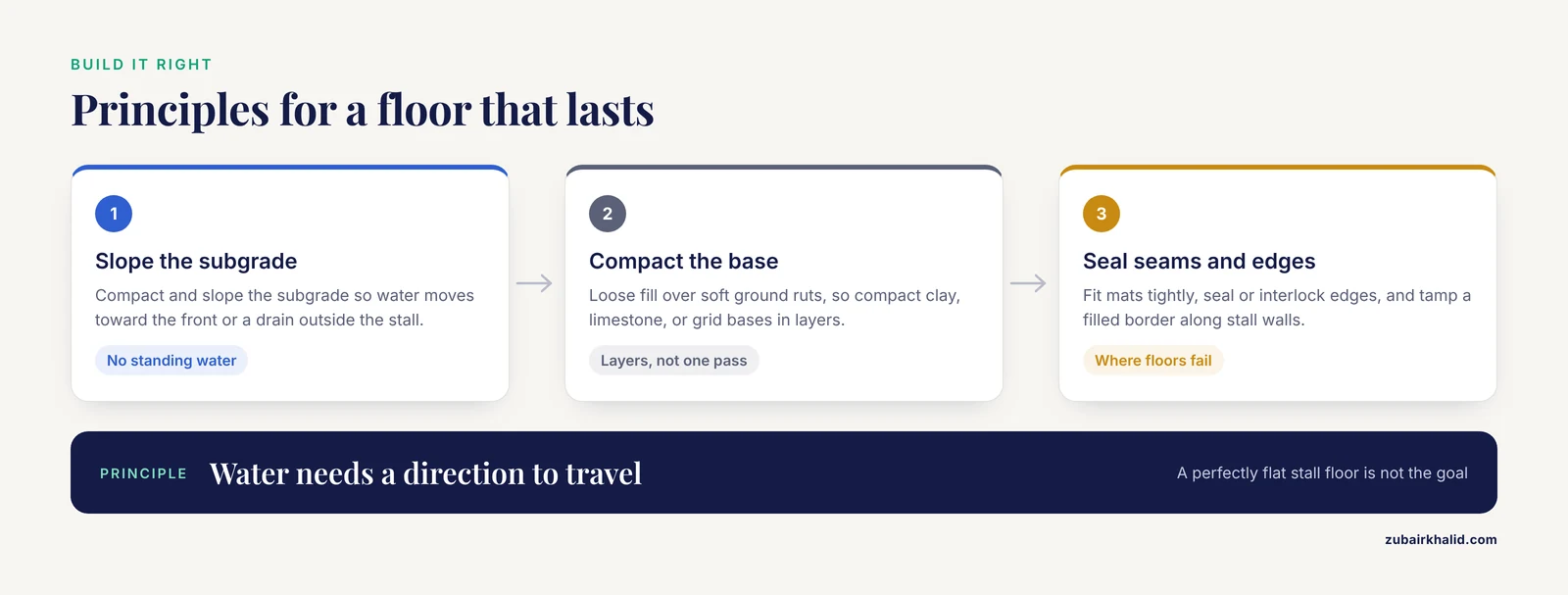
Whatever surface you choose, three principles separate floors that last decades from floors that fail in two winters.
First, the subgrade should be compacted and sloped so water moves somewhere. A gentle slope within the stall, commonly toward the front or toward a drain outside the stall, prevents standing water. Water that cannot leave becomes mud, odor, and fly habitat.
Second, the base layer does the structural work. Loose fill over soft ground, no matter how good the top surface, will rut. Compaction in layers is the standard for clay, limestone, and grid systems alike.
Third, seams and edges are where impermeable floors fail. Mat seams allow urine infiltration. Wall joints allow digging. Tight-fitting mats, sealed or interlocked edges, and a filled, tamped border along stall walls prevent the slow degradation that turns a good floor into a pit.
Hygiene, Ammonia, and Fly Control on Any Floor
Flooring choice sets the stage, but daily hygiene determines whether the stall environment stays healthy. Urine left in contact with bedding releases ammonia, which irritates the respiratory tract, and damp bedding attracts flies. The American Association of Equine Practitioners and the Merck Veterinary Manual both emphasize regular stall cleaning, dry bedding, and manure management as core stable-management practices, and the specific methods vary less than the consistency with which they are applied.
Flies deserve specific attention because stalls concentrate manure, urine, and moist organic material, exactly what flies need to breed. A controlled study published in the American Journal of Veterinary Research tested daily application of sodium bisulfate on stall floors across twelve privately owned farms and found that at the highest application rate, fly numbers on sticky traps dropped significantly in treated stalls compared with untreated controls on most farms, with reduced but still measurable effects at lower rates [3]. Sodium bisulfate is an acidifier available as a stall-dry type product, and it works by lowering the pH of the moist surface where fly larvae develop. Discuss product choice and application with your veterinarian or extension agent, and always follow label directions, because rates and formulations vary.
Whatever floor you have, these habits matter more than the material:
- Remove wet spots and manure daily, completely, rather than skimming the surface.
- Keep bedding dry in contact zones, especially where the horse urinates against the wall.
- Allow the floor to dry during cleaning when the schedule allows, particularly under mats.
- Store and manage manure away from the barn, since nearby manure piles reseed the fly population no matter how clean the stalls are.
Pairing Flooring with the Right Bedding
Flooring and bedding function as a system. On impermeable floors like concrete with mats, absorbent bedding controls the urine that stays on the surface. On permeable floors, bedding must also buffer moisture moving up from below.
The bedding options most farms use are wood shavings, pelletized wood products, long straw, and pelletized straw. Research following groups of horses bedded on each of these four materials found that the choice affects waste volume and the chemical characteristics of the resulting stall waste, including nutrient content relevant to composting [2]. For a small farm that spreads or composts stall waste, that means the bedding you choose for a given floor also shapes your manure management, not just your horse's comfort.
Practical pairings that work well:
- Concrete or asphalt base with rubber mats: shavings or pellets, used thinly because the floor does the absorption work.
- Clay or limestone base: deeper straw or shavings packs that create a urine-absorbing cushion the horse can dig into.
- Grid systems with stone dust fill: a moderate bedding depth over the dust cap keeps the surface clean and dry.
- Dirt floors: generous bedding depth, refreshed frequently, since the floor itself offers no moisture control.
Worked Scenarios
Scenario 1, The Two-Stall Backyard Barn on Clay Soil
You have two stalls in a small barn built on heavy clay soil that stays wet after rain. You clean the stalls yourself each morning. The best fit here is usually mats over a prepared base. Spend the effort leveling and compacting the existing floor, adding fill where the horses have dug out, and sloping it toward the door. Lay heavy rubber mats tightly. Bed with wood pellets or shavings used economically, since the mats reduce bedding needs. Accept that twice a year you will pull the mats, let the floor dry, scrape away any sludge that accumulated at the seams, and reset them.
Scenario 2, New Construction on a Wet, Low-Lying Site
You are building a six-stall barn on ground that stays damp. Budget allows proper construction. Here the strongest option is a grid system over a compacted, sloped subgrade with a drainage path, topped with stone dust and bedding. Alternatively, a concrete slab with mats and edge drainage performs excellently and is easier to sanitize, which matters if you plan to rotate horses, quarantine new arrivals, or manage a horse with a contagious condition. Both options handle the wet site. Choose based on whether drainage through the floor or an impervious, washable surface fits your management better.
Scenario 3, The Older Barn with a Historic Wood Floor
You have an old barn with sound oak plank floors you do not want to remove. Wood in a stall rots and blocks drainage, so the goal is to protect the planks and the horse at once. Level any warped areas as much as possible, then install rubber mats over the wood to create a consistent, cushioned surface and keep bedding and urine off the planks. Inspect the boards annually for soft spots and splinters. This preserves the floor, improves footing, and keeps maintenance predictable.
Common Mix-Ups and Mistakes
Buying mats to fix a bad floor. Mats laid over an uneven, dug-up dirt floor rock, trap sludge, and clean worse than the bare floor did. Preparation comes first.
Assuming rubber solves drainage. Rubber is impermeable. On a wet site without a drainage plan, it moves the water problem to the seams and the stall edge. Rubber changes comfort and traction. It does not manage water.
Confusing bedding depth with flooring quality. A deep bedding pack can hide a failing floor for a while, but the underlying problems, trapped moisture and odor, continue underneath. Address the floor, then optimize bedding.
Treating a dirt floor as zero-maintenance. Dirt floors need leveling, filling, and moisture management just like any other option. The cost is lower but it is not zero.
Ignoring the area under mats indefinitely. Out of sight becomes out of mind until the barn smells. Build mat lifting and under-mat cleaning into the routine calendar.
Skipping slope. A perfectly flat stall floor is not the goal. Water needs a direction to travel.
A Horse Care Checklist for Stall and Floor Management
Good flooring supports a broader daily routine. This horse care checklist covers the stall-side items that pair with any flooring choice:
- Daily: remove manure and wet bedding completely, check footing for wet or uneven spots, refill water, confirm feed.
- Daily in fly season: apply stall-drying or fly-control products per label, empty and manage manure away from the barn.
- Weekly: assess bedding depth, check mat seams and edges, verify drainage paths are clear.
- Monthly: lift and inspect mats in at least one stall, check for digging along walls, inspect for ammonia odor at nose level.
- Seasonally: level and compact dug areas, refresh fill material, deep-clean under all mats, evaluate drainage performance after heavy rain.
- Annually: full floor inspection, board or paver check, base repair where ruts have formed.
Pair the checklist with a horse health record template so observations about your horse link to stall conditions. A simple template tracking dates, body condition, any foot or joint soreness, respiratory signs, and notes about stall environment lets you see patterns. If a horse stiffens when rising every morning on one flooring type and not another, or if respiratory signs track with ammonias-prone stalls, the record shows what memory alone misses. Free templates from university extension services and equine organizations give you a structure, and the habit of filling one out matters more than the format.
Limitations and When to Contact a Veterinarian
This article is educational and is not a substitute for veterinary diagnosis or treatment.
Flooring guidance here is general. Individual cases need a veterinarian, and a horse with existing joint disease, chronic foot problems, or respiratory sensitivity may need a specific flooring and bedding approach tailored by your veterinarian and, where relevant, a farrier. Site evaluation for drainage and construction is a job for an experienced builder or agricultural engineer, not a guess from an article.
Contact your veterinarian promptly if you see any of the following:
- Reluctance to lie down in the stall, repeated getting up and down, or marks on the hips, hocks, or elbows suggesting the horse is struggling on the surface.
- Persistent coughing, nasal discharge, or labored breathing in a stabled horse, which can indicate environmental respiratory irritation that flooring and ventilation changes should accompany veterinary care.
- Swelling, heat, or lameness after a stall-related slip or a period of stalled confinement.
- Skin sores or thrusting behaviors, such as pawing through to the base, that show the floor is failing.
- A strong ammonia smell at horse nose height despite regular cleaning, since ammonia exposure warrants both environmental fixes and a veterinary assessment of any respiratory signs.
- Any sudden behavior change in a stabled horse, from refusing to enter the stall to restlessness that suggests discomfort with the surface.
Your veterinarian can also connect you with regional extension resources for barn design, since state extension services publish detailed stall construction guidance for local soil and climate conditions.
Frequently Asked Questions
What is the best flooring for a horse stall?
For most owners, the best horse stall flooring is a well-compacted clay or limestone base, or a concrete base, topped with properly fitted rubber mats and appropriate bedding. The truly best option for your barn depends on your site's drainage, whether you are building new or retrofitting, and how much maintenance you can sustain.
Are rubber stall mats enough without bedding?
No. Rubber mats alone leave urine pooling on an impermeable surface, create ammonia, remove the comfort and insulating value of bedding, and encourage horses to develop bed-sore-like pressure points and hock sores from lying on hard rubber. Mats are a base improvement, not a substitute for bedding.
Does stall flooring need to drain?
Water needs a place to go, and flooring design should account for it. Impermeable floors manage moisture by letting you remove wet bedding and by directing liquid to a drained edge, while permeable and grid systems move water down through the floor. A floor with no drainage plan traps moisture, odor, and flies.
How often should I clean under rubber stall mats?
A practical schedule is inspecting seams and edges weekly, and lifting mats for a full under-cleaning at least a couple of times per year, more often in high-use stalls or wet conditions. Urine and organic material accumulate under seams and create odor and slippery sludge if left unaddressed.
Can I use gravel as stall flooring?
Gravel alone is too loose and uneven for a stall surface and can cause hoof problems, but it functions well as part of a drainage base underneath grid systems, stone dust layers, or mats. Think of gravel as infrastructure under the floor rather than the surface the horse stands on.
How do I control flies in my horse's stall?
Daily manure and wet bedding removal is the foundation, combined with managing manure piles away from the barn. Stall-drying products such as sodium bisulfate can add meaningful reduction in fly numbers when applied daily according to label directions, and a controlled farm-based study found significant fly reductions in treated stalls at higher application rates. For persistent problems, ask your veterinarian about an integrated fly control plan.
Further Reading
- Designing accessible and independent living spaces for visually impaired individuals: a barrier-free approach to interior design.
- The Vernacular Landscape of Assisted Living.