Resource Guarding in Dogs With Cats in the Home
By Dr. Zubair Khalid, DVM, MS, PhD ·
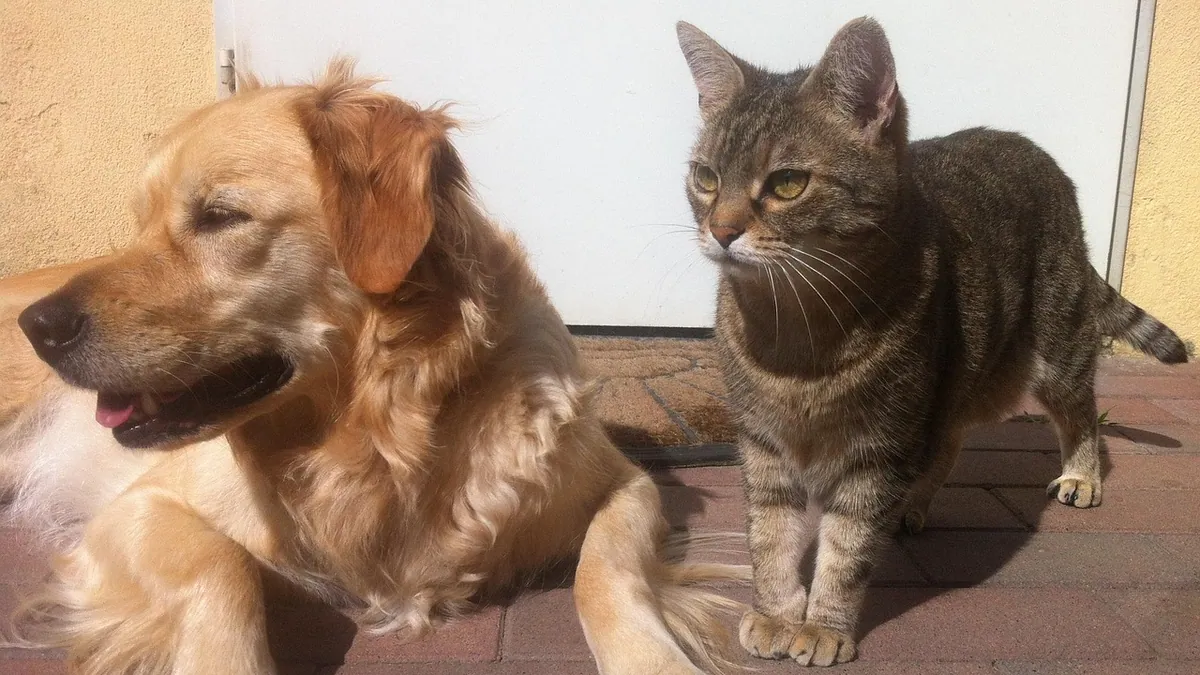
Resource guarding in dogs with cats means your dog controls access to food, toys, beds, or you when a cat comes near. It can range from a hard stare to a snap, and it often looks quieter than guarding aimed at another dog. This article is educational and is not a substitute for veterinary diagnosis or treatment.
Quick Answer
- Resource guarding is a normal canine behavior that becomes a safety problem when it targets your cat [1][2].
- Dogs and cats read each other poorly, so a cat may miss the stiff body, freeze, or hard stare that signals a dog is about to escalate.
- Feed pets in separate rooms or behind barriers, and never take food or stolen items away from a guarding dog [1].
- Supervise all together time, and separate the pets when you are not home [3].
- Call your veterinarian for any bite, any broken skin on the cat, or a sudden new guarding behavior in an adult dog.
Why Dogs Guard Resources From Cats
Guarding is normal dog behavior
Resource guarding describes behavior a dog uses to control access to something it values [2]. That can be food, a chew bone, a stolen sock, a favorite bed, a toy, or a person. Growling, stiffening, hovering over an item, and eating faster when someone approaches are all part of the same pattern [1].
Dogs vary in what they guard. Some only guard chew bones or toys. Some guard stolen items, like food wrappers or socks. Many dogs guard food [1]. Your dog may guard from every cat in the house or only from one.
Why a cat triggers a different response
When a dog guards from another dog, the two animals usually share a social language. They read each other's posture, tail position, and eye contact, and they often negotiate with a lot of noise before anything physical happens.
Cats do not share that language. A cat may walk straight toward a food bowl, jump onto the couch where the dog is chewing, or brush past a dog's face. The cat is not challenging your dog. The cat simply does not recognize the warning. That mismatch is what makes resource guarding in dogs with cats so easy to miss until it escalates.
Predatory behavior is a separate issue
Some dogs stalk, chase, or grab small animals. That is predatory behavior, and it is a natural part of dog behavior [3]. It is not the same as guarding a bone. A dog that stalks your cat needs a different plan than a dog that growls over a chew toy, and some dogs are simply not a safe fit for a home with a cat [3]. If you are seeing stalking or chasing, read Dog Aggression Towards Cats: How to Manage Multi-Pet Households before you change anything at home.
Medical Causes to Rule Out Before Training
A sudden change in behavior deserves a veterinary visit first. Pain, dental disease, arthritis, vision loss, and hearing loss can all make a dog more reactive when a cat approaches. An older dog that never guarded before may snap because moving away from the food bowl hurts.
Cats have their own medical triggers. Fear, anxiety, and stress are among the most common behavioral problems in cats, and they can look like aggression or hiding [4]. Feline aggression has both genetic and environmental causes, and the evidence base is still incomplete [5]. Your veterinarian can check for pain, thyroid disease, and other conditions that affect mood and appetite.
Bring both pets' histories to the appointment. Describe exactly what happens, who moves first, and what the dog does. Video is more useful than memory.
When Guarding Becomes a Problem
Guarding is a problem when it puts the cat at risk, when it makes the cat hide or stop eating, or when you feel unsafe intervening.
Watch for these signs in your dog:
- Freezing or going still when the cat approaches
- Eating faster, gulping, or moving the food bowl
- Standing over an item with a stiff body
- Hard stare, whale eye (whites showing), or lip curl
- Growling, snapping, or lunging
- Blocking doorways, hallways, or your lap
Watch for these signs in your cat:
- Avoiding rooms the dog uses
- Hiding under beds or in closets more often
- Peeing or pooping outside the litter box
- Eating less or skipping meals
- Hissing, swatting, or fleeing when the dog enters
A cat that changes its daily routine is telling you the household no longer feels safe. That matters even if the dog has never made contact.
Step-by-Step Management at Home
Step 1: Separate feeding completely
Feed your dog and cat in different rooms with the doors closed, or use a crate and a barrier [1]. Pick up bowls when the meal is finished. Do not free-feed the dog if the cat has access to the same space.
Step 2: Manage high-value items
Give chew bones, stuffed toys, and food puzzles only in the dog's crate or a closed room. If your dog steals something, do not chase or pry it out of the mouth [1]. Trade for a high-value treat tossed away from the dog, or block access and wait.
Step 3: Control the environment
Use baby gates, cat trees, shelves, and cat-only rooms so the cat always has a vertical or gated escape route. Cats need a cat-friendly environment with safe spaces and predictable routines [4]. A cat that can leave the room without passing the dog is a cat that stays calm.
Step 4: Supervise all interactions
Even if your dog is friendly and social with your cat, do not leave them together unsupervised when you are not home [3]. Supervised means you are in the room, watching, and able to step in.
Step 5: Build positive associations
Reward your dog with treats whenever the cat appears at a distance. Keep sessions short and stay under the dog's threshold. If your dog stiffens, you are too close. Back up and try again later.
Step 6: Add enrichment for both species
A tired, mentally satisfied dog guards less. Use sniff walks, food puzzles, and training games. Give your cat daily play with a wand toy, scratching posts, and perches. Enrichment lowers tension for everyone.
Step 7: Train a solid "leave it" and "come"
These cues give you a way to move your dog away from a resource without a confrontation. Practice when no cat is present, then add distractions slowly. For more on the training side, see Dog Resource Guarding: How to Stop It Safely.
If you also have a second dog, the dynamics get more complex. See Resource Guarding in Multi-Dog Homes: Managing Food and Toy Aggression.
What Not to Do
Do not punish growling. A growl is information. If you suppress it, the dog may skip the warning and go straight to a bite.
Do not take food or stolen items away by force. This is one of the most common ways guarding escalates [1]. Manage the environment instead.
Do not use alpha rolls, scruff shakes, or shock collars. These methods raise fear and make aggression more likely, not less.
Do not assume the cat will handle it. Cats often freeze or flee instead of fighting back, and a fleeing cat can trigger a chase.
Do not assume a dog that is fine with one cat is fine with all cats. A dog raised with a small animal may still stalk, chase, or kill unfamiliar small animals [3].
Do not rely on "they'll work it out." Unsupervised time is how bites happen.
When to Involve a Veterinarian or Behavior Professional
Call your veterinarian if:
- Your dog has bitten or snapped at your cat
- Your cat has any wound, limp, or change in eating
- Guarding started suddenly in an adult dog
- Your dog guards from people too, not only the cat
- You feel you cannot safely manage the household
Your veterinarian can rule out medical causes and discuss behavior-modifying medication when appropriate. For cats, treatment planning includes environmental changes and, in some cases, medication to reduce fear and stress [4].
Ask for a referral to a board-certified veterinary behaviorist or a certified applied animal behaviorist for in-home assessment. A qualified professional can watch the actual interactions and build a plan for your specific pair. Rehoming is not the only option, and many households can be managed safely with the right setup.
Limitations and When to Contact a Veterinarian
No article can assess your dog, your cat, or your home. Individual cases need a veterinarian who can examine both animals and see the behavior in context.
Contact your veterinarian the same day if:
- Your cat has a bite wound, puncture, or broken skin (cat bites and dog bites can abscess and infect quickly)
- Your cat stops eating, hides constantly, or avoids the litter box
- Your dog shows new guarding toward people
- You see stalking, chasing, or a hard stare that does not break
Go to an emergency clinic now if:
- A bite broke skin on a person or a pet
- Your cat is limping, crying, breathing hard, or collapsed
- Your dog will not release the cat or a person
- There is heavy bleeding or a deep wound
Schedule a routine visit if:
- Guarding is mild and you want a behavior plan
- Your dog is due for a wellness exam and you want to discuss behavior
- You want a referral to a behavior specialist
Frequently Asked Questions
Is resource guarding in dogs with cats different from guarding with other dogs?
Yes, mostly because cats do not read dog warnings well. A dog that guards from another dog usually gets a warning sequence that the other dog understands. A cat may walk right into the danger zone, so the dog escalates faster and with less warning.
Can a dog and cat live safely together if the dog guards resources?
Often yes, with strict management. Feed separately, control high-value items, supervise all contact, and give the cat escape routes. If the dog has bitten the cat or shows predatory behavior, the risk is much higher and you need professional help [3].
Should I take the bone away to teach my dog not to guard?
No. Removing items by force tends to make guarding worse [1]. Instead, prevent access to items your dog guards, or trade for something better. Teach a reliable "leave it" and "drop it" with reward-based training.
Will my cat be fine if it just avoids the dog?
Not always. A cat that hides, stops eating, or avoids the litter box is stressed, and stress has real health effects [4]. Cats need safe spaces, perches, and predictable routines. If your cat's daily habits changed, treat that as a medical and behavioral concern.
Do I need to rehome one of my pets?
Not automatically. Many guarding cases can be managed with separation, enrichment, and training. Rehoming becomes the safer choice when a dog has injured the cat, shows strong predatory behavior, or when management keeps failing despite professional help [3]. Talk with your veterinarian and a behavior specialist before you decide.
Can medication help?
Sometimes. Behavior-modifying medication is one tool your veterinarian may consider, especially when fear or anxiety drives the behavior [4]. Medication works best alongside training and environmental change, and your veterinarian calculates the dose from your pet's weight and health.
Related Articles
- Resource Guarding in Multi-Dog Homes: Managing Food and Toy Aggression
- Dog Resource Guarding: How to Stop It Safely
- Dog Aggression Towards Cats: How to Manage Multi-Pet Households
- Flea Prevention Dogs Cats
- Dog Cat Behavior Problems
- Pets At Home
- Resource Guarding in Cats: Signs and How to Stop It
- How to Stop Dog and Cat Aggression Toward Each Other
- Do Cats and Dogs Get Along? How to Build Peace at Home
References
- Food Guarding. ASPCA Animal Poison Control Center.
- Defining and Clarifying the Terms Canine Possessive Aggression and Resource Guarding: A Study of Expert Opinion. Frontiers in veterinary science, 2018.
- Introducing Dogs to Small Pets and Cats. ASPCA Animal Poison Control Center.
- Tools for the Approach of Fear, Anxiety, and Stress in the Domestic Feline: An Update. Veterinary medicine international, 2025.
- Genetic and Environmental Causes of Aggression in the Domestic Cat. Veterinary sciences, 2026.