Dog-Proofing Your Home: Hazards and Safe Setup
By Dr. Zubair Khalid, DVM, MS, PhD ·
Dog-proofing your home means removing or securing everything your dog could eat, spill, break, or get trapped in, and then giving the dog a defined safe free roam area where it can spend time alone without risk. The work has two halves. The first half is subtractive. You walk every room at your dog's eye level and clear away the household dangers for dogs, such as medications, cleaning products, toxic foods, cords, and trash. The second half is additive. You build a space with water, safe bedding, and enrichment so the dog can rest and stay occupied without supervision. This guide covers both halves, room by room, with a same-day checklist, the mistakes that cause most failures, and clear signs for when a veterinarian needs to be involved.
This article is educational and is not a substitute for veterinary diagnosis or treatment.
At a Glance: A Same-Day Dog-Proofing Checklist
| Priority | Action | Where it applies |
|---|---|---|
| 1 | Choose one room as the dog's safe zone and clear it completely | Laundry room, mudroom, or gated kitchen |
| 2 | Move all medications into closed, latched cabinets | Bathroom, kitchen, nightstands, bags and purses |
| 3 | Replace open trash cans with locking-lid models or in-cabinet bins | Kitchen, bathroom, garage |
| 4 | Secure or cover electrical cords, chargers, and blind cords | Every room |
| 5 | Shelf and seal all food, including pet food and treats | Pantry, counters, low cabinets |
| 6 | Move houseplants out of reach or out of the dog's zone | Living areas |
| 7 | Latch all cleaning product storage | Bathroom, laundry, garage |
| 8 | Do a nose-height crawl through every room the dog can enter | Whole house |
| 9 | Set up water, washable bedding, and one chew or food puzzle | The safe zone |
| 10 | Test with a five-minute supervised absence, then adjust | The safe zone |
Why Dog-Proofing Your Home Matters for Behavior and Welfare
Dogs are widely regarded as family members, and that status carries responsibility for their health, housing, and behavioral needs alongside affection [1]. Most of that responsibility is exercised at home, because the house is where a dog spends the most unsupervised time, and it is where the preventable problems happen, from swallowed socks to chewed cables to trash raids.
Safety and behavior are the same project. A dog left in an unmanaged room will explore with its nose and teeth, because that is normal canine behavior. When exploration leads to a trash can or a charging cable, the dog gets corrected for doing something natural, the owner gets frustrated, and the dog learns nothing useful about the object itself. Management removes the conflict before it starts.
There is also a welfare argument. Research on canine stress shows that unpredictability and social instability are major drivers of the stress response, which activates the hypothalamic-pituitary-adrenal axis and expresses itself behaviorally as fear- and anxiety-related responses [2]. A home with consistent rules, a predictable routine, and a secure place to rest lowers that load. Treat dog-proofing your home as permanent infrastructure for good behavior and lower stress, not as a one-time chore for puppy owners.
How to Dog Proof a Room: The Four-Step Method
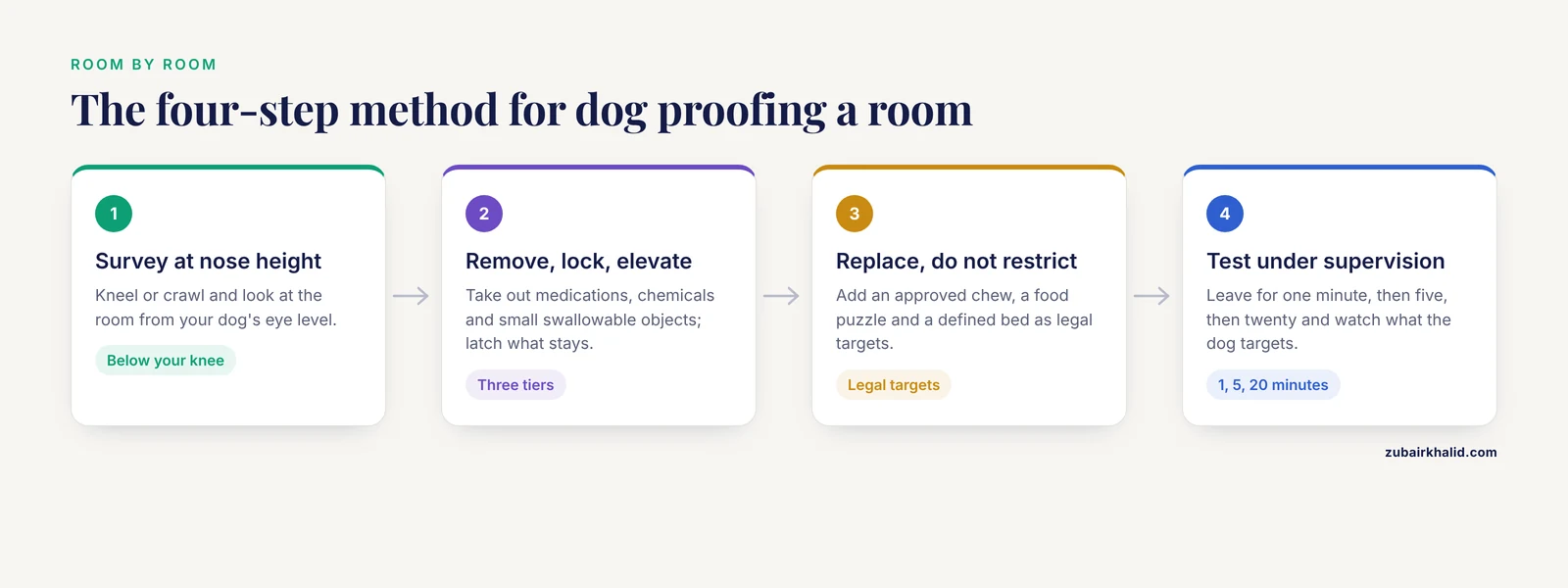
Step 1: Survey at nose height
Kneel or crawl through the room and look at it from your dog's eye level. Anything at or below your own knee is within reach of most dogs, and anything that dangles, spills, shatters, or fits whole into a mouth is a candidate for removal. Pay attention to scent. Food wrappers, used tissues, shoes, and laundry hampers attract dogs even when the contents look worthless to you.
Step 2: Remove, lock, or elevate
Sort everything you found into three tiers. Remove the truly dangerous items from the room entirely, which is the only reliable option for medications, chemicals, and small swallowable objects. Lock away items that must stay in the room, using cabinet latches, high closed shelving, or locking bins. Elevate what remains, understanding that height only works for dogs that do not climb or take food from counters.
Step 3: Replace, do not just restrict
A dog-proofed room with nothing in it does not stop the urge to chew, dig, or forage. It only removes the illegal targets. Give the dog legal ones, such as an approved chew, a food puzzle, and a defined bed. A dog with an outlet is far less likely to invent one.
Step 4: Test under supervision
Leave the room for one minute, then five, then twenty, and watch what the dog targets. Every escape artist, cord chewer, and trash raider reveals itself during supervised tests, not during the emergency. Expand freedom in small increments and shrink it back the moment something gets chewed or eaten.
Household Dangers for Dogs, Room by Room
Kitchen and pantry
The kitchen combines food, heat, chemicals, and the household trash can, which makes it the highest-risk room in most homes. Secure the trash first, because cooked bones, skewers, wrappers, coffee grounds, and food scraps all end up there. Move food off counters and out of low cabinets, including bread, fruit bowls, and open bags of pet food. Latch lower cabinets that hold cleaning products, close the dishwasher after loading, and keep compost behind a latched door. If your dog takes food from counters, treat every counter surface as within reach.
Bathroom and medicine cabinet
Bathrooms hold the densest concentration of toxic household items for dogs in a small space. Store all medications, yours and your dog's, in closed cabinets, never on counters and never in bags on the floor. Keep toilet lids closed, especially if you use bowl cleaners. Latch the cabinet that holds cleaning products. Floss, razors, cotton swabs, hair ties, and soap slivers belong in lidded bins, because all of them are swallowable.
Bedroom and living room
Living spaces carry the hazards of habit. Chargers and power cords run along baseboards, remotes hold batteries, socks and underwear end up on the floor, and houseplants sit at exactly the right height for browsing. Cover or route cords, keep remotes and small electronics in drawers, sweep laundry daily, and move plants to hanging or high positions. Secure televisions and heavy decor so they cannot be pulled down, and use screens around fireplaces and space heaters. Keep candles, diffusers, and aromatherapy products out of reach, and confirm with your veterinarian which products are safe to use around dogs at all.
Garage, laundry, and utility spaces
These rooms hold the most concentrated chemicals in the house. Antifreeze, pesticides, rodenticides, fertilizers, paint, solvents, detergent pods, and dryer sheets should live on high, closed shelving or in locked cabinets. Wipe spills immediately, especially where a car is parked. Keep the door closed by default, and check the floor for nails, screws, and small hardware before letting a dog into these spaces.
Home office and entryway
Purses, backpacks, and coat pockets are the most overlooked hazard site in the home, because they carry medications, sugar-free gum, snacks, and small objects down to dog height every day. Establish a household rule that bags hang on hooks or live on shelves, never on beds or floors. Store button batteries, pens, pins, and shredders out of reach, and keep an unattended shredder unplugged. At the entryway, keep shoes on a rack and mail off the floor.
Toxic Household Items for Dogs
Some categories should be treated as off-limits by default in any home with a dog. The list below covers the groups that come up most often. Danger depends on the specific item, the amount, and the size of the dog, which is a question to confirm with your veterinarian before your dog has access, not after.
- Human medications, including over-the-counter pain relievers, sleep aids, supplements, and prescription drugs. Store every one in a latched cabinet, and treat a dropped pill as an emergency until a professional tells you otherwise.
- Cleaning products, including bleach, toilet bowl cleaners, drain openers, oven cleaners, laundry detergent, detergent pods, and disinfectant wipes.
- Human foods, including chocolate, candy and gum sweetened with xylitol, grapes and raisins, onions and garlic, alcohol, caffeine, yeast dough, moldy food, and macadamia nuts.
- Plants, including many common houseplants, holiday plants, flower bulbs, and outdoor ornamentals. Confirm every plant in and around your home with your veterinarian.
- Automotive and yard products, including antifreeze and coolant, pesticides, rodenticides, slug and snail bait, fertilizers, and ice melts.
- Personal items, including nicotine products and vapes, human toothpaste, essential oils, and hand sanitizer.
- Objects that are not poisons but still injure, including button batteries, coins, strings, ribbons, hair ties, socks, cooked bones, and corn cobs.
Owners take this seriously and want reliable guidance. In a US survey of 508 respondents, the highest trust shares for canine welfare information went to the ASPCA at 25.1 percent, veterinarians at 16.4 percent, and the AVMA at 14.1 percent [3]. Build your own list of dangerous items with your veterinarian's input, and keep it where everyone in the household can see it.
If an ingestion happens anyway, act immediately. Remove the dog from the area, keep the packaging, note the time and the estimated amount, and call your veterinarian or an animal poison hotline. Do not wait for symptoms, because waiting costs treatment time. Do not induce vomiting unless a professional directs you to.
Building a Safe Free Roam Area for Dogs
A safe free roam area for dogs is a fully dog-proofed space where the dog can be left alone without risk to itself or the house. It is the foundation of the whole system, because it gives you a reliable fallback for every day that supervision is not possible.
Choosing the space
Look for a room with hard, non-slip flooring that cleans easily, a door or gate that closes securely, moderate temperature, and no through-traffic. Laundry rooms, mudrooms, gated kitchens, and large crates or exercise pens all work. The space needs water at all times, comfortable bedding, and enough room for the dog to stand, turn, and lie down stretched out. Avoid spaces with water heaters, chemical storage, or access to the trash.
Introduce the dog to the space gradually. Feed meals in the zone, settle the dog there when the household is calm, and keep early sessions short and positive. A space that predicts rest and food becomes a retreat. A space used only for sudden isolation becomes a source of conflict.
Flooring, bedding, and hygiene
Floor and bedding choices are welfare decisions, not decor. In a welfare assessment of 2,667 dogs across 20 breeding and boarding facilities, the type and suitability of flooring affected the likelihood of skin lesions, and clean bedding was associated with a lower likelihood of dogs being filthy or wet [4]. At home, that translates to non-slip surfaces where the dog rests, washable bedding, and a washing routine you actually keep. Veterinary husbandry guidance for licensed breeding establishments makes the same point from the regulatory side, requiring accommodation that can be cleaned and disinfected, with good hygiene standards and recorded cleaning routines [5]. Choose surfaces and beds you can sanitize, and keep a simple schedule.
What goes inside
Keep the safe zone simple. Water, a bed, one or two safe chews or food puzzles, and nothing else. Boring is the goal, because every extra object is a potential chew target.
How much freedom to give
Freedom is earned in increments, and the right amount depends on the individual dog. Puppies, newly adopted dogs, and any dog with a history of chewing or house soiling start in the smallest safe zone and expand only after weeks of clean supervised tests. Temperament matters too. In a survey of agility dogs, excitability showed a positive correlation with separation-related behaviors, which means highly excitable dogs often need a more structured confinement plan rather than more freedom [6]. If your dog has already destroyed items or soiled when alone, shrink the zone and rebuild from a level the dog can succeed at.
In multi-dog households, the safe zone may need to be per dog. Separate dogs during unattended time if there is any food guarding, toy possession, or rough play that escalates, and confirm the arrangement with a trainer or your veterinarian if tension appears.
Enrichment Makes the Setup Work
Dog-proofing removes hazards. Enrichment removes the motivation to go looking for them. A dog with nothing to do will find work, and the work it finds is usually destructive. Facilities discover the same pattern at scale. In the breeding and boarding facility assessment, abnormal behaviors such as anxiety were much higher where facilities provided no enrichment [4]. Reviews of kennel-housed dogs reach a similar conclusion, that enrichment and training programs can mitigate stress, although a subset of individuals struggles to adapt and needs additional support [7].
The evidence on specific activities is encouraging. A systematic review of judgment bias research in dogs, which measures optimistic and pessimistic responses to ambiguous cues, found that nosework enrichment was associated with more optimistic responses, while observational studies linked aversive training methods with less optimistic responses than reward-based methods [8]. In practical terms, sniffing games and reward-based training are the two activities with the strongest support behind them.
Build enrichment into the safe zone and the daily routine. Rotate a small set of food puzzles and chews so they stay novel. Feed at least part of the daily ration through puzzles instead of a bowl. Add short sniff walks and brief reward-based training sessions. Keep the schedule consistent, because a predictable rhythm around meals, confinement, and exercise reduces the friction of the whole system.
Breed, Age, and Temperament Factors
Flat-faced and other extreme conformations
Some dogs need a modified plan from day one. Extreme brachycephalic morphotypes, such as severely flat-faced breeds, show compromise across every major welfare domain from birth according to a Five Domains analysis [9]. A veterinary health assessment comparing purebred Pugs with Pug crosses found a significantly higher prevalence of respiratory, ocular, dermatological, and musculoskeletal disorders in the purebred Pugs [10]. For a flat-faced dog in your home, that means planning a cool resting area with good airflow, watching for noisy breathing at rest, avoiding situations that leave the dog winded, and discussing safe exercise limits with your veterinarian before starting any routine.
Puppies and adolescents
Puppies explore with their mouths, teethe for months, and lack the impulse control to make good choices, so they need the strictest zone and the closest supervision. Adolescents often regress around maturity, so expect to tighten management again during the teenage months even if the puppy phase went well.
Seniors
Older animals had poorer welfare scores in a household welfare assessment that examined enrichment, stressor exposure, and living environment [1]. For a senior dog, adjust the setup rather than the expectations. Add non-slip rugs on slick floors, provide ramps or steps to favorite spots, keep water accessible on every level the dog uses, and review the setup with your veterinarian as mobility changes.
Fearful or anxious dogs
Chronic fear and anxiety are significant welfare concerns in domestic dogs [11]. A fearful dog needs a hideaway option inside the safe zone, such as a covered crate or a bed in a quiet corner, and it should never be forced into interactions it avoids. Persistent anxiety deserves professional help early rather than after months of coping attempts.
Common Mistakes
- Dog-proofing once and never again. Households change, medications arrive, holiday plants appear, and dogs develop new abilities. Re-walk the house seasonally.
- Trusting an adult dog to know better. Adult dogs chew and scavenge too, especially newly adopted adults whose history you do not know.
- Leaving trash accessible. The trash can is the most reliable hazard in the house. Lock it or cabinet it.
- Granting full free roam too early. Freedom should follow a track record, not a hope.
- Punishing after the fact. A dog corrected for a mess it made an hour ago learns to fear the owner, not to avoid the object. Management beats correction.
- Using the crate as punishment. The crate should predict rest and good things. If it predicts trouble, confinement stops working.
- Inconsistent rules. If one person feeds from the table and another scolds counter browsing, the dog learns that rules depend on who is home.
- Ignoring early stress signals. Pacing, drooling, and escape attempts in the safe zone are information, not defiance.
Supplies Checklist
Selection criteria for each item, with no brands required:
- Gates. Measure the opening first. Use hardware-mounted gates at the top of any stairs and pressure-mounted gates elsewhere. Height should exceed the dog's standing shoulder height with a margin.
- Crate or exercise pen. The dog must be able to stand, turn, and lie down stretched out. Latches should resist paws and teeth, and ventilation should be good on all sides.
- Cabinet locks and latches. Choose models that fit your cabinet style and that adults can open one-handed, or the humans will defeat them first.
- Locking-lid trash can or in-cabinet bin. The lid must require a hand, not a nose.
- Cord covers and cable boxes. Rigid covers for baseboard runs, and boxes for desk tangles.
- Lidded storage bins. For toys, laundry, and pantry overflow.
- Washable bedding and non-slip mats. Keep at least two sets of bedding so one can be in the wash.
- Food puzzles and chews. Sized for your dog's jaw strength and durable enough that pieces cannot be bitten off and swallowed. Confirm chew selection with your veterinarian if your dog has dental disease or a history of gulping.
- Pet-appropriate cleaning products. Confirm suitability with your veterinarian, especially for dogs that lick floors.
Troubleshooting
The dog defeats the barrier
Check the latch first, then the height, then the climbing route. If a pen fails, switch to a room with a solid door. Do not chase a dog that slips out, because being chased turns escape into a game. Reset calmly and tighten the setup.
Barking, whining, or scratching when confined
Build duration gradually, starting with absences the dog already handles. Exercise and give a toilet break before confinement, and leave a food task that lasts. Return during calm moments rather than during noise, so calm predicts your arrival. If distress persists despite gradual training, ask your veterinarian or a qualified behavior professional, because some dogs cannot adapt to confinement without additional support [7].
Destructive chewing continues
Tighten management first, because a chewing habit rehearsed daily will not stop on its own. Then audit exercise and enrichment, rotate chews so they stay interesting, and identify the time of day destruction happens so you can pre-empt it.
House soiling in the safe zone
Shrink the space, review the toilet schedule, and clean accidents with a product suited to pet messes. Soiling in a previously reliable dog is also a reason to contact your veterinarian, because medical causes need to be ruled out.
Stress signs in the setup
Pacing, panting without heat, drooling, lip licking, food refusal, and escape attempts are stress signals, not stubbornness. Adjust the space, shorten absences, and rebuild. Dogs with unstable early environments, including many dogs adopted from shelters or free-roaming backgrounds, share stress-related experiences that can make home adjustment harder, and they benefit from extra structure and patience [2]. If stress signs persist, involve your veterinarian.
Limitations and When to Contact a Veterinarian
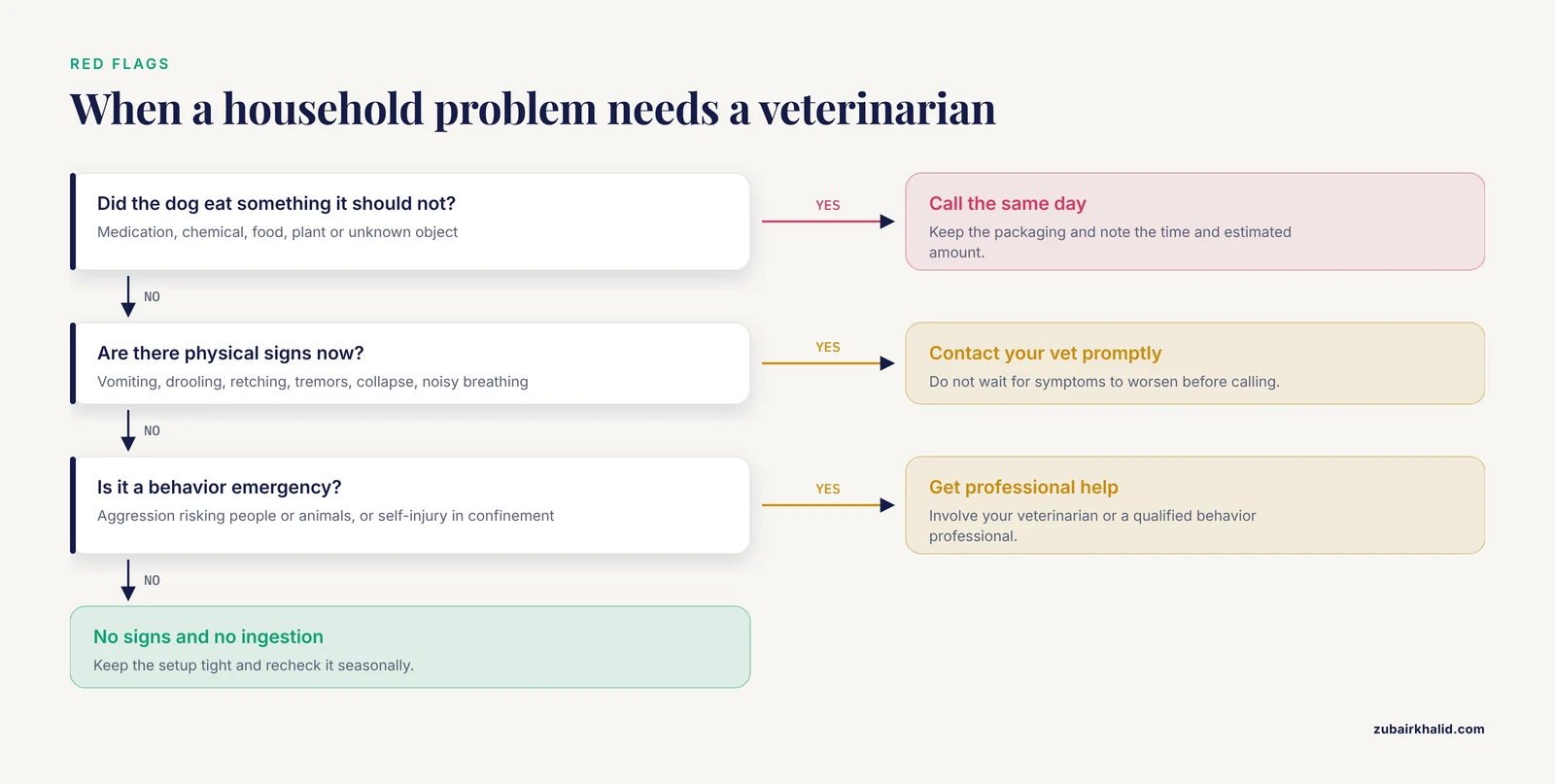
Individual cases vary, and your veterinarian is the one who knows your dog's history, health status, and temperament. Use this guide as a framework and confirm the details that depend on your specific dog.
Contact your veterinarian promptly, the same day, in these situations:
- Suspected ingestion of any medication, chemical, food, plant, or unknown object, even with no symptoms yet.
- Repeated vomiting, diarrhea, drooling, gagging, or unproductive retching.
- Tremors, seizures, stumbling, or collapse.
- Difficulty breathing, noisy breathing at rest, or extreme panting without heat or exertion.
- A distended or painful belly.
- Refusal of food or water.
- Any sudden behavior change, including disorientation or unusual hiding.
- Signs of heat stress, such as heavy panting, weakness, or bright red gums.
- Behavior emergencies, including aggression that risks people or animals, or self-injury during confinement.
Also involve your veterinarian in the setup itself for puppies, seniors, pregnant dogs, dogs with chronic disease, and flat-faced breeds, because confinement duration, temperature needs, and exercise limits all change with health status.
Frequently Asked Questions
How long does it take to dog proof a house?
A focused weekend covers the basics for most homes. Dog-proofing then becomes ongoing maintenance, because your dog's abilities, mobility, and your household contents keep changing.
What are the most common household dangers for dogs?
Human medications, cleaning products, toxic foods, certain plants, trash, electrical cords, and small swallowable objects top the list. Store every category out of reach and confirm item-specific questions with your veterinarian.
How do I dog proof a single room quickly?
Work at nose height, remove or lock up everything dangerous, add a gate or closed door, and provide water, bedding, and one chew. Then test with short supervised absences and adjust what the dog targets.
Should I crate my dog or allow free roam?
Match freedom to your dog's proven track record. Start with a small dog-proofed zone, expand gradually after clean supervised tests, and use a crate for short periods if your dog is relaxed in one. Never use the crate as punishment.
How do I know if my dog is too anxious to be left alone?
Pacing, drooling, escape attempts, destruction at doors or windows, and house soiling only when alone are common signs. Ask your veterinarian or a qualified behavior professional early, because anxiety responds better to early help.
Are some dogs harder to dog proof for?
Yes. Flat-faced breeds need extra attention to temperature and breathing, large or athletic dogs defeat weak barriers, and highly excitable dogs need a more structured confinement plan.
What should I do if my dog eats something it should not?
Contact your veterinarian or an animal poison hotline immediately, keep the packaging, and note the time and estimated amount. Do not wait for symptoms and do not induce vomiting unless a professional directs you.
How often should I recheck my dog-proofing?
Recheck after any change in routine, furniture, medications, or household members, and at least seasonally. Puppies, newly adopted dogs, and seniors need the most frequent reviews.
Sources
- Responsible Ownership and Welfare Indicators for Dogs and Cats in Rural Lithuania: Self-Reported Practices and In-Person Assessment.
- Stress in Free-Roaming and Shelter-Housed Dogs: A Review of Neurobiological, Physiological and Behavioral Mechanisms Relevant to Welfare Assessment.
- US Residents' Perceptions of Dog Welfare Needs and Canine Welfare Information Sources.
- Assessment of the welfare of breeding and boarding dog farms in the greater Cairo region: application of the Farm Quality Protocol (FQP).
- Importance of good husbandry in dog breeding establishments
- Behavioural Profile of Agility Dogs Using the Mini-CBARQ in Santiago de Chile.
- Welfare Under Transient Pressure: Rethinking Behavioral Assessments and Stress Mitigation for Shelter Dogs.
- Assessing affective states in domestic dogs through judgment bias tasks: a systematic review of methods, influencing factors, and welfare applications.
- 'Teleonomes in Tatters': The Welfare Costs of Selecting Dogs for Extreme Phenotypes, and the Case for Change.
- A solution right under our nose? Crossbreeding extreme brachycephalic dogs results in better health outcomes while preserving behavioural profiles and dog-owner relationship quality.
- Investigating targeted and untargeted approaches to biomarker discovery in fearful, adult dogs.