Water Conditioner for Well Water: Special Considerations
By Dr. Zubair Khalid, DVM, MS, PhD ·
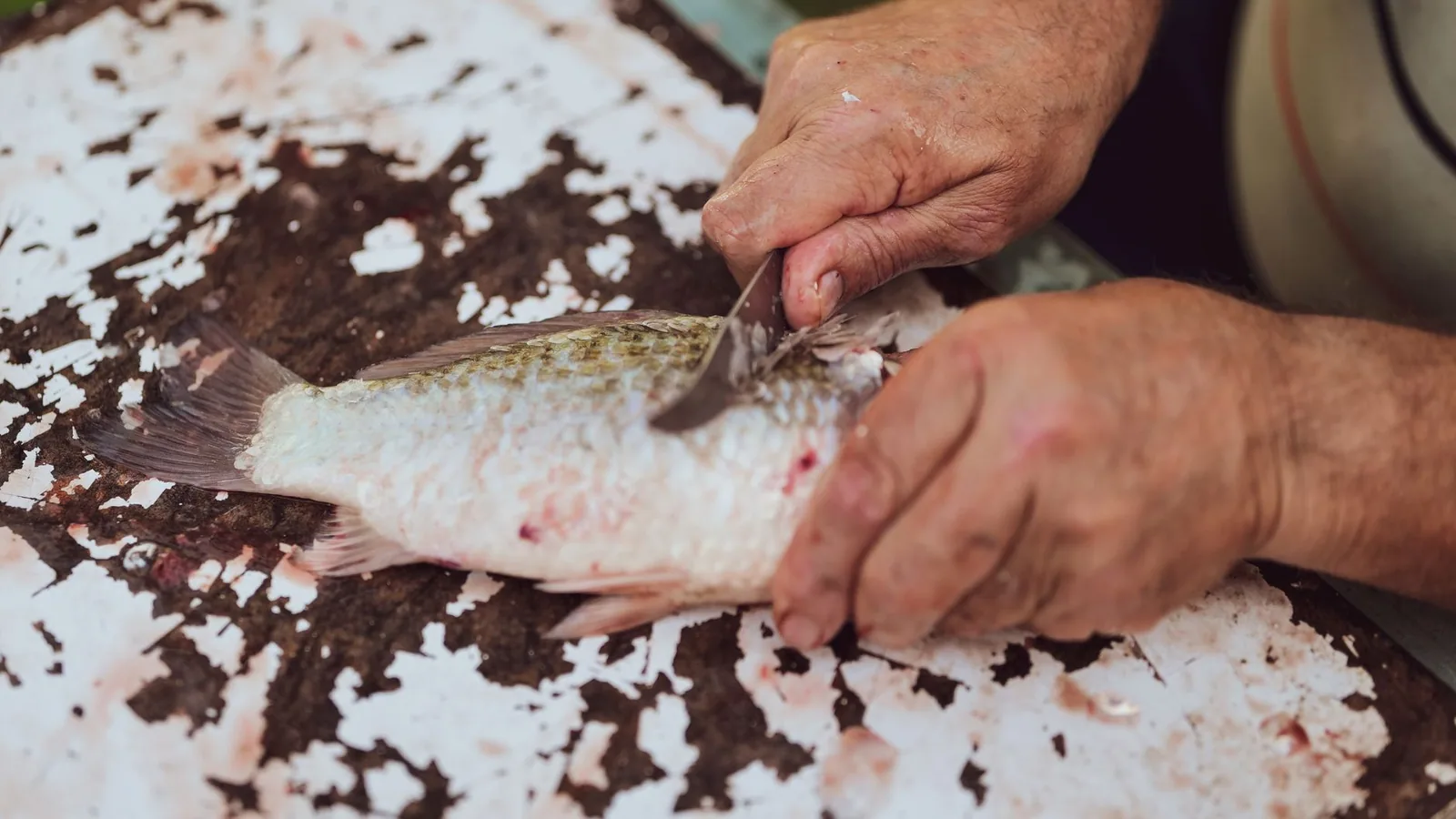
A water conditioner for well water must do more than remove chlorine. Well water contains no chlorine to begin with, but it often carries dissolved heavy metals, nitrogen compounds, iron, sulfur bacteria, and unstable gas levels that municipal tap water does not. A standard dechlorinator that neutralizes chlorine and chloramine will not fix those problems. A healthy well water aquarium starts with a full water test, a conditioner matched to what the test actually shows, and a conditioning routine that treats every drop of replacement water before it enters the tank.
This article explains what well water typically contains, why it causes problems in fish tanks, how to fix a well water aquarium step by step, and when the situation calls for an aquatic veterinarian. Aquatic veterinary guidance, including resources from the World Aquatic Veterinary Medical Association (WAVMA) and the Merck Veterinary Manual's pet fish section, consistently frames water quality as the first and most important variable in fish health. Well water owners simply have more variables to manage.
At a Glance: Your Well Water Aquarium Setup Checklist
| Step | Action | Why It Matters |
|---|---|---|
| 1 | Test raw well water for pH, hardness, iron, copper, nitrate, and dissolved gases | Well water chemistry varies by well and season, and problems are invisible to the eye |
| 2 | Match your water conditioner to your test results | Dechlorinators treat chlorine, which well water does not contain |
| 3 | Aerate and age replacement water in a separate container before use | Lets dissolved gases escape and stabilizes temperature and pH |
| 4 | Dose every water change according to the product label for your actual tank volume | Under-dosing leaves contaminants untreated, over-dosing wastes money and can harm fish |
| 5 | Use a fish tank calculator to convert tank dimensions to real water volume | Accurate volume drives accurate dosing |
| 6 | Maintain filtration and test the aquarium itself, not just the source water | Source water quality and tank water quality are two different measurements |
| 7 | Wash hands and equipment after tank maintenance | Aquarium water can carry organisms that infect both fish and people |
| 8 | Call an aquatic veterinarian for unexplained fish deaths or persistent water anomalies | Some well water problems require professional diagnostics |
What Makes Well Water Different
Municipal water is treated, tested, and adjusted to a relatively stable profile before it reaches your faucet. Well water comes straight from an aquifer, and its chemistry reflects the rock, soil, and any human activity surrounding your property. Two houses on the same road can draw water with very different mineral content, metal levels, and gas composition.
For a well water aquarium, that variability is the central challenge. Your fish are living in whatever the ground delivers, concentrated further by evaporation in the tank and altered by the biological processes of filtration. Every water change introduces a new dose of whatever your well produced that day.
Heavy Metals: The Problem You Cannot See
Heavy metals are natural components of the Earth's crust, and contamination through water is one of the most common exposure routes for both people and animals [1]. Elements such as lead, copper, iron, cadmium, and arsenic can enter well water from the surrounding geology, from aging plumbing, or from industrial and agricultural runoff [1].
These metals are toxic because of their high chemical reactivity. They form complexes with compounds inside cells, disrupting cellular pathways and leading to cell dysfunction, necrosis, and apoptosis, with the nervous, gastrointestinal, hematopoietic, renal, and dermatological systems as the main targets [1]. Fish absorb dissolved metals directly across their gills, so an aquarium filled with metal-contaminated water exposes fish continuously through their primary respiratory surface.
Cadmium is a documented example of how quickly this becomes a veterinary problem. In a tilapia culture system deliberately polluted with cadmium, the metal accumulated in the liver, gills, and muscle of the fish and produced measurable damage: elevated stress hormones, elevated liver and kidney enzymes, blood abnormalities, and cellular damage in hepatic and renal tissue [2]. Remediation with a specialized cadmium-adsorbing material reduced the metal load in the water and reversed many of those effects, which demonstrates both the severity of heavy metal exposure and the fact that it is treatable when the contaminant is identified and removed [2].
If your well test shows copper, lead, zinc, or cadmium, a standard water conditioner will not solve it. These problems require source treatment or alternative water, discussed below.
Nitrogen Compounds: Nitrate and Ammonia
Well water in agricultural areas frequently carries elevated nitrate, which leaches from fertilizer, septic systems, and animal waste. Nitrate toxicity is a recognized veterinary problem in livestock. A study of nitrate administration in calves tracked the resulting clinical signs, blood gas changes, and acid-base disturbances, confirming that nitrogen compounds in the water supply produce measurable physiological harm in vertebrates [3]. Fish are similarly exposed to nitrate through constant branchial contact, and aquarium nitrate also accumulates from fish waste on its own, so well water that starts high in nitrate sets your tank behind before the nitrogen cycle even begins.
Ammonia can also appear in some wells, particularly those influenced by septic or agricultural contamination. In the cadmium-polluted tilapia study referenced above, the treatment material reduced both cadmium and ammonia in the water, and ammonia reduction was itself associated with improved fish health markers [2]. The lesson for well water owners is that dissolved contaminants act together. Reducing one without measuring the others leaves fish sick.
Dissolved Gases and Oxygen
Groundwater under pressure can hold gases differently than surface water. Water drawn from a deep well may be low in dissolved oxygen or supersaturated with nitrogen or carbon dioxide, and both extremes stress fish. Dissolved oxygen monitoring is a well-established part of water quality assessment, and recent work has produced accessible colorimetric test devices validated on freshwater samples, including aquarium water, with detection limits low enough to be meaningful for fish keeping [4]. A dissolved oxygen reading from your raw well water tells you whether simple aeration will suffice or whether you need active gas correction.
Iron, Sulfur, and Bacterial Activity
Iron-rich well water stains fixtures orange and gives tank water a rusty or tea-colored tint. Sulfur-reducing bacteria produce the characteristic rotten egg smell of hydrogen sulfide. Neither is automatically lethal, but both signal that your aquifer delivers reduced, oxygen-poor water with active microbial chemistry, and both can complicate filtration and fish respiration. These conditions also explain why some well water aquariums develop persistent bacterial film or unexplained low oxygen despite clear appearance.
Iodine and Trace Element Gaps
Water chemistry affects more than gills and kidneys. Thyroid disorders in fish, including follicular cell hyperplasia (goiter), adenoma, and carcinoma, have been documented in aquarium-housed fish, and the resolution of thyroid hyperplasia in that case series was associated with changes in water treatment and the addition of potassium iodide to the feed [5]. Well water with unusual mineral content, including iodine deficiency or excess, can contribute to endocrine and developmental problems in fish over time. This is one more reason the full water panel matters before you stock the tank.
Why Standard Conditioners Fall Short in a Well Water Aquarium
Most commercial water conditioners are formulated against municipal water problems. They neutralize chlorine and chloramine, bind some heavy metals, and often claim to detoxify a limited amount of ammonia. In a well water aquarium, the primary issues are different:
- There is usually no chlorine to remove, so the main active function of a dechlorinator is irrelevant.
- Heavy metal binding capacity in typical conditioners is designed for trace amounts from plumbing, not for well water with genuinely elevated metal content.
- Nitrate is not removed by standard conditioners at all.
- Dissolved gas imbalances are physical problems that no chemical conditioner corrects.
- Well water can fluctuate seasonally, so a conditioner dose that worked in March may be wrong in September.
The solution is not a bigger dose of the same product. The solution is matching the conditioner and the broader treatment approach to the measured chemistry of your specific well.
How to Fix a Well Water Aquarium: Step by Step
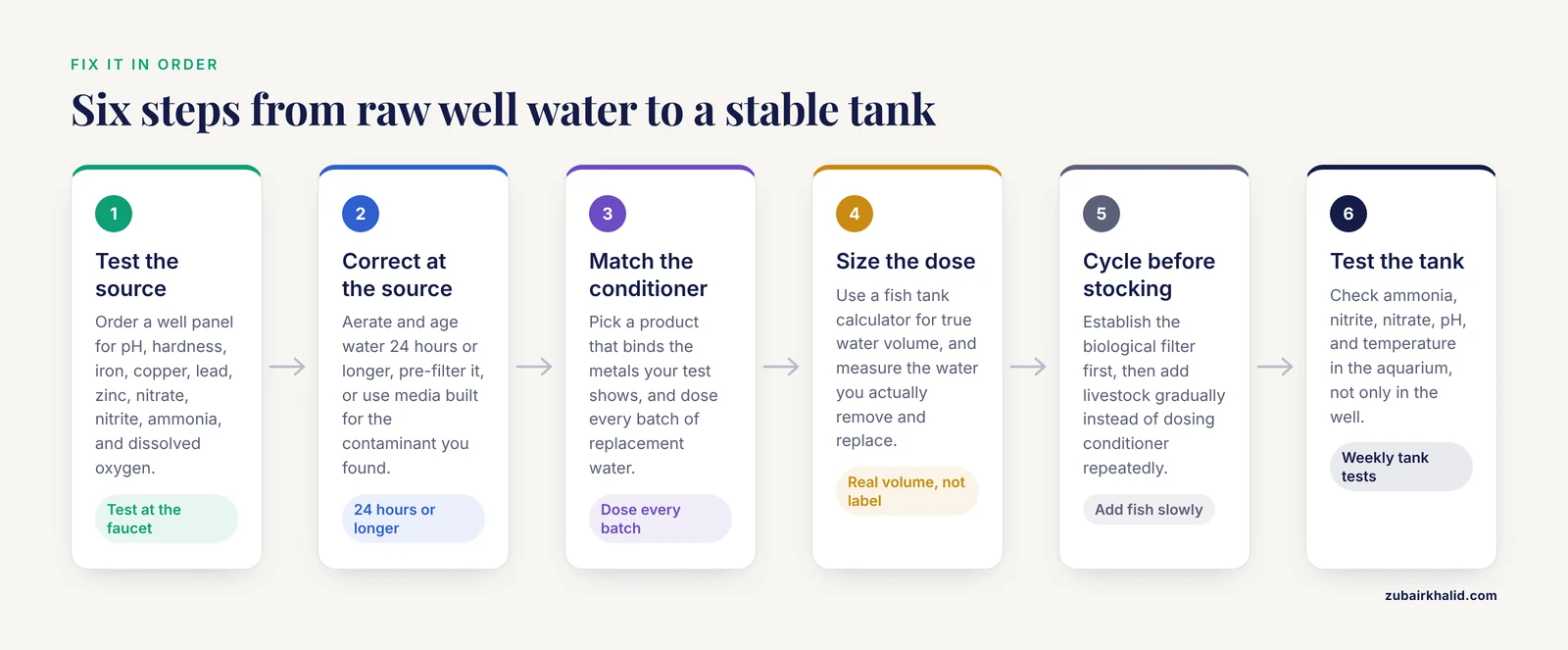
Step 1. Test the Source Water Before It Touches the Tank
Order a well water panel that includes pH, total hardness and alkalinity, iron, copper, lead, zinc, nitrate, nitrite, ammonia, and total dissolved solids. Add a dissolved oxygen check, which can now be done with inexpensive colorimetric devices validated for aquarium water [4]. Test again after seasonal changes, because aquifer chemistry shifts with rainfall, pumping patterns, and time.
Test the water coming out of your faucet, not just the wellhead, so the results include anything leaching from your plumbing. Copper from pipes is a common and fish-relevant contaminant that appears between the well and the tank.
Step 2. Correct What You Can at the Source
Well water aquarium solutions fall into two tiers. Tier one is point-of-use treatment for the aquarium only. Tier two is whole-house treatment, which is worth discussing with a water treatment professional if the well itself is compromised.
For the aquarium, the practical options include:
- Aeration and aging. Fill a dedicated, clean container with well water, run an air stone in it for 24 hours or longer, and let it reach room temperature. This drives off excess dissolved gases and raises low dissolved oxygen, addressing the physical problems that no conditioner touches.
- Filtration of replacement water. A pre-filter or carbon block on the fill line reduces particulates and some dissolved organics. Filtration in the aquarium itself remains the backbone of water quality. Research in zebrafish larvae showed that simply moving animals into a larger volume of filtered, recirculating water improved survival, activity, and water quality compared with unfiltered housing [6]. The same principle applies at home: filtered, stable water outperforms stagnant water regardless of source.
- Contaminant-specific media. If your test shows a specific dissolved contaminant, select media or treatment designed for that contaminant rather than a general conditioner. The cadmium study demonstrates the concept: a targeted adsorptive material bound the contaminant, lowered its concentration in water and fish tissue, and reduced the associated toxic effects [2]. The commercial products available to hobbyists differ from research materials, but the principle of contaminant-specific treatment holds.
- Alternative water. If the well delivers metals or nitrate at levels you cannot economically treat, using a different water source for the aquarium, conditioned and matched to your parameters, is a legitimate and often simpler solution.
Step 3. Choose and Dose a Water Conditioner for Well Water
Once you know your water profile, select a conditioner for the problems it actually shows:
- If your water contains detectable dissolved heavy metals, choose a conditioner that explicitly binds heavy metals, and dose according to the label for your true water volume.
- If your well water is untreated with chlorine but picks up metals from plumbing, a metal-binding conditioner still has a role.
- If you chlorinate your well system periodically, as some owners do, you need dechlorination after each treatment event before any water enters the tank.
- If your conditioner claims to neutralize ammonia or nitrite, understand that this is an emergency tool, not a substitute for established biological filtration.
Follow the manufacturer's dosing instructions for the measured volume of water, and dose every batch of replacement water, not just the initial fill. There is no universal dose for well water because there is no universal well.
Step 4. Size Your Treatment Correctly with a Fish Tank Calculator
Dosing errors are among the most common mistakes in well water aquariums, and they usually come from one assumption: that the tank holds what the label says. A "55 gallon" tank with substrate, rock, and a sump holds a different volume of water than 55 gallons of glass capacity.
A fish tank calculator converts your tank's dimensions into actual water volume, and most will also subtract displacement from substrate and decorations. Use one to determine:
- True water volume, which drives conditioner dosing.
- Total system volume including sumps and filters, which matters for dosing entire systems.
- Replacement water volume, which matters for dosing water changes.
Measuring the water you actually remove and replace during a water change, using a bucket or a marked container, is the most reliable method for change-specific dosing.
Step 5. Build the Biological Foundation Slowly
An aquarium is not just water, it is a filtration system full of bacteria that process fish waste. Established filtration measurably improves water quality and animal outcomes in controlled settings [6]. Well water that arrives clean still becomes ammonia-laden once fish are added, so the nitrogen cycle must establish in the tank regardless of source water quality.
Cycle the tank before adding fish, add livestock gradually, and resist the urge to correct early instability with repeated conditioner dosing. Conditioners bind or neutralize, they do not remove, and the biological filter remains the permanent solution.
Step 6. Test the Tank, Not Just the Well
Source water testing tells you what enters the tank. Aquarium testing tells you what the fish actually live in. Both matter. Ammonia, nitrite, nitrate, pH, and temperature in the aquarium are the parameters that drive day-to-day fish health, and they diverge from source water values as soon as fish, food, and filtration begin acting on the water.
A Practical Aquarium Care Checklist for Well Water Owners
Use this recurring checklist as your baseline routine:
- Test raw well water monthly for pH, hardness, nitrate, and any metal flagged on your initial panel.
- Test aquarium water weekly for ammonia, nitrite, nitrate, and pH.
- Age and aerate all replacement water before use.
- Condition every batch of replacement water at label dose for the measured volume.
- Perform partial water changes on a consistent schedule rather than reacting to problems.
- Siphon debris from the substrate during water changes.
- Rinse mechanical filter media in removed tank water, never tap or well water, to preserve bacteria.
- Track test results in a log so seasonal well changes become visible.
- Observe fish at feeding time daily, since appetite and behavior changes are early illness signals.
- Wash and dry hands after every maintenance session.
Common Mistakes in Well Water Aquariums
Treating symptoms instead of testing. Adding conditioner repeatedly because fish look stressed, without knowing what is actually in the water, wastes money and delays real diagnosis. Test first, then treat.
Assuming potable means aquarium-safe. Water that meets human drinking standards can still be unsuitable for fish. Humans do not breathe their water through gills, and drinking standards were not written with fish in mind.
Underestimating plumbing contamination. A clean well test paired with fish problems may mean copper or other metals are entering the water between the well and the tank. Test at the faucet.
Skipping the aging step. Freshly drawn well water can be oxygen-poor or gas-supersaturated. Aging with aeration costs one evening and prevents a range of respiratory and buoyancy problems.
Dosing to tank label volume. Real water volume is almost always lower than nominal capacity. Use a fish tank calculator and measure change volumes directly.
Ignoring hand hygiene. Aquarium water is not just a fish environment. Mycobacterium szulgai, a mycobacterial species capable of causing human infection, has been isolated from a patient, from a tropical fish, and from the aquarium water in the same case, linking the tank environment directly to human disease [7]. In a separate documented case, Aeromonas sobria isolated from an infant's stool was also isolated from the household aquarium water, which was suspected as the source of a severe infection [8]. These cases justify a simple rule: gloves for deep cleaning, and handwashing after every tank contact.
Troubleshooting Persistent Problems
Fish gasping at the surface after water changes. Fresh well water may be low in dissolved oxygen or high in dissolved gas. Age and aerate replacement water longer, and consider a dissolved oxygen test on both source and tank water [4].
Recurrent ammonia or nitrite spikes despite conditioning. The biological filter is underdeveloped or has been damaged. Reduce feeding, confirm filtration is running and oxygenated, and retest rather than adding more conditioner.
Persistent illness or growth abnormalities in fish. Unexplained masses, wasting, or developmental problems warrant veterinary evaluation. Thyroid tumors and hyperplasia have been documented in aquarium fish and were associated with water treatment practices and iodine availability in the reported case series [5]. An aquatic veterinarian can pursue diagnostics beyond what water testing alone reveals.
Visible metal stains or unusual water color. Iron, manganese, or tannins from well plumbing can produce discoloration. Confirm with a water test rather than assuming, because color does not distinguish harmless from harmful causes.
Unexplained fish losses in an otherwise clean system. Broaden the investigation to the well. Seasonal changes in aquifer chemistry, nearby agricultural activity, and pump or pressure tank degradation can change water composition between tests. Document what changed and when, and share that timeline with your veterinarian.
Welfare and Safety Considerations
Fish welfare depends on stable water, appropriate space, compatible tankmates, and protection from chronic sublethal exposure. Chronic heavy metal exposure damages multiple organ systems in vertebrates [1], and contaminated aquarium water measurably harmed fish health in the tilapia study before remediation [2]. Sublethal exposure does not always kill quickly. It suppresses immunity, impairs growth, and predisposes fish to secondary infection, which is why prevention through water management matters more in fish than almost any other companion animal.
Human safety matters too. The documented links between aquarium water and human pathogens, including mycobacteria and Aeromonas species, support routine hygiene around tank maintenance, especially in households with children, elderly family members, or immunocompromised individuals [7] [8].
Limitations and When to Contact a Veterinarian
This article provides educational guidance for well water aquarium management and is not a substitute for veterinary diagnosis or treatment. Individual wells, individual tanks, and individual fish vary, and a veterinarian who examines your system can interpret your specific findings.
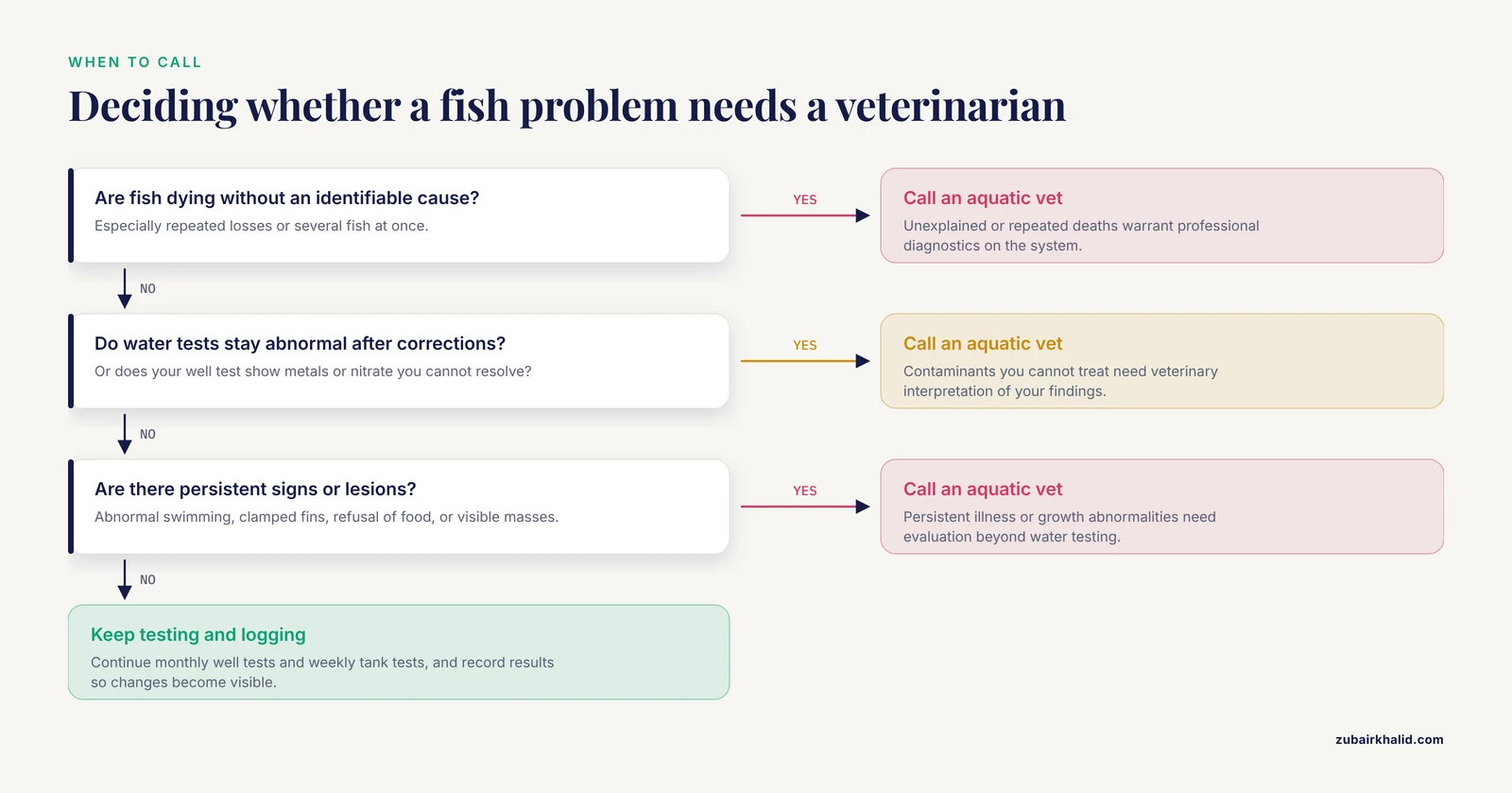
Contact an aquatic veterinarian when:
- Fish die without an identifiable cause, especially in numbers or repeatedly.
- Fish show persistent abnormal swimming, respiration, clamped fins, refusal of food, or visible lesions.
- Water tests remain abnormal despite corrective measures, or your well test shows heavy metals, nitrate, or other contaminants you cannot resolve.
- Household members develop unexplained skin lesions or gastrointestinal illness with possible tank exposure, and consult a physician as well. Documented cases have linked aquarium water to human infections with Mycobacterium and Aeromonas species [7] [8].
- You are planning medication use, because treatment dosing and drug choices in fish require professional guidance.
The WAVMA maintains a directory of aquatic veterinary professionals, and the Merck Veterinary Manual's pet fish resources and AVMA aquatic animal health guidance provide additional background on when professional involvement improves outcomes.
Frequently Asked Questions
Can I use well water in an aquarium without treating it?
You can sometimes, but you should never assume so. Well water chemistry varies widely by aquifer, season, and plumbing, and contaminants such as dissolved heavy metals and nitrogen compounds are invisible without testing. Test the water first, then treat or amend based on what the test shows.
What does a water conditioner for well water actually do?
It depends on the formulation. Most standard conditioners neutralize chlorine and chloramine and bind small amounts of heavy metals, which addresses plumbing contamination but does nothing for nitrate, dissolved gases, or genuinely elevated metal levels in the well itself. Match the conditioner to your water test rather than buying based on general claims.
How long should well water sit before adding it to an aquarium?
Aerate replacement water in a clean container with an air stone for at least 24 hours before use. This drives off excess dissolved gases, raises low dissolved oxygen, and lets the water reach room temperature. Longer aging is reasonable for deep wells with known gas issues.
Why do my fish keep dying even though my well water is safe to drink?
Drinking water standards protect humans, not fish. Fish live in continuous gill contact with dissolved contaminants, and metals such as cadmium and copper cause documented organ damage in fish at levels that may not concern a human drinker. Test specifically for fish-relevant parameters and compare them against aquarium-appropriate ranges.
Does boiling well water make it safe for fish?
Boiling drives off chlorine and some volatile gases but does not remove dissolved heavy metals or nitrate, and it can concentrate dissolved solids as water evaporates. Boiling is not a substitute for proper testing and conditioning.
How often should I test my well water for my aquarium?
Test raw well water monthly at minimum, and immediately after any event that could change the aquifer or your plumbing, such as heavy flooding, nearby construction, well service, or new plumbing work. Seasonal shifts in well chemistry are common and justify more frequent testing in the first year.
Can aquarium water make people sick?
It can in specific circumstances. Mycobacterium szulgai and Aeromonas sobria have each been isolated from both infected people and the aquarium water in their households, linking tank water to human disease. Wear gloves during deep cleaning and wash hands after any tank contact, particularly if someone in the home is immunocompromised.
When should I call a veterinarian about my well water aquarium?
Call an aquatic veterinarian when fish die without explanation, when illness persists despite water corrections, when your well test shows contaminants you cannot resolve, or before starting any medication. A veterinarian can also help interpret a history of changing water quality over time.
This article is educational and is not a substitute for veterinary diagnosis or treatment.
Sources
- Clinical and Forensic Signs Resulting from Exposure to Heavy Metals and Other Chemical Elements of the Periodic Table
- Nanoremediation of tilapia fish culture using iron oxide nanoparticles biosynthesized by Bacillus subtilis and immobilized in a free-floating macroporous cryogel.
- Clinical signs, blood gases and acid-base balance after nitrate administration in calves
- Capillary Flow-Driven, Disposable Device for Dissolved Oxygen Sensing in Water Samples.
- Follicular Cell Hyperplasia (Goitre), Adenoma and Adenocarcinoma of the Thyroid Gland in Fourlined Terapon (Pelates quadrilineatus): Clinical and Histopathological Study: 2022-2023.
- Filtered aquatic small tubular mesh-bottomed containers (FAST-MC): A low-cost, efficient method for rearing zebrafish larvae in filtered water.
- Mycobacterium szulgai Isolated from a Patient, a Tropical Fish and Aquarium Water
- Acute Renal Failure in an Infant Associated with CytotoxicAeromonas sobria Isolated from Patient's Stool and from Aquarium Water as Suspected Source of Infection