How to Choose the Right Sponge Filter Size
By Dr. Zubair Khalid, DVM, MS, PhD ·
Sponge filter sizes differ in two ways that matter to your fish: how much porous surface the foam offers to beneficial bacteria, and how much water the airlift can pull through it each hour. The working rule for sponge filter size selection is simple. Buy the size rated for your tank volume, then step up one rating band or add a second unit whenever stocking is dense, fish are messy, or fish are still growing toward adult size. Extra biological capacity forgives husbandry lapses. Too little capacity lets ammonia climb.
A sponge filter is a block of open-cell foam fitted around a vertical lift tube. An air pump feeds an airstone at the base, and the rising bubble column drags water up the tube and through the surrounding foam. The foam traps particles and hosts a biofilm of bacteria that process fish waste. The word sponge appears in other branches of science, including genetics, where researchers use it for RNA molecules that soak up microRNAs [1]. In fishkeeping, the term means this simple foam block, and in many tanks it is the only filtration the fish will ever need.
This guide explains what size actually controls, compares the main sizing options side by side, walks through real stocking scenarios, and closes with a maintenance checklist and clear signs that call for professional help.
This article is educational and is not a substitute for veterinary diagnosis or treatment.
What Size Actually Controls
Every submerged surface in an aquarium grows a bacterial film. On filter foam, that film is the working part of the filter. Bacteria in the biofilm convert ammonia, the toxic end product of fish waste and decaying food, into nitrite and then into nitrate. The foam protects and houses this community, and its volume sets how much waste the community can process before the tank outgrows it.
Porous, filter-feeding structures are prime bacterial real estate in nature. In the ocean, sponges and similar filter-feeding animals harbor dense communities of bacteria that break down tough organic polymers, including chitin, the material that forms shrimp and crayfish shells, and researchers describe these structures as hotspots for that turnover [2]. Aquarium foam works on the same logic. The biofilm on the pore surfaces processes dissolved waste, and molts and other chitinous debris become food for heterotrophic members of the film.
That film is also metabolically diverse. In one study of the bacteria associated with a carnivorous marine sponge, researchers cultured 67 isolates, some from specimens kept in aquaria, and about 16 percent of the isolates showed chitin-degrading activity, with smaller shares producing antimicrobial or antioxidant compounds [3]. A sponge filter's biofilm is a living community, not an inert strainer.
Size governs three outcomes:
- Capacity. Foam volume sets the ceiling on bacterial housing and on how much trapped waste the unit can hold between cleanings.
- Service interval. Larger, coarser foam keeps flowing longer before it clogs.
- Flow character. The air supply, not the foam alone, sets how much water moves and how gently.
An undersized filter fails quietly. Ammonia and nitrite creep upward over days to weeks as waste production outgrows the biofilm, long before anything looks wrong in the water. An oversized filter rarely causes harm, because a biofilm grows to match the waste actually reaching it.
Sponge Filter Size Selection at a Glance
Two tables cover the decision. The first compares the sizing options you will face at the store so you can weigh the pros and cons before you buy. The second maps common tank situations to a setup. Manufacturer ratings vary by brand, so treat the gallon bands as guides rather than promises.
| Sizing option | Typical rating band | What it does well | Trade-offs | Best fit |
|---|---|---|---|---|
| , - | , - | , - | , - | , - |
| Small or mini unit | Up to about 10 gallons | Gentle flow, fits tight quarters, fry-safe, inexpensive | Little spare capacity, clogs sooner | Bettas, shrimp, fry, hospital tanks |
| Medium unit | About 10 to 20 gallons | Balanced capacity and footprint, easy to place | Single point of failure | Standard community tanks |
| Large or double-stack unit | About 20 to 40 gallons and above | Large bacterial housing, long service intervals, absorbs messy fish | Footprint, higher air demand, possible current | Heavily stocked or messy tanks |
| Two or more medium units | Scaled to the tank | Redundancy, distributed flow, one unit stays online while the other is cleaned | More airline, valves, and cleaning touchpoints | Breeding tanks and displays holding irreplaceable fish |
| Large unit alongside a canister or hang-on-back | Matched to the display tank | Adds biological capacity and emergency cover, protects fry | Not a substitute for mechanical turnover on big tanks | Community tanks of 40 gallons and above |
| Tank situation | Suggested setup | Foam pore type | Why it works |
|---|---|---|---|
| , - | , - | , - | , - |
| Betta or shrimp nano, 5 to 10 gallons | One small unit on an adjustable valve | Medium to coarse | Low current, plus a grazing surface for shrimp |
| Fry or breeding tank | One or two small units spread across the tank | Fine to medium | No impeller intake, biofilm for grazing, gentle distributed flow |
| 10 to 20 gallon community | One medium unit | Layered coarse to fine | Balanced capacity with light polishing |
| 20 to 40 gallon community or breeding livebearers | One large unit, or one medium now and a second as numbers climb | Coarse outer face, finer inner layer | Headroom for population growth |
| 55 gallon-plus community | Two large units, or one large alongside the main filter | Coarse | Distributed flow and a shared biological load |
| Goldfish or large cichlids | Multiple coarse-pore units on sturdy bases | Coarse | Heavy waste loads and digging behavior |
| Quarantine or hospital tank | One medium unit kept seeded in an established tank | Medium | Cycled filtration ready the day it is needed |
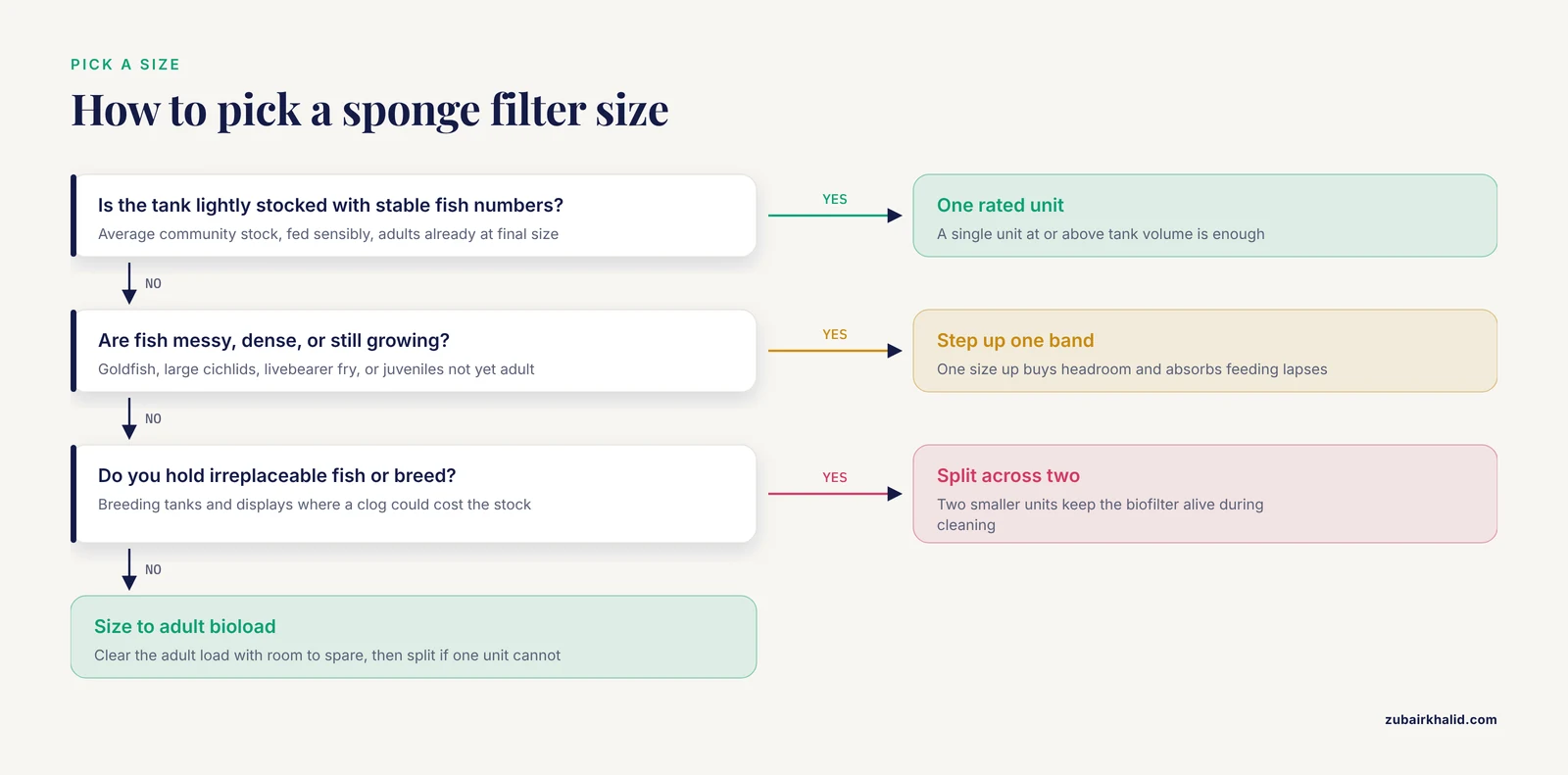
The best sponge filter size selection clears your tank's adult bioload with room to spare. If one unit cannot do that, split the job across two. Redundancy matters most in tanks holding irreplaceable fish. Headroom matters most in tanks where populations grow.
Sizing Options, Pros and Cons
Every sponge filter size selection option on the market reduces to one of four strategies. Each has a place, and the pros and cons below decide which one fits your tank.
One filter rated to your tank
A single unit rated at or above your tank volume suits lightly to moderately stocked community tanks with stable populations. The pros are low cost, one airline, and one item to maintain. The cons are the absence of a backup if the foam clogs or the pump fails, and no headroom if you add fish later.
One size up
Stepping up one rating band buys headroom, and headroom is the cheapest insurance in fishkeeping. A biofilm grows to match the waste reaching it, so surplus surface area simply stands ready rather than causing harm. The extra capacity absorbs feeding lapses, new arrivals, and medication periods. The cons are cost, footprint, higher air demand, and occasionally more current than weak swimmers tolerate. An adjustable valve solves the current issue for bettas and other slow fish.
Two or more smaller filters
Splitting capacity across units trades a little convenience for a lot of resilience. If one foam clogs, the other keeps the biofilter alive while you rinse. You can clean one unit at a time and never take the whole filter offline. You can also keep a seeded spare running in another tank, ready to move at a moment's notice. The cons are more airline, more valves, and more cleaning touchpoints.
Primary versus supplemental
On nano and medium tanks, a correctly sized sponge filter can be the only filter the tank needs. On larger or heavily stocked tanks, sponges usually work alongside a canister or hang-on-back filter, contributing biological capacity, gentle circulation, and fry protection. In that role, think of the sponge as biofilter and insurance rather than as a replacement for mechanical turnover.
How to Size by Bioload, Not Just the Gallon Rating
Read the rating as a floor
Manufacturer gallon ratings assume an average community stock fed sensibly. They describe a starting point, not a promise. Real demand depends on factors the box cannot see:
- Adult size and mass of the fish. A tank of juveniles today is a tank of adults within a year, and the filter must fit the adults.
- The number of mouths, plus how much and how often you feed. Overfeeding is the most common reason a correctly rated filter starts to fall behind.
- Species messiness. Goldfish, large cichlids, and bottom sifters move far more waste per inch of body than small tetras do.
- Plant mass. Live plants absorb nitrate and buy the system slack.
- Water change frequency, which sets how much help the filter gets each week.
Run your stocking plan through a fish tank calculator before you buy. Most stocking calculators estimate adult size and waste load, which is exactly the number your filter has to handle. If the calculator flags your plan as heavily stocked, treat the manufacturer rating as a floor and size up.
Match the air pump
Moving water through filter media costs energy at every scale. Researchers tracking whale sharks, the largest filter-feeding fish, documented increased swimming effort during filter feeding, with sharks raising their stroke rate and amplitude at the surface while still maintaining high foraging efficiency [4]. An air pump pays that price in miniature every hour it runs. A large, fine-pored sponge starved of air will underperform a right-sized sponge on a matched pump.
Check three things when pairing pump and filter. The bubble column should be even and vigorous, with a steady stream leaving the top of the lift tube. Deeper tanks need more pressure to push air down to the airstone. Use a gang valve to feed multiple units from one pump, and fit a check valve so a power cut cannot siphon water into the pump.
Choose the pore structure
Porous materials reward close study. In particle therapy research, physicists measure how ion beams pass through porous foams and find the effect depends on the microscopic pore structure, density, and thickness of the material rather than its outside dimensions alone [5]. Aquarium foam obeys the same broad principle. Two sponges with identical footprints can differ enormously in usable surface area, open volume, and clogging behavior.
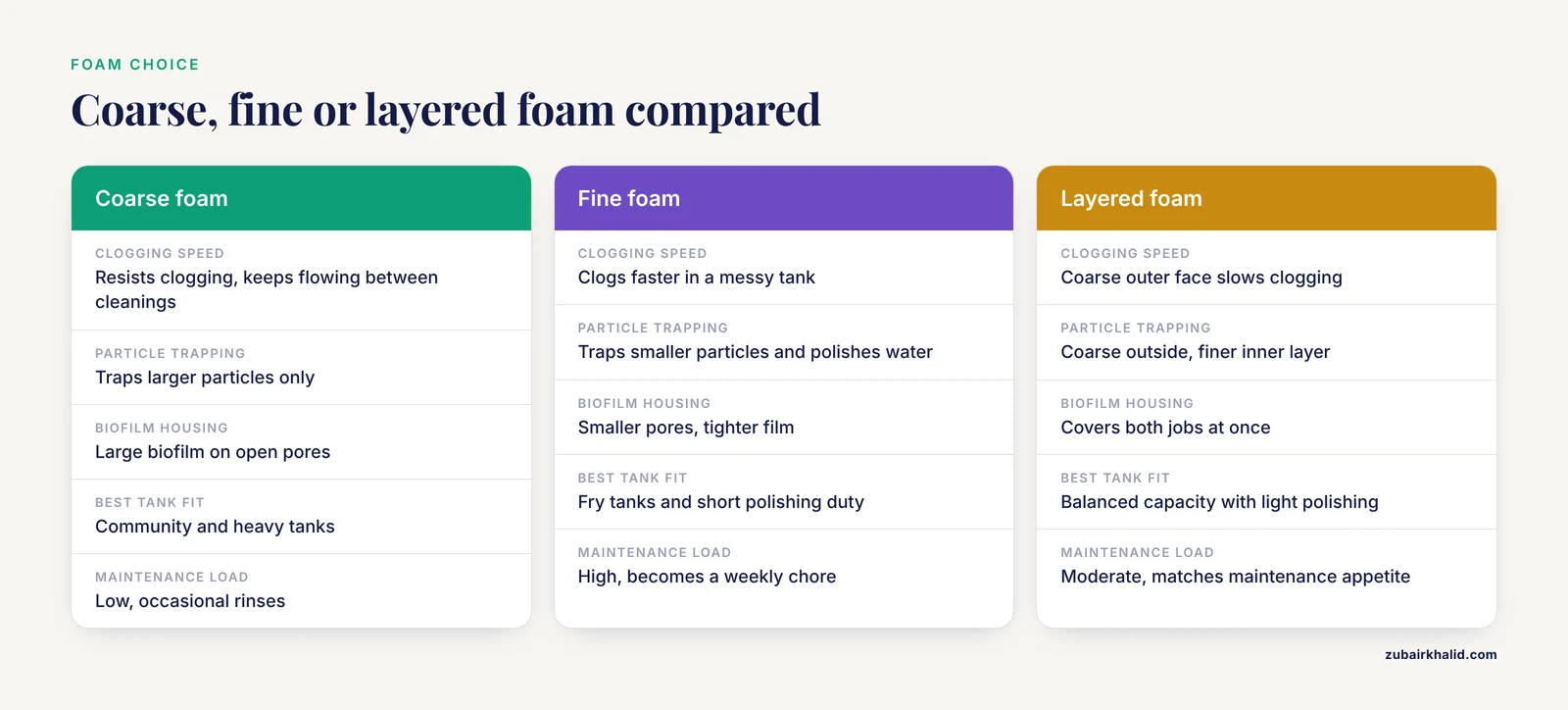
Coarse foam, with larger pores, resists clogging, holds a large biofilm, and keeps flowing between cleanings. It is the default for community and heavy tanks. Fine foam traps smaller particles and polishes water but clogs faster, which suits fry tanks and short polishing duty. Layered designs pair a coarse outer face with a finer inner layer and cover both jobs. Match the pore choice to your maintenance appetite, because a fine-pored sponge in a messy tank becomes a weekly chore.
Worked Scenarios
Numbers on a box mean little until they meet a real tank. These five scenarios show the decision logic in action.
A single betta in a planted 5 gallon
Choose one small unit with medium pores on an adjustable valve. Turn the valve until the surface shimmers rather than ripples. Light stocking and live plants leave plenty of slack, so capacity is comfortable. Rinse the foam in removed tank water when the bubble column weakens.
Breeding Endler's livebearers in a 20 gallon long
Start with one medium unit and add a second medium when the population climbs. The sponge design itself protects fry, since there is no impeller intake to draw them in, and the biofilm gives them a grazing surface. Plan the second unit before you need it, because livebearer populations grow fast.
A 75 gallon mbuna tank already running a canister
Add two large coarse-pore sponges at opposite ends of the tank. They share the biological load, polish particulate waste the canister misses, and give fry a fighting chance. Sink the bases into stable positions among the rockwork, because cichlids redecorate.
A 10 gallon shrimp tank
Choose one small coarse-pore unit. Shrimp graze the biofilm, so never scrub the foam clean, and avoid treatments in the display tank casually. Coarse pores keep mulm from choking the flow, and the gentle current suits molting shrimp.
A quarantine tank set up only when needed
Keep one medium sponge running permanently in a display tank or sump. When a quarantine tank is needed, move the seeded sponge with the fish, and the biofilter moves with it. Size the spare to match the bioload of the fish most likely to pass through quarantine.
Common Mix-Ups
These mistakes account for most sponge filter failures:
- Sizing to water volume while ignoring adult fish size. Juveniles grow, and the filter must fit the fish you will own.
- Pairing a large fine-pored sponge with an undersized pump. The foam never sees its rated flow.
- Choosing fine foam throughout a heavy tank, then fighting clogs every few days.
- Rinsing foam under hot tap water, using soap, or replacing it on a calendar. Each erases the biofilm you invested cycle time in. Rinse in removed tank water, and only when flow drops.
- Assuming a new sponge arrives cycled. It does not. Seed it from an established filter or cycle it before adding sensitive fish.
- Trusting the gallon rating on a heavily stocked tank. Ratings assume average stocking and average feeding.
- Letting debris blanket the foam or blocking the top of the lift tube, which starves the whole unit of flow.
An Aquarium Care Checklist for Sponge Filter Owners
Use this aquarium care checklist alongside your regular water change routine. The whole list takes minutes.
- Watch the bubble column at feeding time. Weak, uneven, or silent flow points to a clogged foam, a clogged airstone, or an airline problem.
- Test ammonia and nitrite weekly in any new, resized, or recently treated tank, and after adding fish.
- During water changes, squeeze and swish the foam in the removed tank water, and only when flow has visibly dropped.
- Keep soap, hot water, and disinfectants far away from the foam.
- Check the airline, check valve, and gang valve monthly for cracks, kinks, and algae.
- Log cleaning dates and test results on a note near the tank so trends are visible.
- Keep a seeded spare sponge running in an established tank for emergencies and hospital use.
- After any treatment period, keep testing until ammonia and nitrite read consistently undetectable.
Limitations and When to Contact a Veterinarian
Individual cases need a veterinarian, and the rules of thumb in this article are starting points rather than prescriptions. Stocking density, water source, feeding habits, and underlying fish health all shift the right answer for a given tank.
Contact an aquatic veterinarian or an experienced fish health professional if any of the following occur:
- Ammonia or nitrite reads detectable on any test.
- Fish gasp at the surface, hover at the filter outflow, or breathe rapidly.
- Gills look inflamed, pale, or ragged, or fish flash and scrape against decor.
- Fish stop eating, hide constantly, or hold clamped fins for more than a day.
- Unexplained deaths occur, or several fish sicken at once.
- Water stays cloudy despite a working filter while fish show distress.
The World Aquatic Veterinary Medical Association maintains a directory for locating a fish veterinarian, and organizations such as the AVMA and the Merck Veterinary Manual publish pet fish resources that help owners describe water quality problems accurately. Bring your test results, stocking list, and filter details to the appointment.
This article is educational and is not a substitute for veterinary diagnosis or treatment.
Frequently Asked Questions
Can a sponge filter be too big for a tank?
Rarely. A biofilm grows to match the waste available, so surplus foam mostly stands ready. The practical downsides are current that bothers weak swimmers, lost aquascape space, and higher air demand. An adjustable valve turns an oversized filter into a luxury rather than a problem.
What size sponge filter do I need for a 10 gallon tank?
A single medium unit rated around 10 gallons handles a lightly to moderately stocked 10 gallon community tank. Step up to a large unit or add a second small one for heavy stockers or breeding livebearers.
Do I really need one sponge filter for every 10 gallons?
No. The one-per-ten-gallons convention is a starting point, not a law. Bioload decides. A lightly stocked 20 gallon can run comfortably on one medium unit, while a crowded 10 gallon needs more.
How long does a new sponge filter take to cycle?
A new sponge filter takes several weeks to cycle on its own, and much faster when seeded with media or tank water from an established filter. Test ammonia and nitrite, and wait until both read consistently undetectable before adding sensitive fish.
Is a bigger sponge filter better than a hang-on-back filter?
They do different jobs. Sponge filters deliver gentle flow, large biological capacity, and fry-safe intakes. Hang-on-back filters move more water and handle mechanical cleaning on larger tanks. Ratings do not translate between the two, and many keepers run both.
How often should I clean a sponge filter, and does size change that?
Clean when flow drops, not on a calendar, and rinse only in removed tank water. Large coarse-pored sponges go longer between cleanings, while small fine-pored units need more frequent attention in busy tanks.
Sources
- Genome-wide identification of clusters of predicted microRNA binding sites as microRNA sponge candidates.
- Selection of marine bacterial consortia efficient at degrading chitin leads to the discovery of new potential chitin degraders.
- Exploring cultivable Bacteria from the prokaryotic community associated with the carnivorous sponge Asbestopluma hypogea.
- Whale sharks increase swimming effort while filter feeding, but appear to maintain high foraging efficiencies.
- Modulation power of porous materials and usage as ripple filter in particle therapy.