Signs of Stress in Community Fish and How to Help
By Dr. Zubair Khalid, DVM, MS, PhD ·
Stressed community fish announce trouble through behavior and body condition long before they stop eating or die. The most common signs of stress in community fish are clamped fins, hiding, refusal of food, rapid gill movement, gasping at the water surface, faded or darkened color, flashing against decor, and uncharacteristic aggression or submission. The most effective first response is husbandry, not medication. Test the water, stabilize temperature and oxygen, remove crowding and aggression, and give the tank stability. Bring in a veterinarian who treats fish when signs persist after the water is corrected, when several fish are affected at once, or before any medication goes into the tank.
Owner triage in the first five minutes:
- Watch the gills. Rapid breathing or gasping at the surface is the most urgent sign in the room.
- Test the water. Ammonia, nitrite, nitrate, pH, and temperature explain more than any visual exam.
- Count who is affected. One fish points toward aggression or individual disease. The whole tank points toward water or environment.
- Add nothing yet. Hold off on salt, medications, and bottled additives until the cause is identified.
- Escalate on schedule. Call an aquatic veterinarian if signs last beyond a couple of days after water correction, if ammonia or nitrite is detectable, or before using any treatment.
This article is educational and is not a substitute for veterinary diagnosis or treatment.
At a Glance: Reading Your Tank's Warning Signs
Use this table as a sorting tool, not a diagnosis. It pairs what you see with a first action and a trigger for veterinary help.
| What you see | Most likely meaning | First action | Contact a vet if |
|---|---|---|---|
| Gasping at the surface, rapid gill movement | Low oxygen, gill irritation, ammonia or nitrite exposure | Test water immediately, increase aeration, partial water change with treated, temperature-matched water | Breathing stays fast after water correction |
| Clamped fins, persistent hiding | New environment, bullying, poor water quality | Test water, watch for a chasing tank mate, add cover | Signs last more than about 48 hours |
| Flashing, rubbing against substrate or glass | Skin or gill irritation, often external parasites | Examine body and fins closely, note which fish and when | Parasites are visible, spreading, or scratching continues |
| Faded or darkened color | Stress response, dominance conflict, poor conditions | Check water and light cycle, review the tank mate list | Color change comes with other physical signs |
| Refusal of food | Stress, water problem, internal disease, feeding competition | Test water, offer a favored food, watch who reaches the food | A fish that ate well refuses food for two to three days |
| Frayed or reddened fins | Aggression damage or bacterial infection | Check water, identify any nipper, consider separating the target | Tissue loss spreads or the fin base reddens |
| White spots, cotton-like patches, visible worms | Parasite or fungal disease | Photograph the signs, prepare a quarantine plan | Before using any medication, get a diagnosis |
| Multiple fish dying over days | Acute water-quality event or toxin | Large partial water change with treated matched water, retest everything, pause feeding | Immediately, and bring water test results |
Why Fish Show Stress in Their Bodies First
Fish cannot limp, cry out, or point to a sore spot. They live in permanent contact with their environment, because water touches the gills and skin directly and carries every change in chemistry into the body without delay. Stress in fish therefore shows up as visible biology before it becomes obvious disease.
Aquatic veterinary medicine describes the stress response in three linked phases. The primary response is hormonal, with stress hormones released within moments of a perceived threat. The secondary response is physiological, with shifts in heart rate, breathing, blood sugar, and the balance of water and salts inside the body. The tertiary response is the whole-animal level, where behavior, appetite, growth, color, immune defense, and reproduction all change. Owners see the tertiary phase first, which is exactly what the checklist below captures.
Three body systems do most of the visible talking.
The gills sit at the center of fish physiology. They exchange oxygen and carbon dioxide and regulate the movement of ions and water, all across tissue only a few cells thick. Ammonia, chlorine, low dissolved oxygen, and gill parasites injure this tissue directly, so rapid gill movement and surface gasping are among the earliest and most serious warnings an owner can see.
The skin and its mucus coat form the main barrier against pathogens and abrasion. Stress degrades the quality of this coat, and opportunistic bacteria and fungi move into the gap. Excess slime, cloudy patches, or a dull body surface often reflect a coat under strain rather than a disease that arrived from nowhere.
Color cells called chromatophores respond to nervous system and hormonal signals. Fear, dominance disputes, and poor conditions can darken or fade a fish within minutes to days, which makes color change useful but nonspecific.
The lateral line, a sensory strip along each flank, detects water movement and vibration. Constant vibration from nearby speakers, slamming doors, or heavy foot traffic registers as a persistent threat the fish cannot escape.
Chronic stress also suppresses immune function, which is why stress and infectious disease travel together in community tanks. A fish that seems merely shy for two weeks and then develops fin rot was probably never merely shy.
Community tanks add one more layer. Several species with different tolerances share one volume of water, so the same water change that relieves one species can stress another, and the most sensitive fish in the tank usually shows trouble first.
Signs of Stress in Community Fish: A Complete Checklist
Stressed community fish symptoms fall into three groups, and reading all three together prevents misdiagnosis. Observe twice, once at feeding time and once after lights out, because some signs only appear when the fish feels unobserved.
Behavioral signs
- Hiding that does not fade. New fish hide for a few days. A fish that has hidden for more than a week, or a previously confident fish that suddenly disappears into decor, is telling you something in the environment has changed.
- Loss of appetite. Watch the feeding moment, not just the food. A fish that stops coming to its usual feeding spot is often the first stressed fish in the tank.
- Lethargy. Low activity, listless drifting, and sitting motionless in the open differ from normal resting behavior. Compare against the species' usual pattern.
- Flashing. This is the fish-keeping term for rubbing or scraping the body against substrate, rocks, or glass. It signals skin or gill irritation and is classically associated with external parasites.
- Darting and erratic swimming. Sudden bursts, crashing into decor, or frantic circling point to irritation, toxins, or neurological problems.
- Gasping at the surface or hovering at the filter outflow. Fish seek the most oxygenated water they can find when gills are compromised.
- Aggression shifts. A peaceful tank that turns fractious, or a once-dominant fish that becomes withdrawn, both signal that the social structure is under strain.
- Escape attempts. Repeated jumping at the lid or persistent glass-surfing usually means the fish wants out of its current conditions.
Physical signs
- Clamped fins. Fins held tight against the body instead of spread naturally are a classic, nonspecific stress sign that deserves a water test the same day.
- Rapid gill movement. Learn each species' normal breathing rhythm while it is healthy so you can recognize the difference.
- Color change. Fading in fish that normally glow, or darkening in fish that normally stay pale, both reflect internal state.
- Excess mucus. A visible gray-white film or cloudy patches mean the skin barrier is irritated.
- Fins that fray, split, or redden. Damage from chasing and nipping looks similar to early bacterial infection, and water quality determines which way it develops.
- Visible organisms or growths. White spots the size of salt grains, cotton-like tufts, worms, or unusual bumps all warrant close documentation.
- Body shape changes. A bloated belly with raised scales, a sunken belly despite feeding, one protruding or cloudy eye, or a curved spine are late-stage signs that need professional eyes.
Group patterns
- The whole tank dims together. When every species slows down at once, look at water and environment first.
- One fish stands out. A single affected fish among healthy tank mates points toward aggression, injury, or an individual disease process.
- New arrivals fade first. Fish that decline within days of purchase often arrived stressed or carried pathogens, which is why quarantine matters.
- Feeding-time chaos. Watch who eats and who does not. Persistent exclusion at feeding produces slow starvation that looks like mysterious wasting.
What Causes Stress in Community Fish
What causes stress in community fish usually falls into one of six categories, and more than one often applies at once.
Water quality problems
Fish waste, uneaten food, and decaying plant matter break down into ammonia. Beneficial bacteria convert ammonia to nitrite and then to nitrate. In a mature tank this biological filter handles the load. In a new or overcleaned tank it does not, and ammonia and nitrite damage gills and blood directly. Aquatic veterinary resources, including the Merck Veterinary Manual's coverage of pet fish, place water quality at the foundation of fish health, and detectable ammonia or nitrite at any level warrants corrective action.
Other water-side stressors include pH that swings up and down between changes, tap water treated with chlorine or chloramine that was never dechlorinated, heaters that fail or short-cycle, and nitrate that creeps upward between infrequent maintenance sessions.
These failures are not rare. A study published in a German veterinary practice journal examined 103 freshwater home aquaria against published care and welfare standards and disclosed faults in everyday management, then offered recommendations for eliminating and avoiding them [1]. Well intentioned owners miss things, which is why objective testing beats impressions.
Overcrowding and incompatible tank mates
Crowding raises waste production, lowers oxygen, and forces constant competition. It also keeps a dominance hierarchy under permanent tension. Common compatibility failures include territorial species placed in quiet communities, slow long-finned fish housed with fast fin-nippers, shoaling species kept in groups too small to settle, and large fish housed with fish small enough to be chased or swallowed. Mixing drastically different sizes in one small space creates exactly the kind of problem researchers documented when they observed drastic size differences among fish sharing confined transport bags [2].
Transport and introduction stress
A new fish may arrive already depleted. Researchers evaluating 1,000 shipments of ornamental fish at Frankfurt Airport found that 41 percent of shipments spent 31 to 42 hours in transit, that 5.2 percent of transport bags showed oxygen deficits, and that dead fish on arrival, damaged containers, high fish densities, and drastic size differences within bags were all documented, along with formal documentation defects in 99 percent of cases [2]. Water testing of 100 shipments revealed an undeclared anesthetic, 2-phenoxyethanol, in every sample taken from shipments originating in Singapore [2]. A fish that survives that journey enters your tank with depleted reserves, damaged barrier function, and suppressed immunity, which is why new arrivals hide, clamp their fins, and sulk even in excellent water.
Disease and parasites
Stress and disease form a loop. Stress hormones suppress immune defense, pathogens that were previously held in check multiply, and the resulting illness causes further stress. Parasites on the gills or skin cause irritation, flashing, and rapid breathing. Bacterial infections follow fin damage and skin abrasions. Internal parasites produce wasting despite a normal appetite. Every treatment decision in a community tank should begin with a diagnosis, for reasons the section on unsafe remedies explains.
Feeding and nutrition
Overfeeding is the most common feeding mistake because uneaten food becomes ammonia. Underfeeding and feeding competition are quieter problems. In a mixed community, fast surface feeders can intercept most of the food while slow bottom dwellers lose weight over weeks. Feed for the whole tank, not just the boldest fish.
Environment and disturbance
Lighting left on around the clock, tanks without hiding places, recent rearrangement of decor, and constant vibration or traffic near the tank all register as chronic threats. A tank beside a doorway, under a television, or next to a busy kitchen produces fish that never fully settle.
Which Fish Are Most at Risk
Risk factors stack, and the fish at the top of several lists is the fish that fades first.
Recent imports. Fish that have just crossed continents arrive with the transport-related depletion described above. Ask your supplier how long stock has been in the store and prefer fish that are already feeding confidently.
Species fundamentally unsuited to home aquaria. Germany's pet store association has declared that fish from three freshwater families should not be kept in home aquaria at all, yet more than 1,200 fish from those families were still imported during the study period [2]. Some species sold in the trade cannot thrive in typical home tanks regardless of owner effort. Research adult size, social needs, and specialized requirements before purchase.
Mixed sizes and ages. Juveniles grow, and a tank stocked with young fish of mismatched adult sizes becomes a hierarchy problem within months. Fry and small juveniles are outcompeted and bullied first.
Social mismatches. Shoaling species kept in numbers too small to establish natural behavior stay chronically uneasy. Solitary or territorial species in busy communities stay chronically aggressive. Slow, long-finned fish in fast company get nipped. These are classic mismatches, and each species' actual requirements should be verified before purchase.
Advanced species. Some ornamental species demand far more than a standard community setup. Freshwater stingrays, which are exported worldwide as ornamentals [3], require specialized care that places them well beyond a typical community tank.
A history of improvised care. Tanks with irregular maintenance, untested water, or repeated unguided medication carry a backlog of problems that surface as stress signs in the most sensitive fish first.
Veterinary Examination and Diagnostics
A veterinarian who treats fish works the problem in layers, from least invasive to most definitive.
History and water testing come first. Expect questions about tank size, stocking, filtration, maintenance schedule, feeding, recent changes, and every product added in recent weeks. Bring your water test results, including ammonia, nitrite, nitrate, pH, and temperature, plus dates and photos or video of the abnormal behavior. Aquatic veterinary organizations such as the World Aquatic Veterinary Medical Association maintain directories that help owners locate qualified fish veterinarians, and university programs, including Cornell University's College of Veterinary Medicine aquatic resources, support fish health work.
Direct examination. The vet observes respiration, posture, fin position, and social interaction, then examines affected fish for parasites, lesions, fin damage, and body condition.
Sampling. Skin scrapes and gill biopsies identify external parasites and gill damage under the microscope. Fecal exams detect internal parasites. These in-clinic tests turn a guess into a diagnosis.
Blood work. Fish blood can be collected and interpreted, and species-specific reference data matters. A 2021 study of three freshwater stingray species in the Rio Negro basin of Brazil documented the morphology, dimensions, and staining profiles of their blood cells as a step toward reference standards for species exported worldwide as ornamentals [3]. The practical point for owners is that aquatic veterinarians have laboratory tools beyond visual inspection, and results are interpreted against what is normal for that species.
Necropsy. When fish die despite intervention, a post-mortem examination of a recently deceased fish can identify the cause and protect the rest of the tank. Keep recent deaths chilled rather than frozen and contact the clinic promptly.
The community-tank wrinkle. One tank holds many patients sharing one environment. A vet may need to treat the water and the fish as a single system, which is another reason diagnosis should precede any whole-tank intervention.
How to Calm a Stressed Community Fish
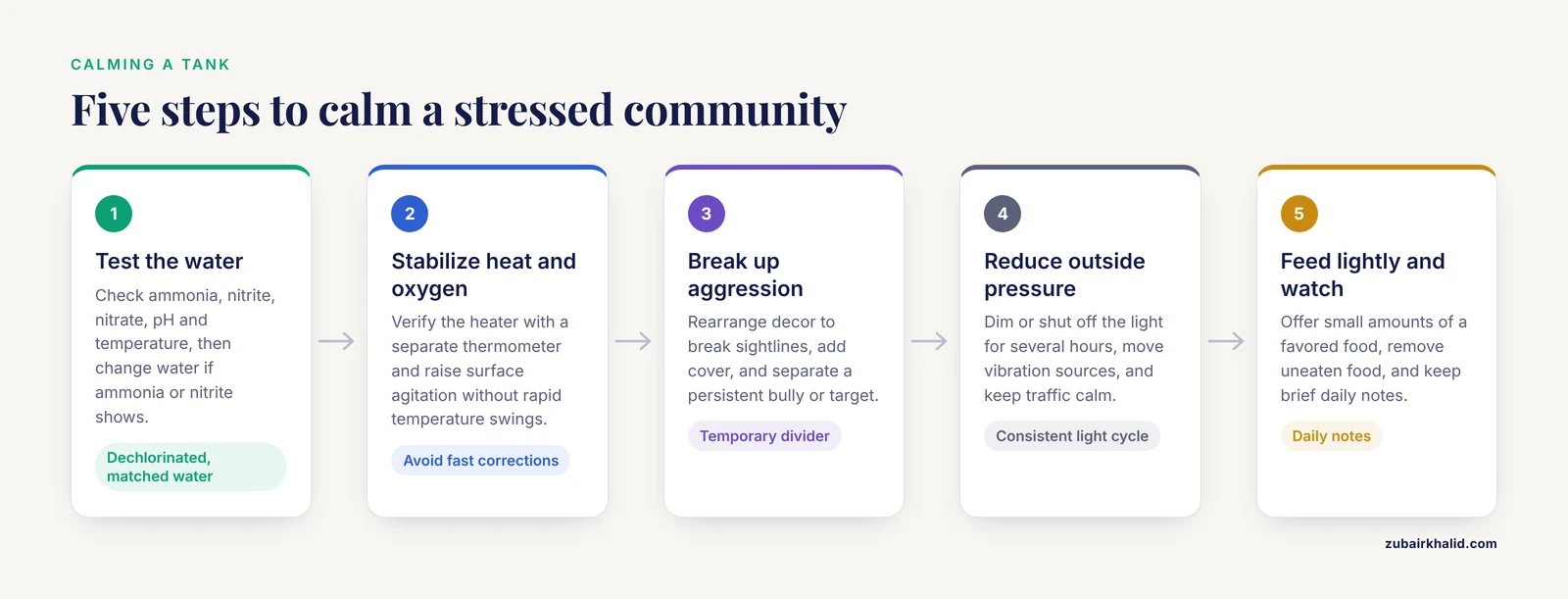
How to calm a stressed community fish comes down to removing stressors in order, not adding products. Work through the steps below and resist skipping ahead to treatments. Do not chase fish around the tank with a net to check on them, because every capture event is a stress dose.
Step 1: Test the water and act on the numbers
Test ammonia, nitrite, nitrate, pH, and temperature. If ammonia or nitrite is detectable, perform a partial water change using dechlorinated water matched to tank temperature, then retest. Feed lightly or pause feeding briefly while the biological filter recovers, because every pellet added becomes waste the system must process. If nitrate is high, a water change plus a review of your maintenance interval is the fix. If pH swings between tests, look at change frequency and water source stability. Stability matters more than any single target number.
Step 2: Stabilize temperature and oxygen
Verify the heater with a separate thermometer and correct any mismatch between the setting and the actual water temperature. Increase aeration or surface agitation, because warmer or overcrowded water holds less dissolved oxygen. Avoid large rapid temperature corrections, which add their own stress.
Step 3: Break up aggression
Rearrange decor to break long sightlines, which resets established territories. Add cover so subordinate fish can get out of view. If one fish is a persistent bully or one fish is a persistent target, separate them, either by rehoming one or by using a temporary divider. For shoaling species, increasing the group size toward the species' natural school size often settles the whole tank.
Step 4: Reduce outside pressure
Dim or shut off the aquarium light for several hours during an acute episode, then keep the light cycle consistent afterward. Move sources of vibration away from the tank, stop tapping the glass, and keep traffic around the tank calm. Give the fish predictable days.
Step 5: Feed lightly and watch
Offer small amounts of a favored food once the fish are interested again and remove uneaten food. Keep brief daily notes on breathing rate, appetite, and behavior so you can see the trend rather than guess.
If signs do not improve after water correction and environmental changes, that is information, not failure. It means the cause is disease, deep-seated social conflict, or something the home toolkit cannot measure, and that is the point to involve a veterinarian.
Unsafe Home Remedies and Common Mistakes
Home aquaria are full of improvised treatment, and the pattern has consequences. A review published in the journal Animals examined informal treatment practices in ornamental aquaria and found that many preventive and curative interventions, including antimicrobials, antiparasitics, antiseptics, oxidizing agents, copper-based products, dips, and commercial formulations, occur without veterinary diagnosis, microbiological confirmation, standardized dosing, ingredient transparency, or follow-up monitoring [4]. Whole-system treatments can affect non-target organisms, biofilter communities, fish-associated microbiota, and water quality stability [4]. Digital communities circulate empirical protocols quickly, which spreads both useful husbandry guidance and unverified treatment recipes.
The specific mistakes that harm community tanks include:
- Antibiotics added on a hunch. Undiagnosed bacterial treatment wastes time, damages the biofilter, and drives the stewardship concerns the review documented.
- Copper and other broad treatments in tanks with invertebrates or plants. Whole-tank dosing reaches shrimp, snails, and beneficial bacteria along with the target.
- Doses guessed upward. Adding a little extra because the situation looks bad produces toxicity, especially in small tanks and in sensitive species.
- Treating the whole tank for one fish's problem. Quarantine exists so treatment can happen where it does not destabilize the community.
- Salt as a universal remedy. Salt has real uses in fish medicine, but as an undiagnosed additive to a community tank it stresses freshwater plants and invertebrates and does nothing for causes it does not match.
- Homebrew dips and baths. Unformulated chemical dips injure gills and skin.
- Massive water changes with untreated or mismatched water. Chlorinated or temperature-mismatched replacement water can turn one problem into two.
- Repeated netting and moving. Each capture event is another stress dose on top of the first.
In the United States, antimicrobial use in animals falls under veterinary oversight and stewardship expectations, and the informal, undiagnosed treatment pattern documented in home aquaria is precisely the pattern those expectations exist to prevent [4]. The safe sequence is always diagnosis first, then a targeted treatment at a defined dose, then follow-up.
Prevention: Building a Low-Stress Tank From Day One
Prevention in fish keeping is mostly planning plus routine.
Quarantine every new arrival. A separate quarantine tank protects the community from pathogens that arrive with transport-depleted stock and gives new fish time to recover before they join an established hierarchy.
Cycle the tank before the first fish. Establish the biological filter before stocking, and resist adding a full community at once.
Plan stocking on paper first. Research adult size, temperament, water preferences, and social needs for every species before purchase. Verify compatibility for the specific species rather than relying on a generic community-fish label at the store.
Run a maintenance routine and test it. Regular partial water changes with dechlorinated, temperature-matched water, filter media care that preserves beneficial bacteria, and a consistent testing schedule catch drift before fish feel it. The home aquarium study cited earlier also produced recommendations for avoiding the faults it found, and the core message is to benchmark your husbandry against established standards rather than against how the tank looks on a given day [1].
Source fish responsibly. The documented problems in international ornamental fish transport, from long transit times to oxygen deficits and overcrowded bags, are largely invisible at the store counter [2]. Ask how long fish have been in the store, watch for overstocked tanks, and choose suppliers whose stock is alert, feeding, and free of clamped fins.
Keep records. A simple log of test results, changes, and treatments turns the next mystery into a timeline.
Prognosis for Stressed Community Fish
Most community fish recover fully when the stressor is identified and removed early, because fish physiology responds quickly to improved conditions. Appetite and color often return before behavior does. The outlook worsens with duration, with chronic stress that has already produced disease, and with causes that cannot be fixed in the home tank, such as fundamentally incompatible stocking or advanced disease. Species matter too, since hardy species tolerate transient stress that would overwhelm sensitive ones. For an individual fish, the veterinarian who examines it can weigh cause, duration, body condition, and secondary disease into an honest prognosis. The most reliable predictor of a good outcome is short duration, and the most reliable way to keep duration short is to test water and act at the first sign rather than the fifth.
Emergency Red Flags That Need Immediate Action
Treat the following as same-day problems.
- Gasping at the surface or rapid gill movement across multiple fish
- Detectable ammonia or nitrite at any level
- Multiple fish dying or found dead over several days
- Red streaking in fins or body, ulcers, or open hemorrhages
- Inability to stay upright, severe bloating with raised scales, or a protruding eye with systemic signs
- The entire tank refusing food
- Sudden water cloudiness combined with deaths
While arranging veterinary help, perform a partial water change with dechlorinated, temperature-matched water, increase aeration, stop feeding, and stop adding any product. Bring water test results with you.
Limitations and When to Contact a Veterinarian
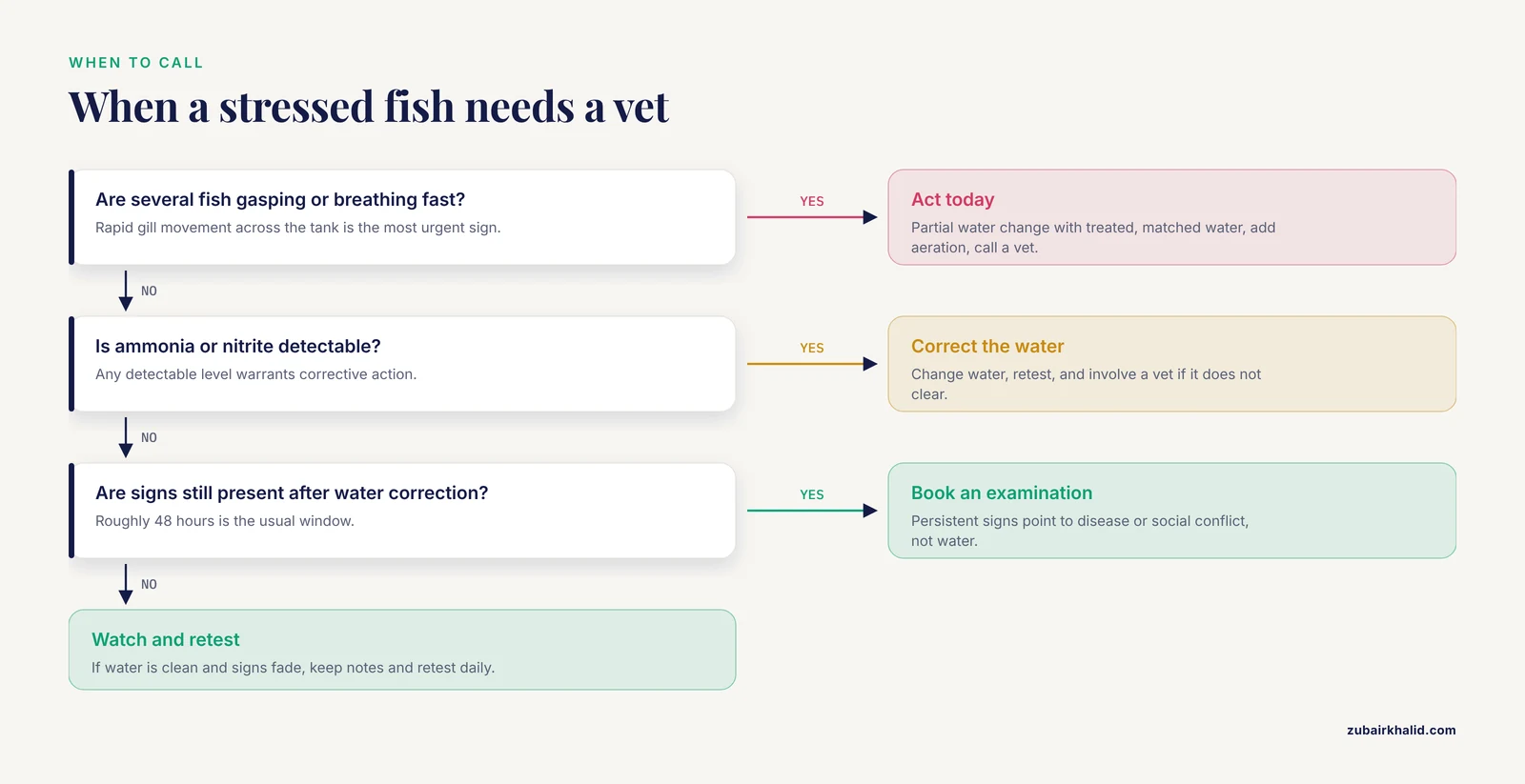
Individual cases vary, and a veterinarian who can examine the fish and the water is the right person to judge any specific tank. The question of when to see a vet for a stressed community fish has concrete answers, and the escalation criteria below convert that principle into triggers.
Contact a veterinarian who treats fish when any of the following applies:
- Signs persist beyond roughly 48 hours after water quality has been corrected
- Ammonia or nitrite is detectable and does not clear with a water change
- Multiple fish are affected at once or declining together
- You can see parasites, white spots, cotton-like growths, worms, or unusual lumps
- A fish has visible injuries from aggression, or fin damage that is spreading
- A fish that previously ate well refuses food for two to three days
- Any unexplained death has occurred in the tank
- You are considering any medication, dip, or additive, so the diagnosis comes before the treatment
If you do not have a fish veterinarian, the World Aquatic Veterinary Medical Association directory, AVMA owner resources, and university aquatic programs such as Cornell University's College of Veterinary Medicine are practical starting points for locating qualified help.
Frequently Asked Questions
What are the most common signs of stress in community fish?
Clamped fins, hiding, loss of appetite, rapid gill movement, gasping at the surface, faded or darkened color, flashing against decor, and unusual aggression or submission are the most common signs. Any one of them justifies a water test the same day.
How do I calm a stressed community fish quickly?
Test the water and correct ammonia, nitrite, or temperature problems first, then increase aeration, dim the lights, and remove aggressive tank mates or other stressors. Do not add salt, medication, or additives until you know the cause.
What causes stress in community fish most often?
Poor or unstable water quality is the most common cause, followed by overcrowding, incompatible tank mates, recent transport, and disease. Several causes usually overlap in a struggling tank.
Why is my new fish hiding and not eating?
New fish are usually reacting to transport stress and an unfamiliar environment. Keep the water clean and stable, dim the light, and give them a few quiet days. If hiding and appetite loss continue past about a week, test the water and check for a bullying tank mate.
Can stress actually kill community fish?
Yes. Acute water-quality stress can kill quickly, and chronic stress suppresses the immune system until opportunistic disease takes over.
Should I add salt or medication to a stressed tank?
No, not before you know the cause. Undiagnosed whole-tank treatments can harm the biofilter, invertebrates, and the fish themselves, so get a diagnosis first and treat only what is confirmed.
When should I see a vet for a stressed community fish?
See a vet when signs persist beyond a couple of days after water correction, when ammonia or nitrite is detectable, when multiple fish are affected, when you can see parasites or injuries, when any unexplained death occurs, or before using any medication.
How long does recovery from stress take?
Many fish improve within days once the stressor is removed, with appetite and color often returning first. Recovery takes longer when stress was chronic or secondary disease has developed, so involve a veterinarian if progress stalls.
Sources
- [[Fresh water aquaria and veterinary practice. 2. Studies of proper raising of ornamental fish].](https://pubmed.ncbi.nlm.nih.gov/1609405/)
- [[Aspects of animal welfare and species protection in the international trade of ornamental fish and air transport to Germany].](https://pubmed.ncbi.nlm.nih.gov/15918482/)
- Morphological, cytochemical and ultrastructural aspects of blood cells in freshwater stingray species in the middle Rio Negro basin of Amazonian Brazil.
- Informal Treatment Practices in Ornamental Aquaria: An Overlooked Interface Between Aquatic Animal Health, Antimicrobial Stewardship, and One Health.