Bringing Home a New Betta Fish: First Week Guide
By Dr. Zubair Khalid, DVM, MS, PhD ·
Most betta fish need three to fourteen days to settle into a new home, and the first week is when you can do the most to lower their stress. Research on confined bettas shows that molecular stress responses peak around day three in a new environment and return to baseline by day fourteen, which tells us the adjustment window is real and measurable [1]. Your job during the new betta fish first week is simple in principle. Keep the water stable, keep handling and disturbances minimal, feed lightly, and watch your fish every day so you notice problems early.
This guide walks you through each day, explains why each step matters, and tells you exactly when to involve a veterinarian. A single caveat up front. Individual cases always need individual judgment, and an experienced aquatic veterinarian should guide any decision that involves medication, salt treatment, or a fish that seems genuinely unwell.
At a Glance: New Betta Fish First Week Checklist
Use this checklist to prepare before and during the first week. Print it or save it to your phone.
| Step | When | Why It Matters |
|---|---|---|
| Set up and cycle the tank in advance | Days before arrival | Stable water chemistry is the single biggest predictor of a smooth transition |
| Confirm heater, filter, and thermometer are running | Before pickup | Bettas are tropical fish and need consistent warmth |
| Add hiding places and live or silk plants | Before arrival | Cover reduces fear and lets the fish establish a territory |
| Transport the fish in an insulated bag or container | Day of pickup | Temperature swings and sloshing water are avoidable stressors |
| Float and slowly acclimate the fish | Arrival day | Gradual adjustment to water chemistry prevents shock |
| Keep lights dim and skip handling | First 24 to 48 hours | Darkness and quiet lower the fear response |
| Feed a very small amount | Day 2 onward, only if the fish acts interested | Uneaten food degrades water quality during a delicate period |
| Test water parameters daily | All week | Ammonia and other spikes are most dangerous early |
| Observe behavior at the same times each day | All week | A daily baseline makes it easy to spot abnormal swimming, color, or appetite |
| Schedule a first vet visit if anything looks off | Any time | Early intervention works far better than late intervention |
Bringing Home a Betta Fish: Preparation Before Pickup
The single most common mistake new owners make is buying the fish first and setting up the tank second. Betta fish are frequently sold in tiny cups and small containers at pet stores. Research has examined exactly this kind of confinement and found that even when standard blood markers like cortisol and glucose did not change dramatically, confined bettas showed meaningful changes in stress related gene expression that peaked around day three of confinement [1]. In other words, a betta that looks calm in a cup may still be under physiological stress you cannot see. Your goal is to shorten the time the fish spends in that state, which means the destination tank should be ready before the fish ever leaves the store.
Tank Size and Setup
Choose the largest tank your space and budget allow. Bigger volumes of water hold temperature and chemistry more steadily, and stability is what a newly transported fish needs most. A bare minimum setup that is genuinely adequate includes:
- A glass or acrylic aquarium with a secure lid, since bettas can jump
- An adjustable aquarium heater with a reliable thermometer
- A gentle filter, since strong current can exhaust a fish with long fins
- A water conditioner that removes chlorine and chloramine from tap water
- Substrate, live or silk plants, and at least one hiding place such as a cave or dense plant cover
- A water test kit for ammonia, nitrite, nitrate, and pH
Your aquatic veterinarian or an experienced local fish store can help you confirm that your specific setup is appropriate for a betta before you bring the fish home. Ask about biological filtration, often called cycling, because a biologically mature filter handles the ammonia that fish produce. If your tank has not cycled, tell your veterinarian, since frequent partial water changes and close monitoring become essential.
What to Ask at the Store
Ask the seller what food the fish has been eating, what the water temperature has been, and how long the fish has been in the cup. Continuity in diet avoids digestive upset, and knowing the source water helps you acclimate more accurately. Take note of the fish's appearance and behavior at the store. A fish that arrives home with an existing problem will need different first week care than a healthy one, and a baseline photograph from the store can help your veterinarian later.
The Trip Home
Transport is a genuine stressor, and research on confined bettas confirms that small volume confinement activates measurable stress responses in this species [1]. You can shorten and soften the journey with a few practical choices.
- Use an insulated container or a paper bag inside a dark bag to block light and buffer temperature
- Keep the ride under an hour when possible and avoid errands on the way home
- Secure the bag so it cannot tip or roll
- Never leave the fish in a parked car, even briefly, because passenger compartments change temperature quickly
- Drive gently. Sudden stops slosh water and stress the fish
Once home, resist the urge to open the bag repeatedly to look at the fish. Light and motion extend the stress response.
Acclimation: The First Hours
Acclimation is the controlled process of letting your betta adjust to the temperature and chemistry of your tank. Rushing it can cause shock, and shock can kill a fish that was otherwise healthy. A cautious approach looks like this.
- Turn off the aquarium light and keep the room dim.
- Float the sealed bag in the tank for fifteen to twenty minutes so the water temperature equalizes gradually.
- Open the bag and add a small amount of tank water to the bag water. Wait ten to fifteen minutes.
- Repeat the small water addition two or three more times over the next half hour.
- Gently release the fish using a soft net or your cupped hand rather than pouring store water into your tank.
Do not feed during acclimation. Do not add store water to your aquarium, because it can carry pathogens. After release, turn the light off or leave it dim for the rest of the day and let the fish explore on its own terms.
First 24 to 48 Hours: The Quiet Phase
A newly introduced betta may hide, hover near the bottom, breathe rapidly, refuse food, or show pale or dull coloration. All of these are normal short term responses to relocation. Stress in this species has been documented at the molecular level during confinement and relocation style conditions, with changes in genes that regulate stress hormones and cellular stress proteins [1]. Behavior that looks like fear is often a fish doing exactly what its biology tells it to do.
Your role in the first two days is to be nearly invisible. Keep the light low, keep hands out of the water, and do not tap the glass or rearrange decor. Hiding places you placed before arrival now do their job by giving the fish a choice between cover and open water. A fish that can choose is a fish that settles faster.
Feeding during this window should be minimal or skipped entirely. A stressed fish often will not eat, and uneaten food fouls the water at the worst possible time. Offer nothing on day one unless the fish is actively alert and cruising, in which case a single small portion is reasonable.
How Long for a Betta Fish to Settle In
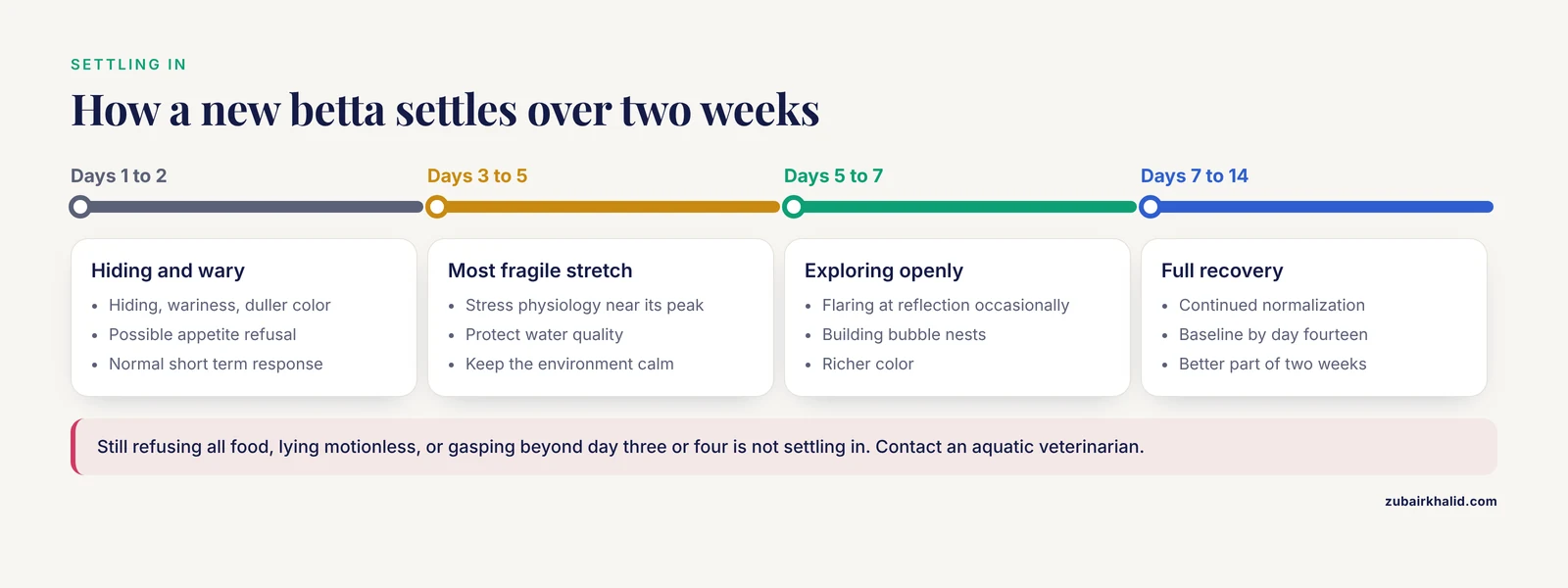
This is one of the most common questions new owners ask, and the honest answer is that settling in is a process with a recognizable shape. In a study that tracked confined bettas over fourteen days, stress related gene expression peaked around day three and had returned to baseline levels by day fourteen [1]. Translated into practical terms for the new betta fish first week, you should expect:
- Days 1 to 2. Hiding, wariness, possible appetite refusal, duller color. This is normal.
- Days 3 to 5. Often the most fragile stretch. Stress physiology is near its peak in the early confinement window, so protect water quality and keep the environment calm.
- Days 5 to 7. Most fish begin exploring openly, flaring at their reflection occasionally, building bubble nests, or showing richer color.
- Days 7 to 14. Continued normalization. Full physiological recovery in the research context took the better part of two weeks.
If your fish is still refusing all food, lying motionless at the bottom, gasping at the surface, or showing visible damage beyond day three or four, stop waiting and contact an aquatic veterinarian. Those signs are not settling in. They are illness or water quality failure, and both respond better to early treatment.
Feeding During the First Week
Appetite is one of the best real time indicators of how a betta is coping. Begin feeding on day two or three with a very small amount of the food the fish was already eating at the store. Watch closely. If the food is ignored after a few minutes, remove it with a net and try again the next day. Feed lightly all week. A slightly hungry fish is safe. A polluted tank is not.
Diet and environment interact. In a feeding study, bettas raised in their preferred environmental color ate more feed than bettas in other environments, which shows that visual surroundings influence appetite in this species [2]. If your new fish eats poorly, look at the whole sensory environment, not just the food. Harsh lighting, glaring bare backgrounds, and bright red or high contrast decor can all suppress feeding behavior in a nervous fish.
Environment, Color, and Early Enrichment
Bettas perceive and respond to the color of their surroundings, and this is directly relevant to how you decorate and light the tank during the first week. In a controlled preference study, male and female bettas spent the most time in green environments and avoided red environments, regardless of sex [2]. Follow up testing showed that rearing juveniles in their preferred environmental color increased feed intake over a fifty six day period, supporting the idea that a suitable visual environment promotes positive behavioral responses and better performance [2].
For a new fish in a strange tank, you can apply these findings conservatively.
- Provide a planted look with live or silk green plants rather than a sterile bare tank
- Avoid bright red gravel, backgrounds, and decor, which bettas avoided in preference testing [2]
- Use subdued lighting for the first week rather than intense full spectrum light
- Position the tank away from constant foot traffic and sudden movement
Enrichment is not decoration for your benefit. It is environmental management for the fish's welfare, and the first week is when the sensory environment does the most good or the most harm.
Common First Week Mistakes
These errors account for most early betta losses, and every one of them is avoidable.
- Adding the fish to an uncycled, unstable tank. If your tank is not biologically mature, ask your veterinarian or an experienced fish store how to manage ammonia exposure during the transition.
- Feeding too much, too soon. Overfeeding a stressed fish pollutes the water. Small portions and patience win.
- Water changes that are too large or too frequent. Enthusiastic owners sometimes replace most of the water daily, which destroys stability. Stability beats cleanliness by a small margin in week one. Ask your veterinarian for a water change schedule suited to your tank size and cycle status.
- Placing the tank near a speaker, a television, or a sunny window. Vibration and temperature fluctuation are invisible stressors.
- Adding tank mates immediately. A new fish needs time to establish territory before navigating social pressure. Delay introductions.
- Treating the tank with medications or salt on your own. Experimental work has shown that sodium chloride reduced cortisol and stress gene expression in confined bettas, which is a genuine finding [1], but translating a research protocol into a home treatment requires dosing decisions that belong with a veterinarian. Salt is a tool, not a default.
- Keeping the fish in its shipping cup or a temporary bowl while the tank gets ready. This recreates exactly the confinement conditions that research has linked to stress responses [1].
Troubleshooting the First Week
My betta is not eating
Give it until day three. If appetite has not appeared by then, test your water first, because poor water quality suppresses appetite faster than any other factor. If water tests fine and the fish still refuses food, check the environment for bright light, red or glaring decor, and nearby movement, since these visual factors measurably influence feed intake in this species [2]. Persistent refusal beyond several days warrants a veterinary call.
My betta is pale or dull
Color change in the first days is usually a stress response, not disease. Keep conditions stable and give it time. Rapid color loss combined with clamped fins, lethargy, or labored breathing is different and needs veterinary attention.
My betta is gasping at the surface
Bettas breathe atmospheric air naturally, so occasional surface trips are normal. Constant gasping is not. Test oxygen related conditions and water chemistry, confirm your filter is running and aerating the surface, and contact a veterinarian if the behavior continues.
My betta looks injured or has torn fins
Fin damage can come from transport, sharp decor, or the fish's own thrashing. Remove sharp objects, keep the water pristine, and photograph the fins daily to track healing. Worsening fraying, redness, or white edges need veterinary assessment.
Your First Vet Visit for a Betta Fish
Many owners assume fish cannot be treated by veterinarians. They can. Aquatic veterinary medicine is an established field, and the World Aquatic Veterinary Medical Association maintains resources to help owners locate practitioners experienced with ornamental fish. The Merck Veterinary Manual also maintains a pet fish section covering diagnosis and care of aquarium species, which reflects the mainstream veterinary status of ornamental fish medicine.
Plan a first vet visit for a betta fish in these situations:
- The fish shows abnormal swimming, buoyancy problems, or loss of balance
- Visible lesions, fin rot, bloating, or abnormal growths appear
- Appetite is absent for more than a few days despite good water quality
- The fish was purchased with visible damage or illness and has not improved
- You are unsure whether your water parameters are safe
What to bring. A water sample from the tank, your test results, a photograph of the full tank, close up photos of the fish taken on several days, and a record of what and when you fed. If the fish is very small or fragile, call the clinic first, because some aquatic veterinarians will advise on transport methods suited to fragile patients.
What to expect. A good aquatic veterinarian will ask about your water source, your filtration, your cycle status, and your feeding routine before examining the fish. Many betta problems trace back to water quality, and correcting the environment often matters as much as any medication. Follow up timing will depend on the diagnosis, but expect your veterinarian to recommend a recheck for any treated condition rather than a single visit.
For day to day guidance between visits, the AVMA provides pet owner resources on fish health and husbandry, and the Merck Veterinary Manual's pet fish content is a reasonable reference for understanding what symptoms mean before you describe them to your veterinarian.
Welfare and Safety Points
Betta welfare in the first week comes down to three things. Environmental stability, sensory comfort, and freedom from unnecessary stressors. The research record for this species supports each of these. Confinement studies show that bettas mount real physiological and molecular stress responses to restrictive conditions [1]. Environmental preference studies show that the fish actively choose some visual conditions over others and that the right environment improves feeding [2]. A betta in a stable, thoughtfully decorated, appropriately sized tank is not a luxury. It is the baseline for this species.
Practical welfare rules for week one:
- Never house a betta in a cup, vase, or bowl as a long term plan
- Never use distilled water without remineralizing it under veterinary guidance
- Never place the tank where it receives direct sun or sits beside a heat source
- Always dechlorinate tap water before it touches the fish
- Always wash your hands before and after tank contact, and avoid soaps and lotions right before putting your hands in the water
Limitations and When to Contact a Veterinarian
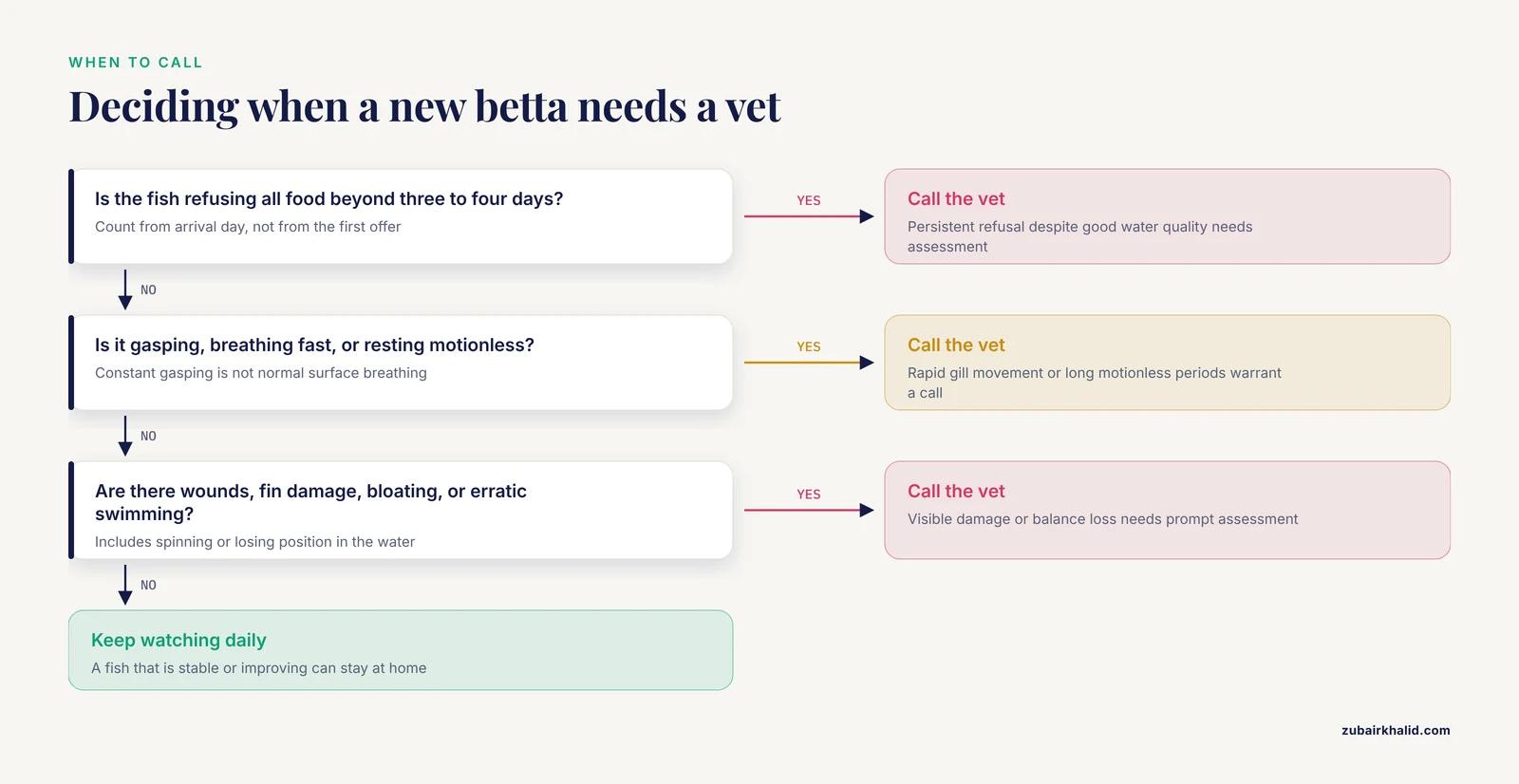
This guide describes typical first week patterns for betta fish, but every fish, tank, and water supply is different, and individual cases need a veterinarian rather than a general article. Contact an aquatic veterinarian promptly if you observe any of the following:
- Refusal of all food beyond three to four days after arrival
- Gasping at the surface, rapid gill movement, or resting motionless for extended periods
- Visible wounds, fin deterioration, bulging eyes, bloating, or abnormal swelling
- Erratic swimming, spinning, or inability to maintain position in the water
- Sudden color loss combined with lethargy
- Ammonia or nitrite reading above zero on your test kit
- Any condition that is worsening rather than stable or improving
Do not wait out escalation criteria in the hope that a fish will recover on its own. Fish hide illness well, and by the time a betta looks obviously sick, the problem is usually advanced. Early veterinary consultation costs less, in every sense, than late treatment.
Frequently Asked Questions
How long does it take a betta fish to settle in?
Most bettas show clear behavioral improvement within five to seven days, though full physiological adjustment can take closer to two weeks. Judge settling in by appetite, exploration, color richness, and resting posture rather than by the clock alone.
Should I feed my betta on the first day?
Most fish do better with little or no food on arrival day. Offer a tiny portion on day two or three, remove anything uneaten, and build up gradually as appetite returns.
Why is my new betta fish hiding all day?
Hiding is a normal fear response to an unfamiliar environment. Dim the lights, confirm it has cover, keep hands and activity away from the tank, and give it a few quiet days before concluding something is wrong.
Can I add tank mates during the first week?
No. Let your betta establish territory and normal behavior first, and discuss any stocking plan with your veterinarian or an experienced fish store, since compatibility depends on tank size and individual temperament.
Does my betta need a heater and a filter?
Bettas are tropical fish and do best in a heated, filtered tank with stable conditions. Confirm your specific equipment and temperature targets with an aquatic veterinarian or a knowledgeable fish store rather than guessing.
When should I do the first water change?
That depends on whether your tank is biologically cycled and how it is stocked, so ask your veterinarian for a schedule matched to your setup. In general, small frequent partial changes are safer than large abrupt ones during the first week.
Do betta fish care about tank colors and decor?
Yes. Bettas distinguish between environmental colors and show clear preferences, so plant cover, subdued lighting, and avoiding harsh red surroundings can meaningfully affect how comfortable and how hungry a new fish feels.
Can I use aquarium salt to reduce my new betta's stress?
Salt has been shown to reduce stress markers in bettas under research conditions, but applying it at home involves dosing decisions that depend on your fish, your water, and the problem you are trying to solve. Ask an aquatic veterinarian before adding anything to the water.
This article is educational and is not a substitute for veterinary diagnosis or treatment.