Aquarium Lighting for Fish-Only Tanks
By Dr. Zubair Khalid, DVM, MS, PhD ·

A fish-only tank needs light for you and for the fish, not for photosynthesis, and that single difference should shape every purchase you make. The best lighting for a fish-only aquarium is usually a moderate, dimmable LED running on a timer, not the most powerful fixture on the shelf.
The working rule of thumb is simple. Buy the least intense light that shows every fish clearly, renders colors honestly, and lets you spot trouble early, then run it on a fixed schedule with a true dark period overnight. Get those two decisions right and nearly every other choice becomes cosmetic.
This article is educational and is not a substitute for veterinary diagnosis or treatment.
Why a Fish-Only Tank Needs Less Than You Think
Light does four jobs in a tank without corals or dense plant growth. It lets you see and enjoy the animals you keep. It gives fish a cue system for orientation and normal activity. It anchors a day-night rhythm that separates active hours from rest hours. And it acts as a throttle on algae, which respond to light as eagerly as anything else in the water.
Reef aquarists buy brute-force fixtures because the corals, not the fish, set the light demand. Remove the corals and that requirement leaves with them. What remains is a viewing and welfare problem, and viewing problems rarely need wall-of-light output.
Lighting still deserves deliberate thought, because researchers treat it as one of the chronic low-level stressors a home aquarium can impose. Captive fish may face crowding, changed lighting, food deprivation, and vibration from pumps or tapping on the glass, and the cumulative weight of these quiet stressors is easy to underestimate [1]. Under-lighting carries costs of its own. A dim, flickering, or badly colored tank hides early signs of illness, weakens the day-night anchor, and turns routine observation into guesswork.
So the target is adequate, controlled, and consistent. Not maximal, and not minimal.
What Research Shows About Spectrum and Stress
The most directly relevant evidence comes from zebrafish, a standard laboratory species. Researchers housed replicate groups of six fish and exposed them to stressors familiar to any home keeper: stocking densities between 0.13 and 1.2 fish per liter, three fluorescent lighting types (cool white at 6,500 K, warm white at 4,100 K, and an ultraviolet-enhanced 420 actinic tube), food deprivation lasting up to nine days, and random tapping on the tank glass that produced a startle response [1]. They scored behaviors such as fin display, body fluttering, aggression, and mouth gaping, measured cortisol released into the water, and examined heat-shock proteins in muscle tissue.
Of all the treatments, only food deprivation produced significant differences between control and treatment fish. Dissolved cortisol declined after 120 hours without food, and two muscle heat-shock proteins rose significantly after 216 hours. Behavior and heat-shock readings also varied widely inside every group, controls included, which made the effects of the milder treatments hard to separate from ordinary variation.
Read that as cautious reassurance rather than a blank check. The three everyday spectra tested did not emerge as standout stressors under those conditions, and neither did crowding or vibration. The loudest signal came from hunger, a reminder that feeding and husbandry basics outrank gear upgrades. Because individual measurements varied so much, an undetected effect is not proof that lighting never matters.
The practical takeaway is freedom of choice. Pick a spectrum for honest color rendering and a look you enjoy, keep the photoperiod steady, and let your fish's behavior, not marketing copy, tell you whether the setup suits them.
Lighting Options for Fish-Only Aquariums
Seven practical routes cover almost every fish-only installation. Each earns its place in a specific situation.
Standard LED Strips
Fixed-output light bars, often bundled with starter kits, dominate the entry level. They run cool, sip electricity, and ask nothing of the owner beyond flipping a switch. The trade-offs are rigidity and flatness. Output cannot be dialed down, spread is fixed, and the look can feel clinical. If the fixture lacks a built-in timer, add an inexpensive wall timer so the photoperiod stays honest.
Dimmable and Programmable LED Ramps
Adjustable fixtures with intensity control, and often multiple color channels plus sunrise and sunset ramps, solve the problems strips cannot. You can match brightness to shy species, soften transitions so fish are not startled by an abrupt switch, and cut output the moment algae respond. The costs are a higher upfront price and more settings to misuse. For a dedicated display, this is the default recommendation.
T5 and T8 Fluorescent Tubes
The legacy standard still works. Tubes spread light evenly along long tanks, replacements are inexpensive, and the technology is thoroughly understood. Downsides include bulky hardware, higher heat and power draw than LED, and gradual output loss as tubes age. Keep spare tubes on hand and replace them when the tank visibly dims rather than stretching their service life indefinitely.
RGB and Color-Enhancing Fixtures
Multi-channel fixtures tuned for appearance can make ordinary fish look extraordinary. Strong color rendering genuinely helps photography and evening enjoyment. The risk runs the other direction too. Saturated modes flatter the tank while distorting the colors you rely on for health checks, and owners tempted by maximum drama tend to run brighter and longer than the fish need.
Actinic and Blue-Heavy Lighting
Spectra weighted toward blue create a dramatic, moonlit-ocean look, especially on marine fish. Nothing in a fish-only system depends on it biologically, so treat it as an aesthetic choice. A blue phase works nicely as a dusk transition or evening viewing mode. Its drawback is color distortion during observation, so keep a neutral mode available for health checks.
Moonlight and Night Lights
Low-output blue LEDs let you watch nocturnal and crepuscular species without flooding the tank. These fish map their world with senses beyond sight, so gentle illumination reveals natural night behavior without overwhelming them. The failure mode is overuse. A night light left burning until morning stops being a moon simulation and starts eroding the dark period fish need for rest.
Room Light Alone
Relying on windows and living-room lamps costs nothing and delivers exactly what you pay for. Photoperiod drifts with the seasons and the household schedule, glare makes viewing poor, tanks near sunny windows grow algae enthusiastically, and there is no control over any of it. Ambient light is a fine supplement and a weak foundation.
Side-by-Side Comparison of Aquarium Lighting for Fish-Only Tanks
The table below puts the seven options next to each other on the criteria that actually decide purchases.
| Option | What it is | Pros | Cons | Best for |
|---|---|---|---|---|
| , - | , - | , - | , - | , - |
| Standard LED strip | Fixed-output light bar, common in kits | Inexpensive, cool-running, energy efficient, simple | No dimming, fixed spread, flat appearance | Starter and community tanks, first-time owners |
| Dimmable LED ramp | Programmable fixture with intensity and channel control | Matches light to species and room, dawn and dusk ramps, room to grow | Higher upfront cost, more settings to misuse | Dedicated displays, shy fish, algae control |
| T5 or T8 fluorescent | Traditional tube lighting on a reflector | Even spread, cheap replacement tubes, proven design | Bulky, tubes fade with age, more heat and power draw | Budget builds, long simple tanks, spare systems |
| RGB or color-enhancing LED | Multi-channel fixture tuned for looks | Excellent color rendering, flexible scenes | Easy to over-brighten, distorts observation, algae risk | Display-focused tanks, photography |
| Actinic or blue-heavy fixture | Spectrum weighted toward blue | Dramatic look, doubles as dusk mode | Distorts colors, unnecessary for fish-only biology | Marine fish-only tanks, evening viewing |
| Moonlight LED | Low-output night light | Reveals nocturnal behavior, gentle | Extra wiring and timer, easy to overuse | Nocturnal or crepuscular species |
| Ambient room light only | No fixture, reliance on windows and lamps | Free | Unpredictable photoperiod, poor viewing, seasonal swings, algae | Not recommended as a sole source |
Every option in this table can keep fish healthy. The real differences lie in control, running cost, and how much algae risk you accept.
Pros and Cons of the Main Lighting Choices
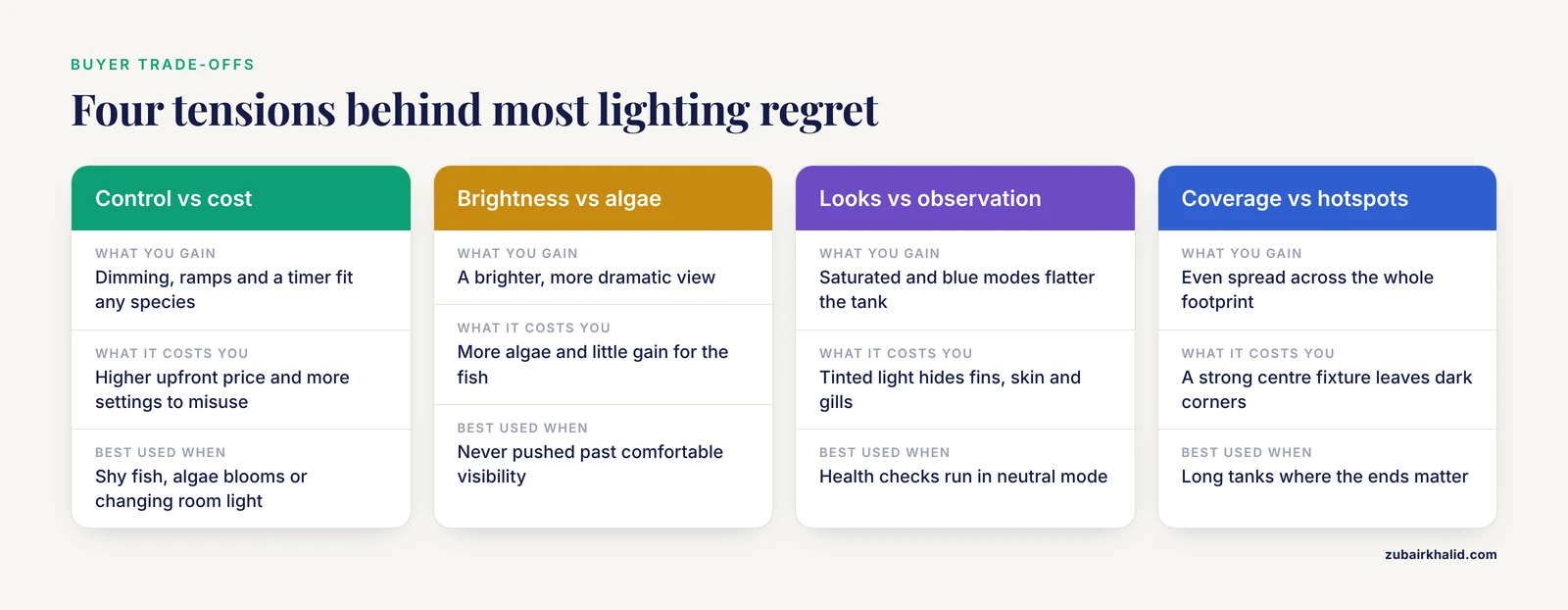
Stepping back from individual products, four tensions explain most buyer regret in this category.
Control versus cost. Dimmable programmable fixtures cost more on day one and repay it in flexibility. Fixed strips are cheap and rigid, which works until a shy species, an algae bloom, or a change in room lighting demands adjustment you cannot make.
Brightness versus algae. Every increase in output or photoperiod feeds algae as surely as it brightens the view, and fish gain little beyond comfortable visibility. In a fish-only tank, restraint is a feature.
Aesthetics versus observation. Blue-heavy and saturated RGB modes look fantastic and hide disease. Neutral, color-accurate light looks plainer and shows you the truth about fins, skin, and gills. Serious keepers keep both modes available and use the honest one for health checks.
Coverage versus hotspots. A strong fixture that concentrates light in the center leaves dark corners and bright blast zones. Even spread across your exact footprint beats raw power every time.
How to Choose Lighting for a Fish-Only Aquarium
Work through these criteria in order and the right fixture usually picks itself.
- Measure before you shop. Record the tank's length, width, depth, and any canopy or rim that constrains mounting. Run your dimensions and stocking plan through a fish tank calculator first, so you know the volume you are actually lighting and the footprint the fixture must cover. A fixture that spreads evenly across your tank beats a stronger one that leaves shadows at the ends.
- Match output to the species mix. Active open-water fish generally show well under brighter, neutral light. Shy, nocturnal, or dim-habitat species do better with dimmed or shaded setups. Vision research underlines how varied fish photoreception can be. Blind Mexican cavefish tracked moving stripes at light intensities below 20 lux, and the response survived removal of their vestigial eye structures, which points to light sensing outside the eyes altogether [2]. Those same fish ignored visual motion whenever solid landmarks were available, a reminder that hardscape and layout carry orientation weight alongside the fixture.
- Respect species oddities. Some fish carry their own light hardware. Two codling species described from Indian Ocean reef drop-offs position small light organs along the belly between the pelvic fin base and the anus [3]. Golden sweepers in the genus Parapriacanthus go further still, obtaining both their luciferin and the luciferase enzyme that powers their glow from bioluminescent ostracod prey, a borrowed system researchers call kleptoprotein bioluminescence [4]. You may never keep these animals, but the lesson scales down to everyday choices. Light biology varies more than shoppers assume, so ask about a species' native light habitat before you fix its brightness permanently.
- Choose spectrum for honesty. Neutral, daylight-style output renders reds, whites, and blacks truthfully, which matters when you are checking for pale patches or fin damage. Heavily tinted modes flatter the display and conceal problems.
- Pay for control, not raw power. Dimming, a dependable timer, and ramped transitions solve more real problems than extra lumens ever will.
- Mind heat and running cost. LED fixtures run cooler and draw less power. Fluorescent gear remains serviceable, particularly secondhand, but budget for tube replacement as output fades.
- Buy for where the tank is going. If plants might join the display later, a dimmable full-range fixture set low today saves a complete repurchase next year.
Worked Scenarios
A 20-Gallon Freshwater Community Tank
Tetras, rasboras, corydoras, and livebearers in a standard rectangular tank are the easiest case in the hobby. A standard LED strip or an entry-level dimmable ramp with a neutral spectrum covers it. Put the fixture on a timer, hold the photoperiod steady, and watch the glass during the first month. If algae film builds faster than you clean it, step the intensity or duration down before changing anything else. Skip reef-class fixtures entirely, since their output buys nothing here except scrubbing.
A 75-Gallon Tank With Large or Messy Fish
Robust cichlids or big community fish change the priorities. Choose a sturdy fixture with solid mounting, splash protection, and wide even spread across a long tank, because dark ends on a big display look worse than modest brightness anywhere else. Dimming matters for shy individuals and for the moment you bring home a nervous new arrival. Favor reliability and simple maintenance access over color features, and expect the fixture to live above humid, splashed water for years.
A Fish-Only Saltwater Tank
Clownfish, damsels, gobies, and similar marine fish carry none of the light demands that corals impose. A moderate LED with a neutral primary mode handles observation and viewing, and an optional blue-heavy secondary channel covers evening enjoyment. Consistency is the marine keeper's best tool, so fix the photoperiod on a timer and leave it alone. Resist the urge to buy coral-grade output on the theory that you might add a coral someday, because that someday arrives with its own equipment decisions.
A Tank for Nocturnal or Dim-Habitat Species
Knifefish, banjo catfish, and cave-dwelling loaches arrive from environments where bright open light means danger. Run a dimmable fixture at low output, provide heavy structure and shading, and add a moonlight LED for occasional after-dark viewing. Give these fish a real dark period every night, and judge their adjustment by normal foraging and steady behavior rather than by how photogenic the tank looks at noon.
Common Mix-Ups
- Buying reef-strength output for a tank with no corals, then fighting the algae bloom that follows.
- Reading the Kelvin rating as brightness. Color temperature describes hue, not intensity.
- Running lights around the clock or skipping the dark period, which erodes the day-night rhythm.
- Assuming brighter light means healthier fish. Visibility serves the keeper, welfare comes from consistency.
- Adding planted-tank intensity as insurance, then harvesting algae as the return on that investment.
- Judging a fixture under store lighting instead of on your own tank at home, where room light and backdrop change everything.
- Skipping the timer, so the photoperiod drifts with whatever time you walk past the tank.
- Changing fixture, spectrum, and schedule in the same week, then blaming the fish for acting strangely when three variables moved at once.
An Aquarium Care Checklist That Covers Lighting
Lighting earns a permanent line on any aquarium care checklist because it touches observation, behavior, and algae at the same time. Fold these items into your existing routine.
Daily
- Confirm the lights ran on schedule and shut off on time.
- Count every fish under full light and scan fins, skin, body shape, and gill movement.
- Feed on schedule and remove uneaten food.
Weekly
- Wipe the fixture lens or lid so condensation and dust do not block output.
- Check the timer after any power cut or clock change.
- Note algae films on glass and decor, and step back the photoperiod if they accelerate.
Seasonally and ongoing
- Reassess intensity as daylight in the room changes through the year.
- Replace faded fluorescent tubes rather than stretching their service life.
- Log every fixture or schedule change so behavior shifts have a traceable cause.
- Keep water chemistry stable, since stable parameters are a recurring theme in ornamental-aquarium health guidance [5].
Watch Fish Under Honest Light
Observation is the cheapest diagnostic you own. Columnaris disease, caused by the bacterium Flavobacterium columnare, affects numerous freshwater fish species worldwide, and research ties its virulence to how effectively the bacteria adhere to gill tissue, with good management practices standing as a primary line of defense [6]. Lethargy, abnormal swimming, fraying fins, or labored breathing are far easier to catch under bright, even, color-accurate light than in a dim or tinted tank. If your fixture makes the fish hard to see, the fixture is part of the health plan, not just the decor.
Quarantine With Its Own Light
Biosecurity guidance for ornamental aquarium animals leans on cheap, effective habits: quarantining new arrivals for 4 to 6 weeks, visual inspection under adequate lighting, preventative baths where appropriate, removal of egg masses, and stable water quality [5]. Much of that guidance was written around corals and their pests, and the inspection principle carries straight over to fish. Give your quarantine tub a plain, bright, neutral fixture of its own. Parasites, lesions, and fin damage stand out sharply against pale glass under even illumination, which is exactly when you want to see them, before anything joins the display.
Limitations and When to Contact a Veterinarian
Every aquarium is its own case, and an aquatic veterinarian should evaluate individual problems, especially when several stressors overlap. Controlled studies such as the zebrafish work described earlier come from laboratory settings with a single species and high measurement variability, so they inform judgment rather than replace observation of your own tank.
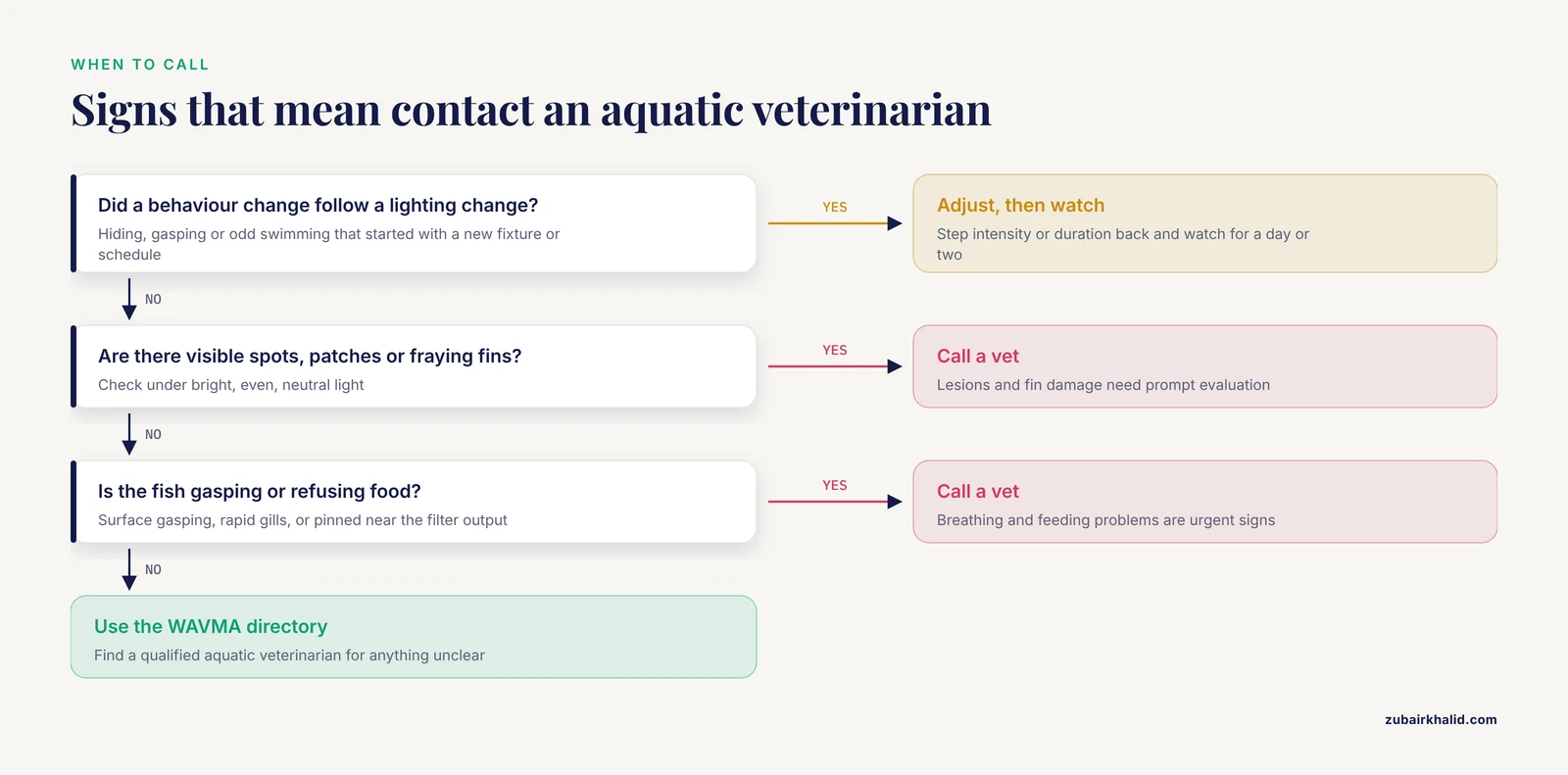
Contact an aquatic veterinarian promptly if you see any of the following:
- A sudden behavior change that follows a lighting change and persists beyond a day or two
- Gasping at the surface, rapid gill movement, or fish pinned near the filter output
- Visible white spots, patches, fraying fins, bloating, or open sores
- Refusal of food, persistent hiding, or uncharacteristic aggression
- A death with no obvious cause
- Water quality or algae problems you cannot correct with photoperiod adjustments and routine maintenance
The World Aquatic Veterinary Medical Association (WAVMA) maintains a directory of aquatic veterinarians, which is the fastest route to qualified help. For background reading between visits, the Merck Veterinary Manual's pet fish section and the AVMA's pet owner resources are reliable starting points.
Frequently Asked Questions
Do fish-only aquariums really need special lighting?
No. A fish-only tank needs modest, reliable light for viewing and a stable day-night rhythm, not the high output that corals or dense plant growth demand. A basic or dimmable LED on a timer covers nearly every fish-only setup.
What is the best color temperature for a fish-only tank?
A neutral, daylight-style spectrum is the safest default because it renders fish colors honestly and supports clear observation. Common aquarium spectra have not stood out as stress drivers in controlled comparisons, so treat appearance and viewing quality as the deciding factors.
How many hours a day should aquarium lights be on?
There is no single required number. Pick a fixed span that fits your household schedule, put it on a timer, and keep the tank dark overnight. Consistency matters more than the exact duration, and an aquatic veterinarian can suggest a photoperiod suited to your species mix.
Can aquarium lighting stress fish?
Light is one of the chronic low-level stressors researchers study in captive fish, but common aquarium spectra have not emerged as major stress drivers in controlled comparisons. Watch behavior instead. Fish that hide constantly, stop eating, or behave abnormally under a new light are telling you to adjust the setup.
Will a stronger light cause more algae in a fish-only tank?
Usually yes. Algae respond to light like any other light-dependent organism, so brighter fixtures and longer photoperiods tend to mean more scraping. If algae take over after an upgrade, reduce intensity or duration before reaching for chemical fixes.
Do I need actinic blue lighting without corals?
No. Blue-heavy and actinic looks are aesthetic choices in a fish-only tank. Many marine keepers enjoy the appearance, and a blue phase can double as dusk lighting, but fish health does not require it.
Sources
- Effects of aquarium-related stressors on the zebrafish: a comparison of behavioral, physiological, and biochemical indicators.
- BLIND MEXICAN CAVE FISH (ASTYANAX HUBBSI) RESPOND TO MOVING VISUAL STIMULI.
- Two new species of the codling fish genus Physiculus from Lakshadweep, India (Gadiformes: Moridae).
- Kleptoprotein bioluminescence: Parapriacanthus fish obtain luciferase from ostracod prey.
- Ornamental coral pests and parasites: a biosecurity alert for aquarium trade.
- Flavobacterium columnare infections in fish: the agent and its adhesion to the gill tissue.