How to Measure a Fish Tank
By Dr. Zubair Khalid, DVM, MS, PhD ·

To measure a fish tank, measure the inside length, inside width (front to back), and inside height of the aquarium in inches, multiply those three numbers together, and divide by 231. That result is the water volume in US gallons. Divide by 61.02 instead if you want liters. A tank that measures 36 inches long, 12 inches wide, and 16 inches tall holds about 29.9 gallons, which is why retailers call it a 30 gallon aquarium.
That simple calculation answers the question, but accurate measurement involves a few more steps. You need to decide whether to measure inside or outside the glass, account for glass thickness, subtract the space taken up by substrate and decorations, and record the true operating water volume rather than the volume printed on a sticker. This guide walks through the entire process step by step, explains why the numbers matter for fish health, and lists the mistakes that trip up most owners.
At a Glance: Measuring Your Tank Today
| Step | What to do | Why it matters |
|---|---|---|
| 1 | Empty your pockets, grab a rigid tape measure, a notepad, and a calculator | Measuring with soft cloth tape distorts the numbers |
| 2 | Measure inside length, inside width, inside height in inches | Inside dimensions give true water volume |
| 3 | Multiply length × width × height, then divide by 231 | Converts cubic inches to US gallons |
| 4 | Measure your actual fill line and water level | Real operating volume is lower than brim-full volume |
| 5 | Subtract an allowance for substrate, rocks, and driftwood | Displaced volume changes the true figure |
| 6 | Estimate full weight (water plus tank plus equipment) | Confirms your stand and floor can carry the load |
| 7 | Write the results in your aquarium care checklist | Records make stocking, dosing, and vet visits easier |
If you only have two minutes, measure inside dimensions, multiply, divide by 231, and write the number down. Everything else refines that figure.
Why Accurate Tank Measurement Matters
The size of an aquarium is not just a number on a receipt. It drives almost every downstream decision in fish keeping: filtration capacity, heating wattage, medication dosing, water change volume, and stocking choices. When you measure a fish tank correctly, you give yourself the foundation for all of those decisions at once.
The biological case for getting tank size right is well documented. In a study of Atlantic salmon smolts, researchers moved fish between tanks of very different volumes and tracked what happened. Fish shifted from a 190 cubic meter tank down to a 0.9 cubic meter tank suffered 46 percent mortality after transfer, while fish moved to 3 cubic meter tanks had 29 percent mortality and fish moved to 103 cubic meter tanks had 19 percent. Growth and feed intake also increased with tank size [1]. Home aquaria are obviously smaller and different in many ways, but the underlying principle holds across scales: the volume of water a fish lives in, and changes to that volume, affect survival, growth, and feeding.
Tank size also influences production outcomes in ornamental species. Work on goldfish (Carassius auratus) under tropical conditions examined how tank size and management practices influence production of this common pet species [2]. For an owner, the takeaway is straightforward. The measurements you take of your tank are the baseline for matching fish to their environment.
Water volume feeds directly into husbandry math. Precise fish size and mass information is used in professional settings to manage feeding regimes, calculate oxygen consumption, guide medication use, and support welfare, and researchers have built automated systems that estimate fish mass from dorsal body geometry for exactly these purposes [3]. You do not need an infrared camera at home, but you do need an accurate gallon figure, because water treatment products, from dechlorinator to Ich medications, are dosed per gallon. An owner who guesses a 55 gallon tank when the true volume is 45 gallons will chronically underdose or overdose everything added to the water.
What You Need Before You Start
Gather four items before measuring:
- A rigid steel or fiberglass tape measure, at least 60 inches long
- A notepad and pen, or a notes app on your phone
- A calculator, or a fish tank calculator website or app that converts dimensions to volume
- Optionally, a flashlight for reading dim corners and a level for checking where the tank sits
Measuring an empty tank is easier and more accurate than measuring a full one. If the tank is set up and running, you can still measure it, but you will work from outside dimensions and subtract the glass thickness, or measure the inside walls through the open top.
How to Measure Fish Tank Size Step by Step
This is the core procedure. Follow it in order and write down each number before moving on.
Step 1: Confirm the Tank Is Safe to Approach
If the tank is full, check that the stand is stable and the floor around it is dry before you lean over it. Do not press on the glass while reaching across. If the tank is empty, place it on a flat, level surface so the walls are vertical and your measurements are true.
Step 2: Measure the Inside Length
Run the tape along the inside of the tank from the inner face of the left front glass panel to the inner face of the right front glass panel. Measure at the level of the top rim, where the glass is easiest to read. Record the number in inches to the nearest quarter inch. Inside length is what matters because the silicone seams and glass edges do not hold water.
Step 3: Measure the Inside Width
Measure front to back, from the inner face of the front glass to the inner face of the back glass. On standard rectangular tanks this is often called the depth. Trimming the tape so it sits flat against both walls helps. Record this second number next to the first.
Step 4: Measure the Inside Height
Measure from the inside bottom pane up to the top edge of the glass. Do not include the plastic trim frame or a canopy hood, because neither adds water volume. If your tank has a built-in rimless brim, measure the glass only.
Step 5: Calculate the Volume
Multiply the three inside dimensions, then divide by 231, because one US gallon occupies 231 cubic inches.
Worked example with a common 55 gallon tank:
- Inside length: 48 inches
- Inside width: 13 inches
- Inside height: 20 inches
- 48 × 13 × 20 = 12,480 cubic inches
- 12,480 ÷ 231 = 54.0 gallons
The measured figure of 54 gallons is the brim-full volume. Manufacturers round to a nominal size, in this case 55 gallons, and the nominal figure includes small allowances for trim and commercial rounding. If you prefer liters, multiply cubic inches by 0.016387, or divide cubic centimeters by 1,000. Any reputable fish tank calculator online performs these conversions, and using one is a reasonable way to double-check your arithmetic.
Step 6: Measure Your Real Water Line
Almost nobody fills an aquarium to the absolute brim. Filtration flow, surface agitation, evaporation, and simple prudence leave an inch or more of dry glass at the top. Measure from the inside bottom of the tank up to your normal operating water line and recalculate using that height. If your 54 gallon tank runs with an inch of headspace, the true volume is 48 × 13 × 19 ÷ 231, or about 51.3 gallons.
Step 7: Subtract Displaced Volume
Substrate, rocks, driftwood, and large ornaments occupy real space. A one inch layer of gravel in that same tank displaces 48 × 13 × 1 ÷ 231, or roughly 2.7 gallons. A piece of driftwood the size of a basketball displaces close to another gallon. Add a conservative allowance of 5 to 10 percent of brim-full volume for hardscape in a typical planted or decorated tank, and subtract it from your water line volume. That final number is your working volume, and it is the number you should use for medication dosing and water change planning.
Step 8: Estimate Total Weight
Water weighs approximately 8.34 pounds per US gallon. Multiply your working volume by 8.34, then add the dry weight of the tank itself, the substrate, the rock, the stand contents, and the equipment. As a rough frame, a filled 55 gallon aquarium system commonly approaches several hundred pounds. Confirm that your stand is rated for the load and sits level, with weight transferred through its legs rather than its edges.
Measuring Unusual Tank Shapes
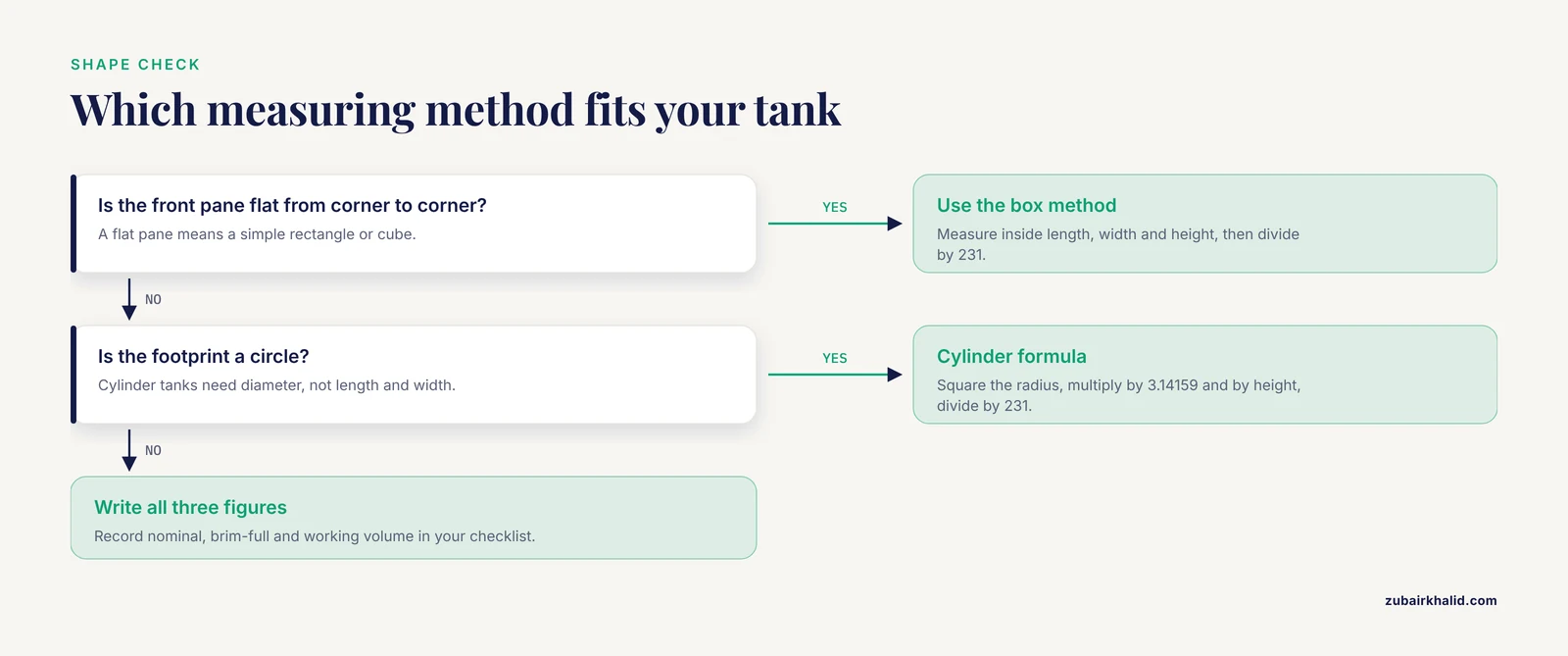
Rectangular and cube tanks follow the simple length-times-width-times-height rule. Other shapes need adjustment.
Bowfront Aquariums
A bowfront has a curved front pane that bulges outward. Treat it as a rectangle using the tank's maximum depth at the center of the curve for one estimate, and the depth at the corners for another, then average the two volumes. Alternatively, measure the rectangle formed by the back length, the average front-to-back depth, and the height, calculate the volume, and subtract roughly 10 percent for the curved corners that lose capacity relative to a full rectangle. The result lands within a few percent of the true figure.
Cylinder and Hexagon Tanks
For a cylinder, measure the inside diameter across the center, divide by two to get the radius, square the radius, multiply by 3.14159, multiply by the inside height, and divide by 231. For a hexagon, measure the width across the flats, treat the footprint as a hexagon with area of approximately 0.866 times the width squared, and multiply by height. Where the math gets tedious, a fish tank calculator with a shape selector is the faster and more reliable route.
Long, Shallow, and Rimless Tanks
Long low tanks, often used for bettas, axolotls, and shallow reef scapes, measure exactly like rectangles. The mistake to avoid here is assuming a tall narrow tank and a long shallow tank with the same volume behave the same way. They do not. Footprint, meaning length times width, drives surface area, swimming room, and territory space in ways that total gallons alone do not capture.
How to Measure Fish Tank Size: Practical Tips
These tips separate a careful measurement from a sloppy one.
- Measure twice at different heights. Glass panels are rarely perfectly parallel. If your top and bottom inside measurements differ by more than a quarter inch, average them.
- Use the inside faces, not the outside. Glass thickness on larger tanks can exceed a quarter inch per panel, which shifts a 55 gallon calculation by more than a gallon.
- Ignore the trim. Plastic framing adds height and width but no water.
- Convert units once, at the end. Mixing inches and centimeters mid-calculation is a leading source of errors.
- Write down the nominal size, the brim-full calculated size, and your working volume as three separate entries. Each one answers a different question. Nominal size matters for replacement parts and stands. Brim-full volume matters for capacity. Working volume matters for dosing.
- Record measurements in an aquarium care checklist along with filter model, heater wattage, stocking list, and water test results. Digital monitoring systems in professional and home settings increasingly track parameters such as dissolved oxygen, temperature, pH, ammonia, and nitrates continuously, and even a simple paper checklist serves the same goal of connecting your tank's physical specifications to its water quality record [4].
- Re-measure after any modification. Adding a sump, changing substrate depth, or installing a background overflow changes your working volume.
How to Measure Fish Tank Size: Common Mistakes
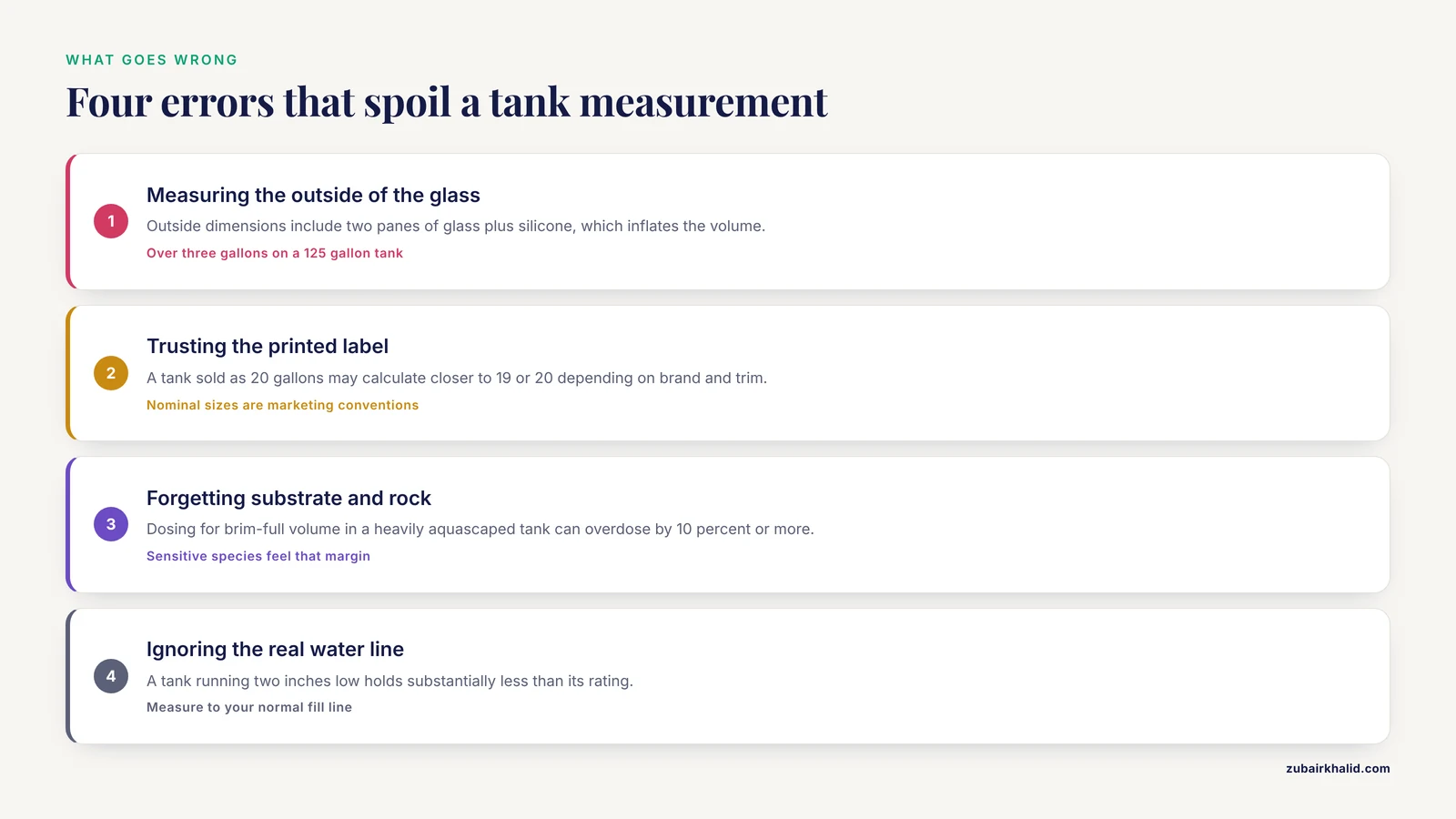
The following errors account for most bad tank measurements. Each one is avoidable.
Measuring the outside of the glass. Outside dimensions include two panes of glass plus silicone, inflating the calculated volume. On a 125 gallon tank this error can exceed three gallons.
Using the nominal label as the truth. A tank sold as 20 gallons may calculate closer to 19 or 20 depending on brand and trim. Nominal sizes are marketing conventions. Your measured working volume is the number that matters.
Forgetting the substrate and rock. Owners who dose medications for the brim-full volume of a heavily aquascaped tank can overdose by 10 percent or more. Invertebrates, scaleless fish, and sensitive species feel that margin.
Ignoring the water line. A tank that runs two inches low because of an overflow weir or a preferences for lower water can hold substantially less than its rating.
Assuming the tank is level. A tank sitting out of level has a skewed water line, and the shallow end holds less water than your calculation predicts. Place a level on the empty tank's bottom frame and shim the stand before filling.
Measuring a curved tank as a rectangle. Bowfront and corner tanks overestimate badly when measured as simple boxes.
Confusing gallons with imperial gallons. A US gallon is 3.785 liters, while an imperial gallon is 4.546 liters. Products imported from the United Kingdom sometimes dose per imperial gallon. Confirm which gallon a product label means before treating a sick fish.
Writing nothing down. A measurement you did not record is a measurement you will repeat incorrectly later, usually at the moment you are dosing an antibiotic at midnight.
Does Tank Shape and Size Configuration Matter Beyond Volume?
Volume is the headline number, but the same gallons arranged differently produce different living conditions. Research comparing rectangular and circular tanks of matched sizes found that circular tanks produced higher water flow rates than rectangular tanks, an effect the authors attributed to outlet placement and the resulting gravitational dynamics within the vessel [5]. Commercial circular systems are designed around this property, and while a home aquarium is not a production tank, the same physics applies. A tall narrow tank with the same gallons as a long shallow one has less surface area for gas exchange and less horizontal swimming room.
Fish size relative to tank size deserves equal attention. In juvenile red-spotted grouper, researchers documented that cannibalism becomes likely when a prey fish reaches roughly 60 percent of a cannibal's total length, and they used that morphometric relationship to design size-grading schedules that kept size distributions below the danger threshold. Home aquarists face the same biological logic in miniature. A tank must accommodate adult fish size, not purchase size, and fish of very different sizes in a modest volume create predation and aggression risks that no amount of filtration solves.
The encouraging counterpoint is that tank size is one welfare input among several. A judgement bias study in female guppies kept in small versus large tanks and in small versus large social groups found no difference in the fish's measured mental state across those housing conditions, suggesting either that the conditions were equally acceptable to the fish or that other factors dominated [6]. Clean, stable water and appropriate social structure can matter as much as raw volume. Measuring your tank correctly does not end the job. It starts a care plan that monitoring and maintenance carry forward.
Building Your Aquarium Care Checklist
An aquarium care checklist turns your measurements into a working management document. Keep it with your test kits and record entries on a schedule. Professional aquaculture increasingly relies on continuous sensing and automated management of water quality parameters, including ammonia, nitrate, temperature, pH, and dissolved oxygen, with alert thresholds that trigger intervention before fish suffer. Similar internet-connected systems pair water quality monitoring with disease detection and automated feeding to improve fish welfare with less manual intervention [7]. Research prototypes even deploy robotic sensor platforms that swim among the fish, reading water chemistry and reporting to the cloud [8]. Your checklist is the manual version of that infrastructure, and it costs nothing.
A complete home checklist includes:
- Measured inside dimensions: length, width, height
- Nominal tank size, brim-full calculated volume, and working volume
- Stand and location confirmation, including level check and weight allowance
- Filter model, media type, and last service date
- Heater wattage and thermostat set point
- Water change volume and frequency, plus dechlorinator dose per water change
- Test results for pH, ammonia, nitrite, and nitrate, logged by date
- Feeding type, amount, and frequency
- Stocking list with species, count, purchase date, and approximate size
- Notes on any treatments used, the dose calculated from your working volume, and the dates given
Review the checklist monthly. When a fish shows signs of illness, bring the checklist to your aquatic veterinarian. Dosing history, water trends, and accurate tank volume let a vet reach a diagnosis faster and prescribe safely.
Welfare and Safety Points Tied to Your Measurements
Your measurements protect you as well as the fish. Water weighs about 8.34 pounds per gallon, so volume and weight scale together, and an underbuilt stand or a floor that cannot carry a filled 75 gallon system is a household hazard as much as an animal welfare one. Confirm the stand rating against your calculated full weight before filling any tank larger than 20 gallons, and place large systems on load-bearing floors near walls.
From the fish's side, accurate volume supports three welfare essentials. First, it enables correct dosing of water conditioners and medications. Second, it allows realistic stocking plans matched to adult body size, which professional aquaculture manages deliberately through grading and density control because crowding and size mismatch drive injury and mortality. Third, it anchors oxygen and filtration planning, since oxygen demand scales with fish biomass, a relationship that professional systems calculate explicitly when managing feed and fish mass [3].
If you are unsure whether your tank suits a species you want to keep, ask an aquatic veterinarian or a qualified fish health professional before you buy. The World Aquatic Veterinary Medical Association maintains resources for finding aquatic animal veterinarians, and the AVMA publishes pet owner guidance on aquatic animal care. These organizations are useful referral points when a husbandry question crosses into a health question.
Limitations and When to Contact a Veterinarian
Measuring a tank is husbandry, not medicine, but the two meet at stocking, water quality, and treatment. Individual cases vary, and a qualified veterinarian should evaluate any specific health concern with your fish.
Contact an aquatic veterinarian, or a general practitioner with aquatic experience, in any of these situations:
- A fish shows abnormal swimming, gasping at the surface, clamped fins, lesions, frayed fins, loss of appetite, or sudden death in the tank
- Water tests show ammonia or nitrite above zero despite your maintenance routine, or you cannot interpret your results against your tank's working volume
- You need to treat disease and are unsure how to calculate a dose from your working volume, especially in tanks with invertebrates, live plants, or sensitive scaleless species
- You are planning to add fish and want a stocking and compatibility review based on your measured footprint and volume, particularly where size differences between existing and new fish could create predation risk
- You are moving a large filled or partially filled tank and need guidance on safe handling and fish transport
- Your fish stopped eating, breeding, or growing despite water parameters that look acceptable, since growth and intake are sensitive to holding conditions and recent changes in environment
Escalate urgently, rather than at the next scheduled check, if multiple fish show signs at once, if fish are gasping or gathering at the filter outflow, or if the water has changed color or smell suddenly. Those patterns suggest acute water quality failure or infectious disease, and hours matter.
Frequently Asked Questions
How do I calculate my fish tank's volume in gallons?
Multiply the inside length, inside width, and inside height in inches, then divide the product by 231. For example, 30 × 12 × 18 equals 6,480 cubic inches, and 6,480 divided by 231 equals about 28 gallons.
Is the size printed on the tank the same as the actual water volume?
No. The printed size is a nominal figure used for retail, and your actual working volume is lower after you subtract headspace above the water line and the space taken by substrate, rocks, and decorations. Use your measured working volume for dosing and stocking decisions.
Do I measure a fish tank from the inside or the outside?
Measure from the inside faces of the glass whenever the tank is empty or you can reach the inside. Outside measurements include glass thickness and trim, which inflates the calculated volume. If the tank is full and running, measure outside and subtract the glass thickness, or use the manufacturer's inside specification if available.
How do I measure a bowfront or curved aquarium?
Measure the back length, the height, and the front-to-back depth at both the center of the curve and the corners. Average the two depth readings, calculate the resulting rectangle, and subtract roughly 10 percent to account for the curved corners. A fish tank calculator with a bowfront option gives a more precise figure.
How much does a filled fish tank weigh?
Multiply your working water volume in gallons by 8.34 to get the water weight, then add the empty tank weight, substrate, rock, stand, and equipment. Water dominates the total, so a tank advertised as 55 gallons carries well over 450 pounds of water alone once filled.
How many fish can I keep in my measured tank?
Base stocking on adult fish size, behavior, and your tank's footprint, not on total gallons alone, and be cautious about mixing fish of very different sizes, since size mismatch drives aggression and predation in many species. When you have a calculated volume and a species list in mind, confirm the plan with an aquatic veterinarian or an experienced fish health professional.
Does tank shape matter if the volume is the same?
Yes. Two tanks with equal volume can differ in surface area, swimming room, and water circulation. Circular tanks move water differently than rectangular ones, and a long shallow footprint supports different behavior than a tall narrow one. Shape, not just gallons, should inform which species you keep.
What should I do if my tank has no size label?
Measure the inside dimensions yourself and calculate the volume with the length-times-width-times-height formula, dividing by 231 for gallons. Write the nominal, brim-full, and working volumes into your aquarium care checklist so the numbers are available for dosing, filtration, and veterinary visits.
Sources
- Tank size and fish management history matters in experimental design
- Tank size and aquaculture management influence on the production of gold fish, Carassius auratus (L.), under tropical conditions.
- Automated within tank fish mass estimation using infrared reflection system
- Development of a Smart Fish Tank Monitoring System using Deep Learning and Multi-Sensor Networks
- Production of Energy from Water Flow Output in Fish Tank
- Insights from the judgement bias paradigm: social group and tank size do not affect mental state in female guppies.
- IoT-Based Solution for Fish Disease Detection and Controlling a Fish Tank Through a Mobile Application
- AI Based Fish Farm Management System Using Internet of Under Water Things (IoUT)