How Many Lumens Do You Need for Your Fish Tank? A Simple Guide
By Dr. Zubair Khalid, DVM, MS, PhD ·
Most fish tanks need between 15 and 40 lumens per liter of water. That works out to roughly 55 to 150 lumens per gallon. A standard 20-gallon tank therefore needs about 1,100 to 3,000 lumens depending on what lives in it, while a planted tank usually sits at the higher end of that range and a fish-only tank at the lower end. If you want a single number to start with, aim for 20 lumens per liter (about 75 lumens per gallon) and adjust from there based on your plants, your fish, and how the tank responds over the first few weeks.
Lighting is one of the most commonly misjudged parts of aquarium care. Too little light and live plants struggle, which degrades water quality. Too much light and you get algae blooms, stressed fish, and a tank that looks worse, not better. Aquatic veterinary guidance consistently emphasizes that stable environmental conditions, including appropriate light cycles, are central to keeping ornamental fish healthy. This guide gives you a practical formula, worked examples, and a checklist you can act on today.
At a Glance: Lighting Targets by Tank Type
| Tank type | Target lumens per liter | Target lumens per gallon | Example for a 20-gallon tank |
|---|---|---|---|
| Fish-only, low light | 10 to 15 | 40 to 55 | 750 to 1,150 lumens |
| Community tank with easy plants | 15 to 25 | 55 to 95 | 1,150 to 1,900 lumens |
| Planted tank, moderate light | 25 to 40 | 95 to 150 | 1,900 to 3,000 lumens |
| High-light planted or aquascape | 40 to 60+ | 150 to 225+ | 3,000 to 4,500+ lumens |
Quick checklist you can complete today:
- Measure your tank in gallons and multiply by 3.785 to get liters.
- Choose a target from the table above based on what you keep.
- Multiply liters by your target lumens per liter.
- Pick an LED fixture rated at or slightly above that output, since real-world output is always lower than the box number.
- Put the light on a timer set for 8 to 10 hours per day.
- Reassess after two to four weeks and adjust.
Why Light Matters for Fish Health, Not Just Looks
Light in an aquarium does three jobs at once. It powers photosynthesis in live plants, it sets the daily rhythm your fish follow, and it drives the algae balance in the tank. All three affect fish welfare directly.
Fish are not plants, but they are strongly affected by light cycles. A consistent photoperiod supports normal feeding behavior, resting behavior, and coloration. Constant illumination, or a light that blasts the tank 16 hours a day, disrupts rest and is a recognized stressor in ornamental fish husbandry. Chronic stress in fish suppresses immune function and makes them more susceptible to the common bacterial, fungal, and parasitic diseases seen in home aquaria. This is why lighting duration and intensity belong in the same conversation as water quality, not just decor.
Live plants add another layer. Healthy aquatic plants consume dissolved nitrogen compounds and produce oxygen during the lit period, which supports water quality. When light is insufficient, plants decline, decaying plant matter adds nutrients back into the water, and water quality suffers. When light is excessive relative to the nutrients available, algae take over. The Merck Veterinary Manual notes that poor water quality and environmental instability are among the leading contributors to disease in pet fish, and lighting imbalances are one of the most common upstream causes of that instability.
The World Aquatic Veterinary Medical Association frames environmental management, including light, as part of responsible husbandry for ornamental fish kept in home aquaria. In practical terms, your goal is not maximum brightness. Your goal is the right amount of light for your specific tank, delivered on a predictable schedule.
Lumens, Watts, Kelvin, and PAR: What Each Number Actually Tells You
Aquarium lighting marketing throws four different units at buyers. Here is what each one means and which one you should actually use.
Lumens measure the total amount of visible light a fixture emits as perceived by the human eye. This is the most useful single number for comparing LED fixtures at the pet-owner level, and it is the basis for the formula in this guide.
Watts measure electrical energy consumption, not light output. The old hobby rule of "watts per gallon" made sense in the fluorescent era, when wattage correlated reasonably well with brightness. Modern LED fixtures produce far more light per watt, so watts per gallon rules no longer translate. A 30-watt LED fixture can outperform a 100-watt fluorescent tube. Use watts only to estimate your electricity cost.
Kelvin describes color temperature, not brightness. Freshwater community tanks generally look best and support photosynthesis well in the 5,500 to 8,000 Kelvin range, which mimics neutral daylight. Very blue-heavy spectra are marketed for marine tanks and can make freshwater plants look odd. Kelvin choice is largely aesthetic, so pick what shows your fish and plants well.
PAR (photosynthetically active radiation) measures the light plants can actually use for photosynthesis at a given point in the tank. It is the most scientifically precise metric for planted tanks, but most consumer fixtures do not publish PAR data, and measuring it requires specialized equipment. Lumens are the practical proxy. If a manufacturer does publish PAR values at different depths, use them as a secondary check for a demanding planted setup.
The reason lumens work as a starting point is simple. Lumens scale with tank size in a way watts no longer do, and they are printed on nearly every modern fixture.
The Formula: How to Calculate How Many Lumens for Your Fish Tank
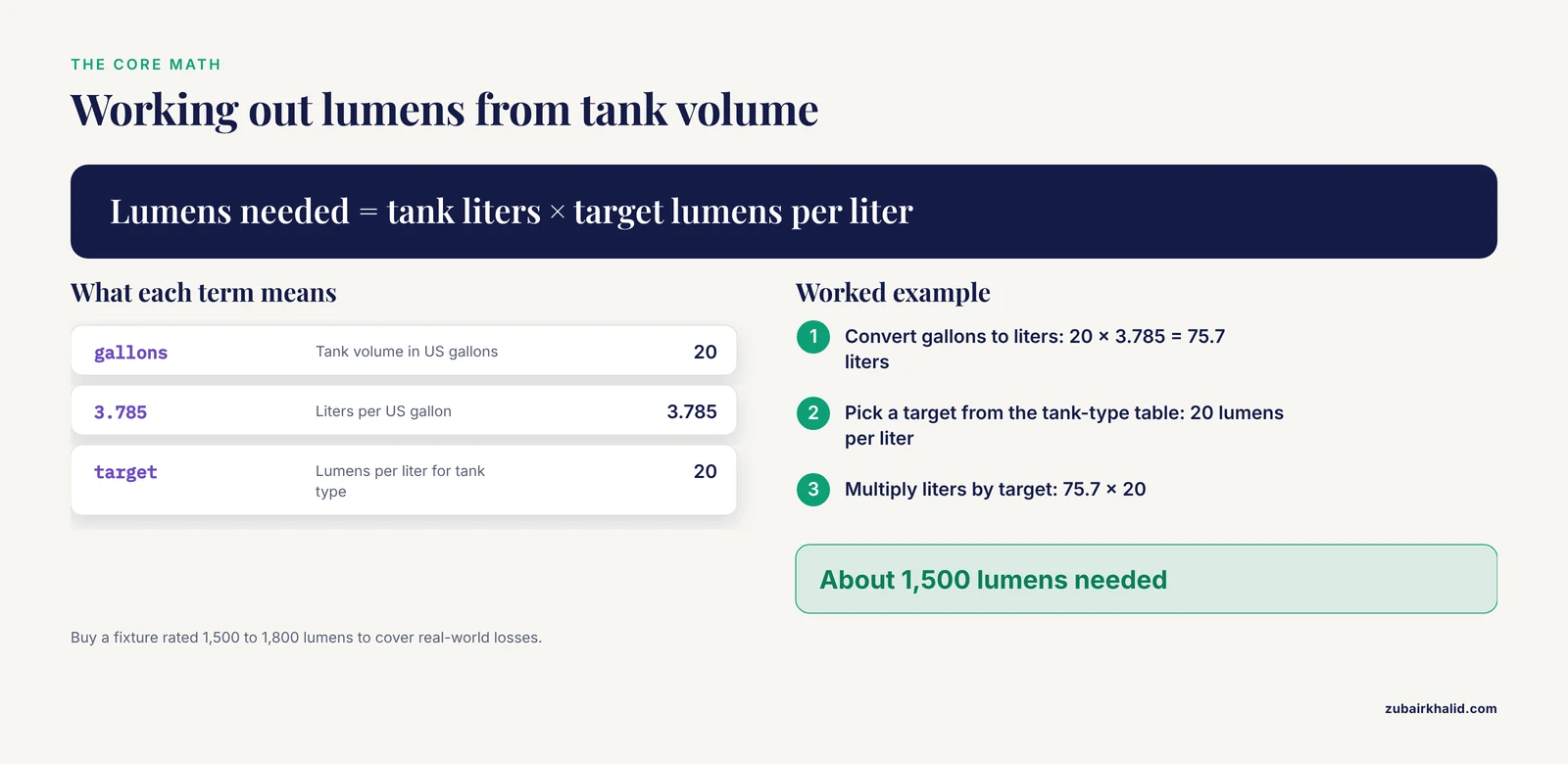
The calculation takes two steps.
Step 1. Convert your tank volume to liters.
US tanks are sold by gallons. Multiply gallons by 3.785.
- 10-gallon tank = 37.9 liters
- 20-gallon tank = 75.7 liters
- 29-gallon tank = 109.8 liters
- 40-gallon tank = 151.4 liters
- 55-gallon tank = 208.2 liters
- 75-gallon tank = 283.9 liters
If you know your tank dimensions but not its rated volume, multiply length in inches by width in inches by height in inches, divide by 231 to get gallons, then convert to liters. Use the actual water volume if your tank is not filled to the brim, since substrate, rocks, and driftwood displace water.
Step 2. Multiply liters by your target lumens per liter.
Lumens needed = tank liters × target lumens per liter
Choose your target from the tank-type table above. Fish-only setups need the least light. Tanks with live plants need more, and demanding planted aquascapes with high-light plant species need the most.
This is the core of how to calculate how many lumens for fish tank setups of any size. The formula is deliberately simple. Real tanks add complications, which the next section addresses.
Worked Examples
Worked Example 1: A 20-Gallon Community Tank with Easy Plants
A 20-gallon tank holds about 75.7 liters. You keep tetras, corydoras, and a few easy plants like java fern and anubias, which tolerate low to moderate light. Target 20 lumens per liter.
75.7 × 20 = approximately 1,500 lumens
Look for an LED fixture rated around 1,500 to 1,800 lumens for this tank. That slight buffer accounts for real-world losses discussed below.
Worked Example 2: A 55-Gallon Fish-Only Tank
A 55-gallon tank holds about 208 liters. You keep a mix of community fish with no live plants, or only plastic and silk plants. Target 12 lumens per liter.
208 × 12 = approximately 2,500 lumens
A fixture rated 2,300 to 2,700 lumens covers this comfortably. There is no reason to buy a high-output planted-tank fixture for a fish-only aquarium, since the extra light primarily feeds algae.
Worked Example 3: A 10-Gallon Betta Tank with Low Light Plants
A 10-gallon tank holds about 38 liters. Bettas prefer subdued lighting and heavily planted, calm environments. Target 15 lumens per liter.
38 × 15 = approximately 570 lumens
A small fixture rated 500 to 700 lumens is appropriate. This example also shows why lumens per liter beats one-size-fits-all advice. The same rule that sizes a 55-gallon cichlid tank also correctly produces a modest, gentle light for a small betta aquarium.
Worked Example 4: A 40-Gallon High-Light Planted Tank
A 40-gallon tank holds about 151 liters. You are keeping stem plants and carpeting species that demand strong light. Target 45 lumens per liter.
151 × 45 = approximately 6,800 lumens
At this level you are shopping for dedicated planted-tank LED fixtures, and you should plan for CO2 supplementation and a fertilization routine as well, because high light without adequate carbon and nutrients produces algae rather than growth.
Adjusting the Number: Real-World Factors That Change the Math
The formula gives you a starting point. Several physical factors determine whether your actual delivered light matches the number on the box.
Tank depth. Light intensity falls off rapidly with distance from the source. A fixture that comfortably lights a 16-inch-tall tank will under-light a 24-inch-tall tank of the same footprint. For tanks deeper than about 20 inches, bias toward the high end of your target range or choose a fixture with focused optics designed for deeper aquaria.
Fixture efficiency and optics. Two fixtures with identical lumen ratings can deliver very different light to the substrate depending on reflector design, lens, and diode arrangement. Wide, diffuse optics spread light across a broad shallow tank. Narrow optics concentrate light downward for deep tanks.
Lid, canopy, and glass cover. A glass top or plastic canopy absorbs a meaningful share of output before light ever reaches the water. Open-top tanks deliver more usable light from the same fixture. If you run a covered tank, add roughly 10 to 20 percent to your target.
Floating plants and surface cover. Frogbit, duckweed, and similar floaters shade everything below them. Tanks with heavy surface cover can run at the low end of the range and still support fish and shade-tolerant plants.
Plant mass and fish load. A densely planted tank with a light fish load can use more light productively. A sparsely planted tank with a heavy fish load cannot. Match the light to the biological reality of your tank, not the other way around.
Ambient room light. A tank in a bright room receives supplemental light all day. A tank in a dim room relies entirely on its fixture. Bright-room tanks can run shorter photoperiods.
Photoperiod: How Long the Light Stays On Matters as Much as Brightness
Intensity and duration work together, and duration is where many owners go wrong. Standard hobby practice for both fish-only and planted freshwater tanks is 8 to 10 hours of light per day, on a timer, at the same times daily. Planted tanks with strong lighting often do better at 6 to 8 hours, especially while the aquascape matures.
A timer is not optional equipment. Fish adapt poorly to erratic light schedules, and inconsistent photoperiods are a frequent contributor to algae problems because the tank never reaches a stable equilibrium. If you keep light-sensitive species or notice persistent stress behaviors such as constant hiding or flaring, discuss your lighting schedule with an aquatic veterinarian, since behavior changes in fish can signal environmental problems, disease, or both.
Every tank needs a true dark period. Leaving a light on around the clock, or relying on a bright room as continuous illumination, prevents normal rest and is a recognized husbandry error in ornamental fish care. If your tank lights are also the room's ambient light, add a dim night light or room lamp elsewhere so the tank itself goes dark.
Choosing Equipment: What to Look For in an Aquarium Light
Modern LED fixtures dominate the market for good reasons. They are energy efficient, they produce little heat, they last years, and most offer adjustable output. When comparing fixtures, use these selection criteria rather than brand names.
- Rated lumens at least equal to your calculated target. Treat published numbers as optimistic and buy one step up if you are between ratings.
- Adjustable intensity. Dimming lets you fine-tune without replacing hardware and lets you ramp light up gradually in a new tank, which reduces early algae pressure.
- Appropriate spectrum. Look for a full-spectrum white output in roughly the 5,500 to 8,000 Kelvin range for freshwater community and planted tanks.
- Footprint coverage. The fixture should span most of the tank length. Undersized fixtures create bright centers and dark corners, which plants show you quickly.
- Timer or programmability. Built-in timers or app control eliminate the most common husbandry mistake, which is inconsistent on-off schedules.
- Mounting height and adjustability. Raising a fixture away from the water surface reduces delivered intensity, which is a useful tuning tool.
- Heat and electrical safety. Fixtures sit above open water. Look for splash-resistant construction and follow the manufacturer's drip-loop guidance on cords. Electrical safety near water is a genuine hazard in home aquaria and deserves the same attention as any other equipment around the tank.
Avoid fixtures that publish only wattage with no lumen or output data, and be skeptical of lumens-per-dollar marketing on fixtures with no adjustability. A slightly costlier dimmable fixture usually outperforms a fixed-output unit over the life of the tank.
Common Mistakes and How to Fix Them
Buying too much light for a fish-only tank. Excess light with no plants to use it produces algae. If your tank has no live plants, stay at the low end of the range and keep photoperiods moderate.
Ignoring the dark period. Lights running 12 or more hours daily, or left on indefinitely, cause chronic stress and persistent algae. Fix this with a timer before buying any new equipment.
Chasing algae with more light changes than the tank can absorb. When algae appears, owners often cut light drastically or leave it off for days. Sudden, large changes destabilize the tank further. Reduce photoperiod by one to two hours, hold that schedule for two weeks, and reassess.
Judging the tank in the first week. New tanks go through bacterial and algal swings as biological filtration establishes. Aquatic veterinary resources consistently point to the establishment of stable biological filtration and stable water chemistry as the foundation of fish health. Make lighting adjustments slowly and give each change time to show results.
Skipping acclimation for new fish. Turning full light on immediately after introducing fish adds visual stress to an already stressful transition. Dim the light or leave it off for the first several hours after any fish enters the tank.
Confusing watts with output. Replacing an old fluorescent setup with an LED of equal wattage will often leave you badly under-lit. Always recalculate in lumens when switching technology.
Troubleshooting Light-Related Problems
Persistent green or brown algae on surfaces. This usually means light and nutrients are out of balance. Reduce photoperiod to 6 to 8 hours, verify you are not overfeeding, and increase live plant mass if appropriate. Note that some algae presence in a mature tank is normal and not a disease state.
Stunted or pale plant growth. Insufficient intensity is the usual cause in planted tanks, especially in deeper aquaria. Move toward the higher end of your target range or raise output gradually. Pale, yellowing new leaves can also indicate nutrient deficiency, so address both light and nutrition.
Fish hiding constantly or appearing washed out. Some species prefer subdued light and heavy cover. Dim the fixture, add floating plants or structure, and observe. Persistent abnormal behavior, rapid breathing, clamped fins, or lesions are medical concerns, not lighting problems, and warrant veterinary evaluation.
Plants fine, fish restless at lights-on. A sudden jolt of full brightness startles many species. Use a ramp-up feature if your fixture has one, or start the day at reduced intensity.
Cloudy water after increasing light. Rapid algal or bacterial growth can follow an abrupt increase in photoperiod or intensity. Step light back to its previous level, confirm filtration is appropriate for the stock, and test water parameters before increasing light again.
Welfare and Safety Points
Environmental stability is the throughline of aquatic animal welfare. The AVMA's guidance for pet fish owners emphasizes maintaining appropriate water quality, suitable environment, and attentive daily observation as the cornerstones of keeping ornamental fish healthy. Lighting decisions feed directly into that stability because light drives plant health, algae balance, and fish behavior.
Two safety points deserve explicit mention. First, electricity and water coexist in every aquarium. Use equipment rated for aquarium use, keep cords arranged so water cannot travel along them into an outlet, and use a drip loop on every connection. Second, resist the urge to use lighting as entertainment. Tapping the glass or flashing lights at fish to provoke a response is a stressor, and repeated acute stress contributes to disease susceptibility in ornamental fish. Watch the tank in calm conditions and let the fish set the pace.
Your Aquarium Care Checklist
Lighting is one item on a longer list of daily and weekly husbandry tasks. Here is a compact aquarium care checklist that places lighting in context.
Daily
- Confirm the light ran on its normal schedule via the timer.
- Observe every fish briefly for behavior, breathing, and appetite.
- Verify equipment is running (filter flow, heater, aeration).
- Feed appropriately and remove uneaten food.
Weekly
- Test water parameters and record the results.
- Perform a partial water change appropriate to your stocking and plant load.
- Clean the glass and remove visible algae by hand.
- Trim plants and remove dead leaves before they decay.
- Check that the fixture, timer, and mounts are secure and dry.
Monthly
- Wipe or rinse the light cover or lens, since dust and mineral film cut delivered light significantly.
- Assess overall algae and plant trends and adjust photoperiod gradually if needed.
- Review fish count against tank capacity as fish grow.
Seasonally or as needed
- Replace LED fixtures that have visibly dimmed with age.
- Reassess your lumen target whenever you change the tank's plant load or stocking.
Owners who want to streamline the math can build their own fish tank calculator in a spreadsheet with three cells: gallons, liters (gallons × 3.785), and required lumens (liters × target). Because the target differs by tank type, a simple version uses one target value while a fuller version includes a dropdown for fish-only, community planted, or high-light planted.
Limitations and When to Contact a Veterinarian
The lumen ranges in this guide are general husbandry starting points drawn from established hobby practice. Individual tanks vary with depth, plant mass, stocking, nutrient dosing, and ambient room light, so treat the formula as a baseline and adjust based on how your specific tank responds. Individual cases, especially those involving disease, need evaluation by a veterinarian with aquatic animal experience, and no article can replace that assessment.
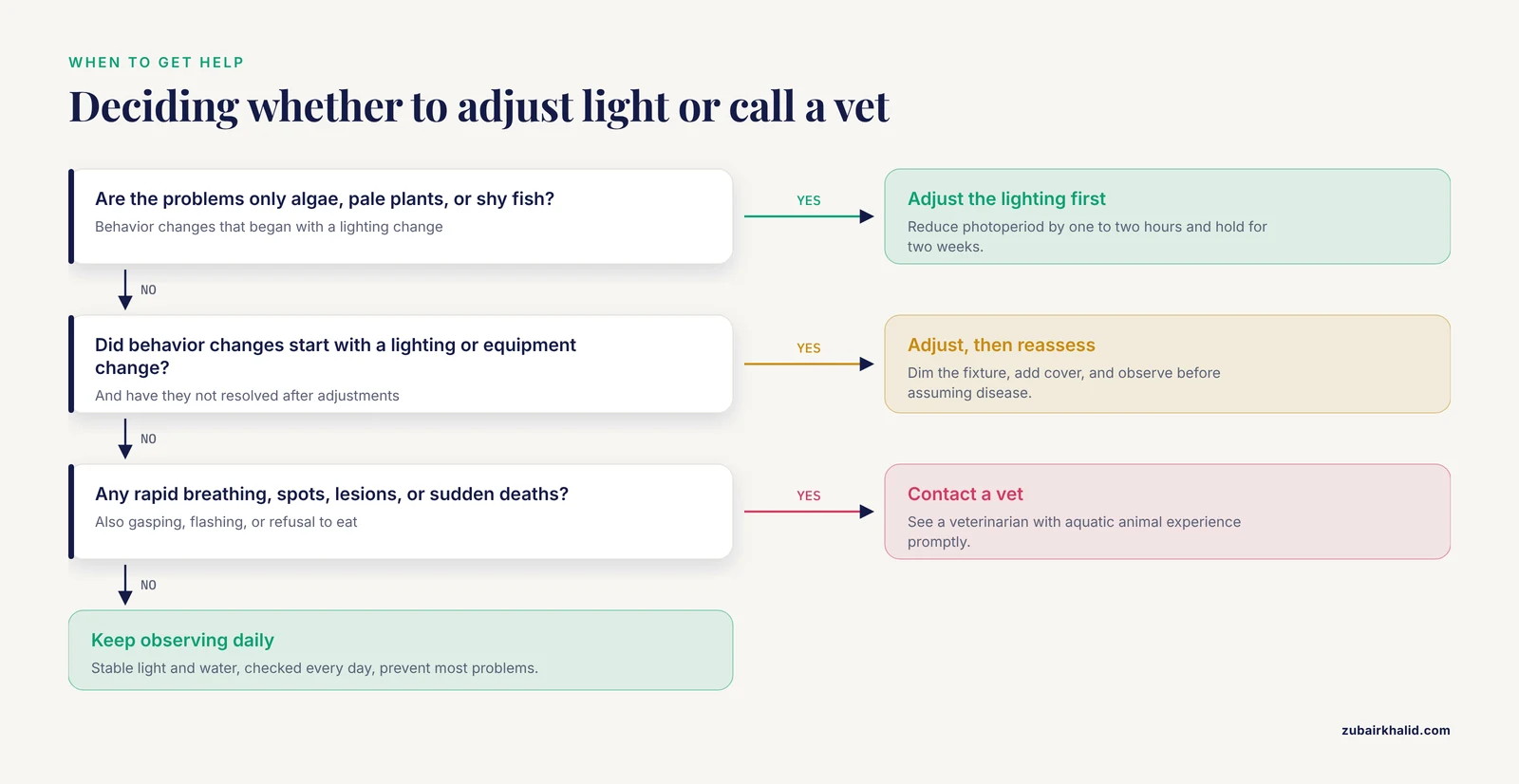
Contact a veterinarian, ideally one with aquatic animal training or certification through organizations such as the World Aquatic Veterinary Medical Association, if you observe any of the following:
- Rapid breathing, gasping at the surface, or labored ventilation
- White spots, frayed fins, ulcers, red streaks, dropsy-like swelling, or visible parasites
- Sudden deaths or multiple fish ill at once
- Abnormal swimming, loss of balance, or flashing (rubbing against surfaces)
- Refusal of food lasting more than a couple of days
- Water quality problems that persist despite corrective water changes
- Behavior changes that began alongside lighting or equipment changes and did not resolve after adjustments
Aquatic veterinarians can distinguish environmental disease from infectious disease and can guide water-quality correction, which is usually the first intervention in sick aquaria. Bring recent water test results, your stocking list, and your lighting and feeding schedule to the appointment, since those details accelerate diagnosis.
Frequently Asked Questions
How many lumens do I need for a fish tank?
Most fish tanks need 15 to 40 lumens per liter, which equals roughly 55 to 150 lumens per gallon. Fish-only tanks sit at the low end, community tanks with easy plants in the middle, and demanding planted tanks at the high end. Multiply your tank's liters by the target for your tank type to get your number.
Is there a simple formula for fish tank lumens?
Yes. Liters × target lumens per liter = total lumens needed. Convert gallons to liters by multiplying by 3.785. For example, a 75.7-liter 20-gallon tank at 20 lumens per liter needs about 1,500 lumens.
How many lumens for a 55-gallon fish tank?
A 55-gallon tank holds about 208 liters. A fish-only setup needs roughly 2,100 to 3,100 lumens at 10 to 15 lumens per liter. A planted 55-gallon needs roughly 3,100 to 5,200 lumens at 15 to 25 lumens per liter, and high-light planted tanks need more.
Are watts or lumens better for choosing an aquarium light?
Lumens are better. Watts measure electricity consumed, not light produced, and modern LED fixtures generate far more light per watt than the older fluorescent systems that watts-per-gallon rules were based on. Compare fixtures by lumen output and use watts only for estimating running cost.
How many hours a day should aquarium lights be on?
Most freshwater tanks do well with 8 to 10 hours of light daily on a timer. Strongly lit planted tanks often do better at 6 to 8 hours. Every tank needs a genuine dark period for fish to rest, and erratic schedules contribute to stress and algae.
Can too much light harm my fish?
Excessive light primarily harms the tank's balance by driving algae growth and destabilizing water chemistry, and it can stress fish by extending their active period or eliminating their dark rest phase. Chronically stressed fish are more susceptible to disease. Adjust photoperiod and intensity gradually rather than abruptly.
Do betta fish need low light?
Bettas generally prefer subdued lighting and benefit from heavily decorated tanks with shaded resting areas. For a 10-gallon betta tank, roughly 500 to 700 lumens at around 15 lumens per liter is a sensible target, ideally delivered by a dimmable fixture on a timer.
When should I ask a veterinarian about my aquarium lighting?
Ask a veterinarian with aquatic experience when abnormal behavior, breathing changes, skin or fin lesions, refusal to eat, or unexplained deaths occur, or when water quality problems persist despite your corrections. Lighting changes can contribute to stress and instability, but those clinical signs usually require medical evaluation rather than another adjustment to the light timer.
This article is educational and is not a substitute for veterinary diagnosis or treatment.