Heavy Metals in Aquarium Water: Common Problems and Fixes
By Dr. Zubair Khalid, DVM, MS, PhD ·
Heavy metals in aquarium water enter the tank in three main ways: through the tap water you use for water changes, through copper plumbing, equipment, and medications, and through rocks, gravel, or decorations that slowly leach metals into the water. The fix follows a predictable sequence. Identify and remove the source, dilute the contamination with partial water changes using verified clean water, run adsorptive filtration or metal-accumulating plants, and retest until levels stay low. Fish exposed to metals can carry tissue residues for weeks after the water looks clean, so patience and follow-up testing matter as much as the initial response.
This guide walks through the causes, the biological effects, the testing options, and the practical fixes, along with a maintenance checklist that keeps the problem from coming back.
At a Glance: Your First 48 Hours
| What you notice | Likely explanation | Do today | Do next |
|---|---|---|---|
| Sudden deaths across several species, gasping at the surface, inflamed gills | Acute metal spike, often from source water or a recent treatment | Stop all dosing products, perform a large partial water change with tested clean water | Test source water and tank water, review everything added in the past two weeks |
| Snails or shrimp dying while fish appear fine | Sensitive invertebrates often react to metals first | Move survivors to clean, aged water if possible | Investigate tap water and copper sources |
| Slow decline in appetite, color, and activity over weeks | Chronic low-level exposure | Pull any suspect rocks or ornaments | Request a water quality report or lab test on your source water |
| Recurring problem after water changes | The source is still active, usually the supply line or an ornament | Test the water you are adding, not just the tank | Switch to an alternative water source such as reverse osmosis water |
What Heavy Metals Are and Why Closed Aquariums Are Vulnerable
The term heavy metals covers elements such as copper, zinc, cadmium, lead, mercury, nickel, arsenic, and uranium that are toxic to aquatic life above trace concentrations. Iron, manganese, zinc, and copper are also essential micronutrients, which is part of what makes diagnosis tricky. Plants and animals need tiny amounts, but the margin between a nutrient and a poison is narrow, and research on aquarium plants shows that accumulation behavior changes with both the metal and the dose present in the water [1].
An aquarium is a closed recirculating system. Unlike a river, it has no continuous flush. Whatever enters the water stays there unless something actively removes it, through a water change, an adsorptive filter medium, or a living organism that takes the metal into its own tissues. Metals do not break down the way organic waste does. A filter that handles ammonia and nitrite beautifully does nothing for dissolved copper or lead.
This is why small, ongoing inputs matter so much. A trickle of metal from a corroded fitting or a slightly contaminated source water supply accumulates week after week until fish, invertebrates, or plants begin to show damage.
Heavy Metals in Aquarium Water Causes
Tap Water and Source Water
Municipal tap water in the United States is tested against federal maximum contaminant levels set by the Environmental Protection Agency for human drinking water. Those limits are designed for human health, not for the most sensitive animals in your tank. Research on apple snails cultured in tap water found trace elements including mercury, arsenic, and uranium present at concentrations within the maximum allowed for human consumption, and those elements accumulated in the snails' tissues [2]. Water that is perfectly legal and safe for you to drink can still carry a metal load that stresses delicate aquarium animals over months of exposure.
Private wells add another layer of uncertainty. Well water is not regulated the way municipal supply is, and naturally occurring arsenic, lead from old well components, or industrial runoff can appear without warning. If you keep sensitive species, know what is in your source water before it goes in the tank.
Copper From Plumbing, Equipment, and Treatments
Copper deserves its own warning. Older homes may have copper supply lines, and hot water drawn from those lines carries more dissolved copper than cold water. Some fish medications and algaecides contain copper compounds, and dosing errors are one of the most common ways keepers accidentally poison their own tanks.
Copper is especially dangerous because damage can continue after the water is clean. In controlled laboratory exposures, cold-water corals exposed to copper concentrations between 60 and 600 micrograms per liter for 96 hours showed no immediate mortality during the exposure itself. Deaths then occurred in a concentration-dependent pattern over the following one to three weeks, even after the animals were moved to clean flowing water [3]. A tank can look recovered while animals are already doomed. This delayed mortality is why any copper exposure in a tank with invertebrates should be treated as an emergency, not a wait-and-see problem.
Leaching From Rocks, Substrate, and Decorations
Not everything sold for aquariums is inert. Crushed substrates and some rocks can release metals, particularly in soft, acidic water, which dissolves minerals more aggressively. Salvaged materials, gravel from craft stores, painted or glazed ornaments not made for aquariums, and metal frames or fittings in contact with water are all recurring sources. If a problem began shortly after a new item went into the tank, remove that item first and retest.
How Metals Harm Fish, Invertebrates, and Snails
Metals damage aquatic animals through several pathways, and much of the harm is invisible from outside the glass.
Endocrine and reproductive disruption. In the apple snail study mentioned above, females reared in tap water developed significantly longer copulatory structures than females reared in metal-free water, indicating that real-world tap water metal loads can alter development in sensitive invertebrates [2]. Reproductive and developmental changes like these are hard for a hobbyist to see and easy to misattribute to genetics or diet.
Organ damage and stress physiology. In a cadmium-polluted tilapia culture system, contaminated water produced measurable harm across the body. Cadmium accumulated in the liver, gills, and muscle, and the fish showed elevated plasma lipids, glucose, the stress hormone cortisol, the liver enzymes AST and ALT, and the kidney function marker urea, along with depressed white blood cell counts [4]. In plain terms, the fish were under biochemical stress with strained livers and kidneys long before an owner would necessarily notice anything wrong at the glass.
Direct uptake from water. Fish do not need to eat a contaminant to accumulate it. Controlled aquarium experiments with silver Prussian carp demonstrated measurable uptake of dissolved contaminants directly from the water into muscle and bone tissue, with uptake rates that rose sharply with water temperature and feeding level [5]. This means a contaminated tank doses its residents continuously, even when they are fed clean food.
Slow clearance. The same carp work found that once tissues were contaminated, levels declined slowly, with biological half-lives ranging from roughly 75 to 248 days depending on water temperature and feeding rate [5]. Cleaning the water does not instantly clean the fish. This single fact shapes the entire recovery timeline after a metal event.
Translation from water to body burden. A study comparing wild and captive spotted seal pups found significant differences in metal levels among hair, blood, and feces and confirmed correlations between metal levels in the animals and in their water environments [6]. The lesson for keepers is straightforward. What dissolves in your tank water ends up in your animals.
Signs Your Tank May Have a Metal Problem
Heavy metal toxicity produces signs that overlap with many other water quality problems, so treat this list as a reason to test rather than a diagnosis.
- Sudden or unexplained deaths, especially of invertebrates, sometimes with no visible external damage
- Gasping, rapid gill movement, or red and inflamed gill tissue
- Loss of appetite, lethargy, hiding, or clamped fins without a detectable ammonia or nitrite problem
- Poor color, failed molts in shrimp, or abnormal shell growth in snails
- Reproductive failure, eggs that never hatch, or unusual developmental changes in a colony
- Chronic, gradual decline in a tank where all standard parameters test normal
The tilapia cadmium work is a useful reality check here. The most reliable indicators of metal poisoning in that study were internal, blood chemistry, liver enzymes, stress hormones, and tissue metal levels, none of which an owner can see [4]. When fish sicken and your ammonia, nitrite, nitrate, and pH all check out, unmeasured contaminants belong near the top of your suspect list.
Testing: Confirm the Problem Before You Spend Money
Standard aquarium test kits measure ammonia, nitrite, nitrate, pH, hardness, and sometimes chlorine. They do not measure copper, zinc, lead, mercury, or arsenic. To confirm metals, you have three practical routes.
- Your utility's annual water quality report. Water suppliers in the United States publish consumer confidence reports listing detected contaminants, including lead, copper, and arsenic. This is free and tells you what is arriving at your tap.
- A copper test kit. These are available at aquarium retailers and are worth owning if you keep invertebrates or reefs, or if you ever use copper-based medications.
- Laboratory analysis. A certified water testing lab can run a metals panel on a sample of your source water or tank water. This is the definitive option when the stakes are high or the cause is unclear.
Test the source water and the tank water separately. If the tank reads high and the source reads low, the problem is inside the system, such as an ornament, a fitting, or a treatment. If both read high, your incoming water is the source and no amount of in-tank remediation will outpace it.
How to Fix Heavy Metals in Aquarium Water
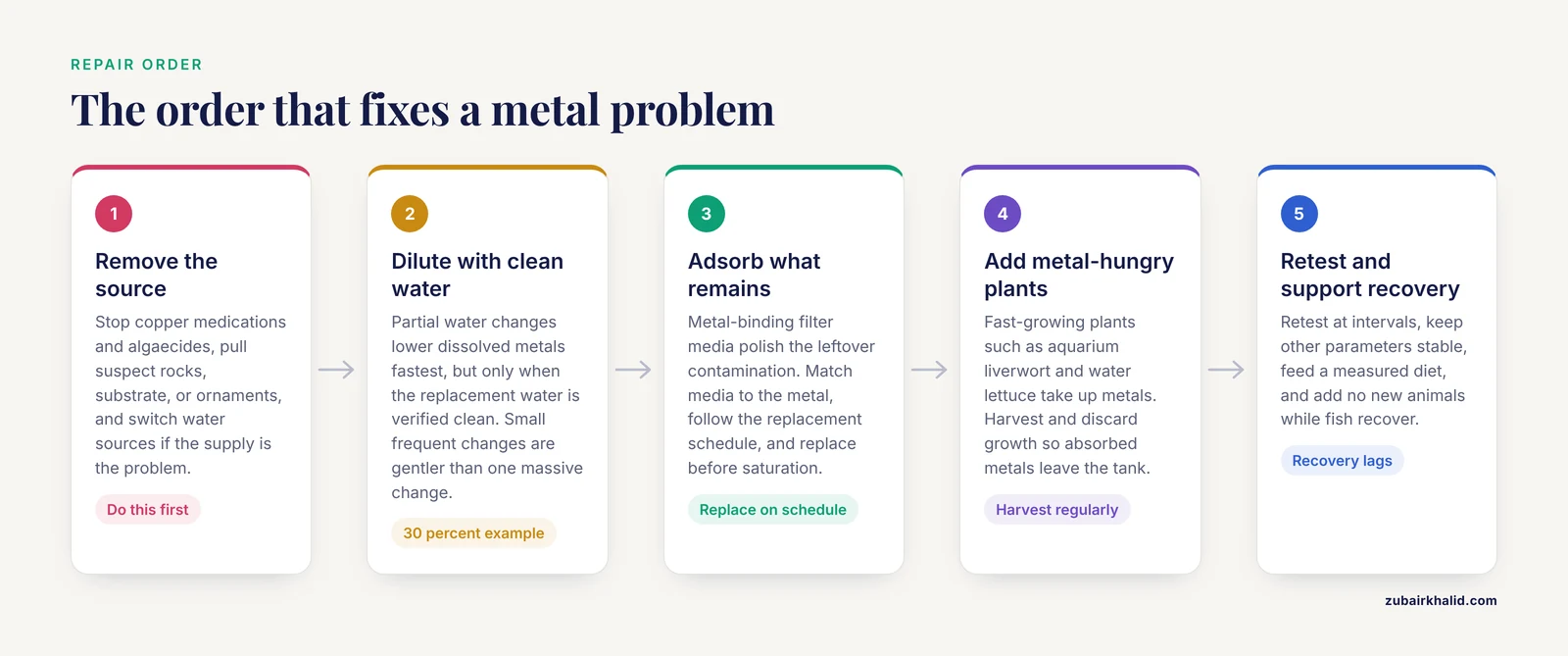
These solutions work in sequence. Skipping the first step wastes money on everything after it.
Step 1: Find and Remove the Source
- Stop using any copper-based medication or algaecide and remove residual chemical filtration media that may re-release what they absorbed.
- Remove any rock, substrate, or ornament that entered the tank recently or that you cannot verify as aquarium-safe. Place suspect items in a separate bucket of dechlorinated water and test that water later for comparison.
- If your source water is the problem, switch water sources. Reverse osmosis or distilled water, remineralized appropriately for your species, gives you a clean baseline. Never substitute plain distilled water long term without remineralizing it, because fish and shrimp need dissolved minerals.
Step 2: Dilute With Clean Water Changes
Partial water changes are the fastest way to lower a dissolved metal concentration. The size and frequency depend on how far the level needs to fall and how much stress your animals can tolerate. A fish tank calculator is genuinely useful here. Enter your tank's internal dimensions to get its true volume in gallons or liters, then calculate the percentage of water you plan to change. Knowing the real volume also lets you dose conditioners and treatments accurately instead of guessing by tank nominal size, which often overstates actual water volume once substrate, rock, and equipment displacement are counted.
Two principles guide the schedule. Small frequent changes are gentler on fish than one massive change, and each change should use water you have verified is free of the contaminant. Changing 30 percent of the water with water that itself contains the metal simply resets the clock.
Step 3: Adsorb What Is Left
After the source is gone and dilution has brought levels down, filtration media that bind dissolved metals can polish the remaining contamination. This is an area of active research, and the approaches are getting more sophisticated. In one laboratory system, iron oxide nanoparticles produced by Bacillus subtilis were immobilized in a free-floating macroporous gel and added to a cadmium-polluted tilapia culture. The gel adsorbed cadmium from the water, lowered cadmium concentrations in the fish's liver, gills, and muscle, and reversed the associated elevations in cortisol, liver enzymes, and kidney function markers [4]. Work like this signals where the field is heading, and metal-binding resins and media are already available at the retail level. Match any media to your situation, follow the manufacturer's replacement schedule, and replace media before it becomes saturated.
Step 4: Use Plants That Pull Metals Out of the Water
Living plants offer a biologically elegant solution called phytofiltration. Two studies support the approach at aquarium scale.
The aquarium liverwort Monosoleum tenerum, grown under controlled conditions, removed zinc, copper, nickel, manganese, and iron from spiked water within seven-day exposures, with accumulation patterns that shifted by metal and dose. Copper and zinc accumulated most strongly at low concentrations, and after a longer exposure the plants held the most copper by weight, followed by iron [1].
Water lettuce, Pistia stratiotes, grown in laboratory aquariums dosed with increasing concentrations of metal-contaminated effluent, took up cadmium, copper, iron, lead, and zinc into its roots, leaves, and whole plant tissues, with uptake that varied by element and concentration [7].
The practical technique follows directly from this science. Stock the tank or a sump with fast-growing plants, give them good light, and, critically, harvest and discard plant material regularly. A plant that absorbs metals and then dies and decomposes in the tank returns them to the water. Harvesting is what turns a plant from a metal sponge into a permanent removal pathway.
Step 5: Retest, Monitor, and Support Recovery
Retest at intervals after your interventions. Expect biological recovery to lag behind chemical recovery. The depuration data from the carp experiments, with tissue contaminant half-lives stretching across weeks to months, explain why fish can remain unwell after the water tests clean [5]. During recovery, keep every other parameter stable, feed a measured and varied diet, avoid adding new animals, and resist the urge to dose the tank with unnecessary additives. If fish remain symptomatic weeks after confirmed clean water, consult an aquatic veterinarian rather than cycling through more products.
An Aquarium Care Checklist That Prevents Metal Problems
Prevention is cheaper and kinder than remediation. Fold these items into your routine aquarium care checklist.
Weekly
- Observe every animal. Appetite, activity, and appearance tell you more than any single test.
- Check equipment for corrosion, white crusty deposits, or discolored water at fittings.
- Perform a partial water change with verified clean water.
Monthly
- Test ammonia, nitrite, nitrate, and pH.
- Test copper if you keep invertebrates or reefs.
- Rinse mechanical filter media in removed tank water, never tap water, and replace chemical media on schedule.
- Inspect substrate and decor for unusual discoloration or crumbling.
Quarterly and annually
- Review your utility's latest water quality report when it publishes.
- Inventory everything added to the tank in recent months if problems recur.
- Deep clean siphon gravel and prune and harvest plant mass.
- Recalculate your true tank volume with a fish tank calculator after any aquascape change, since rock and substrate displacement alters change volumes and dose calculations.
Before any purchase
- Verify that rocks, gravel, and ornaments are sold as aquarium-safe.
- Read labels on medications and supplements for metal content.
- Check compatibility of any treatment with invertebrates before dosing.
Choosing Equipment and Supplies
When you select remediation gear, judge candidates against these criteria rather than brand names.
- Test equipment. Prioritize a copper test with a detection range suited to the low concentrations that harm invertebrates, and keep records so you can compare readings over time.
- Water source. Reverse osmosis units vary in stages and output rate. For a single small aquarium, a compact unit paired with a remineralizing supplement is usually sufficient.
- Adsorptive media. Look for products that specify the metals they bind, state a capacity, and give a replacement interval. Replace on schedule, since exhausted media can stop protecting your tank.
- Plants. Choose fast-growing species with high biomass, such as floating plants and vigorous mosses, and plan for regular harvesting. Rooted and floating plants differ in what they can reach, and the water lettuce research demonstrated uptake into roots, leaves, and whole plant tissue alike [7].
- Tools. A dedicated siphon, buckets used only for the aquarium, and accurate measuring containers prevent accidental contamination from household chemicals.
Common Mistakes That Make Things Worse
- Assuming clear water is clean water. Dissolved metals are invisible. Water clarity says nothing about copper or lead.
- Changing all the water at once. A total teardown shocks the biological filter and stresses fish without removing metals bound in substrate, media, and silicone.
- Trusting softened water. Household softeners exchange minerals rather than removing metals, so softened tap water is not automatically safe for fish.
- Redosing copper medications repeatedly. Copper accumulates in a closed system. Invertebrates in the same water pay the price, and invertebrate deaths should prompt an immediate reassessment of any metal-based treatment.
- Ignoring invertebrate deaths. Snails and shrimp are often the early warning system. Losing them before the fish is a signal, not bad luck.
- Skipping the source water test. Treating the tank while continuing to add contaminated water is like bailing a boat with the hole still open.
- Adding unverified rocks or shells. Materials from construction sites, roadways, or craft shelves can leach metals for months.
Limitations and When to Contact a Veterinarian
This article is educational and is not a substitute for veterinary diagnosis or treatment.
Individual cases vary, and an aquatic veterinarian can run diagnostics that no hobby test kit can match, including tissue and blood analysis. Owner-facing resources from organizations such as the Merck Veterinary Manual, the AVMA, and the World Aquatic Veterinary Medical Association can help you locate qualified aquatic animal health support.
Contact a veterinarian promptly if any of the following apply:
- Multiple animals of different species die or sicken within days of one another
- Deaths continue after you have performed water changes with verified clean water
- Fish show signs of organ strain, severe lethargy, or abnormal buoyancy that persists more than a few days after the water tests clean
- A breeding colony shows reproductive failure or abnormal development, which can reflect endocrine disruption rather than simple toxicity
- You keep a valuable, rare, or protected collection where a confirmed diagnosis changes management decisions
- You plan to eat anything from the tank or pond, since accumulating metals in animal tissue is also a human health question
The studies behind this article also carry limits. Most were conducted under controlled laboratory conditions with defined exposures, and real aquariums present mixtures of contaminants at concentrations that are rarely measured. A lab result tells you what a metal can do. Your own testing tells you what is in your water.
Frequently Asked Questions
How do heavy metals get into aquarium water?
The three most common routes are the source water itself, copper from plumbing and medications, and leaching from rocks, substrate, or decorations. Studies have documented mercury, arsenic, and uranium in tap water used for aquarium culture at concentrations within legal drinking water limits [2].
How can I tell if my fish are affected by heavy metals?
Watch for unexplained deaths, gasping, inflamed gills, appetite loss, and invertebrate die-offs, especially when ammonia and nitrite test normal. Confirm with a copper test kit, a lab metals panel, or your utility's water quality report, since standard aquarium kits do not measure metals.
Will a water change fix heavy metals in aquarium water?
Water changes dilute dissolved metals and are the fastest first response, but they only work if the replacement water is clean and the source inside the tank is removed. Otherwise the level climbs back with every change.
Do live plants remove heavy metals from aquarium water?
Yes, some do. Aquarium liverwort removed zinc, copper, nickel, manganese, and iron from spiked water within days [1], and water lettuce took up cadmium, copper, iron, lead, and zinc in laboratory aquarium trials [7]. Harvest and discard plant growth regularly so absorbed metals leave the system.
Is tap water safe for my aquarium?
Tap water that meets drinking water standards can still carry metal loads that affect sensitive aquarium animals, as the snail research demonstrated [2]. Check your utility's water quality report, and use remineralized reverse osmosis water for the most sensitive species.
Are snails and shrimp more sensitive to heavy metals than fish?
Generally yes. Invertebrates frequently die first in a metal contamination event, and metals have been shown to accumulate in snail tissues and alter development [2]. Treat invertebrate deaths as an early warning and test promptly.
How long does recovery take after a metal exposure?
Water chemistry can correct within days, but biological recovery lags. Fish can carry tissue contamination for weeks to months depending on water temperature and conditions, so keep conditions stable and monitor rather than expecting overnight recovery.
When should I contact an aquatic veterinarian?
Call when deaths continue after corrective water changes, when several species sicken at once, when fish remain symptomatic after the water tests clean, or whenever a rare or valuable collection is at stake. A veterinarian can order laboratory diagnostics that home kits cannot provide.
Sources
- Phytofiltration of chosen metals by aquarium liverwort (Monosoleum tenerum).
- Evaluation of female masculinization in Pomacea canaliculata (Caenogastropoda, Ampullariidae) induced by tributyltin, heavy metals, and uranium in culture water.
- Beyond deep-sea mining sublethal effects: Delayed mortality from acute Cu exposure of the cold-water octocoral Viminella flagellum.
- Nanoremediation of tilapia fish culture using iron oxide nanoparticles biosynthesized by Bacillus subtilis and immobilized in a free-floating macroporous cryogel.
- Uptake from water and depuration of (137)Cs and (90)Sr by silver Prussian carp (Carassius gibelio).
- Differences in Heavy Metal Accumulation in Wild and Captive Spotted Seal (Phoca largha) Pups in the Bohai Sea.
- Heavy metal uptake by water lettuce (Pistia stratiotes L.) from paper mill effluent (PME): experimental and prediction modeling studies.