How to Read Aquarium Water Test Results
By Dr. Zubair Khalid, DVM, MS, PhD ·
Reading aquarium water test results comes down to three numbers first: ammonia and nitrite should be undetectable in an established freshwater tank, and nitrate should be low and stable. Every other reading, including pH, general hardness, and carbonate hardness, is interpreted against the specific needs of the fish you keep rather than a single universal target.
This guide walks through freshwater aquarium water test results explained parameter by parameter, the patterns that most commonly confuse keepers, what home test kits cannot detect, and when a result should prompt a call to a veterinarian who treats fish.
Why Water Testing Matters
A freshwater aquarium is a closed microbial system. Fish excrete ammonia through their gills and urine, and decaying food and plant matter add more. In a healthy tank, microbes in the biological filter convert that toxic ammonia into less toxic nitrate through the intermediate nitrite, which is the core of what aquarists call the nitrogen cycle [1].
Recent research on home aquariums shows how dynamic that filter community really is. In a 12-week study tracking three new household tanks, nitrification reduced ammonia and nitrite to undetectable levels by week 3 in two tanks and by week 8 in the third. Complete ammonia-oxidizing Nitrospira, bacteria that perform the entire ammonia-to-nitrate conversion in one cell, turned out to dominate mature freshwater aquarium biofilters [1]. This matters for interpretation because a young tank and a mature tank can produce very different test results from identical stocking and feeding.
Aquaria are also used as research platforms in many fields, from microfluidic "nano-aquariums" built to observe living microorganisms in fresh water to toxicology and biodegradation studies that use aquarium filter material as a source of real microbial communities [2][3]. The same principle applies on your living room shelf. The water test is the only routine window into the invisible chemistry and microbial activity that determine whether your fish thrive.
The Core Parameters Explained
Most freshwater keepers test six core values. The table below summarizes what each parameter measures, the typical goal in an established community tank, and what an abnormal reading usually points to. Species-specific targets vary, and the section on hardness shows why one number is never right for every fish.
| Parameter | What it measures | Typical goal in an established freshwater tank | A high or abnormal reading usually means |
|---|---|---|---|
| Ammonia (NH3/NH4+) | Toxic nitrogen waste from fish and decay | Undetectable (0 ppm) | The biofilter is not mature yet, was disrupted, or the tank is overloaded |
| Nitrite (NO2-) | Intermediate nitrogen compound | Undetectable (0 ppm) | The filter is mid-cycle or its nitrifying community was damaged |
| Nitrate (NO3-) | End product of nitrification | Low and stable, diluted by regular partial water changes | Maintenance or water changes are infrequent, or the tank is overfed or overstocked |
| pH | Acidity or alkalinity | Stable within the range your species needs | Buffering capacity is exhausted, source water changed, or something in the tank is altering chemistry |
| General hardness (GH) | Dissolved calcium and magnesium | Species dependent | Source water characteristics, dissolved rocks or shells, or water treatments |
| Carbonate hardness (KH) | Carbonate and bicarbonate buffering | High enough to hold pH steady | Buffering is being consumed, which often precedes a pH drop |
Ammonia
Ammonia is the most urgent result on any test. Aquarium nitrification exists precisely because ammonia is toxic to fish, and the biofilter's job is to convert it into nitrate [1]. In an established, healthy tank, a correct reading is undetectable. Any repeatable ammonia reading above zero means the biofilter is not keeping up with the waste being produced.
Common causes include a tank that is still cycling, a filter that was cleaned too aggressively, a medication that damaged nitrifying bacteria, a dead fish or decaying plant, or simply more fish and food than the filter can process. The first response is always the same in direction, even though exact steps vary. Stop or reduce feeding, perform a partial water change to dilute the ammonia, and retest after the change to confirm the reading is falling.
Nitrite
Nitrite is the middle step of nitrification, produced as ammonia is oxidized and consumed as nitrate is formed [1]. A nitrite reading above zero in an established tank tells you the second half of the microbial workforce is not fully functional. In a new tank, rising nitrite with falling ammonia is expected and means the cycle is progressing, not that you failed.
Treat a nonzero nitrite reading the same way you treat ammonia. Dilute with a partial water change, reduce feeding, and retest daily until both read zero. If ammonia reads zero while nitrite stays elevated, the ammonia-oxidizing microbes are working but the nitrite oxidizers are lagging, which is common in the middle of a cycle.
Nitrate
Nitrate is the endpoint of nitrification and is far less toxic than ammonia, but it still accumulates because a standard filter does not remove it [1]. In practice, nitrate is the parameter that tells you whether your maintenance schedule matches your bioload. A reading that climbs week after week means water changes are not frequent or large enough for the stocking and feeding level in that tank.
There is no single universal nitrate target for every freshwater aquarium. Heavily planted tanks can read very low because plants take up nitrate, while a busy community tank with large fish may need substantial weekly water changes to keep nitrate from trending upward. The interpretive skill is in the trend. A stable, low nitrate is healthy. A steadily rising nitrate tells you to increase water change frequency or volume.
pH
pH measures whether the water is acidic or alkaline. The most important interpretive rule is that stability matters more than any specific number. Most freshwater community fish tolerate a moderate pH range well, but they suffer when pH swings rapidly.
A falling pH over days or weeks usually means carbonate buffering is being consumed by acids produced during nitrification and decay. A pH that reads differently from your tap water often points to something dissolving in the tank, such as limestone, shells, or certain substrates, or to additives. When you test pH, test it at the same time of day, because pH can shift naturally across a light cycle.
General Hardness (GH) and Carbonate Hardness (KH)
General hardness reflects dissolved calcium and magnesium, measured in practice as ppm of calcium carbonate equivalent. Carbonate hardness reflects the water's buffering capacity, which resists pH swings. These two readings explain many confusing results, such as a pH that will not hold or a tank that behaves differently from the tap water you filled it with.
Hardness is also biologically meaningful, and not in a uniform direction. A controlled study grew two popular aquarium species, the guppy (Poecilia reticulata) and the betta (Betta splendens), at water hardness levels of 150, 320, 540, and 900 ppm CaCO3. Growth and reproductive potential increased with hardness in guppies, with the best fecundity and gonadosomatic index at 900 ppm, while bettas showed the opposite pattern, with reduced hatchability and disturbed bubble nests at 900 ppm compared with the 150 ppm control [4]. The practical lesson for interpreting your GH reading is that the right number depends entirely on the species in your tank. Livebearers like guppies often do well in harder water, while soft-water species can be stressed by it.
Freshwater Aquarium Water Test Results Interpretation: Common Patterns
Individual numbers matter less than the pattern they form together. These are the patterns that account for most interpretation questions keepers ask.
Ammonia and Nitrite Both Above Zero
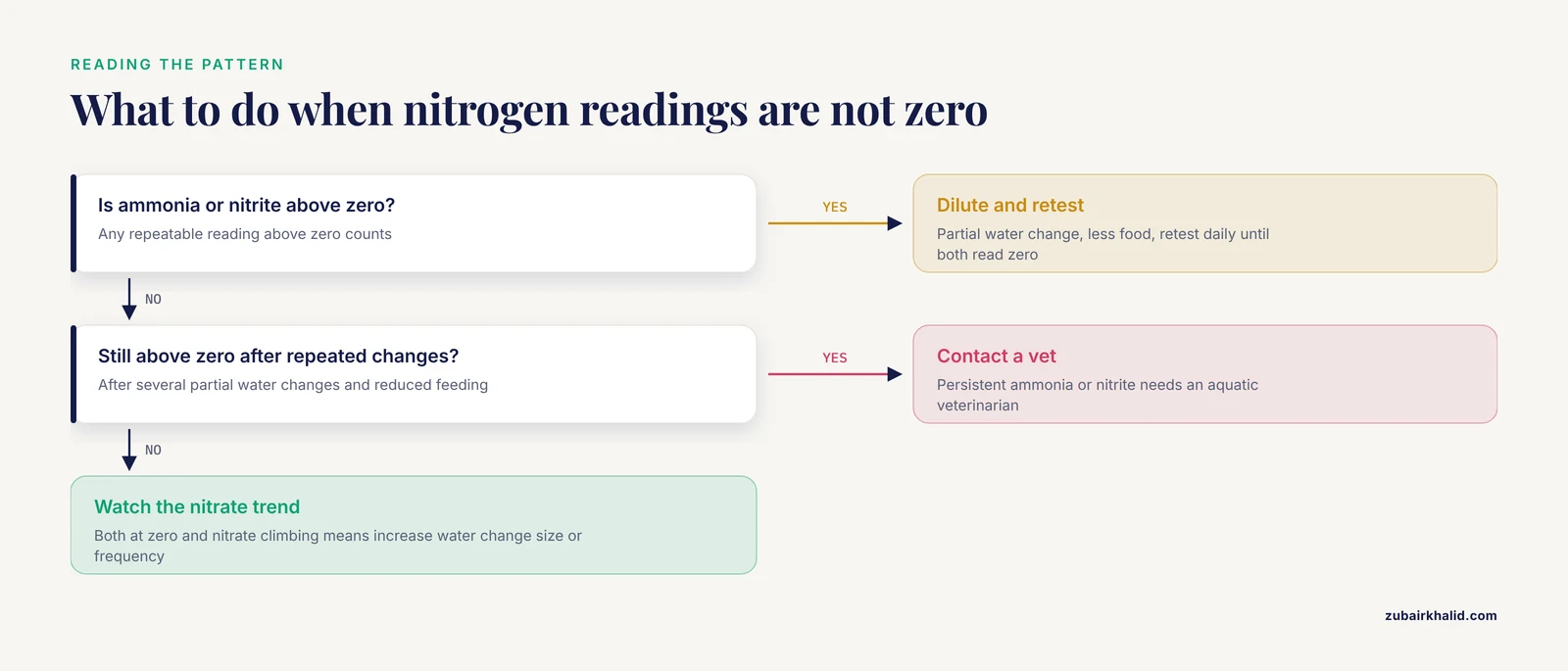
This is the signature of a tank that has not finished establishing its biofilter, or of an established filter that was damaged, for example by overcleaning in untreated tap water or by certain medications. New tanks vary widely in how quickly they stabilize, and research on real home aquariums found that some reached undetectable ammonia and nitrite within about three weeks while others took closer to two months [1]. Test daily during this period, keep feeding light, and use partial water changes to keep ammonia and nitrite as close to zero as possible while the microbial community develops.
Ammonia Zero, Nitrite Above Zero
The first stage of the filter is functioning but the nitrite-oxidizing stage is lagging. This is common mid-cycle and after partial filter disruption. Keep diluting with water changes and retest. Patience matters here, because forcing the process with large livestock additions usually makes the reading worse.
Ammonia Zero, Nitrite Zero, Nitrate Climbing
Congratulations in one sense, because this means the biofilter is complete. But rising nitrate is a maintenance signal. The interpretation is simple. Waste production exceeds removal, so increase water change frequency or volume until the trend flattens.
All Nitrogen Readings at Zero, Even Nitrate
In a stocked tank this can mean the tank is understocked or underfed, or in planted tanks that plants are absorbing nitrate as fast as it is produced. It can also mean the test was performed incorrectly. If you have a heavily planted, lightly fed tank with thriving fish, a zero nitrate reading can be genuine. If you have a crowded tank and every number reads zero, retest with fresh reagents before trusting it.
pH Unstable or Drifting Down
A drifting pH usually means carbonate buffering is being exhausted. Check the KH reading, because a low KH explains a pH that falls between tests. Correction is usually gradual, through regular water changes with suitably buffered water, rather than a sudden chemical adjustment, because rapid pH change stresses fish more than a stable pH slightly outside the ideal range.
GH Far From Your Species' Needs
Match the reading to the fish, not to a chart. The guppy and betta study demonstrated that the same hardness level can improve reproduction in one species and harm it in another, so a hardness reading only has meaning in the context of what you keep [4]. If your tap water hardness does not suit your species, the standard approaches involve blending with reverse osmosis water or using appropriate substrates and treatments, and any change should be gradual.
What Home Test Kits Cannot Detect
This is the part of freshwater aquarium water test results explained that most guides skip. Standard kits measure a short list of parameters, and the water in your tank can contain things no hobby kit measures.
Dissolved contaminants are one category. Researchers have developed passive sampling films specifically to detect urban insecticides, including pyrethroids, fipronil, and organophosphates, at trace concentrations in water, and validated them in a large aquarium with circulating water flow before field deployment. Detected concentrations ranged from 0.5 to 18.5 nanograms per liter, levels far below anything a hobby test kit registers [5]. If household pesticides are sprayed or fogged near an aquarium, or contaminated water is added to the tank, the standard nitrogen panel will look perfect while fish are still exposed.
Other dissolved substances affect fish behavior before they affect your test results. In a laboratory experiment, threespine sticklebacks exposed to the plasticizer butyl benzyl phthalate at 0.1 milligrams per liter for 26 days changed how they shoaled and spent more time on the bottom of the aquarium, even though these are subtle changes an owner might mistake for personality [6]. Research in crayfish has shown that dissolved chemical signals alone, passed through a simple air stone into test aquaria, measurably change fish and invertebrate behavior, which illustrates how much information water carries that no colorimetric test reveals [7]. When your water panel is clean but fish act differently, behavior itself is a legitimate signal worth taking seriously.
Even particles too small to see can matter. An experiment exposing common carp to environmentally relevant microplastic concentrations of 0.75 and 8.25 micrograms per liter found no visible harm to growth, gut morphology, or metabolic rate, but detected an increased frequency of micronucleated cells as microplastic concentration rose, a marker of potential genotoxicity [8]. The takeaway for interpretation is not to panic about plastic, but to recognize that a clean nitrogen panel does not certify water as harmless in every respect.
Finally, remember that tap water itself is not identical everywhere. If your results drift after a change in water source, or if you are starting a tank with unusually hard, soft, or high-pH tap water, test the source water directly so you know what you are adding before you interpret the tank's numbers.
Reading Results Alongside Fish Behavior
A water test tells you what dissolved chemicals are present. Your fish tell you whether those conditions are tolerable for them. The two should always be read together.
Fish respond to their water in measurable ways. In the stickleback study, altered shoaling and bottom-dwelling behavior appeared after weeks of exposure to a dissolved pollutant, demonstrating that behavior can shift in response to water quality before gross illness appears [6]. Research using holographic interferometry has even visualized how fish swimming displaces water in a home-type aquarium, a reminder that the tank is a physically dynamic environment where conditions are never static [9].
Practically, build a habit of pairing each test session with a short observation. Note appetite, activity level, positioning in the water column, breathing rate, and how fish interact. A test panel that is technically acceptable combined with fish that hide, gasp, clamp their fins, or refuse food is a stronger warning sign than either signal alone.
An Aquarium Care Checklist Built Around Testing
Consistency beats intensity in aquarium maintenance. Use this checklist as a weekly and monthly rhythm.
Weekly
- Test ammonia, nitrite, nitrate, and pH at the same time of day
- Observe every fish for behavior, appetite, breathing, and appearance
- Perform a partial water change sized to your nitrate trend
- Vacuum visible detritus from the substrate during the change
- Match the temperature and treat the replacement water before adding it
Monthly
- Test GH and KH along with the core parameters
- Rinse mechanical filter media gently in removed tank water, never untreated tap water
- Check that test kit reagents are within date, because expired reagents produce false readings
- Record every result in a log, since trends carry more information than single values
Ongoing
- Keep feeding measured, because uneaten food becomes ammonia
- Quarantine new arrivals before adding them to a display tank
- Retest after any medication treatment, filter change, or large cleaning
- Retest tap water whenever your municipal source may have changed
Using a Fish Tank Calculator With Your Results
A fish tank calculator is most useful when its outputs are anchored to real test data. Two uses stand out for interpreting water test results.
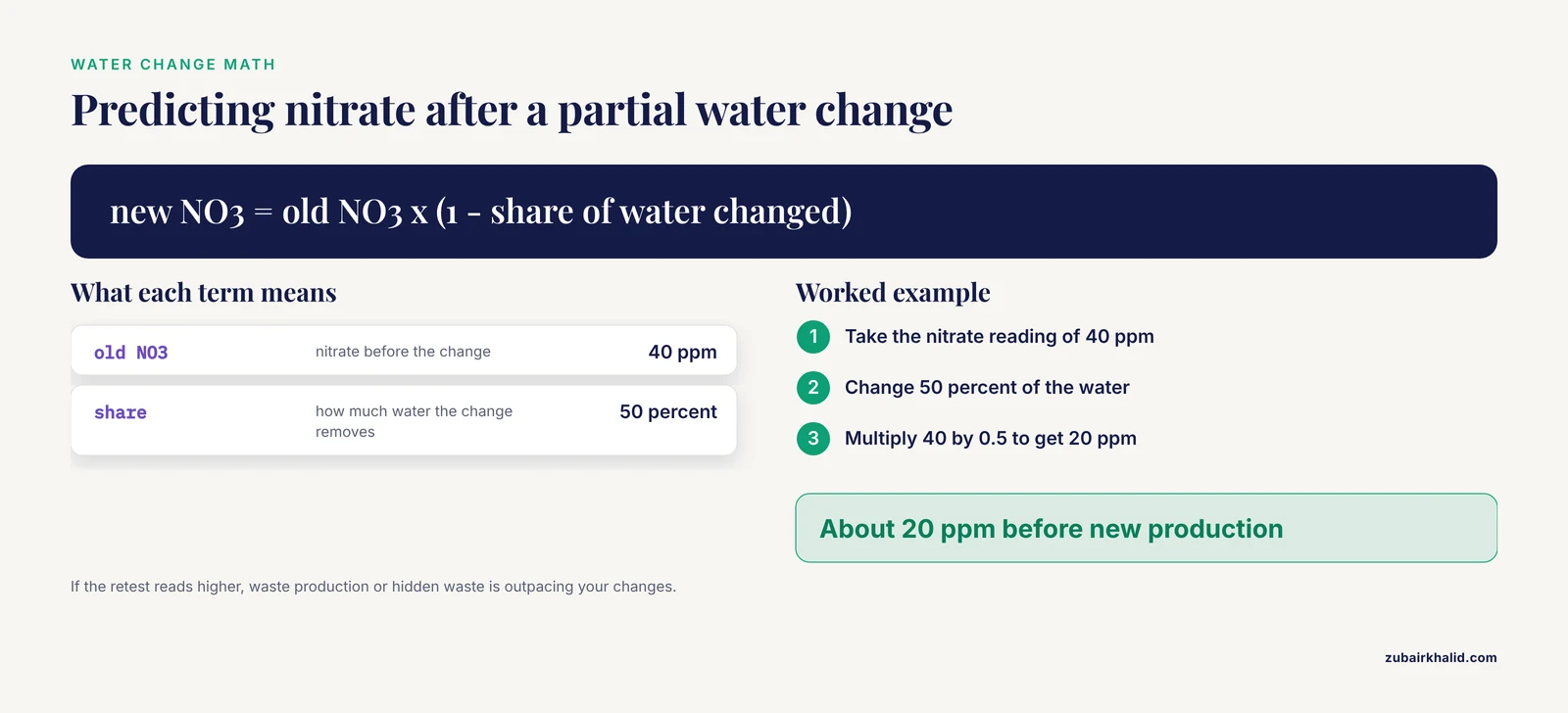
First, volume and water change calculators. Knowing your actual tank volume in gallons, after accounting for substrate, rocks, and displacement, lets you calculate how much water a partial change removes. If nitrate reads 40 ppm and you change 50 percent of the water, the arithmetic predicts roughly half the nitrate before accounting for ongoing production. Comparing that prediction with your retest tells you whether your maintenance schedule is adequate or whether hidden sources of waste, such as overfeeding or a dead organism, exist.
Second, stocking and bioload calculators. These tools estimate the waste load your filter must process. When ammonia or nitrite creeps above zero in an established tank, the combination of your test results and a stocking calculation often reveals that the bioload simply outgrew the biofilter. The resolution is fewer fish, less food, more filtration capacity, or more frequent water changes.
Treat calculator outputs as estimates that your test results either confirm or refute. The test kit is the ground truth. The calculator only helps you plan.
Common Myths About Water Test Results
Myth: Clear water means healthy water. Water can be optically crystal clear while carrying ammonia, dissolved contaminants, or other hazards. The stickleback and microplastic studies both involved water that would look normal to the eye while fish were measurably affected [8][6]. Clarity is not a test.
Myth: A perfect single test means the tank is fine. A snapshot can miss a trend. A tank tested the morning after a water change can read beautifully and still be drifting toward a problem. Logged, repeated testing is what makes freshwater aquarium water test results interpretation meaningful.
Myth: You must chase a specific pH number. Fish generally fare better with a stable pH than with one that is repeatedly adjusted toward an ideal figure. Sudden chemical corrections cause more stress than a steady reading slightly outside a textbook range.
Myth: Zero everything always means success. In a heavily planted, lightly stocked tank, zero nitrate can be real. In a crowded tank with waste production you can see, all-zero results should prompt a retest with fresh reagents before celebration.
Myth: Hard water is bad and soft water is good. The controlled hardness study in guppies and bettas showed the opposite can be true depending on species, with guppies reproducing best at 900 ppm while bettas fared worst there [4]. The correct target is the one that matches your fish.
Limitations and When to Contact a Veterinarian
Home test kits have real limits. They measure a short list of parameters, they do not detect pesticides, plasticizers, microplastics, heavy metals, or dissolved organic compounds, and strip tests in particular can be less precise than liquid reagent kits. Reagents also expire. Results should always be interpreted alongside fish behavior, feeding history, tank maturity, and recent maintenance, not in isolation. And every individual case is different, so a veterinarian who treats fish should evaluate any situation that does not resolve with basic husbandry steps.
Contact an aquatic veterinarian, or a veterinarian willing to consult on fish cases, when any of the following occur:
- Ammonia or nitrite remains detectable after repeated partial water changes and reduced feeding
- Fish show gasping at the surface, rapid gill movement, clamped fins, severe lethargy, refusal of food, visible lesions, or abnormal swimming
- Multiple unexplained deaths occur within a short period
- Fish behave differently, such as hiding or bottom-sitting, while your test panel reads normal, especially if a pesticide, aerosol spray, or contaminated water could have entered the tank
- Water chemistry swings sharply and you cannot identify the cause
- You plan to medicate a tank, because treatments can damage the nitrifying biofilter and change your future test results
The World Aquatic Veterinary Medical Association and the AVMA provide owner resources for locating veterinarians with aquatic animal experience, and the Merck Veterinary Manual's pet fish section covers common disorders that owners frequently investigate after abnormal water readings.
One further responsibility falls on every keeper. Aquatic species traded for water gardens and aquariums, including certain frogs, toads, and snails, have established invasive populations when released, which is why tank water and animals should never be discarded into ponds, lakes, or waterways [10]. Dispose of old tank water down a drain and rehome unwanted animals through a store, club, or another keeper.
Frequently Asked Questions
What do freshwater aquarium water test results mean in a brand new tank?
In a new tank, ammonia typically appears first, then nitrite, and finally nitrate as the biofilter matures, so nonzero ammonia and nitrite are expected temporarily rather than an immediate emergency. Keep feeding light, dilute with partial water changes, and test daily until ammonia and nitrite read zero consistently.
How often should I test my aquarium water?
Test ammonia, nitrite, nitrate, and pH weekly in an established tank, and daily during a new tank cycle or any water quality problem. Add GH and KH monthly, and always retest after medications, filter cleaning, or changes to stocking or feeding.
Is any ammonia reading dangerous to fish?
Ammonia is toxic to fish, which is exactly why biofilters convert it to nitrate, so any confirmed reading above zero warrants action. Reduce feeding, perform a partial water change, and retest to confirm the number is falling.
Do liquid test kits or test strips give better results?
Liquid reagent kits are generally considered more precise for ammonia, nitrite, and nitrate, while strips trade accuracy for speed and convenience. Whichever you use, keep reagents fresh, follow timing instructions exactly, and confirm surprising results with a second test.
Why does my nitrate stay high even after water changes?
Persistent high nitrate usually means ongoing waste production exceeds what your maintenance removes, from overfeeding, overstocking, or insufficient change volume. Calculate how much water your changes actually replace, then adjust frequency or volume until the trend flattens between tests.
What does a low pH reading mean for my fish?
A low or falling pH often means carbonate buffering has been exhausted, and the danger comes more from rapid pH swings than from the absolute number itself. Check KH, make corrections gradually through water changes, and match the target to your fish species rather than a universal chart.
What GH should my freshwater aquarium have?
There is no single correct GH, because species differ sharply. Guppies performed better at high hardness while bettas reproduced poorly at the same level in controlled testing, so identify the needs of the species you keep and adjust gradually toward that range.
How do I use a fish tank calculator with my test results?
Use a volume calculator to determine real gallons for dosing and water change math, and a stocking calculator to estimate bioload against your filter capacity. Then let your actual test results confirm or override the estimate, since the test kit is always the ground truth.
This article is educational and is not a substitute for veterinary diagnosis or treatment.
Sources
- Microbial community succession of home aquarium biofilters associated with early establishment of comammox Nitrospira.
- Ready biodegradability test in seawater: a new methodological approach.
- Nano-aquarium for dynamic observation of living cells fabricated by femtosecond laser direct writing of photostructurable glass.
- Water hardness influenced variations in reproductive potential of two freshwater fish species; Poecilia reticulata and Betta splendens.
- Development of polyurethane-based passive samplers for ambient monitoring of urban-use insecticides in water.
- Butyl benzyl phthalate affects shoaling behavior and bottom-dwelling behavior in threespine stickleback.
- Mating behaviour and evidence for a female released courtship pheromone in the signal crayfish Pacifastacus leniusculus.
- Revealing the hidden threats: Genotoxic effects of microplastics on freshwater fish.
- Fish swim water bulk displacement visualization with digital holographic interferometry.
- Evaluating Potential Distribution of High-Risk Aquatic Invasive Species in the Water Garden and Aquarium Trade at a Global Scale Based on Current Established Populations.