Fish That Eat Algae in Ponds: What Works and What Does Not
By Dr. Zubair Khalid, DVM, MS, PhD ·
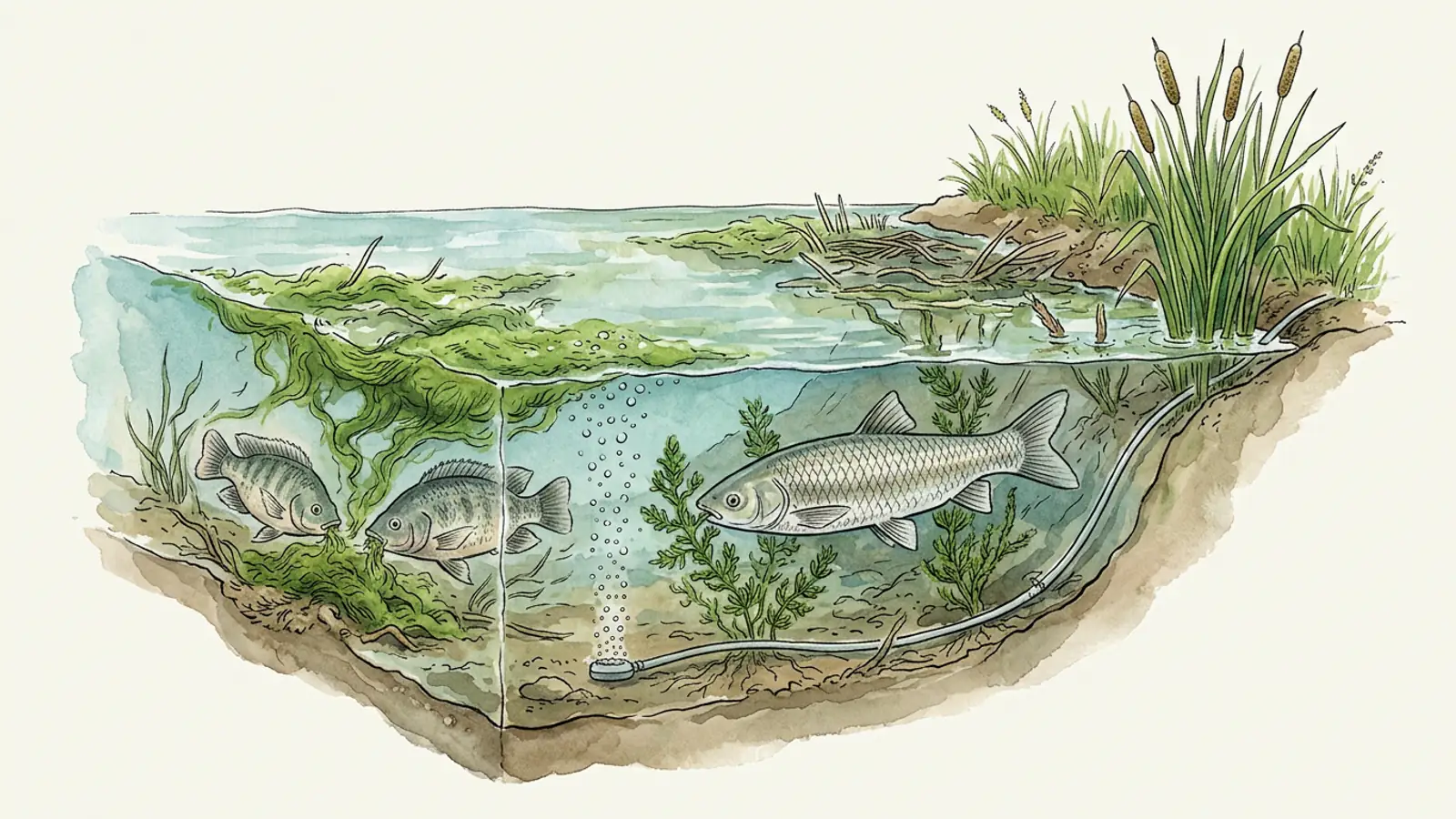
The short answer is that no fish will fix an algae problem on its own, and several of the fish sold as "algae eaters" make ponds worse. Tilapia graze filamentous algae aggressively but die when water drops into the mid 50s Fahrenheit and require state permits in many places. Triploid grass carp eat submerged plants well and filamentous or planktonic algae poorly, and they also require permits in many states. Koi and goldfish nibble algae but add the nutrients that feed it. Tropical plecos are a poor fit for most outdoor ponds and are invasive in warm states. The real fix is reducing nutrients and light, and using fish only as a supplement inside a broader plan.
This article is educational and is not a substitute for veterinary diagnosis or treatment.
Key Takeaways
- No fish fixes a pond algae problem alone; tilapia graze filamentous algae but die when water drops into the mid 50s Fahrenheit and need state permits in many places.
- Koi and goldfish nibble algae but add nutrients through waste and feeding, so adding more of them to control algae is counterproductive.
- Triploid grass carp eat submerged vascular plants like hydrilla and elodea well, but control filamentous and planktonic algae poorly and require permits in many states.
- Test pond water for nitrogen and phosphorus before buying any fish, since these nutrients and light drive blooms regardless of how many algae-eating fish are added.
- Copper-based algaecides can kill fish in soft, acidic water because free cupric ions become more toxic as pH drops, so test alkalinity and pH first.
At a Glance: What Actually Helps
| Approach | What it does | Limits and legal notes |
|---|---|---|
| Tilapia | Grazes filamentous algae | Cold-sensitive, dies in the mid 50s F. Permits required in many states |
| Triploid grass carp | Eats submerged vascular plants | Poor control of filamentous and planktonic algae. Permits required in many states |
| Koi and goldfish | Nibble some algae | Add nutrients through waste and feeding |
| Plecos (tropical) | Graze algae in warm water | Unsuitable for most outdoor ponds. Invasive in warm states |
| Snails and mussels | Graze surfaces or filter water | Not a standalone control method |
| Nutrient control | Removes the fuel for blooms | Slow, requires ongoing maintenance |
| Shading and buffer strips | Cuts light and runoff | Needs planning and planting time |
| Aeration | Supports oxygen and nutrient cycling | Does not remove nutrients by itself |
| Mechanical removal | Physically takes algae out | Labor-intensive, repeat as needed |
| Label-directed algaecide | Kills algae fast | Copper toxicity risk in soft water, oxygen crash after die-off |
Quick checklist you can act on today
- Test pond water for nitrogen and phosphorus before buying any fish.
- Identify the algae type: filamentous strands, planktonic green water, or submerged plants.
- Reduce nutrient inputs: stop overfeeding, redirect runoff, add buffer strips.
- Add or improve aeration.
- Add shade, either plants or a physical structure.
- Remove algae mechanically on a schedule.
- Check state permits before buying tilapia or grass carp.
- Use algaecides only per label directions and only with an oxygen plan.
Why Fish Alone Cannot Fix a Pond
Algae grow because nutrients and light are available. A pond that receives nitrogen and phosphorus from fish waste, decaying leaves, fertilizer runoff, or sediment will keep producing algae no matter how many algae-eating fish you add. Research on urban ponds shows that dissolved nitrogen and phosphorus trigger blooms, and that bloom peaks coincide with sharp increases in dissolved total nitrogen and phosphorus [1]. Another study on shallow freshwater systems found that adding nitrogen and phosphorus increased cyanobacteria biomass and toxin concentrations, and that warming could add to the effect [2].
This is the core problem with the "buy fish, fix pond" approach. Fish that eat algae still excrete waste. That waste returns nutrients to the water. Koi and goldfish are the clearest example. They graze on algae, but they are also heavy waste producers, and the nutrients they release can feed the next bloom. You end up trading one problem for a slightly different version of the same problem.
The nutrient pathway is well documented in treatment systems. Filamentous algae matrices have been used to strip nitrogen and phosphorus from polluted water, removing roughly 79.8 percent of nitrogen and 81.2 percent of phosphorus in one study [3]. That is the same biological process happening in your pond, just without a harvest step. If you do not remove the algae biomass, the nutrients it absorbed go right back into the system when it dies and decomposes.
So the practical rule is this: control nutrients and light first, then decide whether fish can add anything useful.
The Fish That Get Recommended, and What They Really Do
Tilapia for Algae Control
Tilapia are among the more effective grazing fish for filamentous algae in warm ponds. They are omnivorous, they graze on algae mats, and they tolerate crowded, warm, nutrient-rich water better than most species.
The problem is temperature. Tilapia are tropical fish. They die when water cools into the mid 50s Fahrenheit. In most of the United States, that means tilapia are a seasonal tool at best. You stock them in late spring, they graze through summer, and they die or must be removed before winter. In southern states with year-round warm water, they may survive, but that is exactly where they are most likely to be regulated.
Legal status matters. Tilapia are restricted or require permits in many states because they can escape, establish populations, and compete with native species. Check with your state fish and wildlife agency before buying. Do not assume that a fish sold at a farm store is legal to stock in your pond.
Tilapia also reproduce quickly in warm water, which can lead to overcrowding and a new nutrient load. They are a grazing tool, not a permanent solution.
Does Grass Carp Eat Algae?
This is the most common misunderstanding in pond management. Triploid grass carp are plant eaters, but their preference is submerged vascular plants, not algae. They will eat some filamentous algae when they are young or when preferred plants are scarce, but they are not an effective control for filamentous algae or planktonic green water. If your pond is full of stringy algae or pea-soup green water, grass carp will disappoint you.
What grass carp do well is consume submerged plants like hydrilla, elodea, and pondweed. That can be useful, but it can also be a problem. If you remove too many submerged plants, you lose the plants that compete with algae for nutrients and provide habitat for beneficial organisms. Overstocking grass carp can strip a pond of vegetation and leave it more vulnerable to algal blooms.
Triploid grass carp are sterile, which is why they are the legal form in most states. Diploid grass carp can reproduce and are banned or tightly restricted in many places. Even triploid fish require permits in many states, and some states prohibit them entirely. Confirm the rules before you buy.
Koi and Goldfish
Koi and goldfish eat some algae, especially the soft films that grow on rocks and liner surfaces. They are not effective against filamentous mats or green water. They also produce a lot of waste, and they are usually fed commercial food, which adds more nutrients. In a pond where koi or goldfish are the main residents, the fish themselves are often a major nutrient source. Adding more of them to control algae is counterproductive.
That does not mean koi and goldfish are bad pond fish. It means they are not an algae solution. Manage their stocking density and feeding rate as part of your nutrient budget.
Tropical Plecos
Plecos are popular algae eaters in aquariums, and they do graze algae. They are a poor choice for most outdoor ponds because they are tropical and cannot tolerate cold water. In warm states where they can survive, they are invasive. Released plecos have established populations in several warm-water regions, and they are not a responsible choice for outdoor ponds. Keep plecos in indoor aquariums.
Snails and Freshwater Mussels
Snails graze algae from surfaces, and freshwater mussels filter particles from the water. They are part of pond ecosystems, but they are not a standalone algae control method. Snail populations can explode and add to the nutrient load when they die. Mussels are sensitive to water quality and may not survive in a poorly managed pond. Treat them as ecosystem components, not as tools.
Nutrient Control: The Root Cause
Every effective algae plan starts with nutrients. Nitrogen and phosphorus are the two main drivers, and phosphorus is usually the limiting nutrient in freshwater ponds. That means small reductions in phosphorus can produce large reductions in algae.
Research on phosphorus binding technology shows that reducing water column total phosphorus shifted the algal community away from scum-forming cyanobacteria toward less problematic planktonic forms [5]. That is the goal: not zero algae, but a shift toward a balanced community.
Practical nutrient reduction steps
- Stop overfeeding fish. Uneaten food decomposes and releases nutrients.
- Keep leaves and grass clippings out of the pond. Decaying organic matter is a nutrient source.
- Direct runoff away from the pond. Fertilizer, pet waste, and soil all carry nutrients.
- Add buffer strips of plants around the pond edge to slow and filter runoff.
- Remove algae biomass after it grows. If you leave it to decompose, the nutrients return.
- Consider professional nutrient inactivation if phosphorus is high and persistent.
Aeration supports the microbial processes that cycle nutrients, and it helps prevent the low-oxygen conditions that occur when algae die. It does not remove nutrients by itself, but it makes every other step work better.
Light Control: Shading and Buffer Strips
Light drives photosynthesis. Reduce light and you reduce algae growth. Two tools do most of the work.
Shading
Trees, tall shrubs, and floating plants reduce the amount of sunlight reaching the water. In small ponds, a shade sail or floating plant cover can make a visible difference. Aim for partial shade, not full shade, because some light supports beneficial plants and maintains oxygen production.
Buffer strips
A buffer strip is a band of vegetation between the pond and the surrounding land. It filters runoff, stabilizes the bank, and reduces erosion. Native grasses and perennials work well. The wider the buffer, the more effective it is at trapping nutrients and sediment.
Buffer strips take time to establish. Plant them in the growing season and water them until they are rooted. Once established, they require little maintenance.
Aeration and Oxygen
Aeration does two things that matter for algae management. It keeps oxygen levels up, which supports fish and beneficial bacteria. It also helps prevent the oxygen crash that follows a large algae die-off.
When a dense algae bloom dies, the decomposition process consumes oxygen. If oxygen drops far enough, fish can die. This is one of the most common pond emergencies, and it is often triggered by algaecide treatment of a heavy bloom. Aeration reduces the risk, but it does not eliminate it. If you treat a severe bloom, plan for oxygen support and monitor fish behavior.
Mechanical Removal
Mechanical removal means physically taking algae out of the pond. Options include rakes, nets, skimmers, and specialized harvesters for larger ponds. The advantage is that you remove the nutrients locked in the algae biomass. The disadvantage is labor. You will need to repeat the process as algae regrow.
For filamentous algae, a rake or a long-handled net works well in small ponds. For larger ponds, a mechanical harvester or a contractor may be necessary. Compost the removed algae away from the pond so nutrients do not wash back in.
Algaecides: Use With Care
Algaecides can provide rapid relief, but they carry real risks. Copper sulfate is one of the most widely used algicides for controlling phytoplankton in lakes, reservoirs, and ponds [6]. It works, but copper is toxic to fish, and the margin between an effective dose and a harmful dose is narrow.
Copper toxicity in soft water
Copper toxicity depends on water chemistry. In soft water with low alkalinity and low pH, copper is more bioavailable and more toxic. Research on zebrafish found that copper oxide particles became far more toxic as pH dropped, because more free copper ions dissolved in acidic water [7]. Free cupric ions are the most toxic form of copper, and their availability depends on the ligands present in the water [8].
This means a dose that is safe in hard, alkaline water can kill fish in soft, acidic water. Never use copper-based algaecides without knowing your water chemistry. Test alkalinity and pH first, and follow the label exactly.
Sublethal effects
Even when copper does not kill fish outright, it can cause harm. Carp exposed to copper sulfate showed increased activity of functional enzymes and changes in gill structure, with partial recovery after the exposure ended [6]. Nile tilapia exposed to copper sulfate and copper oxide nanoparticles showed changes in plasma biochemistry and oxidative stress markers, especially after 21 days [9].
These findings matter for pond owners because they show that copper exposure has costs even when fish survive. Repeated treatments can accumulate stress and damage.
Oxygen crash after die-off
The biggest acute risk of algaecide use is the oxygen crash. When a large algae bloom dies, bacteria decompose the biomass and consume oxygen. If the pond cannot replenish oxygen fast enough, fish suffocate. This risk is highest in warm water, in ponds with heavy organic loads, and in ponds without aeration.
If you must treat a heavy bloom, treat in sections rather than all at once. Add aeration. Monitor fish for gasping at the surface. Be ready to act if oxygen drops.
Label directions
Algaecide labels exist for a reason. They specify dose rates, water chemistry conditions, and safety precautions. Follow them. Do not double the dose to get faster results. Do not treat when water is very warm or when oxygen is already low. Do not use copper products in soft water without professional advice.
A Step-by-Step Pond Algae Plan
Step 1: Identify the problem
Determine whether you have filamentous algae, planktonic algae, or submerged plants. Each requires a different approach. Filamentous algae form strands and mats. Planktonic algae cause green water. Submerged plants are rooted and visible below the surface.
Step 2: Test the water
Measure nitrogen, phosphorus, pH, alkalinity, and dissolved oxygen. These numbers tell you what is driving the bloom and what tools are safe to use.
Step 3: Cut nutrient inputs
Stop overfeeding. Keep organic matter out. Add buffer strips. Redirect runoff.
Step 4: Reduce light
Add shade. Plant trees or shrubs. Use floating plants in small ponds.
Step 5: Add aeration
Improve oxygen levels to support fish and beneficial bacteria and to reduce the risk of a die-off crash.
Step 6: Remove algae mechanically
Rake or net out what you can. Compost it away from the pond.
Step 7: Consider fish, with legal checks
If you want to add fish, check state rules first. Tilapia can help with filamentous algae in warm water but die in cold. Grass carp eat submerged plants, not algae. Koi and goldfish add nutrients. Plecos are unsuitable for outdoor ponds.
Step 8: Use algaecides only as a last resort
If you use an algaecide, follow the label, test your water, treat in sections, and support oxygen.
Common Mistakes
- Buying fish before fixing nutrients. The bloom returns.
- Stocking tilapia in a pond that freezes. The fish die and add nutrients.
- Expecting grass carp to eat filamentous algae. They prefer submerged plants.
- Adding koi to control algae. They add nutrients.
- Releasing plecos into warm ponds. They are invasive.
- Using copper algaecide in soft water without testing. Fish can die.
- Treating a heavy bloom all at once. Oxygen crashes.
- Leaving dead algae in the pond. Nutrients recycle.
Troubleshooting
Algae returns after treatment
Nutrients are still present. Recheck your nutrient inputs and removal plan.
Fish gasping at the surface
Oxygen is low. Add aeration immediately. This often follows a die-off or a heavy bloom.
Green water will not clear
Planktonic algae respond to nutrients and light. Reduce both. Mechanical removal does not work well for planktonic algae.
Stringy algae keeps growing
Filamentous algae thrive in shallow, sunlit, nutrient-rich water. Add shade, reduce nutrients, and remove biomass regularly.
Fish dying after algaecide
Copper toxicity or oxygen crash. Test water chemistry and review the label. Contact a veterinarian or aquatic specialist.
Welfare and Safety Points
Fish are animals with welfare needs. Stocking density, water quality, temperature, and oxygen all affect their health. Adding fish to control algae without meeting their needs is a welfare problem, not just a management problem. The World Aquatic Veterinary Medical Association (WAVMA) and the Merck Veterinary Manual both emphasize that aquatic animal health depends on proper environment and husbandry. If you are unsure whether your pond can support a given species, ask a veterinarian with aquatic experience before stocking.
Algaecides are pesticides. Store them safely, away from children and pets. Wear protective equipment when applying. Never exceed label rates.
Limitations and When to Contact a Veterinarian
This article is educational and is not a substitute for veterinary diagnosis or treatment. Individual ponds vary in chemistry, biology, and legal status, and individual fish vary in health and tolerance. A veterinarian with aquatic animal experience can assess fish health, diagnose disease, and advise on treatment.
Contact a veterinarian or aquatic specialist if:
- Fish are dying and you do not know why.
- Fish are gasping at the surface or behaving abnormally.
- You plan to use copper-based algaecides in soft water.
- You have a heavy bloom and are considering treatment.
- You want to stock fish and are unsure about legality or suitability.
- You see lesions, fin erosion, or unusual behavior in your fish.
For regulatory questions about tilapia, grass carp, or other species, contact your state fish and wildlife agency.
Frequently Asked Questions
What is the best algae eating fish for ponds?
There is no single best fish. Tilapia graze filamentous algae well in warm water but die in cold water and need permits in many states. Grass carp eat submerged plants, not algae. Koi and goldfish add nutrients. The best approach is nutrient and light control, with fish as a supplement.
Does grass carp eat algae?
Grass carp eat submerged vascular plants well and filamentous or planktonic algae poorly. They are not an effective algae control fish.
Is tilapia good for algae control?
Tilapia graze filamentous algae effectively in warm water. They die when water cools into the mid 50s Fahrenheit and require permits in many states.
Can I use plecos in my outdoor pond?
No. Plecos are tropical and cannot tolerate cold water. In warm states where they survive, they are invasive.
Do koi and goldfish eat algae?
They eat some algae, especially soft films on surfaces. They are not effective against filamentous mats or green water, and they add nutrients through waste and feeding.
Will snails or mussels clear my pond?
Snails graze surfaces and mussels filter particles, but neither is a standalone algae control method. Treat them as ecosystem components.
Why does algae come back after I treat it?
Nutrients and light are still present. Algae regrow when the conditions that caused the bloom remain.
Is copper algaecide safe for fish?
Copper algaecide can be safe when used per label directions in suitable water. It is more toxic in soft, acidic water, and it can cause oxygen crashes after a large die-off. Test your water and follow the label.
Related Articles
- Carp Farming: Pond Production, Feeding, and Harvest Management
- Tilapia Farming: Production Planning for Pond, Cage, and Tank Systems
- Is Tilapia a Real Fish? Species Profile and Aquaculture Importance
- Pond Fish Harvesting Equipment and Techniques
- Pond Bottom Preparation for Fish Health and Harvest
- Pond Preparation Before Stocking Fish
- Dissolved Oxygen Management in Fish Ponds
- Aquaponics vs Hydroponics: Differences, Costs and Which to Choose
Sources
- Dissolved nitrogen and phosphorus trigger Euglena sanguinea blooms via Burkholderiaceae enrichment and extracellular polymeric substance stimulation.
- The Impact of Warming and Nutrients on Algae Production and Microcystins in Seston from the Iconic Lake Lesser Prespa, Greece.
- High-rate algal pond coupled with a matrix of Spirogyra sp. for treatment of rural streams with nutrient pollution.
- Marine macroalgae Chaetomorpha aerea as a dietary supplement: Optimizing immunity and resistance to Edwardsiella tarda in tilapia (Oreochromis mossambicus).
- Influence of Phoslock® on legacy phosphorus, nutrient ratios, and algal assemblage composition in hypereutrophic water resources.
- Functional enzymes activity and gill histology of carp after copper sulfate exposure and recovery.
- Toxicities of copper oxide nanomaterial and copper sulphate in early life stage zebrafish: Effects of pH and intermittent pulse exposure.
- Review of Copper and Copper Nanoparticle Toxicity in Fish.
- Effects of Individual and Co-exposure of Copper Oxide Nanoparticles and Copper Sulphate on Nile Tilapia Oreochromis niloticus: Nanoparticles Enhance Pesticide Biochemical Toxicity.
- Exposure of male tilapia (Oreochromis niloticus) to copper by intraperitoneal injection: DNA damage and larval impairment.