How Tank Size Affects Fish Compatibility
By Dr. Zubair Khalid, DVM, MS, PhD ·
Tank size affects fish compatibility because volume, swim length, and floor space determine how much territory, exercise, and chemical stability each fish receives. The same two species that coexist quietly in a 75-gallon aquarium can fight relentlessly in a 20-gallon one. The rule of thumb is to buy the tank for the adult size and adult behavior of the fish you want, then choose livestock that fits that tank, in that order. Keepers who reverse those steps, buying fish first and planning to upgrade later, usually end up rehoming fish or nursing injuries.
This guide explains how fish tank size compatibility works, compares the main tank size options side by side, walks through worked stocking scenarios, and closes with a calculator workflow, a care checklist, and the signs that justify a call to a fish veterinarian.
This article is educational and is not a substitute for veterinary diagnosis or treatment.
Why Tank Size Decides Fish Compatibility
Aggression in aquariums is mostly a space problem. Cichlids, bettas, gouramis, and many other popular species defend a patch of substrate, a cave, or an entire tank. In a roomy aquarium, a chased fish can break the defender's line of sight and reset. In a cramped one there is nowhere to go, so a single dominant fish can harass tankmates around the clock. Chronic stress suppresses the immune system, which is why aggression and disease so often arrive together.
Volume also buffers water chemistry. Fish waste becomes ammonia, and a spike that a 75-gallon tank absorbs quickly can poison a 10-gallon tank within hours. The Merck Veterinary Manual's pet fish coverage treats water quality as a central factor in fish health, and crowding is the fastest way to degrade it. A larger tank does not replace filtration, but it buys time when something goes wrong.
Swimming demand matters as much as fighting. Species built to cruise, such as danios and many tetras and barbs, need horizontal distance. Paced against glass all day, they redirect that energy into fin nipping and boundary disputes. Floor space matters for bottom dwellers, which sort out feeding order and resting spots across the substrate rather than in the water column.
Undersized tanks also distort growth and behavior. Fish held in cramped quarters for long periods may stay smaller than their genetics intend, and stunted growth does not shrink a fish's territorial drive or waste output to match. A stunted fish in a small tank is still a fully armed fish in a smaller battlefield.
The stakes extend past the glass. Ornamental fish keeping is a global hobby, and collecting wild ornamentals remains an economically viable industry in parts of the world, which is why researchers study these species even outside home aquaria [1]. Planning a tank well is the part of that chain an individual keeper controls. Aquatic veterinary professionals organize their work around the same reality, that environment and stocking density sit upstream of most fish illness, and organizations such as the AVMA make the same point for pet owners in plain terms.
Fish Tank Size Compatibility at a Glance
The table below condenses the main fish tank size compatibility options into the terms that actually decide stocking outcomes. Read the footprint column before the gallon column, because shape changes behavior within every class.
| Tank class | What the footprint gives you | Compatibility role | Main pros | Main cons |
|---|---|---|---|---|
| Nano (under 10 gallons) | Short swim length, tiny floor area | Single fish, a calm pair, or shrimp and snails | Low cost, small room footprint, fast maintenance | Fast chemistry swings, almost no aggression buffer |
| Mid-size (15 to 30 gallons) | Enough length for small schools | First true community tanks | Stable enough for beginners, layered stocking possible | Still too small for territorial medium fish |
| Large (40 to 75 gallons) | Real territory zones and multiple swim lanes | Mixed communities, semi-aggressive species | Aggression dilutes, far more stocking plans work | Higher cost, heavy weight, scaled-up maintenance |
| Very large (90 gallons and up) | Room for large-bodied adults | Show tanks and large-fish communities | Most stable water, widest species range | Serious cost, space, and structural demands |
Treat the classes as overlapping bands rather than hard borders. A 30-gallon cube behaves differently from a 30-gallon long, and a heavily decorated 40 can hold fewer territories than a sparsely furnished 55. The rows describe tendencies, not guarantees. The next section expands each row with its pros and cons.
Fish Tank Size Compatibility Options, Size Class by Size Class
Nano Tanks (Under 10 Gallons)
Nanos are species tanks, not community experiments. The realistic stocking list is short: one male betta, a shrimp colony, a snail setup, or at most a small group of one tiny, peaceful species. Anything resembling a full community list belongs one class up.
Pros:
- Low cost and light weight, and the tank fits desks and counters
- Water changes take minutes
- Simple equipment needs
Cons:
- Temperature and chemistry can swing within hours
- There is almost no aggression buffer or escape space
- The species list is short, and mistakes turn fatal fast
Most nano failures start with a stocking list copied from a 20-gallon community guide. If a mixed community is the goal, the best fish tank size compatibility starts one class up.
Mid-Size Tanks (15 to 30 Gallons)
This is where community keeping starts to work. The 20-gallon long and the 29-gallon are the classic entries because their footprints provide genuine swim length and usable floor area. A mid-size tank can hold a small school of mid-water fish, a bottom crew, and one centerpiece species without crowding anyone.
Pros:
- The first class with true layered community stocking
- Slower chemistry swings than nanos
- Social species can be kept in proper groups
Cons:
- Territorial medium-sized fish still outgrow the space
- School sizes cap out quickly
- Stocking must be staged over weeks, not finished in an afternoon
For a first community aquarium, this class offers the best balance of cost, stability, and species choice.
Large Tanks (40 to 75 Gallons)
The 40 breeder, 55, and 75 unlock real compatibility planning. Length creates multiple swim lanes, and depth of decor creates two or three parallel territories instead of one contested zone. Semi-aggressive species become workable because targets can evade and bullies can be screened by rockwork.
Pros:
- Multiple schools and mixed temperament tiers become possible
- Aggression dilutes across space and group size
- Water stays steadier under equal care
Cons:
- Real cost in tank, stand, filtration, and electricity
- Filled weight requires floor planning
- Every water change moves more water
None of that changes the biology, but it changes the daily reality of ownership, and it should be planned for rather than discovered.
Very Large Tanks (90 Gallons and Up)
At this class the question shifts from whether the fish fit to whether the room does. Very large tanks keep large-bodied species at adult size and host the most stable water conditions in the hobby. Aggression management becomes an aquascaping exercise, with rockwork dividing the tank into defensible zones.
Pros:
- Adult-size housing for big species
- The most stable chemistry and the widest species range
- Layout can create genuine territorial boundaries
Cons:
- Substantial equipment and structural demands
- Water changes move serious volume
- Size never overrides temperament research
Even here, size does not guarantee peace. A mismatched pair of large cichlids can wreck a 125-gallon as thoroughly as a 30-gallon.
Tank Size vs. Fish Compatibility: The Criteria That Decide Real Choices
Gallons are the price tag. These six criteria decide what that price actually buys.
Start With Adult Size, Not Purchase Size
Almost every fish sold in stores is a juvenile. The small pleco in the algae-eating tank and the inch-long goldfish in the starter kit are both babies of much larger adults. Adult size is such a fundamental trait that researchers assessing ornamental fish stocks build their estimates around maximum size and growth rate [1]. Hobbyists should treat those same two numbers as the start of every compatibility decision. Look up the adult length of every species on the list, then ask whether the tank gives that fish a fair share of volume and swim length for life, not just for the first six months.
Match Temperament to Volume
Temperament describes how a fish uses space. Territorial species need definable zones. Schooling species need group size. Shy species need cover. Slow, long-finned fish fail next to fast nippers in almost any volume. What volume changes is encounter frequency. Aggression that stays tolerable in a large tank becomes constant in a small one, because the same two fish meet far more often in less shared space. When weighing tank size vs. fish compatibility, ask how often each pair of species will meet and whether either one can leave the meeting.
Footprint Beats Height for Most Fish
Most community fish are horizontal travelers. A 20-gallon long gives them more usable room than a 20-gallon tall, despite identical volume. Bottom dwellers care about floor area, since they feed, rest, and sort out rank across the substrate. Height mainly serves a handful of shape-specialized species, such as angelfish, plus plants. When comparing tanks of equal volume, prefer the longer, shallower footprint for community stocking.
Count the Group, Not Just the Fish
Social species behave badly in numbers too small to satisfy them. A trio from a schooling species is often nervous, hidden, or nippy, while a fuller school settles into normal behavior. That means the real unit of stocking is the group, and groups multiply quickly. Two small schools plus a bottom crew is a very different load than a handful of individual fish. Plan tank size around the group sizes the species need, not around a simple headcount.
Budget for Bioload
Waste output scales with body size and feeding rate, not with a fish's price or beauty. A few large, messy fish can overload a tank that holds dozens of tiny fish comfortably. Filtration processes waste but does not create swim length or territory, which is why an oversized filter cannot rescue an undersized tank. If the list includes heavy waste producers, treat tank size as a water quality tool first and a space tool second.
Plan Structure and Escape Routes
Decor is compatibility equipment. Broken sightlines, multiple caves, and dense plant stands let subordinate fish opt out of confrontations. Larger tanks support more of this structure, which is one reason they host mixed communities more reliably. Rearranging rockwork periodically also resets stale territories, a long-standing technique for a dominant fish that has claimed too much. A tank that cannot be easily restructured offers fewer second chances.
Worked Scenarios
Four common situations show how these criteria interact in practice.
A Male Betta in a 10-Gallon
A single male betta is one of the few fish genuinely suited to a nano tank, because he treats the whole tank as his territory anyway. Compatibility planning still applies. Flashy, long-finned, or similarly colored tankmates can trigger attacks, and fin-nipping species will target his fins. A few small, dull-colored, peaceful bottom dwellers can work in a 10-gallon with a plan and close observation. If aggression appears, the betta wins the tank and the tankmates need a rehome plan. A 20-gallon long gives the same betta a richer layout and steadier water, and it widens the list of companions who can live with him safely.
A 20-Gallon Long Community
The classic recipe is one school of small mid-water fish, a bottom crew, and a single centerpiece. The long footprint is what makes it work. A school of small tetras or rasboras cruises the length, corydoras sift the floor, and one calm centerpiece occupies the middle without dominating it. The same list squeezed into a 10-gallon tall fails on every criterion at once. Swim length collapses, the school cannot form, the floor crew competes for a tiny substrate patch, and water chemistry swings with every feeding. This is the smallest class where a layered community is fair to the fish.
A 55-Gallon Semi-Aggressive Mix
Semi-aggressive schooling fish, such as larger barbs and tetras, show how volume changes the math. In a 29-gallon, a big barb school tends to redirect surplus energy into harassing slower tankmates. In a 55-gallon, the same school has the length to burn energy cruising, targets have escape routes, and the keeper can anchor decor to break sightlines. Add a robust bottom crew and the tank settles into a working hierarchy. The lesson is not that barbs are bad fish. It is that the same temperament needs different geometry, and a larger footprint converts borderline compatibility into workable compatibility.
Fancy Goldfish That Outgrew a Starter Kit
Goldfish are the classic tank size casualty. The kit-based version of the hobby treats them as small fish, but fancy varieties reach a substantial adult size and produce waste out of proportion to their length. In an undersized tank the water fouls quickly, growth slows, and chronic poor water quality surfaces as illness rather than as one obvious emergency. The fix is volume and strong filtration, plus a single-species setup, because goldfish prefer cooler water than most tropical community fish and their flowing fins invite nibbling. Planning for adult size at purchase prevents the entire problem.
Common Mix-Ups
Most compatibility failures trace back to a short list of repeat errors.
- Buying for the size in the bag. Juveniles grow, and adult size is the only number that matters for planning.
- Treating all gallons as equal. Shape, footprint, and decor change what a given volume can support.
- Assuming strong filtration raises capacity. Filters process waste, they do not create territory or swim length.
- Stocking the full list on day one. Biological filtration needs time to match the load, and early crowding invites ammonia spikes.
- Mixing one aggressive fish with gentle smalls at any size. A mismatch is a mismatch in 100 gallons too.
- Ignoring sex. Two males of a territorial species will contest the tank no matter how large it is, and males and females of many species differ in size and behavior.
- Counting height as swimming room for bottom fish. Floor area, not vertical water, is what corydoras and loaches actually use.
- Trusting a calculator over behavior. Numbers screen a stocking plan, observation confirms it.
Using a Fish Tank Calculator the Right Way
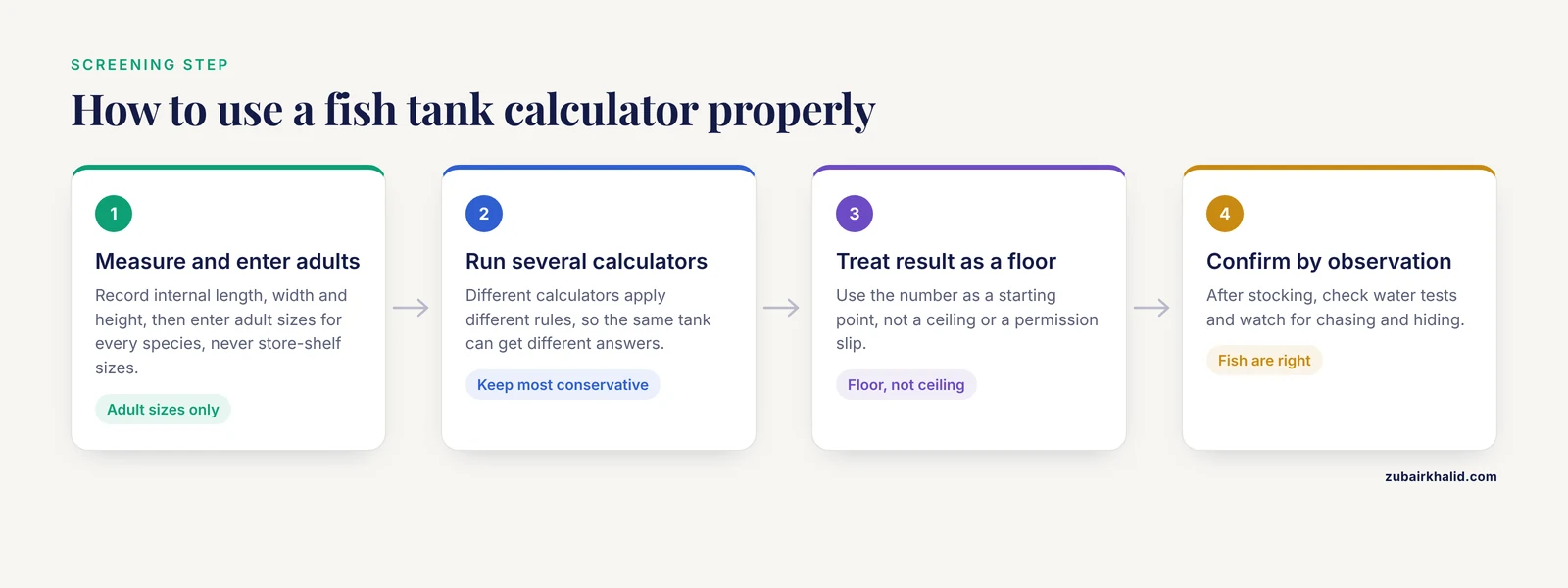
A fish tank calculator converts the tank's dimensions into a volume estimate and applies a stocking rule, usually an inches-per-gallon heuristic or a surface-area formula, to produce a number. Used correctly, it is a screening tool. Used incorrectly, it becomes a permission slip. Calculators cannot see temperament, territory, swim style, or group dynamics, and different calculators apply different rules, so the same tank can receive different answers from different tools.
A sensible workflow has three steps. First, measure the tank's internal length, width, and height, and enter adult sizes for every species on the list, never the sizes on the store shelf. Second, run the list through more than one calculator and keep the most conservative result. Third, treat that result as a floor rather than a ceiling, then confirm it with water testing and behavior observation after stocking. If a calculator says a list fits and the fish still chase and hide, the fish are right and the calculator is wrong.
Your Aquarium Care Checklist After Stocking
Compatibility is decided at purchase but maintained through routine. This aquarium care checklist covers the habits that keep a stocked tank peaceful and healthy.
- Confirm adult size and temperament for every species before buying, using more than one reference.
- Establish the nitrogen cycle before the first fish goes in.
- Quarantine new arrivals in a separate tank before they join the display.
- Test water on a fixed schedule for ammonia, nitrite, nitrate, and pH, and log the results.
- Change a portion of the water on a weekly schedule and treat replacement water to remove chlorine.
- Feed measured amounts and remove uneaten food before it decomposes.
- Watch the tank quietly each day for chasing, nipping, hiding, clamped fins, and rapid breathing.
- Keep a divider or a backup tank ready for a fish that will not settle.
- Reassess stocking whenever any fish approaches half of its expected adult size.
- Record additions, losses, and water readings so trends become visible early.
None of these steps is complicated. The value comes from doing them on schedule rather than in response to a crisis.
Limitations and When to Contact a Veterinarian
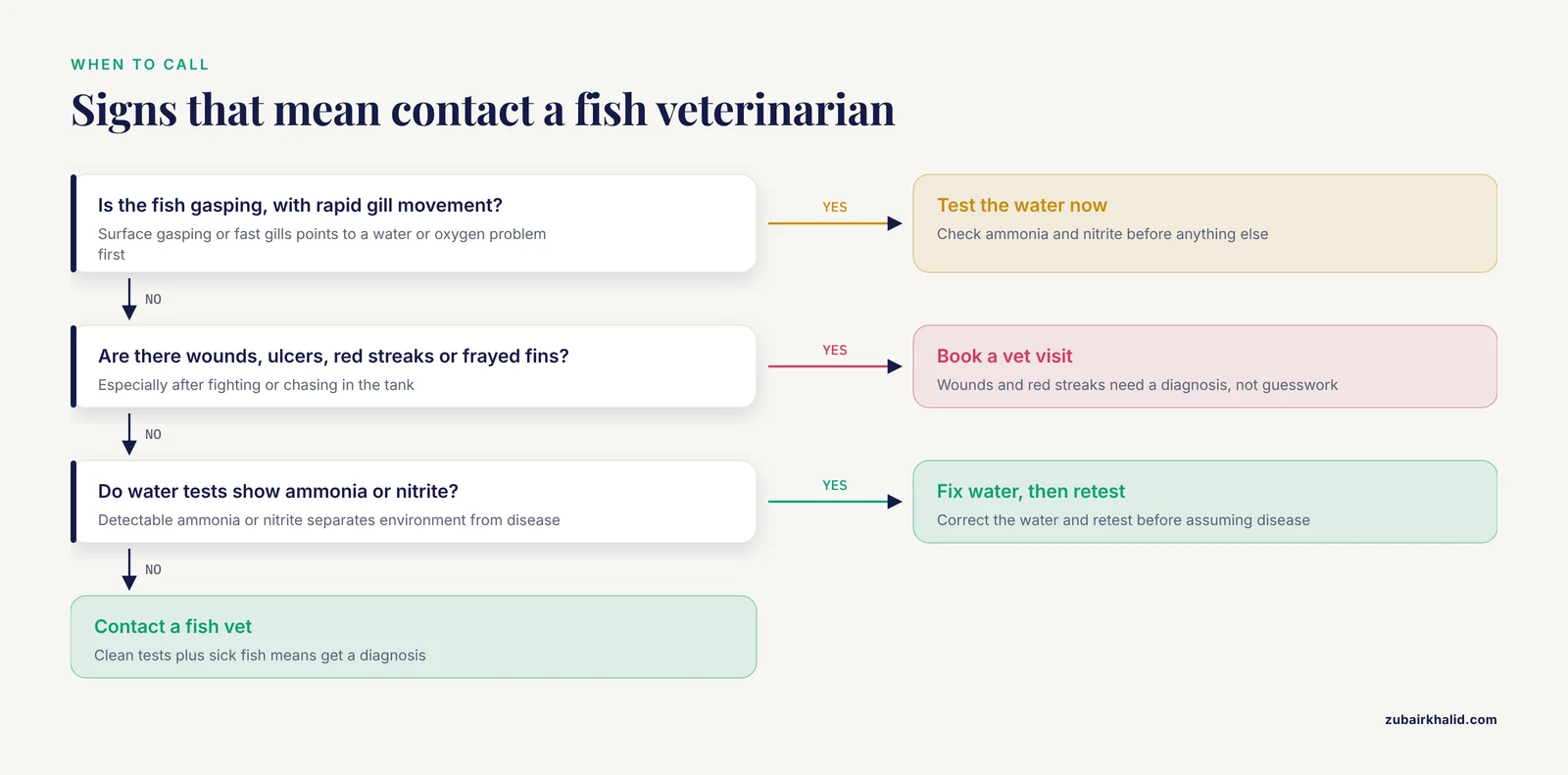
General rules cover populations, not individuals. Every tank is a unique system, and individual cases need a veterinarian, ideally one with aquatic experience. Contact a fish veterinarian or an aquatic animal health service when any of the following appears:
- Gasping at the surface or rapid gill movement
- Visible wounds, ulcers, or red streaks, especially after fighting
- Frayed or clamped fins that do not improve within days
- White spots, cottony patches, or visible parasites
- Bloating, raised scales, or an abnormal swimming posture
- Refusal to eat in a fish that was feeding reliably
- Detectable ammonia or nitrite on a water test
- Several unexplained deaths in a short period
Water testing matters because it separates environment problems from disease problems. If tests come back clean and fish still look ill, stop adjusting chemistry and get a diagnosis instead. Bring recent test results, photos, and short video of the abnormal behavior to the appointment, because fish signs are intermittent and recordings help. Aquatic veterinarians can be located through professional directories such as the World Aquatic Veterinary Medical Association, and veterinary colleges, including Cornell University, maintain aquatic animal health programs. The Merck Veterinary Manual's pet fish coverage is a reasonable reference for recognizing common disease signs while an examination is arranged.
Frequently Asked Questions
Does a bigger tank really make fish more compatible?
Yes, in most cases. More volume means more territory, longer swim paths, faster dilution of waste, and more stable water, and each of those reduces how often fish conflict and how costly the conflict is. Temperament mismatches can still fail in big tanks, so size improves the odds rather than guaranteeing outcomes.
What is the best tank size for a first community aquarium?
A 20-gallon long or a similar mid-size tank with a wide footprint. It is large enough for a small school, a bottom crew, and a centerpiece, yet small enough to maintain affordably while learning the routines.
Do tall tanks hold more fish than long tanks?
Usually no. Most community fish use horizontal swimming room, so footprint and length matter more than height. Tall tanks favor a few specialized species and heavily planted displays.
Can I trust a fish tank calculator instead of research?
No. A calculator is a screening step, not a verdict. Enter adult sizes, run more than one calculator, keep the most conservative answer, and then verify with observation and water testing.
How many fish can I add at one time?
Only a few. Adding small groups gradually lets the biological filter catch up to the new waste load and lets established fish adjust to newcomers before the next addition.
Can small fish still need a big tank?
Yes. Small schooling species need groups, active species need swim length, and territorial small species need space to defend. Adult behavior, not adult length alone, sets the minimum.
Further Reading
- Plastic ingestion by fish in the coastal waters of the Hengchun Peninsula, Taiwan: Associated with human activity but no evidence of biomagnification.
- Macroecological patterns of sexual size dimorphism in turtles of the world.
Sources
- [[Economic potential of ornamental fish catching under federal protection in Mexico.].](https://pubmed.ncbi.nlm.nih.gov/29466638/)