Fish Food Storage and Shelf Life: How to Keep Nutrients Fresh
By Dr. Zubair Khalid, DVM, MS, PhD ·
Fish food stays fresh for months when you control four things: heat, oxygen, moisture, and time. Heat, oxygen, and moisture strip omega-3 fatty acids and vitamins from flakes, pellets, and frozen feeds long before the food looks spoiled, so fish food storage and shelf life depend far more on how you keep a container than on the date printed on it.
The short answer is this. Keep dry food sealed in its original barrier liner inside an airtight, opaque container in a cool, dark, dry place. Buy package sizes your fish will finish while the food is still fresh. Thaw frozen food in the refrigerator, feed it the same day, and never hold thawed portions at room temperature. Discard anything with a rancid, paint-like odor or an ammonia-like smell. Every rule in this guide follows from the chemistry of lipid oxidation, moisture uptake, and microbial growth documented in published food-science research.
This article is educational and is not a substitute for veterinary diagnosis or treatment.
At a Glance: A Storage Cheat Sheet You Can Act On
| Food format | Where it keeps best | Main threat | Discard it if |
|---|---|---|---|
| , - | , - | , - | , - |
| Flakes and pellets | Original liner inside an airtight, opaque container in a cool, dark, dry cupboard | Oxygen and humidity driving rancidity | Paint-like or stale odor, faded color, clumps, oily dust |
| Freeze-dried tubs and cubes | Same as dry food, sealed tightly after every use | Moisture pickup | Soft or chewy texture, mold, off odor |
| Frozen packs | Freezer at a steady temperature, away from the door | Warm exposure and temperature swings | Sour or ammonia-like odor, slimy film, heavy freezer burn |
| Gel and cube foods | Refrigerator after opening, sealed | Microbial growth | Sour smell, liquefaction, mold spots |
| Live cultures | Short holding times in clean containers | Waste buildup and crowding | Culture crash, foul odor, die-offs |
Why Fish Food Loses Freshness
Four forces drain nutrition from fish food, and each one maps directly to a storage habit you control.
Lipid oxidation destroys fats before anything smells wrong
Fish meals and fish oils supply the omega-3 fatty acids owners pay premiums for, and those polyunsaturated fats are also the food's weakest link. Oxygen attacks them, forming peroxides that break down into aldehydes such as hexanal, the source of the paint-like or stale-crayon smell of rancid feed. Researchers tracking oil-coated extruded kibble over 15 months of ambient storage and 3 months of accelerated heat defined shelf-life failure as a peroxide value of 5 mEq/kg or a combined aldehyde level of 25 ppm [1]. Oils richest in polyunsaturates, including algae, flax, and camelina oil, oxidized fastest and lost the most n-3 fatty acids, while a natural antioxidant blend of tocopherols and rosemary extract at 200 ppm slowed the damage [1]. Reviews of fish-derived ingredients report the same vulnerability from the raw-material side, with oxidation and enzymatic degradation eroding the bioactivity of fish proteins and oils during storage [2].
The practical lesson is that a sealed bag is a shield with a timer. Every opening admits oxygen, and warm storage speeds the reaction, so the freshest food in your cabinet is always the pack you bought smallest and opened newest.
Moisture turns dry food into a spoilage substrate
Dry food is engineered to sit at low water activity, the fraction of unbound water available to microbes and enzymes. Humidity undoes that engineering. In a shelf-life model of dehydrated fish powder packed in different films and stored at 20 to 50°C and 21 to 51 percent relative humidity, moisture migrating through the packaging drove lipid oxidation and color change, and pouches with strong water-vapor barriers such as multilayer PET/PE/EVOH/PE held quality far longer than compostable PLA film [3]. Once dry food absorbs enough moisture, it cakes, crumbles, and eventually supports mold.
Home aquaria make this worse because fish rooms are often humid. An open flake tub beside a tank absorbs airborne moisture with every feeding.
Heat accelerates every reaction at once
Temperature acts as the master dial for spoilage. In yellowfin tuna held across a 0 to 25°C range, microbial counts, volatile nitrogen, and biogenic amines all rose faster as temperature climbed, and histamine tracked spoilage closely enough to anchor predictive shelf-life models [4]. Work on olive flounder by-products stored at 5, 10, and 25°C found practical use limits of about 30 hours at 5°C but only around 6 hours at the warmer settings, with histamine climbing to 88.65 mg/kg within 48 hours at 25°C [5]. Those curves explain why a jar of flakes parked on the aquarium hood, where lights and equipment radiate heat all day, ages far faster than the same jar in a cool pantry.
Microbes finish what moisture starts
Moist foods, including frozen feeds after thawing, spoil through bacterial growth rather than oxidation alone. Small marine fish similar to the sardines and smelt sold as frozen aquarium feeds remained sensorily acceptable for only about 6 days even under proper chilling, while free fatty acids rose by factors of roughly 4 to 19 and trimethylamine by 13 to 52 depending on species [6]. Storage conditions shift those curves sharply. Gilthead sea bream held at a 1:2 ice-to-fish ratio showed significantly lower bacterial counts, volatile nitrogen, trimethylamine, and pH over 16 days than fish held with less ice [7]. Spoilage bacteria also release the alkaline amines that give old seafood its ammonia bite, which is why smart-packaging research uses pH-sensitive dyes that change color as those amines accumulate [8]. Even additive chemistry follows the same logic, since fucoidan folded into fish nugget batter reduced Enterobacteriaceae, psychrotrophs, molds, and yeasts in a dose-dependent manner [9].
Trust your nose here. An ammonia-like odor means microbial spoilage has already progressed well past the point where the food delivers what the label promises.
Fish Food Storage and Shelf Life by Food Type
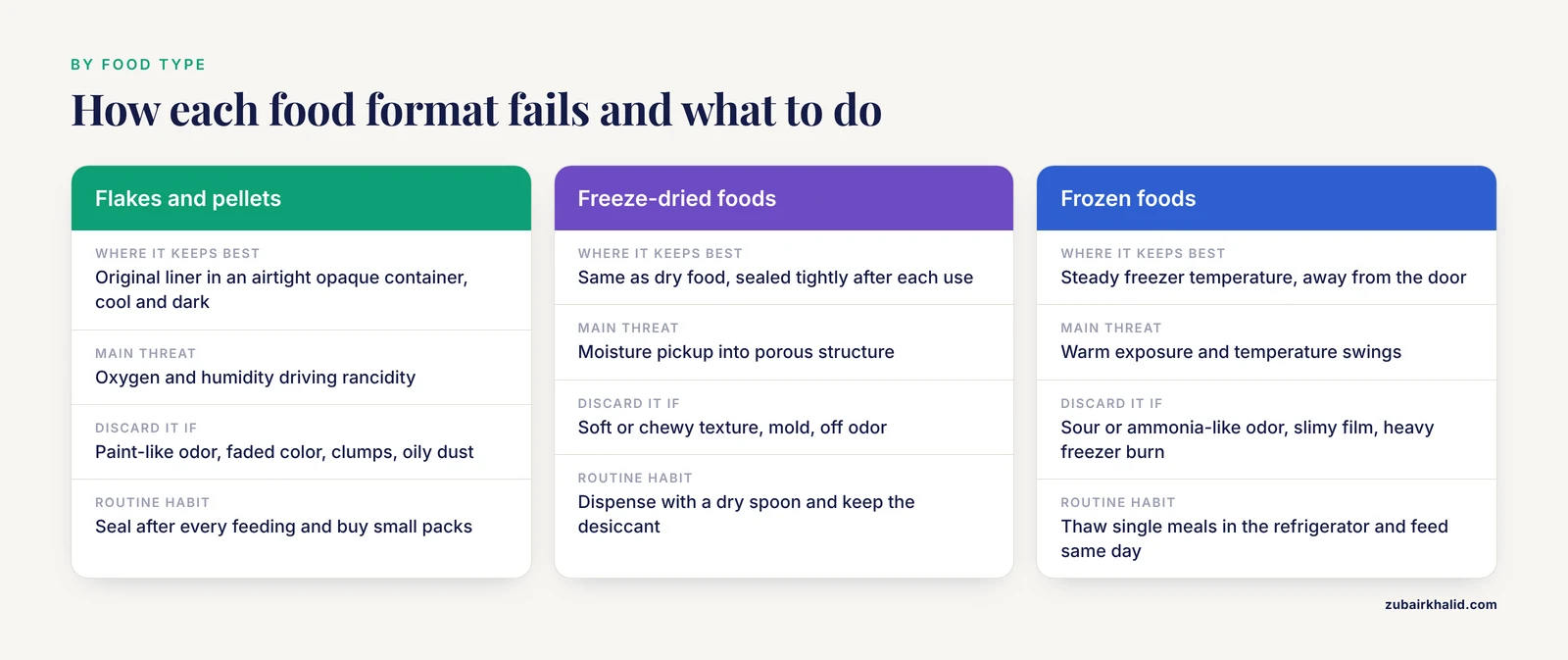
Each format fails in a different way, so each needs its own routine.
Dry flakes, pellets, and crisps
- Keep the original liner. Manufacturers select barrier films deliberately, and packaging research shows barrier quality directly controls moisture uptake and the oxidation that follows [3]. Set the whole liner inside an airtight container rather than pouring food into a decorative jar.
- Seal after every feeding. Oxygen exposure is cumulative, and a half-closed zip undoes the barrier.
- Store cool, dark, and dry. Keep containers away from hood lighting, heaters, sunny windows, stoves, dishwashers, and humid laundry areas.
- Buy small. Match package size to what your fish finish within a few months. A fish tank calculator that estimates system volume and stocking can anchor that math, because feeding demand tracks the animals in the tank.
- Prefer antioxidant protection. Formulations preserved with tocopherols or rosemary extract resist oxidation longer than unprotected ones [1].
Freeze-dried foods
Freeze-dried bloodworms, brine shrimp, and tubifex are even more moisture-sensitive than flakes because their structure is porous and hygroscopic. Keep lids sealed, dispense with a dry spoon, keep the desiccant sachet if the product includes one, and discard any container that smells off or shows softening or mold.
Frozen foods
Frozen packs of mysis, brine shrimp, bloodworms, and silversides hold their nutrition well as long as temperature stays constant.
- Keep packs at a steady freezer temperature and off the door, where openings cause swings.
- Transport purchases home with ice surrounding the packs rather than a single pack resting beside them, mirroring the ice-contact effect seen in chilled-storage research [7].
- Thaw single-meal portions in the refrigerator, in a small sealed container, and feed the same day.
- Never hold thawed feed at room temperature. Warm-storage trials show degradation begins within hours, not days, and the chilled-storage work summarized earlier shows how quickly small oily fish decline once cold chains slip [6].
- Check unopened packs for ice crusting and freezer burn, which signal temperature fluctuation or packaging damage.
Live and gel foods
Live cultures fail through microbial growth and waste buildup, the fastest-moving spoilage forces, so hold them briefly, keep containers clean, and discard crashed cultures rather than salvaging them. Opened gel foods belong in the refrigerator, sealed, and should be finished quickly for the same reason.
How to Fix a Storage Setup That Is Failing
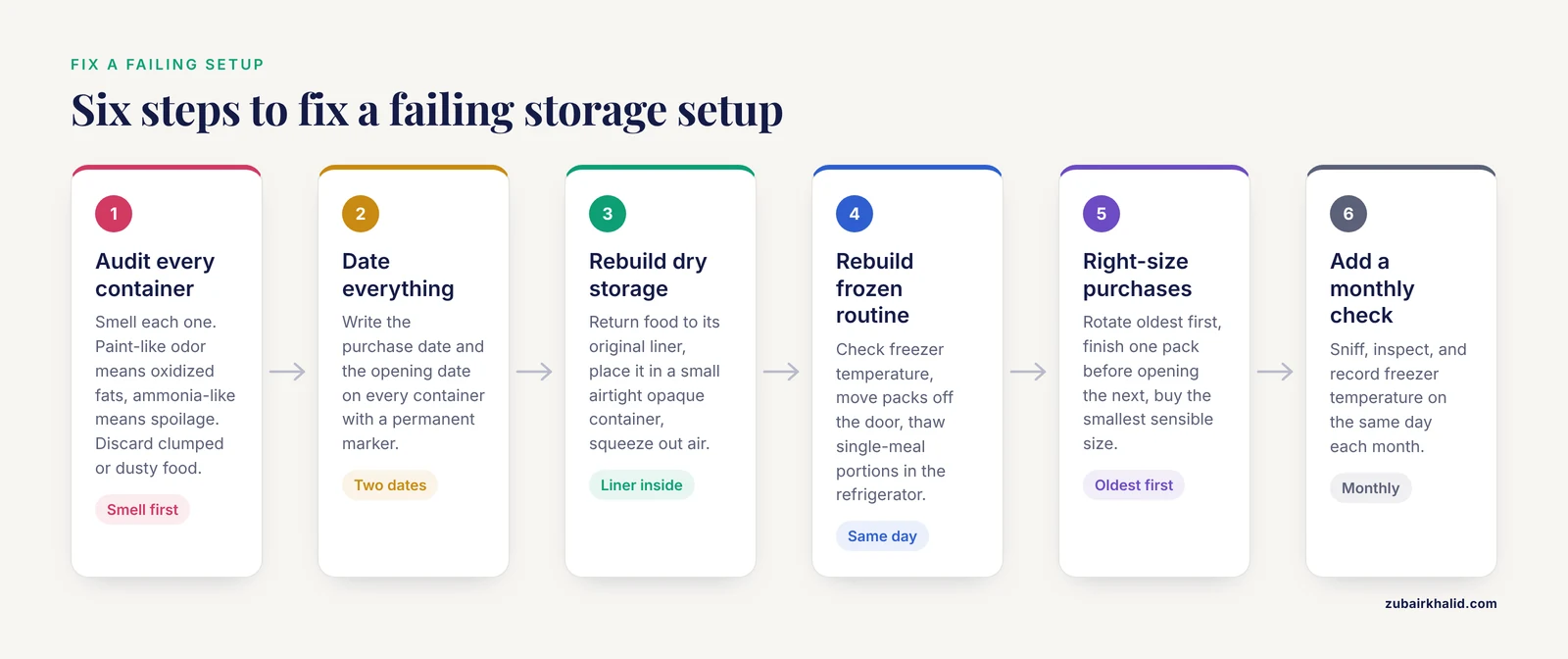
If your current routine involves a crumb-dusted tub on top of the hood, reset it in one afternoon.
- Audit what you own. Open every container and smell it. A paint-like or stale odor means oxidized fats. An ammonia-like odor means microbial spoilage. Discard anything questionable, along with clumped, discolored, or dusty product.
- Date everything. Write the purchase date and the opening date on every container with a permanent marker.
- Rebuild dry-food storage. Return food to its original liner, place the liner inside a small, airtight, opaque container with a gasket lid, squeeze out excess air, and shelve it in a cool, dark, dry spot away from tank equipment.
- Rebuild the frozen routine. Verify freezer temperature with a thermometer, move packs off the door shelf, thaw only single-meal portions in the refrigerator, and use them the same day.
- Right-size future purchases. Rotate stock oldest first, finish one pack before opening the next, and buy the smallest size that makes economic sense for your tank.
- Add a monthly freshness check to your aquarium care checklist. Sniff, inspect, and verify freezer temperature on the same day each month so it becomes automatic.
Mistakes that shorten shelf life
- Buying bulk tubs sized for a fish room you do not have.
- Storing food on the aquarium hood or beside lights and heaters.
- Leaving zips half-closed between feedings.
- Pouring food into clear jars and throwing away the barrier liner.
- Thawing frozen cubes on the counter all afternoon.
- Topping up old food with new instead of finishing and replacing.
- Keeping dry food in humid bathrooms or laundry rooms.
Troubleshooting guide
| Symptom | Likely cause | Fix |
|---|---|---|
| , - | , - | , - |
| Flakes clump or crumble into dust | Moisture uptake and oxidation | Discard smelly or moldy portions, move the rest to a tighter container in a drier room |
| Paint-like or crayon odor | Oxidized fats | Replace the pack and buy a smaller size next time |
| Fish ignore a food they used to eat | Palatability loss from oxidation | Offer a freshly opened small pack and compare acceptance |
| Ice crystals and dried patches on frozen cubes | Freezer temperature swings or damaged packaging | Verify freezer temperature, discard heavily damaged packs |
| Sour or slimy thawed portions | Bacterial growth after warm holding | Discard immediately and switch to refrigerator thawing in single-meal portions |
| Cloudy water or grease film after feeding | Overfeeding or degraded food breaking apart | Cut portion size, remove uneaten food, and test water quality |
Aquarium Care Checklist for Feed Freshness
Weekly
- Reseal every container fully after feeding.
- Wipe crumbs and oil residue from lids and rims.
- Return containers to their cool storage spot instead of leaving them beside the tank.
Monthly
- Sniff-test dry foods and discard at the first rancid note.
- Inspect frozen packs for ice crystals and freezer burn.
- Read and record the freezer thermometer.
Quarterly
- Rotate stock oldest first and replace anything past its label date.
- Reassess package sizes against actual consumption.
Ongoing
- Thaw only single-meal portions.
- Remove uneaten food promptly.
Supplies and Selection Criteria
- Airtight containers. Choose gasket-sealed lids, opaque walls, and small capacities that limit air exchange at each feeding. Glass or food-grade plastic both work.
- Barrier liners. Keep the original packaging whenever possible, since film barrier properties determine moisture uptake in dehydrated fish products [3]. Food-grade foil-lined zip bags are a reasonable substitute.
- Thermometers. A freezer thermometer and a shelf thermometer let you verify the steady temperatures that spoilage kinetics research ties directly to quality loss [4].
- Cooler bag and ice packs. Surround frozen feeds with cold during transport home rather than placing one pack loosely beside them.
- Labels and a marker. Purchase and opening dates drive rotation.
- Desiccant sachets. Food-safe packets help protect freeze-dried foods, replaced when they saturate.
- Vacuum sealer (optional). Removing headspace oxygen attacks the oxidation problem at its source, which is useful for owners who buy larger packages of stable, low-fat staples.
Safety, Welfare, and Water Quality
Spoiled feed threatens fish twice. First through nutrition, because oxidized fats deliver fewer omega-3 fatty acids and depleted antioxidant vitamins such as vitamin E [1]. Second through water quality, because degraded food breaks into fine particles and dissolved waste faster than intact pellets do. General aquatic husbandry guidance from sources such as the Merck Veterinary Manual's pet fish materials and AVMA aquatic resources treats feeding management and water quality as linked duties, and the World Aquatic Veterinary Medical Association promotes the same integration for fish health.
Handle frozen feeds with clean hands and dedicated utensils, keep containers closed against pests, and never feed anything visibly moldy. If a batch of food smells wrong after you already fed some, stop using it, monitor the tank closely, and perform a partial water change if feeding was heavy.
Limitations and When to Contact a Veterinarian
Individual cases need a veterinarian, and aquatic cases especially benefit from one who can evaluate water chemistry alongside diet. Exact shelf-life timelines for a specific commercial product come from its manufacturer label, and the research summarized here comes from controlled food-science settings, so treat its figures as directional rather than guarantees for any particular brand.
Contact an aquatic veterinarian when any of the following occurs:
- Fish refuse multiple consecutive feedings even after you switch to a freshly opened pack.
- You notice white stringy feces, bloating, fluid-filled swelling, or rapid gill movement.
- Several fish sicken or die after eating from one particular batch of food.
- Food you suspect was mold-contaminated has already been fed.
- Feeding problems coincide with an ammonia or nitrite spike, since water testing and correction must happen alongside any diet change.
The World Aquatic Veterinary Medical Association maintains resources for locating aquatic veterinarians, and general fish health guidance is available through AVMA and Merck Veterinary Manual pet fish materials.
Frequently Asked Questions
How long does fish food last after opening?
No single number applies, because format, packaging, and storage conditions all change the answer. Treat the best-by date as the outer limit for unopened food, judge opened food by odor, texture, and color, and replace anything that smells rancid, stale, or ammonia-like.
Can I store dry fish food in the refrigerator?
Yes for frozen food in the freezer and for thawed portions held briefly in the refrigerator. For dry food, refrigeration works only if the container seals tightly, because condensation on cold surfaces can add the very moisture that ruins flakes and pellets.
Does fish food expire or just lose nutrients?
Both happen. Nutrient decline, especially in omega-3 fatty acids and antioxidant vitamins, starts well before obvious spoilage, while microbial spoilage becomes the limiting factor mainly in moist and thawed foods.
How can I tell if flakes or pellets have gone bad?
Smell first. A paint-like, stale, or crayon odor signals oxidized fats, and an ammonia-like or intensely fishy odor signals amine buildup from spoilage. Clumping, faded color, oily dust, and refusal to eat are supporting signs.
Is it safe to refreeze thawed frozen fish food?
Plan to thaw only what the tank will eat and use it the same day. Repeated warming and chilling cycles give spoilage reactions more time to advance, so avoid refreezing thawed portions as a routine practice.
What is the best container for storing fish food?
Keep food in its original barrier liner and place that liner inside a small, airtight, opaque container with a gasket lid. Small containers mean less air exchange each time you feed, and opacity blocks the light that accelerates oxidation.
Does freezing destroy nutrients in fish food?
Freezing pauses spoilage chemistry rather than destroying nutrients, and quality holds as long as temperature stays steady. The bigger risks are freezer temperature swings and long warm thawing, which drive the degradation reactions described in this guide.
How much fish food should I buy at one time?
Buy the smallest package your fish will finish while it is still fresh, then rebuy rather than stockpiling. A fish tank calculator can help you estimate system volume and stocking, which anchors a realistic view of feeding demand and package size.
Sources
- Lipid source and kibble matrix determine oxidative stability and n-3 fatty acid loss in coated extruded dog food.
- Valorisation of Freshwater Fish By-Products: A Review on Extraction Technologies, Stability, Functional Food Applications and Prospects.
- Analytical Prediction of Water Activity Evolution for Shelf Life Modeling of Packaged Dehydrated Foods.
- Preliminary Kinetic Assessment of Quality Deterioration and Shelf-Life Estimation in Yellowfin Tuna Under Different Constant Storage Temperatures.
- Chemical Composition and Time-Temperature Arrhenius Modeling for Shelf-Life Prediction of Olive Flounder (Paralichthys olivaceus) By-Products.
- Integrated Assessment of Shelf Life Evolution in Small Marine Fish from the Northwestern Spanish Coast: Microbial, Chemical, and Sensory Changes During Chilled Storage.
- Influence of ice-to-fish ratio on spoilage kinetics, microbiological quality, and shelf life of refrigerated farmed gilthead sea bream (Sparus aurata).
- Smart and bioactive packaging systems from anthocyanins and zinc oxide nanoparticles for quality monitoring and shelf-life extension of Nile perch (Lates niloticus).
- Effect of Seaweed Fucoidan Incorporated Into Batter on Shelf Life Extension of Silver Carp (Hypophthalmichthys molitrix) Nugget During Refrigerated Storage.