The Complete Fish Feeding Checklist
By Dr. Zubair Khalid, DVM, MS, PhD ·
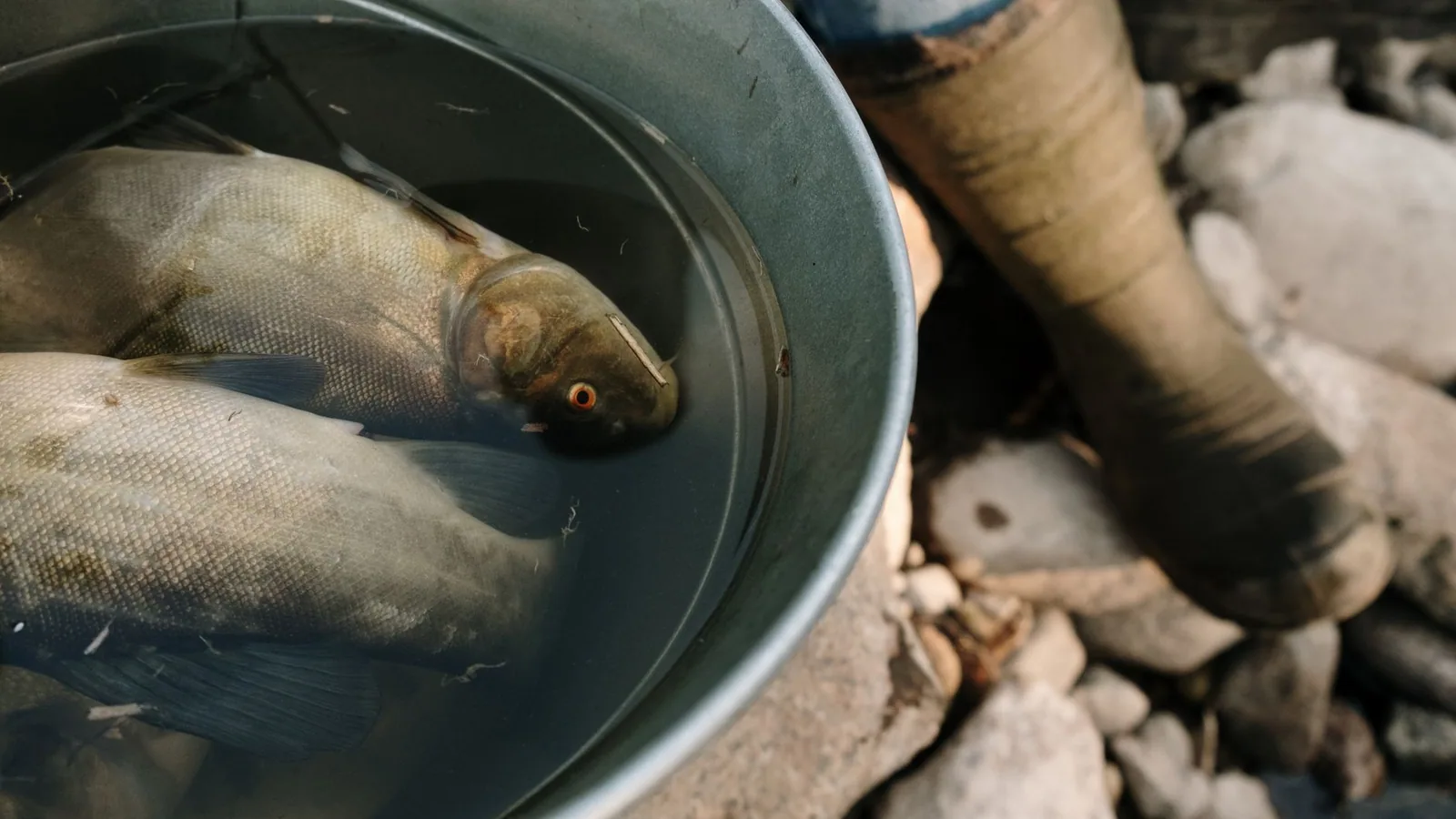
A complete fish feeding checklist answers four questions every day: what should this tank eat, how much, how often, and did everyone actually eat. Getting those four answers right prevents the most common aquarium problems, because feeding drives water quality, body condition, and disease risk more than any other routine task. This guide walks through the whole system, from matching food to species and building a schedule, to storing food safely, logging results, and recognizing when a feeding problem needs an aquatic veterinarian.
The checklist runs in three tiers. Daily items take about two minutes per feeding. Weekly items take ten to fifteen minutes alongside routine water testing. Monthly items are a short review of trends. Once the habit is built, the checklist practically runs itself.
This article is educational and is not a substitute for veterinary diagnosis or treatment.
The Ultimate Fish Feeding Checklist at a Glance
| When | Checklist item | Done looks like |
|---|---|---|
| Before every feeding | Count fish, check filter flow, temperature, and water clarity | Every fish present and behaving normally, equipment running |
| During feeding | Offer the planned food, in the planned amount, at the planned spots | All fish get access, food is taken eagerly |
| After feeding | Remove uneaten food, note who ate and who did not | No leftovers settling, log updated |
| Weekly | Test water, check body condition, inspect open food for freshness | Results recorded, food smells and pours fresh |
| Monthly | Review the log, adjust rations, replace stale containers, verify equipment | Portions match growth, no outdated food in use |
Use this table as your working copy today. The sections below explain the reasoning behind each line, and the template section gives you a fill-in format for your own tanks.
Why a Written Feeding Checklist Improves Fish Health
Feed is the one input you control every single day, and everything you add eventually becomes waste. Field research on coastal wetland fish communities found that fish abundance and diversity correlated negatively with ammonium and positively with dissolved oxygen [1]. The same chemistry governs a home aquarium. Overfeeding loads the water with nitrogen and organic debris, and the fish pay for it.
Feeding schedules also act directly on fish physiology. In a 60-day trial with roho labeo juveniles, changing the feeding schedule and protein level changed red blood cell counts, white blood cell counts, serum protein, and immune cell activity measures [2]. What looks like a harmless shortcut, such as doubling one meal and skipping the next, is a physiological event for the fish.
A written checklist also solves the household problem. Tanks fail when one person feeds carefully and everyone else drops in an extra pinch. A posted checklist with a log keeps every caregiver on the same plan, and the log turns vague impressions into data your veterinarian can actually use.
Know Your Fish Before You Feed
Match the Food to the Dietary Guild
Ecologists sort fish into feeding guilds, and the same sorting works at home. Piscivores eat animal prey, invertebrate feeders target crustaceans, insects, and worms, and primary consumers graze algae, plants, and detritus [1]. Commercial foods are formulated around the same divisions, so the first checklist entry is a species list with every fish assigned to a guild.
Two research findings show why the assignment matters:
- Herbivorous species are built for frequent, small bites. Comparative work on two families of herbivorous reef fish documented ten distinct feeding behaviors, including repeated nibbling, with technique varying by jaw shape, body movement, and whether the fish feeds alone or in schools [3]. A grazing fish expects near-continuous access to plant material, not one large flake meal.
- Carnivorous species handle starch poorly. Largemouth bass, a strict carnivore, showed measurable metabolic stress on starch-rich diets in feeding trials, with changes in glucose, insulin, blood fats, and liver health that improved only when the diet formulation changed [4]. A carnivore fed a generic, plant-heavy staple carries a metabolic load it was never built for.
Feeding Behavior Tells You How to Present Food
Species differ not just in what they eat but in how they capture it. Grazers pick at surfaces with precise jaw actions, while related species use body and head movements to scrape the same substrate [3]. Presentation matters as much as ingredient. Surface flakes never reach shy bottom fish, sinking pellets never reach surface feeders, and a single feeding point lets the fastest fish monopolize everything.
Step 1: Build the Feeding Plan
Before the first feeding, write down five things:
- Species inventory with adult size and guild for every fish in the tank.
- Life stage. Fry and juveniles run on growth and typically need more frequent, smaller meals than adults, while seniors often need rations adjusted downward as activity falls.
- A portion method. Aquaculture trials define daily rations as a percentage of body weight, and juvenile fish in published feeding trials received about 5% of body weight per day [2][5]. Home aquarists rarely weigh their fish, so use observable endpoints instead: every fish gets access, food is taken eagerly, and nothing meaningful is left over. Ask an aquatic veterinarian for a starting ration if you keep unusual, delicate, or heavily mixed tanks.
- A frequency target matched to guild and life stage, with plant material or grazing opportunities offered to herbivores more often than predators receive their larger, less frequent meals.
- A backup feeder, meaning a named person and a written plan for when the regular caregiver travels.
Step 2: Select and Store Quality Food
Read the Label Like a Formulation Scientist
Commercial feed chemistry is a moving target, and product quality varies. Feed scientists continually reformulate protein and lipid sources, and in rainbow trout trials, diets in which microalgae fully replaced fishmeal and fish oil maintained growth and feed conversion equal to the conventional control when the algae combination was chosen well [6]. Ingredient choice also drives cost as well as performance. The lesson for a hobbyist is simple: two containers of tropical flakes are not interchangeable. Check that the product is labeled for your species group and life stage, review the protein and fat sources on the ingredient list, and confirm a production or best-by date before you buy.
Protect the Food You Buy
Feed freshness is a welfare issue. When fish oil in feed oxidizes and goes rancid, the damage is measurable: in yellow catfish, oxidized oil reduced intestinal digestive enzyme activity, weakened antioxidant defenses, shortened and thinned intestinal folds, raised inflammatory signaling, and disrupted the gut microbiota [7]. Rancid fat injures the gut. Your checklist items:
- Buy container sizes you will finish while the food is still fresh.
- Reseal tightly after every use, and squeeze air out of pouches.
- Store food cool, dry, and dark, away from the heat and moisture above the tank.
- Smell-check open containers weekly and discard anything stale, paint-like, or rancid.
- Date every container the day you open it.
Live, Frozen, and Freeze-Dried Options
Live and fresh-frozen items trigger natural foraging and add variety, and diet composition genuinely changes fish biology. Mandarin fish weaned from live prey onto an artificial diet showed different blood, liver, and inflammatory responses to a bacterial challenge than live-bait-fed fish [8], which tells us diet transitions are physiological events. Source live foods deliberately, keep frozen food frozen and never refreeze thawed portions, and make any switch between food types gradually.
Supplements and Additives: Deliberate, Not Default
Research on feed additives is promising and equally species-specific. Probiotic Clostridium butyricum improved growth and shifted gut bacteria toward favorable groups in a hybrid bream trial [9]. A microalgae blend reduced inflammatory metabolites in seabream intestines, though the effect depended on whether the algae were raw or hydrolyzed [10]. Curcumin improved growth and disease resistance in Nile tilapia when delivered in nanostructured lipid carriers, a reminder that delivery format changes whether an additive works at all [11]. None of this justifies pouring random supplements into a home tank. Treat every additive as an experiment: one change at a time, with a baseline log, and with input from an aquatic veterinarian.
Step 3: Set a Consistent Schedule and Technique
Consistency is the cheapest husbandry tool available. Feed at the same times each day and keep the portion constant unless the log gives you a reason to change it.
Technique checklist:
- Present food where the fish can find it. Spread flake across the surface, drop sinking pellets at several points, and use target feeding, meaning a spot-delivered piece with tweezers or a pipette, for slow or shy fish.
- Feed in order of need. Slow grazers and bottom fish eat first if fast mid-water fish would otherwise monopolize the meal.
- Watch the entire feeding window. Feeding time is the best daily health check, because a fish that stops reacting to food is telling you something is wrong.
- Learn your fish's gut timeline. Digestive researchers measure gut emptying because it drives feeding frequency, and in one milkfish trial the fastest gut clearance took about five hours after the meal [5]. Your own observations of appetite at each feeding serve the same purpose at home.
Schedule changes deserve respect. Alternate-day feeding is a serious research strategy in aquaculture, and even well-designed schedule changes moved blood and immune values in juvenile roho labeo [2]. If you plan fasting days or schedule shifts for travel or health reasons, make them deliberate, monitor body condition, and confirm the plan suits your species.
Step 4: Run the Daily Routine
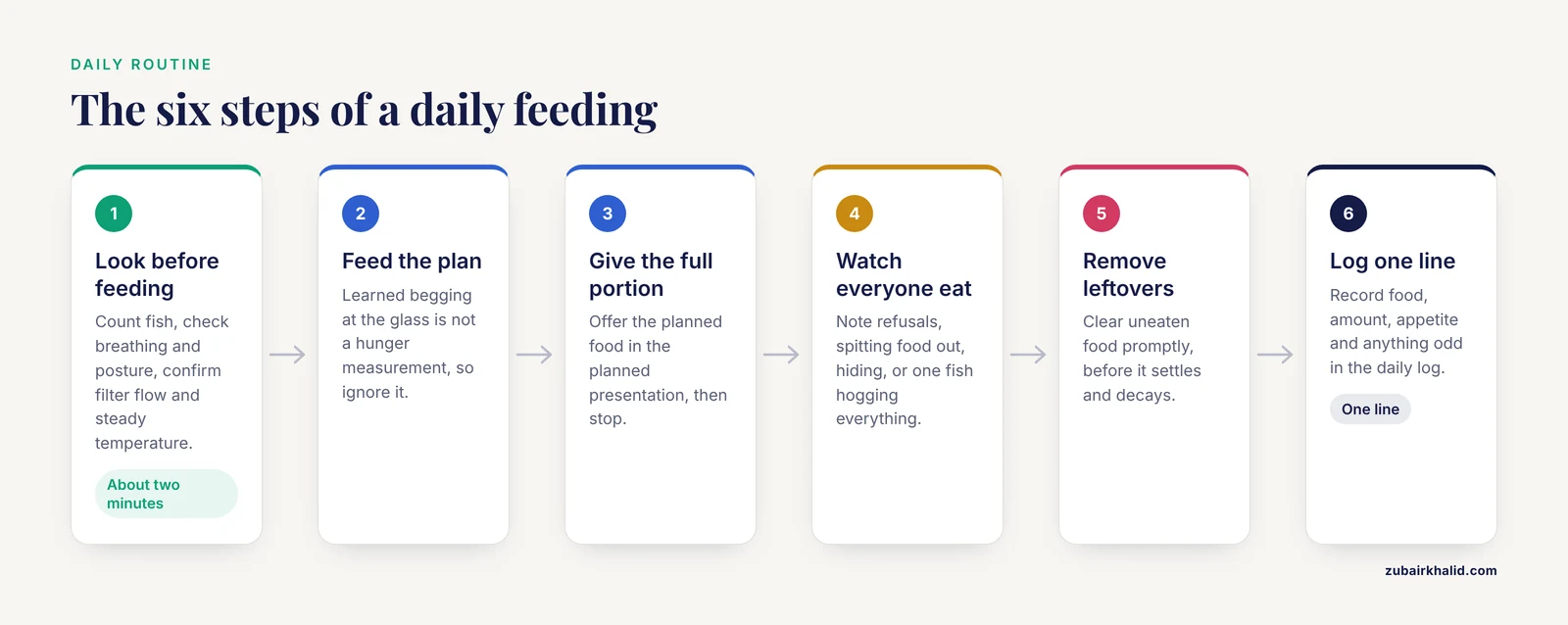
The daily loop, in order:
- Look before you feed. Count fish, check breathing and posture, and confirm the filter is flowing and the temperature holds steady. Feeding an empty or sick tank hides problems.
- Feed the plan, not the begging. Learned begging at the glass is not a hunger measurement.
- Give the full portion in the planned presentation, then stop.
- Watch everyone eat. Note refusals, spitting food back out, hiding, or one fish hogging everything.
- Remove leftovers promptly, before they settle and decay.
- Log one line. Food, amount, appetite, anything odd.
That single log line turns a checklist into a diagnostic tool. Appetite is usually the first vital sign to change in fish.
Step 5: Connect Feeding to Water Quality
Feeding and water chemistry are one system. Protein goes in, nitrogen comes out. Uneaten food and metabolic waste raise ammonium and consume oxygen, and fish communities in nature track those two variables directly, declining as ammonium rises and thriving with dissolved oxygen [1]. Every feeding decision is a water quality decision.
Practical connections:
- Test water on a fixed schedule as part of your broader aquarium care checklist, and treat any detectable ammonia or nitrite as a finding to act on the same day. Follow the target ranges printed on your test kit and confirm species-specific targets with an aquatic veterinarian.
- Watch the feedback loop. Cloudy water, algae growth, and rising nitrate between water changes are classic signs the ration is bigger than the system can process.
- Remember that feed and environment interact. In an American shad trial, fish receiving identical feed under identical feeding conditions grew and digested differently depending on the microbial and water environment around them [12]. Improving filtration, flow, or biological media can change how your fish use the same food.
- Plan stocking with feeding in mind. Total feed added scales with total fish biomass, so run your stocking plan through a fish tank calculator before you buy, and expect checklist portions to grow as your fish do.
Step 6: Weekly and Monthly Deep Checks
Weekly:
- Test core water parameters and record them beside the feeding log.
- Assess body condition from above and from the side. An unusually thin trunk or a persistently swollen belly each warrant attention.
- Check open food containers for freshness, clumping, and moisture.
- Clean the feeding zone and remove debris where food collects.
Monthly:
- Read the log for trends. Falling appetite, slower eating, or rising leftover totals arrive before visible disease.
- Adjust rations as fish grow, as stocking changes, or as seasons shift.
- Replace any open container past its freshest window.
- Verify the equipment that touches feeding: timers, any automatic feeder you use, and thawing tools.
Your Fish Feeding Checklist Template (With a Worked Example)
Any format works as long as it is fast. A wall chart, a notes app, or a spiral notebook by the tank all qualify. The fish feeding checklist format below uses one row per feeding day, with weekly and monthly blocks underneath. Copy it once per aquarium.
Daily log:
| Date | Food given | Amount | All fish ate? | Leftovers removed? | Notes |
|---|---|---|---|---|---|
| Mar 4 | Micro pellets, one piece of algae wafer | One small pinch plus wafer piece | Yes | Yes | Tetras quick as usual, corys active on the wafer |
Weekly block: water test results, body condition notes, food freshness check, equipment check.
Monthly block: ration review, log trends, container replacement, supply restock.
This worked fish feeding checklist example shows the level of detail that helps later. Notes like "tetras quick as usual" give your veterinarian a baseline when something changes.
Common Feeding Mistakes and Simple Fixes
- Feeding by sympathy. Begging is learned behavior, not a hunger meter. Feed the written plan and log the response.
- One container for every fish. A grazer and a carnivore cannot share a staple. Assign each species a guild and buy to match [4].
- Keeping food too long. Rancid fat damages the intestinal tract in feeding trials [7]. Date containers on opening, buy smaller sizes, and smell-check weekly.
- Switching diets overnight. Diet composition changes immune and metabolic responses [8]. Blend new food into old across days to weeks.
- Supplement stacking. Additives shift gut microbiota in species-specific ways [10][9], and delivery format changes results. Change one thing at a time with veterinary input.
- Ignoring the fish that never eats. Fast surface fish outcompete shy bottom fish. Use multiple feeding points and target feeding.
- Splitting feeding from water care. Every ration becomes waste, and fish health tracks ammonium and oxygen closely [1]. Pair the feeding log with the water test log.
Troubleshooting a Fish That Stops Eating
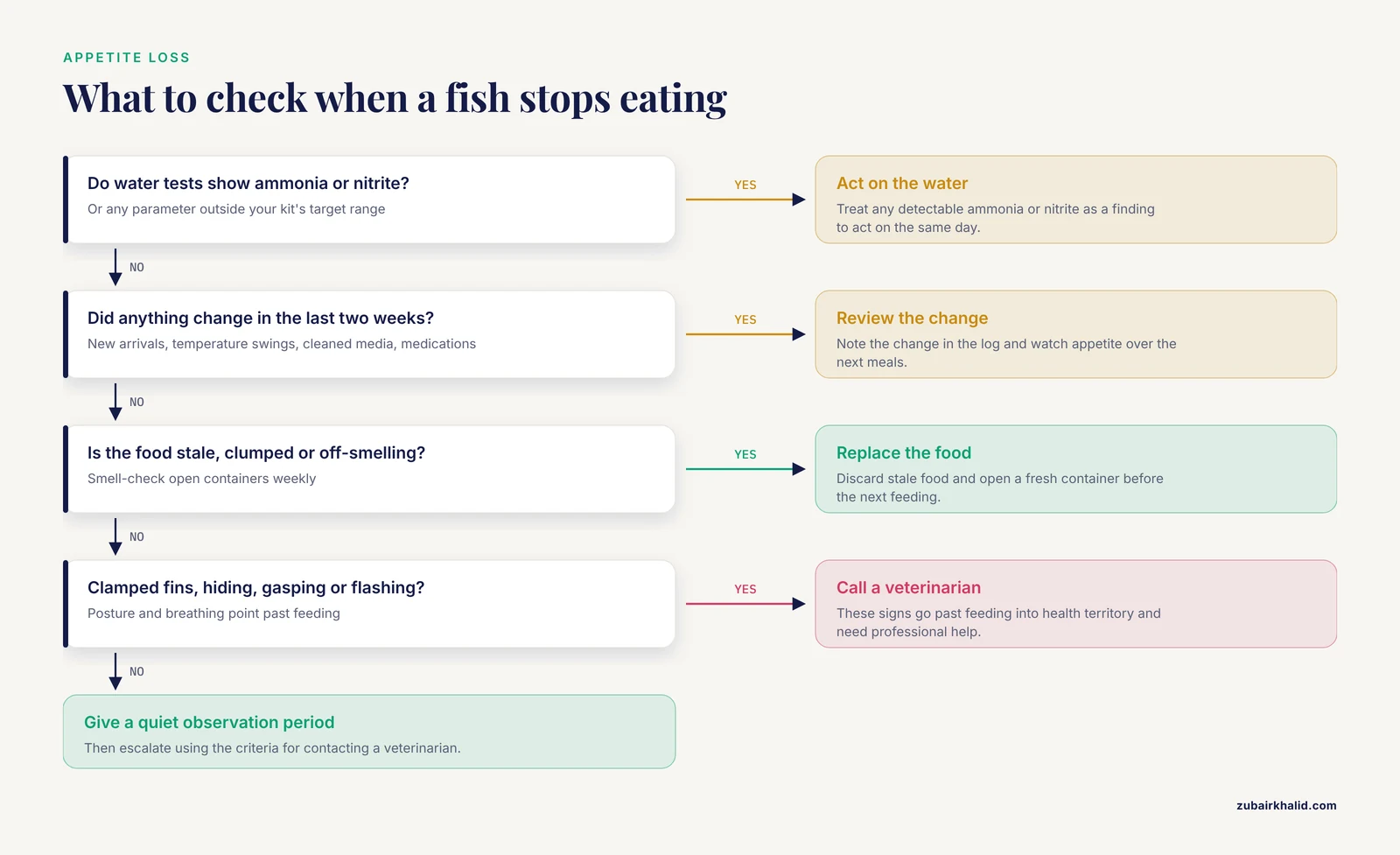
Work the list in order:
- Test water first. Detectable ammonia or nitrite, or any parameter outside your kit's target range, explains most sudden appetite loss.
- Review the last two weeks. New arrivals, temperature swings, cleaned filter media, rearranged decor, or medications.
- Inspect the food itself. Stale, clumped, or off-smelling food gets refused even by hungry fish.
- Watch posture and breathing. Clamped fins, hiding, gasping, or flashing against objects point past feeding into health territory.
- Give a quiet observation period, then escalate using the criteria below.
Welfare, Safety, and Handling Points
- Nutrition is immunity. Diet type altered infection responses in mandarin fish [8], and feed additives changed disease resistance in tilapia [11]. Consistent, species-correct feeding is preventive medicine.
- Feed quality is welfare. Oxidized fat injured the intestinal tract in feeding trials [7], so freshness belongs on the checklist next to portion size.
- Wash hands before and after tank work, and keep soaps and lotions out of the water.
- Any medication in the water or on feed is a veterinary decision, because product, dose, and duration depend on species, size, and diagnosis.
Limitations and When to Contact a Veterinarian
A checklist standardizes routine, it does not diagnose disease, and individual cases need a veterinarian. The research findings described here come from controlled trials in aquaculture species, and your fish's species, age, tank mates, and water supply all modify what applies to your tank.
Contact an aquatic veterinarian when any of the following occurs:
- A fish refuses more than one or two consecutive meals, or the whole tank goes off feed.
- Visible weight loss, a persistently distended belly, or asymmetric swelling.
- Gasping at the surface, rapid gill movement, or fish resting exhausted near outflows.
- Sudden death of any fish, or several fish sick at once.
- Ammonia or nitrite that stays detectable after corrective action, or fish acting oddly in water that tests normally.
- White spots, frayed fins, ulcers, cotton-like growths, or anything attached to a fish that was not there before.
For finding qualified help, the World Aquatic Veterinary Medical Association offers resources for locating aquatic veterinary professionals, and organizations including the AVMA and the Merck Veterinary Manual publish pet fish guidance that pairs well with this checklist.
Frequently Asked Questions
How much should I feed my fish each day?
Feed the smallest amount that lets every fish eat its share eagerly with nothing meaningful left over. Start small, adjust from the log, and ask an aquatic veterinarian for a starting target for unusual or mixed species.
How often should I feed aquarium fish?
Most community tanks do well with one or two measured meals a day, while grazers, fry, and juveniles need smaller amounts more often. Match frequency to each species' feeding style rather than to a fixed rule.
How do I know if I am overfeeding my fish?
Leftover food, cloudy water, algae growth, and rising nitrate between water changes are the classic signs. Fat-bodied fish and a surge in pest snails also point to extra food.
Can I skip feeding my fish for a day or two?
Healthy adult fish commonly tolerate a short break, but the safe length depends on species, age, and body condition. Confirm any plan with an aquatic veterinarian and never skip meals for fry, juveniles, or thin fish.
What is the best type of fish food to buy?
Buy a quality formulated diet labeled for your species group and life stage, matched to the dietary guild of each species. Add frozen or fresh items only where they suit the species.
Should I add vitamins or supplements to my fish's food?
Not routinely. Additive effects are species-specific and depend heavily on how they are delivered, so discuss any supplement with an aquatic veterinarian and change one thing at a time.
Do feeding needs change with the seasons?
Appetite can shift with water temperature and light in many species. Keep indoor schedules steady and ask your veterinarian before making seasonal ration changes.
When should a feeding problem become a veterinary visit?
Call when a fish refuses multiple meals, loses weight, shows swelling or breathing changes, or when water tests stay abnormal despite corrective action. Several fish affected at once is always urgent.
Sources
- Impact of water quality on the fish community in wetlands of Yucatan, Mexico.
- Effect of alternate day feeding strategy of sub-optimal protein level on haemato-biochemical responses in Labeo rohita (Hamilton) juveniles.
- Functional Distinctions in Feeding Behavior of Two Herbivorous Reef Fish Lineages.
- Dietary chromium methionine improves growth and glucose and lipid metabolism and modulates hepatic redox status in juvenile largemouth bass (Micropterus salmoides) fed a high-carbohydrate diet.
- Effects of Lumbricus sp. Extract Supplementation Methods and Levels in Fermented Feed on Digestibility, Growth, Gut Emptying, Blood Glucose and Phagocytic Parameters of Milkfish, Chanos chanos (Forsskal, 1775).
- Toward Sustainable Aquaculture: Microalgae Fully Replace Fishmeal and Fish Oil in Rainbow Trout Diets While Maintaining Growth, Nutritional Quality, and Cost Viability.
- Dietary pyrroloquinoline quinone alleviated intestinal damage of juvenile yellow catfish (Pelteobagrus fulvidraco) induced by oxidized fish oil: insight from intestinal digestive enzyme, antioxidant status, morphology, inflammation, and microbiota.
- Altered immunometabolic responses to Aeromonas hydrophila infection in artificial diet-fed mandarin fish (Siniperca chuatsi).
- Effect of dietary supplementation with Clostridium butyricum on growth, intestinal microbiota, metabolome and transcriptome in a hybrid fish (Megalobrama amblycephala♀ × Culter alburnus♂).
- The diet supplemented with raw and hydrolyzed Microchloropsis gaditana and Arthrospira platensis blend modulates intestinal microbiota and metabolomic profiles in Sparus aurata.
- Dietary curcumin encapsulated in nanostructured lipid carriers improves growth performance, feed utilization efficiency, and resistance to <em>Streptococcus agalactiae</em> in Nile tilapia (<em>Oreochromis niloticus</em>).
- Effects of biofloc technology on growth, physiology, gene expression, and muscle nutritional quality in the filter-feeding fish Alosa sapidissima.