How to Clean Aquarium Glass: Safe Methods
By Dr. Zubair Khalid, DVM, MS, PhD ·
The safe way to clean aquarium glass is to scrape algae from the inside with an aquarium-safe scraper or magnetic cleaner during a scheduled maintenance session, wipe the outside with plain water and a lint-free cloth, and never use soap, household cleaners, or unapproved tools that can leave residue in the water. Cleaning should happen as part of regular husbandry that also includes partial water changes and substrate cleaning, because routine maintenance is linked to healthier microbial balance in aquarium water [1].
This guide covers how to clean aquarium glass step by step, the tools that work on glass and acrylic, tips that make algae easier to control, the mistakes that put fish at risk, and the points where you should bring an aquatic veterinarian into the conversation.
This article is educational and is not a substitute for veterinary diagnosis or treatment.
At a Glance: Safe Glass Cleaning Checklist
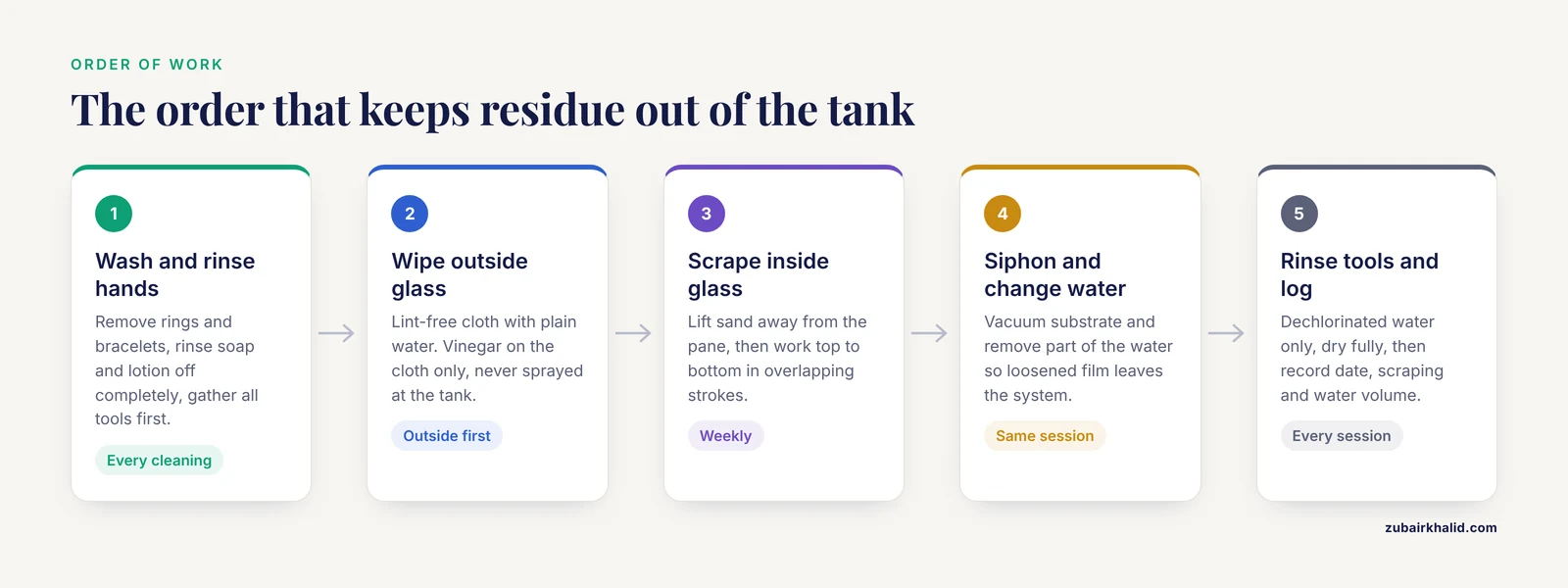
Use this checklist as your working routine. It doubles as the glass-cleaning portion of a broader aquarium care checklist.
| Step | Action | Frequency | Key Caution |
|---|---|---|---|
| 1 | Wash hands, remove rings and bracelets | Every cleaning | Soap residue must be fully rinsed off |
| 2 | Clean the outside glass first | Every cleaning | Plain water or aquarium-safe vinegar spray on a cloth, never sprayed into the tank |
| 3 | Scrape inside glass with an aquarium scraper or magnetic cleaner | Weekly or as algae appears | Lift sand and grit away from the pane before scraping |
| 4 | Spot-clean stubborn spots with a dedicated glass-safe blade tool | As needed | Only on bare glass tanks, never acrylic |
| 5 | Siphon detritus and do a partial water change in the same session | Weekly to biweekly | Routine water changes and substrate cleaning support stable microbial communities [1] |
| 6 | Rinse reusable pads and tools in dechlorinated water only | Every cleaning | Never with soap or in the sink with dishwater residue |
| 7 | Record what you did and what you observed | Every session | Changes in fish behavior after cleaning warrant a note in the log |
Why Clean Aquarium Glass Matters for Fish Health
A clear pane is only part of the story. The film that grows on aquarium glass is a visible sign of what is happening in the water column, and the water column itself is a living microbial ecosystem. Research on freshwater aquarium systems shows that microbial communities in the water underpin nutrient cycling, organic matter decomposition, and water quality regulation, and that these processes directly affect the health of the fish in the tank [1].
The same research tracked waterborne microbiomes over time and found that routine husbandry interventions, such as partial water changes and substrate cleaning, coincided with improved microbial evenness and reductions in opportunistic bacterial taxa [1]. Glass cleaning fits into that same husbandry rhythm. Scraping the glass and removing accumulated organic film is not cosmetic. It is one visible component of a maintenance routine that helps keep the whole system stable.
There is also a monitoring benefit. When you clean the glass regularly, you are at the tank, close up, several times a week. That is when most owners first notice early warning signs, such as a fish hiding more than usual, breathing faster at the surface, frayed fins, or a sudden change in how much film is growing on the panes. Regular cleaning sessions make small problems visible while they are still small.
What Is Actually Growing on Your Aquarium Glass
Most of what owners call "algae on the glass" is one of a few broad categories, and identifying the category changes how you respond.
- Green film algae. A thin green coating that spreads evenly across panes exposed to light. This is the most common type in established tanks and usually responds well to regular scraping and light management.
- Brown diatom film. A dusty brown layer common in newer tanks and in tanks with silicate-rich source water. It wipes away easily but often returns until the tank matures or the water source is addressed.
- Green spot algae. Hard, adherent dots that resist a soft pad and often need a blade tool on bare glass or a stronger scraper.
- Cyanobacteria (blue-green film). A slimy sheet that peels off in sheets and often has a distinct odor. Persistent sheets of this type usually point to an underlying water quality or flow issue worth discussing with an aquatic veterinarian or experienced retailer.
- Biofilm and mineral haze. A pale or cloudy layer that can sit on either side of the glass. Hard water deposits on the outside are mineral scale, not algae, and need a different approach from biological film inside.
If you are unsure whether a film is biological growth or a water-side deposit, run a fingernail gently across it while the tank is dry at that spot during a water change. Mineral scale feels rough and chalky. Biological film feels slick.
How to Clean Aquarium Glass Step by Step
This is the core routine to clean aquarium glass algae safely, in the order that minimizes risk to your fish.
Step 1: Prepare Before Your Hands Go Near the Water
Wash your hands thoroughly and rinse them extremely well. Hand lotion, soap film, and hand sanitizer residue can enter the water and are not part of any healthy aquarium environment. Remove rings and bracelets so you cannot scratch a pane or snag a net. Gather every tool before you start so you are not reaching into cabinets mid-task with wet hands.
Do not use kitchen sponges, and do not rinse aquarium tools in a sink that has dish soap residue. A dedicated bucket labeled for aquarium use only prevents one of the most common and devastating mistakes in fishkeeping.
Step 2: Clean the Outside Glass First
Work from the outside in. Dust, fingerprints, and water spots on the exterior panes are often what make a tank look dirtiest. Use a lint-free cloth dampened with plain water. For mineral scale on the outside of the glass, a cloth lightly dampened with diluted white vinegar works, as long as none of it drips into the tank. Spray cleaner onto the cloth, never onto the tank or hood.
Acrylic tanks scratch far more easily than glass. On acrylic, avoid vinegar on the viewing panes unless the manufacturer confirms it is compatible, and use only pads rated for acrylic.
Step 3: Scrape the Inside Glass
Choose your tool based on your tank's material and the type of film:
- Soft algae pad or sponge (aquarium-only). Best for green film and diatoms on both glass and acrylic.
- Magnetic cleaner. Efficient for routine maintenance. Pick one with a felt side for light film and a scrubbing side for heavier growth. Keep the magnet's contact surfaces free of trapped sand, because a single grain dragged across the pane leaves a scratch.
- Handheld scraper with a long handle. Useful for lower panes and corners without putting your arm in the water.
- Blade tool (glass tanks only). For green spot algae and stubborn adherent growth on bare glass. Hold the blade flat against the pane and work in smooth strokes. Never use a blade on acrylic, and use caution near silicone seams, which a blade can cut.
Technique matters more than force. Work top to bottom in overlapping strokes. Push loosened algae toward the substrate rather than letting it cloud the water, and pause if you notice fish crowding or darting away. Slow, light strokes remove film while protecting the silicone seam and the pane itself.
Before scraping near the substrate, lift any sand or gravel away from the bottom edge of the pane with the scraper's edge or a siphon tube. Trapped grit under a scraping stroke is the leading cause of permanent scratch marks.
Step 4: Siphon and Perform a Partial Water Change
Scraping dislodges organic material, so the most efficient session pairs glass cleaning with substrate vacuuming and a partial water change. This sequence matters beyond convenience. In the study of freshwater aquarium systems referenced above, routine husbandry interventions including partial water changes and substrate cleaning coincided with better microbial evenness and fewer opportunistic bacteria in the water [1]. Removing the organic load you just scraped off the glass prevents it from simply settling and decomposing back into the system.
Match the water change volume to your tank and stock. If you are unsure how much water your tank actually holds after substrate, decorations, and displacement, a fish tank calculator can estimate true water volume and water change quantities, which is more accurate than reading the nominal tank size printed on the box. Condition replacement water to match tank temperature before adding it.
Step 5: Clean Tools and Log the Session
Rinse pads, scrapers, and magnetic cleaners in dechlorinated water, and let them dry fully before storage. Designate a storage spot away from household chemicals. Then write down what you did and what the tank looked like. A simple log entry, date, what you scraped, water change volume, and any fish behavior notes, turns your aquarium care checklist into a record your veterinarian can use if a health question comes up later.
Equipment and Supplies: Selection Criteria
No brand endorsements are needed, because the selection criteria matter more than the label.
- Material match. Acrylic requires acrylic-safe pads and plastic scrapers. Glass tolerates more aggressive tools, including blades.
- Handle length. Choose a handle that reaches the bottom pane without you putting your arm deep into the tank. Less arm-in-tank time means less disturbance of fish and less chance of knocking equipment.
- Magnet strength and enclosure. A magnetic cleaner should be strong enough for your glass thickness but fully enclosed so grit cannot ride between the magnet and the pane.
- Replaceable pads. Pads that trap debris scratch panes. Replaceable or washable pads extend tool life and keep the scratching risk down.
- Dedicated status. Every tool should live only in the aquarium toolbox. Tools that have touched soap, cleaning products, or other tanks are retired or never introduced.
Clean Aquarium Glass Algae Tips That Actually Work
These tips address the causes of glass film, not just the symptom.
- Reduce light duration before buying a stronger scraper. Algae growth follows available light. If film returns within days of scraping, look at how long the tank light runs each day and whether the tank receives direct sunlight from a window.
- Feed deliberately. Uneaten food becomes dissolved nutrients, and dissolved nutrients feed the film on your panes. Feeding measured amounts that fish finish quickly is one of the highest-impact algae tips available.
- Scrape on a schedule, not on a crisis. A thin weekly film comes off in seconds. A three-week-old green layer bonded to the pane takes real effort and increases the chance of scratching.
- Pair every scraping session with a siphon. The loosened film has to leave the system, not settle on the substrate. This is also the pattern associated with healthier water microbiomes in the research cited above [1].
- Watch the corners. Film accumulates first in corners and along the waterline. A short-handled detail scraper or the corner of a pad handles both.
- Keep your hands out when you can. A magnetic cleaner lets you clean the glass without reaching in, which lowers stress for shy fish and keeps topical medications or skin secretions undisturbed.
- Test after heavy cleaning. If a session dislodged a large amount of film, a water test afterward tells you whether the removal added nutrients back into the column and whether your next water change should come sooner.
Common Mistakes When Cleaning Aquarium Glass
These are the errors that show up again and again in fishkeeping, and each one is preventable.
- Using soap or household glass cleaner inside the tank. Even a trace of soap residue in a rinsed sponge can harm fish gills and skin. Aquarium tools never touch soap.
- Spraying cleaners near an open tank. Aerosol and pump sprays travel. Cover the tank or move the fish room's cleaning products away from it before you spray anything in the room.
- Scraping with grit under the pad. One grain of sand dragged across glass leaves a permanent arc scratch. Clear the substrate line first.
- Using a blade on acrylic. Acrylic scratches easily and cannot be repaired invisibly. Blades are for bare glass only.
- Scraping into silicone seams. The silicone bond holding panes together can be nicked by an angled blade. Work away from the seams.
- Cleaning all the filtration media at the same time as a full tear-down. Beneficial microbial communities live on surfaces throughout the system. Aggressive simultaneous cleaning disrupts the microbial balance that maintains water quality [1]. Rinse filter media gently in removed tank water and stage big tasks across separate sessions.
- Ignoring the cause while fighting the symptom. If algae returns faster every week, the driver is light duration, feeding rate, nutrient load, or water change frequency. Scraping alone never fixes a cause.
- Netting or chasing fish out of the tank before cleaning. Removal and re-release is far more stressful than brief proximity to a scraper. Let fish move away on their own.
- Using the family sponge, bucket, or towels. Cross-contamination from dish soap, cleaning chemicals, or other pets' items is a recurring cause of sudden tank problems.
- Cleaning the glass while ignoring fish behavior. If fish hide, gasp, or clamp fins during or after cleaning, that observation belongs in your log and may warrant veterinary input.
Troubleshooting Persistent Algae on Glass
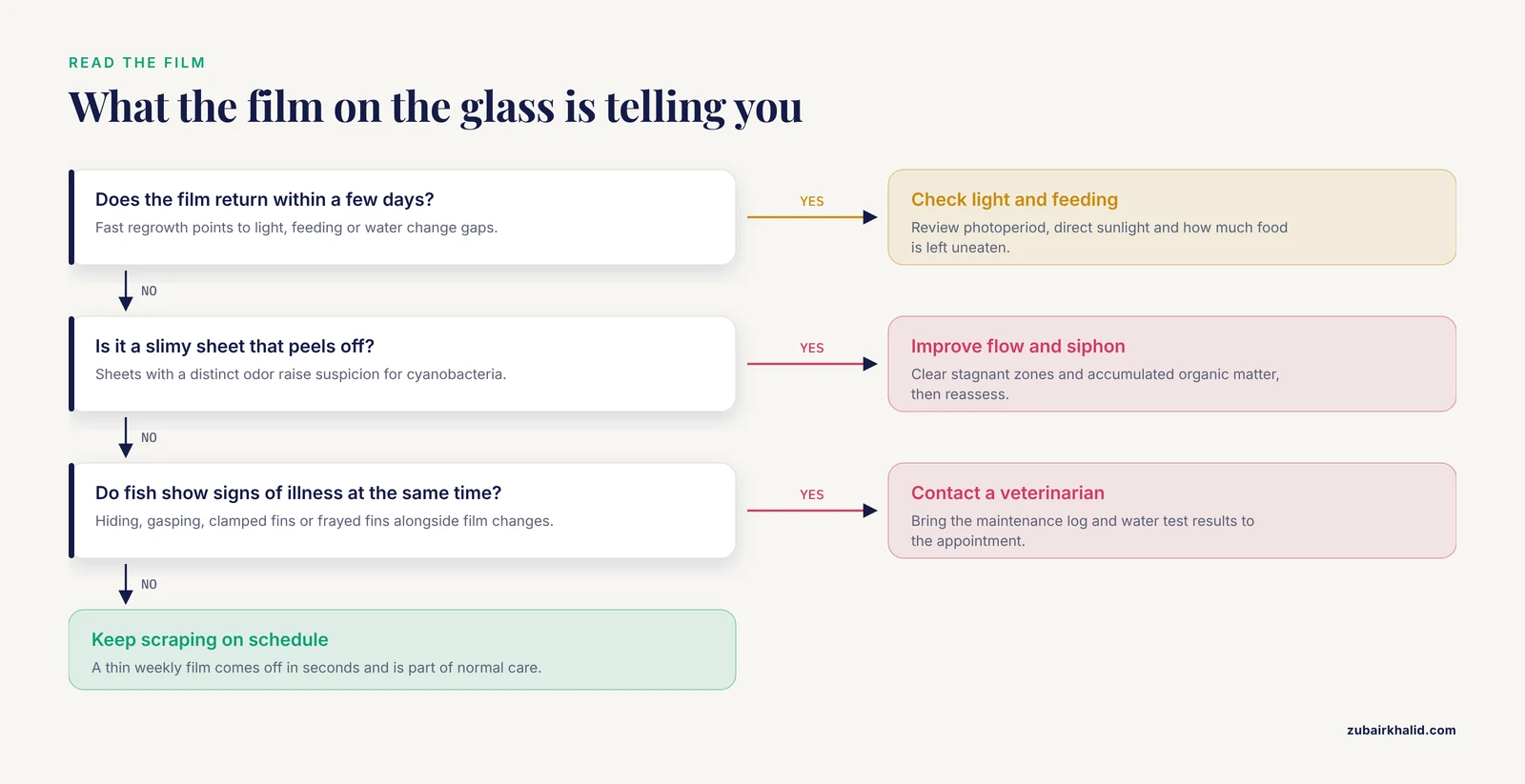
If you clean aquarium glass algae thoroughly and it returns within a few days, the film is a symptom of an imbalance rather than a cleaning problem.
- Rapid green film regrowth usually points to excess light, long photoperiods, or high dissolved nutrients from overfeeding or under-diluted water changes. Review your lighting timer and feeding quantities first.
- Persistent brown film in a mature tank can reflect source water characteristics. Have your tap water tested, and discuss the results with your aquarium retailer or an aquatic veterinarian if the pattern continues.
- Slimy sheets that peel off and return raise suspicion for cyanobacteria, which often follows stagnant zones or accumulated organic matter. Improving water movement and siphoning more thoroughly helps, and recurring outbreaks deserve a professional assessment.
- Hard spot algae that no pad touches may simply be part of a mature, well-lit tank. A blade on bare glass handles it, and many established tanks carry a small amount of spot algae indefinitely without any harm to the fish.
Escalate to a veterinarian when algae changes character abruptly, when fish show any signs of illness at the same time, or when water tests stay outside your normal range despite your routine. Sudden shifts in a tank's biological balance can involve opportunistic bacterial overgrowth, and veterinary guidance is the right next step in those cases.
The Broader Aquarium Care Checklist
Glass cleaning works best as one item in a whole-system routine. A practical weekly and monthly aquarium care checklist includes:
- Feed measured amounts, remove uneaten food within a few minutes.
- Observe every fish daily for appetite, posture, breathing, and social behavior.
- Scrape inside glass and wipe outside glass on your maintenance day.
- Siphon substrate and perform a partial water change with temperature-matched, conditioned water.
- Test water parameters on your established schedule and record results.
- Check filter flow and rinse mechanical media in removed tank water.
- Inspect equipment, heater seals, airline tubing, and seams during cleaning.
- Keep the log current, because patterns across weeks reveal problems that single visits to the tank hide.
For owners planning a new setup or resizing their maintenance routine, a fish tank calculator helps convert nominal tank dimensions into actual water volume, which then drives how much replacement water to prepare and how much conditioner to use. Planning around true volume rather than labeled volume makes every step of the checklist more accurate.
Welfare and Safety Points During Cleaning
Fish welfare during cleaning comes down to minimizing stress and protecting the physical environment.
- Work slowly and predictably. Fast arm movements in the water startle fish and can injure slow-moving species near the glass.
- Never drain most of the tank to clean. Fish exposed in shallow water experience crowding stress, and temperature swings happen quickly in small volumes.
- Keep hands and tools away from heater glass when the heater has recently run, since contact can burn you and damage the unit.
- Use two hands on long-handled tools near the waterline so you cannot lever the tool against the rim and crack a brace.
- Wash and dry hands before and after, both to protect the fish and to protect yourself, since aquarium water can harbor organisms of concern to human health. Anyone with open cuts, immunocompromise, or pregnancy should discuss aquarium handling precautions with their physician, and the AVMA and WAVMA both emphasize good hygiene practices around aquatic animals and their water.
If a fish appears injured by a tool, isolate the concern in your log, avoid re-scraping that area until it can be assessed, and contact an aquatic veterinarian. The Merck Veterinary Manual's fish resources and WAVMA's directory of certified aquatic veterinarians are reasonable starting points for locating qualified help in the United States.
Limitations and When to Contact a Veterinarian
Individual cases vary, and any specific health question about your fish needs a veterinarian, ideally one with aquatic animal experience. Contact a veterinarian promptly if you observe any of the following:
- Fish gasping at the surface, breathing rapidly, or hovering near filter output after a maintenance session.
- White spots, frayed or clamped fins, ulcers, pop-eye, abnormal swelling, or visible skin changes.
- Sudden deaths, or more than one fish affected at once.
- Refusal of food lasting more than a day or two in species that normally eat readily.
- Water that stays cloudy or tests outside your established normal range despite correct water changes.
- Abrupt changes in the type, color, or growth rate of film on the glass, particularly if fish behavior changes at the same time.
Bring your maintenance log, water test results, tank dimensions, filtration description, stocking list, and feeding amounts to the appointment. In cases of unexplained illness, veterinarians may consider waterborne opportunistic bacteria among the possibilities, since genera such as Aeromonas, Flavobacterium, Pseudomonas, and Mycobacterium are recognized as potential pathogens in freshwater aquarium environments [1]. Diagnostic workup and treatment decisions belong with your veterinarian, who can tailor recommendations to your species, system, and test results.
Frequently Asked Questions
How often should I clean algae off aquarium glass?
Once per week is a practical starting rhythm for most established tanks, timed with your water change. Tanks with brighter light, more feeding, or higher nutrient load may need a quick touch-up midweek. Adjust to what your tank shows you, not to a fixed calendar.
What is the safest tool to clean aquarium glass with?
A dedicated aquarium algae pad or magnetic cleaner is safest for routine film, matched to your tank's material. Reserve blade tools for bare glass tanks with stubborn spot algae, and never use household sponges or scrubbers that may carry soap residue.
Can I use vinegar to clean aquarium glass?
Yes, on the outside of the glass and only with a cloth, never sprayed into the tank. Vinegar dissolves mineral scale on exterior panes. Wipe with plain water afterward, and confirm acrylic compatibility with the tank manufacturer before using it on acrylic.
How do I remove hard water stains from my fish tank?
Exterior hard water stains respond to a cloth dampened with diluted white vinegar, applied away from the open tank. Interior mineral deposits above the waterline can be treated during a partial drain, but any product contact inside the tank should be limited to what the tank manufacturer approves, followed by thorough rinsing and refilling before fish return contact.
Why does algae keep coming back after I clean the glass?
Algae regrows when its drivers remain: light duration, direct sunlight, overfeeding, and nutrient accumulation between water changes. Cleaning removes the visible film, but the underlying balance has to change for regrowth to slow. Review photoperiod, feeding amounts, and water change consistency.
Is it safe to clean the glass with my hands in the tank?
Clean, soap-free hands are generally fine, and many keepers clean by hand. The bigger risks are rings scratching panes, lotion residue, and startling fish. A magnetic cleaner or long-handled scraper reduces all three risks, which is why many owners prefer them for routine sessions.
Should I remove my fish before cleaning the glass?
No. Removing fish causes more stress than a calm cleaning session. Leave fish in the tank, work slowly, and let them move away from the scraper on their own. Only move fish for major procedures such as a full deep clean or tank repair, and plan those around veterinary or experienced-retailer guidance.
Can cleaning the glass harm the beneficial bacteria in my tank?
Aggressive whole-tank cleaning can disrupt microbial communities, but glass scraping by itself is low risk because most beneficial nitrifying bacteria colonize filter media and substrate rather than the viewing panes. The greater risk is combining glass cleaning with simultaneous media replacement and deep substrate disturbance in one session. Stage maintenance tasks and support microbial stability with routine, moderate interventions such as partial water changes, the pattern associated with healthier microbial communities in published aquarium research [1].