Flakes vs. Pellets vs. Frozen vs. Live: Choosing the Right Fish Food
By Dr. Zubair Khalid, DVM, MS, PhD ·
Flakes, pellets, frozen food, and live food differ mainly in moisture content, nutrient density, how closely they match a fish's natural feeding behavior, and how much waste they add to your water. The rule of thumb: use a quality flake or pellet matched to your fish's mouth size and feeding position as the daily staple, and use frozen or live food as targeted supplements for picky eaters, conditioning breeders, and raising fry. There is no single best fish food across flakes, pellets, frozen, and live options. The right answer depends on the species in your tank, their life stage, and how much maintenance you are willing to do.
This guide walks through the best fish food flakes, pellets, frozen, and live pros and cons, then compares them on the criteria that actually decide a purchase. Along the way it pulls in what published fish nutrition research says about protein levels, feeding schedules, waste production, and the genuine advantages of live feed for young fish.
This article is educational and is not a substitute for veterinary diagnosis or treatment.
Quick Comparison: Flakes vs. Pellets vs. Frozen vs. Live
| Criterion | Flakes | Pellets | Frozen | Live |
|---|---|---|---|---|
| Moisture content | Very low | Very low | High | High |
| Nutrient retention after processing | Moderate, degrades once the jar is opened | Good, dense and stable | Very good, minimal processing | Excellent, unprocessed |
| Best suited for | Small community fish that feed at the surface | Medium and large fish, bottom dwellers (sinking types) | Most species, picky eaters, conditioning | Fry, larval fish, predators, natural hunters |
| Water quality impact | Low if eaten promptly, scatters and dissolves fast if overfed | Low if eaten, dense so uneaten pellets sink and foul substrate | Low if rinsed and fully consumed | Low, but uneaten live organisms may die and decay |
| Storage and handling | Easiest, dry jar | Easiest, dry jar or bag | Freezer space and thawing required | Most demanding, cultures or live purchases |
| Pathogen and parasite risk | Negligible | Negligible | Very low with commercial frozen product | Highest, varies by source |
| Cost and effort over time | Low | Low to moderate | Moderate | Highest |
| Feeding behavior enrichment | Low | Low to moderate | Moderate to high | Highest |
The table above is the core of the flakes vs. pellets vs. frozen vs. live decision. Everything below explains how to read it for your own tank.
Flakes: The Default Staple, With Limits
Flakes are thin, dried sheets of processed ingredients. Their advantages are real. They float for a long time, which suits surface-feeding community fish such as tetras, danios, guppies, and many barbs. They are inexpensive, easy to portion, and require no preparation. A well-made flake from a reputable manufacturer is fortified with vitamins that survive extrusion and drying reasonably well.
The weaknesses come from the same physics that makes flakes convenient. Because flakes are thin and low in density, they lose nutrients faster than other formats once the container is opened. Air, light, and moisture degrade fat-soluble vitamins over months. A jar that has been open for a year is not the food the label describes.
Flakes also scatter. A pinch thrown into a tank spreads across the whole surface, and small fragments drift down toward the filter intake and substrate. Overfeeding with flakes is the most common water quality mistake in hobby aquariums, and it matters more than most owners expect. Nutritional bioenergetic research on rainbow trout has shown that feeding schedule details, including how often food is delivered, produce measurable diurnal spikes in waste production such as ammonia and solids [1]. In a home aquarium, uneaten flake does the same thing on a smaller scale. It becomes ammonia, and ammonia becomes your water change schedule.
Practical guidance for flakes:
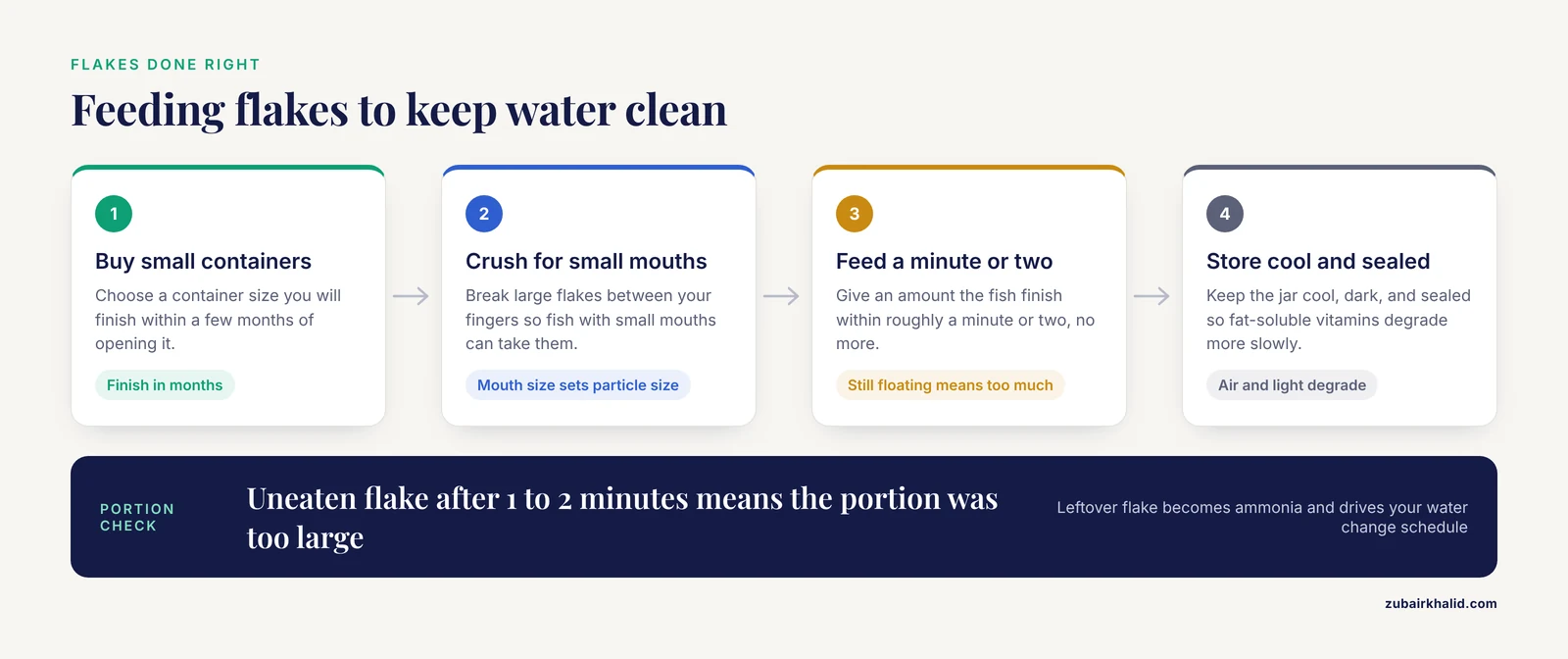
- Buy container sizes you will finish within a few months of opening.
- Feed an amount the fish finish within roughly a minute or two. If flakes are still floating after that, you fed too much.
- Crush large flakes between your fingers for fish with small mouths.
- Store the jar cool, dark, and sealed.
Pellets: Dense Nutrition for Larger Mouths and Bottom Dwellers
Pellets are compressed, extruded formulations with a much higher nutrient density per unit volume than flakes. They come in floating, slow-sinking, and sinking versions, and in pellet diameters from sub-millimeter micro-granules up to sticks for koi and large cichlids. This format flexibility is why pellets are usually the correct staple for medium and large fish, and the only sensible staple for catfish, loaches, and other bottom feeders that cannot realistically compete for floating food.
The high density cuts both ways. A pellet that is eaten delivers excellent nutrition with minimal waste. A pellet that is not eaten sinks, hides in gravel, and decomposes slowly, continuing to load the tank with nutrients for days. Pellet overfeeding is less visible than flake overfeeding, which makes it more insidious.
Pellet quality varies with formulation. Modern aquaculture research increasingly treats diet composition as a system property rather than a single number. A bioenergetic modeling study on rainbow trout found that both energy-rich diets and diets with excessive or poor protein levels reduced food intake, and that the dietary protein-to-energy ratio directly shaped how much fish ate and how efficiently they assimilated it [1]. In practical terms, the crude protein percentage on a pellet label only means something in the context of the energy content beside it. A higher protein number is not automatically better. This is also why the species matters. Studies in rohu juveniles showed that dietary protein level interacts with feeding frequency, with alternate-day strategies at sub-optimal protein levels producing measurable differences in red blood cell counts, hemoglobin, serum protein, and immune cell activity compared with continuous feeding of an adequate protein diet [2]. Translated for the home aquarist: protein quality, protein amount, and how often you feed interact. Young, growing fish and species with high protein requirements need a properly formulated pellet every day, not a diluted or erratic regimen.
Practical guidance for pellets:
- Match pellet diameter to mouth size. A fish that has to spit out its food is not being fed.
- Choose floating pellets for surface and midwater species, sinking pellets or wafers for catfish, loaches, and shrimp.
- Pre-soak hard pellets for fish prone to gulping air at the surface, such as some bettas and goldfish keepers' fish, if buoyancy problems are a concern to discuss with an aquatic veterinarian.
- Count pellets for small tanks. It is easy to drop in twice what a tank of six small fish actually needs.
Frozen Food: The Sweet Spot of Nutrition and Safety
Frozen fish food covers bloodworms, brine shrimp, mysis shrimp, daphnia, chopped mussel, and similar products sold as flat packs or cubes. Freezing preserves nutrients with very little processing damage, which puts frozen food closer to the nutritional quality of live food than any dry format can reach. At the same time, commercial freezing dramatically reduces the parasite and pathogen risk that makes raw live food risky. This combination is why frozen food is the workhorse supplement in serious fishkeeping.
Frozen food solves several specific problems. Fish that ignore dry food, wild-caught or newly imported specimens, and species with strong carnivorous preferences often accept frozen food immediately. Keepers conditioning fish for breeding rely on frozen meaty foods to bring fish into reproductive condition. Discus, some pufferfish, and many gobies and dragonets are far easier to establish on frozen food than on flakes alone.
The costs are convenience and discipline. You need freezer space. Cubes need thawing, ideally in a small cup of tank water, and rinsing for some products to avoid adding nutrient-rich thaw water to the display tank. And because frozen food is nutritionally dense, portion discipline matters even more than with flakes. One frozen cube is often several days of food for a small community tank.
There is also a modern category of functional feed ingredients worth knowing about, because it is moving from aquaculture into the ornamental market. Research on Atlantic salmon showed that supplementing diets with the microalga Chlorella vulgaris modulated the gut microbiota and altered the fish's physiological response to an oxidative stressor, though high inclusion levels worsened feed conversion while lower or intermittent levels improved protein retention [3]. The practical takeaway is not to run out and buy algae supplements. It is that feed formulation now includes ingredients selected for effects beyond basic growth, and that dose matters even for seemingly benign additions. If you supplement beyond a complete staple diet, do so deliberately and discuss specifics with an aquatic veterinarian or experienced breeder rather than adding multiple products on faith.
Practical guidance for frozen food:
- Buy commercially packaged frozen food, not live bait or uncertain bulk sources, to minimize disease introduction.
- Thaw before feeding and never refreeze a thawed portion.
- Feed what is consumed within a couple of minutes, and target the food at the fish that need it.
- Keep frozen food as a supplement to a complete staple diet unless a specialist has advised a specific regimen.
Live Food: Unmatched Stimulation, Real Risks
Live food includes cultured brine shrimp (Artemia), microworms, vinegar eels, daphnia, blackworms, and live feeder organisms. Nothing else matches live food for triggering natural hunting behavior, and for the smallest life stages it is often not optional.
The clearest evidence comes from ornamental fish larviculture. Neon tetras, one of the most commonly kept aquarium fish in the world, depend on live feed organisms such as Artemia nauplii during their larval stage. Research characterizing the development of neon tetra larvae found that they pass through an agastric stage, meaning they have no functional stomach, with very low digestive enzyme activity at the start of exogenous feeding. Stomach differentiation and the onset of pepsin production did not occur until about 20 days post hatch, and abrupt increases in trypsin, lipase, and pepsin activity marked the shift from an agastric to a gastric digestive mode [4]. The same research team evaluated weaning schedules off live Artemia onto prepared microparticulate diets and found that fish fed live food until 32 days post hatch could be weaned starting at either 12 or 17 days post hatch with survival similar to fish kept on live Artemia [4].
Two lessons follow for the home breeder. First, very young fry of many species need live food of appropriately minute size because their digestive systems cannot yet handle inert prepared food. Second, weaning does not have to be an all-or-nothing cliff. Gradual weaning schedules work, and the timing of the switch matters because it should follow the development of the fish's own digestive capacity rather than the keeper's convenience.
Live food for adult fish is mostly about enrichment and conditioning. Hunting live prey engages foraging behavior that no other format replicates, and many keepers report improved color and condition on varied live diets. The risks are equally real. Live food from uncontrolled sources can introduce parasites and pathogens. Culturing your own brine shrimp, daphnia, or worms controls that risk at the price of labor and space. Live food is also nutritionally incomplete on its own for most species, so it should supplement, not replace, a balanced staple.
Practical guidance for live food:
- Use live food for fry, picky eaters, and conditioning, not as a sole long-term diet.
- Culture from clean starter cultures rather than harvesting from unknown ponds or buying from bait shops.
- Gut-load or enrich live feeds where the product allows it.
- Quarantine practices that protect your tank from new fish also apply to live food sources of unknown origin.
The Criteria That Actually Decide the Choice
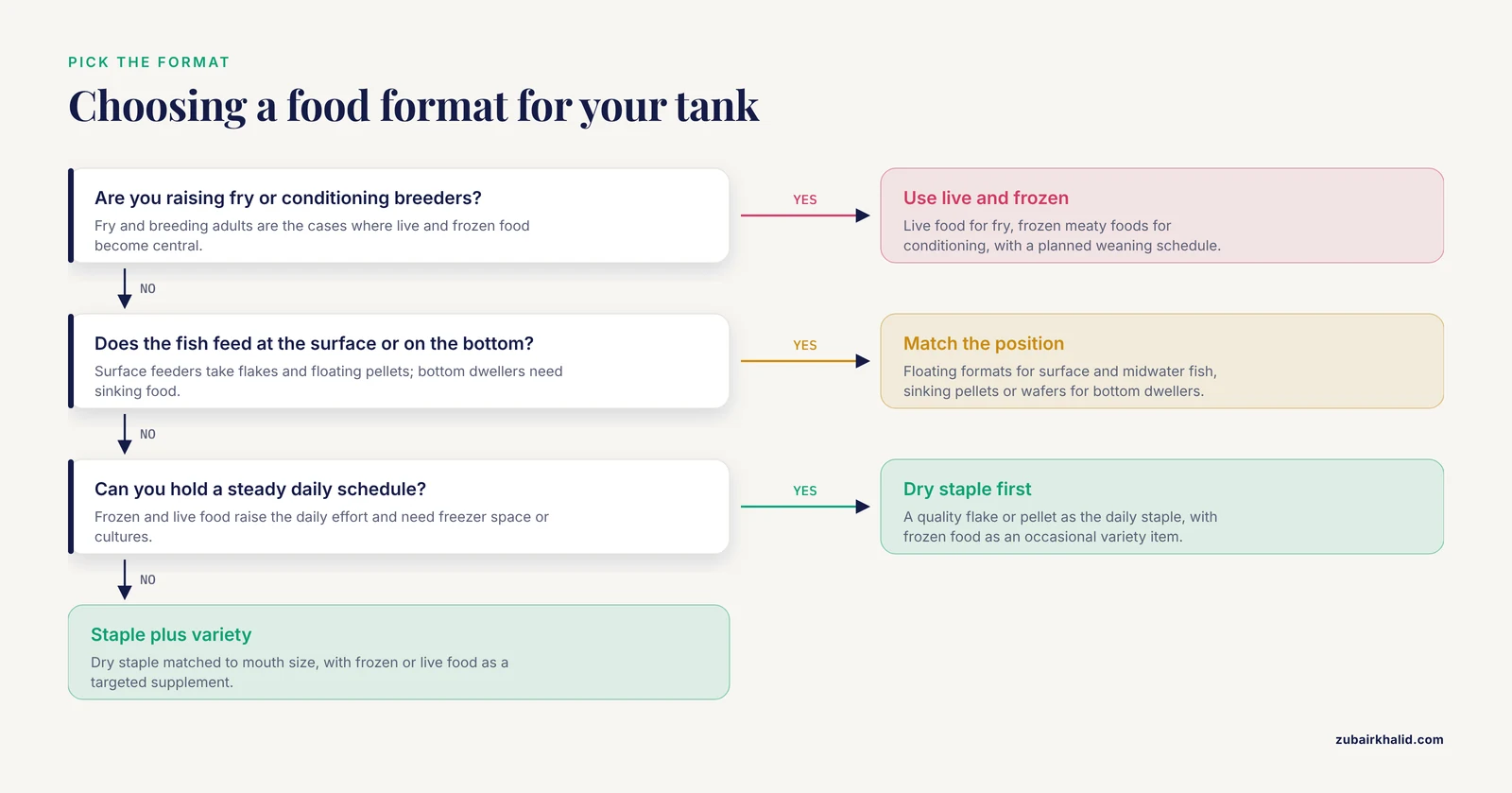
Once you understand each format, the flakes vs. pellets vs. frozen vs. live decision reduces to five questions.
Where does your fish feed, and how big is its mouth?
Surface feeders do well on flakes and floating pellets. Midwater fish need slow-sinking formats. Bottom dwellers need sinking pellets or wafers. Mouth size sets particle size more strictly than most beginners assume, and the neon tetra research is a reminder that mouth size and digestive capability develop together in young fish, not instantly [4].
What does the species eat in nature?
Herbivorous and omnivorous species do poorly on high-protein carnivore diets over the long term, and the reverse is equally true. The protein-to-energy balance in the food influences intake and assimilation efficiency, as demonstrated in the rainbow trout modeling work [1], so a food that is perfect for a trout is not automatically perfect for a goldfish.
How much maintenance can you sustain?
Frozen and live food raise the ceiling on nutrition and behavior but raise the floor on daily effort. If your schedule is unpredictable, a dry staple with occasional frozen supplementation will serve your fish better in practice than an ambitious regimen you abandon after two months. Feeding consistency itself has physiological consequences. Research on rohu showed that different feeding schedules produced different hematological and immune outcomes even at the same protein levels [2], and circadian studies in shrimp, which share many feeding-rhythm principles with fish, showed that self-feeding behavior follows an endogenous rhythm synchronized to light and mealtime, with most feeding activity concentrated in specific phases of the day [5]. Feeding at erratic times of day fights your animals' internal clocks. Pick a schedule you can hold steady.
How much waste load can your tank handle?
Every gram of food that is not eaten becomes a water quality problem. Bioenergetic modeling quantifies this relationship directly. Such models predict oxygen consumption, carbon dioxide, ammonia, and solid waste production under various temperatures and feeding quantities and compositions [1]. You do not need the model itself to apply the principle. The less uneaten food in your tank, the more stable your water, and stable water is the single biggest determinant of fish health that you control.
This is also where the secondary keyword fish tank calculator fits naturally. Online fish tank calculator tools help you estimate stocking density, tank volume in US gallons, and bioload before you buy. Feed amounts should scale with the actual biomass of fish in the tank, not with the size of the tank or with how many fish you plan to own someday. A tank that is overstocked by a calculator's estimate will need tighter feeding discipline, more frequent water changes, or both.
Are you raising fry or conditioning breeders?
If yes, live food and high-quality frozen food move from optional to central, at least for a period, with a planned weaning schedule onto prepared diets as the fry grow [4].
Worked Scenarios
A 20-gallon community tank of tetras, rasboras, and corydoras. Staple on a small slow-sinking micro-granule or quality flake fed once or twice daily in tiny amounts. Sinking wafers a couple of evenings a week for the corydoras. Frozen bloodworms or mysis once or twice weekly as variety. No live food needed unless you decide to breed.
A single betta in a heated 5-gallon tank. A high-protein small pellet as the staple, with frozen bloodworms or brine shrimp two or three times a week. Bettas are prone to overfeeding by enthusiastic owners. Two small feedings beat one large one, and one fasting day per week is a widely used routine worth discussing with your veterinarian.
Goldfish. Sinking pellets or gel food as the staple, because floating dry food combined with surface gulping is associated with buoyancy complaints in this species. Soak pellets, feed modest portions, and lean on blanched vegetables and varied formats. Goldfish produce heavy waste loads relative to their size, so every feeding decision interacts with filtration.
A breeding project with fry. Adults get frozen meaty foods and varied staples for conditioning. Fry get live infusoria, microworms, or newly hatched Artemia matched to their size, with a planned, gradual weaning onto microparticulate or crushed staple food once their digestive development supports it [4].
A tank of bottom-dwelling catfish and loaches. Sinking pellets are non-negotiable. Feed after lights out if the fish are nocturnal, because feeding rhythms follow light cycles and activity patterns [5]. Food dropped for diurnal midwater fish during the day will be gone before the nocturnal species wake up unless you target the substrate directly.
Common Mix-Ups That Harm Fish
- Feeding for human enjoyment, not fish need. Fish beg. Most healthy adult community fish do well on one to two small feedings daily, and many keepers overfeed by a wide margin.
- One food for every fish in a mixed tank. Surface flakes never reach the catfish. A varied format plan solves this in two minutes a day.
- Assuming more protein is always better. Intake and growth depend on the balance of protein to energy, not on a maximized protein number [1]. Species-appropriate formulation beats label bravado.
- Keeping flake for years. Opened flake loses nutrient value steadily. Buy smaller containers.
- Cutting live food off fry too abruptly. Weaning is a transition with a schedule, and digestive development sets the timeline [4].
- Treating supplements as harmless. Even functional ingredients can change feed conversion and gut microbiota at the wrong inclusion level [3]. More is not better.
- Ignoring the clock. Animals have endogenous feeding rhythms synchronized to light and feeding time [5]. Feeding whenever you remember to, rather than at consistent times, works against their physiology.
- Skipping the water test. Feeding mistakes show up as ammonia and nitrate. Your test kit is the feedback loop that tells you whether your feeding plan is right for your tank.
The Aquarium Care Checklist for Feeding
An aquarium care checklist that covers nutrition looks like this. Work through it monthly.
- Confirm species list, feeding positions, and mouth sizes for every fish in the tank.
- Verify each open food container is within its practical freshness window.
- Confirm you feed a consistent amount at consistent times each day.
- Check that bottom dwellers are actually receiving their share.
- Test ammonia, nitrite, and nitrate, and confirm your feeding rate is not outpacing your filtration.
- Plan one variety item, such as a frozen food, into the weekly rotation.
- For breeding projects, confirm live food cultures are healthy and a weaning schedule is written down.
- Reassess total bioload with a fish tank calculator whenever you add or lose fish.
- Observe body condition. Thin fish and bloated fish both indicate a feeding or health problem that needs attention.
- Log water change dates and feeding changes so problems can be traced to causes.
Limitations and When to Contact a Veterinarian
The published research behind this article comes largely from controlled aquaculture settings with species such as rainbow trout, rohu, Atlantic salmon, and neon tetras [1],, [3], [4]. Those findings establish principles, but they do not give exact feeding rates, gram amounts, or product recommendations for every home aquarium species. Individual cases, especially sick fish, unusual species, or complex mixed tanks, need an in-person evaluation.
Contact an aquatic veterinarian or a fish health specialist through organizations such as the World Aquatic Veterinary Medical Association (WAVMA), or consult the aquatic animal resources maintained by the AVMA and the Merck Veterinary Manual, when you see any of the following:
- Refusal of all food for more than a few days in a fish that was previously eating well.
- Rapid weight loss, muscle wasting, or a visibly sunken abdomen despite feeding.
- Persistent bloating, dropsy-type swelling, or abnormal swimming after meals.
- White, stringy, or unusually colored feces lasting more than a day or two.
- Multiple fish in the tank losing condition at the same time, which suggests a water quality or infectious problem rather than a diet choice.
- Sudden deaths after a feeding change or the introduction of new food or live feed.
- Any plan to feed live food of uncertain origin, since disease introduction is the primary risk of that format.
A veterinarian with aquatic experience can examine water chemistry, body condition, and husbandry together, because in fish those three factors are rarely separable.
Frequently Asked Questions
Are flakes or pellets better as a daily staple?
Pellets are generally the better staple because they retain nutrients longer, deliver more nutrition per unit volume, and come in sinking versions for midwater and bottom-dwelling fish. Flakes remain a fine staple for small surface-feeding community fish when used fresh and fed sparingly. Most keepers are best served by pellets as the core and flakes as one component of variety.
How much frozen food should I feed compared to dry food?
Because frozen food is nutritionally dense and moist, a small portion goes much further than an equivalent-looking volume of flake. Feed only what the fish consume within a couple of minutes, thaw the food first, and treat frozen items as a supplement to a complete staple diet rather than a replacement unless a specialist has set up a specific regimen for your situation.
Do fish really need live food?
Adult fish do not need live food if they are eating a balanced prepared diet, but live food is frequently necessary for the smallest fry and is the strongest option for triggering natural hunting behavior and conditioning breeding adults. Neon tetra larvae, for example, depend on live Artemia during early development, with weaning onto prepared diets possible on a gradual schedule as their digestive systems mature.
How often should I feed my aquarium fish?
Feed small amounts once or twice daily at consistent times, adjusting for species and life stage, and remove or avoid leaving uneaten food. Growth-stage juveniles need more frequent small feedings than adults, and feeding schedules have measurable effects on fish physiology, so consistency matters as much as quantity. Your water test results are the best check on whether your schedule suits your tank.
Can I mix all four food types in one tank?
Yes, and for most mixed community tanks a combination is the correct answer. A species-appropriate dry staple covers daily nutrition, sinking pellets cover bottom dwellers, and frozen or live food adds variety, conditioning support, and behavioral enrichment. The combination works only if the total daily amount stays modest and each item is matched to the fish that should eat it.
How do I know if I am overfeeding?
The earliest signs are not in the fish, they are in the water. Persistent ammonia or nitrate readings, cloudiness, uneaten food on the substrate, and filter media clogging faster than usual all point to excess feeding. Food research in farmed fish shows that feeding rate and frequency directly drive waste production and oxygen demand, so tightening portions usually improves both water quality and fish health at the same time.
Further Reading
Sources
- A Nutritional Bioenergetic Model for Farmed Fish: Effects of Food Composition on Growth, Oxygen Consumption and Waste Production.
- Effect of alternate day feeding strategy of sub-optimal protein level on haemato-biochemical responses in Labeo rohita (Hamilton) juveniles.
- Dietary Chlorella vulgaris supplementation modulates health, microbiota and the response to oxidative stress of Atlantic salmon.
- Larval digestive system ontogeny and early weaning in neon tetra Paracheirodon innesi.
- Synchronization to light and mealtime of the circadian rhythms of self-feeding behavior and locomotor activity of white shrimps (Litopenaeus vannamei).