The Best Fish Foods for a Balanced Diet: Top Picks
By Dr. Zubair Khalid, DVM, MS, PhD ·
The single biggest difference between thriving aquarium fish and struggling ones is usually not the brand on the label but whether the food format matches the species, the life stage, and the amount actually eaten in under a minute. The best rule of thumb is simple: build the diet around a quality staple food matched to your fish's natural feeding style, then add one or two complementary formats for variety, and feed only what the tank can consume cleanly.
This guide explains the best fish foods for a balanced diet, compares the major formats and brand considerations side by side, and shows how feeding choices fit into a wider aquarium care checklist.
Why Food Choice Matters More Than Brand Names
Fish nutrition research consistently frames aquarium fish as animals with species-specific dietary requirements rather than animals that thrive on one universal product. Reviews of food requirements and dietary practice in aquarium fish emphasize that nutritional needs vary widely across species, life stages, and feeding habits, and that diets should be planned around those differences rather than around marketing claims [1][2].
Three practical consequences follow from that principle.
First, format matters as much as formulation. A surface-feeding livebearer, a bottom-dwelling catfish, and a mid-water predatory cichlid eat differently even when they eat the same nutrient profile. A granule that sinks, a flake that floats, and a live prey item are not interchangeable tools.
Second, variety has measurable effects. In controlled feeding trials on guppy fry, the best growth and survival came from a combination of artificial food plus Artemia (brine shrimp), while groups fed only one food type performed worse [3]. In a separate aquarium study, swordtails raised on a combined diet that included organic food objects reached puberty earlier and had a longer life cycle than guppies raised on the same diet, showing that diet effects on growth and reproduction differ sharply between related species [4].
Third, food is not only nutrition, it is behavior. Food-based environmental enrichment, such as slow-dissolving food items that make fish work for their meal, measurably reduces inactivity and increases foraging in freshwater species held in aquaria, including curimbas and pacus [5]. For a home aquarist, this means that how food is delivered (floating, sinking, slow release, scattered) is a welfare decision, not just a convenience decision.
The Best Aquarium Fish Food Brands and Formats at a Glance
There is no single answer to "what are the best aquarium fish food brands," because peer-reviewed head-to-head brand comparisons are rare and species-specific. One controlled study on striped snakehead (Channa striata) fry compared three commercial artificial feeds, Quality Gold, Osaka Green, and Tropical Granule Deluxe, against a mixed feed and a control group. The mixed feed produced the highest growth and survivability, and Tropical Granule Deluxe produced the second-highest growth performance among the single brands tested [6]. The take-home message from that trial is broader than any one product: rotation and mixture of foods beat any single brand used alone.
Because brands change formulations and availability, this table compares the food formats you will actually choose between, which is where real decisions are made.
| Food Format | Best For | Pros | Cons | Practical Notes |
|---|---|---|---|---|
| Flakes | Small surface and mid-water community fish, livebearers, tetras, small barbs | Easy portioning, floats where surface feeders can find it, widely available | Loses vitamins faster once opened, low density means heavy feeders miss it, powders into water pollution | Best as a staple for small community tanks, buy sizes you finish within a few months |
| Pellets and granules | Mid-water and bottom fish, cichlids, larger community fish, slow sinking for bettas and loaches | Denser nutrition per volume, sinks toward bottom feeders, holds shape in water | Can expand in the gut if fish grab floating pellets too fast, overfeeding is easy because pieces are calorie-dense | The format most often tested in controlled growth trials, including the Channa striata brand comparison [6] |
| Frozen foods | Carnivorous and omnivorous species, conditioning fish for breeding, picky eaters | Close to natural prey nutritionally, minimal processing damage, high palatability | Requires freezer storage, can carry handling risks for humans (see allergy section), easy to overportion | Thaw in tank water before feeding, never refreeze a thawed portion |
| Freeze-dried foods | Convenient protein toppers, mid-water feeders, owners who want shelf-stable variety | Long shelf life, low moisture means less tank pollution, good travel option | Lower moisture means less like natural prey, some fish ignore it, floats and may frustrate bottom dwellers | Rehydrate before feeding so fish do not swallow dry pieces that expand |
| Live foods | Fry, predatory species, breeding conditioning, natural foraging behavior | Highest behavioral and foraging stimulation, matched to natural hunting patterns | Short shelf life, most work to keep, can introduce water quality changes if overfed | Baby brine shrimp are a practical home-hatched option for small fish [7] |
| Slow-release and enrichment items | Larger fish, species prone to inactivity and stereotypies, public-aquarium style husbandry at home | Prolongs foraging behavior and reduces inactivity, adds mental stimulation [5] | Not all products suit small tanks, uneaten slow-release items can degrade water | Best used occasionally as enrichment alongside the staple diet |
The Major Food Formats Explained
Flakes
Flakes remain the default staple for small community aquariums, and for good reason. They float long enough for surface feeders like guppies, tetras, and many livebearers to find them, and they let you portion food precisely for small mouths.
Their weaknesses show up over time. Flakes lose vitamin potency faster than other formats once the container is open, and they break into fine particles that sink into gravel and feed the bacterial load in the tank. Store an opened container sealed, away from light and heat, and plan to finish it within a few months rather than buying bulk sizes.
Flakes work best as the base of a rotation, not as the entire diet. Even in species where flake feeding is traditional, controlled trials show better outcomes when a supplementary live or frozen food is added [3].
Pellets and Granules
Pellets and granules are the workhorse format for most home aquariums. They carry more nutrition per piece, sink predictably, and come in slow-sinking and fast-sinking versions that let you target mid-water and bottom-feeding fish separately. Small soft pellets are also the format of choice for bettas and many dwarf cichlids.
The controlled snakehead fry trial mentioned earlier is one of the few published head-to-head comparisons of commercial pellet and granule brands under aquarium conditions. Across a six-month rearing period, the mixed feed treatment outperformed every single brand, and among the individual products the Tropical Granule Deluxe formulation produced the second-highest weight and length gains [6]. That result supports a practical rule: if you feed pellets, rotate at least two products or blend a pellet with a frozen or live protein.
Two cautions apply. Dry pellets can expand after swallowing, which is a known risk when surface-feeding fish grab floating pellets greedily, so pre-soaking large pellets is a reasonable habit. And because pellets are calorie-dense, it is easy to overfeed a tank that looks hungry even after a full meal.
Frozen Foods
Frozen foods, including bloodworms (red midge larvae), brine shrimp, and mysis, are the closest practical approximation to natural prey for carnivorous and omnivorous fish. They are nutritionally intact, highly palatable, and useful for conditioning fish toward breeding or coaxing finicky new arrivals to eat.
They also carry a human health consideration that most care guides ignore. Occupational allergy studies have documented IgE-mediated allergic reactions to aquarium fish foods, specifically red midge larva (bloodworms), freshwater shrimp, and earthworm, in people who handle these products regularly [8]. Earlier clinical reports described aquarium allergy, including bronchial asthma caused by polyvalent sensitization to various components in fish food [9][10]. For a household aquarist this means frozen and live invertebrate foods should be handled with gloves if you have any history of seafood, dust, or insect allergies, and containers should be sealed and stored away from living areas.
Live Foods
Live foods are the most behaviorally enriching and the most demanding format. They trigger full foraging sequences, which is exactly the behavior that enrichment research shows captive fish often lack [5]. They are also the format with the clearest growth evidence for fry and young fish.
In guppy fry feeding trials across 60 days, the group receiving artificial food supplemented with Artemia achieved the best weight, length, specific growth rate, and survival, while the group fed Daphnia alone had the lowest growth performance and survival [3]. In guppy habitat monitoring research, baby brine shrimp produced smaller pH shifts and lower turbidity than pellets, making them one of the cleanest protein options for small tanks [7].
Work with predatory ornamental species has also tested replacing part of a combined commercial diet with organic food objects (live prey). In that study, swordtails receiving the combined diet reproduced more successfully than guppies on the same diet, and part of the commercial feed for cichlids was successfully replaced with measured live prey at 0.75 g per head per day [4]. The practical lesson is that live foods can replace a meaningful share of a prepared diet, but the replacement rate needs to be matched to the species.
The downsides are real. Live cultures need space and maintenance, they are seasonal in availability, and overfeeding live prey into a small tank degrades water quickly. Treat live food as a supplement and a conditioning tool, not an everyday staple for most community tanks.
Enrichment and Slow-Release Foods
Slow-dissolving food items deserve their own category because their purpose is behavioral as much as nutritional. In the study of curimbas and pacus in a public aquarium, introducing slow-dissolving "acorn" food items during the enrichment phase reduced inactivity in both species and increased foraging in curimbas, alongside increased use of different tank areas [5]. Interestingly, the presence of visitors also promoted foraging and reduced inactivity, which mirrors the stimulation home fish get from household traffic [5].
For home aquarists, the equivalent is any food delivery that makes fish search, chase, or work: scattering food across the surface, using a feeding cone for slow sinking, or offering slow-release items occasionally. Use these in tanks large enough that uneaten portions can be removed or fully consumed.
Automatic Feeders
Automatic feeders are food delivery tools, not a food type, but they determine whether your chosen foods are fed accurately. Several designs have been validated in controlled testing. A time-controlled automatic feeder for indoor aquaria, built with a servo-controlled food chamber and programmable intervals, dispensed accurate amounts reliably in testing [11]. An Arduino-based feeder using a real-time clock and a load cell to weigh dispensed food achieved roughly an 83 percent success rate over a scheduled multi-day trial, with failures traced to clock errors rather than the feeding mechanism itself [12]. IoT-connected feeders have been built specifically to keep workplace and home aquariums fed during prolonged owner absence.
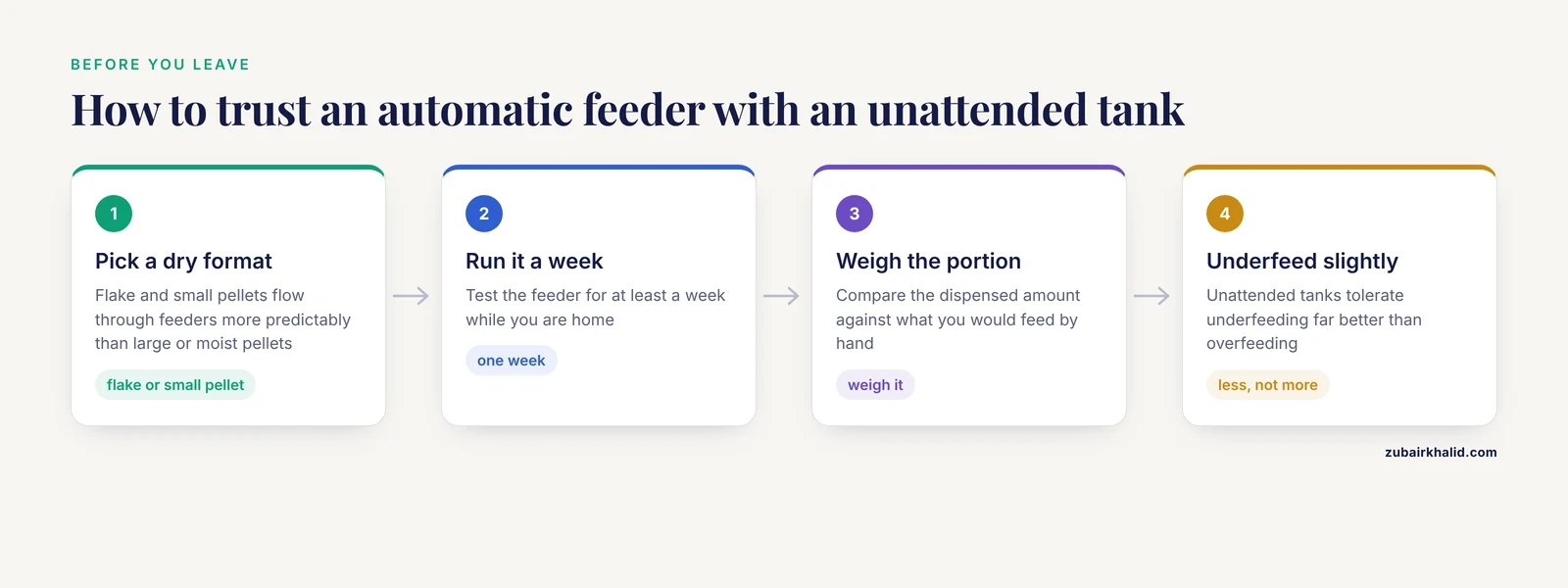
If you use a feeder, test it for at least a week while you are home, weigh the dispensed portion against what you would feed by hand, and remember that flake and small pellet formats flow through feeders far more predictably than large or moist pellets.
How to Compare Best Aquarium Fish Food Brands Options: Pros and Cons
When you evaluate best aquarium fish food brands options in a store or online, judge each candidate on five criteria rather than on packaging.
- Species match. Does the product state a target feeding style (surface, mid-water, bottom) and species group? A cichlid formula and a small tropical flake are not substitutes for each other.
- Life stage match. Fry and juveniles need different nutrition than adults, and the guppy fry trials show that fry performance on a given food cannot be predicted from adult results. The best-growing fry group in that trial needed the Artemia supplement, not the artificial food alone [3].
- Format behavior in water. Watch the food during the first feeding. Does it float, sink, cloud the water, or break apart? Water-stable pellets that hold shape for a few minutes give fish time to eat without polluting the tank.
- Rotation potential. Choose products that pair well. The strongest consistent finding across the feeding literature reviewed here is that mixed or rotated diets outperform single products [6].
- Your own handling risk. If anyone in the household has allergies, check whether the product contains midge larvae, shrimp, or earthworm ingredients, which are documented human allergens in aquarium food [8][9][10].
The honest pros and cons of brand selection come down to this. The pro of a single trusted brand is consistency, simpler storage, and predictable feeding behavior. The con is nutritional and behavioral monotony, and the controlled evidence suggests monotony costs you growth and welfare. The pro of mixing brands and formats is better growth and foraging. The con is that you must track which foods each tank is getting so no single nutrient or ingredient dominates.
How Much and How Often to Feed
Feeding amount, not feeding brand, is where most home aquariums fail. Two findings from the research literature make the risk concrete.
Overfeeding is a direct water quality hazard. Excess food in a guppy tank causes pollution that can poison and kill fish, which is why the IoT monitoring study of guppy habitats tracked turbidity and pH as indicators of feeding-related water degradation [7]. Protein metabolism itself produces ammonia as a waste byproduct, and ammonia that accumulates beyond safe levels leads to fish death, which is why ammonia monitoring systems for aquaria measure water chemistry as a proxy for feeding and bioload management [14].
The working rules that follow from this are straightforward. Feed an amount the fish finish within about a minute. Feed adult community fish once or twice daily rather than several small meals you cannot track. Remove visibly uneaten food after feeding. When fish show altered feeding behavior, such as the reduced food intake and compensatory metabolism documented in fish exposed to degraded water conditions, treat the change as a water quality signal first and an appetite problem second.
For routine scheduling, a three-times-daily pattern has been used in automated systems, with programmed feeds in morning, midday, and evening [12]. That schedule suits growing juveniles and busy surface feeders better than it suits slow bottom dwellers, so adjust to your stock.
Worked Scenarios
Scenario 1: A 20-gallon guppy and tetra community tank
Base diet is a quality small flake fed once daily in an amount the fish finish quickly. Add frozen or live baby brine shrimp once or twice weekly, since baby brine shrimp showed the cleanest water quality profile and reliable growth support in guppy-focused work [3]. If you breed the guppies, feed fry a combination of crushed flake plus Artemia rather than any single food, matching the combination that produced the best fry growth and survival [3]. Keep an ammonia check in your weekly routine, because protein feeding in a small tank moves ammonia quickly [14].
Scenario 2: A predator tank with larger cichlids or similar carnivores
Base diet is a sinking pellet or granule matched to mouth size, rotating at least two products, because the mixed-feed approach outperformed every single commercial product in the controlled fry comparison [6]. Add live or frozen prey on a measured schedule rather than ad hoc, following the principle that live prey can replace part of a prepared diet when the amount is controlled [4]. Add a slow-release or scatter-fed item occasionally to promote foraging and reduce inactivity, which enrichment research shows has measurable behavioral benefits [5]. Watch aggression closely, since the enrichment study recorded increased agonistic interactions during enrichment feeding in one species, and adjust delivery if feeding turns into fighting [5].
Scenario 3: An office or vacation tank
Use a tested automatic feeder with a flake or small pellet that flows reliably. Validated feeder designs dispensed accurate portions on programmable schedules in controlled testing [11][12], and IoT feeders were built precisely for tanks that must be fed during prolonged owner absence [13]. Before you leave, run the feeder for a full week while you are present, confirm the portion size, and underfeed slightly relative to a normal day since unattended tanks tolerate underfeeding far better than overfeeding.
Common Mix-Ups
Buying bulk sizes to save money. Opened flake food loses nutrient potency over months. Buy what your tank finishes.
Substituting Daphnia for Artemia in fry feeding. The guppy fry trial found Daphnia alone produced the lowest growth and survival of all tested feeding groups [3]. If you feed live foods to fry, Artemia-based options have the stronger track record.
Feeding one brand exclusively because it tested well somewhere. The snakehead fry study tested multiple commercial brands and the mixture beat them all [6]. A brand that works for one species and life stage is not automatically right for yours.
Assuming frozen foods are risk-free for the household. Bloodworms, freshwater shrimp, and earthworm ingredients are documented human allergens, and sensitization can progress to respiratory symptoms with repeated exposure [8][9][10]. Seal containers, wash hands, and wear gloves if anyone has allergy history.
Reading the automatic feeder as a set-and-forget device. Even well-tested feeder prototypes had failure trials, traced in one study to clock errors rather than the dispensing mechanism [12]. Test feeders before unattended use and verify portions visually.
Treating changes in appetite as a food problem first. Fish exposed to degraded water quality reduce food intake and shift to stored energy reserves, with growth restriction as the visible result [15]. Before switching brands in a tank with declining appetite, check water parameters.
The Feeding Part of an Aquarium Care Checklist
Feeding decisions only work inside a healthy system. A practical aquarium care checklist that connects food choice to overall husbandry looks like this:
- Confirm your stocking level before you plan feeding. A fish tank calculator helps you estimate whether your tank volume and filtration can handle the bioload your fish produce, and feeding volume is a direct driver of that bioload because protein metabolism generates ammonia [14].
- Match each species in the tank to a feeding position (surface, mid-water, bottom) and buy a format for each position.
- Establish a staple food and one or two rotation items per tank.
- Feed an amount consumed in about a minute, and remove leftovers.
- Monitor water quality on a schedule, particularly ammonia and turbidity, which rise first when feeding outpaces the system [14][7].
- Keep temperature in the appropriate range for your species, since automated clownfish husbandry systems maintain water between roughly 25 and 28 degrees Celsius as the standard band for that marine species [16].
- Store opened food sealed, cool, and dark, and date the container.
- Test automatic feeders for a week before any unattended period [11].
- Observe feeding behavior daily. Reduced interest in food is an early signal of water or health problems.
- Handle frozen and live invertebrate foods with allergy precautions.
Limitations and When to Contact a Veterinarian
This article is educational and is not a substitute for veterinary diagnosis or treatment.
Individual cases need a veterinarian, ideally one with aquatic animal experience. The World Aquatic Veterinary Medical Association maintains resources for locating aquatic veterinary professionals, and the Merck Veterinary Manual's pet fish section and AVMA aquatic animal health guidance provide general background owners can use before an appointment.
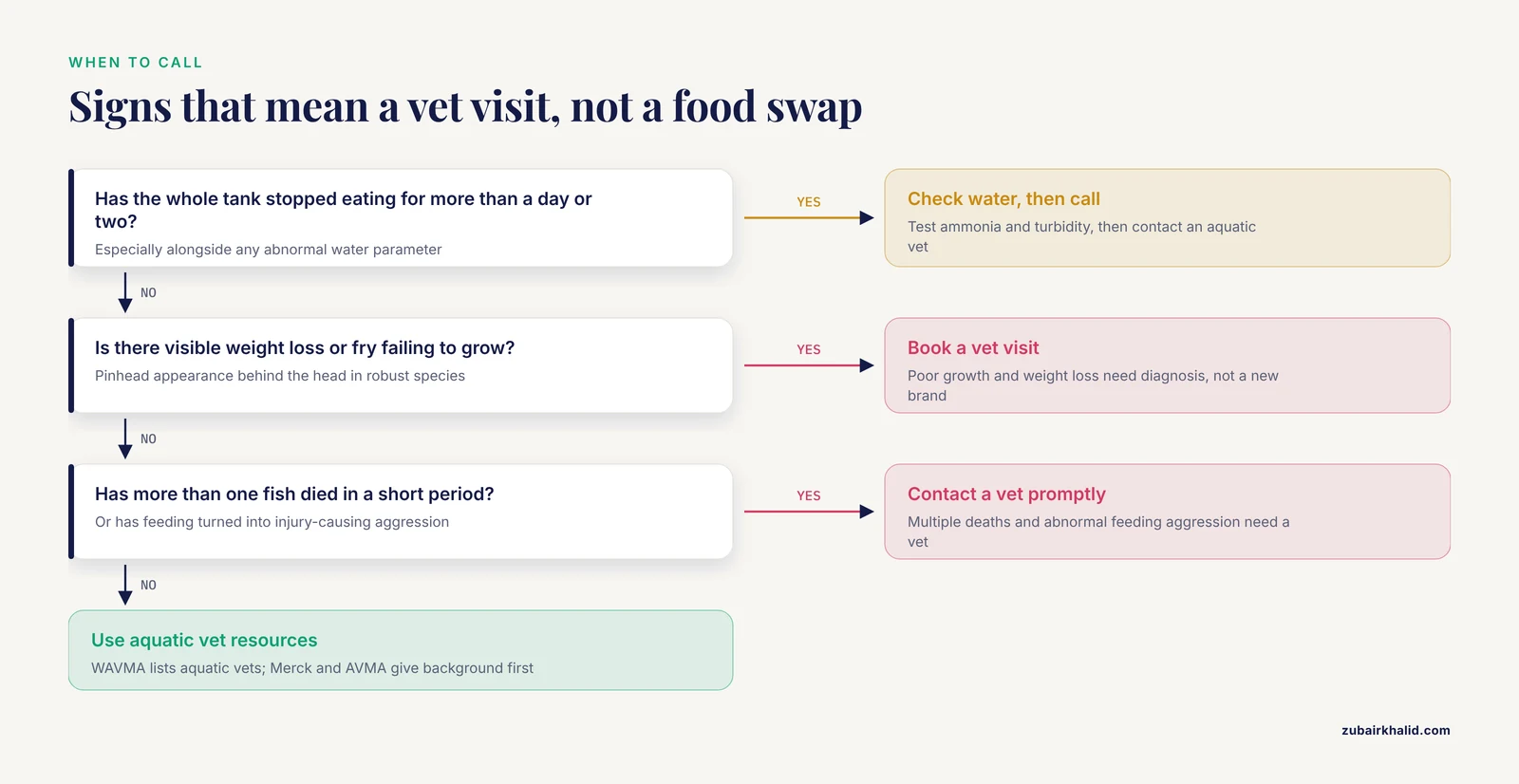
Contact a veterinarian promptly when you see any of the following:
- A tank-wide loss of appetite lasting more than a day or two, especially alongside any water parameter abnormality.
- Visible weight loss, pinhead appearance behind the head in normally robust species, or failure of fry and juveniles to grow.
- Increased aggression or abnormal activity around feeding that leads to injury.
- Mortality of more than one fish in a short period.
- Signs of oral or systemic infection in fish kept for food purposes, since pathogenic organisms such as Candida species can colonize the digestive tract of aquarium-held fish and cause severe losses in closed systems, and environmentally oriented interventions in that setting required professional guidance [17].
- Human allergy symptoms such as skin reactions, sneezing, or wheezing that appear when handling fish food, since documented fish food allergies include respiratory involvement [8][10].
Also keep expectations proportionate. Published feeding trials cover a limited number of species, mostly small livebearers, cichlids, and juvenile food fish, under controlled conditions that differ from a mixed home aquarium. Extrapolate the principles (rotation, format matching, conservative portions) rather than the exact numbers.
Frequently Asked Questions
What are the best aquarium fish food brands?
No single brand wins across all species and situations. The strongest evidence-based advice is to choose reputable brands whose format matches your fish and to rotate at least two products, because a mixed feed outperformed every individual commercial brand in a controlled six-month comparison of three named products [6]. Ask your aquatic veterinarian or a reputable local fish store for brands currently consistent with your species' needs.
Can I feed my fish only flakes?
You can, but controlled feeding trials consistently show better growth and survival when a prepared staple is supplemented with a protein-rich option such as Artemia. In guppy fry, the flake-plus-Artemia style combination produced the best results of all tested groups. For adult community fish, rotate flakes with a frozen or granule food at least weekly.
Are live foods better than prepared foods?
Live foods are the strongest choice for foraging behavior and fry growth, with Artemia-based feeding showing the best measured performance in fry trials [3] and slow-release or live prey increasing foraging and reducing inactivity in enrichment studies [5]. They are not the best everyday choice for most tanks because of maintenance demands and water quality risk, so use them as supplements and conditioning tools.
How do I know if I am overfeeding my fish?
Cloudy water, rising turbidity, uneaten food on the substrate, and drifting ammonia readings are the clearest signs. Excess food causes pollution that can kill fish, and protein metabolism generates ammonia that becomes lethal when it accumulates [14]. Feed only what the tank finishes within about a minute and remove leftovers.
Can fish food cause allergies in people?
Yes. Red midge larvae (bloodworms), freshwater shrimp, and earthworm used in aquarium foods are documented human allergens in clinical studies, including cases of occupational allergy and aquarium-associated asthma [8][9][10]. Use gloves and sealed storage, and seek medical advice if handling food triggers respiratory or skin symptoms.
Are automatic fish feeders reliable?
Well-designed units are reliable when tested first. Validated prototypes dispensed accurate portions on programmable schedules [11], with one trial system succeeding on about 83 percent of scheduled feeds, with failures traced to clock errors rather than the feeder itself [12]. Run any feeder for a week while you are home before trusting it with an unattended tank.
Sources
- FOOD REQUIREMENTS AND DIETARY IN AQUARIUM FISH
- Review article FOOD REQUIREMENTS AND DIETARY IN AQUARIUM FISH ) Review (
- Effects of feeding with aquarium fish food and some live foods on growth in fry guppies (Poecilia reticulata Peters, 1859).
- Growing aquarium fish on organic food objects
- How Does Food Enrichment and the Presence of Visitors Affect the Behaviour of Two Species of Freshwater Fish in a Public Aquarium?
- Effects of different artificial feed brands on growth performance and survival of Air-breathing Shol fish (Channa striata) Fry
- Design and Analysis of IoT-based Aquarium Monitoring System for Guppy Fish Habitats
- Occupational allergy to aquarium fish food: red midge larva, freshwater shrimp, and earthworm. A clinical and immunological study.
- [["Aquarium allergy": fish food, another domestic allergen].](https://pubmed.ncbi.nlm.nih.gov/6867655/)
- [["Aquarium" allergy: bronchial asthma caused by polyvalent sensitization to various components in fish food].](https://pubmed.ncbi.nlm.nih.gov/3583729/)
- Time controlled automatic fish feeder for indoor aquarium
- AUTOMATIC FISH FEEDING CONTROL SYSTEM BASED ON RTC AND ARDUINO UNO FOR AQUARIUM APPLICATION
- IoT Based Fish Food Dispenser
- Ammonia Monitoring in Aquarium for Fish Protection and Alert Generation
- Constrained growth of the aquarium fish Black Molly, Poecilia sphenops (Valenciennes, 1846), under the exposure of ZnS nanoparticles
- PH monitoring system, temperature automation and clown fish feeding in aquarium using fuzzy logic method based on internet of things
- Phagocytosis in the Fish Oreochromis Niloticus against the Background of Candidaemia Development under Aquarium Conditions