Best Aquarium Light Placement and Height
By Dr. Zubair Khalid, DVM, MS, PhD ·
The best aquarium light placement is directly above the tank, centered over the area you want illuminated, with the fixture high enough to spread light evenly across the whole aquarium and low enough that plants receive usable intensity. For most freshwater community and planted tanks, a starting height of roughly 8 to 14 inches above the water surface works well, and you then adjust based on plant growth, algae, and fish behavior. Fish-only tanks generally tolerate a slightly higher fixture because they need less light than planted tanks, while shallow tanks with demanding plants usually need the fixture closer to the water.
Light placement is not a cosmetic decision. Light drives photosynthesis, sets the day and night rhythm your fish live by, and strongly influences algae growth. Poorly placed lighting creates bright spots and dark corners, stresses fish that prefer shaded cover, and feeds nuisance algae. Fish health resources from the Merck Veterinary Manual emphasize that stable, appropriate environmental conditions are the foundation of keeping pet fish healthy, and lighting is part of that environment. The World Aquatic Veterinary Medical Association likewise treats the captive aquatic environment, including light, as a core welfare consideration for fish under human care.
This guide walks through how light behaves in an aquarium, gives you an aquarium light placement height step by step method, lists aquarium light placement height tips and common mistakes, and ends with a complete aquarium care checklist you can use today.
At a Glance: Placement Checklist You Can Act On
| Step | Action | Target |
|---|---|---|
| 1 | Measure tank length, width, and depth | Fixture should span most of the tank length |
| 2 | Choose tank type | Planted, fish-only, or reef, because each has different light demands |
| 3 | Position fixture centered and parallel to the tank | Even coverage front to back and side to side |
| 4 | Set initial height | About 8 to 14 inches above the water for most freshwater tanks, closer for shallow planted tanks, higher for fish-only tanks |
| 5 | Set photoperiod | 8 to 12 hours per day on a timer, darkness at night |
| 6 | Observe for 2 to 4 weeks | Watch plant growth, algae, and fish behavior |
| 7 | Adjust in small steps | Raise or lower the fixture or reduce duration, one change at a time |
Use this table as your starting framework, then fine-tune with the detailed sections below. If your fish show unusual behavior after a lighting change, the troubleshooting and veterinary sections explain what to watch for.
Why Light Placement and Height Matter
Light intensity drops quickly with distance
Light intensity in water falls off rapidly with distance. Every inch you move a fixture away from the water surface reduces the light that reaches your plants and substrate. This is why height is the single most powerful adjustment you have. Moving a light a few inches up or down can be the difference between lush plant growth and a tank covered in hair algae, without buying any new equipment.
The effect is strongest in tall or deep tanks. Light that easily reaches the gravel in a 12-inch-tall tank may barely reach the substrate in a 24-inch-tall tank from the same fixture height. Deeper tanks generally need the light mounted lower, a stronger fixture, or both.
Light placement shapes fish behavior and welfare
Fish respond directly to light. Constant or badly placed illumination can suppress natural behaviors such as sheltering, foraging, and resting. The Merck Veterinary Manual notes that chronic environmental stress in pet fish contributes to immune suppression and disease susceptibility, which is why owners are advised to keep conditions consistent and species-appropriate. Aquatic veterinary guidance from the World Aquatic Veterinary Medical Association frames environmental quality, including light cycles, as part of responsible fish welfare. In practical terms, fish kept under harsh, unbroken light often hide more, eat less, and show duller coloration than fish given a proper day and night cycle with shaded retreats.
Light placement controls algae
Algae needs the same light your plants need. When light is concentrated over one spot or runs too long, algae colonizes that area first. Uneven placement is one of the most common hidden causes of persistent algae on driftwood, rocks, and glass. Correcting placement and photoperiod is often the first step in algae management, alongside normal water changes and maintenance.
Light sets the biological clock
Fish, plants, and the beneficial microorganisms in your aquarium all run on daily rhythms. A consistent photoperiod, meaning a fixed span of light each day followed by true darkness, supports normal feeding activity, breeding behavior, and plant metabolism. Cornell University College of Veterinary Medicine aquatic resources highlight that environmental stability, including consistent daily routines, reduces stress-related illness in fish.
Understanding Your Tank Before You Place a Light
Identify your tank type
Light requirements differ sharply by setup.
Planted freshwater tanks. Live plants, especially demanding stem plants and carpeting plants, need strong, evenly distributed light. Fixtures are usually mounted lower, often 8 to 12 inches above the water, and coverage must reach the front glass so low-growing plants at the edges do not decline.
Fish-only freshwater tanks. Fish do not photosynthesize. Their lighting needs are about visibility, day and night rhythm, and viewing pleasure. Moderate light at a greater height, roughly 12 to 16 inches above the water, is usually plenty and makes algae easier to control.
Shrimp and nano tanks. Small volumes heat and cool quickly, and shallow depth concentrates light. Keep fixtures modest and watch shrimp behavior closely, because invertebrates are sensitive to rapid environmental swings.
Reef and marine tanks. Corals with photosynthetic algae depend on appropriate spectrum and intensity delivered consistently across the rockwork. Reef lighting is a specialized subject, and coverage over the full aquascape matters more than height alone. If you keep corals, plan placement around the light demands of the most demanding coral you keep, and get species-specific advice from a knowledgeable aquatic retailer or aquatic veterinarian.
Measure for coverage
Record three numbers before shopping or mounting:
- Tank length. Your fixture should cover nearly the full length so both ends receive light. A fixture much shorter than the tank leaves dead zones where plants thin out and detritus accumulates.
- Tank depth front to back. Wide or deep tanks need fixtures that spread light across the full footprint rather than a narrow beam down the center.
- Tank height. Taller tanks require either lower mounting or higher output to reach the substrate.
A fish tank calculator, available from many aquarium retailers and hobbyist sites, can help you work through tank volume, stocking, and coverage questions during planning. Use any calculator as an estimate and confirm your setup with real observations in the tank.
Aquarium Light Placement Height Step by Step
Follow this sequence when installing or adjusting a light.
Step 1: Center the fixture over the tank
Mount the light parallel to the long axis of the aquarium, centered front to back and side to side. An off-center light produces a bright zone on one side, which pushes plants to lean and invites algae on the favored side. Suspension kits, mounting arms, and standard center braces all work, as long as the fixture sits level and stable.
Step 2: Set an initial height based on tank type
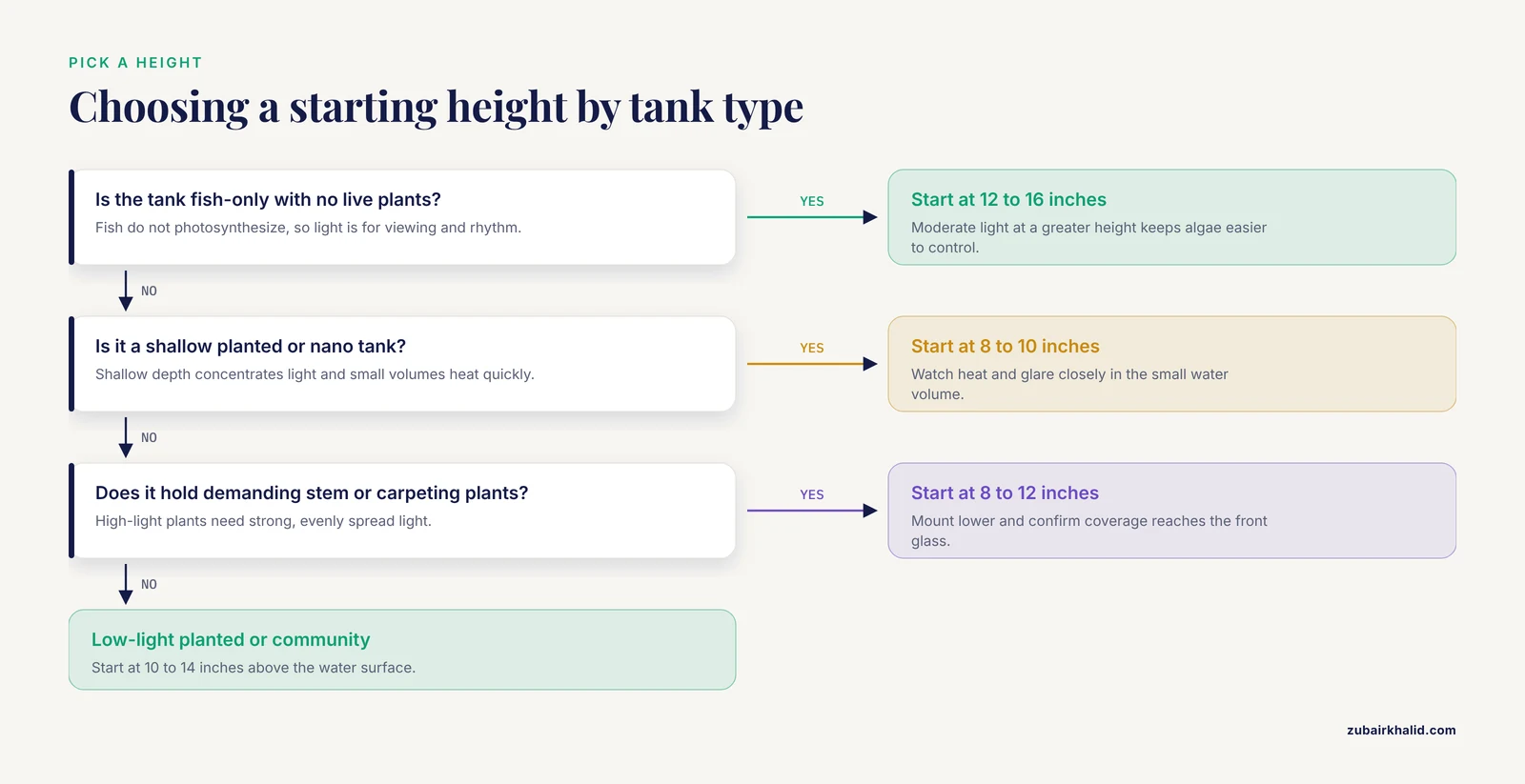
Use these starting points and adjust from observation:
- High-light planted tanks: 8 to 12 inches above the water surface.
- Low-light planted and community tanks: 10 to 14 inches above the water surface.
- Fish-only tanks: 12 to 16 inches above the water surface.
- Shallow planted or nano tanks: 8 to 10 inches, with attention to heat and glare.
These are practical starting ranges drawn from widespread aquarium husbandry practice, not fixed rules. Dimmable fixtures give you a second adjustment lever, so you can start with moderate output and increase gradually.
Step 3: Install a timer
Set the photoperiod to 8 to 12 hours per day, on every day, at the same times. A plug-in timer costs little and removes the single most common husbandry error, which is lights running 16 or more hours because someone forgets to turn them off. Consistency matters more than any specific hour count, and Cornell aquatic resources emphasize routine stability as a pillar of fish health.
Step 4: Provide shaded retreats
Whatever height you choose, give fish places to get out of the bright zone. Live or silk plants, driftwood, caves, and clay hides all serve this purpose. Fish evolved with variable light under overhanging vegetation, and a tank that is uniformly bright from front glass to back glass offers no behavioral choice.
Step 5: Observe for two to four weeks
Watch three things:
- Plants. Healthy plants show compact growth and steady new leaves. Leggy, stretched growth with wide gaps between leaves suggests too little light reaching the plant.
- Algae. Rapid algae covering surfaces within weeks suggests excessive intensity, excessive duration, or both.
- Fish. Fish that constantly hide, refuse food, or crowd in one dark corner may find the light too harsh. Fish that forage actively, show normal coloration, and rest visibly at night are adapting well.
Step 6: Adjust one variable at a time
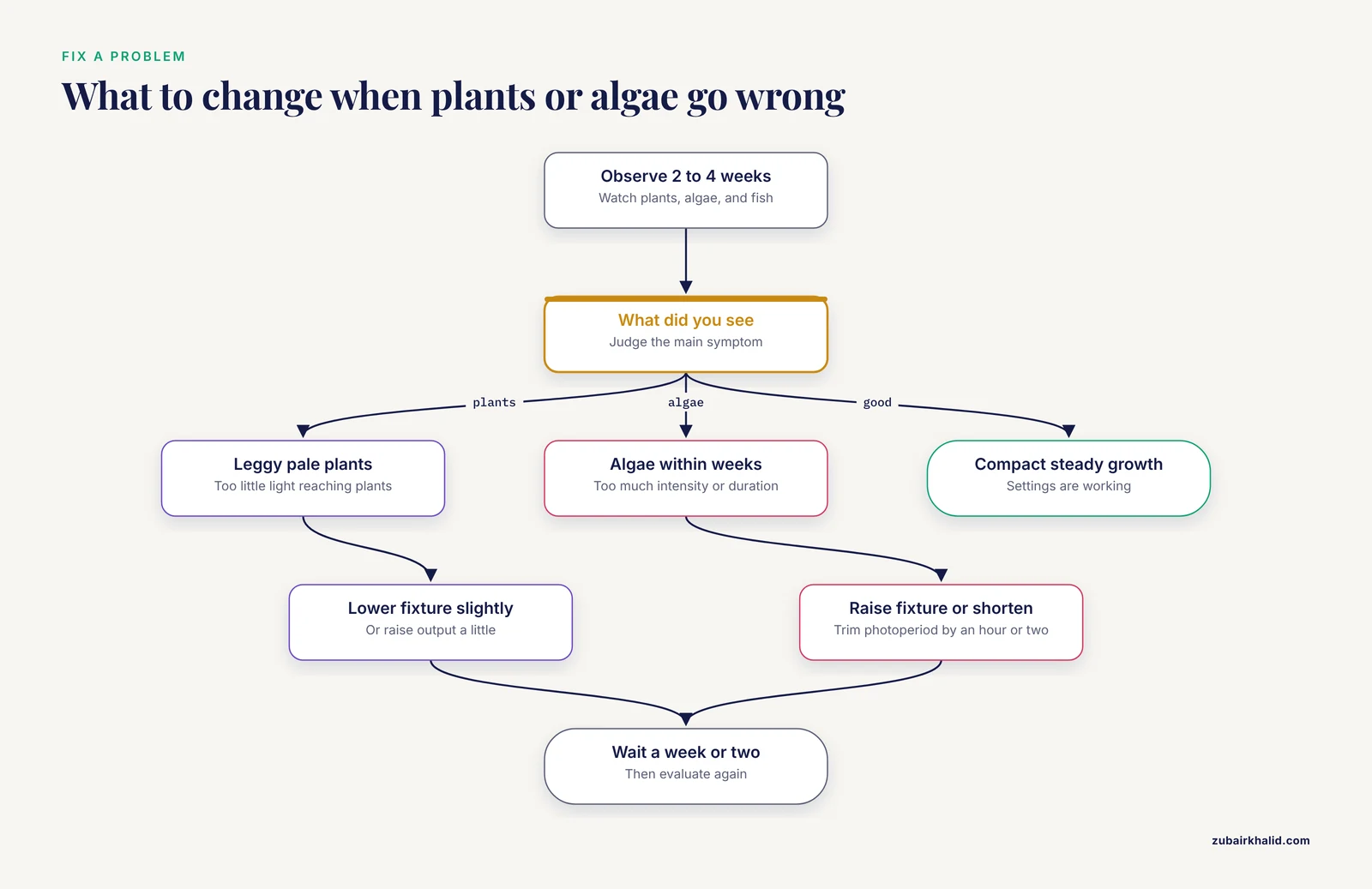
If plants are struggling, lower the fixture slightly or increase output. If algae is booming, raise the fixture, shorten the photoperiod by an hour or two, or dim the light. Change one thing, wait a week or two, and evaluate again. Simultaneous multiple changes make it impossible to know what worked.
Aquarium Light Placement Height Tips
These practical refinements solve the problems owners report most often.
Tilt beats sheer height in wide tanks. On very wide or rimless tanks, a fixture angled slightly toward the front glass can eliminate the dark strip along the front viewing pane without dropping the whole fixture lower.
Use reflectors and spreader lenses instead of mounting dangerously low. If plants at the edges are weak, a spreader lens or wider fixture distributes existing output more evenly. Mounting an intense light 4 inches above the water raises glare, heat, and evaporation.
Watch the water line. Fixtures mounted very low accumulate mineral spray and salt creep, which dim output and corrode hardware. Open-top tanks splash, so leave clearance or use a splash shield.
Black out one end for shy species. For tanks with nervous fish such as many tetras and dwarf cichlids, letting floating plants or a dimmer zone shade one side of the tank gives them security while the other side stays bright for plants.
Match light to the food schedule. Feeding during the lit portion of the day lets fish use their strongest visual period. Avoid feeding right after lights snap on, since many fish need a few minutes to become active.
Ramp light in the morning if your fixture allows. A gradual dawn and dusk transition, which many modern fixtures offer, reduces the startle response some fish show when lights snap on abruptly.
Log your settings. Write down fixture height, output percentage, and photoperiod whenever you change something. When algae appears three weeks later, that record tells you exactly which adjustment caused it.
Aquarium Light Placement Height Common Mistakes
Avoiding these errors prevents most lighting-related failures.
Mistake 1: Running the light far too long. Twelve or more hours of continuous light, or lights left on overnight, is the leading driver of nuisance algae and stressed fish. Fish need a defined night. Timers solve this completely.
Mistake 2: Confusing brightness with good placement. A very bright fixture centered over a deep tank can still leave the substrate dim, while blasting the upper water column. Coverage and penetration matter more than raw output numbers on the box.
Mistake 3: Mounting the fixture too low over an open tank. Low-mounted lights over open-top tanks increase water temperature swings through the fixture's heat, increase evaporation, and expose fish to intense glare with nowhere to escape.
Mistake 4: Ignoring the dark corners. Both ends of a tank lit by a short fixture become dim, low-flow zones where detritus settles and algae patterns form unevenly. Match fixture length to tank length.
Mistake 5: Making big jumps when troubleshooting. Dropping a fixture from 16 inches to 6 inches in one move can trigger an algae bloom or stress light-sensitive fish. Adjust in increments of a couple of inches or 10 to 20 percent output.
Mistake 6: Keeping light on during treatment or recovery. Sick or recovering fish benefit from reduced stimulation. Dimmed lighting, or even brief periods of darkness, can help a stressed fish rest. Fish health resources from Cornell note that reducing environmental stressors supports recovery in ill fish.
Mistake 7: Blocking the light with lids, covers, and film. A dirty glass lid or a scratched acrylic canopy can cut transmitted light dramatically and unevenly. Clean lids regularly as part of routine maintenance.
Mistake 8: Treating light as a substitute for water quality. No fixture placement compensates for poor water conditions. The Merck Veterinary Manual identifies water quality management as the foundation of pet fish health, and lighting decisions should always come second to filtration, cycling, and water change routines.
Choosing Equipment: Selection Criteria Without Brand Names
You do not need a specific brand. You need a fixture that meets these criteria.
Adequate coverage. Fixture length should match or nearly match tank length. Check the manufacturer's stated coverage footprint, not just tank size ratings.
Adjustable output. Dimming capability is the most valuable feature for fine-tuning placement and height, because it lets you tune intensity without moving hardware.
Adjustable spectrum where relevant. Planted tanks benefit from fixtures with a spectrum suited to plant growth. Reef keepers need spectrum control for coral health. Fish-only tanks do well with a neutral white spectrum that renders fish color naturally.
Reliable timer compatibility. Whether built in or external, timer control is non-negotiable.
Safe, aquarium-rated hardware. Fixtures must be rated for humid environments, with cords routed drip-loop style so water cannot run down the cord into the outlet. This is a genuine electrical safety issue in homes with children and pets, and the AVMA's pet owner safety guidance encourages keeping electrical devices away from water contact in pet households.
Heat management. Fixtures over small tanks should not measurably warm the water. If you see temperature climbing on warm days, raise the fixture or reduce photoperiod.
Troubleshooting Placement Problems
Symptom: Algae on glass, rocks, and plants within weeks of a new light. Lower the fixture height was likely too aggressive, or the photoperiod is too long. Raise the light a couple of inches, trim the photoperiod to the low end of the 8 to 12 hour range, and increase plant mass so plants outcompete algae.
Symptom: Plants grow tall and thin with pale leaves. Classic insufficient light reaching the plants. Lower the fixture gradually, clean the lid, and confirm the fixture actually spans the tank length.
Symptom: Plants in the front row decline while center plants thrive. The fixture's spread is too narrow. Widen coverage with a longer fixture, a spreader lens, or a slight frontward tilt.
Symptom: Fish hide constantly and appear washed out. The light is likely too intense for the species or lacks shaded refuge. Add cover, dim the output, or raise the fixture. If hiding persists after lighting adjustments, review water quality, because abnormal hiding is also a common early sign of illness in fish.
Symptom: Constant surface film and heavy evaporation. Low-mounted open fixtures drive evaporation. Raise the fixture or add a well-ventilated lid.
Symptom: Water temperature swings between day and night. Lighting contributes heat. Raise the fixture, shorten the photoperiod, or switch to an LED fixture with less radiant heat.
Welfare and Safety Points
Fish are sentient animals under human care, and their welfare standards are the same principles veterinary organizations apply to other pets. AVMA resources for fish owners stress responsible husbandry, appropriate environment, and prompt attention to signs of illness. Applied to lighting, that means:
- Provide a true dark period every night so fish can rest.
- Avoid sudden, dramatic changes in lighting, which startle fish and can trigger stress responses.
- Give every fish in the tank access to both lit and shaded areas.
- Secure the fixture so it cannot fall into the tank, which could electrocute livestock or injure a curious pet or child.
- Route all cords with drip loops and use grounded outlets near the aquarium.
- Never rely on tank light as a room night light for other pets, since constant illumination disturbs the fish.
Small children and cats are naturally drawn to glowing tanks. Mount fixtures securely above reach and teach children that the tank light is not a toy. Cats knocking a fixture into an aquarium is a documented household hazard, and the electrical risk extends to the whole family.
Aquarium Care Checklist Including Lighting
Integrate lighting checks into this recurring aquarium care checklist.
Daily:
- Confirm the timer switched the light on and off at the set times.
- Feed appropriately during lit hours.
- Observe fish behavior, appetite, and appearance.
Weekly:
- Test water parameters appropriate to your system.
- Perform a partial water change per your established schedule.
- Wipe algae from glass as needed and note which areas it favors, since uneven algae growth points to uneven light.
- Clean the light fixture and any lid or canopy.
Monthly:
- Deep-clean filter media per manufacturer guidance using dechlorinated water.
- Trim plants and remove dead leaves before they decay.
- Reassess fixture height and output against plant and fish condition.
- Check cords, outlets, and drip loops for wear.
Quarterly:
- Replace or clean any diffusers, reflectors, or lenses.
- Review the log of lighting changes and their effects.
- Recheck equipment timing after any power outage, since timers can reset.
Limitations and When to Contact a Veterinarian
Lighting guidance in this article reflects general aquarium husbandry practice. Individual tanks vary with depth, plant species, fish species, water chemistry, and local conditions, so your specific setup may require different settings. For fish showing signs of illness, or for specialized systems such as reef aquariums with valuable coral collections, consult a veterinarian with aquatic animal experience. The World Aquatic Veterinary Medical Association maintains resources for locating aquatic veterinary professionals.
Contact an aquatic veterinarian promptly if you observe any of the following:
- Fish gasping at the surface, flashing or rubbing against objects, or swimming abnormally.
- Sudden deaths or multiple fish ill at once.
- Visible signs of disease, including white spots, frayed fins, bloating, open sores, or labored breathing.
- Loss of appetite lasting more than a day or two in a previously healthy fish.
- Skin or eye changes after any new equipment, including new lighting, is introduced.
- Illness that does not improve despite corrected water quality and lighting.
Bring your lighting log, water test results, and tank parameters to the appointment. Aquatic veterinarians evaluate the whole environment, and your records shorten the diagnostic process.
This article is educational and is not a substitute for veterinary diagnosis or treatment.
Frequently Asked Questions
How high should an aquarium light be above the water?
For most freshwater tanks, start with the fixture roughly 8 to 14 inches above the water surface, with planted tanks at the lower end and fish-only tanks at the higher end. Treat this as a starting point and adjust based on plant growth, algae, and fish behavior over the following weeks.
Does light placement affect algae growth?
Yes. Light concentrated in one area or left on too long fuels algae in exactly those zones. Centering the fixture, matching its length to the tank, and limiting the photoperiod to 8 to 12 hours are the most effective placement-related algae controls.
How long should aquarium lights stay on each day?
Aim for 8 to 12 hours daily on a timer, with complete darkness at night. Consistency matters more than the exact number, so pick a window and keep it the same every day.
Can too much light harm my fish?
Excess light is primarily an indirect harm, driving algae, heat, and stress by denying fish shaded refuge. Fish kept under harsh light may hide constantly or lose appetite. If behavioral changes persist after you soften the lighting, discuss the fish's condition with a veterinarian.
Should I use the light that came with my aquarium?
Standard hood lights are usually adequate for fish-only tanks but often lack the intensity and coverage for demanding live plants. Assess your tank type first, then choose a fixture with adequate length, adjustability, and timer compatibility rather than assuming the included light is sufficient.
Does light color spectrum matter for placement?
Spectrum and placement are separate decisions. Placement controls where light lands, spectrum controls what plants and corals can use. Choose the spectrum appropriate to your tank type first, then optimize height and coverage.
Can aquarium lights burn fish or plants?
Lights cannot burn fish the way a heat source can, but intense, low-mounted fixtures cause stress, bleaching in some corals and plants, and glare that fish cannot escape. Raise the fixture, dim the output, and provide shaded cover if fish or corals show adverse reactions.
Do fish need darkness at night?
Yes. Fish need a dark resting period each night for normal behavior and health. Continuous light disrupts rest and is a common husbandry error. A timer that enforces a nightly off period resolves this automatically.