Aquarium Filter Making Noise? Causes and Fixes
By Dr. Zubair Khalid, DVM, MS, PhD ·
A noisy aquarium filter almost always comes down to one of five things: a low water level, debris or air trapped in the impeller, clogged or rattling media, a worn impeller or motor shaft, or vibration transferred to the stand. In most cases, you can fix the problem in ten to twenty minutes by topping off the water, unplugging the unit, removing the impeller, and cleaning it and its housing. Noise is a symptom, not a disease, but it often signals that the filter is working harder than it should, and that has real consequences for water quality and fish health.
This guide walks through every common cause of aquarium filter noise, gives you step-by-step solutions, and explains when a loud filter points to a bigger problem in the tank, such as an overloaded biological filter or a stocking level that has crept past what the system can support.
At a Glance: Filter Noise Causes and First Fixes
| Sound you hear | Most likely cause | First fix to try today |
|---|---|---|
| Grinding or crunching | Debris, sand, or a broken impeller blade in the impeller chamber | Unplug, remove impeller, rinse chamber, inspect blades |
| Buzzing or humming that got louder | Low water level or a motor running dry | Top off the tank or reservoir to the fill line |
| Clicking or tapping | Air bubbles trapped in the impeller or lift tube | Reprime the filter, check for air leaks in tubing |
| Rattling or vibrating | Loose cover, worn impeller shaft, or filter housing touching the stand | Reseat the filter, add padding under the base, inspect the shaft |
| Gurgling or splashing | Return flow breaking the surface too hard or a clogged outflow | Adjust flow direction, clear the outlet, lower the spray bar |
| Loud from day one | Filter sized poorly for the tank or flow set too high | Match flow to tank volume and stocking using a fish tank calculator |
Why Your Aquarium Filter Is Making Noise
Every powered aquarium filter has the same core parts: a motor with a spinning magnetic impeller, an intake that draws water in, media chambers that hold mechanical and biological filtration material, and an outflow that returns water to the tank. Noise comes from a handful of failure points within that loop.
The impeller is the usual suspect. It spins thousands of times per minute on a small ceramic or steel shaft, and anything that disturbs its smooth rotation, such as a grain of gravel, a strand of plant matter, a crust of mineral deposit, or a cracked blade, turns into grinding, rattling, or clicking. The motor itself adds a low hum that you barely notice when the filter is new and becomes obvious as bearings and bushings wear.
Water noise is the second family of sounds. Gurgling, splashing, and trickling come from the return flow, from an air stone competing with the filter, or from air being sucked into the intake. These sounds change with water level, which is why a filter that ran quietly for months can suddenly turn loud after a week of evaporation.
The third family is structural. A filter housing that touches glass, a lid, or a wooden stand transmits vibration, and the whole tank can act as a sounding board. Because a filter runs twenty-four hours a day, even a small vibration becomes noticeable, especially at night when background noise drops.
Common Aquarium Filter Making Noise Causes
Low water level
Evaporation is the most common reason a previously quiet filter turns loud. Hang-on-back filters and canister filters with external reservoirs need water at a specific line to run smoothly. When the level drops, the motor works harder, the impeller can splash or suck air, and the return flow becomes a noisy waterfall instead of a steady stream. Check the fill line on the filter body or the reservoir before you open anything up.
Debris in the impeller chamber
Fish food, plant leaves, snails, sand, and fine gravel find their way into the impeller well. A filter pulling from a tank with sand substrate or loose planting material picks up grit that lodges against the impeller. The result is a harsh grinding or crunching sound that gets worse over time. Left alone, grit scores the shaft and the impeller housing, turning a cleaning job into a parts replacement.
Air trapped in the system
Air locks are common after water changes, power outages, or media cleaning. Trapped air bubbles cycle through the impeller and produce a rhythmic clicking or churning sound. Air can also enter through a loose intake tube, a cracked airline, or an intake strainer sitting at or above the water surface.
Clogged media and an overloaded biofilter
Mechanical media that has not been rinsed chokes off flow, and a filter pushing against resistance gets louder. There is a biological side to this as well. Research on closed-circulation aquarium systems shows that the microbial community in rearing water changes significantly with loading intensity, meaning the amount of fish and waste the system carries [1]. As loading increases, the microbial balance shifts, and certain microbes associated with eutrophic, nutrient-rich conditions become more prominent [1]. In a home aquarium, a filter that is loud because it is clogged, working in a tank with a heavy bioload, is also a filter whose biological capacity is under strain. A clogged filter cannot deliver steady flow across the biofilter media, and unstable flow is one of the drivers of that microbial shift.
A worn or damaged impeller
Impeller blades crack, shafts wear, and bushings degrade. An aging impeller often produces a consistent rattling or a grinding sound that cleaning does not fix. Impellers are inexpensive, widely available consumable parts, and most manufacturers recommend inspecting them whenever a filter develops a noise that survives cleaning.
Vibration and poor mounting
A filter that is not seated flat, a hang-on-back unit with a worn clip, a canister sitting unevenly on a stand, or airline tubing pressing against the housing all transmit vibration into the tank and the furniture beneath it. If the noise changes when you press lightly on the filter housing, you are dealing with vibration rather than an internal mechanical problem.
Air pumps and accessories interacting with the filter
Air stones, air-driven sponge filters, and check valves can add bubbling and rattling sounds that owners attribute to the main filter. A sponge filter, which is itself a biological filter relying on a colony of beneficial organisms, needs steady airflow to function, and a failing air pump or a clogged stone changes its sound noticeably.
How to Fix Aquarium Filter Making Noise: Step-by-Step Solutions
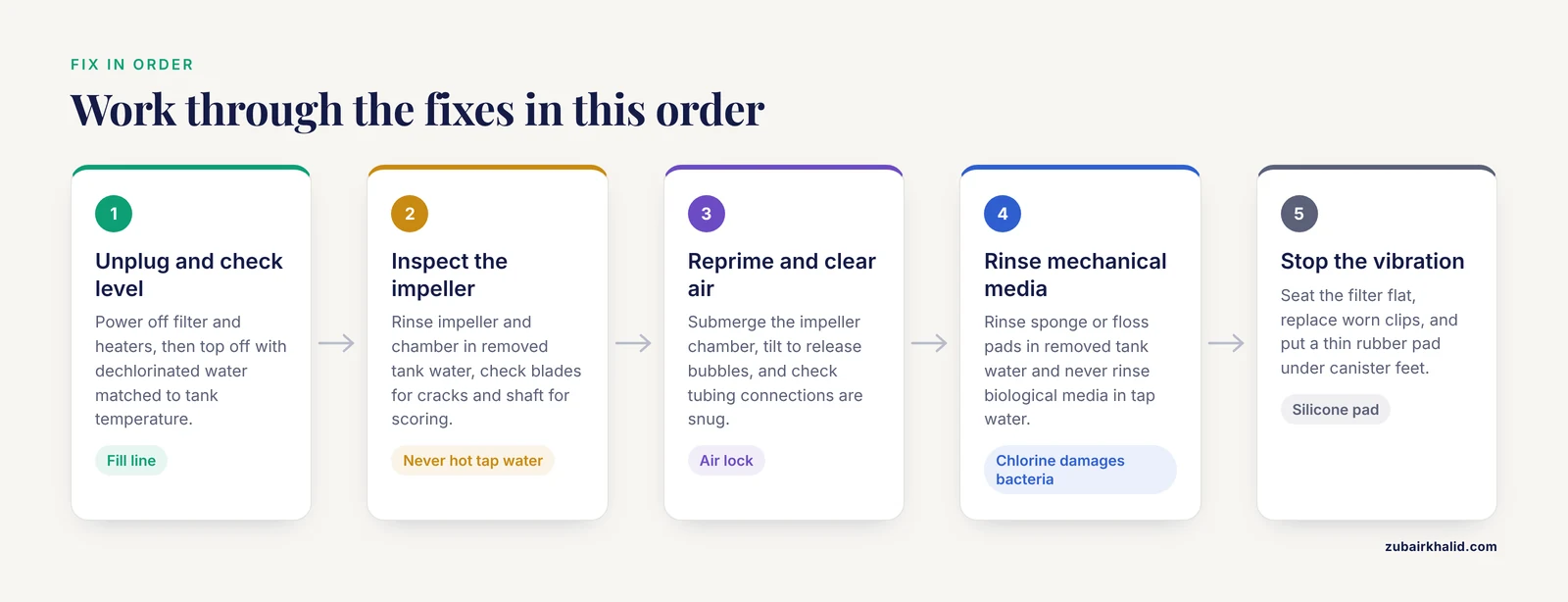
Work through these steps in order. Most owners find the culprit before step five.
Step 1: Unplug everything and check the water level
Power off the filter and any heaters before you put your hands in the water or open the filter. Look at the fill line. If the level is low, top off with dechlorinated water matched to your tank temperature. In many cases this alone silences the filter.
Step 2: Remove and inspect the impeller
Take off the filter cover, locate the impeller, and pull it out according to your model's instructions. Rinse the impeller and the chamber in water you removed from the tank during a change, never hot tap water, which can deform plastic parts. Run your finger along each blade and check for cracks, warping, or missing pieces. Inspect the shaft for scoring and the bushings for wear. Rinse away grit, hair, plant fibers, and mineral crust. Reassemble, refill, and restart.
Step 3: Reprime the filter and clear trapped air
If the noise is clicking or churning, air is likely trapped. Submerge the impeller chamber fully, tilt the filter to release bubbles, and refill the media chambers before restarting. For canister filters, follow the priming procedure for your model. Check that the intake strainer sits fully underwater and that tubing connections are snug.
Step 4: Rinse mechanical media and check flow
Remove mechanical media such as sponge or floss pads and rinse them in removed tank water. Never rinse biological media, the sponge, ceramic rings, or bio-balls, in untreated tap water, because chlorine damages the nitrifying bacterial communities that make the biofilter work. Those microbial communities are exactly what researchers measure when they study how filter systems maintain water quality in closed aquarium systems [1]. Reassemble and listen. If flow is visibly stronger and the sound has dropped, clogging was the cause.
Step 5: Eliminate vibration
Seat the filter flat, replace worn hang-on-back clips, and place a thin rubber or silicone pad under canister feet. Separate tubing and power cords from the housing. If the noise persists only through the stand, the filter body itself is probably fine.
Step 6: Replace worn parts
If cleaning does not fix a grinding or rattling sound, order an impeller and shaft kit matched to your exact filter model. Keep the old impeller as a reference when you order. Replacement is usually a matter of dropping the new impeller into the chamber and reassembling.
Step 7: Reassess the system, not just the filter
If the filter is clean, primed, and intact and still runs loud, the filter may be undersized or the tank overstocked. Use a fish tank calculator to compare your tank volume and stocking level against typical filtration capacity, and consider whether your bioload has grown since you set the tank up. Fish grow, reproduce, and get larger with age, and a filter that was adequate at setup can become marginal a year later. Loading intensity is a documented driver of microbial conditions in aquarium systems, so an underfiltered, heavily stocked tank is a water quality risk as well as a noise problem [1].
Why Filter Noise Matters for Fish Health
A loud filter is a mechanical warning, and it also has direct animal welfare relevance. Three points connect the sound in your living room to the health of your fish.
First, filtration failure degrades water quality, and water quality drives the microbial environment your fish live in. Studies of closed-circulation aquarium systems show that fish type and loading intensity significantly shape the microbial community in the water, and that microbe and metabolite networks are linked in ways that can be steered by adjusting the tank environment [1]. A filter that runs erratically or that is clogged cannot keep that environment stable.
Second, some aquarium livestock are filter feeders whose health depends directly on water movement and quality. Aquarium sponges, which are kept in home and laboratory aquaria and are among the simplest filter-feeding animals, are maintained long-term in ex situ culture only under carefully controlled water conditions [2]. If you keep filter-feeding invertebrates, a filter running roughly or delivering uneven flow is not just an annoyance, it is a husbandry problem for animals that depend on steady, clean water movement to feed [2].
Third, flow and swimming effort are connected. Research on large filter-feeding fish shows that when drag increases, such as when a whale shark feeds with an open mouth against the water, the fish measurably increases stroke rate and swimming amplitude to compensate [3]. Translated to the home aquarium, fish that must swim constantly against a return flow that is too strong, or that huddle away from an uncomfortably powerful outflow, are dealing with an energy cost that a correctly adjusted, quiet-running filter would avoid [3].
Choosing a Quieter Filter: Selection Criteria
If replacement is on the table, judge candidates on these criteria rather than brand names.
- Impeller design and access. Look for a filter whose impeller chamber opens without tools and whose impeller is a cheap, available spare part.
- Rated flow matched to your tank. Match rated flow to your actual tank volume and stocking, not just the gallon range printed on the box. A fish tank calculator helps you account for stocking density and biofilter demand.
- Adjustable flow. An adjustable outflow lets you tune the return so it does not splash or blast the tank. Gentler surface agitation also means less gurgle.
- Self-priming or easy priming. Filters that hold prime after power outages stay quieter after maintenance.
- Media capacity. More room for biological media supports a more stable microbial community, which matters because microbial composition in these systems responds to loading and filter configuration [1].
- Rubber mounting feet or pads. Isolation at the base is the cheapest noise control a manufacturer can build in.
Aquarium Care Checklist for Quiet, Healthy Filtration
Build this aquarium care checklist into your routine so noise never surprises you.
Weekly
- Check the water level against the filter fill line and top off as needed.
- Listen to the filter for five seconds. New sounds mean new problems.
- Look at the outflow. Is the stream steady or sputtering?
Every one to two weeks
- Rinse mechanical media in removed tank water.
- Check the intake strainer for debris, snails, and plant matter.
- Confirm air stones and air pumps are running at normal strength.
Monthly
- Remove, rinse, and inspect the impeller and shaft.
- Check tubing, clips, and seals for wear.
- Test water parameters to confirm the biofilter is keeping pace with your bioload.
Every few months and at stocking changes
- Reassess stocking with a fish tank calculator, especially after fish have grown.
- Inspect biological media and never replace it all at once.
- Re-check filter seating and padding on the stand.
Aquatic veterinary organizations such as the World Aquatic Veterinary Medical Association and resources like the Merck Veterinary Manual's pet fish section emphasize that stable water quality and functioning filtration are the foundation of fish health, and a filter that has gone quiet on its own, or one that has gone suddenly loud, is a signal worth acting on quickly.
Common Mistakes That Cause or Worsen Filter Noise
- Cleaning media in tap water. Chlorine damages the biofilter bacteria. Rinse biological media only in dechlorinated water or water removed from the tank.
- Replacing all media at once. This can crash the biological filter and is rarely needed. Mechanical media is disposable, biological media is not.
- Running the filter dry. Running a motor with an exposed impeller wears it within hours.
- Ignoring the first grinding sound. Grit in the impeller costs a cleaning today or an impeller replacement next month.
- Oversizing flow instead of filtration. More flow is not the same as better filtration, and excessive flow stresses fish, who pay an energetic cost to swim against current, a principle demonstrated even in large filter-feeding species [3].
- Chasing noise with oil or lubricant. Aquarium filter motors are sealed magnetic drives. They do not take oil, and additives contaminate the tank.
- Fixing the noise without fixing the load. A clean filter in an overstocked tank will clog again quickly. Load management and filtration capacity have to be solved together.
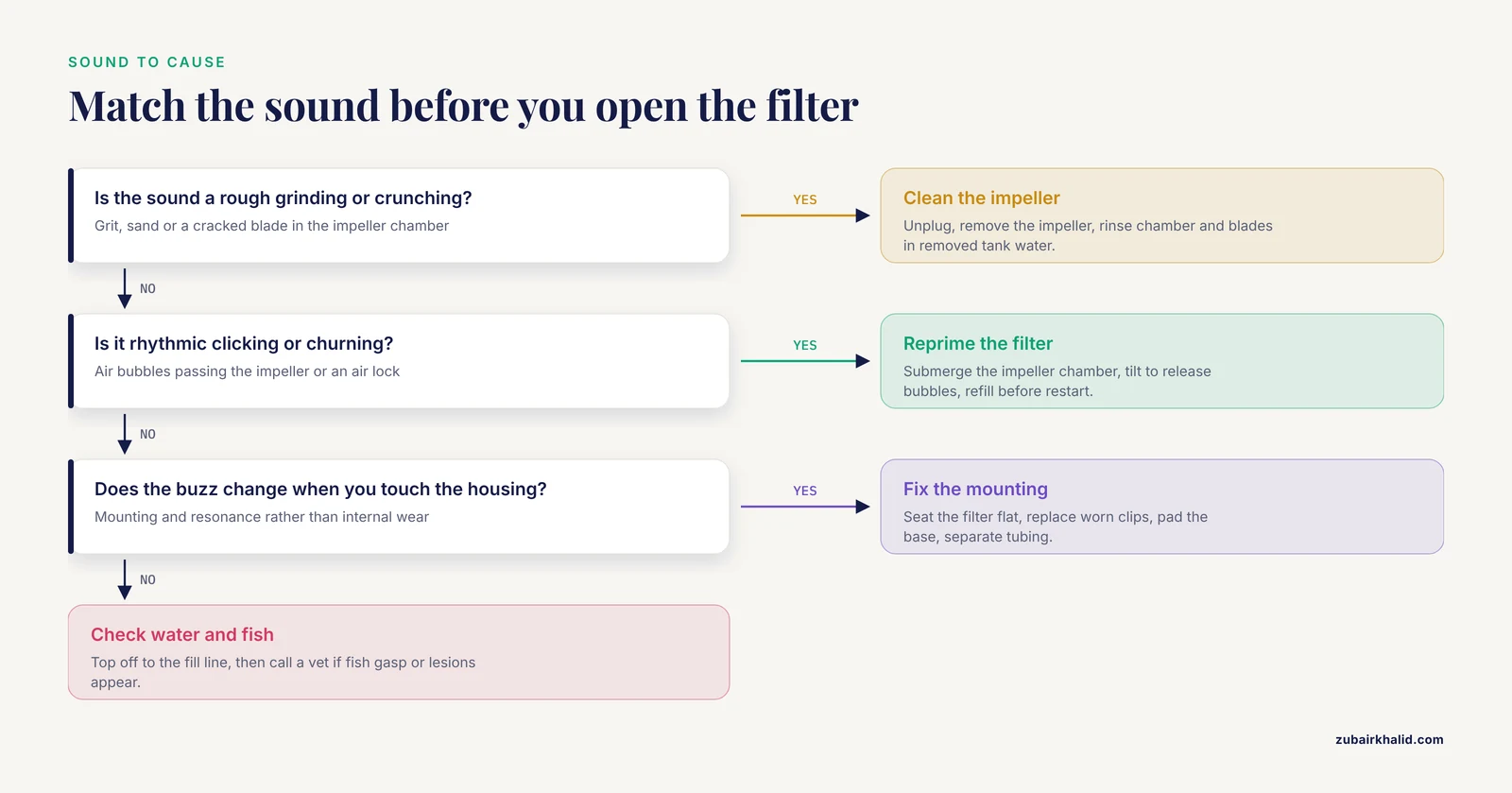
Troubleshooting Filter Noise by Sound Type
| Noise | Sound pattern | What it means | What to do |
|---|---|---|---|
| Grinding | Rough, continuous, worsens over days | Grit or a damaged impeller | Clean impeller chamber, replace impeller if blades are damaged |
| Clicking | Rhythmic ticks | Air bubbles passing the impeller | Reprime, lower water into intake, seal tubing connections |
| Rattling | Loose, metallic shake | Worn shaft, broken blade, or loose cover | Inspect and replace impeller kit, tighten covers |
| Humming | Steady low tone, louder than before | Motor wear or restricted flow | Clean media, check flow, replace motor unit if humming persists after service |
| Gurgling | Irregular bubbling and splashing | High return flow or air injection | Redirect outflow, lower spray bar, adjust air supply |
| Vibrating buzz | Changes when you touch the housing | Mounting and resonance | Reseat filter, pad the base, separate tubing |
Limitations and When to Contact a Veterinarian
This article covers the mechanical and husbandry causes of aquarium filter noise, and individual situations vary with filter model, tank setup, and livestock. A qualified aquatic veterinarian should evaluate your fish when noise is paired with clinical signs. Contact a veterinarian when you observe any of the following:
- Fish gasping at the surface, flashing, or showing rapid gill movement after filter problems began.
- Visible deterioration in water clarity, film on the surface, or a persistent unusual odor alongside filter malfunction.
- Fish carrying visible lesions, frayed fins, or abnormal swimming after a period of poor filtration.
- Mortality of more than one fish in a short period, or any mortality in a system where the filter has been running loudly or intermittently.
- Livestock such as filter-feeding invertebrates that stop feeding or visibly shrink, since these animals depend on continuous, clean water flow to feed and are sensitive to disruption [2].
A veterinarian can also help you interpret water test results and stocking plans, and can advise on whether your filtration capacity matches your bioload before you add more animals. This article is educational and is not a substitute for veterinary diagnosis or treatment.
Frequently Asked Questions
Why is my aquarium filter making noise all of a sudden?
Sudden noise almost always means the water level dropped, debris entered the impeller, or air got trapped after a water change or power interruption. Check the fill line first, then unplug the filter and inspect the impeller. Sudden loud noise after maintenance usually indicates an air lock that clears once the filter is reprimes and refilled.
Is a noisy filter dangerous to my fish?
The noise itself rarely harms fish, but the underlying cause can. A clogged or failing filter delivers inconsistent flow through the biological media, and unstable conditions shift the microbial balance of the water, especially in tanks with a heavy bioload [1]. Treat noise as an early warning for water quality.
How do I fix a grinding noise coming from my filter?
Unplug the filter, remove the impeller, and rinse the impeller and its chamber in removed tank water. Look for gravel, food, plant fibers, or a cracked blade. If the impeller is damaged or the shaft is scored, replace the impeller kit for your specific model. Cleaning resolves most grinding sounds, and replacement resolves the rest.
Why does my filter sound louder at night?
Background noise in your home drops at night, so the same filter sounds louder. Vibration transmitted to the stand also becomes more noticeable. If the filter has genuinely gotten louder over time rather than just seeming louder, check the water level and the impeller, since motors get noisier as parts wear.
Can a noisy filter mean my tank is overstocked?
It can. Overstocking raises the waste load the filter must process, and research on closed aquarium systems shows that higher loading intensity measurably changes the microbial community in the water, favoring microbes associated with nutrient-rich conditions [1]. A filter that clogs faster and runs louder than it used to is often a filter matched to a tank that has outgrown it. Recheck your stocking with a fish tank calculator.
How often should I clean filter media to prevent noise?
Rinse mechanical media whenever flow drops or noise rises, which for most home tanks falls in the one-to-two-week range depending on stocking and feeding. Never rinse biological media in untreated tap water, and never replace it wholesale, because the microbial community it hosts is doing the tank's nitrogen processing [1]. Let flow and sound guide your schedule rather than the calendar.
Do silent filters exist, or should I replace my noisy one?
All powered filters make some sound, but well-maintained filters with good impeller design, adjustable flow, and vibration isolation run quietly. Before replacing, clean the impeller, top off the water, rinse the media, and pad the base. If a clean, correctly filled, correctly sized filter still runs loud, replace the impeller kit, and if that fails, replace the unit.
When should I call a veterinarian about filter noise?
Call an aquatic veterinarian when filter noise is accompanied by fish gasping, abnormal swimming, visible lesions, rapid gill movement, unexplained deaths, or a filter-feeding animal that stops feeding [2]. Also seek advice if water quality readings have declined and stayed poor after the filter was cleaned, since persistent water quality problems need professional interpretation alongside the mechanical fix.
Sources
- Microbiome and Metabolome Analyses in Different Closed-Circulation Aquarium Systems and Their Network Visualization.
- The genomes of the aquarium sponges Tethya wilhelma and Tethya minuta (Porifera: Demospongiae).
- Whale sharks increase swimming effort while filter feeding, but appear to maintain high foraging efficiencies.