Aquarium Filter Flow Rate: How Many Gallons Per Hour
By Dr. Zubair Khalid, DVM, MS, PhD ·
Most home aquariums do well when the filter moves roughly four to six times the total tank volume every hour. A 20-gallon tank therefore needs a filter delivering about 80 to 120 gallons per hour (GPH), while a 75-gallon tank needs roughly 300 to 450 GPH. Those numbers are starting points, not rules. The right flow rate for your tank depends on the species you keep, how heavily the tank is stocked, whether live plants or delicate fish are present, and how much resistance the water meets between the pump and the tank.
This article walks you through the aquarium filter flow rate calculator formula, shows a worked example you can copy with your own tank, explains why flow matters for fish health, and covers the common mistakes that leave new aquarists with water that is either stagnant or swirling like a river.
At a Glance: Your Flow Rate Checklist
| Step | Action | Why It Matters |
|---|---|---|
| 1 | Confirm your true tank volume in US gallons | The whole calculation starts here, and "20 gallon" kits often hold less |
| 2 | Choose a turnover target, usually 4 to 6 times per hour as a starting convention | This is the multiplier in the formula |
| 3 | Multiply gallons by turnover target to get target GPH | Example: 29 gallons × 5 = 145 GPH |
| 4 | Adjust up for heavy stock loads, goldfish, or marine systems | Bioload changes what the filter must handle |
| 5 | Adjust down for bettas, fry, shrimp, and slow species | Strong current exhausts weak swimmers |
| 6 | Buy a filter rated above your target, since real flow is always lower than the box rating | Head loss from tubing, media, and height cuts output |
| 7 | Measure actual flow after setup and recheck monthly | Clogged media silently reduces flow over time |
| 8 | Watch the fish, not just the numbers | Behavior is the final test of whether flow is right |
What Flow Rate Actually Means
Aquarium filter flow rate is the volume of water the filter moves in a given time, almost always expressed in gallons per hour in the United States. Manufacturers print a maximum GPH on the box, measured under ideal laboratory conditions with no tubing, no media clogging, and no vertical lift.
Aquarists usually talk about flow in terms of "turnover," which is how many times the full tank volume passes through the filter each hour. A tank with 5 turnovers per hour does not mean every single molecule of water passes the filter five times in sixty minutes, because water mixes imperfectly and some volume recirculates while some lingers in dead spots. Turnover is still the most practical way to compare setups, and it is the number the aquarium filter flow rate calculator formula uses.
Flow does three jobs in a tank. It physically removes suspended waste and delivers dirty water to the filter media. It oxygenates the water at the surface, where gas exchange happens. And it distributes heat and dissolved chemicals evenly so fish are not living in localized pockets of poor conditions. When flow is too low, waste settles, oxygen can drop, and filtration suffers. When flow is too high, fish burn energy fighting the current and some cannot feed or rest at all.
The Aquarium Filter Flow Rate Calculator Formula
The core calculation takes one line.
Target GPH = Tank volume in gallons × Desired turnovers per hour
That is the entire aquarium filter flow rate calculator formula. Everything else is adjustment and judgment. To use it well, follow these steps.
Step 1: Determine your real tank volume
Use the nominal size printed on the tank for a first estimate, then correct it. Substrate, rocks, driftwood, and displacing equipment all reduce actual water volume, often by 10 percent or more in decorated tanks. If you want precision, measure the interior length, width, and water height in inches, multiply the three numbers together, and divide by 231, because one US gallon occupies 231 cubic inches. Any decent fish tank calculator online will do this arithmetic for you if you enter the dimensions.
Step 2: Pick a turnover target
A widely used starting convention among aquarists is 4 to 6 turnovers per hour for community freshwater tanks. Treat that as a middle-of-the-road default and adjust based on your stocking and livestock, which the next sections cover. Heavily loaded systems and many marine setups are commonly run higher, while tanks built around slow, delicate fish are commonly run lower. The convention is a hobby guideline, not a veterinary standard, and individual systems vary.
Step 3: Multiply and get your target
This is the simplest part, and it is where many flow rate questions get answered.
Worked Example
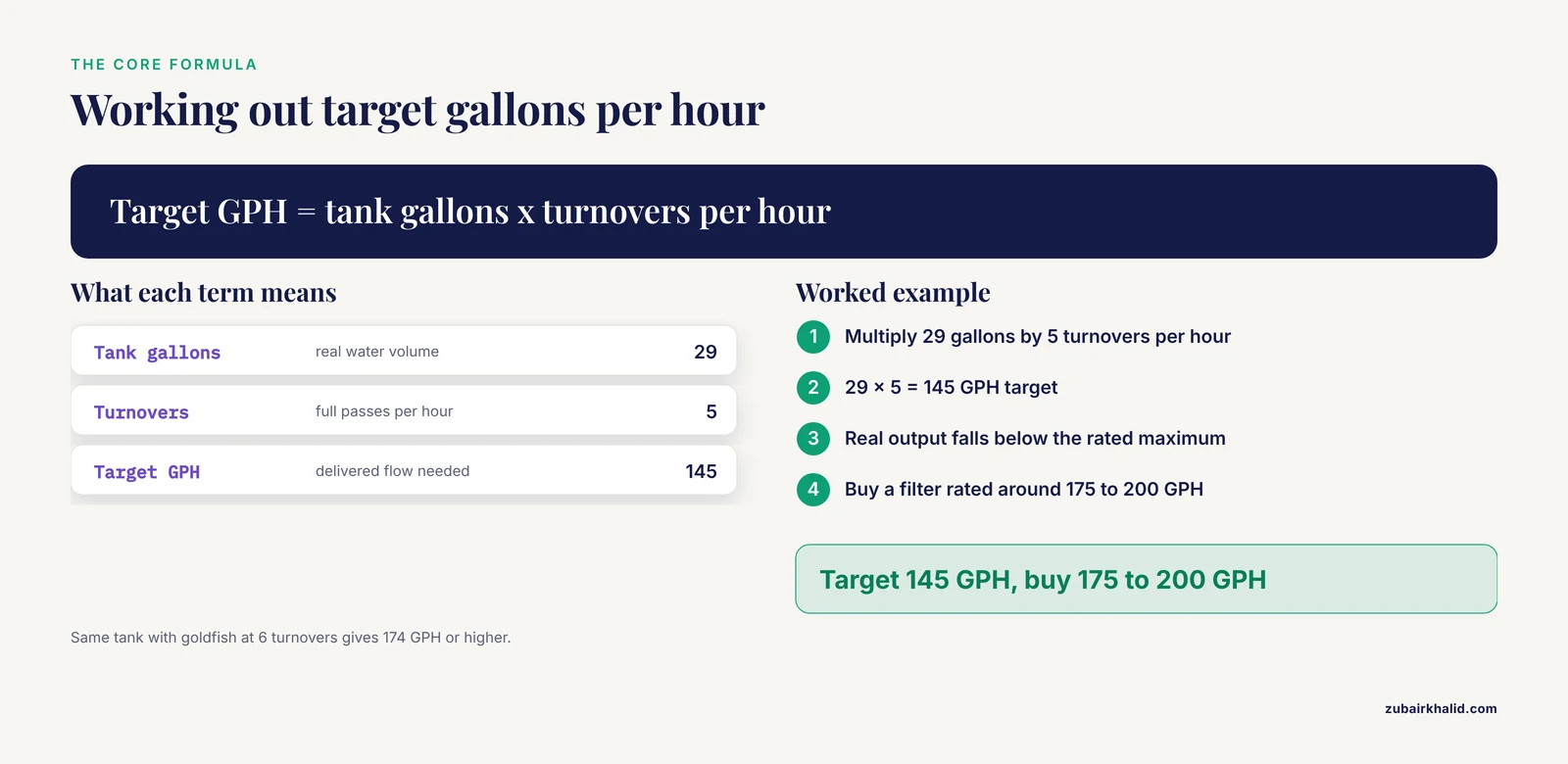
Suppose you keep a 29-gallon community aquarium with tetras, corydoras, and a handful of livebearers, moderately planted, stocked at a reasonable density.
- Tank volume: 29 gallons
- Turnover target: 5 per hour (middle of the 4 to 6 range)
- Target GPH: 29 × 5 = 145 GPH
Because real output always falls below the rated maximum, you would shop for a filter rated around 175 to 200 GPH so the delivered flow lands near your target after losses. If the same tank held large goldfish instead, you might raise the target to 6 or more turnovers, giving 174 GPH or higher, and buy accordingly. If it housed a single betta with fine, long fins, you might aim closer to 3 or 4 turnovers, about 87 to 116 GPH, and rely on adjustable flow or baffling to soften the current.
Run the same three lines of arithmetic for any tank and you have your own aquarium filter flow rate calculator worked example. The formula never changes, only the inputs.
Step 4: Account for losses between the pump and the tank
Every inch of vertical lift, every elbow in the tubing, and every layer of clogged media reduces delivered flow. Canister filters pushing water up four feet of hose may deliver dramatically less than their rating. Sponge filters driven by air pumps cannot be judged by GPH ratings at all, because manufacturers rarely publish comparable figures. This is why the practical advice is to buy headroom, then measure what you actually get.
How to Measure Real Flow, Not Box Flow
To check actual flow, time how long it takes the filter outlet to fill a one-gallon jug or bucket. Seconds divided into 3,600 gives GPH. If a filter rated at 200 GPH fills a gallon container in 30 seconds, actual flow is 120 GPH, and you now know your real turnover rate rather than an advertised one. Repeat this monthly. A gradual slowdown is often the first sign that media needs rinsing or that the impeller is wearing or fouled.
Flow pattern matters as much as flow volume. Two filters delivering the same GPH can produce completely different conditions depending on where the outlet points. Aim the outflow along the length of the tank rather than directly at the glass, and check for dead zones behind decorations where detritus collects.
Why Bioload Changes the Answer
The single biggest variable in flow rate planning is how much waste the system must process. Fish load, feeding rate, and stocking density shape the microbial community that lives in your water and filter, and that community changes with conditions. Research on closed-circulation aquarium systems compared three experimental tanks holding different fish species and loading intensities and found that microbial community composition in the rearing water differed significantly between them, with certain bacteria appearing at higher loading intensity that may indicate eutrophic conditions [1]. In practical terms, a heavily fed, heavily stocked tank develops a different and more demanding water chemistry than a lightly stocked one, and your filtration, including flow, has to keep pace.
A useful way to think about it is that flow rate and bioload must scale together. Doubling the fish does not double the GPH requirement in a strict linear sense, but it does push you toward the top of your turnover range and toward oversized mechanical and biological media. Under-filtered, overstocked tanks are among the most common sources of preventable fish disease seen in practice, which is why any honest aquarium care checklist puts flow and stocking review near the top.
Matching Flow to the Animals You Keep
Fish that need gentle flow
Bettas, many gouramis, fighting fish in general, fry of any species, shrimp, and long-finned varieties struggle in strong current. Fish with labyrinth organs or heavy finnage evolved in still water. For these tanks, aim low in the range, direct outflow toward the glass or baffle it with plants and hardscape, and watch whether the fish can hold position and feed without being shoved around.
Fish that need strong flow
Fish from riverine habitats, such as many loaches, hillstream species, and active barbs and danios, thrive with high turnover and visible current. Marine reef systems are also conventionally run with high total flow, often far above the 4 to 6 range, because coral health depends on water movement. In those systems the filter turnover number is less meaningful than total in-tank circulation from powerheads, but the principle of matching flow to the animal stands.
Filter-feeding and unusual livestock
Some aquarium inhabitants are themselves filters. Sponges are sessile filter feeders, and small demosponge species such as Tethya wilhelma and Tethya minuta are maintained long-term in aquarium culture as laboratory models, illustrating that water throughput is not just a service the filter provides to fish but sometimes a feeding requirement of the livestock itself [2]. If you keep suspension feeders, flow planning has to account for their needs as well as your fish.
A Lesson From the Largest Filter Feeder
Nothing puts flow rate mathematics in perspective like the whale shark. Researchers studying whale sharks feeding off the Yucatan Peninsula calculated flow using the same basic principle a hobbyist does, velocity multiplied by area. The sharks swam at an average of 1.1 meters per second with mouths open, and based on that flow speed and mouth area, a 443 cm shark was estimated to filter about 326 cubic meters of water per hour, with a 622 cm shark filtering about 614 cubic meters per hour [3]. Converted roughly, that larger figure is on the order of 162,000 gallons per hour passing across a filtering apparatus built of pads with mesh openings averaging about 1.2 millimeters.
The energetics matter too. A later study using inertial measurement units logged nearly 400 hours of whale shark behavior and found that surface filter feeding made up about 20 percent of the sharks' time budget, with feeding bouts lasting up to 11 consecutive hours, and that sharks increased stroke rate and amplitude while feeding to overcome the drag of an open mouth [4]. Moving water is never free. Every animal that processes large volumes of water pays an energy cost to do it, and your aquarium fish are no different at their own scale. A betta fighting a powerhead all day is paying that same drag tax, just in miniature. This is the biological logic behind matching flow to species rather than maximizing it blindly.
Flow, Carbon, and Medication Removal
Flow rate also determines how fast your tank clears dissolved substances. Activated carbon removes medications and contaminants by adsorption, and removal speed depends on how quickly water contacts the carbon. This was demonstrated directly in an aquarium disease outbreak. When a collection of frogs was diagnosed with chytridiomycosis and treated with itraconazole baths and tank-water treatments, the antifungal was removed from the tank water after 30 minutes using high-rate-of-flow activated charcoal filters, and the treatment program successfully eradicated the disease from the collection [5]. The takeaway for fishkeepers is practical. If you dose a medication and later want it gone, or if you use carbon to polish water, adequate flow through the carbon bed is what makes the difference between carbon that works and carbon that sits idle. Conversely, remember that running carbon will pull some medications out of solution, so remove chemical media during treatment unless the product label says otherwise, and discuss any medication plan with an aquatic veterinarian.
Choosing Equipment: Selection Criteria
No brand endorsement belongs in a veterinary article, but selection criteria do not require one. When comparing filters, judge the following.
- Rated GPH relative to your calculated target. Buy above the target, not at it.
- Adjustability. Valves or variable-speed pumps let you tune flow after the fish arrive, which is far easier than replacing equipment.
- Media capacity and flexibility. Room for mechanical, biological, and chemical media in separate stages.
- Head height rating for canister and external filters, so you can predict real-world losses.
- Intake safety. A prefilter sponge protects fry, shrimp, and small fish from impellers.
- Noise and reliability, since a filter that gets unplugged because it annoys the household is a dead filter.
- Surface agitation capability, because oxygen exchange happens at the surface, not inside the media.
Aquatic veterinary organizations such as the World Aquatic Veterinary Medical Association, along with fish health resources maintained by the Merck Veterinary Manual and guidance for owners from the AVMA, consistently frame environmental quality, including water movement and filtration, as the foundation of ornamental fish health. Equipment choice is a health decision, not just a hardware decision.
Common Mistakes
- Trusting the box rating. A filter rated 200 GPH rarely delivers 200 GPH in a real tank with media, tubing, and lift.
- Calculating on nominal volume. A "55 gallon" tank with a thick substrate bed and large hardscape may hold closer to 45 gallons of water. Calculate on real volume.
- Ignoring stocking density. Two tanks of identical size can need very different flow depending on how many fish produce waste in each.
- Pointing the outflow across open water. This creates a swirling center and dead corners. Angle flow along the tank length.
- Forgetting surface agitation. High flow through media with a glassy-still surface still risks low oxygen.
- Letting flow decay silently. Media clogs gradually, and fish adjust to worsening conditions without obvious alarms until they cannot.
- One number for every tank. The 4 to 6 convention is a starting point. A betta tank and a goldfish tank at the same volume are not the same problem.
- Adding flow when the real problem is maintenance. If ammonia or nitrite is detectable, more current will not fix an uncycled or undercycled biofilter. Water testing and water changes come first.
Troubleshooting Flow Problems
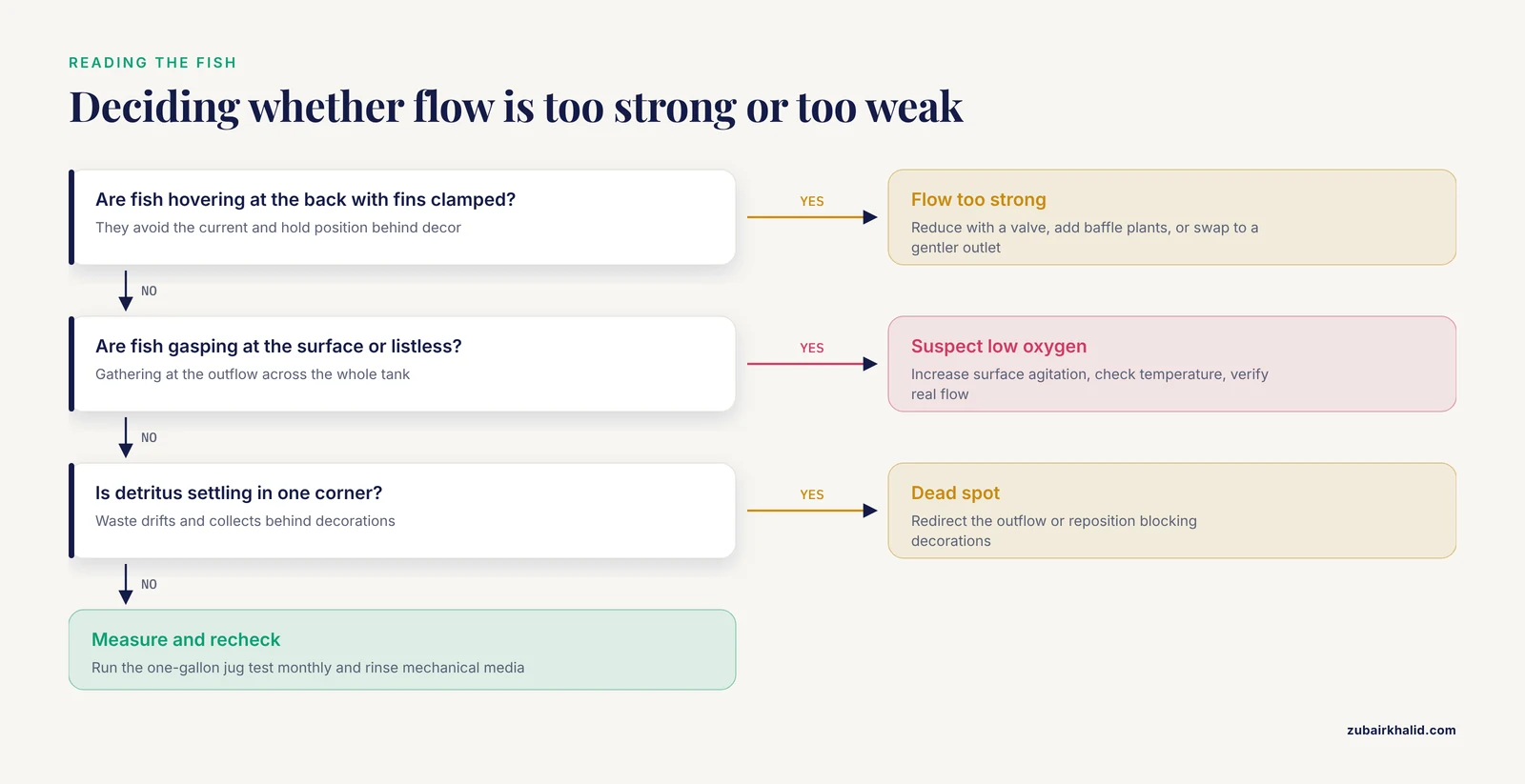
Fish hovering at the back, fins clamped, avoiding the current. Flow is likely too strong for the species. Reduce it with a valve, add baffle plants or hardscape, or swap to a gentler outlet.
Fish gathering at the outflow, gasping at the surface, or listless across the whole tank. Suspect low oxygen or poor distribution. Increase surface agitation, check temperature, and verify the filter is actually moving its rated volume.
Detritus drifting and settling in one corner. Dead spot. Redirect the outflow, add a small circulation aid, or reposition decorations that block current.
Flow dropping week over week. Rinse mechanical media in removed tank water, check the impeller for debris or snails, and confirm tubing has not kinked. Never rinse biological media under tap water, because chlorine damages the nitrifying bacteria colonies your tank depends on.
Constant cloudiness despite strong flow. Overfeeding, overstocking, or an immature biofilter are more likely culprits than insufficient current. Test water, review feeding, and give a new tank time to cycle.
Welfare and Safety Points
Flow is a welfare variable. Fish forced to swim continuously against excessive current show exhaustion, reduced feeding, and fin damage over time, while fish in stagnant water live in accumulating waste and lower oxygen. Neither extreme is humane. Watch posture and behavior during your daily observations, and treat any change in how fish hold position in the water column as information about their environment.
Electrical safety belongs in the same conversation. Filters combine water and electricity, so use drip loops on every cord, connect equipment to a grounded outlet with ground-fault protection, and keep spare impellers and tubing on hand so a failed part does not leave the tank unaerated while you wait for a replacement.
An aquarium care checklist that works as a weekly rhythm looks like this: observe every fish, confirm outflow and surface movement, check temperature, feed appropriately, and test water parameters on the schedule your system requires. Monthly, measure actual GPH with the jug test, clean the impeller, and rinse mechanical media. Quarterly, review stocking against your original flow calculations, because tanks grow into their bioload over time.
Limitations and When to Contact a Veterinarian
This article provides general husbandry guidance. Individual cases vary, and a qualified aquatic veterinarian should guide decisions about sick fish, medication, and system-level disease problems. Contact an aquatic veterinarian, or a general veterinarian with aquatic experience, when any of the following occurs:
- Fish show persistent gasping, flashing, clamped fins, lesions, abnormal swimming, or refusal to eat for more than a day or two despite corrected conditions.
- You detect ammonia or nitrite in established tank water, or water parameters will not stabilize with standard water changes.
- Disease appears in multiple fish or multiple species at once, which suggests a water-quality or infectious cause that needs diagnosis rather than guesswork.
- You plan to medicate the primary tank, because treatment choices, dosing, and the effect of chemical filtration media on drug levels all require professional input.
- A mortality event occurs, since necropsy and water testing can identify causes that affect the whole system.
- You are setting up a system for species with specialized needs, such as delicate marine invertebrates or wild-caught riverine fish, before problems rather than after them.
The AVMA provides owner resources for locating veterinarians with aquatic animal experience, and the Merck Veterinary Manual maintains reference material on pet fish diseases and husbandry that can help you prepare informed questions for an appointment.
This article is educational and is not a substitute for veterinary diagnosis or treatment.
Frequently Asked Questions
How many gallons per hour does my aquarium filter need?
As a starting convention, aim for 4 to 6 times your tank volume per hour, so a 40-gallon tank needs roughly 160 to 240 GPH delivered. Adjust up for heavy bioload or riverine species and down for bettas, fry, and shrimp.
What is the formula for aquarium filter flow rate?
Multiply tank gallons by desired turnovers per hour. A 29-gallon tank at 5 turnovers needs 145 GPH. This is the same calculation behind every aquarium filter flow rate calculator you will find online.
Is a higher flow rate always better?
No. Excessive current stresses fish that evolved in still water, burns energy they need for growth and immunity, and can prevent weak swimmers from feeding. Match flow to the species, not to a maximum number.
Why is my actual flow lower than the rating on the filter box?
Box ratings are measured under ideal conditions. Vertical lift, tubing bends, and clogging media all reduce delivered flow, which is why you should buy above your calculated target and verify real output with a bucket and a timer.
Does flow rate affect water quality and fish health?
Yes. Flow delivers waste to the filter media, oxygenates the surface, and prevents dead zones. Water chemistry and the microbial communities in recirculating aquarium systems shift with fish species and loading intensity, so filtration must scale with what the tank houses.
What flow rate is right for a betta or shrimp tank?
Aim low, roughly 3 to 4 turnovers per hour or less, and baffle the outflow with plants or sponge attachments. The test is behavioral, meaning the fish should be able to swim, rest, and feed without being pushed around.
How often should I check or clean my filter to maintain flow?
Do a quick visual check of outflow daily, and measure actual GPH monthly with the one-gallon jug test. Rinse mechanical media in removed tank water whenever flow slows, and clean the impeller if slowdown persists.
Do different types of filters need different flow calculations?
Yes. Hang-on-back and canister filters can be compared by GPH with losses factored in, sponge filters driven by air pumps rarely publish comparable ratings, and reef systems often rely on separate powerheads for circulation beyond what the filter provides.
Sources
- Microbiome and Metabolome Analyses in Different Closed-Circulation Aquarium Systems and Their Network Visualization.
- The genomes of the aquarium sponges Tethya wilhelma and Tethya minuta (Porifera: Demospongiae).
- Feeding anatomy, filter-feeding rate, and diet of whale sharks Rhincodon typus during surface ram filter feeding off the Yucatan Peninsula, Mexico.
- Whale sharks increase swimming effort while filter feeding, but appear to maintain high foraging efficiencies.
- Chytridiomycosis in an aquarium collection of frogs: diagnosis, treatment, and control.