The Essential Aquarium Equipment Checklist
By Dr. Zubair Khalid, DVM, MS, PhD ·
The essential aquarium equipment checklist covers eight core categories: the tank and stand, filtration, heating, lighting, water treatment and testing, maintenance tools, hygiene supplies, and a written setup plan. Buying in this order prevents the most common failure in fishkeeping, which is purchasing fish and a tank on the same day and improvising the life-support equipment afterward. A written checklist works because it forces you to verify every item before water ever enters the glass, and structured checklists of this kind have repeatedly improved workflow reliability in high-stakes settings, from operating rooms to emergency dispatch [1][2].
This article is educational and is not a substitute for veterinary diagnosis or treatment.
At a Glance: The Core Checklist
| Category | Item | Why You Need It |
|---|---|---|
| Container | Tank and stand sized to the room and floor load | Everything else scales from tank volume |
| Life support | Filter sized for the tank, rated media | Removes waste, houses beneficial bacteria |
| Climate | Heater and thermometer for tropical setups | Stable temperature is a basic welfare requirement |
| Light | Timer-controlled aquarium light | Supports fish behavior and, in planted tanks, plant health |
| Water | Dechlorinator, test kits, siphon, buckets | Water changes and chemistry monitoring |
| Hygiene | Dedicated nets, gloves, disinfectant for gear | Prevents disease transfer between tanks and households |
| Documentation | Written setup and care checklist | Reduces skipped steps and forgotten maintenance |
| Contingency | Battery air pump, spare heater or filter media | Covers power outages and equipment failure |
Tick every row before you buy a single fish.
Why a Written Checklist Beats Memory
Hospitals, emergency services, and rehabilitation clinics all converged on the same answer to human error: put the process on paper and verify it step by step. When a surgical team set up an intraoperative MRI unit, they ran simulations on healthy volunteers first and drafted checklists specifically to ensure a smooth workflow and catch problems before they reached a patient [1]. Emergency medical dispatch researchers assessed responder skill using standardized checklists under direct observation, because a checklist turns a subjective impression into a verifiable pass or fail on each item [2]. Physiotherapy researchers built an eight-item checklist covering motivation, safety, and equipment to help clinicians decide whether a treatment plan was ready to proceed [3].
An aquarium rewards the same discipline. A psychiatrist-led consensus project built a checklist of priorities to improve adherence to treatment, on the observation that more than half of patients with major depression stop their medication, often because instructions and follow-up were never clearly structured [4]. Skipping the nitrogen cycle, or forgetting dechlorinator, are the fishkeeping equivalents of that problem. The failure is rarely a lack of knowledge. It is an unverified step. A hepatology review made the same point in a different field, noting that embedding a simple algorithm directly into existing care checklists was the most efficient way to make sure the step actually happens every time [5].
A laboratory automation group put it well when they described validation and verification as the foundation of process quality, verifying accuracy, precision, and turnaround before trusting any new workflow [6]. Your home aquarium is a life-support system for captive animals. It deserves the same verification mindset, at a proportionate scale.
Core Equipment: The Non-Negotiables
Tank and Stand
The tank is the one purchase that determines every other decision. Larger volumes dilute waste and resist rapid swings in temperature and water chemistry, which is why most experienced keepers steer beginners toward the biggest tank their space and budget allow. Researchers modeling the running costs of home aquariums used example sizes of 50, 200, and 400 liters, which is a useful frame for thinking about the small, medium, and large tiers of home fishkeeping [7].
Checklist items:
- Glass or acrylic tank, inspected for chips and cracks before purchase
- A stand rated for the filled weight, which for a tank is roughly one kilogram per liter of water plus the mass of the tank, substrate, and rock
- A level surface away from direct sunlight, which drives algae growth and temperature swings
- A tight-fitting lid or canopy, because many fish species will jump
Filtration
The filter is the heart of the system. It performs three jobs: mechanical removal of particulate waste, biological conversion of toxic nitrogen compounds by beneficial bacteria, and optional chemical polishing with activated carbon or similar media. Checklist items:
- A filter rated for your tank volume or above
- Biological media that is never rinsed in tap water, since chlorine kills the bacterial colony
- Replacement mechanical media on hand
- A powerhead or circulation pump if your species need current
When you replace or clean media, preserve the biological media and wash mechanical media in water you have removed from the tank, not under the tap.
Heating and Temperature Control
For tropical species, a heater and an independent thermometer are separate purchases, never one combined unit. Checklist items:
- Heater or heaters appropriate to the volume, with tropical setups typically needing one
- A separate glass or digital thermometer, verified against each other at setup
- A temperature logging habit, even a written note on the weekly care checklist
Stability matters more than any single target number. Rapid temperature swings stress fish and suppress immune function, so the thermometer exists to catch drift, not to set a record.
Lighting
Light supports plant growth where you keep live plants and lets you observe behavior, appetite, and skin condition, all of which are early warning signs in fish. Checklist items:
- An aquarium light appropriate to planted or fish-only setups
- A plug-in timer, because inconsistent photoperiods drive algae
- A dark period every night, since fish need rest
Water Treatment and Testing
Checklist items:
- Dechlorinator or water conditioner suitable for your municipal supply
- Test kits for ammonia, nitrite, nitrate, and pH at minimum
- A gravel siphon and dedicated buckets used only for the aquarium
- Water from a source you trust, matched to your species requirements
Fish and equipment from pet shops carry a documented microbial load, and one three-year survey of 107 pet shop aquarium fish found that 79.4 percent were positive for non-tuberculous mycobacteria, including recognized human pathogens [8]. This is a hygiene problem with equipment solutions, covered later in this article.
Sizing Decisions and the Fish Tank Calculator
Before you buy, run your proposed tank through a fish tank calculator. These free online tools take tank dimensions and return volume in liters or gallons, which you then compare against the adult size and bioload of the fish you plan to keep. The checklist step looks like this:
- Measure or record the tank's length, width, and height.
- Enter the dimensions into a fish tank calculator to get true volume.
- Subtract the estimated displacement of substrate, rock, and decor.
- Match the remaining volume and swimming space to your species list.
- Confirm your stand and floor can carry the filled weight.
The sizing conversation matters beyond stocking density. Researchers who modeled the environmental footprint of home aquariums calculated their estimates across 50, 200, and 400 liter example tanks, and found that running conditions changed the numbers as much as size did [7]. A fish tank calculator, combined with a realistic equipment list, lets you see the true cost of a setup before you commit to it.
Your Aquarium Equipment Checklist Example
Below is a working aquarium equipment checklist example in a simple template format. Copy it, print it, or adapt it to a spreadsheet. The format follows the verification logic used in clinical settings, where each item is confirmed rather than assumed [6][2].
Setup checklist (complete before adding fish):
| # | Item | Verified |
|---|---|---|
| 1 | Tank placed on a level, load-rated stand away from sunlight | ☐ |
| 2 | Substrate rinsed and laid | ☐ |
| 3 | Decor and hardscape rinsed and arranged | ☐ |
| 4 | Filter assembled, media installed, running | ☐ |
| 5 | Heater set and thermometer reading confirmed | ☐ |
| 6 | Dechlorinator added, water at correct temperature | ☐ |
| 7 | Equipment drip loops and no cords in water | ☐ |
| 8 | Test kit readings recorded on day one | ☐ |
| 9 | Nitrogen cycle started and monitored | ☐ |
| 10 | Fish species list matched to tank size and water parameters | ☐ |
| 11 | Quarantine tank equipped if you plan to add fish in stages | ☐ |
| 12 | Hygiene station set up (nets, gloves, disinfectant) | ☐ |
This aquarium equipment checklist template is deliberately short. In clinical checklist design, researchers found that items needed to be few, relevant, and confirmed by an expert panel to survive real-world use [3]. A twenty-page list that nobody finishes is worse than a twelve-row table that gets ticked every time.
Setup Sequence: How to Use the Checklist Step by Step
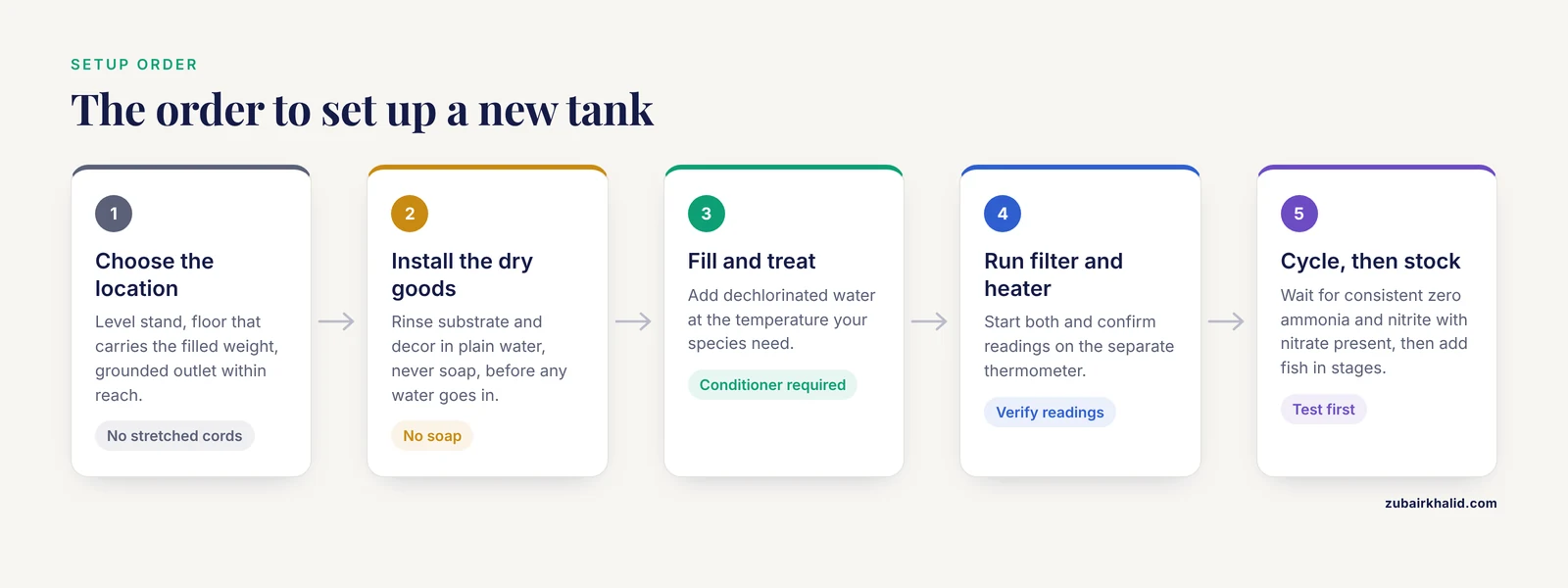
- Choose the location first. Confirm the stand sits level, the floor can carry the filled weight, and a grounded outlet is within reach without stretched cords.
- Install the dry goods. Rinse substrate and decor in plain water, never soap, and arrange them before any water enters.
- Fill and treat. Add dechlorinated water at the temperature your species need. Conditioner is not optional with municipal tap water.
- Start filtration and heating. Run the filter and heater and verify readings with your independent thermometer.
- Cycle the tank. Establish the biological filter before fish arrive, monitoring ammonia and nitrite with your test kits until both read zero on a consistent basis and nitrate has begun to accumulate.
- Verify, then stock. Only when your recorded parameters are stable across repeated tests do you introduce fish, in stages rather than all at once.
Researchers in the iMRI study found that a rehearsal with simulations, followed by a written protocol, turned a complex setup into a repeatable process with a documented learning curve [1]. Your first tank setup benefits from exactly the same rehearsal mindset. Walk through the checklist with everything dry, then execute.
The Ongoing Aquarium Care Checklist
Setup is a one-time event. Care is a recurring one. The aquarium care checklist below is the maintenance rhythm most keepers settle into, and embedding it into your week, the way clinicians embed screening algorithms into existing visit checklists, is what makes it stick [5].
Daily (two minutes):
- Count fish and check that all are present, swimming normally, and eating
- Verify thermometer reading
- Confirm filter flow and heater operation
- Note any dead plant matter or uneaten food
Weekly:
- Test ammonia, nitrite, nitrate, and pH and log the results
- Partial water change using dechlorinated, temperature-matched water
- Siphon visible debris from the substrate
- Wipe glass and clean light fixture covers as needed
Monthly:
- Rinse mechanical filter media in removed tank water
- Check equipment for wear, cracks, and mineral buildup
- Review your logged parameters for drift
Quarterly or as needed:
- Replace worn mechanical media
- Inspect seals on glass tanks
- Deep-check the standby equipment, including the battery air pump
Written logs matter. When a fish health problem develops, the parameter history you recorded is often the single most useful thing you can show an aquatic veterinarian.
Common Mistakes
- Buying fish on tank day. The biological filter needs time to establish. Fish added before cycling are exposed to toxic ammonia and nitrite.
- Skipping the test kits. Clear water is not clean water. Ammonia is invisible and lethal.
- Undersizing the tank. Small volumes change chemistry fast. A fish tank calculator run before purchase prevents regret.
- Overfeeding. Uneaten food becomes waste, waste becomes ammonia, ammonia becomes disease.
- Treating all media as disposable. Throwing away biological media throws away the bacteria doing the critical work.
- Mixing equipment between tanks. Nets, siphons, and buckets that move between aquariums move pathogens with them.
- Ignoring the lid. Many species jump, and a missing lid turns an evening into a loss.
- No plan for power failure. A battery air pump costs little and preserves oxygenation when the filter stops.
Hygiene, Biosecurity, and Household Safety
Fishkeeping equipment is a fomite. The mycobacteria survey of pet shop fish identified Mycobacterium marinum, M. fortuitum, and M. chelonae in roughly 90 percent of the positive samples, and M. marinum itself is a recognized human pathogen that causes skin infections, so the authors explicitly urged caution when handling both the fish and the equipment [8]. Translate that finding into your checklist:
- Wear gloves for tank maintenance, especially if you have any cuts or skin conditions on your hands and forearms
- Wash hands with soap and water after every contact with tank water, fish, or equipment
- Never use kitchen sponges, sinks, or buckets for aquarium work
- Disinfect nets and tools between tanks and between uses
- Keep aquarium water out of the mouths of children and away from open wounds
- Quarantine new arrivals before they join an established tank
The aquatic veterinary community treats this seriously. Organizations including the World Aquatic Veterinary Medical Association and the Merck Veterinary Manual's pet fish resources emphasize quarantine, observation, and professional input when disease appears, and the AVMA provides pet owner guidance on aquatic animal health. The practical version for a home keeper is simple. Anything that touched a fish or the water gets cleaned before it touches you or another tank.
Advanced and Professional-Grade Equipment
Most home keepers never need the following, but the checklist is incomplete without acknowledging where professional equipment begins, because knowing the boundary tells you when to involve a specialist.
Identification and record-keeping equipment. Public aquariums implant passive integrated transponder (PIT) tags to identify individual fish. A retrospective review of 728 implantations across 105 teleost and elasmobranch species at the New England Aquarium found tag placement safe, with adverse effects extremely rare, and calculated an equipment cost of $2.83 per ten implantations [9]. Individual identification enabled decades-long records of longevity, welfare, and medical management. Home keepers rarely need implants, but the underlying principle applies at every scale. Individual records, even a notebook entry per fish, improve welfare outcomes.
Anesthetic and handling equipment. Fish anesthesia is routine in ornamental practice, aquaculture, and research, typically delivered by immersion in agents such as tricaine, benzocaine, and isoeugenol. A symposium of fish anesthesia specialists concluded that while administration is common, monitoring procedures often lag behind mammalian standards, and that analgesia and aversiveness deserve explicit attention in any anesthetic protocol [10]. Two practical takeaways follow. First, never attempt to anesthetize a fish at home with a home-remedy compound, because dosing is species dependent and monitoring is a learned skill. Second, when a procedure requires sedation, it belongs with an aquatic veterinarian who has the agents, the monitoring, and the recovery equipment.
Energy, Water, and Environmental Footprint
Aquariums are running appliances, not one-time purchases. A modeling study across France, Poland, and the UK estimated that a home tropical aquarium produces between 85.3 and 635.2 kilograms of carbon dioxide equivalent per year depending on size and running conditions, equal to 1.6 to 12.4 percent of an average UK household's emissions, and consumes between 156 and 31,200 liters of water per year [7]. The same analysis noted that even the higher aquarium estimates sit below the dietary carbon footprint of an average dog, estimated at 127 to 1,592 kilograms per year, or a cat, estimated at 121 to 251 kilograms [7].
For your checklist, this translates into three equipment-level choices:
- Select heaters and filters sized correctly rather than oversized, since heating is the dominant energy cost in tropical tanks
- Plan water changes on a schedule, because a routine partial change is far more water-efficient than emergency full drain-and-refills
- Choose LED lighting, which delivers adequate output at lower draw than older technologies
The footprint is not an argument against keeping fish. It is an argument for an efficient setup, which is itself a checklist item.
Limitations and When to Contact a Veterinarian
Every aquarium is an individual system. Stocking lists, water sources, local tap water chemistry, and species requirements vary, and a checklist cannot substitute for matching your specific setup to your specific animals. When a health question involves a diagnosis, a medication, or a dose, that decision belongs with a licensed veterinarian, ideally one with aquatic animal experience. The fish anesthesia literature makes the species-dependence of dosing explicit, noting that multi-species tanks present challenges that general advice cannot resolve [10].
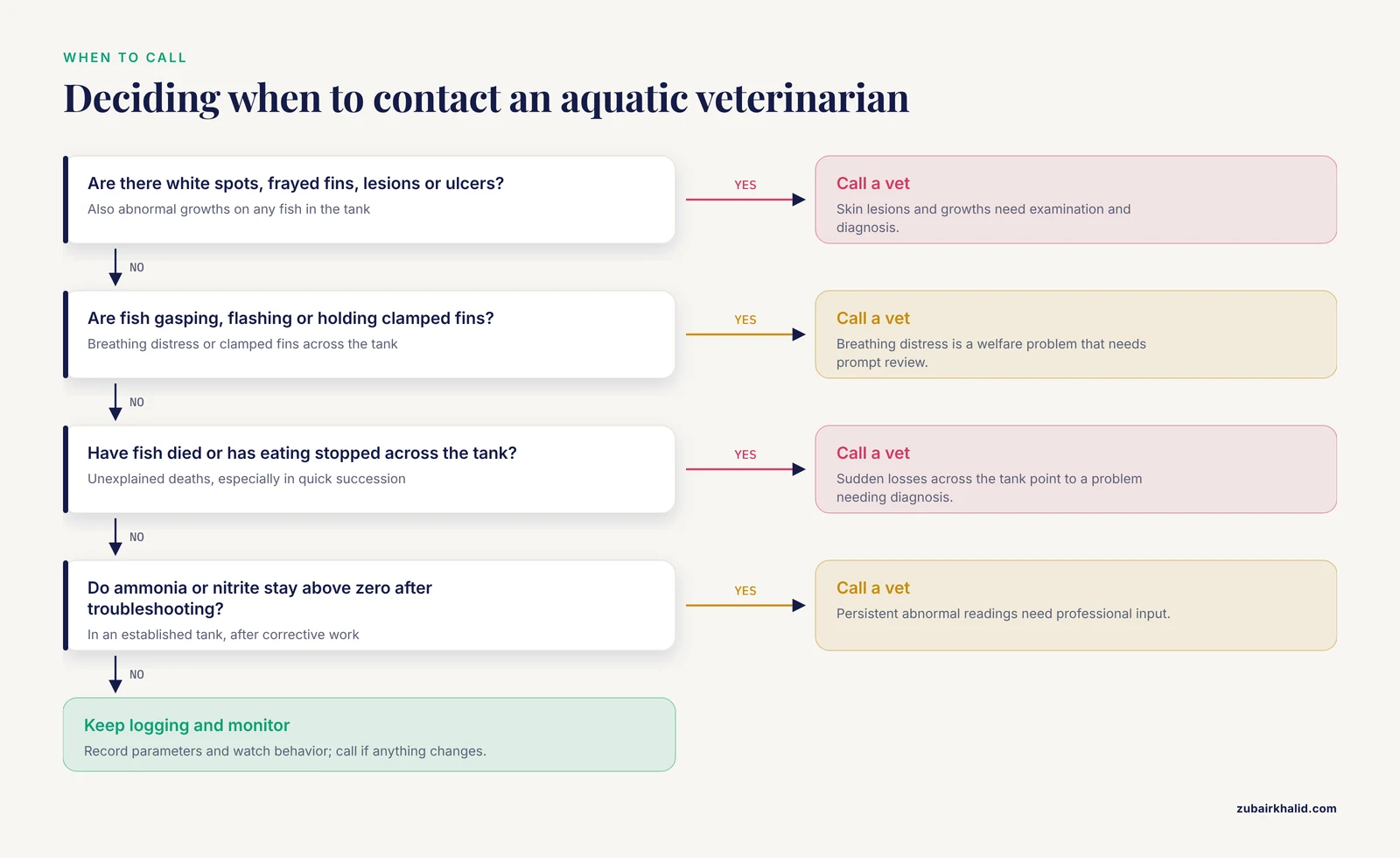
Contact an aquatic veterinarian promptly if you observe:
- White spots, frayed fins, lesions, ulcers, or abnormal growths
- Gasping at the surface, flashing, or clamped fins
- A sudden stop in eating across multiple fish
- Unexplained deaths, especially in quick succession
- Ammonia or nitrite readings above zero in an established tank after troubleshooting
- Skin infections, nodules, or persistent lesions on any person in the household after tank contact, which warrants medical attention given the documented zoonotic potential of aquarium mycobacteria [8]
- Any situation where a procedure requiring sedation or surgery is being considered
For general husbandry questions, the Merck Veterinary Manual's pet fish resources and the AVMA's pet owner materials are reasonable starting points, and WAVMA maintains a directory to help owners find aquatic veterinary professionals.
Frequently Asked Questions
What is the essential aquarium equipment checklist for a beginner?
The essentials are a tank and stand, a filter with biological media, a heater and separate thermometer for tropical fish, lighting on a timer, dechlorinator, test kits for ammonia, nitrite, nitrate, and pH, a siphon and dedicated buckets, nets, and a written setup plan. Buy all of it before you buy any fish.
Can I set up a fish tank without a heater?
Only if you keep species whose natural temperature range matches your room year round. Most popular aquarium fish are tropical, so a heater and thermometer belong on the checklist, and stability matters as much as the target temperature itself.
How do I use an aquarium equipment checklist template?
Print the template, hang it near the tank, and physically tick each row as you complete it. The value is in verification, not memory, which is the same reason clinical teams run checklists before high-risk procedures rather than relying on recollection.
How does a fish tank calculator work?
You enter the tank's length, width, and height, and the calculator returns the water volume. Subtract the space taken by substrate, rock, and decor, then match the true volume and swimming space to the adult size and needs of the species you plan to keep.
How long should I wait before adding fish to a new tank?
Wait until the nitrogen cycle is established, confirmed by your own test kit showing consistent zero ammonia and zero nitrite with nitrate present. The timeline varies by setup, so the number on your test kit, not the calendar, makes the decision.
Do I need an air pump if I have a filter?
Not always. Many filters agitate the surface enough to oxygenate the water, but air pumps help in warm water, densely stocked or heavily planted tanks, and during power outages if you keep a battery-powered model. Assess oxygen demand against your specific stocking.
How often should I test my aquarium water?
Test daily during cycling, then weekly once the tank is stable, and again any time fish look unwell or after any change to stocking, decor, or maintenance routine. Log every result, because the trend line matters as much as any single reading.
When should I call an aquatic veterinarian?
Call when fish show skin lesions, breathing distress, appetite loss across the tank, or unexplained deaths, when water parameters stay abnormal after corrective work, or before any procedure that might require sedation. A veterinarian with aquatic training can examine, diagnose, and prescribe appropriately.
Sources
- Setting Up Workflow of an Intraoperative MRI Unit: A Single-Centre Experience of First 53 Cases
- Using a simulation-based approach to evaluate a contextually appropriate, non-internet dependent mobile navigation tool for emergency medical dispatch (EMD) of lay first responders (LFRs) in Sierra Leone: A multi-cohort feasibility trial.
- Development of a Checklist to Assist Physiotherapists in Determination of Patients' Suitability for a Blended Treatment
- How to improve adherence to antidepressant treatments in patients with major depression: a psychoeducational consensus checklist
- Nonalcoholic Fatty Liver Disease Screening in Type 2 Diabetes Mellitus Patients in the Primary Care Setting
- B-032 Total lab Automation Validation/Verification Protocol: First Step of Process Excellence Journey in Smart Core Lab in Kokilaben Dhirubhai Ambani Hospital & Medical Research Institute, Mumbai, India
- The environmental impact of keeping a tropical aquarium in Northern Europe.
- Mycobacteria in aquarium fish: results of a 3-year survey indicate caution required in handling pet-shop fish.
- Observations on the use of passive integrated transponder (PIT) tags in teleosts and elasmobranchs at a public aquarium, 728 cases, 2007-2020.
- Anaesthesia of laboratory, aquaculture and ornamental fish: Proceedings of the first LASA-FVS Symposium.