How to Add Fish to a New Aquarium: A Safe Introduction
By Dr. Zubair Khalid, DVM, MS, PhD ·
The safest way to add fish to a new aquarium is to wait until the tank has completed its biological cycle, test the water before any fish arrive, add only a small number of hardy fish at first, and acclimate each fish slowly to the new water. A brand new tank is not a finished habitat on day one. It is a young ecosystem that needs weeks to develop the bacterial communities that process fish waste, and fish placed into an uncycled tank are exposed to ammonia and nitrite, two compounds that damage gills and body surfaces even at low concentrations.
This guide walks through the entire process, adding fish to a new aquarium step by step, from setting up the tank through the first weeks of care. It also covers the mistakes that cause most early fish losses, the routine tasks that keep water stable, and the situations where a veterinarian with aquatic animal experience should be involved.
At a Glance: Safe Fish Introduction Checklist
Use this checklist as your working plan. Each step is explained in detail below.
| Step | What You Do | Timing |
|---|---|---|
| , - | , - | , - |
| 1 | Set up the tank, dechlorinate the water, and run the filter | Day 1 |
| 2 | Begin the nitrogen cycle by establishing biological filtration | Weeks 1 to 4 or longer |
| 3 | Test water for ammonia, nitrite, nitrate, and pH | Before adding fish, then regularly |
| 4 | Confirm temperature matches the needs of your species | Before purchase |
| 5 | Select a small number of hardy first fish from a healthy source | After cycling is confirmed |
| 6 | Float and drip acclimate each fish | 30 to 60 minutes on arrival |
| 7 | Release fish gently, keep lights dim, skip feeding until settled | Release day |
| 8 | Feed lightly, monitor behavior, and retest water | Daily to weekly |
| 9 | Add remaining fish gradually in small groups | Over several weeks |
Why a New Aquarium Needs Time Before Fish Go In
The single most misunderstood part of fishkeeping is that clear water is not the same as safe water. In a functioning aquarium, fish release ammonia through their gills and in their waste. Beneficial bacteria colonize the filter media and other surfaces and convert that ammonia first into nitrite and then into nitrate, which is far less toxic and is managed with water changes. This process, called biological filtration, is the foundation of every healthy aquarium.
A newly set up tank has no established bacterial population. When fish are added too early, ammonia rises first, then nitrite, and fish exposed to these compounds can show gasping at the surface, red or inflamed gills, lethargy, clamped fins, and sudden death. This pattern is so predictable in newly stocked tanks that it has a common name among keepers and aquatic veterinarians, new tank syndrome. The bacteria need a source of ammonia to multiply, and they need weeks, not days, to reach populations large enough to handle a normal fish load.
Because this is a biological process rather than a product you can buy, no amount of filtration equipment replaces patience. Filters provide surface area and water flow for bacteria. The bacteria themselves grow on a timescale that cannot be rushed by a stronger pump or a bigger canister.
Choosing and Sizing the Tank Before You Buy Fish
Getting the tank size right is the first decision that determines whether fish introduction goes smoothly. Overstocking is one of the most common reasons new aquarists struggle, because more fish means more waste than a young biological filter can process.
When you shop, calculate the actual volume of the aquarium rather than relying on marketing labels, and account for the fact that gravel, rocks, and decorations displace water. An online fish tank calculator can convert tank dimensions into gallons or liters and help you estimate realistic stocking levels for the species you want. As a general principle recognized in aquatic veterinary practice, larger water volumes are more stable than smaller ones, so the biggest tank your space and budget allow is usually the safer choice for a beginner.
Equipment Selection Criteria
You need four categories of equipment, and quality matters more than extras:
- Filtration. Choose a filter rated for your tank volume that holds replaceable biological media, since that media is where your beneficial bacteria will live. Avoid rinsing that media in untreated tap water later, because chlorine will kill the bacterial colony you spent weeks building.
- Heating. For tropical species, use an appropriately sized heater with a reliable thermostat, and confirm with a separate thermometer that the displayed temperature matches the actual water temperature.
- Water treatment. A water conditioner that neutralizes chlorine and chloramine is essential for every water change and top-off, because municipal tap water disinfectants are toxic to fish gills.
- Testing. Liquid test kits or reliable test strips for ammonia, nitrite, nitrate, and pH are not optional equipment. Water quality testing is the core diagnostic tool of fishkeeping, and it is how you know when the tank is ready for fish.
Adding Fish to a New Aquarium Step by Step
Step 1: Set Up the Tank and Start the Cycle
Rinse the tank, substrate, and decorations with water only, never with soap or detergent, which leave residues harmful to fish. Add dechlorinated water, install the filter and heater, and turn everything on. The filter must run continuously from this day forward, because the bacteria in your biological media need constant water flow and oxygen.
To start the cycle, the tank needs an ammonia source. The most controlled approach is to add small amounts of pure ammonia until you detect a low, steady reading. An alternative is to run the tank with a very small number of hardy fish from the start, but this exposes those fish to the worst water quality the tank will ever have, which is why many aquatic veterinarians prefer fishless cycling when it is an option. Whichever route you take, the goal is the same: establish a bacterial population capable of converting ammonia to nitrite and nitrite to nitrate before you place a single fish at risk.
Step 2: Test the Water Before Any Fish Arrive
Cycling is complete when ammonia and nitrite are consistently undetectable and nitrate is present, which shows the full bacterial chain is working. Test daily during cycling and record the results, because the pattern of readings tells you where you are in the process. A tank that reads zero across all parameters immediately after setup is not cycled, it is simply new.
Also confirm pH and temperature are appropriate for the species you plan to keep. Sudden shifts in pH or temperature are physiological stressors for fish, and stressed fish are far more susceptible to the bacterial, parasitic, and fungal diseases that circulate in home aquaria.
Step 3: Choose the Right First Fish
Your first fish carry the heaviest bioload your young filter has ever faced, so choose a small group of hardy, peaceful, appropriately sized species rather than a large or delicate fish. Buy from a store with clean tanks, active fish, no visible signs of disease such as white spots, frayed fins, or labored breathing, and staff who keep new arrivals in quarantine before sale.
Quarantine deserves special emphasis. The World Aquatic Veterinary Medical Association promotes biosecurity practices, including keeping new animals separate from established ones, as a core part of responsible aquatic animal keeping. Ideally, new fish spend several weeks in a separate quarantine tank before joining your display aquarium. This protects your existing fish and gives you time to observe new arrivals for signs of illness while they are easy to treat.
Step 4: Acclimate Each Fish Slowly
Transport is stressful, and the water in the transport bag differs from your tank in temperature, pH, and chemistry. Acclimation bridges that gap gradually.
The floating method works well for most community fish:
- Turn off the aquarium lights and dim the room to reduce stress.
- Float the sealed bag in the tank for roughly 15 to 20 minutes so the water temperature equalizes.
- Open the bag and add a small amount of tank water to it.
- Repeat the addition every few minutes over the next 20 to 30 minutes so the fish adjusts to your water chemistry slowly.
- Gently net the fish out and release it into the tank. Discard the bag water rather than pouring it into your aquarium, because store water can carry pathogens.
For sensitive species, expensive fish, or any fish showing stress, drip acclimation is a gentler version of the same principle. Set the bag or a clean container below the tank water level, run a length of airline tubing from the tank into the container, and tie a loose knot or use a flow regulator so tank water drips in slowly over a longer period. The fish transitions gradually to your water parameters without ever experiencing a sudden change.
Step 5: Release the Fish and Let Them Settle
Release fish into the tank with minimal handling. Never pour fish directly from a net into open water in bright light. Keep the lights off or very dim for the first several hours, do not feed until the fish have settled, and resist the urge to hover at the glass. Hiding is normal on the first day. Fish that remain hidden, refuse food, or breathe rapidly for more than a day or two warrant a closer look at your water quality.
Step 6: Manage the First Days and Weeks
The weeks after the first fish arrive are a repeat performance of the cycling challenge at a larger scale. Every new fish adds waste, and the bacterial population must grow again to match.
Feed sparingly during this period. Uneaten food decomposes into ammonia, so feed only what fish consume within a minute or two, once or twice daily. Test ammonia and nitrite at least weekly during the stocking period, and perform partial water changes with dechlorinated, temperature-matched water whenever ammonia or nitrite are detectable. A water change is the fastest safe way to dilute toxic compounds while the bacterial colony catches up.
Add subsequent fish in small groups, spaced weeks apart, rather than all at once. This gives the biological filter time to expand between additions and dramatically lowers the risk of a water quality crash.
Aquarium Care Checklist for Ongoing Health
Once fish are established, routine maintenance prevents most problems. An aquarium care checklist you can actually follow beats an elaborate schedule you abandon.
Daily
- Confirm all fish are present, active, and eating.
- Check that the filter, heater, and lights are functioning.
- Observe breathing rate, swimming posture, and fin position.
Weekly
- Test ammonia, nitrite, nitrate, and pH.
- Perform a partial water change using dechlorinated, temperature-matched water.
- Siphon debris from the substrate surface.
- Wipe the glass and check equipment.
Monthly
- Clean or replace mechanical filter media as needed, never all at once.
- Rinse biological media briefly in discarded tank water, not tap water, to preserve the bacterial colony.
- Replace chemical media such as carbon if you use it.
- Reassess stocking levels before considering more fish.
Consistency matters more than intensity. Small, frequent water changes are safer for fish than occasional massive ones, because stability is the property fish depend on most.
Common Mistakes When Adding Fish to a New Aquarium
Most early fish deaths trace back to a short list of avoidable errors. Reviewing these common mistakes before you buy is the cheapest insurance in fishkeeping.
Stocking immediately after setup. The most frequent mistake is adding a full complement of fish to a tank cycled for a day or not at all. Ammonia and nitrite spike, gills are damaged, and fish die within days. Patience during cycling is the highest-value investment in the entire hobby.
Adding too many fish at once. Even a properly cycled tank can be overwhelmed by a sudden bioload increase. Stock gradually in small groups.
Overfeeding. New keepers almost universally overfeed. Excess food becomes ammonia. Underfeeding for a few weeks is harmless. Overfeeding during the stocking period is not.
Skipping water testing. You cannot see ammonia or nitrite. Fish suffering from poor water quality often look normal until they suddenly do not. Testing is the only way to know.
Cleaning the filter media in tap water or replacing it all at once. Chlorinated tap water destroys the nitrifying bacteria in your media, effectively resetting your cycle. Always clean biological media in tank water you have siphoned out.
Skipping quarantine. New fish can carry parasites, bacteria, and viruses without appearing sick. Adding them directly to an established tank is one of the most common ways disease enters a healthy aquarium.
Mixing incompatible species. Research adult size, temperament, water preferences, and temperature requirements before purchase, not after. Many fish sold as juveniles grow far larger than their tank can accommodate.
Replacing all the water or deep cleaning the tank. A completely scrubbed, fully water-changed aquarium loses its biological balance and effectively restarts the cycle. Maintenance should be incremental.
Ignoring temperature during acclimation. A temperature shock of even a few degrees, delivered suddenly, stresses fish and suppresses immune function.
Troubleshooting Early Problems
Fish gasping at the surface. Check ammonia, nitrite, and dissolved oxygen conditions immediately. Perform a partial water change with dechlorinated, temperature-matched water and retest. Gilling rapidly while sitting near filter outflow often indicates water quality trouble or low oxygen.
Ammonia or nitrite appears after fish are added. This means the biological filter is not keeping pace with the bioload. Reduce feeding, stop adding fish, and perform partial water changes until tests read clean again.
Cloudy water in a new tank. Bacterial blooms are common in newly set up aquaria and usually resolve as the system matures. Reduce feeding, keep the filter running, and avoid tearing the tank down, which prolongs the instability.
White spots, frayed fins, or abnormal swimming. These are signs of disease, not water chemistry alone. Isolate affected fish if you have a quarantine tank, verify water quality first, and consult an aquatic veterinarian or an experienced fish health professional for diagnosis before treating, because incorrect medication dosing and misdiagnosis are common in home aquaria.
Fish hiding constantly or refusing food. Check water parameters and temperature, confirm tank mates are not bullying, and give new fish a few quiet days. Persistent refusal to eat beyond several days is a reason to seek veterinary input.
Welfare and Safety Points
Fish are vertebrate animals capable of experiencing pain and stress, and the AVMA provides pet owner guidance recognizing fish as animals deserving appropriate husbandry and veterinary care. Meeting their welfare needs in a home aquarium centers on three things: stable water quality, adequate space, and appropriate social grouping.
Handle fish as little as possible. Their protective slime coat is a physical barrier against infection, and nets, dry hands, and rough contact damage it. When handling is unavoidable, wet your hands first and support the fish gently.
Never release aquarium fish into ponds, lakes, or waterways. Beyond the ecological damage, releasing animals is prohibited in many jurisdictions. If you cannot keep a fish, rehome it through a store, aquarium society, or another keeper.
Human safety matters too. Keep electrical equipment on drip loops so water cannot run along cords into outlets, use a grounded outlet with appropriate protection, and never run equipment dry.
Limitations and When to Contact a Veterinarian
Every aquarium, water source, and species combination is different, and individual cases need evaluation by a veterinarian, ideally one with aquatic animal experience. The guidance here reflects general principles of aquarium husbandry and fish health, and your specific situation may require different decisions.
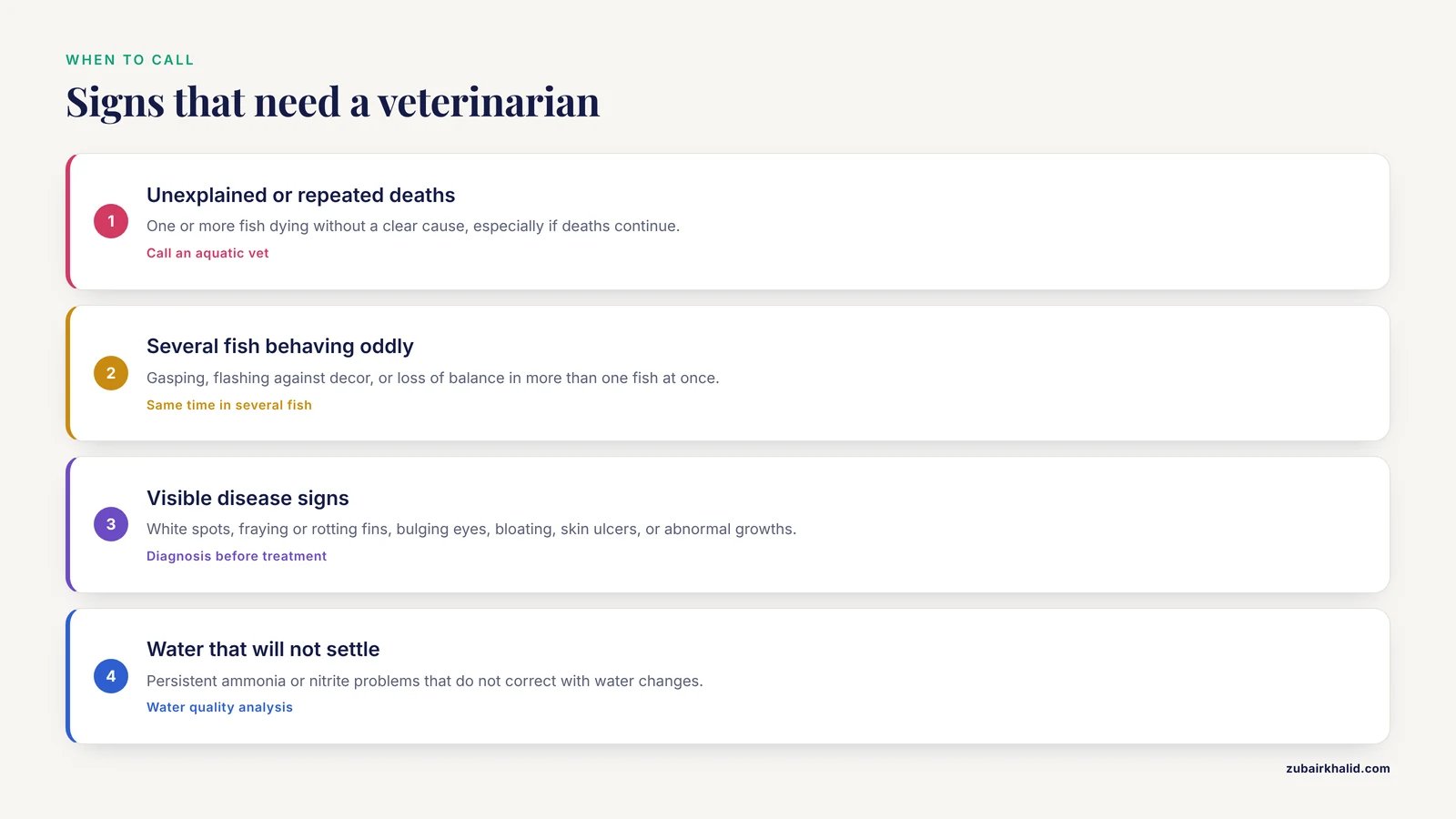
Contact a veterinarian with aquatic experience, or seek help through the WAVMA directory of aquatic veterinary professionals, when any of the following occur:
- Unexplained deaths of one or more fish, particularly if deaths continue.
- Multiple fish showing abnormal behavior at the same time, such as gasping, flashing against decor, or loss of balance.
- Visible disease signs, including white spots, fraying or rotting fins, bulging eyes, bloating, skin ulcers, or abnormal growths.
- Fish that stop eating for more than a few days.
- Persistent water quality abnormalities that do not correct with water changes.
- Suspected contagious disease in a tank with valuable or irreplaceable fish, where accurate diagnosis before treatment matters.
An aquatic veterinarian can perform water quality analysis, examine fish directly, and recommend specific treatments and durations based on an actual diagnosis rather than guesswork. Early consultation protects both the sick fish and the rest of your tank.
Frequently Asked Questions
How long should a new aquarium run before adding fish?
A new aquarium generally needs several weeks to complete the nitrogen cycle before fish are added. The exact time varies with temperature, method, and other factors, so rely on water testing rather than the calendar. The tank is ready when ammonia and nitrite are consistently undetectable and nitrate is present.
How many fish should I add to a brand new tank at once?
Start with a small group, often just a few hardy fish, and add more in small batches spaced weeks apart. Each addition increases waste production, and the biological filter needs time to grow to match the new load.
Can I use fish to cycle a new aquarium?
Fish-in cycling is possible but puts the fish at risk of ammonia and nitrite exposure. If you use this method, stock very lightly, feed sparingly, test frequently, and perform water changes whenever ammonia or nitrite appear. Fishless cycling with a controlled ammonia source avoids exposing fish to these toxins.
How do I acclimate fish from the store bag to my tank?
Float the sealed bag to equalize temperature, then add small amounts of your tank water to the bag over 20 to 30 minutes or more before release. Net the fish out and discard the bag water. For delicate species, drip acclimation over a longer period is even gentler.
Why did my fish die right after I added them to a new tank?
The most common cause is poor water quality from an incomplete nitrogen cycle, with ammonia or nitrite damaging gills. Test the water immediately, perform a partial water change, and confirm the tank was fully cycled before stocking.
Do I need to quarantine new fish before adding them to my aquarium?
Quarantine is strongly recommended. New fish can carry parasites and pathogens without visible symptoms, and a separate quarantine tank protects your established aquarium. Biosecurity through quarantine is a core recommendation of aquatic veterinary organizations.
How often should I test the water in a new aquarium?
Test daily while cycling, then at least weekly during the stocking period, and any time fish show abnormal behavior. Established tanks still need regular testing as part of routine maintenance, because water chemistry problems develop silently.
Should I feed my fish on the first day in a new tank?
Wait until the fish have settled in, typically until the following day, before offering a small amount of food. Newly introduced fish rarely eat right away, and uneaten food degrades water quality in a tank that is still biologically young.