White's Tree Frog Care Guide
By Dr. Zubair Khalid, DVM, MS, PhD ·
Key Takeaways
- White's tree frogs require a specific arboreal enclosure with a minimum height of 45 cm (18 inches) and a substrate that retains moisture, such as coconut fiber or sphagnum moss, to prevent dermatitis and maintain humidity.
- Optimal ambient humidity is 50-70% with brief spikes to 80% post-misting, monitored by a digital hygrometer; prolonged humidity above 80% increases risk of bacterial/fungal infections, while below 40% leads to desiccation.
- A temperature gradient of 24-28°C (75-82°F) during the day and 18-22°C (65-72°F) at night is crucial, with overheating above 30°C (86°F) being potentially fatal; low-level UVB (2-5%) can be beneficial but is not strictly required with proper dietary supplementation.
- Diet consists of gut-loaded insects like crickets and dubia roaches, dusted with calcium/D3 (every feeding for juveniles, every other for adults) and a multivitamin weekly, to prevent metabolic bone disease and hypovitaminosis A.
- Obesity is a significant health risk, leading to hepatic lipidosis and cardiovascular disease; prevention involves limiting high-fat feeders, ensuring adequate enclosure space for climbing and foraging, and monitoring body condition.
- Skin disorders such as red-leg syndrome (bacterial) and chytridiomycosis (fungal) necessitate immediate veterinary diagnosis via skin swabs or PCR, and proactive hygiene, quarantine of new arrivals, and appropriate supplementation are vital for overall health.
The White's tree frog (Litoria caerulea, also known as the dumpy tree frog) is one of the most popular amphibian pets worldwide due to its docile temperament, expressive eyes, and relatively manageable size. Native to Australia and New Guinea, this species thrives in captivity when provided with a carefully maintained arboreal environment, appropriate humidity, a balanced diet, and proactive health monitoring. This guide integrates best practices from veterinary medicine, including standards from the American Veterinary Medical Association (AVMA), the Merck Veterinary Manual, and the Association of Reptile and Amphibian Veterinarians (ARAV), to help owners provide optimal care. Both United States and Commonwealth spellings are used where appropriate (e.g., behavior/behaviour, diarrhea/diarrhoea) to serve a global audience.
Quick Q&A
Question: What is the ideal humidity for a White's tree frog? Answer: White's tree frogs require a humidity level of 50% to 70%, with brief spikes up to 80% after misting. Use a digital hygrometer to monitor levels and mist the enclosure with dechlorinated water once or twice daily. Prolonged humidity above 80% can predispose the frog to bacterial or fungal skin infections.
Arboreal Enclosure Requirements
White's tree frogs are strictly arboreal, meaning they spend most of their time climbing and perching above the ground. A properly designed enclosure must mimic the vertical structure of their native rainforest canopy.
Enclosure Size and Type
For one adult White's tree frog (snout-to-vent length 8 to 10 cm [3 to 4 inches]), a minimum enclosure size of 45 cm (18 inches) tall by 30 cm (12 inches) wide by 30 cm (12 inches) deep is recommended [Merck Veterinary Manual, Amphibian Husbandry]. Taller enclosures are preferred over longer ones. A pair of frogs can be housed in a 60 cm (24 inch) tall enclosure. Glass or PVC terrariums with front-opening doors are ideal because they allow easy access and maintain humidity better than mesh enclosures. Screen tops are essential for ventilation but should be partially covered with glass or acrylic to retain moisture.
Ventilation must be adequate to prevent stagnant air, which contributes to respiratory infections. The AVMA guidelines for exotic pets emphasize providing a temperature gradient within the enclosure to allow thermoregulation [AVMA, Pet Care].
Substrate and Decor
The substrate should retain moisture without becoming waterlogged. Options include coconut fiber (coir), sphagnum moss, or a commercial bioactive mix. Avoid bare glass or plastic because these can cause dermatitis. Live plants such as Pothos (Epipremnum aureum) or bromeliads help maintain humidity and provide hiding places. Branches, cork bark, and PVC pipes placed vertically and horizontally offer climbing opportunities. Provide at least two hiding spots, one near the bottom and one higher up, to reduce stress.
All decor must be securely anchored because White's tree frogs are heavy-bodied and can dislodge unstable items. According to the VCA Animal Hospitals, any sharp edges or rough surfaces can abrade the frog's delicate skin.
Temperature and Lighting
Maintain a daytime temperature gradient of 24 to 28 degrees Celsius (75 to 82 degrees Fahrenheit), with a nighttime drop to 18 to 22 degrees Celsius (65 to 72 degrees Fahrenheit). Overheating above 30 degrees Celsius (86 degrees Fahrenheit) can be fatal. Use a low-wattage ceramic heat emitter or an under-tank heater placed on the side or back (never beneath a glass tank, which can cause thermal burns). All heat sources must be regulated by a thermostat.
White's tree frogs are nocturnal and do not require UVB lighting if fed a properly supplemented diet (see Diet section). However, low-level UVB (2 to 5% intensity) can be beneficial for vitamin D synthesis and overall well-being, as noted in the ARAV husbandry guidelines [ARAV, Amphibian Lighting]. A simple 12-hour photoperiod from a low-output LED or fluorescent bulb is sufficient. Avoid strong basking spots; frogs may become desiccated if forced into a hot area.
Humidity and Hydration
Humidity is arguably the most critical environmental parameter for White's tree frogs. Their skin is permeable and serves as the primary organ for water absorption and respiration.
Maintain ambient humidity between 50% and 70% during the day, with short peaks up to 80% immediately after misting. Use a digital hygrometer placed at the middle height of the enclosure to measure accurately. An analog hygrometer is less reliable. Mist the enclosure once or twice daily with dechlorinated or reverse-osmosis water. A cool-mist humidifier or automatic misting system can be used for consistency, but the system must be cleaned regularly to prevent bacterial growth.
The frog should have access to a shallow water dish for soaking (changed daily). The dish must be heavy enough to prevent tipping and shallow enough to avoid drowning (water depth no more than the frog's chin). Dechlorinated water is essential because chlorine and chloramines damage amphibians.
Prolonged high humidity (above 80% without adequate ventilation) encourages opportunistic infections such as chromomycosis and red-leg syndrome. Conversely, humidity below 40% causes rapid desiccation, with signs including sunken eyes, dry skin, and lethargy. Owners in arid climates (e.g., parts of Australia and the southwestern United States) should monitor humidity more closely. In Europe, the Federation of Veterinarians of Europe (FVE) stresses that exotic pet owners must adapt enclosures to local ambient conditions [FVE, Exotic Pet Welfare].
Diet and Nutritional Needs
White's tree frogs are carnivorous insectivores. In the wild, they prey on a variety of invertebrates, and captive diets must mimic this diversity to prevent nutritional deficiencies.
Feed adult frogs every two to three days, offering three to five appropriately sized insects per feeding. Juveniles (under six months) should be fed daily. Staple feeders include gut-loaded crickets (Acheta domesticus), dubia roaches (Blaptica dubia), and silkworms. Occasional treats include hornworms, waxworms (sparingly, due to high fat content), and small mealworms. Avoid wild-caught insects because they may carry pesticides or parasites.
Gut-loading is non-negotiable. Feed feeder insects a high-quality diet (commercial gut-load formulas, dark leafy greens, carrots) for at least 24 hours before offering them to the frog. Dust insects with a calcium powder containing vitamin D3 at every feeding for juveniles and every other feeding for adults. Additionally, a multivitamin supplement (containing vitamin A and other necessary micronutrients) should be given once weekly. The Merck Veterinary Manual emphasizes that vitamin A deficiency is a common cause of metabolic bone disease and squamous metaplasia in amphibians [Merck Vet Manual, Amphibian Nutrition].
Obesity Risk
White's tree frogs have a notorious tendency toward obesity in captivity. Their natural shape is rotund, but excessive fat deposits (especially in the axillary region and over the tympanum) indicate overweight. Obesity shortens lifespan, predisposes to hepatic lipidosis (fatty liver disease), and compromises cardiovascular function.
To prevent obesity:
- Limit high-fat feeders (waxworms, superworms) to once weekly or less.
- Never leave live insects in the enclosure for more than 12 hours (crickets can bite sleeping frogs).
- Monitor body condition using a simple scale: the frog should have a distinct neck (the head is not a perfect continuation of the body) and the dorsal ridge should not be completely flattened. According to the CVMA (Canadian Veterinary Medical Association), regular weight recording is recommended for captive amphibians to detect trends early.
- Provide an appropriately sized enclosure that encourages climbing and foraging.
Captive White's tree frogs can become overweight when portions are excessive or opportunities for climbing and foraging are limited. Monitor body condition, record weight trends, and discuss unexplained gain or loss with an amphibian-experienced veterinarian.
Health and Disease Management
White's tree frogs are hardy but susceptible to several common health problems. Many conditions arise from suboptimal husbandry. A proactive veterinary relationship with a practitioner experienced in amphibian medicine is recommended; the AAHA (American Animal Hospital Association) encourages annual wellness examinations for all exotic pets.
Skin Disorders
Amphibian skin is delicate and prone to infection. Red-leg syndrome, caused by Aeromonas and other bacteria, presents as erythema on the ventral surface and legs, lethargy, and anorexia. Chytridiomycosis (caused by Batrachochytrium dendrobatidis) is a fungal infection that results in excessive sloughing, lethargy, and neurological signs. Both conditions require immediate veterinary diagnosis (skin swab, culture, or PCR) and treatment. The AVA (Australian Veterinary Association) highlights that chytrid remains a significant threat to native frog populations, and captive frogs should be sourced from disease-free breeders.
Maintain hygiene by spot-cleaning daily and performing a full substrate change every two weeks. Quarantine new frogs for at least 30 days as per ARAV recommendations.
Nutritional and Metabolic Diseases
Metabolic bone disease (MBD) results from inadequate calcium or vitamin D3. Signs include muscle tremors, soft jaw, difficulty climbing, and fractures. Hypovitaminosis A causes swollen eyes (parakeratotic spectacle) and a buildup of skin cells on the cornea. Prevention relies on strict supplementation as described under Diet.
Respiratory and Parasitic Infections
Upper respiratory infections occur when humidity is too high with low ventilation, or when temperatures are persistently suboptimal. Signs include open-mouth breathing, gular fluttering, and excess mucus. Internal parasites (nematodes, protozoa) can cause weight loss, diarrhoea, or bloating. A faecal examination by a veterinarian is recommended annually.
Obesity-Related Diseases
As noted, obesity leads to hepatic lipidosis and cardiovascular disease. Obese frogs have significantly shorter lifespans. Treatment involves gradual weight loss (no more than 2 to 5% total body weight per week), dietary adjustment, and ensuring the frog moves by rearranging the enclosure or temporarily increasing the thermal gradient to encourage activity.
Handling and Behaviour
White's tree frogs are generally tolerant of brief gentle handling, but they should not be handled excessively. Their skin absorbs toxins and is highly sensitive to substances on human hands (oils, lotions, soaps). Always wash hands thoroughly with plain water (no soap) immediately before handling, or wear powder-free nitrile gloves lightly wetted with dechlorinated water. Handling causes stress; limit sessions to 5 minutes or less per week.
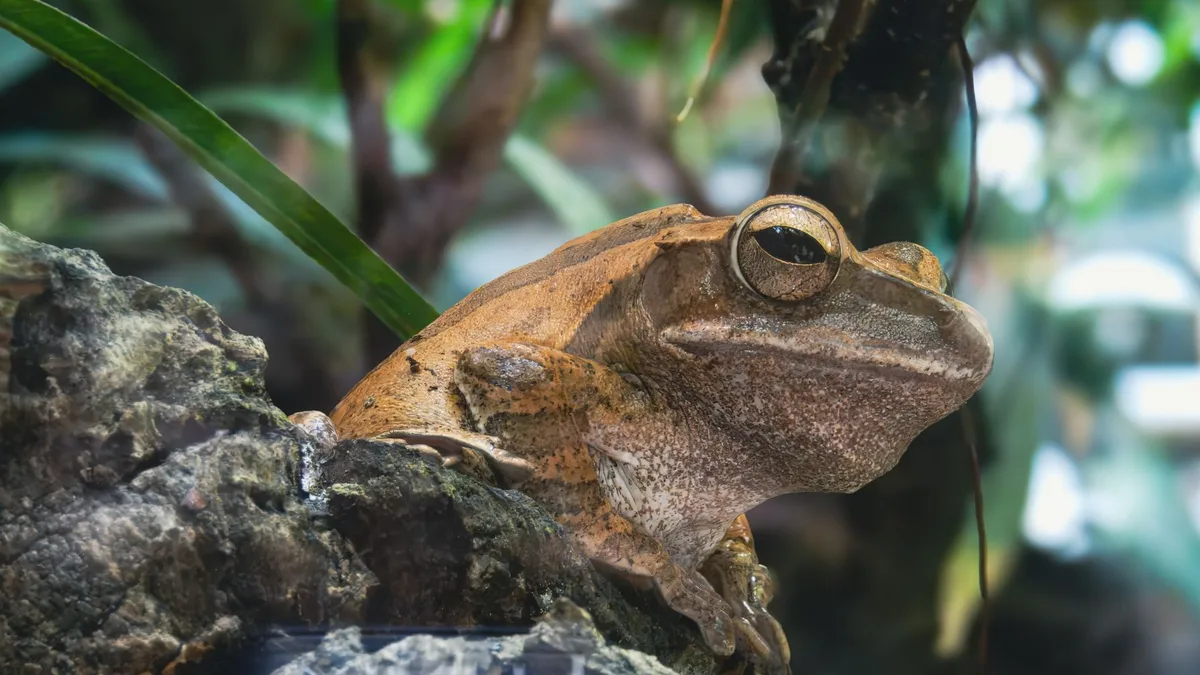 Amphibian skin is permeable, so water chemistry acts directly on the animal. Photo: Jimmyk photos via Pexels.
These frogs are nocturnal and most active at night. They often defecate after feeding, so avoid handling for 24 hours post-feeding. They communicate through soft croaks; males call to attract females. In captivity, excessive calling may indicate stress from overcrowding or improper sex ratios. Consult an ARAV veterinarian if aggression or chronic stress (hiding constantly, refusing food) is observed.
Conclusion
The White's tree frog can thrive for 12 to 16 years in captivity when provided with an appropriate arboreal enclosure, stable humidity and temperature, a balanced insectivorous diet with proper supplementation, and vigilant health monitoring. Obesity remains the most preventable but most common husbandry error. Adhering to guidelines from veterinary organisations such as the AVMA, Merck Veterinary Manual, and ARAV ensures the frog's welfare. Owners should establish a relationship with a qualified veterinary surgeon experienced in amphibian medicine, regardless of whether they are in North America, Europe, Australia, or Canada. With consistent care, this charismatic species rewards keepers with decades of fascination.
Related Articles
Related Clinical & Scientific Guides
References
Merck Veterinary Manual. Amphibian Husbandry and Nutrition. https://www.merckvetmanual.com. American Veterinary Medical Association (AVMA). Enclosure and Environmental Requirements for Exotic Pets. 2023. VCA Animal Hospitals. White's Tree Frog Care. https://vcahospitals.com. Association of Reptile and Amphibian Veterinarians (ARAV). Husbandry Guidelines for Litoria caerulea. 2022. Canadian Veterinary Medical Association (CVMA). Body Condition Scoring in Captive Amphibians. 2021. Australian Veterinary Association (AVA). Chytridiomycosis in Amphibians: Prevention Protocols. 2020. Federation of Veterinarians of Europe (FVE). Exotic Pet Welfare: Environmental Adaptations. 2022. DVM360 Network. Obesity in Amphibians: Diagnosis and Management. 2023.