Signs of Stress in Pet Frogs and How to Help
By Dr. Zubair Khalid, DVM, MS, PhD ·
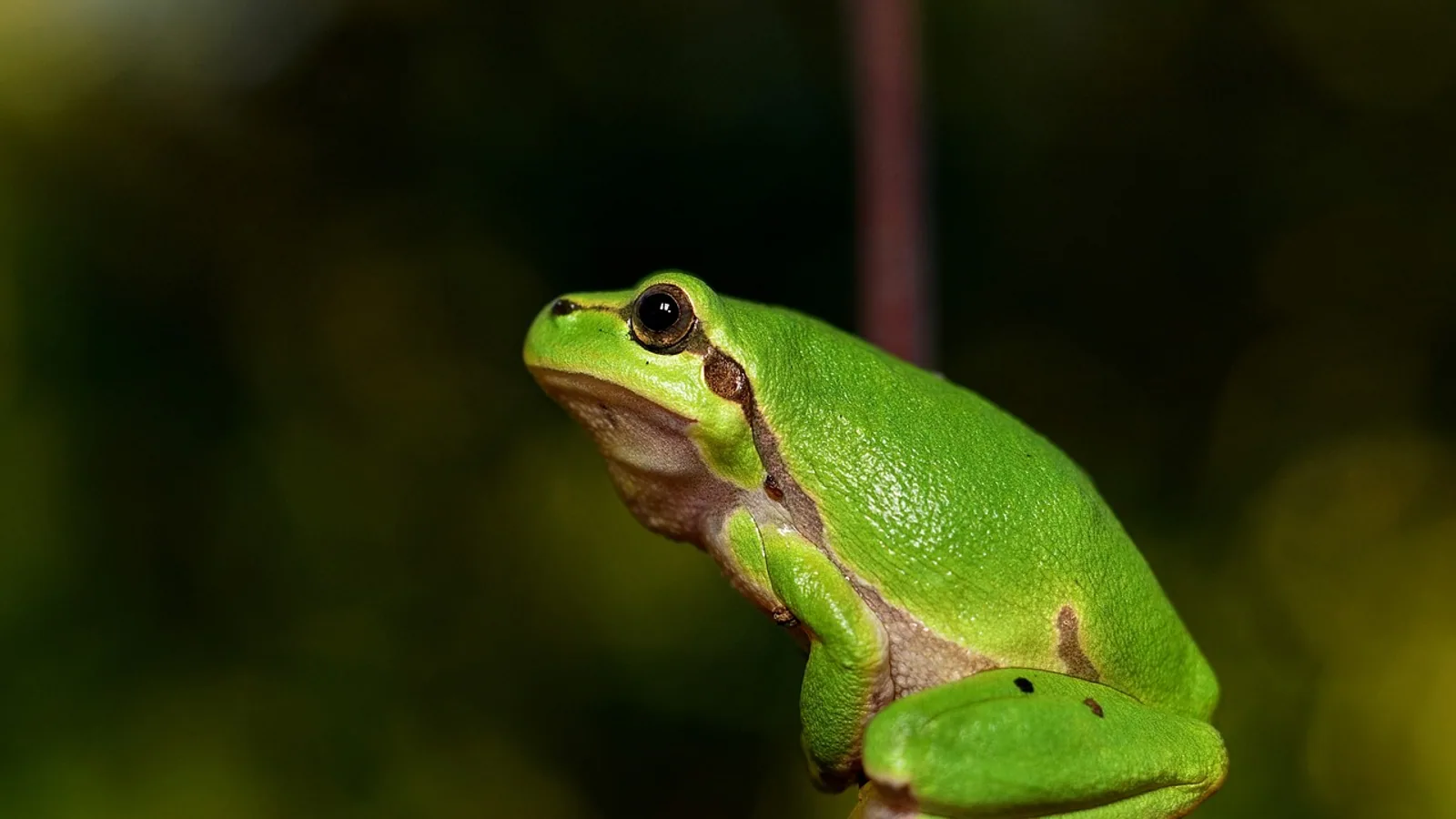
A stressed pet frog usually stops behaving normally before it stops looking normal. The earliest signs of stress in pet frogs are behavioral: refusal of food, prolonged hiding, restless pacing or escape attempts at the glass, unusual daytime activity in nocturnal species, and a change in skin color or posture. Because frogs hide illness until disease is advanced, these early changes are your warning window. Acting on them promptly, correcting the enclosure first and calling an amphibian veterinarian when problems persist, is the single most effective thing an owner can do.
Modern animal welfare science supports exactly this approach. Researchers who build welfare assessment tools for captive wildlife rely on animal-based indicators, meaning observable changes in the animal's own behavior and physical condition, rather than on enclosure paperwork alone [1], [2]. Those same principles apply on your vivarium shelf. This article walks through stressed frog symptoms in detail, explains what causes stress in pet frogs, gives a practical plan for how to calm a stressed frog, and defines clearly when to see a vet for a stressed frog.
This article is educational and is not a substitute for veterinary diagnosis or treatment.
At a Glance: Stressed Frog Symptoms, Likely Causes, and Owner Actions
| What you see | What it may mean | First step at home | Contact a vet if |
|---|---|---|---|
| , - | , - | , - | , - |
| Refusing food for more than a few scheduled feedings | Incorrect temperature, unsuitable prey item, internal disease | Verify temperatures and humidity, offer appropriate live prey, remove disturbances | Refusal persists, or weight loss is visible |
| Constant hiding, never emerging to feed | Enclosure too exposed, too bright, too dry, or too crowded | Add cover, reduce handling and traffic near the tank | Behavior continues after habitat correction |
| Frantic jumping at the glass, pacing, escape attempts | Enclosure too small, wrong substrate, unsuitable tankmates, no secure cover | Review space, cover, and cage mates | Self-injury occurs or behavior does not settle |
| Darkened,patchy, or unusually pale coloration | Stress response, skin disease, or poor water quality | Check water quality and moisture, stop handling | Skin changes persist or worsen |
| Flakiness, shedding problems, or unusual sliminess | Skin barrier problems, infection, hydration failure | Review humidity and water sources | Any skin lesion spreading or worsening |
| Lethargy, sitting abnormally, inability to right itself | Advanced illness, toxicity, emergency | Isolate in a simple, clean, warm hospital container | Immediately |
| Swelling, bloating, red patches on the belly or legs | Fluid accumulation or bacterial infection | Do not squeeze or "pop" anything | Immediately |
Why Frogs Show Stress Differently From Dogs and Cats
Frogs are amphibians, and their biology shapes how stress appears. Two features matter most to owners.
First, frogs are ectotherms. Their body temperature, activity level, digestion, and immune function all track the temperature of their surroundings. An enclosure that is slightly too cold does not make a frog shiver. It makes the frog slow, quiet, and anorexic, which owners often misread as depression or sleep. When welfare scientists develop assessment protocols for captive wildlife, they explicitly match each indicator to the species' biology, because a behavior that means contentment in one species means distress in another [1]. That principle is the foundation of reading a frog correctly.
Second, a frog's skin is not just a covering. It is a respiratory and osmoregulatory organ. Frogs drink and partially breathe through their skin, and the skin's mucus layer is a frontline immune defense. Any stressor that dries the skin, contaminates the water, or damages the mucus layer produces visible change quickly, and that change is both a stress signal and a disease risk in itself.
There is also a third, quieter reason frog stress is easy to miss. Prey animals evolved to conceal weakness. A frog that feels unsafe will sit motionless and look, to an untrained eye, like a frog that is simply resting. Behavioral monitoring resolves this. Studies of captive wildlife show that structured, repeated observation of behavior is one of the most reliable and practical ways to detect welfare problems, and that even non-specialist observers can be trained to record behavior consistently enough to be useful [2], [3]. As an owner, you are in the best observation position of anyone. A short daily check at the same time each day, noting posture, position, activity, and feeding response, will teach you your frog's normal baseline faster than any reference article.
Detailed Signs of Stress in Pet Frogs
The signs below are grouped into behavior, skin and appearance, posture and movement, and appetite and body condition. A single sign is a prompt to look closer. Several signs together, or any sign that persists after you correct the habitat, is a reason to involve a veterinarian.
Behavioral signs
- Refusal to eat or weak feeding response. A frog that strikes hesitantly, misses prey it normally takes, or ignores food entirely is one of the most common stressed frog symptoms. Appetite in ectotherms is tightly coupled to temperature and security.
- Excessive hiding. Using hides is normal. Never emerging, even at the frog's natural activity time, or abandoning a favorite perch, is not.
- Escape behavior. Repeated lunging at the glass, climbing to the lid, and rubbing the nose along the enclosure edge indicate the frog perceives its environment as unsafe or unsuitable.
- Abnormal activity patterns. Nocturnal species becoming restless in bright daylight, or diurnal species never becoming active at all, both signal a problem with lighting, temperature, or security.
- Startle responses disproportionate to the stimulus. A frog that panics at ordinary room movement, or freezes rigidly for long periods, is living above its stress threshold. Research on captive wild animals consistently shows that response to human presence and disturbance is a core welfare indicator [4], [5].
- Aggression or avoidance toward tankmates. Constant chasing, enforced displacement from basking or water sites, and animals that sit apart from the group all indicate social stress.
Skin and appearance
- Color change. Many frogs darken when stressed or cold and pale when ill. Persistent abnormal coloration, especially darkening combined with anorexia, warrants action.
- Dull or patchy skin, retained shed, or excessive sloughing. The shed skin should come off cleanly and is often eaten. Stuck shed, raw patches, or discolored plaques suggest husbandry failure or infection.
- Changes in the mucus layer. Skin that looks dry, matte, or unusually slimy indicates that the skin barrier is compromised.
- Weight loss. In frogs this shows as a more prominent hip and spine outline and a narrower body. Because amphibians tolerate weight loss poorly, visible loss is significant.
Posture and movement
- Abnormal sitting posture, such as sitting with the hind legs splayed, the head tilted, or the body propped oddly.
- Lethargy that does not match temperature. A cold frog is sluggish. A frog that stays limp and unresponsive even at proper temperature is sick.
- Loss of righting reflex, trembling, or inability to swim normally in aquatic or semi-aquatic species. These are late and serious signs.
Droppings and hydration
- Absent or abnormal droppings and a sunken or wrinkled appearance around the abdomen can indicate dehydration, impaction, or digestive disease.
A useful frame for all of this comes from the Five Domains model, the framework used to structure welfare assessment in many captive species. It separates physical domains such as nutrition, environment, and health from the mental states they produce, and it classifies each indicator by whether it contributes negatively or positively to the animal's welfare [1]. In practical terms, each symptom above is negative evidence, and its disappearance, a frog feeding eagerly, moving naturally, and resting openly, is positive evidence that your corrections worked. Contemporary welfare science encourages owners to aim for positive welfare, not merely the absence of obvious distress [6].
What Causes Stress in Pet Frogs
Most chronic stress in captive frogs traces back to a small number of husbandry failures. Working through this list systematically is how you identify what is stressing your animal. When experts build welfare protocols for any captive species, they combine resource-based indicators, meaning the physical inputs you control, with animal-based indicators, meaning what the animal shows [7]. The causes below are the resource side of that equation for frogs.
Temperature outside the species-appropriate range
Too cold, and digestion and immunity slow until the frog stops eating. Too hot, and the frog seeks water or shade, dries out, and can overheat fatally in an enclosed tank. There is no single correct temperature for "frogs," because a species from a cloud forest and a species from a savanna have opposite requirements. Identify your frog's species, obtain a species-specific care reference, and verify actual conditions with thermometers placed in the tank, not the numbers printed on equipment.
Improper humidity and water quality
Because the skin is a respiratory and water-balance organ, dry air, chlorinated or chemically treated water, and soiled substrate all act as direct stressors. Ammonia and waste accumulation in standing water is a frequent silent problem in semi-aquatic and aquatic setups. Water changes, dechlorination appropriate to amphibians, and substrate hygiene are the pillars of prevention here.
Enclosure design failures
Insufficient space, lack of vertical structure for climbing species, lack of deep substrate for burrowing species, absence of secure hides, and excessive openness all produce chronic vigilance. Research on captive ungulates found that enclosure management with consistent food availability and spatial enrichment supported naturalistic behavior and actively mitigated stress [8]. The same logic applies to amphibians. A frog that can express its natural posture, whether that is buried, perched, or partially submerged, and that always has a retreat within reach, experiences measurably less stress.
Excessive handling and disturbance
Frog skin absorbs substances readily, and frogs are prey animals that do not benefit from being held. Handling is a stressor for them, not enrichment. This extends beyond hands to the whole sensory environment. Studies of sensitive captive species show that close human presence and routine disturbance themselves suppress natural behavior, and that low-disturbance observation methods were developed precisely because monitoring can harm what it measures [4]. Place the enclosure away from speakers, televisions, doors, and pet traffic. Keep lights off and the room quiet during the frog's rest period. Observe more, touch far less.
Inappropriate social grouping
Some frog species are territorial and should be housed singly. Others tolerate or require groups but need enough space and visual barriers to escape one another. Forced cohabitation of incompatible animals is a major and underrecognized cause of chronic stress, presenting as one animal that always hides, always loses access to food, and always has the worst body condition.
Diet and feeding errors
Feeding a single prey item exclusively, offering prey that is the wrong size, feeding an inappropriate diet for the life stage, or leaving uneaten live insects in the enclosure to pester the frog all contribute to nutritional and psychological stress. Vitamin and mineral supplementation practices vary by species and setup, and should be confirmed with an amphibian veterinarian rather than copied from a forum.
New arrivals and disease
Any new animal, new decor, or new water source can introduce pathogens or chemical residues. Disease itself is a stressor, and stress suppresses immunity, creating a cycle in which the underlying problem and the stress response reinforce each other. In captive wildlife generally, researchers use biochemical markers of stress alongside behavioral signs to understand this relationship [9], but at home, your observable indicators, the signs listed above, are what you can act on.
How to Calm a Stressed Frog: A Step-by-Step Plan
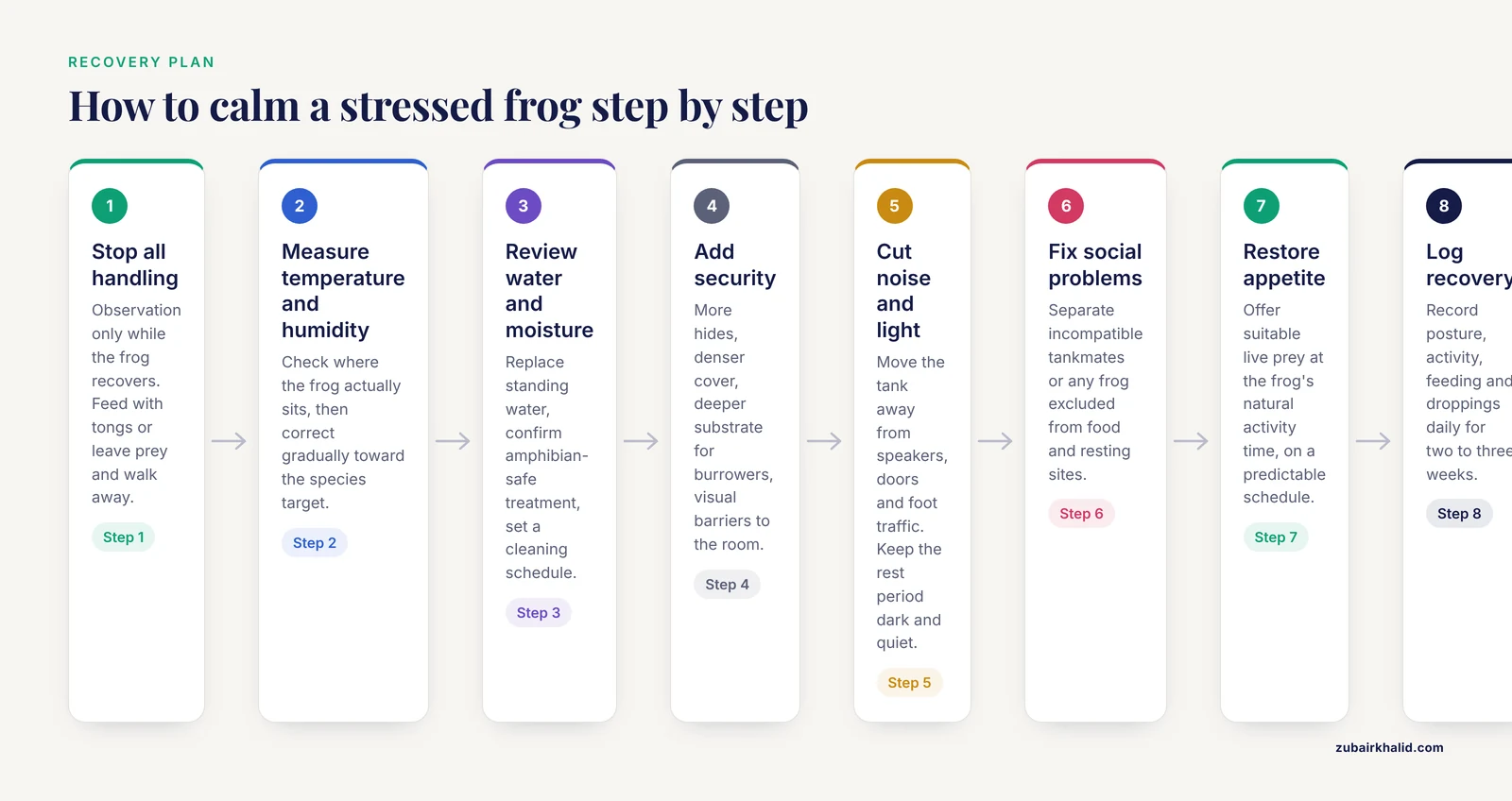
Once you have identified likely causes, work through the following sequence. The order matters. Habitat correction comes before anything else, because most stressed frog symptoms resolve when the environment is right.
- Stop all handling immediately. Commit to observation-only interaction while the frog recovers. Feed with tongs or by placing prey in the enclosure and leaving the area.
- Audit temperature and humidity with instruments. Measure where the frog actually sits, not at tank height in the room. Correct toward your species-appropriate target gradually, because rapid swings are themselves stressors.
- Review water quality and moisture. Replace standing water, confirm any treatment used makes water safe for amphibians, and establish a regular cleaning schedule so waste never accumulates.
- Add security. More hides, denser planting or cover, deeper substrate for burrowers, and visual barriers between the frog and the room. A frog that can choose when to be visible is a calmer frog.
- Reduce external stressors. Relocate the tank away from noise, vibration, and foot traffic. Dim or eliminate nighttime light exposure in the room.
- Fix social problems. If tankmates are incompatible or one animal is being excluded from resources, separate them. Recovery from chronic social stress requires physical separation, not time.
- Restore appetite carefully. Offer appropriate live prey at the correct activity time for your species. If the frog feeds, let it settle into a routine of consistent, predictable feeding, since consistent food availability is associated with naturalistic behavior and reduced stress in captive wildlife [8].
- Track recovery. Keep a simple daily log of posture, activity, feeding response, and droppings for two to three weeks. Routine behavioral tracking over time is exactly how professional keepers detect welfare change in large collections [2], and it works just as well for one animal in one living room. If a frog will not settle after genuine habitat correction, or if any symptom worsens, escalate to veterinary care.
One caution during recovery: resist the urge to frequently rearrange the enclosure or add new enrichment while the frog is stressed. Stability first. Novelty later, once feeding and behavior have normalized.
Veterinary Examination and Diagnostics for a Stressed Frog
If home correction does not resolve the signs, or if the frog is deteriorating, schedule an appointment with a veterinarian experienced in amphibian or at least reptile and exotic animal medicine. Not every small animal clinic sees amphibians, so call ahead and ask.
A thorough amphibian examination typically includes a full history of the enclosure, temperatures, humidity, water source, diet, and supplementation, followed by a hands-on assessment of body condition, hydration, oral cavity, skin, and posture. Diagnostic steps your veterinarian may recommend include a fecal examination to look for parasites, skin or oral swabs or scrapings if infection is suspected, imaging if there is bloating or suspicion of impaction or bone disease, and bloodwork in selected cases. The principle behind this workup is the same one used across captive animal medicine, pairing what the animal shows with objective measures to identify the underlying welfare hazard [10], [7].
Your observation log from the recovery period is genuinely useful at this appointment. Behavior recorded across days is more informative than a single snapshot in a clinic, where transport and handling have already stressed the animal.
Do not delay an appointment because the frog "still eats a little." Amphibians decompensate quickly once they stop compensating.
Home Remedies and Owner Mistakes That Make Things Worse
Well-meaning owners routinely make these errors, and some cause direct harm.
- Handling to "check on" the frog repeatedly. Each capture is a predation event from the frog's perspective. Use observation instead.
- Doubling heat or light to stimulate appetite. Overheating an enclosed tank can kill faster than the original problem. Adjust gradually and verify with a thermometer.
- Adding unproven supplements, teas, or "water conditioners" not designed for amphibians. Frog skin absorbs what it contacts. Nothing goes in the water or on the substrate unless it is confirmed safe for amphibians.
- Squeezing, lancing, or puncturing swellings. Bloating and swellings need diagnosis, not drainage.
- Treating skin changes with products made for reptiles, fish, or humans. Formulations safe for one group can be lethal to amphibians through their permeable skin.
- Treating with leftover medications or doses intended for other animals. Amphibian dosing is a specialist matter.
- Housing a sick frog in a dirty, complex "hospital" setup. A hospital enclosure should be simple, clean, warm, and moist, with paper-based substrate, a shallow water dish, and a hide, so the frog expends no energy on escape or defense.
The safest home interventions are environmental: correct temperature, clean water, moisture, cover, and quiet. Anything beyond that belongs in a conversation with your veterinarian.
Prevention: Keeping a Pet Frog Free of Chronic Stress
Prevention in amphibian keeping is mostly a matter of consistency.
- Match the species before you buy. Research the adult size, temperature and humidity needs, activity pattern, and social tolerance of the specific species, and build the enclosure for the adult, not the juvenile.
- Quarantine new arrivals. House any new frog separately with separate tools and washed hands between enclosures before introducing it to an existing collection.
- Establish fixed routines. Feed on a schedule, clean on a schedule, and keep light cycles stable and appropriate to the species.
- Monitor with instruments, not impressions. Thermometers, hygrometers, and a written log replace guesswork.
- Do a monthly full audit. Check equipment function, substrate condition, water parameters, and the frog's weight and appearance, comparing against your log.
- Enrich within reason. Once stable, offer structural variety, appropriate live prey, and opportunities for natural postures. Enrichment that allows species-typical behavior supports positive welfare states [6], [8].
- Build the relationship with an exotics veterinarian before you need one. Knowing where you will go, and having a baseline examination on file, saves critical time during an emergency.
Prognosis: What Recovery Looks Like
The prognosis for a stressed frog depends on how long the stress persisted and whether an underlying disease has developed. Husbandry-driven stress with no secondary illness often improves within days to weeks once the environment is corrected, with appetite usually returning first, followed by normal activity patterns and skin condition. Chronic stress with weight loss, skin disease, or infection takes longer and needs veterinary treatment alongside habitat correction. A frog that has reached the stage of severe lethargy, inability to right itself, or significant bloating carries a guarded prognosis and needs immediate care. Your daily log is the best early predictor: steady, incremental improvement week over week is reassuring, and any plateau or decline after two to three weeks of corrected care justifies a recheck.
Emergency Red Flags
Go to an amphibian or exotics veterinarian immediately, or contact the nearest emergency exotic animal service, for any of the following:
- Inability to right itself, uncontrolled jumping or spinning, or muscle tremors
- Severe bloating or rapidly developing swelling of the body or limbs
- Rapid breathing through wide-open mouth movements at rest, or gaping that does not stop
- Extensive redness, ulceration, or sloughing of the skin
- Complete refusal of all food combined with marked lethargy, especially if weight loss is visible
- Collapse, dehydration with a sunken body and closed eyes, or unresponsiveness
- Suspected exposure to pesticides, cleaning chemicals, smoke, or aerosols in the room
When in doubt, call. Amphibian emergencies progress in hours, not days.
Limitations and When to Contact a Veterinarian
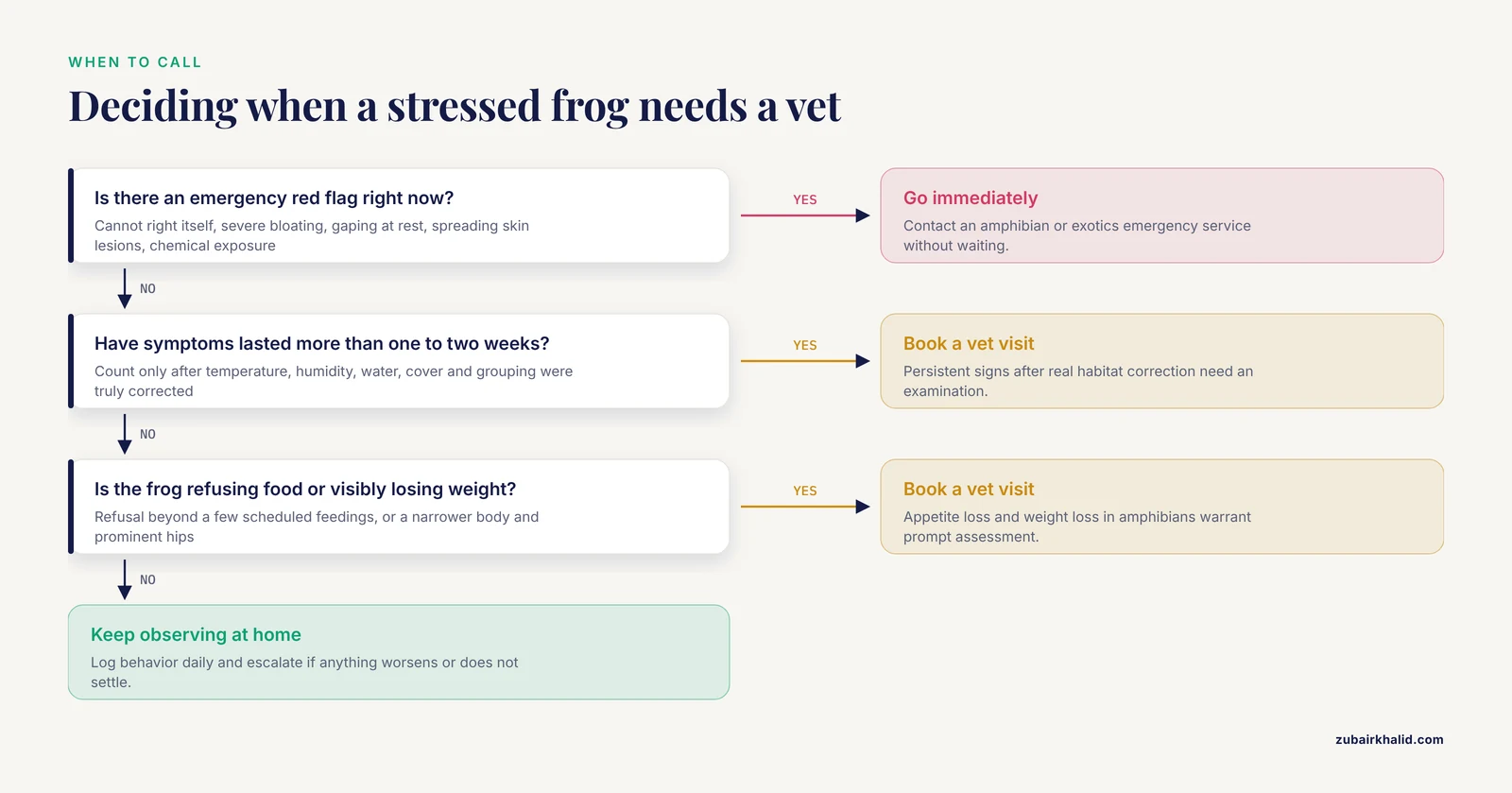
Every frog species has different requirements, and every individual case is different. The guidance here describes general patterns, but your specific animal needs a diagnosis from a veterinarian who can examine it. Individual cases require a veterinarian, and nothing in this article replaces that examination.
Contact a veterinarian when any of the following applies:
- Stressed frog symptoms persist more than one to two weeks after you have genuinely corrected temperature, humidity, water quality, cover, and social grouping
- The frog refuses food beyond its normal pattern for more than a few scheduled feedings, or you can see weight loss
- Any skin lesion, color change, or shedding problem appears, persists, or spreads
- Droppings are absent or abnormal for more than a few days, or the abdomen looks swollen
- Any emergency red flag in the section above appears
- You are unsure of your frog's species or its correct husbandry parameters, since a single visit can establish the target conditions that prevent most future problems
Frequently Asked Questions
What are the first signs of stress in a pet frog?
The earliest signs are usually behavioral: reduced feeding response, excessive hiding, restless glass-cleaning or escape attempts, and abnormal activity timing. Skin darkening and unusual posture often follow. Because frogs mask weakness, catching these quiet behavioral changes early gives you the widest window to fix the problem.
Why is my frog not eating?
Reduced appetite is the most common stressed frog symptom. The leading causes are temperatures outside the species-appropriate range, low humidity or poor water quality, lack of security in the enclosure, unsuitable prey, and underlying disease. Correct the habitat first, and if refusal continues beyond a few feedings or weight loss appears, see an amphibian veterinarian.
Can stress itself kill a pet frog?
Chronic stress suppresses immune function and drives the anorexia and weight loss that seriously weaken frogs, so untreated stress can progress to fatal disease. Acute severe stressors, such as overheating or chemical exposure, can kill directly. The practical takeaway is the same either way: treat stress symptoms as actionable medical information, not a phase.
How do I calm a stressed frog?
Stop all handling, verify and correct temperature and humidity with instruments, ensure clean water and moisture, add hides and cover so the frog can always retreat, move the tank away from noise and traffic, and separate incompatible tankmates. Then leave the frog alone to settle and track behavior daily. Habitat correction and quiet do more than any product.
Do frogs get stressed from handling?
Yes. Frogs are prey animals with permeable skin, and being captured and held is inherently threatening and potentially harmful to them. Handling should be limited to when it is medically necessary, such as health checks or moves, using clean, moistened hands, and kept brief.
What kind of water is safe for my frog?
Water should be free of chlorine, chloramine, and heavy metals, and at an appropriate temperature for the species. Use only products explicitly labeled safe for amphibians, because their skin absorbs whatever the water contains. If you are unsure about your tap water or a product, bring your setup details to an amphibian veterinarian before using it.
How long does it take a stressed frog to recover?
With corrected husbandry and no secondary illness, appetite and behavior often improve over days to a couple of weeks, and full recovery of body condition takes longer. If there is no clear improvement within one to two weeks of genuine habitat correction, or if any sign worsens, book a veterinary examination.
When should I take my frog to the vet?
See a veterinarian when symptoms persist after habitat correction, when the frog stops eating or visibly loses weight, when any skin change appears, when droppings are abnormal, or immediately for lethargy with inability to right itself, bloating, extensive skin lesions, or suspected chemical exposure. Do not wait for a frog to look critically ill, because amphibians hide disease until it is advanced.
Sources
- Validation of indicators for the welfare assessment of captive Yangtze finless porpoises (Neophocaena asiaeorientalis asiaeorientalis)
- Development of a behavioural welfare assessment tool for routine use with captive elephants
- Evaluating the Reliability of Non-Specialist Observers in the Behavioural Assessment of Semi-Captive Asian Elephant Welfare
- A Lightweight Real-Time Vision Framework for Low-Disturbance Veterinary Management and Behavioral Welfare Assessment in Captive Forest Musk Deer
- Using qualitative behavior assessment to investigate the effect of tourist presence on the welfare in captive tigers (Panthera tigris) in three tourism facilities in Thailand.
- Using the Welfare Quality® framework to develop a welfare assessment protocol for captive chimpanzees (Pan troglodytes)
- Identification of Animal-Based Welfare Indicators in Captive Reptiles: A Delphi Consultation Survey
- BEHAVIORAL ASSESSMENT OF SINDH IBEX (CAPRA AEGAGRUS BLYTHI) IN A MIXED GROUP: INSIGHTS INTO CAPTIVE MANAGEMENT AND WELFARE
- Biochemical markers of stress in captive wildlife for welfare assessment
- Developing a Reliable Welfare Assessment Tool for Captive Hibernatory Bear Species