Senior Frog Care: Aging Signs, Diet, and Comfort
By Dr. Zubair Khalid, DVM, MS, PhD ·
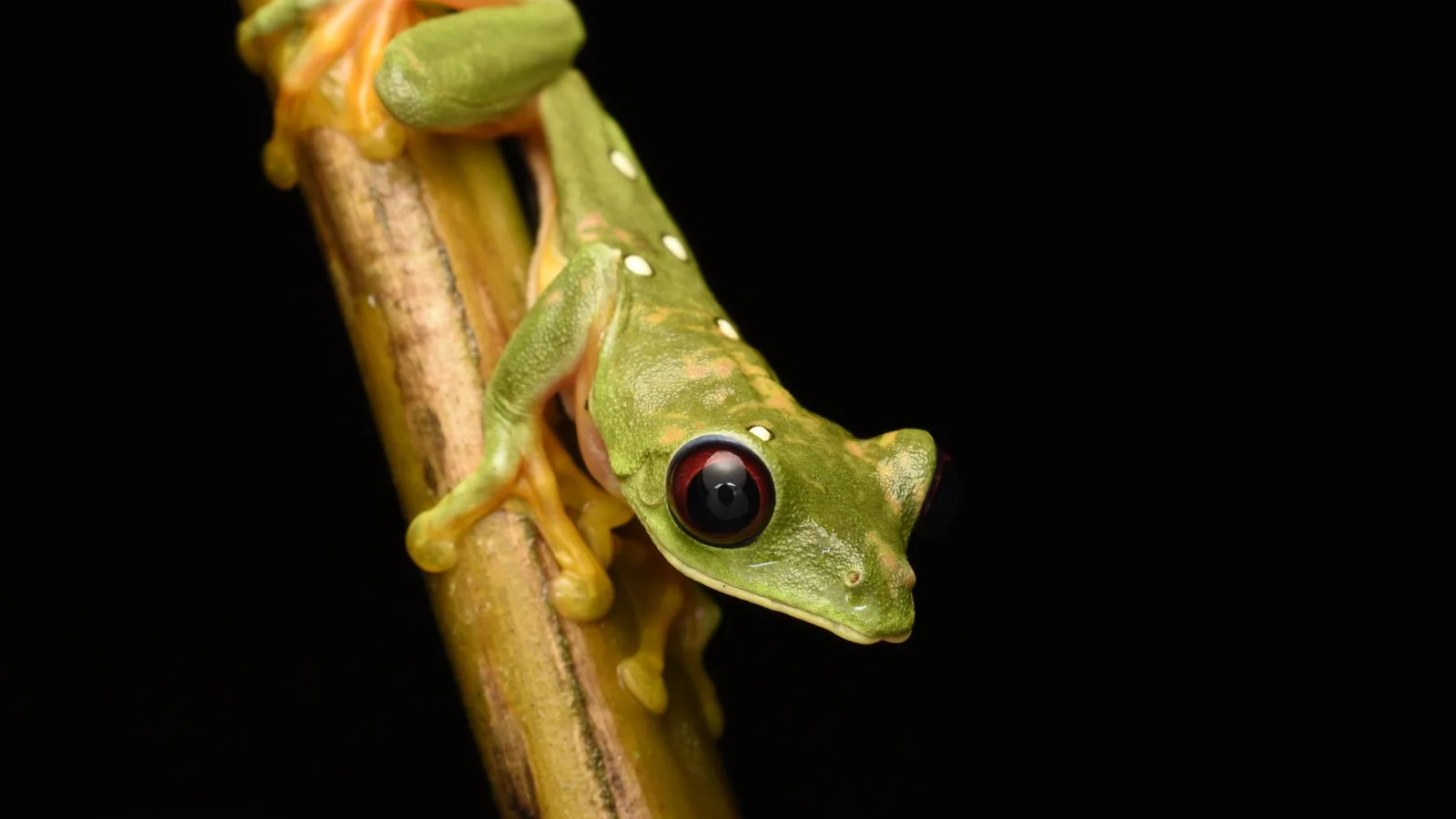
Senior frog care means shifting your routine from growth-oriented husbandry to comfort-oriented husbandry. An older frog needs the same clean water, appropriate temperature, and species-correct food as a younger one, but you watch more closely, feed with more restraint, and respond to small changes faster. Because frogs hide illness until it is advanced, the practical goal of senior frog care is early detection, stable conditions, and prompt veterinary input when something changes.
Amphibians are unforgiving of husbandry errors. Research on captive frog colonies, including work with adult African clawed frogs (Xenopus laevis), has shown that multiagent infections involving fungal organisms such as Saprolegnia and ectoparasites such as Epistylis can take hold in tanks, and that careful water-quality monitoring and husbandry are central to preventing and managing these problems [1]. That finding applies directly to the pet owner caring for an aging frog at home. The older the frog, the less reserve it has to bounce back from a lapse in tank hygiene.
This guide explains how to judge when your frog is senior, which changes you are likely to see as it ages, how to adjust feeding, and how to set up the tank for comfort and safety. It ends with clear criteria for contacting a veterinarian.
Senior Frog Care at a Glance
Use this checklist as your baseline. Each item is covered in detail below.
| Area | What to do | How often |
|---|---|---|
| , - | , - | , - |
| Observation | Watch posture, skin, appetite, activity, and waste for changes | Every day, briefly |
| Water quality | Test and record water parameters, change water on schedule, remove waste promptly | Test weekly at minimum, partial water changes on your established schedule |
| Feeding | Offer a species-appropriate senior frog diet in reduced, controlled portions | Follow your vet-guided schedule, typically less frequent than for growing frogs |
| Skin check | Look for excess mucus, white or gray patches, redness, or unusual shedding | Every day during routine viewing |
| Tank comfort | Keep temperatures and cover stable, provide easy access to basking and water zones | Check readings daily, adjust seasonally |
| Veterinary care | Establish a relationship with an exotics veterinarian and report changes early | Wellness discussion at least yearly, sooner for any change |
How Old Is a Senior Frog?
There is no single age at which every frog becomes senior. The answer depends entirely on species, and frog lifespan varies enormously across the amphibians kept as pets.
Small dendrobatid frogs, many tree frog species, and some toads have very different life expectancies from large pipid frogs such as the African clawed frog or from large terrestrial species such as pixie frogs. Within any species, captive frogs with stable water quality, appropriate temperatures, low stress, and good nutrition generally live longer than wild frogs or poorly kept captives, which is why well-cared-for pet frogs so often outlive the expectations their owners had when they bought them.
Because of this variation, the most useful definition of a senior frog is not a number. A frog is functionally senior when it begins to show the changes described in the next section, or when it has reached the later portion of the typical lifespan for its species. To answer the question for your specific animal, ask the breeder or seller for the hatch or purchase date, keep your own records, and ask an exotics veterinarian to estimate age and life stage during an examination. Species-specific expectations for frog lifespan are also something a herpetological society or an exotics vet can confirm for you.
Two practical implications follow from this. First, many owners underestimate how long they may be caring for the animal, so plan the tank, budget, and backup caregiver around a potentially long commitment. Second, because seniority is functional rather than chronological, you should start the senior care habits in this article, particularly stricter water-quality control and more deliberate observation, well before obvious aging signs appear. Establishing those habits early costs nothing and pays off later.
Signs of Aging in Pet Frogs
Frogs age gradually, and the changes are easy to confuse with illness, which is why the distinction matters. Signs of aging in pet frogs generally include the following patterns. If you see them, adjust care gently. If you see sudden or severe versions of them, treat them as medical concerns instead.
Changes in activity and posture
Older frogs often become less active and spend more time resting in a favorite spot. A senior frog may hunt less eagerly, move more slowly toward food, or stop climbing and swimming as vigorously as it once did. Many older frogs settle into predictable routines, occupying the same corner of the tank day after day.
The key distinction is trend versus event. A frog that is slightly slower this month than last month is likely aging. A frog that is suddenly lethargic, floating abnormally, sitting with its head down and hindquarters raised, or unable to right itself is showing illness signs that need veterinary attention, not patience.
Changes in skin
Skin changes are among the most visible signs of aging in pet frogs. Older amphibians may show duller coloration, slightly thickened or more wrinkled-looking skin, and slower, less complete sheds. Normal shedding continues in senior frogs, but the process may take longer and the frog may eat its shed less reliably.
Skin changes are also where age-related vulnerability and disease overlap most dangerously. Frogs of any age, including the adult laboratory frogs described in the veterinary literature, can develop infections with aquatic fungal organisms such as Saprolegnia and with ectoparasites such as Epistylis, and these conditions produce visible changes on the skin and body surface that owners may mistake for simple aging [1]. Any persistent white, gray, cottony, or fuzzy patch, any area of redness or ulceration, and any excess of slimy mucus beyond the frog's normal coating deserves a veterinary look rather than an assumption that it is old age.
Changes in appetite and body condition
Senior frogs frequently eat less and digest more slowly. Body condition may shift, with some frogs losing muscle along the limbs and others, particularly those fed generously, becoming overweight. Weigh your frog periodically on a small digital scale if it can be handled safely, or track body condition visually by photographing it from above at a consistent interval. Gradual change is expected in old age. Rapid weight loss, refusal of all food for an extended period, or a bloated appearance are medical problems.
Changes in eyes and responsiveness
Some older frogs develop cloudier eyes or appear less reactive to movement outside the tank. Reduced vision and reduced responsiveness mean the frog may rely more on food presented close by and may startle less easily. These same signs can indicate infection or other disease, so note when the change began and how fast it progressed, and share that history with your veterinarian.
Changes in waste and hydration
Older frogs may pass waste less frequently, and their skin may look drier or flakier if humidity and water access are not maintained. Because amphibian skin is a respiratory and osmoregulatory organ as much as a barrier, dehydration shows up quickly in seniors. Wrinkled skin, sunken appearance, or a frog that stops entering its water area warrants immediate review of your moisture and water parameters and a call to your veterinarian if it persists.
The Senior Frog Diet
Feeding is one of the few areas of senior frog care where owners can make an immediate, meaningful difference. The principles are simple. Feed less often, feed species-appropriate foods, and monitor body condition closely.
Why feeding changes with age
A growing frog needs frequent, protein-rich meals to fuel development. An adult frog needs maintenance. A senior frog needs maintenance with fewer calories, because activity has declined and metabolism has slowed. The most common feeding mistakes in older frogs are overfeeding and continuing the juvenile feeding schedule into old age, both of which lead to obesity, fatty deposits, and the reduced mobility that follows.
At the same time, underfeeding is a real risk in seniors that have dental, jaw, or mobility difficulties, or that are outcompeted for food by tank mates. The goal is a middle path, adjusted to your individual frog's body condition, that your exotics veterinarian can help you calibrate.
Building the senior frog diet

A senior frog diet is built from the same food types the species ate when younger, adjusted in size, frequency, and variety.
- Confirm the species-appropriate base. Aquatic species such as African clawed frogs eat a diet centered on appropriate aquatic prey and prepared foods. Terrestrial species eat earthworms, crickets, roaches, and other invertebrates appropriate to their size. Keep the base unchanged. Old age is not the time to introduce unfamiliar foods.
- Reduce prey size. Older frogs with slower strike responses do better with slightly smaller prey items that are easy to capture and swallow. Do not offer prey larger than the width between the frog's eyes, a standard safety rule that becomes more important as reflexes slow.
- Reduce frequency before reducing portion. Most senior frogs do better on fewer, complete meals than on frequent partial ones. If you fed a young frog daily or every other day, discuss stretching the interval with your veterinarian based on your frog's body condition.
- Maintain variety within the safe list. Rotating among two or three appropriate prey types helps prevent nutritional imbalance over the long term. Do not add supplements, vitamins, or gut-loading products on your own. Ask your exotics veterinarian which, if any, supplementation is appropriate for your species and life stage before you start.
- Feed in a consistent location. Senior frogs with reduced vision hunt more successfully when food arrives in the same spot at the same time. Use feeding tongs or a shallow dish to place prey predictably.
- Remove uneaten prey promptly. Leftover live prey can stress or injure an older frog, and uneaten food degrades water quality, the very problem the veterinary literature identifies as a driver of disease in captive frogs [1].
Monitoring the senior frog diet
Keep a simple feeding log. Note the date, what you offered, how much was eaten, and any refusal. Over four to eight weeks, the log tells you whether your frog is eating consistently, and it gives your veterinarian real data rather than a memory if problems develop. Pair the log with monthly photographs or weight checks to track body condition over time.
Water Quality and Habitat Comfort
Husbandry is where senior frog care is won or lost. The published report on Epistylis and Saprolegnia in a colony of adult African clawed frogs concluded that water-quality monitoring and husbandry are central to the care of captive frogs, precisely because poor or fluctuating conditions create the opportunity for opportunistic fungal and parasitic organisms to establish [1]. For a senior frog with less physiological reserve than a young adult, that conclusion carries even more weight.
Water quality routines
Build your water-quality routine around consistency rather than crisis response.
- Test on a schedule. Test the water at least weekly and record the results in the same log as your feeding notes. Consistent records let you catch drift early, before it becomes visible as a health problem.
- Change water partially and regularly. Partial water changes on a fixed schedule keep conditions stable. Avoid full teardowns and complete water replacements unless your veterinarian advises them, because sudden wholesale changes can stress an older frog more than a modest parameter drift.
- Treat and temperature-match replacement water. Any water added to the tank should be dechlorinated and matched closely to the tank's temperature. Temperature shock is a recognized stressor for amphibians, and stressed seniors are more susceptible to the opportunistic infections described in the literature [1].
- Remove waste promptly. Uneaten food, shed skin, and feces should be removed as you see them. Waste load drives the water-quality deterioration that favors organisms such as Saprolegnia [1].
- Watch for biofilm and unusual film on surfaces. A report of Epistylis in captive frogs noted the importance of vigilant observation of the animals and their environment, because these organisms can be present before problems are obvious [1]. Any unusual film, fuzz, or coating on the frog, the glass, or the dcor should prompt closer inspection and a water test.
Temperature, light, and humidity
Keep temperature and humidity within the established species-appropriate range and, above all, keep them stable. Older frogs tolerate fluctuation poorly. Verify temperatures with a reliable thermometer at the level where the frog actually sits, not just at tank height, and check readings daily. Provide a thermal gradient so the frog can move to warmth or coolness as it chooses, and make sure every zone is reachable without climbing, because senior frogs move less.
Lighting should follow the established day and night cycle for your species. Avoid introducing new lighting, heat sources, or equipment configurations in old age unless a problem demands it. Stability is the comfort feature seniors value most.
Making the tank senior-friendly
Small modifications make a tank safer for a slower, less precise frog.
- Lower the effort to reach water and basking areas. Add gradual ramps or stepped dcor so a frog with reduced mobility does not have to jump or climb steeply.
- Remove sharp and abrasive objects. Aging skin is more easily damaged. Check dcor for rough edges, and replace anything the frog consistently bumps into or gets stuck behind.
- Simplify the layout. Reorganize the tank once, thoughtfully, and then leave it alone. A senior frog that knows its territory navigates it confidently. Constant rearrangement forces relearning that an older animal may not manage well.
- Reduce competition. If your frog shares a tank, watch whether younger or bolder tank mates monopolize food or favored resting spots. Separating a senior frog into its own tank is often the kindest solution, and it also lets you monitor its food intake and waste exactly.
- Provide secure cover. A hide on each end of the temperature gradient lets the frog rest where it chooses without leaving the comfort zone.
Skin Health, Parasites, and Infections in Older Frogs
Skin problems deserve their own section because amphibian skin is both the organ most affected by aging changes and the organ most exposed to infectious organisms in the tank environment.
The veterinary literature documents this risk directly. In a report on a colony of adult female African clawed frogs, animals were found to carry both Saprolegnia, a fungal parasite that is relatively common in laboratory-housed frogs, and Epistylis, an ectoparasite that had rarely been described in frogs before that report. The authors discussed the diagnosis and pathology of the Epistylis infection and emphasized water-quality monitoring and husbandry in management [1]. The lesson for pet owners is twofold. First, multiple organisms can be present at once, which is one reason home diagnosis is unreliable. Second, the cornerstone of prevention is not a medication, it is the water-quality and husbandry routine described above.
What owners can and cannot do about skin lesions
What you can do is observe and document. Photograph the lesion with good lighting at the same distance each day so you can show your veterinarian whether it is growing, changing color, or spreading. Note when it first appeared, whether it followed any husbandry change, and whether the frog is eating and behaving normally.
What you should not do is treat it yourself. Over-the-counter amphibian medications, salt treatments, and home remedies can worsen skin damage in frogs, whose permeable skin absorbs whatever is in the water. Diagnosis of conditions such as Epistylis and Saprolegnia requires examination, and appropriate treatment in the reported case was carried out with veterinary guidance as part of a managed program that included husbandry correction [1]. Bring your frog, or a clear video and photographs, to an exotics veterinarian rather than dosing the tank on guesswork.
Quarantine and new additions
If you keep multiple frogs, quarantine any new animal before adding it to an established tank. This practice protects the whole colony, and it matters most for a senior frog whose immune defenses are not what they were. The multiagent infections described in colony-housed frogs illustrate how organisms can move through a shared aquatic environment [1]. A simple quarantine setup with its own water, equipment, and hand hygiene routine is inexpensive insurance for an aging animal.
A Weekly Senior Frog Care Routine
Consistency turns the advice above into a working system. Here is a practical week.
Every day. Spend two minutes observing. Confirm the frog is responsive, in a sensible posture, and free of new skin changes. Verify thermometer readings. Remove visible waste and uneaten food. Confirm water and humidity features are functioning.
Twice weekly or on your established schedule. Perform the partial water change, treating and temperature-matching the replacement water. Wipe glass algae if needed.
Weekly. Run the full water test panel and log the results. Review the feeding log for refusals or changes in appetite. Photograph the frog from above and the side for your body-condition record.
Monthly. Check and clean equipment such as filters and heaters, verifying they hold their settings. Weigh the frog if safe handling is possible, or compare your photographs. Deep-clean one dcor item at a time in dechlorinated water so the tank's microbial stability is not disrupted all at once.
Quarterly. Review the whole setup against this article's checklist. Replace worn equipment. Confirm your exotics veterinarian's contact information is current and ask whether a wellness examination is due.
Equipment and Supplies for Senior Frog Care
You do not need much new equipment for an older frog, but selection criteria matter.
- Water test kit. Choose a liquid test kit or test strips covering the parameters your veterinarian recommends for your species, and replace it before it expires. Accuracy matters more than speed.
- Thermometers. Use at least two, one for each end of the temperature gradient, and verify them against each other periodically.
- Digital scale. A small gram-scale suitable for weighing the frog in a container supports body-condition tracking. Tare the container first and never weigh a frog on a bare surface.
- Feeding tongs and dishes. Long tongs keep your hands away from the frog's strike zone, and shallow dishes let you present food in a consistent place for a frog with reduced vision.
- Smooth, stepped dcor. Select pieces with gradual slopes and no sharp edges. Anything that traps the frog or abrades its skin should be replaced.
- Quarantine container. A simple cycled or prepared holding setup with its own net and tools supports isolation of new animals or of a frog that needs short-term treatment observation under veterinary direction.
Avoid products marketed as amphibian medications, water additives beyond standard dechlorination, and vitamin supplements unless your exotics veterinarian prescribes them. The permeable skin that makes frogs sensitive to poor water quality also makes them sensitive to everything you add to it.
Common Mistakes in Senior Frog Care
- Assuming every change is old age. Lethargy, appetite loss, and skin changes overlap heavily between normal aging and disease. When in doubt, get the frog examined. The differential between a slow senior and a sick frog is exactly the kind of judgment an exotics veterinarian is trained to make.
- Continuing the juvenile feeding schedule. Overfeeding shortens lives. Stretch meal intervals as your veterinarian advises and track body condition rather than feeding by habit.
- Letting water testing lapse. Owners of long-lived, seemingly indestructible frogs often stop testing after years of stability. The colony outbreak report makes the case for continued vigilance, because organisms such as Epistylis and Saprolegnia can establish even in experienced keepers' tanks when monitoring lapses [1].
- Big, sudden husbandry changes. Complete water replacements, new substrates, new lighting, and rearranged tanks all create stress. Change one variable at a time and observe.
- Self-treating skin problems. Home treatment delays proper diagnosis and can add chemical injury to an existing infection. Observation and documentation are your job. Diagnosis and treatment are your veterinarian's.
- Ignoring the substrate and dcor as the frog slows down. A dcor layout that suited a agile two-year-old may trap or exhaust a fifteen-year-old. Audit the tank for mobility annually.
- Skipping quarantine for new tank mates. One new animal can introduce organisms into an established system. Quarantine protects your senior frog, which has the least ability to fight off a new pathogen.
Welfare and Safety Points
Handle as little as possible. Amphibian skin absorbs substances from your hands, and handling stresses older frogs. If you must move your frog, for weighing, tank maintenance, or a veterinary visit, use clean, rinsed, powder-free gloves or thoroughly rinsed hands, keep the contact brief, and never handle around feeding time or shedding.
Secure the tank. An older frog may be less coordinated, but frogs are still escape artists. Verify lids and escapes routes regularly, because an escape combined with a dry environment is rapidly fatal to an amphibian.
Protect the water source. Never use soap or detergent on anything that enters the tank, and rinse everything thoroughly with dechlorinated water. Residues that a young frog might tolerate can overwhelm an older one.
Plan for the end of life with your veterinarian before you need to. A senior frog deserves a plan for comfort, and discussing with your exotics veterinarian what declining quality of life looks like for your species, and what options exist, is far easier to do calmly months in advance than in a crisis.
Limitations and When to Contact a Veterinarian
Every frog is an individual, and this article provides general guidance, not a diagnosis. Species, age, history, and tank conditions all change what is normal, and only an examination by a qualified exotics veterinarian can distinguish aging from disease in your animal. Establish that relationship before you need it urgently, because not every general practice treats amphibians.
Contact an exotics veterinarian promptly, meaning within days rather than waiting, for any of the following.
- Any skin change that persists more than a few days, including white, gray, cottony, or fuzzy patches, redness, ulceration, or excess mucus. These can indicate infections such as Saprolegnia or ectoparasites such as Epistylis, which require diagnosis and veterinary-directed treatment [1].
- Sudden lethargy, loss of the righting reflex, abnormal floating or buoyancy, or a frog sitting with its hindquarters elevated.
- Complete refusal of food beyond the species-normal interval, or any refusal accompanied by weight loss.
- Bloating, swelling of limbs or body, or visible asymmetry.
- Abnormal posture, tremors, muscle twitching, or seizures.
- Difficulty shedding, retained shed around toes or the tail region, or skin that looks dried or cracked.
- Bleeding from any site, or a wound of any kind.
- Rapid deterioration in water quality that you cannot correct, alongside any decline in the frog's condition.
Seek emergency care, meaning same-day, for a frog that is unresponsive, unable to right itself, bleeding actively, or showing severe bloating or open-mouth breathing.
When you call, have ready the frog's species, approximate age, the dates your signs began, your water test results, your feeding log, and photographs of the skin changes if present. This information shortens the diagnostic process considerably.
Frequently Asked Questions
How old is a senior frog?
There is no fixed age, because frog lifespan varies widely between species. A frog is functionally senior when it reaches the later portion of the typical lifespan for its species or begins showing aging changes such as reduced activity, slower feeding responses, and skin changes. Ask your breeder for the hatch date and confirm species-specific expectations with an exotics veterinarian.
What are the most common signs of aging in pet frogs?
The most common signs are gradual reductions in activity and hunting enthusiasm, slower and less complete sheds, duller coloration, changes in body condition, and reduced responsiveness to movement outside the tank. These changes develop over months. Sudden versions of the same signs usually indicate illness instead and warrant a veterinary visit.
How should I change my senior frog's diet?
Feed the same species-appropriate foods in slightly smaller portions at longer intervals, maintain variety among two or three safe prey types, and present food in a consistent location. Remove uneaten prey promptly to protect water quality. Confirm the specific schedule with your exotics veterinarian based on your frog's body condition.
How often should a senior frog see a veterinarian?
Discuss a wellness examination schedule with an exotics veterinarian, and expect at least a yearly check for an aging amphibian. Call sooner for any skin change, appetite loss, posture change, or behavioral shift, because frogs conceal illness until it is advanced.
Can I treat my frog's skin problem at home?
No. Frogs absorb substances through their skin, and over-the-counter treatments can worsen the problem. Conditions such as Saprolegnia fungal infection and Epistylis ectoparasitism require proper diagnosis and veterinary-directed treatment, alongside correction of the water-quality and husbandry conditions that allow such organisms to establish.
Does clean water really matter that much for an old frog?
Yes. Water-quality monitoring and husbandry are the factors the veterinary literature identifies as central to preventing and managing infections in captive frogs, including outbreaks of fungal and ectoparasitic organisms in adult colonies. An older frog has less reserve to tolerate water-quality lapses than a young adult, so consistent testing, partial changes, and prompt waste removal are the foundation of senior frog care.
Should I separate my senior frog from tank mates?
Consider it if the senior frog is losing food competitions, being displaced from resting spots, or showing injuries, or if you need precise monitoring of its eating and waste. A separate, stable, familiar tank is often the kindest arrangement for an aging amphibian, and it also simplifies observation of any health changes.
How can I tell the difference between my frog aging and my frog being sick?
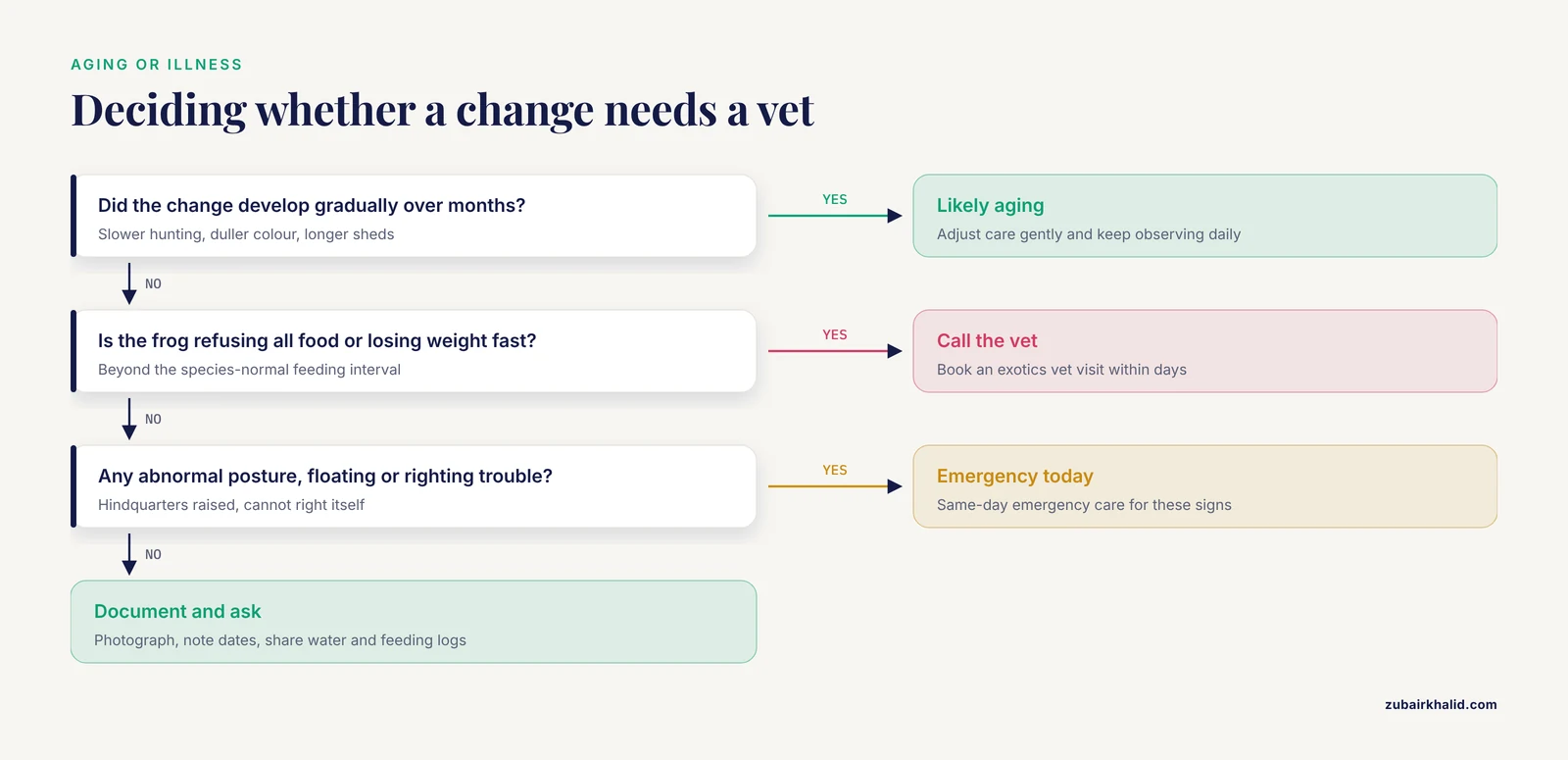
Look at speed and severity. Aging changes are gradual, measured in months, and affect activity and appearance without breaking the frog's routine. Illness tends to be abrupt and to come with red-flag signs such as abnormal posture, buoyancy problems, refusal of all food, rapid weight loss, or visible lesions. If you are unsure, photograph the frog, note the timeline, and ask your exotics veterinarian.
This article is educational and is not a substitute for veterinary diagnosis or treatment.