Bringing Home a New Pet Frog: First Week Guide
By Dr. Zubair Khalid, DVM, MS, PhD ·
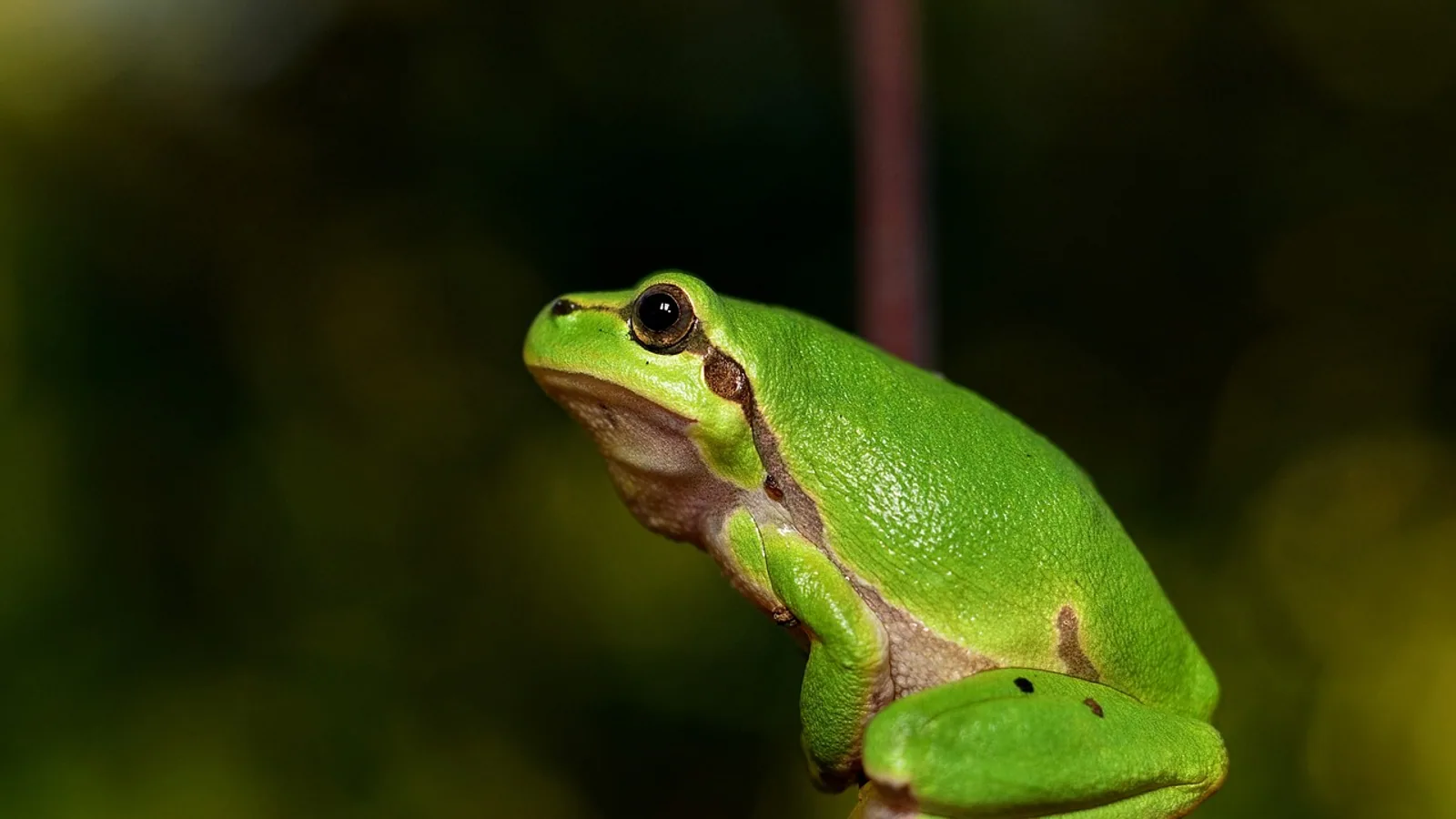
The first week with a new frog is about stability, not socializing. A new frog needs a finished habitat, steady water quality and temperature, near-total quiet, and no handling while it maps its surroundings. Your job during the new frog first week is to prepare, observe, and record, then let the frog decide when to appear.
Most frogs begin exploring and eating within days, though some need longer, and settling speed depends on the species, the animal's age, and its individual temperament. That variation is normal. What is not normal is a frog that holds an abnormal posture, develops skin changes, or swells visibly, and those situations have clear escalation points described in this guide.
Here is the full sequence: the new frog checklist to complete before pickup, a day-by-day plan for the first seven days, how to read settling behavior, the health risks that surface in newly acquired amphibians, and how to plan the first vet visit for a frog.
This article is educational and is not a substitute for veterinary diagnosis or treatment.
Your New Frog's First Week at a Glance
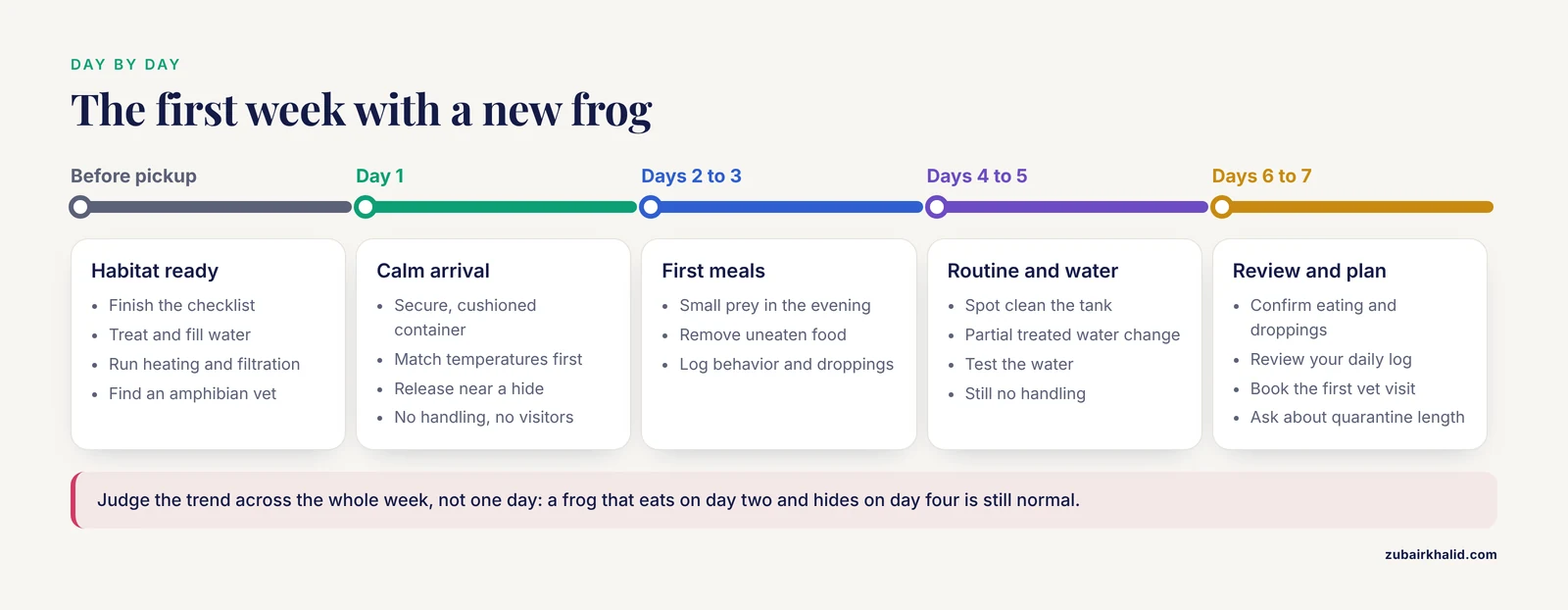
| When | Goal | Key actions |
|---|---|---|
| Before pickup | Habitat ready | Finish the checklist, treat and fill the water, run heating and filtration in advance, identify an amphibian veterinarian |
| Day 1 | Calm arrival | Transport in a secure container, match temperatures, release near a hide, dim the lights, no handling, no visitors |
| Days 2 to 3 | First meals | Offer small, species-appropriate prey in the evening, remove uneaten food, log behavior and droppings |
| Days 4 to 5 | Routine and water care | Spot clean, make a partial water change with treated, temperature-matched water for aquatic species, test the water, still no handling |
| Days 6 to 7 | Review and plan | Confirm eating and droppings, review your log, book the first vet visit, ask your veterinarian how long quarantine should last |
Use the table as your working plan, then read the sections that explain each step and the reasoning behind it.
Why the First Week Matters More Than Any Other
Frogs are prey animals. A frog placed in a new environment assumes a predator could appear at any moment, so it hides, stops eating, and holds still. Handling, tapping on the glass, and a parade of curious visitors all confirm that fear. Quiet, cover, and a predictable routine do the opposite, and they cost nothing.
There is a medical reason for the caution as well. Frogs have permeable skin that exchanges water and absorbs chemicals directly from their surroundings, so water quality, substrate cleanliness, and temperature stability form the core of amphibian husbandry. A 2007 report on a colony of African clawed frogs (Xenopus laevis) built its recommendations on exactly that foundation, water-quality monitoring and sound husbandry, as the basis of care [1].
The first week is also when you establish your frog's baseline of normal. How does this individual sit, when does it move, what does its feeding strike look like, how often does it produce droppings. Owners who write those details down during week one hand their veterinarians something concrete to work with if problems appear later.
Before You Bring Your Frog Home: Setup and the New Frog Checklist
Build the habitat days before pickup, not the afternoon the frog arrives. Water needs treating, filtration needs time to mature in aquatic setups, and temperatures need to prove themselves stable before an animal is inside the tank.
Start by confirming which setup type your species needs, because pet frogs fall into broad groups. African clawed frogs live fully underwater. Pacman frogs are terrestrial burrowers. White's tree frogs climb and need vertical space. If you are unsure which group your frog belongs to, ask the breeder or store before you buy equipment, and check your state and local rules at the same time, since a few frog species are restricted in parts of the United States.
The New Frog Checklist
- Enclosure. Sized for the adult animal, not the juvenile in the store. Research your species' adult size and buy for it. Front-opening doors make maintenance less alarming, and every gap needs to seal, because frogs push through surprisingly small openings and can climb glass.
- Lid. A fine mesh lid with clips. Mesh holds humidity while blocking escapes, and clips stop a determined frog or a curious cat.
- Substrate. Species-appropriate, humidity-holding, free of fertilizers, pesticides, and fragrance. Ask your breeder or veterinarian what they recommend for your species, and avoid loose particles small enough for a ground-feeding frog to swallow.
- Hides. At least two, on opposite sides, so the frog can choose cover without crossing open ground.
- Plants and cover. Live or silk plants that break sightlines. A frog that can see you from every angle never relaxes.
- Water treatment. A dechlorinator rated for aquarium and amphibian use. Every drop of water that touches the frog, the substrate, or the misting bottle gets treated first.
- Thermometer and hygrometer. Digital probes placed where the frog actually sits, not stuck to the glass at eye level.
- Heating. For aquatic species, a guarded heater sized to the enclosure. For terrestrial and arboreal species, ask your veterinarian what heating, if any, the species needs before you buy anything that emits warmth.
- Filtration and test kit. For aquatic setups, gentle filtration that has matured before arrival, plus a liquid test kit that reads ammonia, nitrite, nitrate, and pH.
- Food. Live prey matched to the species and the size of the frog, from a clean, reliable source.
- Supplements. Calcium and vitamin products exist for amphibian feeding, but schedules vary by species, so have your veterinarian design the plan rather than guessing.
- Feeding tools. Long tongs and a shallow dish keep hands out of the tank and make refused meals easy to remove.
- Quarantine tub. A simple second setup, easy to clean, for the new arrival. This is non-negotiable if you already keep amphibians.
- Log. A notebook or phone note for meals, droppings, sheds, behavior, and water readings.
- Dedicated cleaning supplies. Sponges, buckets, and a siphon used only for the tank, with no soap or detergent, and a thorough rinse for everything that enters the water.
Prepare Water and Equipment Early
Treat and fill the water the day before, then run the heater and filter so temperatures and chemistry settle. In aquatic setups, give biological filtration time to mature before the frog moves in, because a brand-new filter cannot process waste yet. If the phrase "matured filtration" is new to you, raise it with your veterinarian or an experienced keeper before purchase day rather than after the frog is home.
Choose the Location
Pick a quiet room with a stable ambient temperature. Keep the tank out of direct sun, which overheats small water volumes quickly, away from speakers and vibrating surfaces, and out of kitchens, where cooking fumes and aerosol sprays drift. A low-traffic corner the household passes once or twice a day beats a centerpiece position in the living room.
Day 1: Bringing Home a Frog and Letting It Settle
Transport shapes how the whole week starts. Keep the frog in its sealed container, cushioned so it cannot slide, held upright and out of sunlight. Never leave it in a parked car, and run no errands on the way home. Resist opening the container for a look, because every opening is a stress event.
At home, set the sealed container inside or beside the finished habitat so temperatures equalize. For aquatic frogs, follow the gradual temperature-matching method your breeder or veterinarian describes rather than pouring the animal straight into new water. Once temperatures have evened out, open the container near a hide, keep the room lights dim, and leave the frog alone.
Expect the frog to vanish. That is correct behavior, not a problem. Keep the room quiet, keep children and other pets out, and skip the flash photography. Most keepers offer the first meal only after several quiet hours, and many frogs ignore it. An ignored first meal is expected, not an emergency.
Days 2 to 7: Routine, Feeding, and Observation
Feeding Without Pressure
Offer small, species-appropriate prey at the time of day your species naturally feeds, which for most common pet frogs means evening. Size prey for easy swallowing. Remove anything uneaten after a short interval, because loose crickets harass and sometimes injure a hiding frog overnight. If a meal is refused, write it down, adjust the prey type or size, and try again the next evening rather than re-offering all day. Ask your veterinarian about gut-loading feeder insects and a supplementation schedule for your species.
Water Care for Aquatic Frogs
Test the water daily in a new setup and record the numbers. Make partial water changes with treated, temperature-matched water, and never replace all of the water at once during the first week, because a sudden full change destabilizes a tank faster than almost anything else an owner can do. Spot clean waste with a siphon or baster.
Humidity for Terrestrial and Arboreal Frogs
Mist with treated water to hold the humidity range your species needs, and read the hygrometer rather than guessing by eye. Keep the substrate as damp as your species requires without turning the whole tank into standing water unless the species actually wants it that way.
The Daily Log
Record what you offered and what was eaten, droppings and their appearance, posture and activity, any shed, and water or climate readings. Two minutes a day builds the single most useful document your veterinarian will ever see for this animal.
How Long Does It Take a Frog to Settle In?
Settling takes days to weeks, and the honest answer to "how long for a frog to settle in" is behavioral, not numerical. A settling frog shows a relaxed resting posture, moves after lights-out, strikes at prey, produces regular droppings, and sheds in complete, thin layers that it often eats.
Several things slow the process. Constant room traffic, handling, tapping, unstable temperatures, prey the frog does not recognize, and a bare tank with nowhere to hide all stretch settling out. Whether the frog is captive-bred or wild-caught can also matter, so ask your source about the animal's background.
Settling is not linear either. A frog that eats on day two and hides on day four is still inside normal behavior, so judge the trend across the week rather than any single day. If the entire first week passes with every meal refused, or with lethargy layered onto the hiding, describe the pattern to an amphibian veterinarian instead of waiting longer on your own.
Water Quality, Parasites, and Skin Problems in the First Week
Newly acquired frogs can carry organisms that do not announce themselves on day one, and daily observation during the first week is your chance to catch them early. A published report on a colony of adult female African clawed frogs (Xenopus laevis) described exactly this kind of discovery, a mixed infection in which the frogs carried both Saprolegnia, a water mold the authors describe as relatively common in laboratory-housed frogs, and Epistylis, an ectoparasite that had been reported in frogs only once before [1]. The authors discussed the diagnosis, pathology, and treatment of Epistylis and emphasized water-quality monitoring and husbandry as the foundation of care for these animals [1].
Four lessons transfer directly to a pet frog's first week. First, skin changes can have more than one cause at the same time, so guessing at a remedy from across the room is a losing strategy. Second, telling a water mold from an ectoparasite requires veterinary examination and microscopy, not a phone photo. Third, the prevention levers you actually control are water quality, quarantine, and husbandry, which is why this guide keeps returning to them. Fourth, the affected animals in that report were adults, so a newly purchased adult frog deserves the same quarantine and first vet visit as a juvenile [1].
Put those lessons into practice with a daily skin check under good light. Look for cottony or fuzzy patches, spiny or stalk-like growths, gray film, redness, sores, or tiny moving specks. Photograph anything you see, note the date, and contact your veterinarian rather than reaching for pet-store additives.
Handling, Household Safety, and Welfare
Keep handling at zero during the first week unless a health check demands it. Frogs are observational pets, and even after settling, contact should stay occasional and brief. When you must handle the frog, wash your hands, rinse them thoroughly, and then wet them with treated water, or wear powder-free gloves rinsed the same way. Soap residue, lotion, and insect repellent can pass straight through amphibian skin.
Household safety centers on three risks. Children should be supervised, should wash their hands after any contact with the frog or its water, and should never hold the animal near their face, and households with young children or immunocompromised family members should ask their veterinarian about additional hygiene precautions. Cats and dogs treat frogs as toys or prey, so the tank needs a clipped lid and a placement they cannot reach. A pet frog should also never be released outdoors, both for the animal's welfare and because nonnative amphibians can damage local ecosystems, one reason several US states restrict certain species in the first place.
If a frog escapes, search at night with a flashlight along walls, under furniture, behind warm appliances, and near any damp area, and leave a shallow dish of treated water out. Move slowly, because a frightened frog keeps traveling.
The First Vet Visit for a Frog
Plan the first vet visit for a frog during the first week or two, or sooner if anything looks wrong. Start by finding a veterinarian who sees amphibians, ask the breeder or store for a referral, or call exotic animal clinics in your area and ask directly. A first visit is valuable even for a frog that seems fine, because it records a baseline weight and exam findings while your week-one log is fresh.
Bring the right materials. Photos and a short video of the full habitat, your daily log, a water sample from an aquatic tank, a fresh fecal sample if you can collect one, and the purchase details, including species, source, date, and whether the animal is captive-bred.
Expect a hands-off visual examination, a weight check, and a close look at the skin, mouth, and body condition. Where the exam warrants it, a veterinarian may use microscopy on skin swabs or fecal material, the same kind of diagnostic work that identified the organisms in the African clawed frog report [1]. If parasites or a water mold are found, treatment depends on the organism and the species involved, the principle behind that report's discussion of Epistylis treatment [1]. Follow your veterinarian's plan rather than pet-store products, and keep the frog in quarantine until your veterinarian clears it.
Use the appointment to ask for numbers. What temperature range and humidity does your species need, how long should quarantine last in your situation, what diet and supplementation plan does the vet recommend, when should the frog be rechecked, and which emergency clinic sees amphibians after hours.
Common First Week Mistakes
- Handling the frog to help it settle. Contact does the opposite.
- Adding untreated tap water, including in the misting bottle. Treat every drop.
- Replacing all the water in an aquatic tank at once. Partial, temperature-matched changes only.
- Oversized prey or constant re-offering. Small meals, removed promptly.
- Adding tankmates during week one. Quarantine first, and ask your veterinarian how long it should last.
- Mixing species in one enclosure. Different frogs carry different requirements and disease risks.
- A loose or missing lid. Escapes happen on night one.
- Cleaning with soap or harsh chemicals. Use dedicated supplies and rinse everything thoroughly.
- Placing the tank in direct sun, on a speaker, or in the kitchen.
- Skipping the log. A vague history makes every later vet visit harder.
Troubleshooting: What to Do When Something Looks Off
Your Frog Will Not Eat
Work through the likely causes in order, temperatures first, then prey type and size, then disturbance level, then feeding time. Offer at the species' natural feeding window and leave the room afterward. Refused meals across a day or two are common in week one. Every meal refused across the full week, especially with visible weight loss, is a call to your veterinarian.
White Patches, Film, or Growths on the Skin
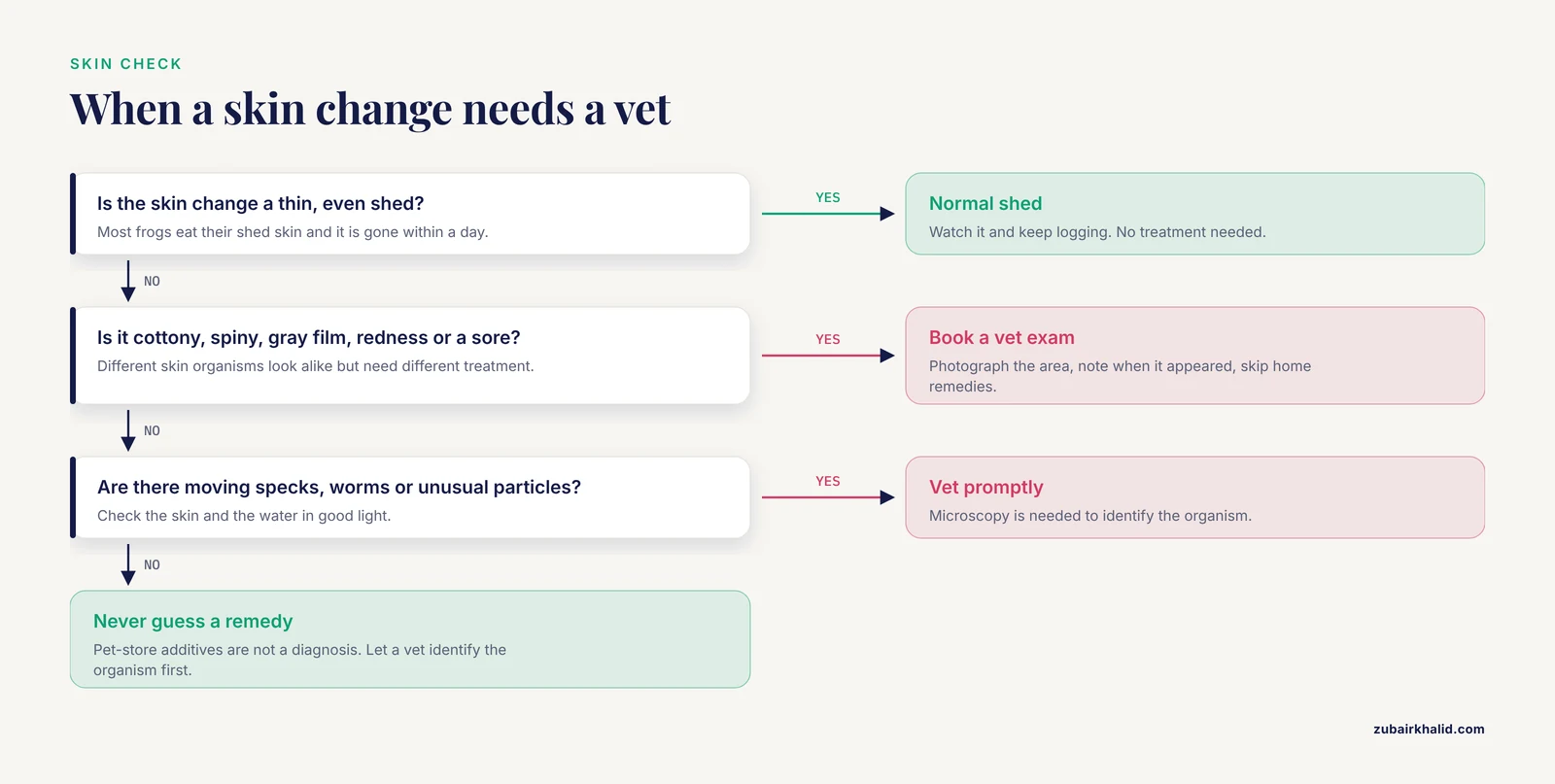
A thin, even shed that disappears within a day is normal, and most frogs eat their shed skin. A persistent cottony or fuzzy patch, spiny or stalk-like growths, gray film that does not shed away, redness, or sores are not normal. Skip home remedies and pet-store additives, because different skin organisms look alike and need different treatment. Photograph the area, note when it appeared, and book a veterinary exam.
Bloating, Listing, or Strange Swimming
A frog that floats sideways, cannot stay submerged, swells asymmetrically, or cannot right itself needs veterinary attention promptly. These are not settling behaviors, and describing your log to the clinic when you call helps them triage.
Water Problems in a New Aquatic Tank
Cloudy or foul-smelling water in the first days usually reflects an immature filter. Test the water, make partial treated changes, ease up on feeding, and avoid tearing the tank down mid-week. If the test kit reads ammonia or nitrite at all, act on it and ask your veterinarian or an experienced aquatic keeper how to correct it safely for an amphibian.
Limitations and When to Contact a Veterinarian
Individual frogs vary, and only a veterinarian who examines your animal can diagnose disease or give you species-specific numbers for temperature, humidity, diet, and medication. Treat this guide as a framework and your first-week log as the evidence your veterinarian will want to see.
Contact a veterinarian during the first week if any of the following appears:
- Any skin change that persists past a normal shed, including cottony patches, spiny growths, persistent gray film, redness, ulcers, or sores.
- Visible moving specks, worms, or unusual particles on the skin or in the water.
- Bloating, asymmetrical swelling, or a frog that cannot submerge or stay upright.
- Gasping at the surface, open-mouth breathing, or tremors.
- Refusal of every meal across the first week, particularly with weight loss or deepening lethargy.
- No droppings at all combined with lethargy or a distended abdomen.
- Injuries from live prey, tankmates, or a fall.
- The sudden death of any tankmate in a shared system, which is a reason to have the surviving animals and the water evaluated.
- Anything that simply worries you. First-week concerns are exactly what an early vet visit is for, and a phone description backed by your log often settles whether the frog should come in.
Treat an inability to right itself, rapid swelling, bleeding, or collapse as urgent, and call the clinic before traveling so the team can prepare.
Frequently Asked Questions
How long does it take a new frog to settle in?
Many frogs begin acting normally within the first week, but settling time varies by species, age, and individual. Judge progress by behavior, relaxed posture, movement after dark, feeding strikes, and regular droppings, rather than by a date on the calendar.
Should I handle my frog during the first week?
No. Keep handling at zero unless a health check requires it, and keep later handling brief. When contact is necessary, wash and rinse your hands, then wet them with treated water so residues cannot pass through the frog's skin.
When will my new frog start eating?
Some frogs eat the first night and others refuse food for several days. Offer small, species-appropriate prey in the evening, remove uneaten items, and call your veterinarian if every meal is refused across the first week.
Do I need to quarantine a new frog?
Yes, if you keep other amphibians. House the new arrival in its own separate setup with its own equipment, wash your hands between tanks, and ask your veterinarian how long your quarantine period should last.
When should I schedule the first vet visit for a frog?
Book within the first week or two, or sooner if you notice skin changes, swelling, or refused meals. The visit records a baseline weight and exam findings while your log is fresh.
What belongs on a new frog checklist?
An enclosure sized for the adult frog, a secure lid, species-correct substrate, hides, treated water, a thermometer and hygrometer, filtration and a test kit for aquatic species, appropriate food, feeding tongs, and a logbook.
How do I tell a normal shed from a skin problem?
A normal shed is thin and usually gone within a day, often eaten by the frog. Persistent cottony patches, spiny growths, gray film, redness, or sores are not normal and need a veterinary exam rather than home treatment.
Can I add a second frog or tankmates during the first week?
No. Wait until your frog eats reliably and your veterinarian clears it, because new animals can carry organisms between setups and quarantine protects every tank in your care.