Bringing Home a New Axolotl: First Week Guide
By Dr. Zubair Khalid, DVM, MS, PhD ·
Most healthy axolotls settle into a properly prepared tank within a few days to two weeks. The first week of ownership is less about entertaining your new pet and more about one thing, which is keeping the water cool, clean, and stable while the animal adjusts to a new environment. If you get the water right, feeding, activity, and normal behavior usually follow on their own schedule.
Axolotls (Ambystoma mexicanum) are fully aquatic salamanders that spend their entire lives underwater. They breathe mainly through their feathery external gills and through their skin, which means water quality problems show up as health problems quickly. Unlike fish, they cannot be treated as starter pets. Their needs are specific, and most first-week problems trace back to three causes, which are water that is too warm, a tank that has not finished cycling, and well-meaning handling.
This guide walks you through the new axolotl first week day by day, from the car ride home to the first meal, first water test, and first veterinary visit. It covers the equipment you need, the mistakes that send new owners back to the store, and the warning signs that mean you should contact a veterinarian experienced with exotic pets and amphibians.
This article is educational and is not a substitute for veterinary diagnosis or treatment.
At a Glance: Your First Week Checklist
Use this table as your working checklist for the week. Print it, stick it near the tank, and check off each item as you go.
| Day | What to Do | What to Watch For |
|---|---|---|
| , - | , - | , - |
| Before pickup | Cycle the tank 4 to 8 weeks ahead, confirm 0 ammonia and 0 nitrite, hold water at 60 to 64°F, verify legal ownership in your state | Tank temperature spikes, ammonia or nitrite readings above zero |
| Pickup day | Transport in a sealed bag or lidded container in the dark, keep temperature steady, go straight home | Water in the bag feeling warm or cold to the touch |
| Day 1 | Float the bag 15 to 20 minutes, add tank water gradually, release gently, lights dim, no feeding, no handling | Frantic swimming, gasping at the surface, gills held forward |
| Day 2 | Run a full water test (ammonia, nitrite, nitrate, pH, temperature), observe behavior | Hiding constantly, floating, clamped gills |
| Day 3 | Offer one small meal (earthworm piece or soft sinking pellet), remove uneaten food within a few hours | Refusal of food, spit-out food |
| Day 4 to 5 | Test water again, do a small water change if ammonia or nitrite reads above zero, repeat feeding offer | Leftover food fouling the water |
| Day 6 to 7 | Confirm stable parameters, schedule or attend the first vet visit, continue minimal disturbance | Any change in gill color, skin, posture, or appetite |
Before Pickup: The New Axolotl Checklist
Bringing home an axolotl goes smoothly when everything is ready before the animal leaves the breeder, rescue, or store. Axolotls do not tolerate the kind of gradual adjustment a dog or cat can manage. A tank that is not ready becomes an emergency on day one.
A Fully Cycled Aquarium
This is the single most important item on the checklist. Beneficial bacteria living in your filter convert toxic ammonia from waste into nitrite, and then into far less harmful nitrate. This process, called the nitrogen cycle, typically takes 4 to 8 weeks to establish in a new aquarium. General amphibian husbandry guidance, including the amphibian care information maintained in the Merck Veterinary Manual, emphasizes that ammonia and nitrite are toxic to aquatic amphibians and must read zero on a water test before an animal is added.
To cycle a tank, set it up with the filter running, dose a source of ammonia, and test the water with a liquid test kit until ammonia and nitrite both read zero and nitrate is present. Do not rely on test strips alone for the final check. Liquid drop kits give more reliable readings for ammonia and nitrite, which matter most for axolotls.
Correct Tank Size and Secure Lid
A 20-gallon long aquarium is the widely recommended minimum for a single adult axolotl because floor space matters more than height. Use a lid or screen top. Axolotls are not escape artists by design, but they can jump or lurch out of open water, and a dried-out axolotl on the floor is a genuine emergency.
Temperature Control
Axolotls are cold-water animals. The commonly recommended range is 60 to 64°F (16 to 18°C). Room temperature in most American homes runs warmer than this, especially in summer, so plan for cooling before you need it. Options include keeping the tank in the coolest room, raising the light fixture away from the water surface, aiming a fan across the surface, or using aquarium chillers for sustained warm weather. Water above about 70°F causes heat stress, and water in the mid-70s and higher can be life-threatening. A reliable thermometer, checked daily, is not optional.
Substrate
Use bare bottom, fine sand, or very large smooth stone that cannot fit in the mouth. Axolotls suction feed, and they swallow gravel with their food. Small gravel causes impaction, one of the most common and serious problems seen in captive axolotls. Skip decorative pebbles entirely.
Filtration With Gentle Flow
Axolotls come from cool, still lakes and dislike strong current. A gentle sponge filter or a canister filter with the outflow pointed at the glass, baffled, or fitted with a spray bar works well. If your axolotl sits with its gills curled forward or has to swim hard to hold position, the flow is too strong.
Dechlorinated Water
Tap water contains chlorine or chloramine, both of which damage gills and skin. Treat all replacement water with a water conditioner labeled to remove chlorine, chloramine, and heavy metals, and choose a formulation without added aloe or other herbal additives that are not designed for amphibians. Always match the temperature of new water to the tank before adding it.
Hides and Dim Lighting
Axolotls are nocturnal and shy. Provide at least one or two hides, such as ceramic caves, terracotta pots laid on their sides, or dense silk plants. Use low light or none at all. Axolotls have no eyelids and are stressed by bright illumination.
Water Testing Kit and Siphon
You will test ammonia, nitrite, nitrate, and pH daily for the first week. You will also need a gravel siphon or aquarium-safe tubing for water changes and for removing uneaten food.
A Veterinarian Identified in Advance
Find an exotic animal or aquatic veterinarian near you before bringing home an axolotl, not after a problem appears. Call and confirm that the practice treats amphibians. This is also the moment to confirm the legal status of axolotl ownership in your state. A small number of US states, including California, Maine, and New Jersey, and the District of Columbia, prohibit keeping axolotls as pets, and some other states require a permit. Verify the rules with your state wildlife agency before you buy.
Transporting Your Axolotl Home
Keep transport simple, short, dark, and temperature-stable. Most sellers pack axolotls in a plastic bag or shallow container with enough water to cover the animal, often with plenty of air in the bag. Follow their packing instructions.
In the car, keep the container out of direct sunlight, out of the passenger seat heater's airflow, and off the floor where temperature swings are worst. The goal is to hold the water near the temperature of the tank waiting at home. A Styrofoam box or an insulated cooler helps in both hot and cold weather. Do not open the bag repeatedly to look at the animal. Axolotls tolerate transport well when left alone in the dark.
Day 1: Acclimation Without Stress
Float the sealed bag in the aquarium for 15 to 20 minutes so the water temperature equalizes. Then add small amounts of tank water into the bag over another 15 to 20 minutes so the animal adjusts to your specific water chemistry, not just the temperature. When acclimation is complete, gently release the axolotl with a soft net or your cupped, clean, wet hands, and let it swim out on its own.
Then do nothing. Turn the tank lights off or keep them dim. Do not feed on day 1. Do not tap the glass, rearrange hides, or reach into the water. The animal will probably spend the first hours or days motionless in a hide or a corner, and that is normal behavior for a stressed new arrival, not a medical problem.
One exception deserves attention. If the animal is gasping at the surface, thrashing, or has its gills curled tightly forward from the moment of release, test the water immediately and check the temperature. Temperature shock or a parameter problem needs correcting before anything else.
Water Parameters to Confirm Every Day This Week
Test once daily for the first week, and record the results. The targets are:
- Ammonia: 0 ppm, always
- Nitrite: 0 ppm, always
- Nitrate: low, ideally below about 20 to 40 ppm, managed with partial water changes
- pH: roughly neutral, in the commonly recommended 6.5 to 7.5 range, and most importantly stable
- Temperature: 60 to 64°F, never above about 70°F
Any ammonia or nitrite above zero means the cycle is not complete or has been disrupted. Perform an immediate partial water change, treat the new water, retest, and consider an established filter media transfer from a healthy aquarium if the cycle has crashed. Ammonia and nitrite damage gills and skin, and repeated exposure causes visible burns on the gill filaments.
Do a modest water change of about 20 percent once or twice during the first week even if parameters read clean, because new animals produce waste and uneaten food adds to the load. Match the replacement water temperature to the tank and dechlorinate it before it goes in.
Feeding During the First Week
Do not feed on day 1. A newly transported axolotl needs 24 to 48 hours to calm down, and uneaten food in the tank degrades water quality quickly.
On day 2 or 3, offer one small meal. Appropriate foods include pieces of earthworm or nightcrawler, which most keepers consider the staple diet, and soft sinking pellets formulated for carnivorous aquatic amphibians. Frozen bloodworms can serve as an occasional supplement but are not nutritionally complete as a staple. Offer food with long tongs or tweezers near the animal rather than dumping it in, and remove anything uneaten within a few hours.
How often to feed depends on size. Young, rapidly growing axolotls eat daily or every other day. Adults typically eat two to three times a week. If your new axolotl refuses the first meal, wait two days and try again. Refusal for the first several days is common during adjustment and is not by itself an emergency, provided the animal is active and the water tests clean. Prolonged refusal beyond a week, or refusal paired with weight loss or lethargy, warrants a veterinary call.
Never feed by hand, and never wiggle food between your fingers. Axolotls strike at movement and cannot tell the difference between an earthworm and a fingertip, and their mouths contain small ridges rather than teeth, but a bite still breaks skin and teaches the animal an undesirable association.
How Long for an Axolotl to Settle In
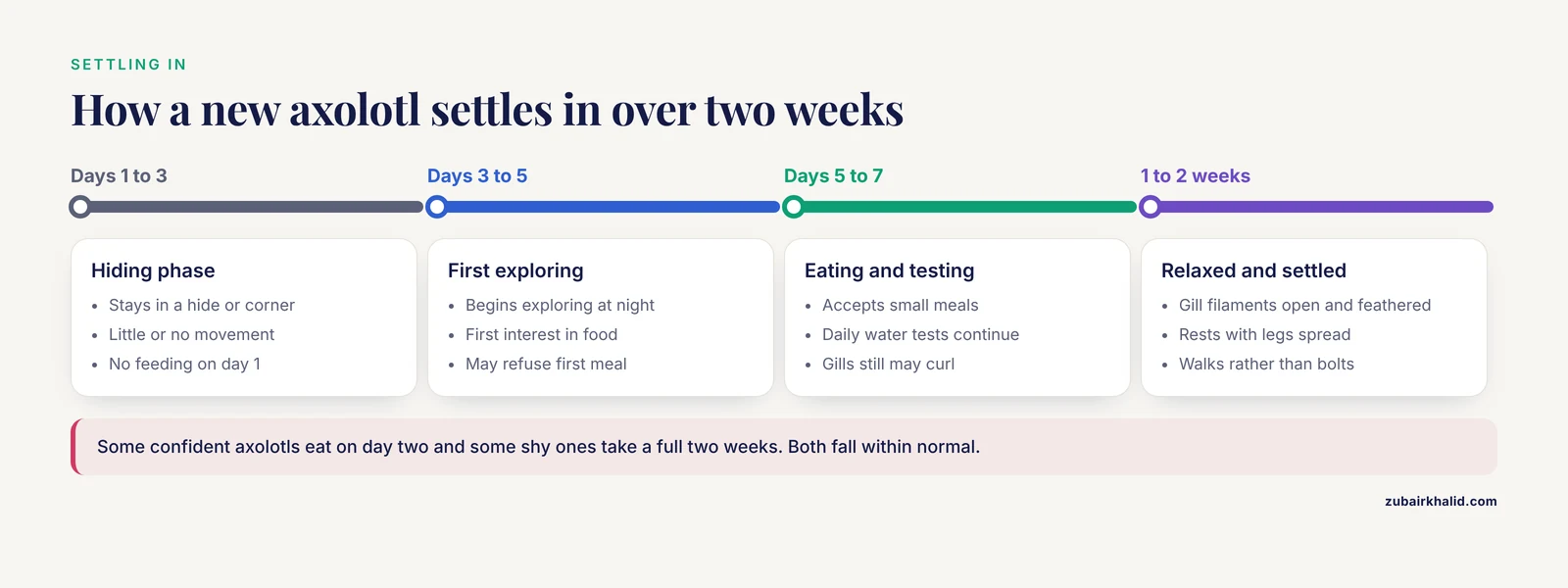
Settling in follows a rough but useful pattern. Most axolotls hide for the first one to three days, begin exploring at night within three to five days, accept food by day three to five, and show relaxed posture and normal gill position within one to two weeks. Some confident individuals eat on day two, and some shy individuals take a full two weeks. Both ends of that range fall within normal.
Look at gills and posture rather than activity to judge settling. Relaxed axolotls hold their gill filaments open and feathered. Stressed axolotls curl the gills forward against the head. A settled axolotl rests on the substrate with legs spread, walks rather than bolts, and reacts to food movement. A stressed axolotl floats repeatedly, hugs a corner, or swims frantically when lights go on.
Judge settling against clean water tests. If the water reads 0 ammonia, 0 nitrite, and 60 to 64°F, and the animal simply seems shy, patience is the correct treatment. If any parameter is off, fix the water first, because behavior problems in axolotls are usually water problems in disguise.
Handling, Tankmates, and Other First-Week Rules
Handle as little as possible, ideally not at all during the first week. Axolotls have a delicate slime coat that protects their skin, and handling removes it. If you must move the animal, use a soft, fine-mesh net or a clean container, and never lift it out of water for more than a few seconds. Wash hands thoroughly and rinse well before any hand contact, because soap, lotion, and hand sanitizer residues are toxic to amphibians through their permeable skin.
Keep the tank single-species. Do not add fish, snails, or a second axolotl during the first week, and think carefully ever after. Fish nip gills, many tankmates carry pathogens, and cohabitation of axolotls carries the risk that one will lose a limb, because hungry axolotls will eat anything that fits in their mouth, including tankmates and their own limbs. Quarantine any new amphibian from existing ones for an extended period under veterinary guidance before considering any contact.
Skip water additives. There is no need for aquarium salt, bacterial supplements marketed as cures, or medications during an uneventful first week. Adding treatments to a stable tank creates problems rather than solving them.
Common First-Week Mistakes
These are the errors that generate most first-week emergencies.
- Adding the axolotl to an uncycled tank. Ammonia and nitrite build up and burn the gills. Cycle the tank first, always.
- Water that is too warm. Home rooms routinely sit above 70°F. Monitor daily and plan cooling for summer before you need it.
- Gravel substrate. Swallowed gravel causes impaction and can be fatal. Use bare bottom or fine sand.
- Feeding too soon or too much. Feed nothing on day 1, small meals after, and remove leftovers.
- Strong filter current. Curling gills forward and sheltering behind the filter often mean the flow is too high.
- Excessive handling and rearranging. Every disturbance resets the settling clock. Let the animal be.
- Untreated or mismatched-temperature water changes. Chlorine and temperature shock both injure gills. Condition and match every drop of new water.
- Cleaning with soap or household chemicals. Rinse equipment with plain hot water only. Soap residue in a tank can kill an axolotl.
- Bright light all day. Provide hides and dim lighting, because these animals are nocturnal.
- Skipping the daily test. Problems in an axolotl tank develop in hours, not weeks.
Troubleshooting the First Week
| Sign | Likely Cause | First Action |
|---|---|---|
| , - | , - | , - |
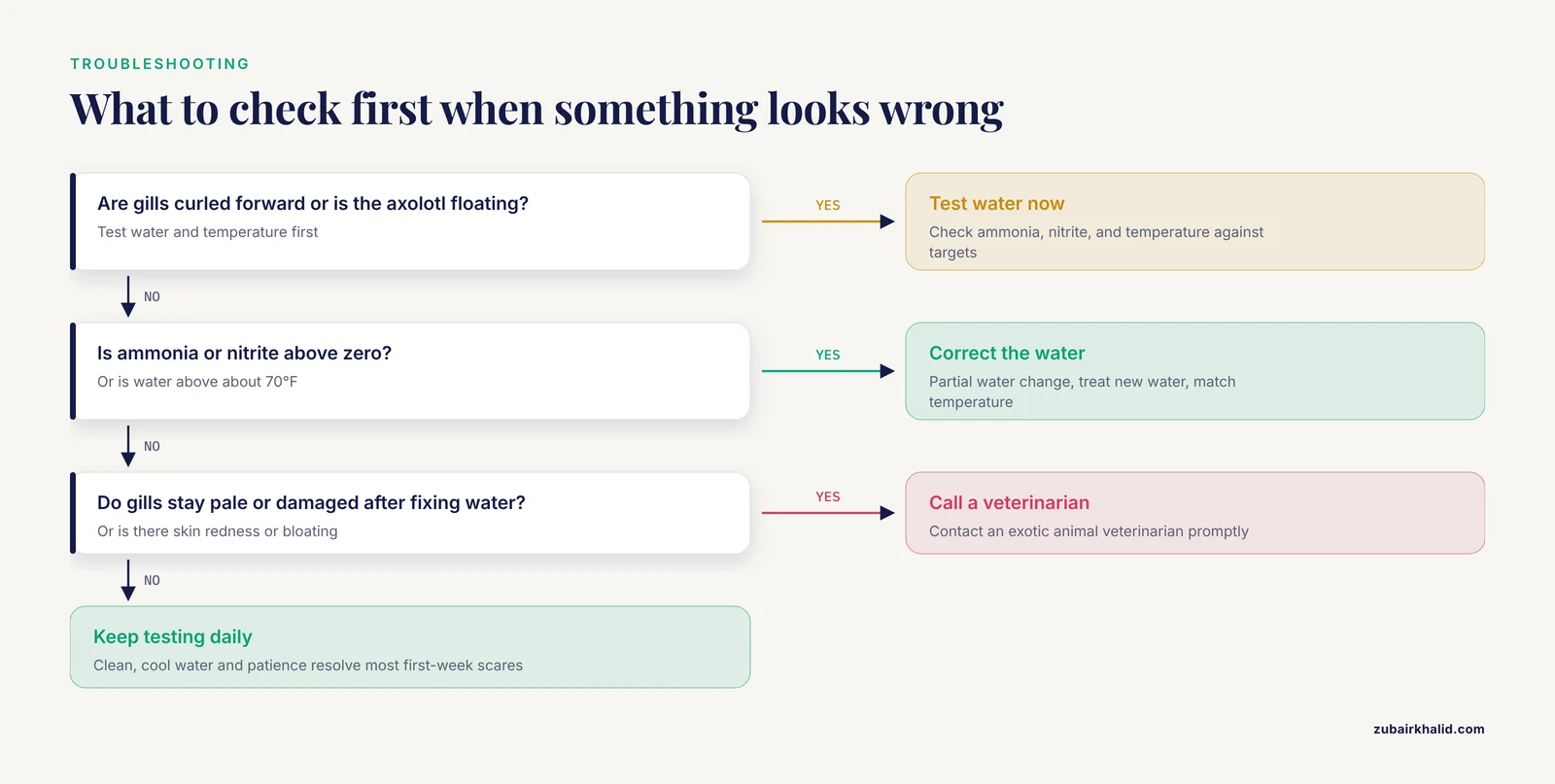
| Gills curled forward | Stress from current, heat, poor water quality, or a new environment | Test water and temperature, reduce flow, dim lights |
| Repeated floating | Gas buildup, water quality issue, or sometimes a swallow problem | Test water, confirm temperature, fast one day, reoffer small food |
| Refuses first two meals | Normal settling-in behavior in many cases | Wait, keep water pristine, try again in two days |
| Frantic swimming at lights-on | Startle response to bright light | Dim or raise lights, provide more hides |
| Milky or cloudy water shortly after feeding | Overfeeding or bacterial bloom from excess nutrients | Remove leftovers, reduce portions, partial water change |
| Pale, shrinking, or damaged gill filaments | Water quality injury, temperature stress, or infection | Test immediately, correct parameters, call an exotic animal veterinarian |
| Axolotl missing from the tank | Escaped through an uncovered top | Search cool, damp areas near the tank, keep the animal moist, call a veterinarian |
The First Vet Visit for an Axolotl
A first vet visit for an axolotl serves two purposes, which are establishing a relationship with a practice that treats exotic animals and catching problems early while the animal is new. Axolotls hide illness well, and by the time an owner notices a sick amphibian at home, the problem has often been developing for days. A baseline exam during the first week or two gives your veterinarian a reference point for every later concern.
Book the appointment in the first one to two weeks if the animal is eating and behaving normally, and sooner if anything looks wrong. Choose a veterinarian with amphibian or exotic animal experience. Not every small animal clinic treats aquatic species, so confirm when you call.
Come prepared. Bring a fresh water sample from the tank in a clean container so the clinic can run its own parameter checks, and bring a fecal sample if you can collect one, because fecal testing identifies parasitic loads that are common in captive-bred and wild-caught amphibians. Expect the veterinarian to take a history, examine the skin, gills, mouth, and eyes, check body condition, and discuss your setup, testing results, and diet. Follow-up is typically scheduled based on findings, with rechecks arranged for any treatment that is started.
General veterinary guidance for exotic pets, reflected in owner resources from organizations such as the AVMA, encourages new owners to establish care with an experienced veterinarian promptly rather than waiting for illness. For a species as specialized as an axolotl, this advice matters even more, because a general practice may not stock the equipment needed to examine a fully aquatic salamander.
Welfare and Safety Points That Last Beyond Week One
The habits you build in the first week set the standard for the animal's life. Keep the water cool and tested, keep the diet simple and appropriate, keep handling rare, and keep the environment calm. Enrichment for an axolotl looks like varied hides, occasional rearranged safe décor, and a predictable routine, not interaction.
Protect the animal from household hazards as well. Aerosols, air fresheners, cleaning sprays, and smoke near an open or screened tank all enter the water column through the air. Wash and rinse your hands before any tank maintenance, and dedicate any buckets, nets, and siphons to the tank alone so they never contact soap or other cleaners.
Limitations and When to Contact a Veterinarian
Every axolotl is an individual, and general husbandry guidance cannot replace an examination of your specific animal. When any treatment, medication, or diagnostic decision is involved, that call belongs to a veterinarian who can see the patient.
Contact an exotic animal veterinarian promptly if you observe any of the following in the first week or at any time:
- Ammonia or nitrite reading above zero that persists after a water change
- Water temperature above about 70°F that you cannot correct quickly
- Gasping at the surface, thrashing, or inability to stay submerged
- Gill filaments that are pale, shrunken, streaked with red, curled forward persistently, or missing at the tips
- White fluffy patches, redness, sores, or unusual discoloration on the skin
- A swollen or bloated abdomen, or a distended cloaca
- Refusal of food beyond roughly a week, especially with visible weight loss
- Repeated uncontrolled floating, or floating on the back
- A limb injury, a bite wound, or a suspected foreign body in the mouth
- Dramatic lethargy, meaning the animal does not respond even to gentle food movement
- Any escape from the tank, even if the animal appears unharmed afterward
Do not medicate the tank on your own. Many fish medications are toxic or untested in amphibians, and dosing errors in an animal the size of an axolotl are easy to make and hard to reverse. Diagnostic testing and treatment decisions belong with your veterinarian.
Frequently Asked Questions
How long does it take for an axolotl to settle in?
Most axolotls settle in within a few days to two weeks. Expect hiding for the first several days, first interest in food around day three to five, and fully relaxed behavior within one to two weeks if the water is clean and cool.
What should be on my new axolotl checklist?
A fully cycled 20-gallon long or larger tank, a gentle filter, a thermometer, a dechlorinating water conditioner, a liquid water test kit, bare bottom or fine sand substrate, at least one hide, appropriate food such as earthworms, and the contact details of a veterinarian who treats amphibians.
When should I feed my new axolotl for the first time?
Wait 24 to 48 hours after bringing the animal home, then offer one small meal of earthworm or soft sinking pellet and remove anything uneaten within a few hours. Refusal of the first offering is normal, so wait two days and try again.
What water temperature does a new axolotl need?
Hold the tank at 60 to 64°F. Test the temperature daily during the first week, and treat any reading above about 70°F as a problem to fix the same day.
Do I need a cycled tank before bringing an axolotl home?
Yes. Ammonia and nitrite must both read zero on a water test before the animal arrives, which usually takes 4 to 8 weeks of tank cycling. Adding an axolotl to an uncycled tank exposes it to toxic compounds that damage gills and skin.
Should I schedule a first vet visit for an axolotl even if it looks healthy?
Yes. A baseline exam during the first one to two weeks establishes care with an amphibian-experienced veterinarian, allows a fecal exam and health check, and gives you a contact for emergencies before you need one.
Why are my new axolotl's gills pale or curled forward?
Forward-curling gills usually signal stress from heat, strong current, or water quality problems, so test the water and temperature first. Pale or deteriorating gill filaments that do not improve after correcting the environment warrant a veterinary examination.
Can I hold or touch my new axolotl?
No, not during the first week and as little as possible afterward. Axolotls have a delicate protective slime coat, and handling damages it. If you must move the animal, use a soft net or a clean container, and keep any necessary hand contact brief, wet, and free of soap residue.