How to Quarantine a New Axolotl: Steps and Timeline
By Dr. Zubair Khalid, DVM, MS, PhD ·
Quarantine a new axolotl by housing it alone in a completely separate tank with dedicated equipment and no shared water, for a commonly used minimum of about 30 days. Extend the axolotl quarantine period toward 60 days or longer when the animal's history is unknown or when test results are still pending. Feed, observe, and weigh the newcomer on a fixed schedule, keep every tool and pair of hands dedicated to one tank, and close quarantine only after appetite, stool, skin, gills, and behavior have stayed normal and any testing your exotics veterinarian recommends has come back clean.
The reason for this discipline is biological, not fussy. The research literature describes the axolotl as highly susceptible to environmental stress, including infectious disease, and notes that the species is particularly vulnerable to certain viral infections compared with other amphibians [1]. A new axolotl can also look completely healthy while carrying pathogens, so quarantine is the only practical buffer between a newcomer and the animals you already own.
This article is educational and is not a substitute for veterinary diagnosis or treatment.
Quarantine a New Axolotl at a Glance
| Step | What you do | When |
|---|---|---|
| 1 | Set up a separate quarantine tank with dedicated tools, dechlorinated water, and a cycled filter or a water-change plan | Before the axolotl comes home |
| 2 | Transfer the animal gently, match water temperature, skip all tankmates | Day 0 |
| 3 | Keep handling near zero, offer small meals, log appetite and stool | Days 1 to 7 |
| 4 | Weigh weekly, photograph skin and gills, keep the water log current | Weeks 2 to 4 |
| 5 | Book an exotics veterinarian exam, bring a fresh stool sample, discuss chytrid skin swab testing | Mid-quarantine |
| 6 | Maintain full biosecurity, always care for the quarantine tank last | Entire period |
| 7 | Close quarantine only after the agreed period, normal findings, and any test results | Commonly 30 to 60 or more days |
| 8 | Introduce the newcomer gradually, supervise closely, stay ready to separate | After clearance |
Why New Axolotls Need Quarantine
Every new amphibian arrives with an unknown exposure history. It may have shared water, tools, or shipping containers with dozens of other animals before it reached you. Shipping itself is a stressor, and stressed animals shed pathogens at higher rates while also resisting them less effectively.
Quarantine protects three parties at once. It protects your established animals from whatever the newcomer carries. It protects the newcomer, who gets a quiet, stable environment to recover from transport without competing for food or territory. It also protects wild amphibians, because responsible disposal of quarantine water keeps pathogens out of ponds and streams.
Standard veterinary biosecurity, the approach summarized in resources such as the Merck Veterinary Manual, rests on isolation, dedicated equipment, and hand hygiene. The AVMA makes the same point for newly adopted dogs and cats, and amphibian owners should apply it even more strictly, because a tank of water is an excellent pathogen reservoir.
One more reason matters for this species specifically. Axolotls are a neotenic, endangered salamander, famous in science for regenerating lost limbs and portions of organs [1]. Fame does not equal hardiness. The same body of research emphasizes that the species tolerates environmental stress and infectious disease poorly [1], and a few U.S. states and municipalities restrict private ownership, so confirm your local rules before acquiring one.
What Research Says About Axolotl Immunity
Recent work on the axolotl genome has mapped the species' antibody genes, and the picture is unusual. More than half of the heavy-chain variable genes are nonfunctional pseudogenes, the kappa light-chain locus is missing entirely, and diversity at the antigen-binding region is restricted compared with other vertebrates. Scientists are still working out the functional consequences of this antibody architecture. Even so, the pattern fits a species that cannot rely on antibody brute force, which helps explain why researchers treat axolotls as infection-sensitive animals that need clean water and careful biosecurity [1].
For an owner, the practical translation is simple. Assume the newcomer is vulnerable rather than tough, and build your quarantine plan around preventing exposure rather than curing problems later.
Diseases Spread by New Axolotls
Chytridiomycosis, the Central Concern
Chytridiomycosis is an infectious skin disease of amphibians caused by two fungal species, Batrachochytrium dendrobatidis (Bd) and B. salamandrivorans (Bsal), and it has been implicated in amphibian population declines worldwide [2]. This is the single most important disease to keep out of your home with a quarantine setup for axolotls.
A published case report from laboratory colonies shows exactly how the problem unfolds. Over a 12-month period, 12 axolotls in a laboratory-reared colony developed multifocal red dermatitis, mainly on the lower limbs and tails [2]. The team first considered poor water quality, bacterial infection, parasitic infestation, and trauma. Antibiotics chosen on the basis of bacterial culture, combined with bleach disinfection of the aquaria, did not resolve the signs. Skin swabs from the affected axolotls, run through a newly available commercial screen, tested positive for Bd, and additional PCR and sequencing confirmed the diagnosis [2].
Two lessons from that outbreak belong in every owner's head. First, testing also found chytrid-positive animals in two aquaria housing newts that showed no clinical signs at all [2]. A healthy appearance does not rule out carriage, which is why visual inspection alone can never end a quarantine. Second, the same report describes a successful treatment protocol for chytridiomycosis in axolotls and rough-skinned newts [2]. Chytrid is serious but treatable when it is caught and diagnosed, which is why early veterinary involvement matters.
Bacterial Infections
Bacterial skin and systemic infections occur in newly acquired amphibians, and the laboratory outbreak team pursued bacterial culture and sensitivity testing as part of the workup [2]. The key point for owners is that empiric antibiotics failed in that outbreak until the true cause was identified. Guesswork treatment wastes weeks and lets real disease progress, so skin problems deserve diagnostics, not immediate medication.
Parasites
Parasitic infestation was on the differential list in the same investigation [2], and parasites are a classic hitchhiker in newly imported or densely housed amphibians. You cannot see most of them. A fresh stool sample brought to an exotics veterinarian is the practical way to check, and your veterinarian can advise whether treatment is needed.
Viral Infections
Compared with other amphibians, axolotls are particularly vulnerable to certain viral infections [1]. There is no home test for this risk. Your defense is sourcing, biosecurity, and quarantine, which is precisely why the isolation period exists.
Water Quality Problems That Mimic Disease
Poor water quality was among the first differentials in the laboratory workup [2], and it is the most common reason a "sick" new axolotl is really a chemistry problem. Quarantine helps here too, because a small, simple tank lets you control ammonia, temperature, and cleanliness while you learn how your individual animal behaves when it is well.
Quarantine Setup for Axolotls
Choosing the Location
A separate room is the gold standard, because it physically blocks airborne droplets, splashes, and casual cross-contamination. If a separate room is impossible, use a separate stand on the opposite side of the room, with no shared shelving, no dripping or draining water that could reach the established tank, and no shared power strip sitting in a splash zone. Pick a quiet spot away from direct sunlight, kitchen fumes, speakers, and heavy foot traffic.
Tank, Water, and Filtration
Choose a tank large enough for full adult growth so you never have to upgrade mid-quarantine, with smooth interior surfaces and a snug lid, because axolotls can surge to the surface and occasionally end up on the floor. Fill it with dechlorinated, temperature-stable water.
Filtration has two workable patterns. The first is a cycled biological filter, established in advance, that converts ammonia and nitrite before the animal ever arrives. The second is a bare setup with frequent partial or full water changes using temperature-matched, dechlorinated water. Either is acceptable. What is not acceptable is seeding the quarantine filter with media, decorations, or water from your established tanks, which would deliver exactly the pathogens you are trying to exclude. Cycle fishless in advance, or lean on water changes.
Temperature, Light, and Hides
Axolotls are a cool-water species, so you are far more likely to need a cooling plan than a heater. Place a thermometer where you can read it at a glance, keep the tank out of sunlit windows, and decide before summer how you will lower water temperature during heat waves. Keep lighting dim, room light is plenty, and provide one or two smooth hides such as a ceramic mug on its side or a length of clean pipe. Most keepers run quarantine tanks bare-bottomed, because bare glass makes waste removal and daily health checks far easier.
Dedicated Equipment Checklist
Buy a second set of everything. Nothing that touches the quarantine tank should ever touch an established tank.
- Two dedicated buckets, one for dirty water and one for clean
- A dedicated siphon or turkey baster
- A soft, fine-mesh net
- Feeding tongs or tweezers
- A thermometer
- Water conditioner for dechlorination
- A digital kitchen scale and a small container for weekly weights
- A notebook or phone log for appetite, stool, weight, and water notes
- Paper towels, hand soap, and alcohol-based hand rub stationed nearby
- An aquarium water test kit, optional but useful for tracking the cycle
Cleaning and Disinfection
Plan for disinfection before you need it. Diluted, unscented household bleach used according to label directions, followed by thorough rinsing and complete air drying, is a standard choice for aquaria and equipment. The laboratory response to the chytrid outbreak included bleach disinfection of the aquaria [2]. Treat disinfection as one layer of defense that complements, never replaces, diagnosis and treatment of the animal itself.
How to Quarantine a New Axolotl, Step by Step
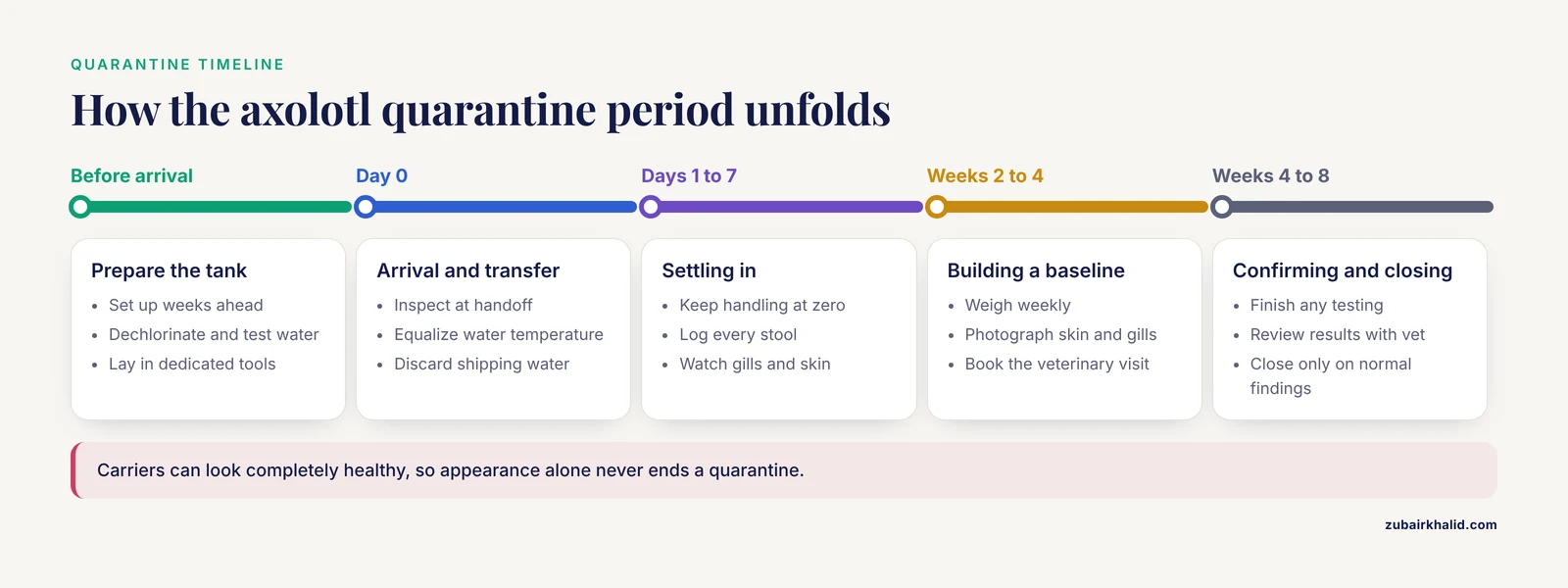
Step 1: Prepare the Tank Before Arrival
Set the tank up weeks ahead when possible, because a biological filter needs time to mature. Fill and dechlorinate the water, run the filter, confirm the temperature holds steady, place the hides, and test the water before the animal is ever in the room. Lay in your dedicated tools now, so you are never tempted to borrow from the established tank at 10 p.m.
Step 2: Day 0, Arrival and Transfer
Inspect the animal at handoff when you can. You want an active posture, intact gill stalks, no white patches or open wounds, and a plump but not bloated body. Transport the animal dark, insulated, and level, with minimal jostling.
At home, float the sealed bag or container so the water temperatures equalize, then move the animal with a clean cup or container rather than pouring shipping water into your quarantine tank. Discard the shipping water away from all aquaria. Dim the lights, leave the animal alone, and offer a small first meal once it has settled. Do not worry if the first meal waits a day.
Step 3: Days 1 to 7, Settling In
Keep handling at zero except when necessary. Feed small amounts, remove uneaten food promptly, and spot-clean. Log every stool, because frequency and appearance become your baseline. Watch the gills, which should look feathery and be held normally, along with the skin, buoyancy, and posture. Brief hesitation to eat after shipping is common. What you are establishing in this first week is what normal looks like for this individual.
Step 4: Weeks 2 to 4, Building a Baseline
Weigh the animal weekly in its container on the digital scale and subtract the container weight. Photograph the skin and gills from the same angles each week so subtle changes become visible. Keep the feeding and water log current.
Schedule the veterinary visit somewhere in this window. Bring a fresh stool sample, and ask whether a chytrid skin swab makes sense for your situation. Swab-based testing is the same approach that confirmed the laboratory outbreak, and an exotics veterinarian can arrange it. Ask your veterinarian about any live or frozen foods you plan to use, because food handling is part of biosecurity.
Step 5: Weeks 4 to 8, Confirming and Closing Out
Finish any testing and discuss the results with your veterinarian. Close quarantine only when every item on this checklist is true:
- The agreed quarantine period has fully elapsed
- Appetite, growth, and stool have been normal and consistent
- Skin and gills have looked normal on repeated checks and in your photos
- Behavior, buoyancy, and posture are normal
- Any test results are back and have been reviewed with your veterinarian
- Your veterinarian agrees the animal is ready
When quarantine ends, transition the animal to its permanent, fully furnished habitat rather than leaving it in the sparse quarantine setup indefinitely. Simplicity serves hygiene during quarantine, not long-term welfare.
The Axolotl Quarantine Period: How Long Is Long Enough?
Most quarantine plans for amphibians run between about 30 and 60 days. Thirty days is the usual floor for a healthy-appearing, captive-bred animal from a trusted source. Sixty days, or longer, is the safer target when the animal's history is unknown, when it passed through a broker or importer, or when test results are still pending. These figures are working conventions rather than hard rules, and your exotics veterinarian should make the final call for your household.
Several factors stretch the timeline. A new animal that shows any sign of illness restarts the conversation entirely, and an animal that receives treatment restarts the clock after treatment ends, on your veterinarian's advice. Adding a second new animal to the quarantine tank restarts the clock for everyone in it. Waiting for laboratory results adds time, and that time is well spent.
The shortest safe period is still measured in weeks, not days, because many infections have a delayed onset and some carriers never look sick. The laboratory outbreak described above included clinically normal animals that tested positive [2], and remembering that fact is the best insurance against cutting the axolotl quarantine period short.
Common Mistakes That Undo a Quarantine
- Ending early because the animal looks fine. Appearance is the weakest evidence available, because carriers exist and look healthy.
- Sharing equipment. One borrowed net or siphon can move pathogens between tanks in seconds.
- Placing the tanks too close. Splashes, drips, and shared drainage defeat a quarantine that is otherwise perfect.
- Seeding the filter from an established tank. Used filter media is one of the most efficient pathogen transfer methods in the hobby.
- Treating blind. Starting antibiotics or antifungals without a diagnosis delays the real answer, as the laboratory outbreak demonstrated when empiric treatment failed until swabs identified the pathogen [2].
- Keeping the tank warm, bright, or busy. Chronic stress suppresses an animal that already has limited immune reserves.
- Adding plants, decor, or water from established tanks. Everything enters the quarantine tank new and clean, or not at all.
- Dumping quarantine water outdoors. Water from any amphibian tank belongs in a drain or toilet, never near ponds, streams, or gardens where wild amphibians live.
- Skipping the log. Trends like slow weight loss or shrinking gills are invisible without records.
- Cohabitating "just to see" before clearance. Early curiosity costs more than any amount of patience.
Troubleshooting Common Quarantine Problems
A New Axolotl That Will Not Eat
Keep the water cool, clean, and still, dim the lights, and offer small meals on a steady schedule. Many axolotls take several days to settle after shipping. Call your exotics veterinarian if refusal continues past the first week, if the animal is visibly losing weight, or if refusal comes with any other sign.
White Patches or Fuzzy Growth on Skin or Gills
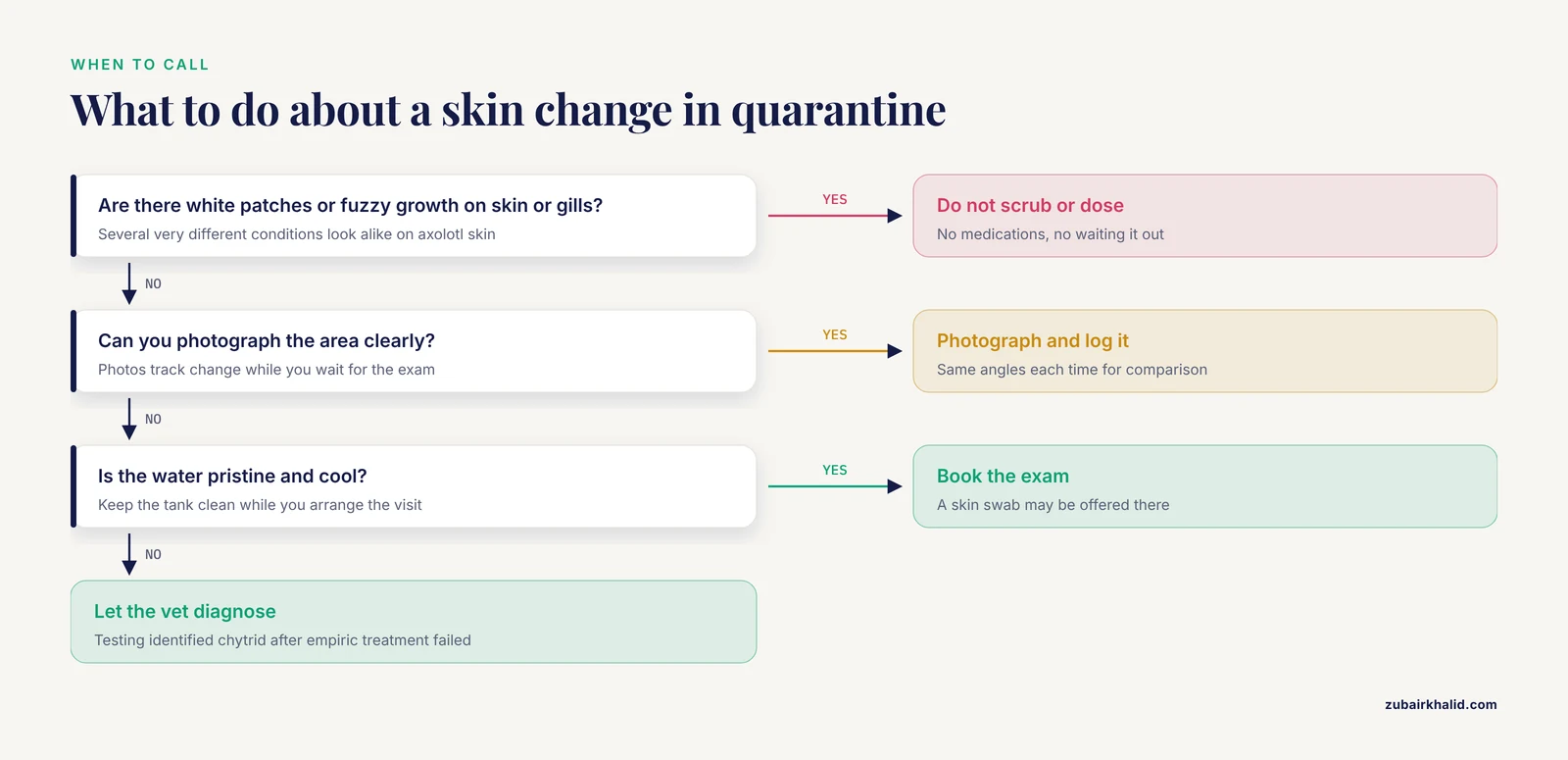
Do not scrub, dose medications, or wait it out. Several very different conditions look alike on an axolotl's skin, and the laboratory team initially considered water quality, bacteria, parasites, and trauma before testing identified chytrid [2]. Photograph the area, keep the water pristine, and book a veterinary exam, where a skin swab may be offered.
Bloating, Floating, or Swelling
Abnormal buoyancy or progressive swelling deserves prompt veterinary attention, especially when it worsens over days to weeks. Imaging and fluid analysis are the tools your veterinarian may use to find the cause, and causes range from digestive problems to organ disease.
A Water Quality Crash
In an uncycled or lightly stocked-filter tank, respond with extra partial water changes using temperature-matched, dechlorinated water, reduce feeding, and retest. If the cycle keeps failing, shift to a full water-change routine rather than chasing additives, and ask your veterinarian or a reputable aquarium store about jump-starting the biological filter safely.
Escapes and Heat Waves
Prevent escapes with a snug lid, and if one happens, search damp, dark areas near the tank, return the animal gently, and check the skin for abrasions. For heat waves, act before the hot weather arrives with a cooler room, increased air movement across the water surface, and a monitoring routine, because an overheated axolotl is an emergency, not an inconvenience.
Welfare and Household Safety During Quarantine
Quarantine is deliberately boring, and boring is the goal. Keep the room quiet, skip tapping on the glass, and let the animal settle into a predictable routine of light, feeding, and cleaning. Handle only when necessary, always with wet, clean hands or a soft container, and never after applying lotions or insect repellent. Children and other pets should be managed around the tank, both for the animal's sake and for electrical and water safety.
Wash your hands after every tank interaction, and ask your exotics veterinarian about zoonotic precautions for amphibians in a household with children, elderly family members, or immunocompromised individuals. Finally, remember that the sparse quarantine habitat is temporary by design. Completing the process and moving the animal into a proper enriched habitat is itself a welfare decision.
Introducing New Axolotls Safely After Quarantine
Introduce a cleared newcomer only after the full quarantine period, normal findings, any agreed testing, and your veterinarian's agreement. Even then, proceed with the understanding that cohabitation carries permanent risks. Size mismatches can end in bites, competition for food is constant, and many experienced keepers and veterinarians recommend housing axolotls individually for exactly these reasons.
If you do proceed, match animals by size, provide multiple hides and visual barriers so each animal can opt out of contact, feed on opposite ends of the tank or in separate containers, and supervise every interaction for the first weeks. Watch both animals for wounds, stress, and appetite changes afterward, because minor injuries and social stress can flare into infections. Stay ready to separate them permanently, and treat that outcome as a success rather than a failure.
Limitations and When to Contact a Veterinarian
Individual animals vary, this article is educational and cannot diagnose your pet, and an exotics veterinarian who has examined your animal should make the final decisions on quarantine length, testing, and treatment.
Contact your exotics veterinarian promptly, and do not wait out the quarantine clock, if you see any of the following:
- No interest in food beyond the early adjustment window, or visible weight loss
- Skin changes such as red patches, ulcers, sloughing, unusual slime, or gill shrinkage and loss
- Abnormal buoyancy, a curled posture, lethargy, or uncoordinated swimming
- Progressive bloating or distension of the body
- Vomiting, straining, or absent stool alongside reduced appetite
- Any new sign in a resident animal after a newcomer arrives, which changes your quarantine plan for every tank in the house
Progressive swelling deserves special emphasis. A published case describes a 9-year-old, 230-gram captive-bred female axolotl with a three-week history of progressive coelomic distension who remained alert and responsive throughout [3]. Imaging revealed free coelomic fluid and a small hepatic mass, and surgical removal with histopathology confirmed a benign hepatocellular adenoma [3]. The lesson is direct. An animal that still looks bright can still be seriously ill, so escalate on trends, not just on dramatic signs.
This article is educational and is not a substitute for veterinary diagnosis or treatment.
Frequently Asked Questions
How long should the axolotl quarantine period last?
Plan on a minimum of about 30 days, and extend toward 60 days or longer when the animal's history is unknown or test results are pending. Your exotics veterinarian should confirm the right length for your situation.
Can I quarantine a new axolotl in the same room as my established tank?
A separate room is better, but the same room can work if nothing ever crosses between the tanks. Keep real distance, share no water or gear, and handle the quarantine animal last with freshly washed hands.
What diseases can new axolotls spread to my other animals?
Chytrid fungus (Bd and Bsal), bacterial infections, and parasites are the main concerns, and axolotls are also considered unusually vulnerable to certain viral infections. Quarantine, dedicated equipment, and testing reduce the risk of passing any of these along.
Do I need chytrid testing before ending quarantine?
Discuss skin swab testing with your exotics veterinarian, because animals can carry chytrid without ever looking sick. A negative result gives you far more confidence than appearance alone.
What supplies do I need for a quarantine setup for axolotls?
A separate tank, dechlorinated water, a cycled filter or a firm water-change plan, a thermometer, hides, a secure lid, and a complete set of dedicated tools. Nothing that touches the quarantine tank should touch your established tanks.
Why is my new axolotl not eating during quarantine?
Brief appetite pauses after shipping are common while an animal settles. Keep the water cool and clean, offer small meals, and call your exotics veterinarian if refusal continues past the first week or the animal loses weight.
Can I handle my axolotl while it is in quarantine?
Handle as little as possible. Quarantine is stressful enough on its own, and every handling event is also a biosecurity event, so use wet, clean hands or a soft container only when necessary.
When can I introduce a new axolotl to my current axolotl?
Only after the full quarantine period, normal findings or clean test results, and your veterinarian's agreement. Even then, introduce slowly, match sizes, supervise closely, and stay prepared to house them separately for good.
Sources
- Characterization of immunoglobulin loci in the gigantic genome of Ambystoma mexicanum
- Treatment of Chytridiomycosis in Laboratory Axolotls (Ambystoma mexicanum) and Rough-skinned Newts (Taricha granulosa).
- Hepatocellular adenoma associated with recurrent hydrocelom in a Mexican axolotl (Ambystoma mexicanum)- a case report