Frog Heat and Cold Safety: Safe Temperatures by Season
By Dr. Zubair Khalid, DVM, MS, PhD ·
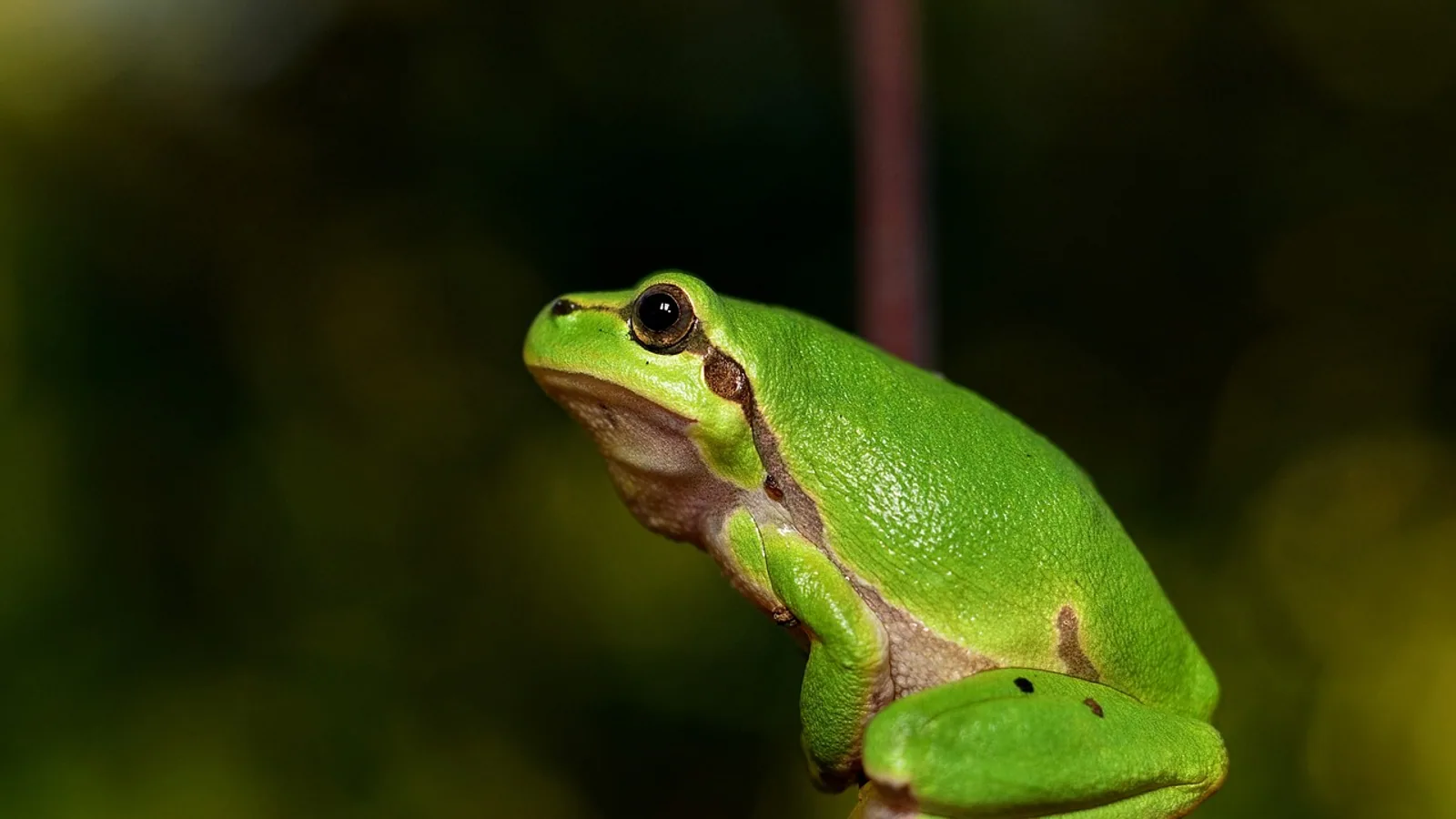
Frogs are ectotherms, which means they rely on their environment to regulate body temperature. Most pet frogs stay healthy when their enclosure holds a stable temperature within the range recommended for their species, typically somewhere between the high 60s and low 80s Fahrenheit for commonly kept tropical and temperate species. Sustained heat above the mid 80s Fahrenheit can push a frog toward heat stress and heat stroke, while prolonged cold below the low 60s can shut down digestion and immunity. The exact numbers depend on the species you keep, so the most valuable habit you can build is simple. Know your frog's target range, watch the thermometer daily, and act the moment temperatures drift outside it.
This guide explains the frog safe temperature range by season, how hot is too hot for a frog, how cold is too cold for a frog, the signs of overheating, and practical methods for keeping a frog warm in winter. It also covers equipment, common mistakes, and the points at which you should involve a veterinarian.
At a Glance: Frog Temperature Safety Checklist
Use this table as a daily reference. Treat the values as general starting points for common pet species and confirm exact numbers for your species with an exotics veterinarian or a species-specific care guide.
| Factor | What to aim for | What to do today |
|---|---|---|
| Daily temperature | Keep the enclosure within your species' target range, usually high 60s to low 80s F for common pet species | Place a thermometer at frog level and check it twice a day |
| Heat source | A thermostat-controlled heater or low-wattage heat source on one side of the tank | Never place a heat mat under a terrestrial frog's substrate |
| Hot weather | Keep the room below the enclosure's upper limit, use ventilation, offer shaded cool zones | Move the tank away from windows and out of direct sun |
| Cold weather | Maintain a stable minimum with a reliable heat source and backup plan | Check the heater monthly and have a spare ready before winter |
| Water temperature (aquatic species) | Match water temperature to the species' target range and keep it stable | Monitor water parameters regularly as part of routine husbandry |
| Emergency signs | Lethargy with open-mouth breathing, disorientation, or skin changes after a temperature excursion | Move the frog to a thermally neutral area and call an exotics veterinarian |
Why Temperature Is a Life-or-Death Parameter for Frogs
A frog does not generate and hold body heat the way a mammal does. Its metabolism, digestion, immune function, and activity level all track the temperature of its surroundings. When the environment warms, the frog's metabolism speeds up. When the environment cools, everything slows down. This is normal biology, not illness, but it leaves very little buffer between "comfortable" and "dangerous."
Three consequences follow from this physiology, and they shape every recommendation in this article.
First, temperature errors build quickly. A tank left near a sunny window on a summer afternoon can climb far faster than the room around it. Glass and water hold heat, and a closed terrarium traps it. A frog cannot escape a sealed enclosure, so it cannot thermoregulate the way a wild frog could by burrowing or moving to shade.
Second, temperature and hygiene interact. Frogs kept at the wrong temperatures experience chronic physiological stress, and stressed amphibians are far more vulnerable to opportunistic pathogens. This is well documented in captive frog colonies. In a reported outbreak in a colony of African clawed frogs (Xenopus laevis), animals were found carrying both Saprolegnia, a fungal parasite that is relatively common in laboratory-housed frogs, and Epistylis, an ectoparasite rarely described in frogs. The authors emphasized the importance of water-quality monitoring and husbandry in the care of these animals [1]. Temperature management is a pillar of that husbandry. A frog held at the wrong temperature for weeks is a frog whose skin defenses and immune system are quietly declining.
Third, amphibian skin is not just a covering, it is a working organ. Frogs absorb water and sometimes electrolytes through their skin, and they breathe partly through it. Anything that dries the skin or disrupts the humidity and temperature balance damages that organ. Heat combined with low humidity is the most dangerous combination a captive frog can face.
The Frog Safe Temperature Range by Species Group
The phrase "frog safe temperature range" has no single answer because frogs evolved on every continent except Antarctica, from desert burrows to cloud forests. What follows are widely used general bands for the species groups most often kept as pets. Use them as orientation, then verify the exact target for your species.
Tropical species
Tropical species such as White's tree frogs, most Pacman frogs, and many dart frog species come from warm, stable climates. For these animals, most keepers target a general range of roughly 72 to 80 degrees Fahrenheit, with a mild drop of a few degrees at night. Consistency matters as much as the number. A tank that swings between 68 and 84 degrees every day is harder on a frog than a tank that holds a steady 76.
Temperate species
Temperate species such as American green tree frogs and some fire-bellied toad setups tolerate and often prefer cooler conditions. A general band of roughly 65 to 75 degrees Fahrenheit suits many of these animals, and they usually need no supplemental heat at all in a comfortably heated home. For these species, summer heat is a bigger risk than winter cold.
Aquatic species
Fully aquatic species such as African clawed frogs live their entire lives in water, so water temperature is the whole story. Their husbandry is essentially aquarium husbandry, and water quality and temperature are inseparable. The Xenopus colony outbreak described earlier illustrates the point. Epistylis and Saprolegnia both flourish when water quality slips, and the treatment discussion centered on correcting husbandry and monitoring water parameters, not just treating the parasites [1]. For an aquatic frog, a stable heater, a thermometer, and a routine water-testing schedule protect against temperature problems and the opportunistic infections that follow them.
A note on gradients
Most terrarium species benefit from a gentle thermal gradient, meaning one end of the enclosure sits a few degrees warmer than the other. The frog then chooses where to sit. A gradient requires a thermostat-controlled heat source on one side only, never heat applied uniformly across the whole enclosure. If the warm end drifts high, the frog must have a cool end to retreat to, and if the whole tank is warm, it has nowhere to go.
How Hot Is Too Hot for a Frog
There is no universal ceiling, but there is a practical rule. For most commonly kept tropical and temperate pet frogs, sustained temperatures above the mid 80s Fahrenheit move from uncomfortable into dangerous territory, and temperatures in the low to mid 90s can be lethal within hours, especially if humidity is low and the frog cannot reach water or a cool retreat.
Heat kills through several mechanisms.
- Dehydration. Warm air holds and demands moisture. A frog loses water through its skin faster as temperatures climb, and dehydration in an amphibian progresses quickly.
- Metabolic collapse. As body temperature rises past the species' tolerance, oxygen demand outstrips what the frog can take in, and cellular damage begins.
- Trapped heat. A frog in a sealed terrarium cannot behaviorally cool itself. It cannot burrow deep enough, find shade, or leave. Every degree the keeper's equipment or the room adds is a degree the frog must endure.
Frog heat stroke signs to watch for
Overheating announces itself in stages. Learn the early signs and you will rarely meet the late ones.
Early heat stress. The frog becomes restless, then ceaselessly active, trying to escape the enclosure. It may sit in its water dish constantly, press against the coolest glass, or adopt a posture that maximizes skin contact with a cool surface. Breathing speeds up.
Progressive heat stress. Activity collapses. The frog becomes profoundly lethargic, floppy, or unresponsive. Skin may look dry or dull instead of moist and glossy. Open-mouth breathing, gaping, and darkening or abnormal skin color can appear. Some frogs regurgitate recently eaten food because digestion fails under heat stress.
Heat stroke. Disorientation, loss of righting reflex (the frog cannot hold itself upright), seizure-like movements, and unresponsiveness. At this stage the animal is in critical condition and needs immediate veterinary contact, but survival becomes uncertain.
What to do if your frog overheats
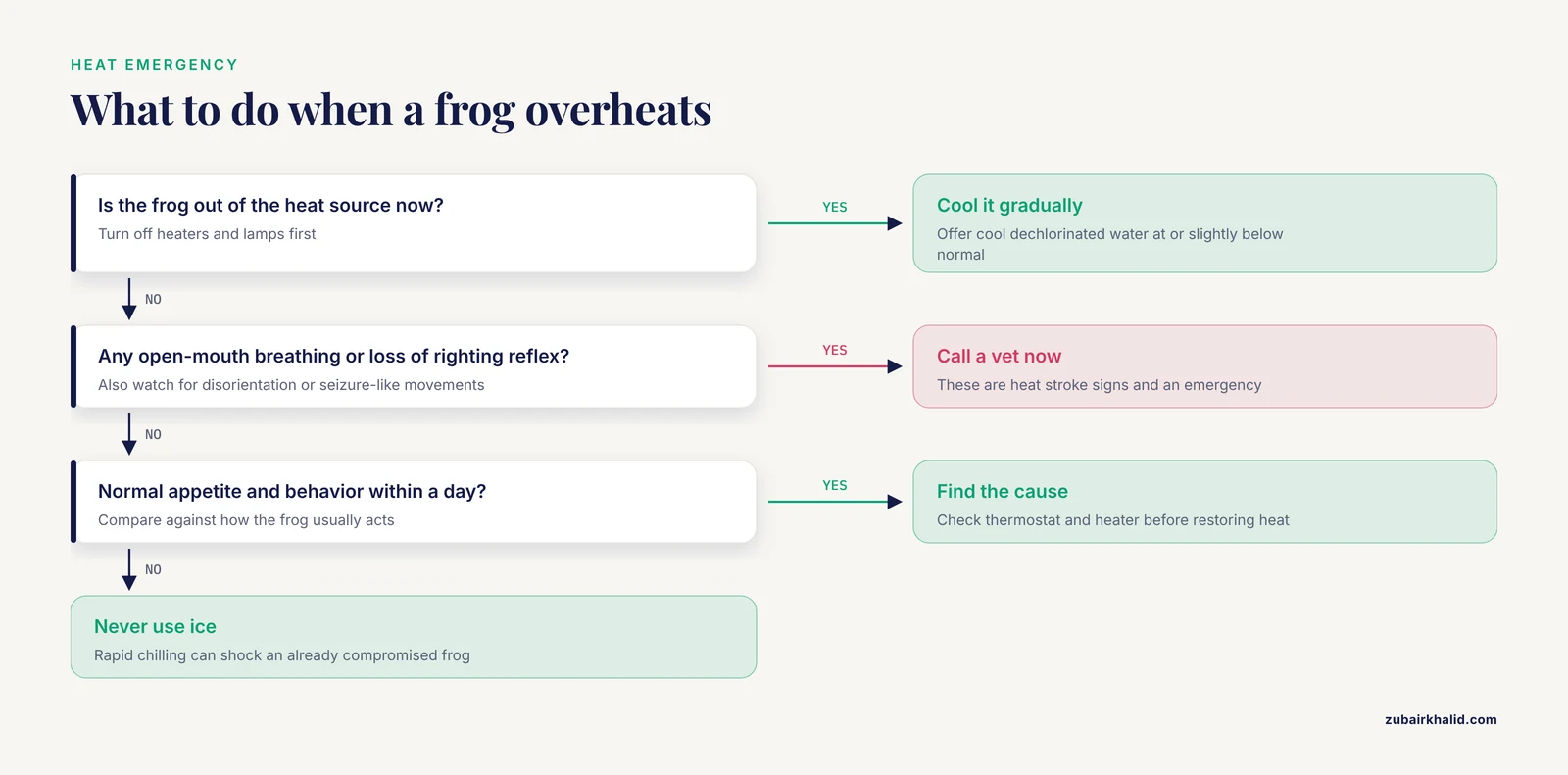
Move fast but move gently. Sudden temperature shocks cause their own injuries, so the goal is gradual cooling toward the normal target range, not ice-cold rescue.
- Move the frog, or the entire enclosure, out of the heat source immediately. Turn off heaters and lamps.
- Offer immediate access to cool, dechlorinated water at or slightly below the frog's normal water temperature so it can rehydrate and cool through its skin. For aquatic species, do a partial water change with appropriately temperature-matched water.
- Increase ventilation and evaporative cooling in the room. Do not apply ice, ice packs, or refrigerated water directly to the frog. Rapid chilling can shock an already compromised animal.
- Keep the frog quiet and observe for the signs listed above for at least several hours. Appetite and behavior that do not return to normal within a day warrant a veterinary visit.
- Find the cause before you restock heat. Failed thermostats, faulty heaters stuck in the on position, and tanks moved into sunlight cause most overheating emergencies.
How Cold Is Too Cold for a Frog
Cold kills more slowly than heat, which makes it easier to miss. For most tropical pet species, temperatures held below the low 60s Fahrenheit for more than a day or two become a genuine welfare problem, and temperatures in the 50s or lower are dangerous for species with no natural cold tolerance. Temperate species tolerate cooler conditions, but even they need the temperature to stay stable rather than plunge.
Cold harms frogs through three routes.
- Digestive shutdown. A cold frog cannot digest food. Food sits in the gut and rots, a condition called impaction or gastrolithiasis in severe cases. Continuing to feed a frog at cold temperatures is one of the most damaging mistakes a keeper can make.
- Immune suppression. Cold-stressed amphibians lose immune function and become susceptible to bacterial and fungal infections. The principle shown in the Xenopus colony report applies here. Environmental stress and lapses in husbandry set up the conditions in which opportunistic organisms like Saprolegnia take hold [1].
- Lethargy mistaken for hibernation. Owners sometimes read a cold, motionless frog as a brumating frog and delay action for days. A healthy, intentionally brumated animal is prepared and monitored. A frog that simply got too cold is in trouble.
Signs of cold stress
Sluggish movement, refusal of food, sitting motionless for days, a hunched or tucked posture, and progressive dullness of the skin. In aquatic frogs, cold water produces drifting, listless floating and loss of interest in food. If your frog has been below its target range and refuses food, warm the enclosure into range first, then wait, and withhold food until temperatures are correct. If appetite does not return within a reasonable window at correct temperatures, contact your veterinarian.
Keeping a Frog Warm in Winter
Winter is when most temperature emergencies happen on the cold side. Heating equipment fails, rooms drop overnight, and power outages arrive with storms. A winter plan has three layers: primary heat, backup heat, and monitoring.
Primary heat equipment and how to choose it
Thermostat-controlled heat sources. Whatever you use to add heat must be governed by a thermostat with a probe placed at frog level in the enclosure. A bare heater without a thermostat is the single most common cause of both overheating and burn injuries in herptile keeping.
For terrestrial and arboreal frogs. Use a low-wattage heat source such as a heat mat or a ceramic heat emitter mounted so it warms one side of the tank, with the thermostat probe positioned where the frog actually sits. Crucially, for terrestrial species that burrow or sit on the substrate, heat mats belong on the side or back wall of the enclosure, never under the substrate. A burrowing frog sitting over an unregulated mat can be burned through the substrate, and amphibian skin burns easily and heals poorly.
For aquatic frogs. Use an aquarium heater sized for the water volume, controlled by an external thermostat if possible, placed where water circulates past it. Pair it with a separate thermometer, because a heater's dial is not a measurement, it is a setting.
Thermometers. Use at least two digital thermometers with probe sensors, one at the warm end and one at the cool end of the enclosure. Analog stick-on dials are approximate at best and should not be your only instrument. Check readings morning and evening. Morning tells you whether the overnight minimum held, evening tells you whether the daytime maximum stayed safe.
A step-by-step winter routine
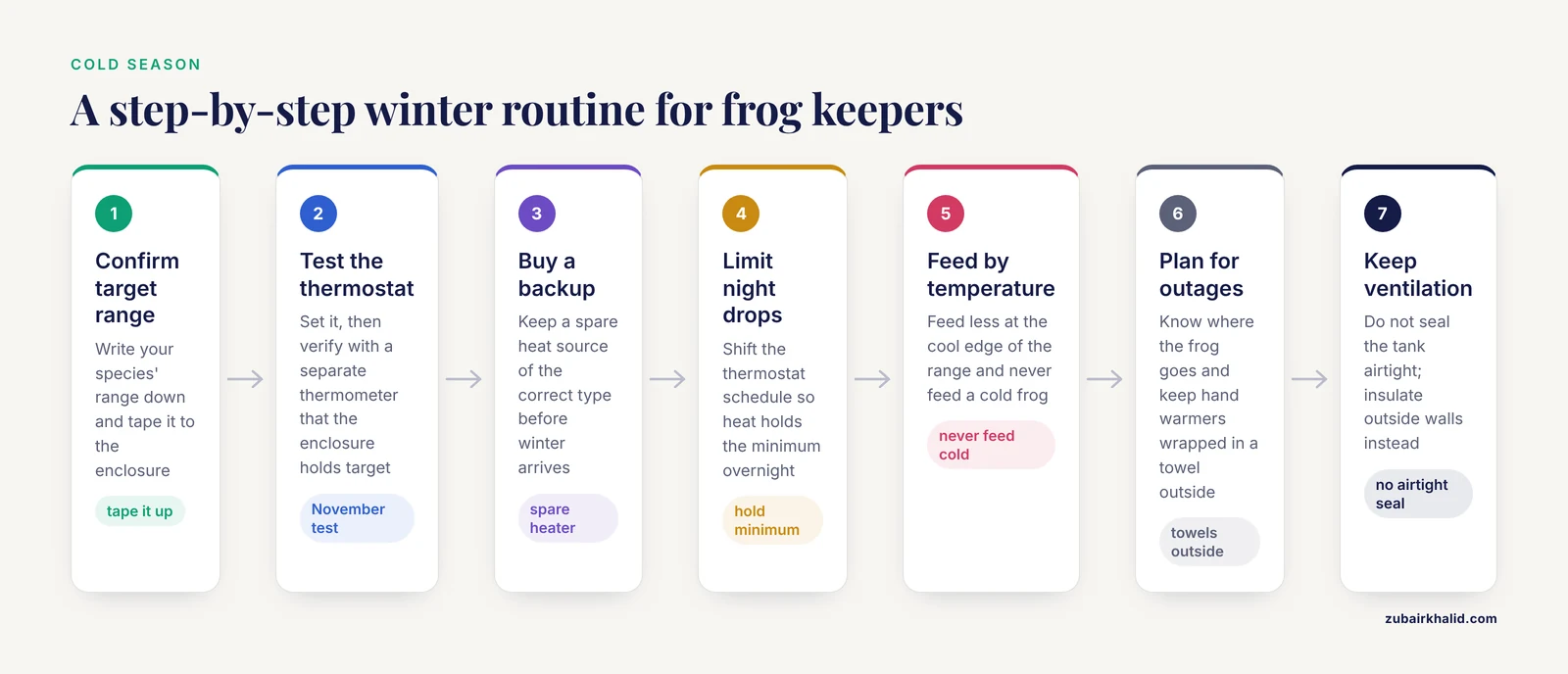
- Confirm your species' target range in writing and tape it to the enclosure. In winter, sleep-deprived or hurried owners need the number in front of them.
- Test the thermostat. Set it, then verify with a separate thermometer that the enclosure actually holds the target. Thermostats drift and fail, and a November test is better than a January emergency.
- Buy a backup before you need one. Keep a spare heat source of the correct type on hand. A spare heater costs far less than an emergency.
- Reduce night drops within reason. A small nighttime drop is natural and fine. A large one is not. If your home drops sharply overnight, shift the thermostat schedule so heat holds the minimum through the coldest hours.
- Feed according to temperature, not the calendar. When temperatures are at the cool edge of the range, feed less often. When they are correct, resume normal feeding. Never feed a cold frog.
- Plan for power outages. Know where you would move the frog in an outage. A bathroom with no windows, insulated by towels around the enclosure, buys hours. Hand warmers activated and wrapped in a towel at the outside of the enclosure, never inside where the frog can touch them, can hold a small tank in range for several hours. Rehearse the plan mentally before winter arrives.
- Do not seal the enclosure airtight to trap heat. Amphibians need ventilation, and stagnant, humid, warm air encourages bacterial and fungal growth on the skin. Balance insulation on the outside of the tank with maintained airflow.
What not to do when keeping a frog warm
- Do not use heat rocks. They are designed for reptiles and are notorious for causing burns, and amphibian skin is far more delicate.
- Do not place a basking lamp over an open-top amphibian enclosure in a way that dries the enclosure out. Heat lamps pull humidity down fast, and dry heat is the worst combination for frog skin.
- Do not warm a cold frog rapidly. Bring the enclosure back into range over an hour or more.
- Do not assume the enclosure temperature equals the room temperature. Tanks near exterior walls, on the floor, or in drafts run several degrees cooler than the thermostat on your wall says.
Temperature Safety by Season
Spring
Spring brings temperature swings rather than extremes. Sunny afternoons can push an enclosure several degrees above the room reading, and cool nights pull it down. This is the season to recheck thermostat function after winter use and to watch for the warm-edge problem returning as the sun angle rises. If your frog overwintered at reduced feeding, resume normal feeding only after temperatures are stable in range.
Summer
Summer is the high-risk season for heat. Practical measures, in order of effectiveness:
- Relocate the enclosure away from windows and out of any direct sunlight. A tank in afternoon sun becomes an oven regardless of room temperature.
- Keep the room itself cool. Air conditioning aimed at the room, not the tank, is the most reliable summer tool. If you do not have air conditioning, use fans to move room air around the enclosure, never blowing directly into it, because moving air strips humidity.
- Provide a thermal refuge. A deeper, shaded, moist area or a large water dish at the cool end gives the frog somewhere to go while you fix the underlying problem.
- For aquatic frogs, monitor water temperature daily in summer. Small tanks heat and cool faster than large ones. Partial water changes with appropriately temperature-matched, dechlorinated water can pull an overheated tank down safely.
- Watch humidity. Summer heat plus evaporating water can swing humidity unpredictably in both directions. Verify both parameters, not just one.
If the room cannot be kept below the frog's upper limit during a heat wave, an exotics veterinarian can advise on the safest short-term holding strategy for your species and setup. Do not improvise with ice.
Autumn
Autumn is preparation season. Test every piece of heating equipment, replace anything unreliable, buy the backup heater, and confirm your thermometer readings are accurate by comparing two probes. Check the enclosure's position against new drafts and colder exterior walls. Begin tapering feeding volume if your species' temperatures will sit at the lower end through winter, since cold frogs should never carry full stomachs.
Winter
Winter is the season of cold-side emergencies, covered in detail in the keeping-a-frog-warm section above. The single most important winter habit is checking the morning minimum temperature every day before you leave the house. A frog that spent the night at 58 degrees needs intervention that morning, not that evening.
Humidity and Temperature Work Together
Temperature and humidity fail together more often than they fail alone. Warm, dry air dehydrates a frog rapidly. Cool, saturated air chills it and promotes skin disease. When you adjust one, recheck the other. Misting, larger water dishes, and covered mesh tops raise humidity and buffer temperature swings. Excessive ventilation or a heat lamp in an open-top enclosure does the opposite.
Hygiene belongs in this same conversation. Environmental quality, water quality, and temperature stability form a single system of husbandry, and the veterinary literature on captive frog colonies treats them that way. The Xenopus colony case concluded that water-quality monitoring and husbandry are central to caring for these animals, alongside diagnosis and treatment of the infections themselves [1]. A keeper who keeps temperature right but lets water quality slide, or the reverse, has solved half the problem.
Common Mistakes That Cause Temperature Emergencies
- No thermostat. A heater without a thermostat is an uncontrolled variable. Eventually it fails, and the failure is usually toward overheating.
- Trusting the heater's dial. The dial is a request, not a measurement. Only a separate thermometer measures.
- One thermometer, wrong placement. A probe at the top of the tank reads the warmest air. Place probes where the frog lives.
- Heat mats under substrate for burrowing species. Burns, impaction from a frog seeking warmth by pressing into the substrate, and dehydration all follow. Wall-mount the mat instead.
- Feeding a cold frog. Undigested food in a chilled frog's gut is a veterinary emergency in the making. Warm first, feed later.
- Reading brumation into lethargy. If temperatures were never intentionally lowered and the frog was never prepared, a motionless frog is a cold frog, not a hibernating one.
- Overcorrecting with ice or refrigerated water. Rapid cooling causes thermal shock. Cool gradually toward the target range.
- Ignoring water quality in aquatic species. Temperature problems and water quality problems arrive together and compound. The Epistylis and Saprolegnia outbreak in captive Xenopus was managed with attention to both diagnosis and the underlying husbandry and water-quality conditions [1].
- Sealing the tank to keep warmth in. Stagnant air, fungal growth, and ammonia accumulation follow. Insulate the outside walls, keep the ventilation functioning.
- Assuming the frog will "let you know." Frogs hide illness until the late stages. The thermometer, not the frog, gives you the early warning.
Troubleshooting Temperature Problems
My tank will not reach the target range even with the heater on. Check the room temperature, check for drafts and exterior walls, verify the heater wattage is appropriate for the enclosure volume, and confirm the thermostat probe placement. A probe placed directly against the heat source reads high and shuts the heater off early, leaving the enclosure cold.
My tank overshoots the target every afternoon. Look for sunlight exposure first, then for a thermostat probe placed too far from the heat source, then for a heat source that is too powerful for the enclosure size. Enclosures overheat more from the room and the sun than from their own equipment in most cases.
My readings are inconsistent between two thermometers. Cross-check both probes in the same glass of water for ten minutes. If they disagree, trust the calibrated digital one and replace the other. A keeper arguing with instruments should buy better instruments.
My frog was cold overnight and is lethargic this morning. Bring the enclosure into the target range gradually, offer water, withhold food, and observe. If normal behavior does not return within a day of correct temperatures, or if the frog shows any skin changes, contact an exotics veterinarian.
My aquatic frog's tank is drifting. Verify the heater against a separate thermometer, check whether the heater is failing or undersized, and review your partial water-change routine. When replacing water, match the replacement water temperature to the tank so you do not shock the animal.
Welfare and Safety Points
A frog's welfare under your care depends on four environmental pillars that stand or fall together: correct temperature, correct humidity, clean water or clean substrate, and appropriate food offered only at correct temperatures. The veterinary case literature from laboratory amphibian colonies reinforces that husbandry quality, including water quality monitoring, is central to preventing disease in captive frogs [1]. Temperature is the pillar owners most often underestimate because failures are invisible until they are not.
Two safety points deserve emphasis. First, amphibians absorb substances through their skin, so anything that contacts the frog's environment, from soap residue on your hands to pesticide spray in the room, matters at every temperature. Rinse and dry your hands before handling the enclosure or its contents. Second, temperature emergencies are largely preventable with equipment that costs little. A thermostat, two thermometers, and a spare heater cover most failure modes a home keeper will ever face.
Limitations and When to Contact a Veterinarian
Individual cases need a veterinarian, and this article provides general education rather than a prescription for any specific animal. Exact safe temperature ranges, heating equipment choices, and emergency interventions vary by species, enclosure, and the individual animal's condition. Establish a relationship with a veterinarian who treats amphibians before you need one urgently, and confirm your species' specific target range with that veterinarian or with a current species-specific care resource.
Contact an exotics veterinarian promptly in any of the following situations:
- Your frog has been above its target range and shows open-mouth breathing, lethargy, disorientation, loss of righting reflex, or seizure-like movements. These are frog heat stroke signs and represent an emergency.
- Your frog has been below its target range, has refused food for more than a few days at correct temperatures, or shows a bloated or abnormally firm abdomen after being fed while cold.
- You notice skin changes of any kind. Discoloration, ulceration, excess sloughing, fuzzy patches, or unusual dryness. Amphibian skin disease progresses quickly, and opportunistic organisms such as Saprolegnia can establish on stressed animals, as documented in captive frog colonies [1].
- Your aquatic frog sits listlessly, drifts abnormally, or stops feeding, especially alongside any change in water temperature or water quality.
- Your frog has survived a temperature excursion and appears recovered. A post-event checkup is a reasonable investment, because internal damage from heat or cold is not always visible at home.
This article is educational and is not a substitute for veterinary diagnosis or treatment.
Frequently Asked Questions
What temperature range is safe for most pet frogs?
For most commonly kept tropical and temperate pet species, a stable range roughly between the high 60s and low 80s Fahrenheit works well, with a modest nighttime drop. The exact target depends on species, so confirm your species' specific range with an exotics veterinarian or a current species-specific care guide.
How hot is too hot for a frog?
For most common pet species, sustained temperatures above the mid 80s Fahrenheit are dangerous, and temperatures in the 90s can be fatal within hours, particularly when humidity is low. Move the frog out of the heat, cool the enclosure gradually, and call an exotics veterinarian if any heat stroke signs appear.
How cold is too cold for a frog?
For most tropical pet species, sustained temperatures below the low 60s Fahrenheit are a welfare problem, and the 50s or lower are dangerous. Temperate species tolerate cooler conditions but still need stability. Warm the enclosure gradually and withhold food until temperatures are correct.
What are the signs of heat stroke in a frog?
Frog heat stroke signs include profound lethargy or floppiness, open-mouth breathing, disorientation, loss of the ability to stay upright, abnormal skin color or dryness, and unresponsiveness. Earlier warning signs include constant escape attempts and sitting in the water dish continuously. Heat stroke is an emergency requiring immediate veterinary contact.
How do I keep a frog warm in winter?
Use a thermostat-controlled heat source sized for the enclosure, verified with separate thermometers at frog level, plus a spare heater stored for failures. Insulate the outside of the tank against drafts, hold a safe overnight minimum, and never feed a frog that has been cold. Plan for power outages before winter arrives.
Do frogs need a heat lamp?
Not necessarily. Many frog species do better with gentle, thermostat-controlled heat from a side-mounted mat or a low-wattage ceramic emitter rather than a bright basking lamp, because lamps dry out amphibian enclosures. Temperate species in a heated home often need no supplemental heat at all. Choose the equipment type that maintains your species' range and humidity together.
Can a frog recover from heat stroke?
Recovery is possible when the overheating is caught early and the frog is cooled gradually to its normal range with access to water, but advanced heat stroke is frequently fatal. Recovery at home does not rule out internal injury, so a veterinary examination after any significant heat event is worthwhile.
Should I let my frog brumate in winter?
Only if your species naturally brumates, you have researched the deliberate protocol for that species, and your frog is healthy and well-conditioned beforehand. An unplugged heater and a motionless frog is not brumation, it is cold stress. If you are unsure whether brumation applies to your species, ask an exotics veterinarian before temperatures drop.