Frog Healthy Weight: Body Condition and Weight Charts
By Dr. Zubair Khalid, DVM, MS, PhD ·
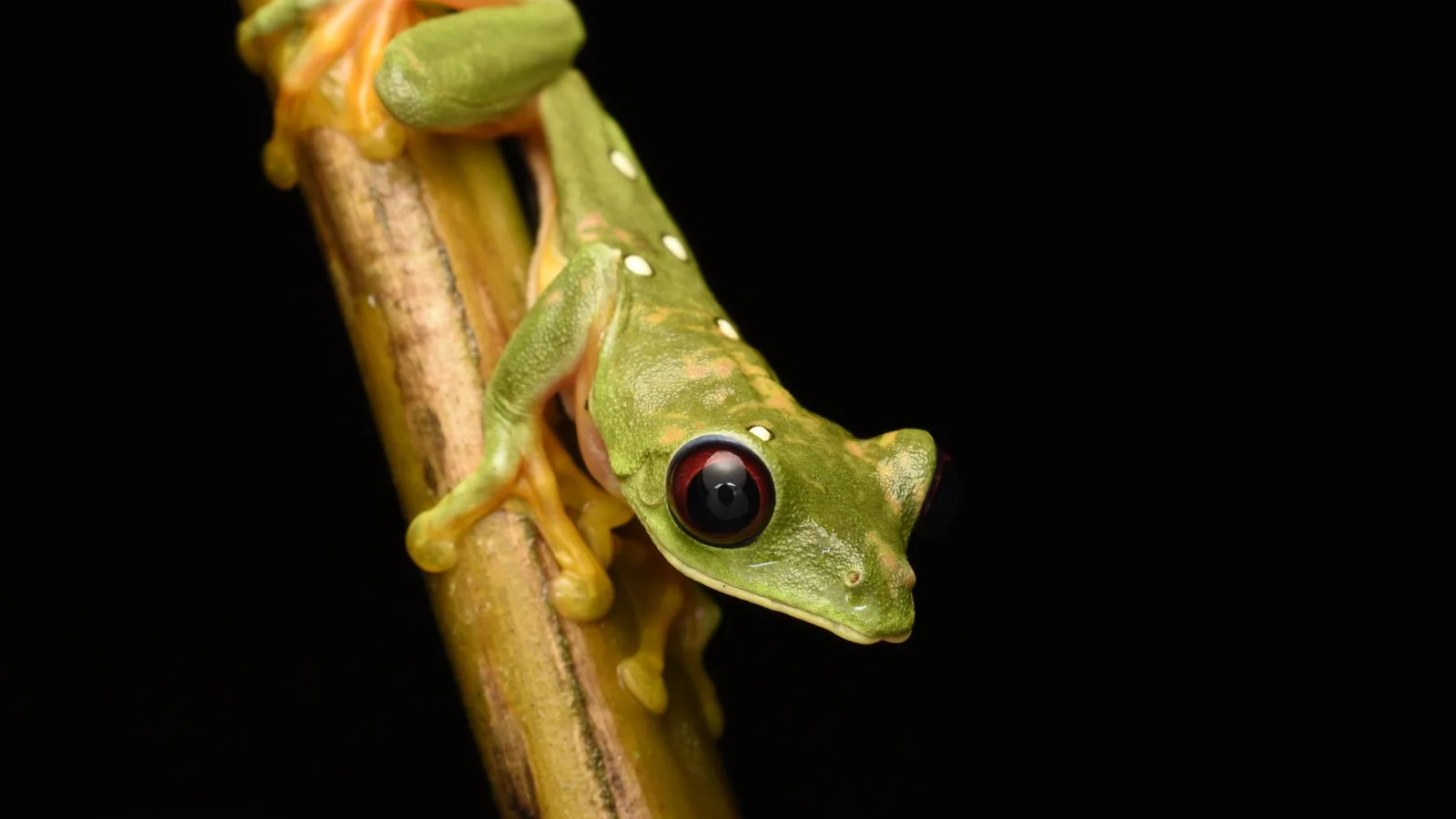
A healthy frog weight is not a single number you can look up for every species. A healthy weight is the weight at which an individual frog carries enough energy reserve to support normal activity and reproduction without storing excess fat, and the most reliable way to find it for your animal is to combine a body condition score with a personal weight record kept over weeks and months. Adult female African clawed frogs (Xenopus laevis) offer one of the few published weight references for any frog species, ranging from about 83 grams at the thinnest score to about 193 grams at the fattest score, which shows how wide the normal range can be even within one species [1]. For most pet frogs, the honest answer to "how much should a frog weigh" is that your frog's own trend line and body shape matter more than any chart printed on the internet.
This guide explains how to assess your frog's body condition at home, how to build a weight record you can actually use, what to do if you suspect your frog is overweight or underweight, and when to involve an exotic animal veterinarian.
Frog Healthy Weight at a Glance
| Step | What to do | Why it matters |
|---|---|---|
| 1 | Buy a digital scale that reads in 1 gram increments | Frogs are light, and small changes are meaningful |
| 2 | Weigh your frog at the same time each week, before feeding | Feeding and defecation shift body weight by several grams |
| 3 | Record every weight in a simple log with the date | Trends reveal problems before a single reading can |
| 4 | Look at your frog from above and from the side each week | Body shape changes often appear before weight changes |
| 5 | Compare shape against the body condition descriptions in this article | A frog body condition score turns a vague impression into a usable label |
| 6 | Contact an exotic veterinarian for rapid weight change, bloating, or refusal to eat | Frogs hide illness until it is advanced |
What a Healthy Weight Actually Means for a Frog
Body condition scoring is the standard veterinary tool for answering whether an animal is too thin, too fat, or in ideal condition. It has been developed and validated for many species, from African elephants, where scores were checked against ultrasound measurements of fat reserves [2], to chimpanzees, where a visual scoring system correlated strongly with actual body weight and identified more overweight individuals than weight records alone [3]. Reptile medicine uses the same approach, and a five point system for Hermann's tortoises correlated significantly with shell based measurement methods across more than 370 animals [4].
Frogs present a special challenge for this system. In mammals, scoring relies on feeling fat under the skin. Clawed frogs, and many other amphibians, store fat as internal fat bodies inside the coelomic cavity rather than as a subcutaneous layer, so the assessment criteria developed for mammals cannot be applied directly to them [1]. Researchers at a German institution addressed this by developing a species specific body condition score for adult female clawed frogs based on body contour, weight, and length, producing a five level scale in which a score of 1 indicates severe wasting and a score of 5 indicates obesity [1].
Why does any of this matter to a pet owner? Because body condition is not cosmetic. In captive populations of many species, obesity and nutrition related disease are major concerns, and captive animals consistently show higher body mass and condition scores than their free ranging counterparts, as documented in giant anteaters [5] and in captive turtles, where a survey of 73 pet African side-neck turtles found 22 percent were overweight or obese and none were emaciated [6]. Fat frogs face the same pattern of risk. Body condition even affects behavior, since golden mantella frogs in better condition held a tonic immobility (death feigning) response for different durations than frogs in poorer condition, suggesting that reserves influence how a frog copes with stress [7].
How Much Should a Frog Weigh?
There is no universal weight for "a frog." Weight depends on species, sex, age, and reproductive state. A White's tree frog, a Pacman frog, a dart frog, and an African clawed frog are built so differently that a single chart would be meaningless. The published data that comes closest to a true weight chart is the body condition study on adult female clawed frogs, which weighed and measured 62 females and matched each body weight to a condition score [1].
Published Weight Reference for Adult Female African Clawed Frogs
| Body condition score | Interpretation | Mean body weight |
|---|---|---|
| 1 | Severe wasting, described as near a humane endpoint | 83 g (a single animal) |
| 2 | Poor condition | 103 to 111 g (three animals) |
| 3 | Lean to adequate | 114.7 g (about 16.7 g standard deviation) |
| 4 | Good condition | 163.1 g (about 16.0 g standard deviation) |
| 5 | Obese | 193.3 g (about 27.6 g standard deviation) |
Two lessons emerge from this table. First, a healthy adult female of a single species can weigh anywhere from roughly 115 to 160 grams and still be in acceptable condition. Second, the heaviest healthy frogs in this study outweighed the thinnest healthy frogs by around 50 grams, which is enormous in an animal that size. This is why judging a frog against a neighbor's frog, or against a random internet number, so often produces false alarms in both directions.
For species other than clawed frogs, no comparable published weight-to-score tables are widely available, so your best reference is your own frog's history. A stable weight in a frog with good muscle tone and normal contours is a far better indicator of a frog healthy weight than any species-average figure. Ask your veterinarian or an experienced keeper of the same species for a realistic weight range, then treat your own log as the authoritative record.
One caveat applies to females of many species. Gravid females carry masses of eggs, and egg load can temporarily inflate body weight. This is a normal reproductive state, not a weight problem, and distinguishing a gravid female from an overconditioned one is a good specific question for an amphibian veterinarian.
Frog Body Condition Score: How to Assess Your Frog Step by Step
A frog body condition score turns "he looks a bit chunky" into a repeatable label you can track. The five level framework validated for clawed frogs gives you the structure, and the same logic of scoring from body contours applies across amphibians [1]. Perform the assessment in good light, with the frog viewed from directly above and from the side, without handling if the animal is stressed.
Step 1. Look at the dorsal (top) outline
Viewed from above, a frog in good condition shows a smooth oval outline. The spine should not form a visible ridge down the middle of the back, and the sides should not bulge sharply outward away from the limbs.
Step 2. Look at the lateral (side) profile
From the side, a well conditioned frog has a gentle curve from snout to vent. A pronounced sagging or bulging belly, especially one that hangs low when the frog sits, suggests excess internal fat or, alternatively, fluid or organ enlargement, which only a veterinarian can distinguish.
Step 3. Check the limbs
The upper arms and thighs should look rounded but not swollen. Legs that look thin and angular, with the bones easy to trace by eye, point toward an underweight frog.
Step 4. Assess overall contour against the five levels
| Score | What you see | What it means |
|---|---|---|
| 1 | Extreme wasting, bony contours prominent, animal weak | Emergency, contact a veterinarian immediately |
| 2 | Thin, visible skeletal ridges, poor muscle over limbs | Underweight, needs veterinary assessment |
| 3 | Lean, slight skeletal definition, good muscle | Acceptable to ideal |
| 4 | Smooth, rounded contours, no visible bones, no sagging | Ideal |
| 5 | Marked fullness, bulging flanks, heavy, sluggish appearance | Obese, plan a weight management program |
The clawed frog validation study confirmed that these contour based categories line up with real differences in body mass, with each score level corresponding to a distinct average weight [1]. That validation is what makes the system trustworthy rather than guesswork.
Reading the results honestly
Owners tend to err in both directions. In the chimpanzee study mentioned earlier, the visual scoring system flagged 36 individuals as overweight while weight records alone flagged only 26, meaning hands-off visual assessment catches fat animals that a scale can miss [3]. The reverse also happens, where a gravid or normally robust frog is mistaken for obese. Score your frog the same way, in the same light, at the same point in the feeding cycle each time, and rely on the pattern across weeks rather than any single assessment.
Building a Weight Record That Actually Means Something
The single most useful thing you can do for your frog's long-term health costs almost nothing. A digital scale that reads in grams, a small smooth container, and a notebook or phone note are all you need.
How to weigh a frog safely

- Place an escape-proof container on the scale and press the tare (zero) button so the container's weight is subtracted.
- Gently transfer the frog into the container, or weigh it inside its temporary transport cup. Never let a frog jump off a hard surface mid-weighing.
- Wait until the reading settles, then record the number, the date, the time, and whether the frog had eaten recently.
- Return the frog to its enclosure promptly and minimize handling time.
How often to weigh
Weekly weighing works well for most adult pet frogs. Growing juveniles can be tracked weekly too, with the expectation of steady upward weight. When your veterinarian is managing a specific problem, such as a frog that needs to lose weight, follow the recheck interval they set, since frequent weighing under stress can be counterproductive.
What the numbers mean
A stable weight across weeks in a scoring frog is the signature of a frog healthy weight. Gradual, deliberate gain is expected in growing juveniles and in females building eggs. The changes that should prompt action are a steady downward trend in an adult, a rapid unexplained loss, or a continued climb in an animal already showing obese contours. Because body condition can change meaningfully within a single month when an animal's environment and feeding change, as demonstrated in a release trial with captive-bred harlequin frogs whose condition shifted within 27 days [8], short intervals between checks give you time to correct problems early.
Is My Frog Overweight? Signs and Risk Factors
Ask these questions of your own frog. Any single "yes" is a reason to score more carefully and start logging weight. Several together point strongly toward excess condition.
- Does the frog look unusually round from above, with the body wider than the head proportionally?
- Do the flanks bulge or sag when viewed from the side?
- Is the frog visibly less active, slower to strike at food, or reluctant to move?
- Does the frog tire quickly during normal activity?
- Are you feeding large volumes of high-calorie or high-fat feeders, or feeding more often than a maintenance schedule?
Captivity itself is the underlying driver. Research across zoo species shows the pattern repeatedly. More than 70 percent of captive Asian elephants surveyed in China were overweight or obese, with insufficient time and space for exercise and calorie-dense diets identified as leading contributors [9]. Captive anteaters carried higher body mass and higher condition scores than free-ranging animals [5]. Captive pet turtles showed a similar tilt toward excess condition, with overweight and obese animals far outnumbering underweight ones [6]. Frogs in a typical home vivarium face the same two forces in miniature, abundant food and limited space, and an owner who recognizes that pattern early can prevent years of gradual weight gain.
Overweight frogs also hide the problem well because their fat is internal [1]. By the time a frog looks obese from the outside, the fat bodies inside the coelom are substantially enlarged, which is why regular scoring and weighing matter more than a casual glance.
How to Help a Frog Lose Weight
If your frog scores as obese, or the weekly log shows steady gain with no reproductive explanation, take a structured approach. Do not simply stop feeding, since abrupt restriction in an amphibian can cause its own problems. Work with an exotic animal veterinarian to set the plan.
Step 1. Get a veterinary baseline first
Before restricting food, have a veterinarian examine the frog. Some causes of a heavy, bloated appearance, including fluid accumulation, organ enlargement, egg retention, and infection, look like obesity from the outside and require entirely different treatment. A professional exam prevents you from putting a sick frog on a diet.
Step 2. Adjust the diet with professional guidance
The evidence from other captive species supports controlling calorie intake rather than eliminating food. When Thai tourist camps reduced the supply of bananas and sugar cane during the pandemic, fewer elephants fell into the obese category and blood triglyceride concentrations dropped [10]. The recommendation arising from the Chinese elephant survey was to control the supply of high-calorie feed while extending exercise opportunity [9]. Applied to frogs, the practical translation is to work with your veterinarian on feeder species, feeder size, and feeding frequency so that total calorie intake falls gradually. Fatty feeder items are the amphibian equivalent of the elephant's sugar cane, and trimming them first is usually the highest-yield change.
Step 3. Increase the opportunity for activity
In the elephant data, insufficient outdoor time and limited space were identified as primary causes of weight gain alongside diet [9]. For a frog, more enclosure space, more structural complexity such as climbing branches and ledges, and feeding methods that require hunting rather than passive delivery all increase daily movement. An exotic veterinarian or an experienced keeper of your species can suggest enrichment appropriate to your frog's climbing and swimming ability.
Step 4. Monitor and follow up
Weigh weekly and rescore body condition every two to four weeks. Weight loss in an amphibian should be slow and gradual. If your frog loses weight too quickly, stops eating, or becomes lethargic, stop the restriction and contact your veterinarian. Schedule a follow-up appointment when you begin the program so the veterinarian can confirm the plan and adjust it at recheck.
What not to do
- Do not fast a frog for extended periods without veterinary direction.
- Do not judge progress by appearance alone, since internal fat bodies change before outward contours do [1].
- Do not compare your frog to other people's frogs or to unnamed internet numbers.
- Do not chase a target weight from a chart for a species with no published chart, such as clawed frogs have.
Common Mistakes in Judging Frog Weight
Weighing at inconsistent times. A frog that has just eaten several insects weighs measurably more than the same frog a day later. Always weigh under the same conditions, ideally before the weekly feeding.
Mistaking a gravid female for an obese one. Egg mass inflates body weight and body fullness. If your female frog's shape changes seasonally or she shares space with a male, ask a veterinarian whether she is gravid before treating her as overweight.
Judging by appetite. Many frogs, especially those kept warm and fed generously, will eat far beyond maintenance needs. A frog that eats eagerly is not necessarily a frog at a healthy weight.
Using the scale alone. The chimpanzee validation study showed that weight records missed roughly a third of the overweight animals that visual scoring identified [3]. For frogs, the reverse problem applies, since a gravid female can post a high weight while being perfectly healthy. Weight and condition score together give the full picture.
Reacting to a single reading. One heavy or light weigh-in means little. Trends over three or more weeks mean a great deal.
Welfare and Handling During Weight Assessment
Frogs tolerate brief weighing well when it is done calmly. Keep handling short, support the body fully, and work over a soft or enclosed surface in case of a jump. If your frog shows defensive behavior such as prolonged death feigning, note that this response is influenced by body condition itself, as shown in golden mantellas where individuals in different conditions held the immobility response for different durations [7]. A frog that repeatedly freezes during handling may be telling you something about its stress level or its reserves, which is useful information to share with your veterinarian.
Body condition interacts with health in ways owners can monitor. In the harlequin frog release trial, body condition, skin bacterial communities, and disease status all shifted within a month of a change in environment, and condition in captive-born frogs was similar to or higher than that of wild counterparts [8]. For a pet frog, the practical reading is that condition responds quickly to how you keep the animal, which is good news. Problems caught early are problems that respond to adjustment.
Limitations and When to Contact a Veterinarian
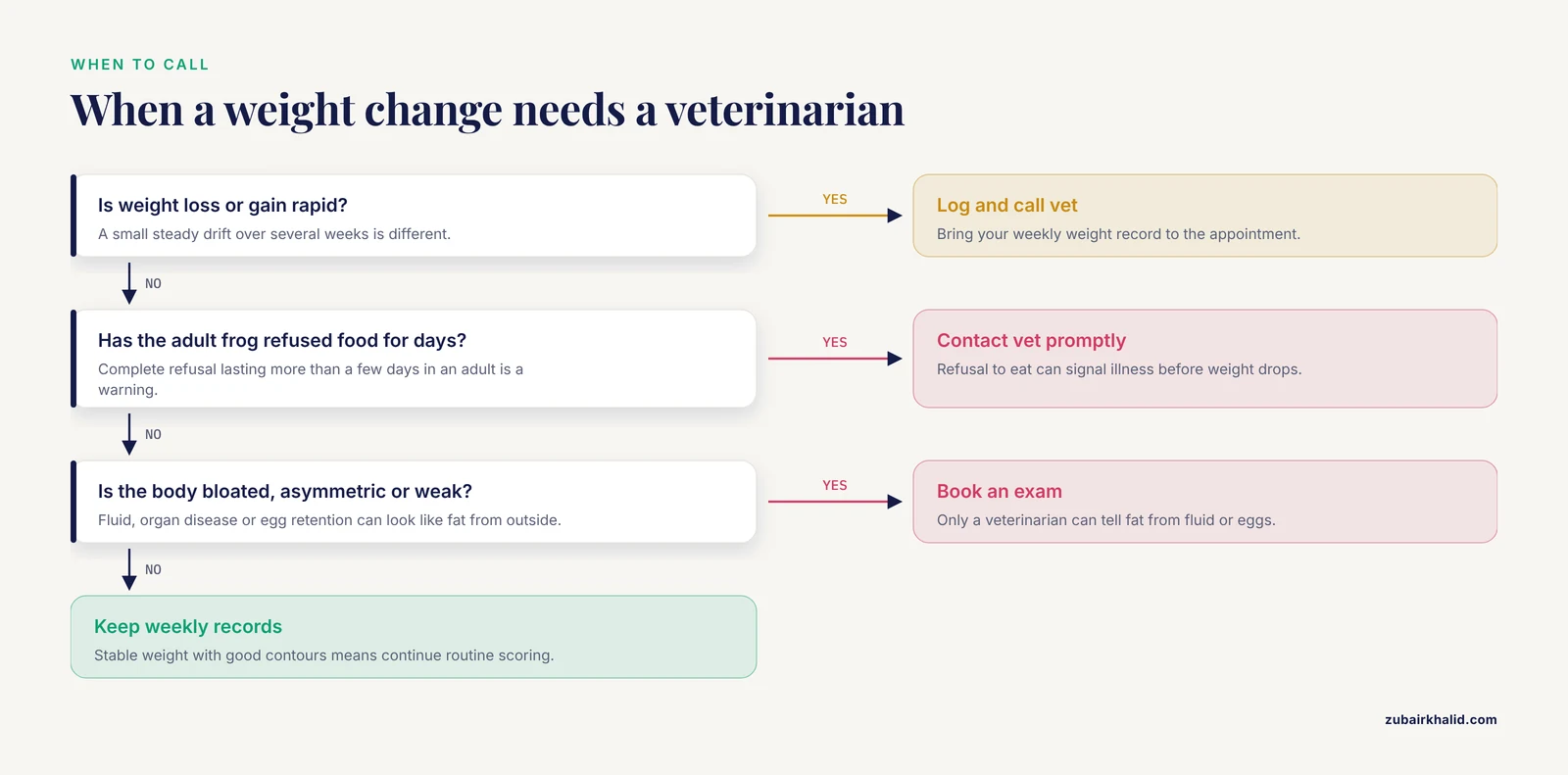
Body condition scoring is a screening tool, not a diagnosis. A score estimates fat reserves from outward appearance. It cannot detect internal disease, and published score systems exist for only a small number of amphibian species, most notably the adult female clawed frog [1]. Individual cases need a veterinarian, and an exotic animal clinician can pair your home records with a physical examination and, when needed, imaging to distinguish fat from fluid, eggs, or organ changes.
Contact a veterinarian promptly if your frog shows any of the following.
- Weight loss or gain that is rapid, or more than a small steady drift over several weeks
- Complete refusal of food lasting more than a few days in an adult
- A bloated or asymmetric body shape, which can indicate fluid or organ disease rather than fat
- Marked lethargy, weakness, or an inability to right itself
- Skin changes such as discoloration, shedding problems, or wounds
- A body condition score of 1 or 2, which indicates severe wasting
This article is educational and is not a substitute for veterinary diagnosis or treatment.
Frequently Asked Questions
How much should a frog weigh?
There is no single answer, because normal weight varies enormously by species, sex, age, and reproductive state. The best available published reference comes from adult female African clawed frogs, where healthy condition spanned roughly 115 to 160 grams and obese animals averaged about 193 grams [1]. For any other species, track your own frog's weight trend and body shape rather than chasing an internet average.
How do I know if my frog is overweight?
Score the body, not just the scale. Look for a round outline from above, bulging or sagging flanks from the side, and reduced activity, and confirm by weighing weekly. Remember that frog fat is stored internally as fat bodies, so outward signs appear relatively late in the process.
What is a frog body condition score?
A body condition score is a five level label, from 1 for severe wasting to 5 for obesity, assigned by assessing the frog's body contour, limb fullness, and overall shape. It is a semi-objective tool adapted from systems validated in many other species, and for clawed frogs it has been shown to correspond to real differences in measured body weight [1].
How often should I weigh my frog?
Once a week under consistent conditions, before feeding, is a practical routine for most adult pet frogs. Weigh more often only if your veterinarian asks you to during a weight management program, and always record the number with the date so trends are visible.
How can I help my frog lose weight?
Have a veterinarian rule out non-diet causes of a heavy appearance first, then gradually reduce calorie intake by adjusting feeder type, size, and frequency, and increase the frog's opportunity for movement with more space and hunting-based feeding. Evidence from other captive species supports exactly this combination of controlled feed and increased exercise [9], [10]. Never fast a frog without professional guidance.
Can a frog be too thin?
Yes, and it is more urgent than being overweight. A frog at the lowest condition scores shows visible skeletal contours, thin limbs, and weakness, and the clawed frog study placed the single thinnest animal at 83 grams, a level its authors associated with a humane endpoint [1]. A frog scoring 1 or 2 needs veterinary attention quickly.
Do male and female frogs weigh the same?
Usually not. Females of many species are substantially larger than males, and gravid females carry additional egg mass that temporarily raises their weight. The published weight chart referenced in this article applies specifically to adult female clawed frogs [1], so do not apply it to males or to other species.
Does body condition affect frog behavior and health?
Yes. In golden mantella frogs, body condition influenced the duration of the tonic immobility response, an anti-predator behavior, meaning reserves affect how frogs cope with stress [7]. In captive-bred harlequin frogs, body condition responded measurably within a month of environmental change [8], which is one more reason to monitor it regularly.
Sources
- Establishment of the body condition score for adult female Xenopus laevis
- Development of a Body Condition Scoring Index for Female African Elephants Validated by Ultrasound Measurements of Subcutaneous Fat
- Validation and Utility of a Body Condition Scoring System for Chimpanzees (Pan troglodytes)
- Body condition scoring facilitates healthcare monitoring in Hermann’s Tortoises (Testudo hermanni ssp.)
- Evaluation and Ultrasonographic Validation of the Body Condition Score in Giant Anteaters (Myrmecophaga tridactyla Linnaeus, 1758).
- Body Condition Scoring and Obesity in Captive African Side-Neck Turtles (Pelomedusidae)
- The tonic immobility test: Do wild and captive golden mantella frogs (Mantella aurantiaca) have the same response?
- Body condition, skin bacterial communities and disease status: insights from the first release trial of the limosa harlequin frog, Atelopus limosus
- Obesity status and its relative factors of captive Asian elephants (Elephas maximus) in China based on body condition assessment
- Physiological changes in captive elephants in Northern Thailand as a result of the COVID-19 tourism ban - muscle, liver, metabolic function, and body condition