Frog Enrichment Ideas That Match Natural Behavior
By Dr. Zubair Khalid, DVM, MS, PhD ·
Good frog enrichment is not about novelty objects. It is about giving a frog the chance to perform the behaviors its body and brain are built for: hiding under cover, hunting moving prey, burrowing, climbing, soaking, and using vertical space. The most effective frog enrichment ideas follow a simple sequence. First, offer multiple shelter options with different materials, shapes, and heights, because shelter choice studies show frogs discriminate strongly between these variables. Second, add structural variety such as branches, ledges, plants, and shallow and deep water zones so the frog can choose microhabitats through the day. Third, build feeding around live or moving prey so hunting behavior stays intact. Fourth, protect all of it with clean water and careful hygiene, because poor water quality and contaminated decorations are documented routes for skin disease in captive frogs.
This article walks through each step, explains the evidence behind shelter design, gives do-it-yourself projects you can build safely, lists the mistakes that cause most enrichment failures, and tells you when a behavior change needs a veterinarian rather than a new decoration.
Frog Enrichment at a Glance
Use this checklist as your starting point. Every item can be implemented today with common supplies.
| Step | Action | Why It Works |
|---|---|---|
| 1 | Provide at least two shelters made of different materials, at different heights | Frogs show measurable preferences for shelter material, size, shape, color, and elevation [1] |
| 2 | Favor rectangular, opaque hides over round ones | Both adults and juveniles in a shelter preference study consistently avoided spherical tunnels [1] |
| 3 | Offer deeper hide structures rather than shallow domes | Deeper tunnels were preferred in the same study [1] |
| 4 | Add climbing and vertical structure appropriate to your species | Many frogs use height for temperature and humidity choice |
| 5 | Feed live or moving prey in varied locations | Preserves natural hunting behavior |
| 6 | Provide a digging or burrowing medium for fossorial species | Matches natural concealment behavior |
| 7 | Test water quality on a routine schedule and log results | Water-quality monitoring is a documented pillar of captive frog care [2] |
| 8 | Disinfect or safely source every natural material before it enters the tank | Contaminated tank contents can introduce skin parasites and fungal organisms [2] |
| 9 | Rotate one element at a time, not the whole tank | Sudden full changes can disrupt established resting spots |
| 10 | Photograph the tank monthly and record behavior | Objective records reveal boredom or stress earlier than memory does |
Why Enrichment Matters for Frogs
Enrichment is the practice of arranging an animal's environment so it can express species-typical behavior and make meaningful choices. For mammals and birds this often means toys and puzzles. For amphibians it means something different. A frog's daily routine in the wild is built around three tasks: staying within a narrow band of temperature and moisture, avoiding predators by hiding, and ambushing prey. A bare tank with a water dish and a single plastic hide forces the frog into a passive existence where none of those decisions exist.
The welfare argument for enrichment is straightforward. An animal that can select its own microclimate, retreat from view, and work for food has control over its environment. Control reduces chronic stress. For amphibians, whose skin is a respiratory and osmoregulatory organ as much as a barrier, chronic stress and poor husbandry interact directly with disease risk. A report on a captive colony of African clawed frogs described a multiagent skin infection involving both a fungal organism, Saprolegnia, and the ciliate ectoparasite Epistylis, and the authors tied the response explicitly to water-quality monitoring and husbandry practice [2]. That lesson generalizes: the same husbandry quality that keeps skin healthy also determines whether your enrichment plan helps or harms.
There is also a design argument. Shelter preference research in Dybowski's frogs tested material, size, shape, color, height, and tunnel structure and found that frogs made consistent, nonrandom choices among these options [1]. If frogs discriminate this precisely among shelters, then enrichment is not decoration. It is a set of decisions the animal can perceive and act on. Getting those decisions right is the difference between a tank the frog tolerates and a habitat the frog uses fully.
Signs of a Bored Frog
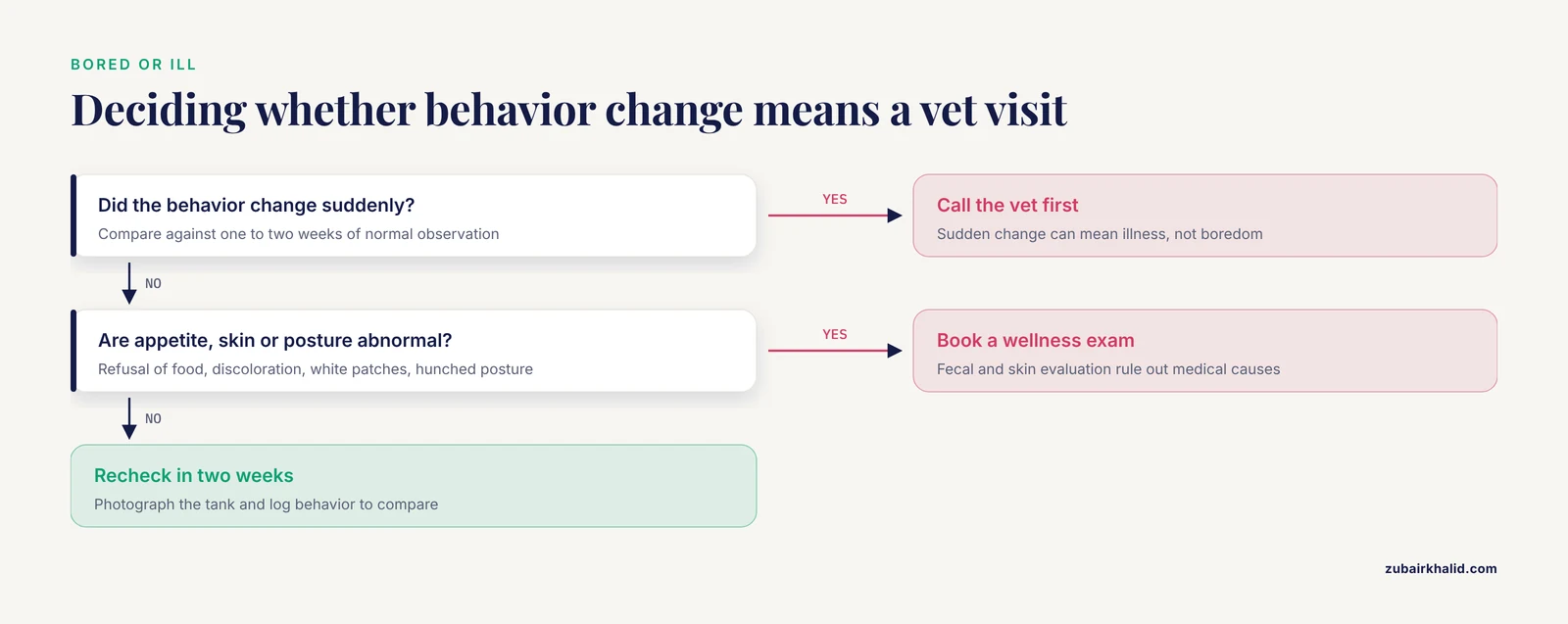
Frogs do not show boredom the way a parrot or a ferret does. They show it as a loss of behavioral variety. Watch for these patterns over one to two weeks of normal observation, ideally at the hours your species is active.
- The frog sits in the same spot on the glass or lid every night, pressing toward the edge of the enclosure in a repetitive escape attempt.
- The frog never uses the hide you provided, or uses only one corner of the tank and ignores the rest.
- Feeding response is weak. Prey is ignored until it physically touches the frog.
- A fossorial species never burrows because there is nothing to burrow in.
- An arboreal or semi-arboreal species never leaves the tank floor because there is nothing to climb.
- Activity consists only of a single nightly circuit from water to land and back.
Each of these signs can also be a symptom of illness. A frog that stops eating, stops moving, or changes its posture may be dealing with improper temperatures, water quality problems, parasitism, or metabolic disease rather than a dull environment. This is the practical rule: if the frog's behavior changed suddenly, call your veterinarian first. If the behavior has always been flat and the husbandry parameters check out, enrichment is the next lever to pull. When in doubt, a wellness examination with a fecal and skin evaluation rules out medical causes before you spend money on decor.
Matching Enrichment to Natural Behavior
The fastest way to plan enrichment is to classify your frog by its primary locomotor and foraging strategy, then build for that strategy.
Terrestrial and Fossorial Frogs
Ground-dwelling burrowers, including many toads and spadefoot-type species, spend most of their lives concealed. Their enrichment priority is substrate and cover. Provide a deep, safe, diggable substrate layer, and scatter multiple hides across the floor so the frog can choose between microclimates. The shelter preference study is directly relevant here. Adult frogs preferred shelters made of palm bark that were larger, rectangular, brown, and elevated 10 cm above the ground, while juveniles preferred even larger rectangular shelters made of ceramic, positioned 5 cm above the ground [1]. Both age classes avoided spherical tunnels and preferred deeper tunnels [1]. The practical translation for any terrestrial species is clear. Offer at least one flat-bottomed, rectangular, opaque hide, elevate it slightly so the frog can slip underneath, and avoid round dome hides as the only option.
Semi-Aquatic and Aquatic Frogs
Fully aquatic species such as African clawed frogs spend their lives in water. Their enrichment is aquatic structure: plants, hides on the bottom, varied water depth, and current-free resting zones. Here the disease lesson from the Xenopus colony report carries the most weight. Epistylis and Saprolegnia infections in that colony were managed alongside diagnosis and treatment through attention to water quality and husbandry [2]. For aquatic and semi-aquatic frogs, every enrichment decision is also a water-quality decision. Uneaten prey, decaying plants, and porous decorations all load the water with organic waste. Build enrichment that you can clean.
Arboreal and Semi-Arboreal Frogs
Climbing species use height. Their enrichment priority is vertical structure: cork rounds, branches angled diagonally, live or robust fake plants, and ledges at multiple levels. Vary the texture. A frog that can choose between rough bark, smooth cork, and waxy leaves is making tactile decisions all night. Place a sheltered spot at the top and at mid-level, not only at the floor, so climbing carries a reward.
Shelter Design: What the Evidence Shows
Shelters are the single highest-value enrichment item for most frogs, and they are also the item owners get wrong most often. The Dybowski's frog preference study is useful precisely because it tested the variables one at a time [1]. Here is what it found and how to apply it.
- Material. Adults preferred palm bark. Juveniles preferred ceramic. These are different answers to the same question, which tells you that material preference is not universal. Offer at least two materials in your tank, such as cork bark on one side and a ceramic or stone hide on the other, and see which one your frog actually uses.
- Size. Both age groups preferred larger shelters. A hide that barely fits the frog defeats the purpose. Size up.
- Shape. Rectangular shelters were preferred, and spherical tunnels were consistently avoided by adults and juveniles alike [1]. Round half-dome hides, the most common commercial product, are the shape frogs liked least in this framework. They can stay in the tank as one option, but they should not be the only option.
- Color. Brown was preferred by adults. Opaque, earth-toned shelters fit this preference and also make the frog feel concealed.
- Height. Adults chose shelters elevated 10 cm above the ground. Juveniles chose shelters 5 cm above the ground [1]. An elevated hide is simply a flat slab or bark piece supported at the edges so a gap exists underneath. This one modification turns a floor hide into a choice-based structure.
- Tunnel depth. Deeper tunnels were preferred over shallow ones [1]. If you build a hide with an entrance passage, make the chamber deeper rather than wider and shallow.
Apply this as a testing exercise in your own tank. Set up two or three shelters that differ in one variable each and track which one holds the frog at your observation times. That is enrichment working as designed, because the frog is exercising a preference you gave it.
DIY Frog Enrichment
Do-it-yourself enrichment for frogs falls into four categories. Each has a safety rule attached.
1. Elevated and Layered Hides
Build the structure the preference data points toward. Take a flat piece of cork bark or a slate tile, prop it on two or three clean, smooth stones so there is a gap of roughly a few centimeters beneath it, and position it over a patch of damp substrate. The frog gains a covered chamber it can enter and exit from either end. Build a second version in a different material and at a different height and place them on opposite sides of the thermal and humidity gradient. This single project captures the material, size, shape, height, and depth variables from the shelter research [1].
Safety rules: no sharp edges, no crumbling material, no adhesive that is not explicitly aquarium-safe and fully cured, and nothing that can shift and pin the frog. Test every build by pressing on it before it goes over an animal.
2. Planting for Cover and Climbing
Live plants do triple duty. They provide cover, they contribute to humidity stability, and they give climbing species grip points. Use species confirmed safe for amphibians, since frogs absorb chemicals through their skin and many common houseplants are toxic. Wash nursery soil off roots completely before planting, because nursery soil can carry pesticide residue. If your frog is aquatic or semi-aquatic, choose plants that tolerate full submersion and do not decay rapidly.
3. Safe Natural Materials
Leaf litter, dried bark, and seed pods enrich the substrate layer and feed the microfauna that many keepers cultivate. The safety rule comes directly from the disease literature. The Xenopus colony outbreak report documented Saprolegnia and Epistylis in captive frogs and emphasized water quality and husbandry as the control points [2]. Organic material collected outdoors and added wet to a warm tank is exactly the kind of substrate free-living aquatic organisms colonize. So treat every natural item as quarantined goods. Collect from areas with no pesticide or road runoff, bake or boil woody items where the material allows, dry leaf litter thoroughly, and never harvest from water bodies where wild amphibians live, because those are parasite reservoirs. If you see white fuzzy growth on any tank surface or decoration, remove the item, check water parameters, and contact your veterinarian, since external fungal and protist organisms are treatable when caught early [2].
4. Feeding Structures and Foraging Stations
Simple builds change how a frog eats. A feeding rock in a new location each session turns a static routine into a search task. A shallow dish buried to its rim in substrate lets a fossorial frog ambush from cover, which is how many species naturally feed. A drifting feeder ring for aquatic species spreads prey across the water column. None of these require special equipment, only a decision to vary the presentation.
The Best Toys for Pet Frogs: A Reframe
The honest answer to "what are the best toys for pet frogs" is that frogs do not play with objects the way mammals do, so the best "toys" are functional structures. The categories below are what a veterinarian or experienced keeper means by toys for this group.
- Hides and caves, especially rectangular, deep, elevated options built on the preference data above [1].
- Climbing furniture for arboreal species: cork tubes, branches, magnetic ledges.
- Moving prey, which is the closest thing to a toy a frog will genuinely engage with, because a cricket or worm triggers the full stalk, orient, and strike sequence.
- Substrate depth for diggers, which functions as a playground and a security blanket at once.
- Water movement and depth variation for aquatic species, achieved with gentle filtration outflow placement rather than strong current.
- Live plants that the frog can push through, sit under, and cling to.
Judge any commercial product against three criteria. Can it be cleaned or is it disposable. Does it have sharp edges, small loose parts, or paint that can flake. Does it create a behavior opportunity, or is it purely visual for the human. A plastic castle fails the third test for most frogs. A cork round with a gap underneath passes all three.
Feeding Enrichment Step by Step
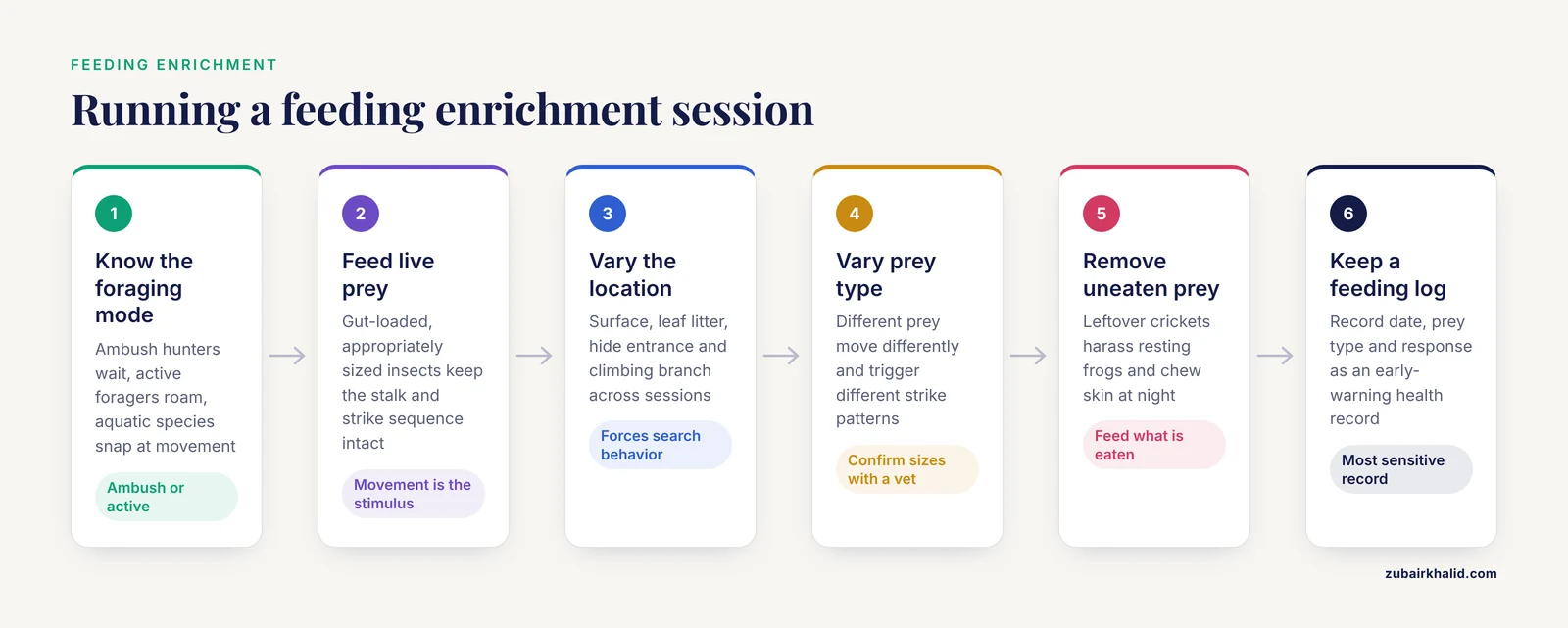
Feeding is the highest-frequency enrichment event in a frog's life, and it is where most owners leave the most value on the table. Follow this sequence.
- Identify your frog's foraging mode. Ambush hunters sit and wait. Active foragers roam. Aquatic species snap at anything that moves in the water. Tong-feeders and hand-feeders bypass the entire hunting sequence, so use them only as a supplement or for medicating, not as the default.
- Feed live prey as the base. Gut-loaded, appropriately sized live insects preserve predatory behavior. The movement itself is the stimulus.
- Vary the location. Place prey at the surface, in the leaf litter, near a hide entrance, and along a climbing branch across different sessions. Variation forces orientation and search behavior.
- Vary the prey type within what your species tolerates. Different prey items move differently and trigger different strike patterns. Discuss appropriate prey species and sizes for your frog with your veterinarian or an experienced exotics practitioner, because prey size misjudgment is a real choking and impaction risk.
- Remove uneaten prey. Leftover crickets harass resting frogs and chew on their skin at night, and in aquatic setups they load the water with waste. Feed what is consumed, not what looks impressive.
- Log it. Note the date, prey type, and response. A feeding log is the single most sensitive early-warning record for amphibian health decline.
Water, Hygiene, and the Health Side of Enrichment
Every enrichment feature you add interacts with water quality. Live plants add organic matter as they shed leaves. Natural hides add tannins and, if unsanitized, microorganisms. Deep substrate accumulates waste. None of this argues against enrichment. It argues for monitoring.
The practical program is simple. Test the water parameters relevant to your species on a fixed weekly schedule and keep a written log. Watch the frog's skin at every feeding, since the skin is the organ most exposed to water conditions. Remove and clean or replace decorations on a rotation so no single item becomes a permanent biofilm farm. The laboratory colony report that documented Epistylis and Saprolegnia in African clawed frogs closed on exactly this point: diagnosis and treatment mattered, but water-quality monitoring and husbandry were the foundation [2]. A tank rich in enrichment and poor in hygiene is worse than a bare tank with clean water. Do both.
Quarantine deserves a mention here. Any new frog, new plant, or new decoration is a potential carrier of organisms you cannot see. New animals should be housed separately and observed before joining an established tank, and this is a standard exotics practice worth discussing with your veterinarian for your specific situation.
Common Mistakes
- Round dome hides as the only shelter. The shape frogs avoided most consistently in the preference study was the spherical tunnel [1]. Rectangular and deep beats round and shallow.
- Decorating for the owner instead of the frog. Bright colors, open layouts, and glass-front display tanks prioritize human aesthetics. Frogs respond to cover, shade, and brown.
- One hide, one spot, forever. A single shelter gives no choice. Choice is the mechanism of enrichment.
- Adding everything at once. A full rescape destroys the mental map the frog has built. Change one element per week.
- Feeding only by hand or tong. Convenient for the owner, impoverishing for the frog. Keep live hunting in the routine.
- Ignoring the disease risk of outdoor materials. Unquarantined wood, soil, and water from natural sources can introduce parasites and fungal organisms [2].
- Confusing inactivity with contentment. A motionless frog in the open is often a stressed frog. A motionless frog inside a deep hide is often a secure one. Position and context tell you which.
- Skipping the water tests because the tank "looks fine." The organisms implicated in real colony outbreaks were invisible without examination [2]. Looks are not data.
Troubleshooting
The frog ignores every hide. Check placement first. A hide in the hottest or driest corner will never be used. Move it into the preferred microclimate, usually the coolest and most humid zone, and give it a week.
The frog uses the water dish only. For terrestrial species this often means the land area is too dry or too bright. Add cover over the land portion and increase substrate moisture within species-appropriate limits.
The frog stops eating after a rescape. Give it several quiet days with minimal disturbance and resume feeding at the previous location. If appetite does not return within the normal interval for the species, call your veterinarian, because anorexia in amphibians escalates quickly.
White or gray patches on skin or decorations. This can indicate Saprolegnia-type fungal growth, which was documented alongside Epistylis in a captive colony and treated successfully when addressed [2]. Isolate the item, verify water quality, and get a veterinary diagnosis before applying anything to the frog or the tank.
The frog paces the glass nightly. First rule out temperature, humidity, and enclosure-size problems with your veterinarian or a trusted husbandry reference. If parameters are correct, add cover along the glass line so the frog cannot see a clear escape route, and confirm the tank has at least two distinct usable zones.
Safety and Welfare Points
- Anything entering the tank must be inert, clean, and free of sharp edges, loose paint, and small detachable parts.
- Frogs absorb substances through their skin. Never use soap, detergent, or chemical cleaners on tank items. Use hot water, physical scrubbing, and dedicated tools.
- Handle as little as possible. Enrichment for amphibians is environmental, not social. Contact with human skin salts and oils is a stressor, not a treat.
- Keep the light cycle consistent. A dark, quiet day retreat is as important as the active-night layout.
- Secure the lid. Enrichment that increases climbing increases escape attempts. A determined frog finds gaps you did not know existed.
- Wash your hands before and after tank maintenance, and use separate equipment for each enclosure if you keep more than one.
A Weekly Rhythm You Can Sustain
Sustainable enrichment beats elaborate enrichment. A workable week looks like this. Once a week, test water parameters and log them. At each feeding, vary the prey location. Once a week, change one element: move a hide, add a leaf litter handful, reposition a plant, or introduce a new-safe climbing surface. Once a month, photograph the tank and review your behavior notes. Once a season, deep-clean nonliving decor and replace anything degraded. This rhythm keeps the environment dynamic without destabilizing it, and it produces the records your veterinarian will want if the frog ever gets sick.
Limitations and When to Contact a Veterinarian
The strongest evidence in frog enrichment concerns shelter design preferences [1] and the link between husbandry, water quality, and skin disease in captive colonies [2]. Individual species differ widely, and what holds for one species may not hold for another. Individual cases vary, and a veterinarian who can examine your frog and your setup is the right person to confirm that a behavior problem is environmental rather than medical. Contact a veterinarian promptly for any of the following: refusal of food beyond the species' normal interval, skin discoloration, shedding problems, unusual posture such as sitting hunched with the head down, bloating, lethargy that persists beyond a normal rest period, injuries from tank furniture, white fuzzy patches or visible parasites on the skin, sudden aggression or frantic escape behavior, or any situation where water parameters are abnormal and stay abnormal after corrective steps. Amphibians decline faster than most pets once illness is visible, so early consultation is the welfare-saving move. This article is educational and is not a substitute for veterinary diagnosis or treatment.
Frequently Asked Questions
How do I keep a frog entertained?
Build choice into the enclosure. Offer multiple hides of different materials and heights, structure for climbing or digging to match your species, and live prey that triggers hunting. A frog that can select its microclimate and work for food is occupied by definition.
What are the best toys for pet frogs?
The best frog toys are functional structures rather than play objects. Deep rectangular hides, elevated flat shelters, cork bark and branches for climbers, deep diggable substrate for burrowers, and varied feeding stations all create behavior opportunities a plain tank does not.
What are the signs of a bored frog?
The patterns are repetitive glass pacing toward the enclosure edge, total disuse of provided hides, weak feeding response, and complete failure to burrow or climb despite the species' anatomy. Sudden changes in activity or appetite can signal illness instead, so confirm health with a veterinarian before assuming boredom.
Can I use items from outside for DIY frog enrichment?
Yes, with treatment. Collect from pesticide-free areas away from roads and water bodies, clean and dry or boil woody items, and quarantine leaf litter before use, because outdoor organic material can carry fungal and protist organisms into the tank.
How often should I change the enrichment in a frog tank?
Change one element per week rather than rebuilding the whole tank. Small rotations keep the environment interesting while preserving the frog's mental map and established resting spots.
Do frogs get bored in small enclosures?
Space matters, but usable complexity matters more. A modest tank with layered shelters, varied substrate, and hunting opportunities provides more behavioral choice than a large bare tank. Match minimum space to your species' size and activity level and confirm those requirements with your veterinarian or a current husbandry reference.
Is live prey enrichment necessary?
For most species it is the highest-value enrichment available, because moving prey activates the natural stalk and strike sequence. It also carries risks if prey is the wrong size or is left in the tank uneaten, so feed appropriately and remove leftovers.
When should I call a vet about my frog's behavior?
Call when behavior changes suddenly, when appetite stops, when the skin changes color or texture, when you see white growths or attached organisms, or when the frog holds an abnormal posture. Amphibians hide illness until it is advanced, so early calls save lives.