Frog Care Guide: Daily, Weekly, and Monthly Routine
By Dr. Zubair Khalid, DVM, MS, PhD ·
A sustainable frog care routine has three layers. Daily work is observation and hygiene, feeding on plan, removing waste, and confirming that heat, light, and filtration are running. Weekly work is water testing, a partial water change, filter maintenance, and a hands-on health check with a weight record. Monthly work is a staged deep clean, an equipment audit, and a review of your records for trends. None of these layers takes long once it becomes a habit, and together they prevent most of the problems that bring pet frogs to a veterinarian.
The reason for the structure is the biology of the animal. A frog's skin is a living, permeable surface that exchanges water, gases, and microbes with everything around it. Research on captive African clawed frogs (Xenopus laevis) shows that husbandry conditions shape the microbial communities living on the skin, communities that are part of how the animal defends itself [1]. A separate report from a research colony described a multiagent skin infection that spread through a group of adult frogs and concluded that water-quality monitoring and husbandry are the foundation of prevention [2]. Routine care is the mechanism that keeps the skin barrier and its microbial partners stable.
This guide gives you checklists you can act on today, explains the reasoning behind each task, and tells you exactly when to stop troubleshooting and call an amphibian veterinarian.
This article is educational and is not a substitute for veterinary diagnosis or treatment.
At a Glance: The Frog Care Routine
| Frequency | Core tasks | Purpose |
|---|---|---|
| Daily, 5 to 10 minutes | Visual health check, feed on plan, remove uneaten food, spot clean waste, confirm thermometer and filter readings, write one log line | Catches skin changes and appetite loss early, keeps water from fouling between cleanings |
| Weekly, one fixed block | Test ammonia, nitrite, nitrate, pH, and temperature, partial water change, siphon substrate, rinse filter media in removed tank water, weigh and inspect the frog, clean and dry tools | Measures water chemistry, tracks weight trends, and prevents the conditions linked to skin disease outbreaks in captive colonies [2] |
| Monthly, staged half day | Deep clean decor and glass, refresh substrate per plan, audit heaters, filters, test kits, and seals, review a month of records, recheck quarantine and biosecurity habits | Catches equipment drift and record blind spots before they become emergencies |
If you do nothing else today, do these four things. Look at your frog for one full minute. Remove anything dead or uneaten from the enclosure. Read the thermometer and check the filter. Write one line in your log.
Why a Structured Frog Care Routine Keeps Skin Healthy
Frogs interact with their environment through their skin more than most pets do. Water, gases, and microorganisms all cross or colonize that surface, so amphibian veterinarians treat the water and the habitat as medical variables rather than as background. The skin also carries its own community of bacteria and other microbes, and the frog together with those microbes functions as what biologists call a holobiont [1].
The clearest evidence for how much this matters comes from African clawed frogs, a fully aquatic species that has been kept in captivity for almost a century [1]. In a study of research colonies, adult females housed under two very different systems, a low-microbial-load "clean" system in which embryos were surface sterilized before entering the colony and a conventional "standard" system, ended up with extremely similar skin microbial communities [1]. Tadpoles told a different story, because the skin communities of developing animals differed with housing conditions, which the authors read as strong developmental control over the surface microbiome [1]. The same authors note that scientists do not yet know how such microbiome shifts affect resistance to disease, which is one reason abrupt husbandry overhauls are a poor idea in a home as well as a laboratory [1].
Disease reports fill in the other half of the picture. In one published account, a colony of adult African clawed frogs developed a combined infection involving a fungal parasite and an ectoparasite, and the workup, diagnosis, and treatment consumed substantial effort before the colony returned to normal [2]. The authors tied prevention directly to water-quality monitoring and husbandry [2]. Translated to a home setting, that means your routine, the testing, the water changes, the daily observation, is the preventive medicine.
Before You Start: Frog Care for Beginners
If you are working out how to take care of a frog for the first time, understand that the routine begins before the animal arrives. Frogs are not starter pets in the casual sense, but they are very manageable once the system is set up and the schedule is written down.
Start with a written species plan
Amphibians do not share one care model. Fully aquatic species, like the African clawed frogs in the studies above, live entirely in water. Semi-terrestrial and terrestrial species need land areas, moisture gradients, and humidity control instead of or in addition to a swimming area. Ask an amphibian veterinarian for a written plan covering enclosure size, temperature range, humidity, water parameters, diet, feeding schedule, and cleaning intervals. Keep that sheet with your log, and check your habitat against it during the monthly audit.
Before you acquire any species, confirm with your state wildlife agency that it is legal to keep where you live, because some states restrict certain frog species. If you already own a frog whose legal status you are unsure of, your veterinarian or the state agency can advise you.
Equipment and supplies worth buying once
Choose equipment for the adult size of the animal, for reliability, and for cleanability, not for novelty. The working list looks like this:
- An enclosure sized for the adult frog, with a secure, weighted lid. Frogs climb, push, and find gaps you did not know existed.
- Filtration appropriate to the water volume, with gentle flow for aquatic species.
- Heating and lighting on timers, with at least one thermometer you trust and a hygrometer for any setup with a land area.
- A liquid test kit covering ammonia, nitrite, nitrate, and pH.
- A siphon, two dedicated buckets, and a soft brush used only for the frog habitat.
- A small digital scale for weekly weight records.
Avoid anything that cannot be rinsed clean without residue, and avoid decorative items with sharp edges or small holes a frog can wedge itself into.
Quarantine and biosecurity before the routine begins
Any new frog goes into a separate tank with its own tools for a quarantine period, and your veterinarian should tell you how long that period should be for your situation. The colony outbreak report mentioned above shows why. Once a multiagent infection establishes itself in a group, diagnosing and clearing it is far harder than excluding it at the door [2]. Keep dedicated nets, buckets, and siphons for the quarantine tank, service that tank last in your day, and never share water between enclosures. Wash your hands between tanks even when both look clean.
Your Frog Daily Care Checklist
The daily layer of a frog care routine takes five to ten minutes once it is a habit. Do it at the same time each day, ideally when the frog is awake and active enough to show you its normal behavior.
Run a one-minute visual exam
Learn what normal looks like for your species, then look for departures from it. The basics are clear eyes, intact skin with the color and texture your species sheet describes, steady posture, regular breathing, and interest when food appears. In an aquatic frog, add normal swimming and resting positions, with no sideways floating and no persistent gasping at the surface. In a land-dwelling species, add normal perching or burrowing and skin that looks moist rather than dry or dull.
Note anything that departs from normal, gray or white patches, redness, ulcers, swelling, asymmetry, trembling, a frog sitting oddly, or a frog ignoring food. One day of a small change is a note in the log. A change that repeats or worsens is a phone call.
Feed on plan, then police the leftovers
Follow the feeding schedule and portion plan your veterinarian set for the species and life stage. Frogs are convincing actors, and many will beg regardless of need, so let the written plan and the weekly weight record make the decisions rather than the begging. Remove uneaten food promptly, and be strict about it in water, where decaying food pushes ammonia up, clouds the tank, and feeds opportunistic organisms. In a well-run routine, food never gets the chance to rot.
Spot clean
Remove feces, shed skin the frog has not eaten, dead plant matter, and any visible film on the water surface. A small siphon or turkey baster handles waste in an aquatic tank, and forceps or a scoop handles it on land. Do not scrub the biological film off established filter media, gravel, or mature surfaces during daily cleaning, because that film is part of the living filtration system, and daily sterilizing effort works against the animal.
Confirm the life-support readings
Check that the thermometer sits inside the range on your species sheet, that the filter is flowing normally, that the heater and lights are functioning, and that the lid is secure. In land setups, read the hygrometer and mist if the plan calls for it. Equipment failures are quiet, and a two-minute check catches them before they become emergencies.
Top off evaporated water the right way
Replace evaporation losses with water prepared according to the plan your veterinarian gave you for your local supply, matched closely to the tank's temperature. If you have not yet asked how your tap water should be treated before it reaches the tank, ask before your first top-off, because amphibian skin absorbs whatever the water carries.
Write one line in the log
Record the date, appetite, appearance, water reading, and anything odd. The log turns a vague worry into a data point, and it is the single most useful thing you can bring to a veterinary appointment.
Weekly Frog Care Tasks
Set one fixed block each week, same day, same order. The weekly layer is where water chemistry is actually measured and where early disease is actually caught.
Test the water and write the numbers down
Test ammonia, nitrite, nitrate, pH, and temperature with a liquid test kit, at the same point in the feeding and cleaning cycle each week. Your veterinarian will give you target ranges for your species and system. Write the results down even when everything looks fine, because the trend is the signal, and a slow drift is invisible without records. Water-quality monitoring is the measure that published outbreak reports from captive frog colonies emphasize most heavily [2].
Perform a partial water change
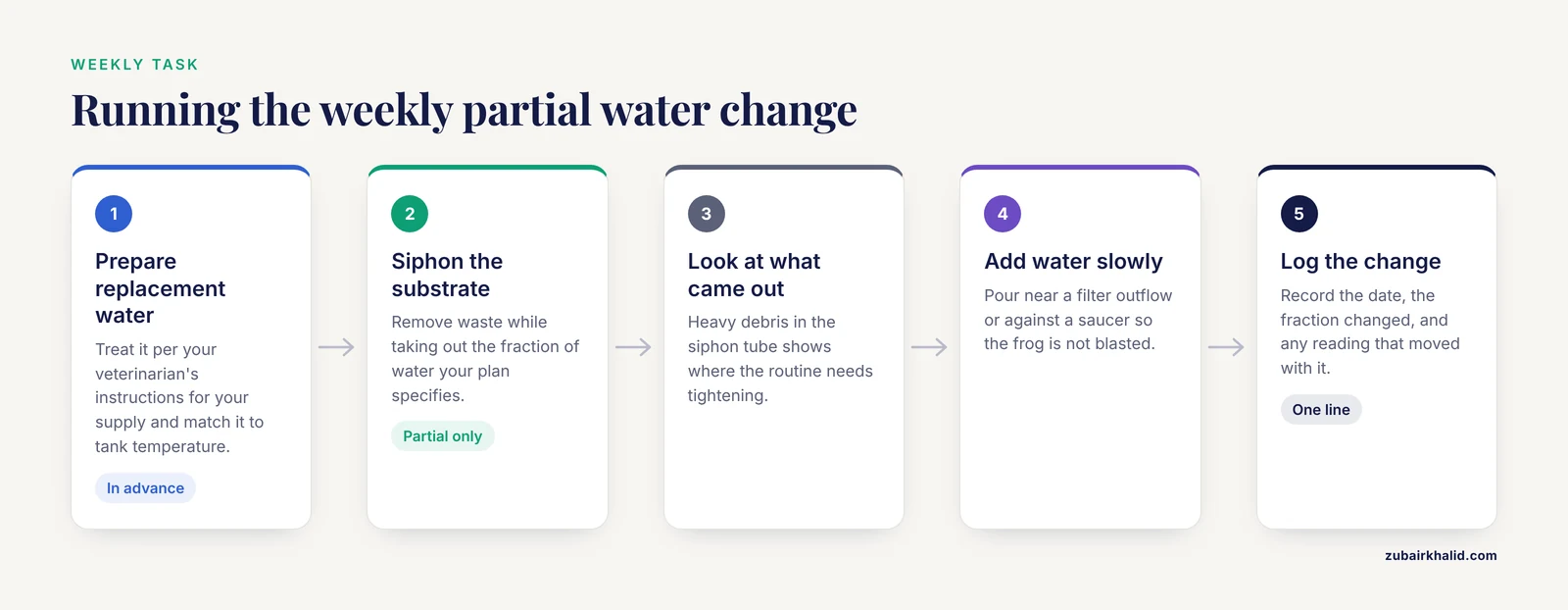
Work through it the same way every time:
- Prepare replacement water in advance, treated according to your veterinarian's instructions for your supply and matched closely to the tank's temperature.
- Siphon waste from the substrate while removing the fraction of water your plan specifies.
- Pause and look at what came out, because heavy debris in the siphon tube tells you where the routine needs tightening.
- Add the replacement water slowly, near a filter outflow or against a saucer so it does not blast the frog or stir the substrate.
- Log the date, the fraction changed, and any reading that changed with it.
Never replace all of the water at once in a healthy, established tank unless your veterinarian directs it, because a full change crashes the biological filter and swings the chemistry the frog has stabilized to.
Service the filter without sterilizing it
Rinse mechanical filter media in the bucket of tank water you just removed, swish and squeeze sponges until the water runs clearer, and reinstall. Never rinse biological media under tap water or hot water, because chlorinated and hot water kill the bacterial populations that keep ammonia under control. Check the impeller for debris and confirm that the flow looks and sounds normal.
Weigh and inspect hands-on
Once a week, weigh the frog on the same scale at the same time of day and record the number in grams. Then inspect the animal in a clear container, skin, toes, toe webs, mouth area, and vent, looking for trapped debris, lesions, discoloration, or anything asymmetric. A stable weight with a steady appetite is the strongest routine evidence that the plan is working, and a downward trend is often the first measurable sign of trouble.
Clean tools and reset hygiene
Rinse the siphon, buckets, and brush, and let them air dry. Keep them dedicated to the frog habitat. Wash your hands and forearms before and after any contact with tank water, and skip lotion on maintenance days, because residues pass through amphibian skin and into the water.
Tidy the land area in semi-terrestrial and terrestrial setups
Check the humidity reading against the species sheet and mist according to the plan. Spot-replace substrate that has gone moldy or sodden, confirm that hides and branches are stable and clean, and check live plants for pests or dying leaves.
Monthly Frog Care Tasks
Monthly work catches drift, in equipment, in records, and in your own habits.
Deep clean in stages, not in one panic session
Move the frog to a prepared temporary container first. For an aquatic frog, use water from its own tank in a covered tub. For a land species, use a secure, moistened tub with a hide. Then work through the habitat in stages. Remove decor and rinse and scrub it with hot water and the dedicated brush until no residue remains. Siphon or refresh substrate according to your plan, and wipe the glass inside and out. Keep established biological filter media wet and untouched throughout the entire process, because that material is the engine of the system. Avoid soap and household chemicals, since residues absorb through amphibian skin, and if you need to disinfect after illness, ask your veterinarian for a product and a rinse protocol rather than improvising.
Reassemble the habitat, return the frog, and log the date and what you did.
Audit equipment and consumables
Compare the tank thermometer against a second thermometer. Inspect the heater, thermostat, tubing, air pump, and seals, and check the lid and its weights. Verify the expiration dates on test kit reagents and replace anything stale. Restock consumables according to your veterinarian's plan. Confirm a drip loop on every cord, and keep power strips out of splash range.
Review the record book for trends
Scan the month of entries. Is the weight line flat or climbing, are the water values steady, how many appetite misses are there, and do any notes repeat? If any trend has moved the wrong way for two consecutive weeks, call your veterinarian now rather than after it becomes an emergency.
Recheck biosecurity habits
Confirm that quarantine animals are still separated, that tools are still dedicated, and that hand washing between enclosures is actually happening. If a new animal joined the collection during the month, confirm its quarantine timeline with your veterinarian before it meets the established animals.
Schedule veterinary touchpoints
Ask your amphibian veterinarian how often a healthy animal of your species should be examined. Bring the log, the water test results, and a fresh water sample to the visit, and ask for updated targets as the animal grows, because juvenile and adult needs differ.
Common Mistakes That Break a Frog Care Routine
Cleaning toward sterility. Full teardowns, boiling every decoration, and replacing all filter media at once wipe out the biological filter and the environmental microbes the animal has settled with. In the African clawed frog research, tadpoles raised under a low-microbial-load system developed skin microbial communities that differed from those of tadpoles raised under conventional conditions, and the authors note that the consequences of such shifts for disease resistance are not yet understood [1]. Aim for clean and stable, not sterile.
Letting water quality drift between tests. Ammonia and nitrite climb quietly after a skipped siphon or an overfeeding week, and by the time the water smells or clouds, the skin has already been dealing with the decline. Test on schedule even when the tank looks clean.
Skipping quarantine. A new animal can carry organisms your established animals have never met. A separate tank with dedicated tools is the cheapest insurance in amphibian keeping.
Overfeeding and leaving food in the water. Frogs beg, leftovers decay, ammonia spikes, and the animal gains weight on top of it. Feed on plan and remove what is not eaten.
Handling too often, or with residues on your hands. Soap, lotion, sanitizer, and insect repellent residues pass through amphibian skin. Handle only when necessary, with clean, well-rinsed hands, and keep sessions brief.
Improvising temperatures, portions, or cleaning chemicals. The right numbers in amphibian husbandry are species specific. Get them from an amphibian veterinarian rather than from a generic care card or a stranger online.
Sharing equipment between enclosures. Pathogens and parasites move on wet nets, wet hands, and shared siphon water. Dedicate the tools, and wash between tanks.
Waiting out symptoms. Frogs hide illness until they cannot hide it anymore. A day of appetite loss is a note. Two days with any other sign is a phone call.
Troubleshooting: Early Warning Signs and What They Mean
White, gray, or cottony patches on the skin, mouth, or eggs. Water molds such as Saprolegnia are described as relatively common fungal parasites in laboratory-housed frogs [2]. These patches signal a skin barrier or water-quality problem, and they need veterinary diagnosis and prescription treatment, not home remedies.
Fuzzy or stalk-like growths on the skin with sluggish behavior. Epistylis, an ectoparasite of the family Epistylididae, was documented in a captive frog colony in a report that noted only one earlier description of this organism in frogs [2]. Microscopic examination is required for diagnosis, so describe what you see, photograph it, and let your veterinarian examine the animal rather than treating blindly.
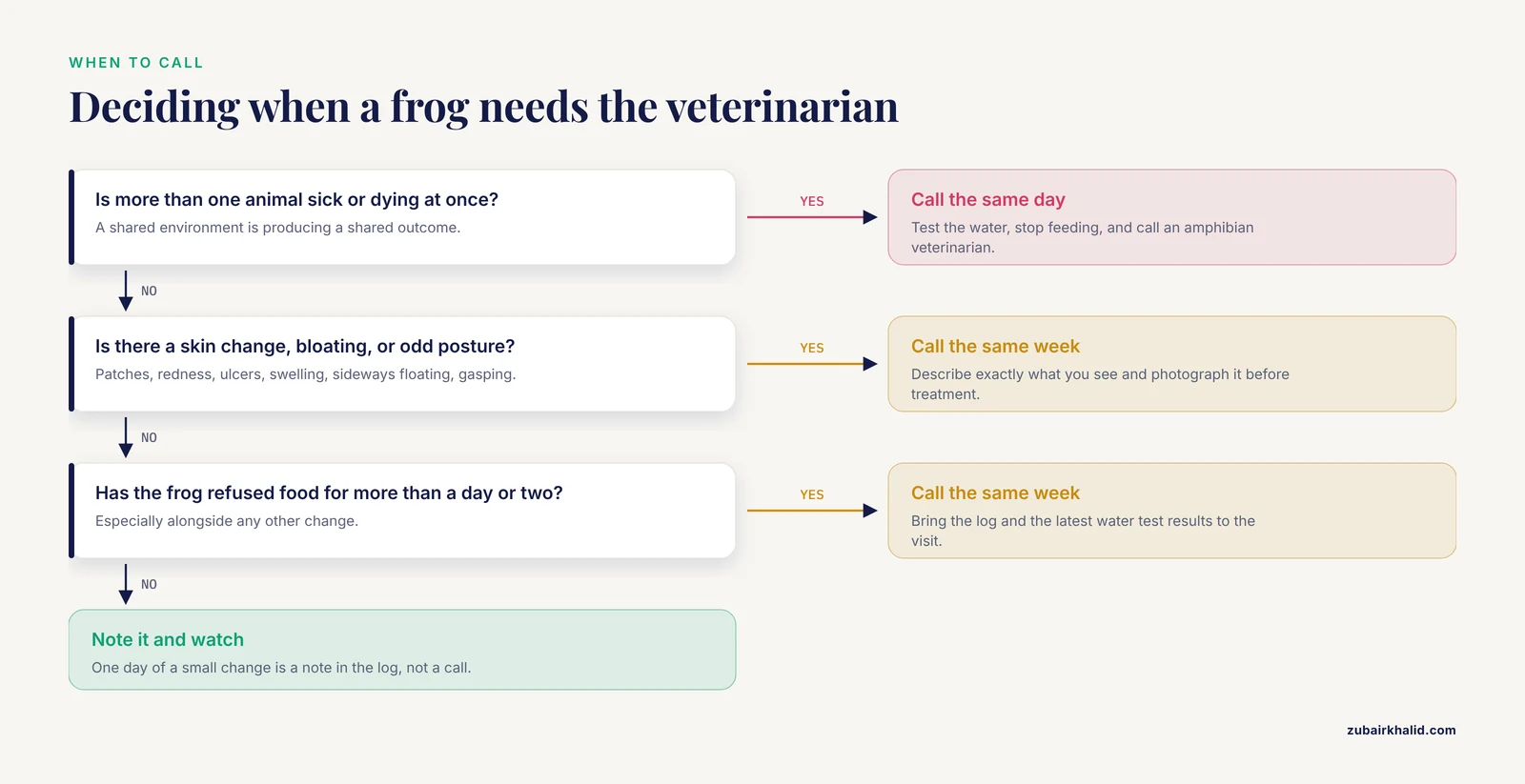
Several animals sick or dying at once. Treat the shared water as the prime suspect. Test immediately, stop feeding, and call an amphibian veterinarian the same day, because a shared environment is producing a shared outcome.
One animal off food for a day. Log it, verify temperature and water, and watch closely. Off food combined with lethargy, a skin change, or abnormal posture is a same-week veterinary call.
Abnormal shedding, redness, ulcers, bloating, or asymmetric swelling. These are examination findings, not routine issues. Call the veterinarian and describe exactly what you are seeing.
Floating sideways, inability to submerge, or persistent gasping at the surface. Test the water and confirm the temperature first, then call, because buoyancy and breathing changes can come from the water, from infection, or from internal disease, and the history you provide helps your veterinarian sort them out.
Welfare and Safety Points
Stability is welfare. Frequent redecorating, handling, and parameter swings are chronic stressors. Keep the layout consistent and make changes one at a time, giving the animal time to settle between them.
Escape prevention. Use a weighted, secure lid with no gaps at cord openings, and check it during the monthly audit. An escaped frog dries out and dies quietly behind furniture, and by the time you find it, the lesson has been expensive.
Chemical safety. Amphibian skin absorbs what it touches, including airborne residues. Keep aerosols, smoke, pesticides, and scented products away from the habitat, and never let soap or cleaning residues reach the water.
Household hygiene. Wash hands after tank work, keep tank water out of food-preparation sinks, and supervise children during maintenance. Ask your veterinarian about any additional precautions for your household, especially for members who are pregnant, very young, elderly, or immunocompromised.
Never release a pet frog outdoors. If you cannot keep the animal, ask your veterinarian, the breeder, or your state wildlife agency about rehoming options. Confirm that your species is legal to keep where you live before you acquire it, and reconfirm if you move.
Limitations and When to Contact a Veterinarian
Every frog is an individual, and the correct routine depends on species, age, life stage, enclosure, and local water chemistry, so use this guide as the framework and confirm the specific numbers and schedules with an amphibian veterinarian. The strongest published evidence on captive frog husbandry comes from managed research colonies of African clawed frogs [1][2], and pet species and home setups differ, so treat that evidence as the reason the routine exists rather than as a substitute for species-specific targets.
Contact an amphibian veterinarian promptly, the same day for the urgent items, when any of the following occurs:
- Your frog refuses food for more than a day or two, especially alongside any other change.
- You see white, gray, or cottony patches, redness, ulcers, abnormal shedding, or any growth on the skin.
- Posture or swimming changes, including floating sideways, inability to submerge, trembling, or weakness.
- The abdomen looks bloated, or asymmetric swelling appears.
- An injury occurs, from a fall, a lid, or a tank mate.
- More than one animal is affected at once, or any animal dies without an obvious cause.
- A water test value falls outside the target range your veterinarian set, even if the frog still looks normal.
- Temperature or filtration cannot be maintained after an equipment failure.
Find a veterinarian who treats amphibians before you need one, and keep the clinic's number with your log.
Frequently Asked Questions
What is a basic frog care routine?
A basic frog care routine is a daily check of your frog, its food, and its equipment, a weekly block of water testing, a partial water change, filter rinsing, and weighing, and a monthly deep clean with an equipment audit and a review of your records.
How do I take care of a frog for the first time?
Get a written species plan from an amphibian veterinarian before you buy, set up and stabilize the habitat first, quarantine any new animal in a separate tank with dedicated tools, and then follow the daily, weekly, and monthly checklists.
What should I check on my frog every day?
Check skin color and texture, eyes, posture, breathing, appetite, droppings, and behavior, then confirm that the thermometer, filter, heater, and lid are doing their jobs and write one line in your log.
How often should I change the water in a frog tank?
Plan on a partial water change every week for most aquatic setups, using the fraction your veterinarian specifies, with replacement water temperature matched and prepared according to your water treatment plan.
How often should I feed my frog?
Feed on the schedule and portions your amphibian veterinarian sets for your species and life stage, remove uneaten food promptly, and let the weekly weight record rather than begging behavior tell you whether the plan is right.
Can I handle my frog?
Handle as little as possible, because frequent handling and residues on human skin stress frogs and can harm them, and when handling is necessary use clean, well-rinsed hands and keep it brief.
Why does my frog's tank get dirty so fast?
Fast fouling usually traces to overfeeding, uneaten food left in the water, an undersized or overloaded filter, or skipped siphoning, and each of those is fixed by tightening the daily and weekly layers of the routine.
When should I take my frog to the veterinarian?
Call for any skin change, appetite loss lasting more than a day or two, abnormal posture or swimming, bloating, injury, several animals sick at once, or a water test value outside the targets your veterinarian set.