Can Axolotls Have Tank Mates?
By Dr. Zubair Khalid, DVM, MS, PhD ·
Key Takeaways
- Axolotls are solitary, obligate carnivores with a suction-feeding strategy, posing a significant predatory risk to any tank mate small enough to be ingested. This instinct necessitates species-only housing to prevent cannibalism and stress.
- The delicate, external gills of axolotls are highly susceptible to nipping by fish species such as tetras and guppies, leading to gill necrosis, secondary bacterial infections (e.g., Aeromonas spp.), and chronic stress, which is contrary to amphibian welfare guidelines.
- Significant thermal incompatibility exists between axolotls (requiring 14-20°C) and most tropical fish (requiring 24-28°C), with prolonged exposure to warmer temperatures being lethal to axolotls, a factor emphasized by EFSA guidelines on aquatic animal welfare.
- Cohabitation with fish presents a substantial risk of disease transmission, as fish can act as asymptomatic carriers for pathogens like Batrachochytrium salamandrivorans (Bsal) and Ranavirus, a concern highlighted by veterinary and agricultural agencies globally.
- Optimal axolotl husbandry, recommended by veterinary professionals, involves species-only tanks, either with a single individual in a minimum 20-gallon long aquarium or carefully managed groups of similarly sized axolotls in larger tanks (minimum 40-gallon breeder for two adults) with ample hiding places.
The axolotl (Ambystoma mexicanum) is a neotenic salamander native to the lake complex of Xochimilco, Mexico. In captivity, these amphibians are prized for their regenerative abilities, external gills, and relatively simple husbandry requirements. However, one of the most common questions from dedicated owners is whether axolotls can share their aquatic environment with other species. The short answer, supported by veterinary consensus and clinical experience, is that axolotls should almost never be housed with other species of fish, invertebrates, or amphibians. This article provides an exhaustive, evidence-based review of the risks, the rare exceptions, and the optimal axolotl-only setups recommended by veterinary professionals.
Quick Q&A
Question: Can axolotls have tank mates?
Answer: In nearly all cases, no. Axolotls are solitary, predatory amphibians that will attempt to eat any tank mate small enough to fit in their mouths, and they are vulnerable to injury from fish that nip at their gills. The safest and most welfare-compliant setup is a species-only tank with a single axolotl or a carefully managed group of similarly sized axolotls.
Why the Answer Is Mostly No: Veterinary and Biological Rationale
Predatory Instinct and Feeding Behaviour
Axolotls are obligate carnivores with a feeding strategy based on suction feeding. In the wild, they consume small fish, crustaceans, insect larvae, and even smaller amphibians. In captivity, this instinct does not diminish. Any tank mate small enough to be swallowed (generally anything under two-thirds the axolotl's head width) will be perceived as prey. This includes small fish, shrimp, and juvenile axolotls. The Merck Veterinary Manual notes that amphibians, including axolotls, should be housed individually or with conspecifics of similar size to avoid cannibalism and stress.
Gill Nipping and Physical Injury
Many commonly suggested tank mates, such as guppies, tetras, and minnows, are fin-nippers. Axolotls have delicate, highly vascularized external gills that are easily damaged. Chronic nipping leads to gill necrosis, secondary bacterial infections (e.g., Aeromonas spp., Pseudomonas spp.), and chronic stress. According to the AVMA guidelines for amphibian welfare, any housing that results in physical injury or chronic stress is unacceptable. In clinical practice, veterinarians frequently see axolotls presented with frayed gills, missing digits, and corneal abrasions from cohabitation with fish.
Water Quality and Temperature Incompatibility
Axolotls require cool water temperatures (14-20°C or 57-68°F) with a pH of 6.5-8.0, low ammonia, and zero nitrite. Most tropical fish require warmer water (24-28°C or 75-82°F), which is lethal to axolotls over time. Conversely, cold-water fish like goldfish produce high bioloads and are incompatible with axolotls due to differing dietary needs and aggression. The European Food Safety Authority (EFSA) guidelines on aquatic animal welfare emphasize that species with divergent thermal optima should never be cohabitated.
Disease Transmission Risks
Axolotls are susceptible to a range of pathogens, including Batrachochytrium salamandrivorans (Bsal), Ranavirus, and Aeromonas hydrophila. Fish can act as asymptomatic carriers of these pathogens. The CVMA and CFIA in Canada have issued advisories against mixing amphibians with fish due to the risk of emerging infectious diseases. In Australia, the Department of Agriculture, Fisheries and Forestry (DAFF) similarly restricts the importation of axolotls and other amphibians to prevent disease spread, and cohabitation with fish is strongly discouraged.
Specific Risks by Tank Mate Type
Fish
| Fish Type | Risk Level | Specific Concerns |
|---|---|---|
| Small tetras, guppies, minnows | High | Gill nipping, predation by axolotl |
| Goldfish | High | High bioload, temperature mismatch, goldfish may eat axolotl slime coat |
| Plecos and catfish | High | Sucker-mouth injuries to axolotl skin, nocturnal aggression |
| Betta fish | High | Aggressive, will attack gills; axolotl may eat betta |
| White cloud mountain minnows | Moderate | Cool water tolerant, but still risk of nipping and predation |
Invertebrates
| Invertebrate | Risk Level | Specific Concerns |
|---|---|---|
| Ghost shrimp | Moderate | Often eaten; may survive if large enough but no benefit |
| Cherry shrimp | High | Almost always eaten |
| Snails (e.g., ramshorn, bladder) | Low-Moderate | May be eaten; risk of impaction from shells |
| Crayfish | High | Aggressive, will injure or kill axolotl |
Other Amphibians
| Species | Risk Level | Specific Concerns |
|---|---|---|
| Other axolotls (same size) | Moderate | Requires large tank, careful monitoring; cannibalism risk if size mismatch |
| Dwarf frogs | High | Predation by axolotl |
| Newts | High | Toxin release, temperature mismatch, disease transmission |
Axolotl-Only Setups: The Veterinary Gold Standard
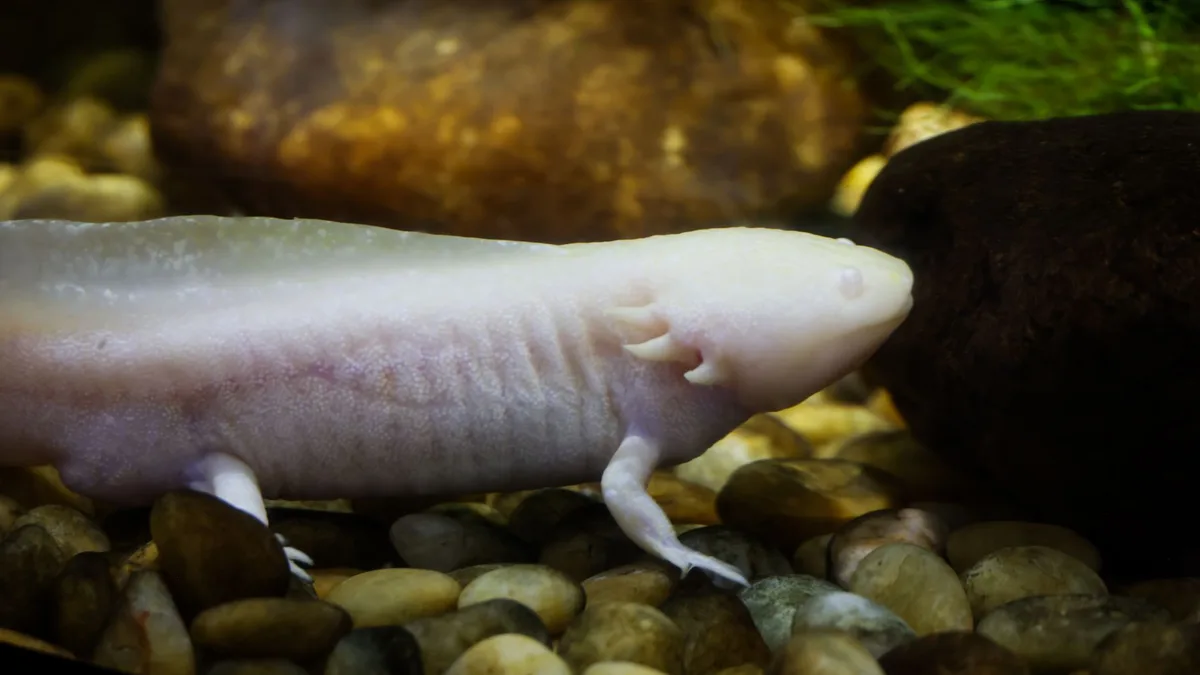 Amphibian skin is permeable, so water chemistry acts directly on the animal. Photo: Magda Ehlers via Pexels.
Single Axolotl Housing
The simplest and safest setup is a single axolotl in a 20-gallon (75-liter) long tank or larger. This eliminates all risks of aggression, competition, and disease transmission. The VCA Animal Hospitals recommend a minimum of 20 gallons for one adult axolotl, with a filter rated for at least twice the tank volume. Water changes of 20-30% weekly are essential to maintain water quality.
Group Housing of Axolotls
If multiple axolotls are kept together, they must be of similar size (within 2-3 cm total length) to prevent cannibalism. A 40-gallon (150-liter) breeder tank is the minimum for two adults, with an additional 10 gallons per extra axolotl. The DVM360 guidelines on amphibian husbandry stress that group-housed axolotls require ample hiding places (e.g., PVC pipes, ceramic caves, live plants) to reduce stress and aggression. Feeding must be done individually to ensure each animal receives adequate nutrition.
Environmental Enrichment
Axolotl-only tanks should include:
- Substrate: Fine sand (particle size <1 mm) or bare bottom. Gravel is contraindicated due to impaction risk.
- Filtration: Canister or sponge filter with low flow. Axolotls prefer still or slow-moving water.
- Lighting: Low to moderate. Axolotls are nocturnal and bright light causes stress.
- Plants: Live or silk plants (e.g., Anubias, Java fern, Vallisneria). Avoid plastic plants with sharp edges.
- Hides: At least one hide per axolotl, plus open swimming areas.
Regional Considerations
United States and Canada
In North America, axolotls are legal in most states and provinces, though some regions (e.g., California, Maine, New Jersey) restrict ownership due to concerns about hybridization with native tiger salamanders. The AVMA and AAHA do not have specific axolotl guidelines, but their general amphibian welfare statements apply: housing must prevent injury, stress, and disease. The CVMA echoes these principles for Canadian owners.
Europe
The FVE and EFSA have published guidelines on the welfare of laboratory and pet amphibians. These emphasize that axolotls should be housed in species-appropriate groups or singly, and that cohabitation with fish is not recommended due to thermal and behavioral incompatibility. In the UK, the Animal Welfare Act 2006 requires owners to provide for the "five needs," including the need to be housed with or apart from other animals as appropriate.
Australia
Axolotls are legal in all Australian states except Tasmania and the Northern Territory (where permits may be required). The AVA and DAFF strongly advise against mixing axolotls with any other species due to biosecurity risks. Australian owners should also be aware that many common fish species are invasive and cannot be released.
Clinical Signs of Stress or Injury in Axolotls
Owners should monitor for the following signs, which indicate that tank mates are causing harm:
- Gill damage: Frayed, shortened, or missing gill filaments
- Skin lesions: Redness, ulcers, or missing digits
- Behavioural changes: Hiding constantly, refusing food, floating at the surface
- Weight loss: Visible ribs or spine
- Lethargy: Reduced movement or response to stimuli
If any of these signs are observed, the tank mate must be removed immediately and the axolotl should be examined by a veterinarian experienced in amphibian medicine.
When Might Tank Mates Be Acceptable?
There are very few scenarios where tank mates are acceptable, and they require strict conditions:
- Dwarf shrimp in a heavily planted tank: Some keepers report success with adult ghost shrimp (Palaemonetes spp.) in large, densely planted tanks where shrimp can hide. However, most will be eaten, and this offers no benefit to the axolotl.
- White cloud mountain minnows: These fish tolerate cool water and are fast enough to avoid predation. However, they may still nip at gills, and the risk of injury remains.
- Snails: Ramshorn or bladder snails may be left alone if the axolotl is well-fed, but they can be eaten and cause impaction.
In all cases, the veterinary recommendation is to avoid these setups. The potential for harm far outweighs any aesthetic benefit.
Conclusion
The question "Can axolotls have tank mates?" has a clear answer from veterinary medicine: almost never. Axolotls are solitary predators that will eat or be injured by most other species. The safest, most welfare-compliant setup is an axolotl-only tank with a single animal or a carefully managed group of similarly sized individuals. Owners who prioritize their axolotl's health over the desire for a community tank will be rewarded with a long-lived, stress-free pet. For any concerns about cohabitation or axolotl health, consult a veterinarian with experience in amphibian medicine.
Related Articles
- How Long Do Axolotls Live? Lifespan and Longevity
- Axolotl Tank Setup and Water Parameters
- Axolotl Floating Problem
Related Clinical & Scientific Guides
References
Merck Veterinary Manual. "Amphibian Husbandry and Management." Merck & Co., Inc., 2023.
American Veterinary Medical Association (AVMA). "AVMA Guidelines for the Euthanasia of Animals: 2020 Edition." AVMA, 2020. (Section on amphibian welfare principles).
European Food Safety Authority (EFSA). "Welfare of Aquatic Animals in Aquaculture and Captivity." EFSA Journal, 2021.
Canadian Veterinary Medical Association (CVMA) and Canadian Food Inspection Agency (CFIA). "Biosecurity Guidelines for Amphibian Owners." CVMA, 2022.
Australian Veterinary Association (AVA) and Department of Agriculture, Fisheries and Forestry (DAFF). "Keeping Axolotls in Australia: Biosecurity and Welfare." AVA, 2023.
VCA Animal Hospitals. "Axolotl Care." VCA, 2023. Available at: vcahospitals.com.
DVM360. "Amphibian Medicine and Husbandry: A Practical Guide." DVM360, 2022.