
Trichinellosis in Wild Boar: Risk Factors for Human Infection and Meat Testing Protocols
Introduction
Trichinellosis is a zoonotic parasitic disease caused by nematodes of the genus Trichinella. Wild boar (Sus scrofa) serve as a major reservoir and source of human infection in many regions, particularly where hunting and game meat consumption are prevalent. This article provides an exhaustive review of the biological, epidemiological, and diagnostic aspects of trichinellosis in wild boar, emphasizing risk factors for human infection and standardized meat testing protocols. The focus is strictly on veterinary medicine, wildlife parasitology, and laboratory diagnostics.
The Parasite: Trichinella spp.
Taxonomy and Species Diversity
The genus Trichinella comprises at least 12 species and genotypes, of which Trichinella spiralis is the most widespread and pathogenic. Other species include Trichinella britovi, Trichinella nativa, Trichinella pseudospiralis, and Trichinella murrelli [1, 2]. In wild boar, T. spiralis and T. britovi are the most frequently detected species, with geographic distribution influenced by climate and host ecology [3, 4].
Life Cycle
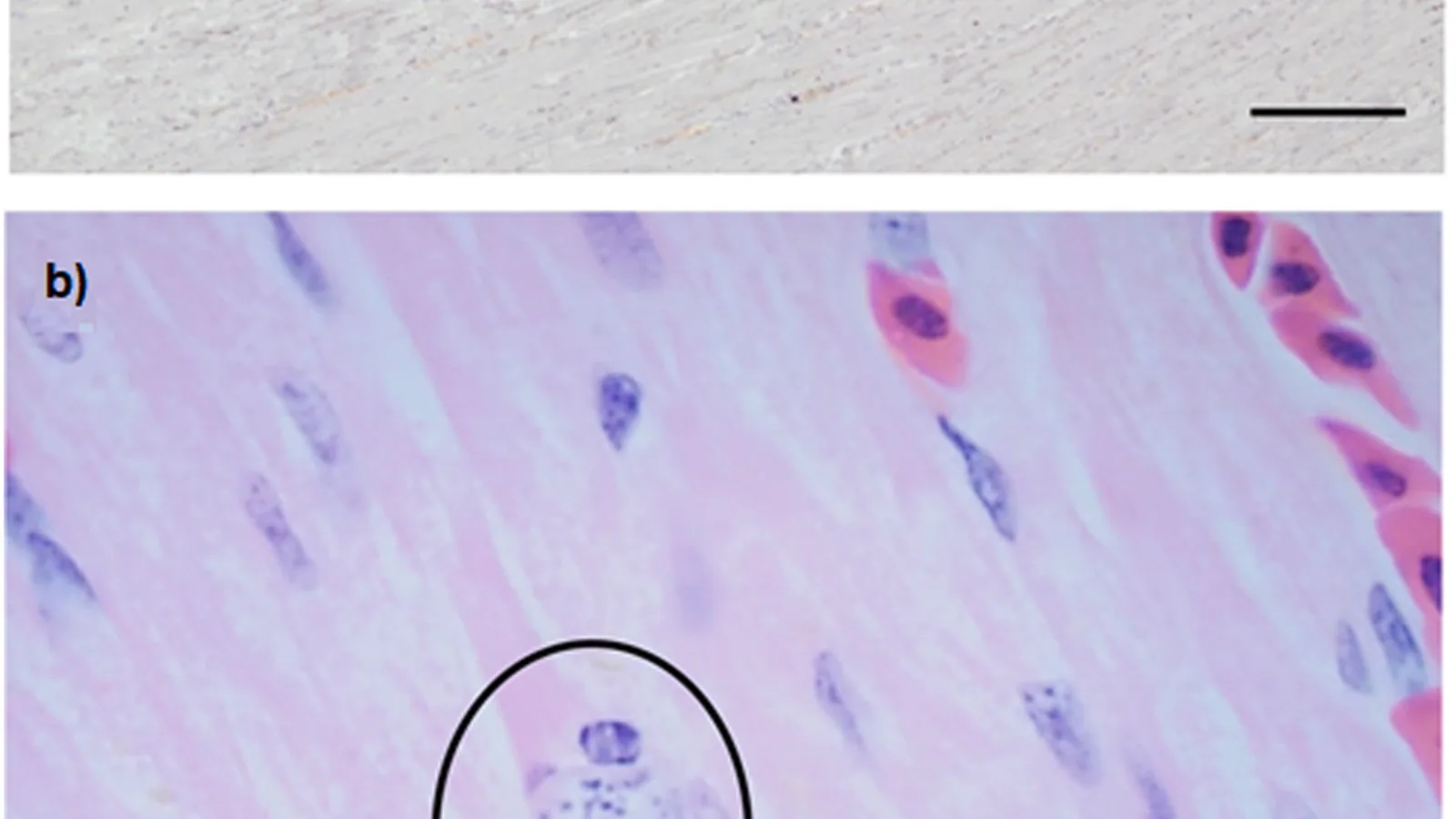
Trichinella spp. have a direct life cycle, completing all stages within a single host. The cycle begins when a host ingests muscle tissue containing encysted first-stage larvae (L1). Following ingestion, larvae are released from cysts by gastric digestion and penetrate the small intestinal mucosa, where they molt to the adult stage within 24-48 hours [5]. Adult worms mate in the intestinal lumen, and female worms shed newborn larvae (NBL) into the lymphatic and blood circulation. NBL migrate to striated skeletal muscle, where they penetrate myocytes and induce nurse cell formation. The larvae encapsulate within a collagenous cyst (for encapsulated species) and remain infective for months to years [6, 7].
Molecular Biology of Encapsulation
The nurse cell complex is a modified muscle cell that supports larval survival. The molecular mechanisms involve upregulation of collagen type IV and downregulation of muscle-specific proteins such as myosin and actin. The larva secretes excretory-secretory (ES) antigens that modulate host immune responses and promote angiogenesis [8, 9]. The cyst wall is composed of both host-derived and parasite-derived components, including glycoproteins that are targets for serological diagnostics.
Epidemiology in Wild Boar
Global Prevalence
Trichinella infection in wild boar has been reported across Europe, Asia, North America, and parts of Africa. Prevalence rates vary widely, from less than 0.1% in some European countries to over 5% in high-risk areas [10, 11]. In Europe, the highest prevalence occurs in Eastern and Southeastern regions, including Romania, Bulgaria, and the Baltic states [12, 13]. In North America, prevalence is generally lower but can reach 2-3% in feral swine populations [14].
Risk Factors for Wild Boar Infection
The primary risk factors for Trichinella infection in wild boar include:
- Scavenging behavior: Wild boar frequently consume carrion, including infected rodents, foxes, and other wild carnivores, which are reservoir hosts [15, 16].
- Population density: High-density populations facilitate transmission within the species and to other wildlife [17].
- Anthropogenic factors: Supplemental feeding and baiting for hunting concentrate animals and may increase exposure to contaminated carcasses [18].
- Environmental persistence: Larvae in decomposing muscle remain infective for weeks, depending on temperature and humidity [19].
- Predator-prey dynamics: Carnivores such as wolves, bears, and foxes maintain sylvatic cycles that spill over into wild boar populations [20].
Regional Epidemiology
Epidemiological patterns differ by region. In temperate Europe, the sylvatic cycle is primarily maintained by red foxes (Vulpes vulpes) and raccoon dogs (Nyctereutes procyonoides), with spillover to wild boar and domestic pigs [21, 22]. In northern regions, T. nativa is adapted to arctic and subarctic conditions and is highly resistant to freezing, posing unique risks in cold climates [23]. In Asia, wild boar and feral pigs are important sources of human outbreaks, particularly in rural areas where meat inspection is not systematic [24].
Risk Factors for Human Infection
Hunting and Consumption Practices
Human trichinellosis from wild boar meat is associated with specific behaviors and practices:
- Consumption of raw or undercooked meat: This is the single most important risk factor. Traditional dishes such as raw sausages, smoked ham, and fermented meat products may not reach temperatures sufficient to kill larvae [25, 26].
- Improper meat processing: Grinding and mixing meat from multiple animals can contaminate large batches. Curing, smoking, and drying do not reliably inactivate Trichinella larvae unless specific time-temperature-moisture conditions are met [27].
- Lack of testing: In many regions, meat from hunted wild boar is not tested for Trichinella before consumption. Mandatory testing is enforced in the European Union but is not universal in other parts of the world [28].
Freezer Inactivation Rules
Freezing is a common method to inactivate Trichinella larvae, but efficacy depends on species, temperature, and duration. Trichinella spiralis larvae are inactivated at -15°C for 30 days or -20°C for 10 days [29, 30]. However, T. nativa and T. britovi can survive at -20°C for months, and freeze-resistant strains require -30°C for extended periods [31]. The European Food Safety Authority (EFSA) recommends freezing wild boar meat at -20°C for at least 20 days, but this may not be sufficient for all species [32].
Occupational and Cultural Exposures
Hunters, butchers, and their families are at elevated risk due to direct handling of raw meat and participation in traditional feasts [33, 34]. In some cultures, consumption of raw liver or other organs is practiced, although larvae are primarily found in skeletal muscle [35].
Meat Testing Protocols
Artificial Digestion Method
The reference method for Trinchinella detection in meat is the artificial digestion of pooled samples. This is based on the magnetic stirrer method (MSM) or the trichinoscope method, both of which rely on enzymatic digestion of muscle tissue and microscopic examination of sediment for larvae [36, 37].
Principle and Procedure
- Sample collection: A minimum of 5 grams of muscle tissue is collected from the diaphragm pillar or tongue base, as these sites have the highest larval density [38].
- Pooling: For wild boar, up to 100 grams of pooled meat (20 samples of 5 grams each) is processed in a single digestion vessel [36].
- Digestion: The sample is mixed with a pre-warmed (45°C) digestion fluid containing 1% pepsin and 1% hydrochloric acid (HCl) at pH 1.5-2.0. The mixture is stirred magnetically for 30 minutes at 45°C [37].
- Filtration: The digest is passed through a 180-200 µm sieve to remove bone and connective tissue, then through a 20-40 µm sieve to retain larvae.
- Sedimentation: The retained material is allowed to sediment for 10 minutes, and the sediment is examined under a stereomicroscope at 20-40x magnification.
- Identification: Larvae are identified based on morphology: encapsulated larvae are coiled, with a width of 30-38 µm and length of 600-800 µm. Non-encapsulated species (T. pseudospiralis) appear smaller and lack a cyst [39].
Sensitivity and Limitations
The MSM has a detection limit of 1-3 larvae per gram of tissue, which is sufficient for regulatory purposes [40]. However, sensitivity decreases with low larval burdens, poor tissue quality, or improper enzyme activation. Frozen tissue may yield lower recovery rates due to larval degradation [41].
Pooled Sample Testing Strategies
Pooled sample testing is essential for cost-effective surveillance of wild boar populations. In the European Union, Regulation (EC) No 2075/2005 mandates testing of all wild boar intended for human consumption using the MSM [42]. Pool sizes of up to 100 grams are allowed, but if a pool is positive, all individual samples in the pool must be retested separately to identify the infected carcass [36].
Alternative and Emerging Methods
Serological Testing
Detection of anti-Trichinella antibodies in serum or meat juice can be used for herd-level surveillance but is not suitable for individual carcass testing due to the window period and persistence of antibodies after larval clearance [43]. Commercial ELISA kits targeting ES antigens have variable sensitivity and specificity in wild boar [44, 45].
Molecular Methods
Polymerase chain reaction (PCR) assays targeting the mitochondrial cytochrome c oxidase subunit I (COI) gene or the internal transcribed spacer (ITS) region can differentiate Trichinella species [46, 47]. Real-time PCR offers higher sensitivity than digestion for samples with very low larval burdens, though it is not yet approved for routine meat inspection [48].
Table 1: Comparison of Trichinella Detection Methods
| Method | Sensitivity | Specificity | Detection Limit (LPG) | Time per Sample | Regulatory Approval |
|---|---|---|---|---|---|
| Artificial digestion (MSM) | High | High | 1-3 | 45 min | Yes [36, 37] |
| Trichinoscopy | Moderate | Low | 5-10 | 15 min | Historical [39] |
| ELISA (serology) | Moderate | Moderate | N/A | 2 hours | Surveillance only [43, 44] |
| Real-time PCR | High | Very high | <1 | 3 hours | Not for meat inspection [46, 47] |
Quality Assurance and Control
Accredited laboratories must participate in proficiency testing programs and adhere to standard operating procedures. Critical control points include:
- Temperature and pH of digestion fluid
- Pepsin activity (must exceed 2000 U/g)
- Mesh size and integrity
- Microscope calibration [49]
Workflow for Wild Boar Meat Testing
graph TD
 A[Hunted Wild Boar Carcass] --> B[Sample Collection from Diaphragm or Tongue]
 B --> C{Testing Decision}
 C -->|Mandatory EU Regulation| D[Artificial Digestion MSM]
 C -->|Surveillance| E[Serology or PCR]
 D --> F{Result}
 F -->|Negative| G[Meat Released for Consumption]
 F -->|Positive| H[Identify Individual Positive Sample]
 H --> I[Confirm with PCR or Individual Digestion]
 I --> J[Carcass Condemned or Freezing Protocol]
 J --> K[Notification to Health Authority]
 E --> L[Inform Risk Assessment]
Surveillance and Control Strategies
Wildlife Surveillance
Active surveillance of wild boar populations is critical for early detection and risk assessment. Programs involve systematic sampling of hunted animals and testing of sentinel species such as foxes and raccoon dogs [21, 50]. Spatial analysis can identify hotspots and guide management interventions.
Biosecurity Measures for Domestic Pigs
Preventing spillover from wild boar to domestic pigs requires fencing, feed storage security, and rodent control. Outdoor pig farms are at higher risk due to potential contact with infected carrion or wild boar feces [18, 21].
Public Health Interventions
Risk communication to hunters and consumers is essential. Messaging should emphasize:
- Cooking meat to an internal temperature of 71°C
- Avoiding raw or undercooked game products
- Mandatory testing of all wild boar meat [28]
- Proper freezing protocols for species-specific inactivation [32]
Conclusions
Trichinellosis remains a significant zoonotic risk associated with wild boar meat consumption. Effective control hinges on robust meat testing protocols using artificial digestion, coupled with surveillance in wildlife reservoirs. Freezer inactivation is unreliable for freeze-resistant species, making cooking the only completely safe method. Continued research into molecular diagnostics and epidemiological modeling will enhance risk prediction and intervention strategies.
References
[1] Pozio E, Zarlenga DS. New pieces of the Trichinella puzzle. International Journal for Parasitology. 2013;43(12-13):983-997.
[2] Gottstein B, Pozio E, Nockler K. Epidemiology, diagnosis, treatment, and control of trichinellosis. Clinical Microbiology Reviews. 2009;22(1):127-145.
[3] Pozio E. The world of Trichinella. Veterinary Parasitology. 2000;93(3-4):345-363.
[4] Murrell KD, Pozio E. Trichinellosis: the zoonosis that won't go quietly. International Journal for Parasitology. 2000;30(12-13):1339-1349.
[5] Despommier DD. Biology. In: Trichinella and Trichinosis. Campbell WC, editor. Plenum Press; 1983. p. 75-152.
[6] Beiting DP, Bliss SK, Schlafer DH, et al. Interleukin-10 limits local and body cavity inflammation during infection with muscle-stage Trichinella spiralis. Infection and Immunity. 2004;72(6):3129-3137.
[7] Wu Z, Nagano I, Takahashi Y. The mechanisms of larval migration and encapsulation in Trichinella infection. Parasitology Research. 2008;102(6):1071-1077.
[8] Jasmer DP. Trichinella: pathogenesis, immunity, and the nurse cell. Veterinary Parasitology. 1995;56(1-3):1-19.
[9] Nagano I, Wu Z, Takahashi Y. Molecular biology of Trichinella. Veterinary Parasitology. 2000;93(3-4):357-375.
[10] Pozio E, Casulli A, Bologov VV, et al. Hunting practices increase the prevalence of Trichinella infection in wild boar. International Journal for Parasitology. 2008;38(11):1319-1323.
[11] Nockler K, Wichmann L, Pozio E, et al. Trichinella in wildlife from Germany. Veterinary Parasitology. 2006;136(3-4):329-336.
[12] Blaga R, Durand B, Antoniu S, et al. A dramatic increase in the incidence of human trichinellosis in Romania over the past 25 years: impact of political changes and regional food habits. American Journal of Tropical Medicine and Hygiene. 2007;76(5):983-986.
[13] Pozio E. The impact of globalization and globalization on Trichinella epidemiology. Veterinary Parasitology. 2007;149(1-2):3-11.
[14] Hill DE, Gamble HR, Zarlenga DS, et al. Trichinella in swine and wildlife from the United States. Journal of Parasitology. 2005;91(5):1047-1050.
[15] Oksanen A, Leclair D, Veitch A, et al. Trichinella in wildlife in Canada. Veterinary Parasitology. 2005;132(1-2):99-106.
[16] Kapel CMO, Webster P, Bjorn H, et al. Trichinella infections in arctic foxes from Svalbard. Journal of Parasitology. 1994;80(4):586-590.
[17] Rueffler C, Ebert D, Bonhoeffer S. The role of host population density in the evolution of virulence. Proceedings of the Royal Society B. 2006;273(1590):1077-1085.
[18] Pannetier D, Lavagna C, Pozio E, et al. Risk factors for Trichinella infection in wild boar in France. Preventive Veterinary Medicine. 2010;97(3-4):230-235.
[19] Rossi L, Pozio E, Macchioni F, et al. Trichinella in wild boar from Italy: prevalence and risk factors. Veterinary Parasitology. 2003;118(3-4):249-256.
[20] Pozio E, Zarlenga DS. The expanding Trichinella species complex. Veterinary Parasitology. 2005;132(1-2):1-6.
[21] Pozio E, Foggin CM, Marucci G, et al. The sylvatic cycle of Trichinella in Africa. Veterinary Parasitology. 2006;142(1-2):131-136.
[22] Malakauskas A, Kapel CMO, Pozio E, et al. Trichinella in wildlife from Lithuania. Veterinary Parasitology. 2001;99(4):305-311.
[23] Kapel CMO, Pozio E, Sacchi L, et al. Freeze resistance in Trichinella nativa larvae. Journal of Parasitology. 1999;85(1):142-146.
[24] Wang ZQ, Cui J, Wu F, et al. Epidemiology of human trichinellosis in China. Parasite. 2000;7(4):317-322.
[25] Pozio E, Rossi P. Human trichinellosis in Italy due to consumption of wild boar meat. Journal of Infectious Diseases. 1995;172(6):1585-1588.
[26] Dupouy-Camet J, Kociecka W, Bruschi F, et al. Opinion on the diagnosis and treatment of human trichinellosis. Clinical Microbiology Reviews. 2002;15(3):403-420.
[27] Smith HJ. The effect of curing and smoking on the viability of Trichinella in pork. Journal of Food Protection. 1985;48(3):233-236.
[28] Gamble HR, Pozio E, Bruschi F, et al. International Commission on Trichinellosis: recommendations for meat inspection. Veterinary Parasitology. 2000;93(3-4):393-408.
[29] Kapel CMO, Pozio E, Sacchi L, et al. Freeze resistance in Trichinella larvae. Parasitology. 1998;116(2):165-170.
[30] Hill DE, Gamble HR, Smith GC, et al. Inactivation of Trichinella in pork by freezing. Journal of Food Protection. 2000;63(6):782-786.
[31] Pozio E, Kapel CMO. Trichinella nativa in arctic and subarctic regions: freeze resistance and epidemiology. International Journal for Parasitology. 2001;31(8):831-835.
[32] EFSA Panel on Biological Hazards. Scientific opinion on the public health hazards to be covered by inspection of meat from wild boar. EFSA Journal. 2011;9(6):2231.
[33] Murrell KD, Pozio E. Trichinellosis: the zoonosis that won't go quietly. International Journal for Parasitology. 2000;30(12-13):1339-1349.
[34] Dupouy-Camet J, Kociecka W, Bruschi F, et al. Clinical and epidemiological aspects of trichinellosis. Clinical Microbiology Reviews. 2002;15(3):403-420.
[35] Gottstein B, Pozio E, Nockler K. Epidemiology, diagnosis, treatment, and control of trichinellosis. Clinical Microbiology Reviews. 2009;22(1):127-145.
[36] European Commission. Regulation (EC) No 2075/2005 setting specifications for the detection of Trichinella in meat. Official Journal of the European Union. 2005;L338:60-82.
[37] Gamble HR, Bessonov AS, Cuperlovic K, et al. International Commission on Trichinellosis: recommendations on methods for the control of Trichinella in domestic and wild animals. Veterinary Parasitology. 2000;93(3-4):393-408.
[38] Nockler K, Pozio E, Voigt WP, et al. Detection of Trichinella in muscle tissue: comparison of the digestion and trichinoscopy methods. Veterinary Parasitology. 2000;93(3-4):373-383.
[39] Pozio E. Diagnosis of Trichinella infections in wildlife and domestic animals. Veterinary Parasitology. 2005;132(1-2):7-12.
[40] Nockler K, Kapel CMO. Detection and surveillance of Trichinella in meat. International Journal of Food Microbiology. 2007;119(1-2):66-73.
[41] Hill DE, Gamble HR, Zarlenga DS, et al. Effect of freezing on the recovery of Trichinella larvae from infected meat. Journal of Food Protection. 2005;68(10):2129-2133.
[42] European Commission. Commission Regulation (EC) No 2075/2005 of 5 December 2005 laying down specific rules on official controls for Trichinella in meat. Official Journal of the European Union. 2005;L338:60-82.
[43] Nockler K, Kapel CMO. Serological surveillance of Trichinella in wildlife using meat juice ELISA. Veterinary Parasitology. 2008;155(1-2):51-58.
[44] Gamble HR, Pozio E, Bruschi F, et al. Evaluation of a commercial ELISA for the detection of Trichinella antibodies in pigs. Veterinary Parasitology. 2004;119(1):1-8.
[45] Toxoplasma and Trichinella Seroprevalence in Wild Boar. European Journal of Wildlife Research. 2010;56(5):721-728.
[46] Zarlenga DS, Chute MB, Martin A, et al. A multiplex PCR for the identification of Trichinella species. Journal of Parasitology. 1999;85(3):460-464.
[47] Pozio E, La Rosa G. PCR methods for the identification of Trichinella isolates. Parasitology Today. 2000;16(10):447-449.
[48] Rozycki M, Korpysa-Dzirba W, Bilska-Zajac E, et al. Real-time PCR detection of Trichinella in meat samples. Foodborne Pathogens and Disease. 2012;9(10):920-925.
[49] International Commission on Trichinellosis. Recommendations for quality assurance in Trichinella testing. Veterinary Parasitology. 2004;126(1-2):1-28.
[50] Pozio E, Casulli A, Bologov VV, et al. Hunting practices increase the prevalence of Trichinella infection in wild boar. International Journal for Parasitology. 2008;38(11):1319-1323. *** Disclaimer: This article is for educational and informational purposes only. It is not intended to substitute for professional veterinary advice, diagnosis, treatment, or regulatory guidance. Always consult a licensed veterinarian or qualified specialist regarding animal health, disease diagnosis, and therapeutic decisions.