Oxyuris equi in Horses: Pinworm Infection, Pruritus Ani, Perianal Egg Deposits, and Diagnostic Approaches
By Dr. Zubair Khalid, DVM, MS, PhD ·
Key Takeaways
- Oxyuris equi, the equine pinworm, primarily causes intense perianal pruritus (pruritus ani) due to the deposition of eggs on the perianal skin by gravid females, leading to tail rubbing, hair loss, and excoriation.
- Diagnosis relies on perianal sampling techniques like the cellophane tape test, as standard fecal flotation is unreliable due to the adhesive nature and perianal deposition of O. equi eggs.
- The life cycle is direct, with infective eggs ingested from contaminated environments; the prepatent period is approximately 4 to 5 months, and adult worms reside in the large intestine.
- Anthelmintic resistance, particularly to ivermectin, is a growing concern, necessitating post-treatment efficacy monitoring via perianal tape tests and consideration of alternative drug classes like pyrantel pamoate or moxidectin.
- Control strategies integrate targeted anthelmintic treatment with rigorous environmental hygiene, including regular removal and replacement of bedding and cleaning of stalls and fences to reduce reinfection pressure from environmentally persistent eggs.
Introduction
Oxyuris equi is a host-specific nematode parasite of the family Oxyuridae that infests the large intestine of equids, including horses, ponies, donkeys, and zebras [<a href="#ref-1">1</a>, <a href="#ref-2">2</a>]. This parasite is commonly referred to as the equine pinworm due to the characteristic pointed tail of the female worm. Unlike many other equine gastrointestinal nematodes that cause colic or weight loss, O. equi is primarily associated with intense perianal pruritus (pruritus ani) resulting from the deposition of eggs in the perianal region [<a href="#ref-1">1</a>, <a href="#ref-3">3</a>]. The clinical significance of this infection lies not in direct mortality but in the behavioral and secondary dermatological consequences of the irritation, including tail rubbing, hair loss, and excoriation of the perineal area [<a href="#ref-1">1</a>, <a href="#ref-3">3</a>].
The global distribution of O. equi is extensive, with archaeological evidence confirming its presence in equids for thousands of years [<a href="#ref-2">2</a>]. Despite its long history as a parasite of horses, O. equi has received comparatively less research attention than strongylid nematodes, and recent reports of anthelmintic treatment failures have renewed interest in its epidemiology and control [<a href="#ref-1">1</a>, <a href="#ref-3">3</a>]. This article provides a detailed clinical and diagnostic reference for O. equi infection, with emphasis on the biophysical mechanisms of egg deposition, the pathophysiology of pruritus ani, and the comparative performance of diagnostic techniques.
Etiology and Morphology
Oxyuris equi is a large nematode with marked sexual dimorphism. Adult female worms measure 40 to 150 mm in length and possess a long, sharply pointed tail, which gives the species its common name [<a href="#ref-2">2</a>]. Male worms are considerably smaller, measuring 9 to 12 mm, and have a ventrally curved tail with two large spicules [<a href="#ref-2">2</a>]. The cuticle of O. equi exhibits prominent lateral alae, which are longitudinal ridges that aid in locomotion within the intestinal lumen [<a href="#ref-2">2</a>].
The eggs of O. equi are operculated, ellipsoidal, and measure approximately 85 to 100 micrometers by 40 to 50 micrometers [<a href="#ref-2">2</a>, <a href="#ref-4">4</a>]. A distinctive feature of O. equi eggs is their asymmetric flattening on one side, giving them a characteristic plano-convex or D-shaped appearance when viewed in profile [<a href="#ref-2">2</a>, <a href="#ref-4">4</a>]. The egg shell is smooth, thin, and translucent, containing a developing embryo at the time of deposition [<a href="#ref-4">4</a>]. The operculum at one pole of the egg is the site through which the first-stage larva emerges after embryonation [<a href="#ref-2">2</a>].
Life Cycle and Transmission
The life cycle of O. equi is direct, meaning no intermediate host is required [<a href="#ref-2">2</a>]. Adult worms reside in the lumen of the cecum, colon, and ventral portions of the large intestine [<a href="#ref-1">1</a>, <a href="#ref-2">2</a>]. Gravid female worms migrate distally through the colon and rectum to the anal canal, where they extrude their anterior ends through the anus to deposit eggs onto the perianal skin and surrounding hair [<a href="#ref-1">1</a>, <a href="#ref-2">2</a>]. This egg-laying behavior is typically nocturnal and is the primary cause of the intense perianal irritation observed in infected horses [<a href="#ref-1">1</a>, <a href="#ref-3">3</a>].
Each gravid female deposits large numbers of eggs in a gelatinous, yellowish-gray mass that adheres firmly to the perianal region [<a href="#ref-2">2</a>, <a href="#ref-4">4</a>]. The eggs are not fully embryonated at the time of deposition and require approximately 3 to 5 days under favorable environmental conditions (warmth and humidity) to develop to the infective first-stage larva (L1) within the egg [<a href="#ref-2">2</a>]. The infective eggs are then dislodged from the perianal area by mechanical friction (rubbing against fences, stalls, or bedding) and contaminate the environment [<a href="#ref-1">1</a>, <a href="#ref-2">2</a>].
Horses acquire infection through ingestion of infective eggs from contaminated feed, water, bedding, or by licking or biting at pruritic perianal areas [<a href="#ref-1">1</a>, <a href="#ref-2">2</a>]. After ingestion, the eggs hatch in the small intestine, releasing L1 larvae that molt through four larval stages (L1 to L4) before reaching adulthood in the large intestine [<a href="#ref-2">2</a>]. The prepatent period, from ingestion of infective eggs to the appearance of eggs on perianal skin, is approximately 4 to 5 months [<a href="#ref-2">2</a>]. Adult worms have a lifespan of several months, and the entire life cycle is completed within the host without any tissue migration phase [<a href="#ref-2">2</a>].
Pathogenesis and Clinical Signs
Pruritus Ani
The cardinal clinical sign of O. equi infection is pruritus ani, an intense itching sensation localized to the perianal and perineal region [<a href="#ref-1">1</a>, <a href="#ref-3">3</a>]. The pruritus is caused by a combination of mechanical and chemical stimuli. The physical presence of the gelatinous egg masses on the perianal skin creates a sticky, irritating film that induces a tactile response [<a href="#ref-2">2</a>, <a href="#ref-4">4</a>]. Additionally, the female worm's cuticle and secretory products may contain antigenic proteins that trigger a localized type I hypersensitivity reaction (mast cell degranulation and histamine release) in sensitized horses [<a href="#ref-1">1</a>, <a href="#ref-3">3</a>].
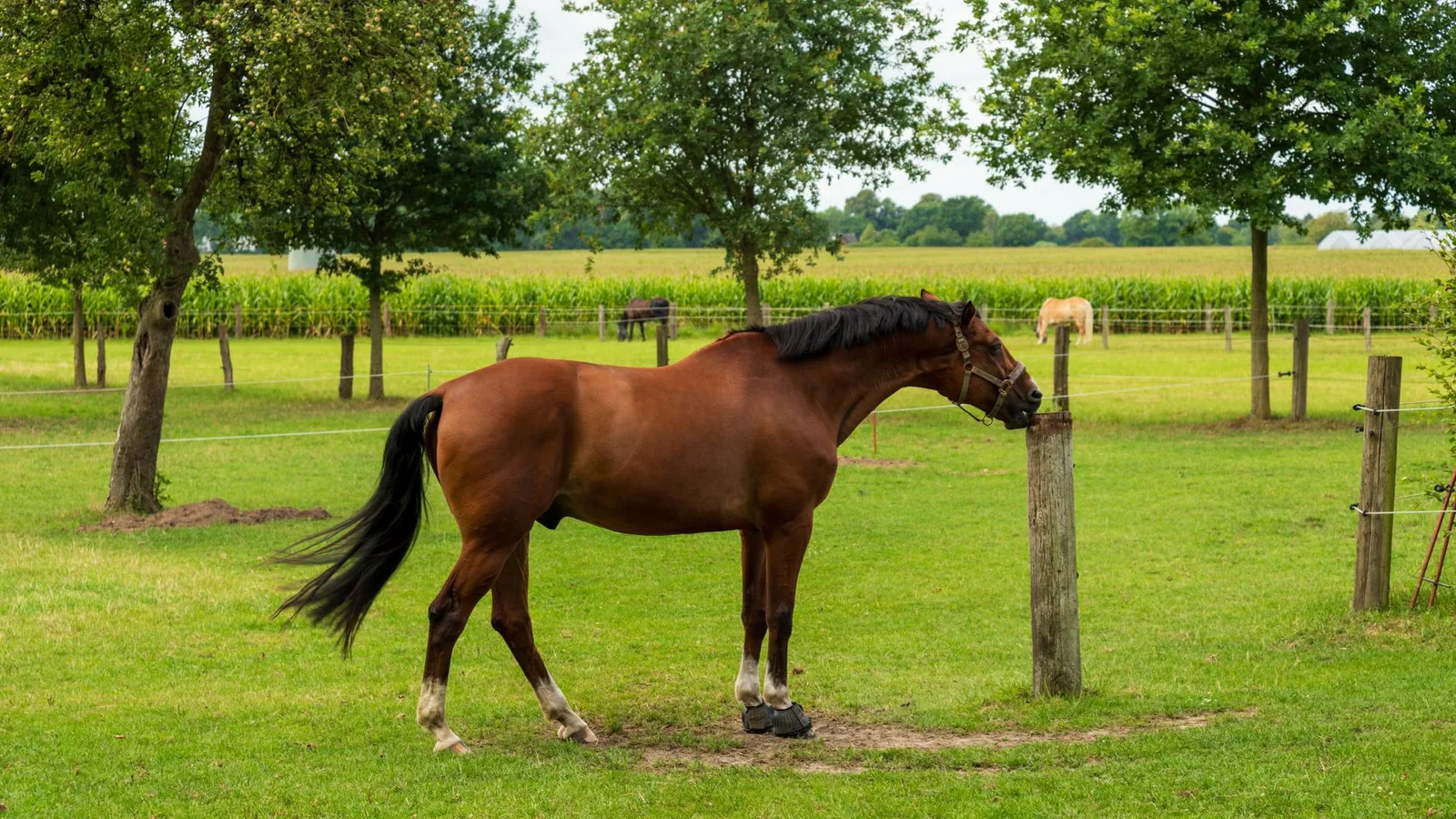
Affected horses exhibit characteristic behaviors including tail rubbing against fixed objects (fences, stall walls, trees), excessive tail swishing, and biting or nibbling at the perineal area [<a href="#ref-1">1</a>, <a href="#ref-3">3</a>]. Chronic rubbing leads to secondary dermatological changes: alopecia (hair loss) of the tail head and perineum, excoriation (superficial abrasions), lichenification (thickening of the skin), and hyperpigmentation [<a href="#ref-1">1</a>, <a href="#ref-3">3</a>]. In severe cases, the tail head may become completely denuded of hair, and secondary bacterial pyoderma may develop [<a href="#ref-1">1</a>].
Perianal Egg Deposits
The egg masses deposited by gravid female O. equi are visible to the naked eye as yellowish-gray, pasty, or crusty accumulations on the perianal skin and the ventral surface of the tail [<a href="#ref-2">2</a>, <a href="#ref-4">4</a>]. These deposits are often described as having a "butter-like" or "cream cheese" consistency [<a href="#ref-4">4</a>]. The egg masses are strongly adhesive and resist removal by simple wiping, requiring mechanical scraping or adhesive tape for collection [<a href="#ref-2">2</a>, <a href="#ref-4">4</a>]. The presence of these visible deposits is pathognomonic for O. equi infection, although their absence does not rule out infection, particularly in horses with low worm burdens or in the early prepatent period [<a href="#ref-1">1</a>, <a href="#ref-3">3</a>].
Other Clinical Signs
While pruritus ani is the dominant clinical feature, heavy infections may be associated with mild colic, diarrhea, or poor coat condition, although these signs are less specific and more commonly attributed to other gastrointestinal parasites [<a href="#ref-1">1</a>, <a href="#ref-3">3</a>]. Foals and young horses are generally more susceptible to heavy infections, but horses of all ages can be affected [<a href="#ref-1">1</a>, <a href="#ref-2">2</a>]. The behavioral changes associated with pruritus can also impact performance and handling, as affected horses may become irritable or difficult to manage during grooming or saddling [<a href="#ref-1">1</a>].
Diagnostic Approaches
Accurate diagnosis of O. equi infection requires specific sampling techniques that target the perianal region, as standard fecal flotation methods are unreliable for detecting O. equi eggs [<a href="#ref-1">1</a>, <a href="#ref-3">3</a>, <a href="#ref-4">4</a>]. The following sections describe the principal diagnostic methods.
Cellophane Tape Test (Perianal Tape Test)
The cellophane tape test, also known as the Scotch tape test, is the most widely recommended method for diagnosing O. equi infection [<a href="#ref-3">3</a>, <a href="#ref-4">4</a>]. The procedure involves pressing a strip of clear adhesive tape against the perianal skin and perineal area, then transferring the tape to a glass microscope slide for examination [<a href="#ref-4">4</a>]. The adhesive surface captures eggs, egg masses, and occasionally adult female worms that are present on the skin surface [<a href="#ref-4">4</a>].
The sensitivity of the cellophane tape test is high when performed correctly, as it directly samples the site of egg deposition [<a href="#ref-3">3</a>, <a href="#ref-4">4</a>]. However, sensitivity can be reduced if the horse has recently defecated, been groomed, or rubbed its tail, as these activities can dislodge egg masses [<a href="#ref-1">1</a>, <a href="#ref-3">3</a>]. The test is best performed in the morning before the horse is turned out or groomed, as egg deposition is primarily nocturnal [<a href="#ref-1">1</a>, <a href="#ref-3">3</a>].
Direct Perianal Scraping
Direct scraping of the perianal skin using a blunt scalpel blade or a wooden spatula can collect egg masses for microscopic examination [<a href="#ref-4">4</a>]. The collected material is placed on a glass slide with a drop of saline or water, covered with a coverslip, and examined under low-power (10x to 40x) magnification [<a href="#ref-4">4</a>]. This method is more invasive than the tape test and may cause discomfort to the horse, but it can be useful when tape test results are negative despite strong clinical suspicion [<a href="#ref-4">4</a>].
Fecal Flotation
Standard fecal flotation using saturated salt or sugar solutions (specific gravity 1.20 to 1.25) is not a reliable method for diagnosing O. equi infection [<a href="#ref-1">1</a>, <a href="#ref-3">3</a>]. The eggs are heavy and adhesive, and they are not shed freely into the fecal stream in large numbers [<a href="#ref-1">1</a>, <a href="#ref-3">3</a>]. When eggs are detected in fecal flotation, it is usually due to contamination of the fecal sample with perianal egg masses during collection [<a href="#ref-1">1</a>]. Therefore, a negative fecal flotation result does not rule out O. equi infection, and a positive result should be interpreted with caution [<a href="#ref-1">1</a>, <a href="#ref-3">3</a>].
Epifluorescence Microscopy
Epifluorescence microscopy using fluorescent dyes has been investigated as a method for visualizing O. equi eggs with enhanced contrast [<a href="#ref-4">4</a>]. Barros et al. (2016) evaluated the use of fluorescent dyes such as acridine orange and calcofluor white for staining O. equi eggs collected via cellophane tape test [<a href="#ref-4">4</a>]. Under epifluorescence illumination, the egg shell and internal structures exhibit bright fluorescence against a dark background, facilitating detection even at low egg densities [<a href="#ref-4">4</a>]. This technique may improve diagnostic sensitivity in research settings, although it requires specialized microscopy equipment not routinely available in field practice [<a href="#ref-4">4</a>].
Molecular Diagnostics
Polymerase chain reaction (PCR) assays targeting ribosomal DNA (rDNA) or mitochondrial DNA (mtDNA) sequences have been developed for O. equi detection, although they are not yet widely used in clinical practice [<a href="#ref-2">2</a>]. Molecular methods offer the potential for species-specific identification and quantification of egg numbers, and they can be applied to environmental samples (e.g., bedding, stall surfaces) for epidemiological studies [<a href="#ref-2">2</a>]. However, the cost and technical requirements of PCR currently limit its use to research and reference laboratories [<a href="#ref-2">2</a>].
Diagnostic Algorithm
The following Mermaid diagram illustrates a recommended diagnostic decision tree for suspected O. equi infection.
flowchart TD
 A["Clinical suspicion: pruritus ani, tail rubbing, perianal irritation"] --> B{"Perform perianal tape test"}
 B --> C["Positive: eggs or adult worms identified"]
 B --> D["Negative: no eggs or worms seen"]
 C --> E["Confirm diagnosis: initiate anthelmintic treatment"]
 D --> F{"Repeat tape test on 3 consecutive mornings"}
 F --> G["Any positive: confirm infection"]
 F --> H["All negative: consider alternative diagnoses"]
 H --> I["Other causes of pruritus: ectoparasites, dermatitis, allergies"]
 G --> E
 E --> J["Post-treatment recheck: tape test 2-4 weeks after treatment"]
 J --> K["Positive: possible anthelmintic resistance"]
 J --> L["Negative: successful clearance"]
 K --> M["Perform fecal egg count reduction test or resistance testing"]
Treatment and Anthelmintic Resistance
Anthelmintic Options
The treatment of O. equi infection relies on macrocyclic lactones (ivermectin, moxidectin) and tetrahydropyrimidines (pyrantel pamoate) [<a href="#ref-1">1</a>, <a href="#ref-3">3</a>]. Ivermectin administered orally at the standard dose of 200 micrograms per kilogram has historically been considered effective against adult O. equi worms [<a href="#ref-1">1</a>, <a href="#ref-3">3</a>]. Pyrantel pamoate at 6.6 milligrams per kilogram (base) is also labeled for pinworm control and acts as a nicotinic acetylcholine receptor agonist, causing spastic paralysis of the worm [<a href="#ref-3">3</a>].
Evidence of Anthelmintic Resistance
Several studies have documented reduced efficacy of ivermectin against O. equi in different geographic regions [<a href="#ref-1">1</a>, <a href="#ref-3">3</a>]. Sallé et al. (2016) reported ivermectin failure in a herd of ponies in France, where post-treatment egg counts remained positive despite repeated ivermectin administration [<a href="#ref-1">1</a>]. Similarly, Reinemeyer et al. (2010) compared the efficacy of pyrantel pamoate and ivermectin paste formulations against naturally acquired O. equi infections and found variable efficacy, with some horses failing to clear infection after treatment with either drug [<a href="#ref-3">3</a>].
The mechanisms of anthelmintic resistance in O. equi are not fully characterized but are presumed to involve genetic mutations in drug target genes (e.g., glutamate-gated chloride channels for macrocyclic lactones, nicotinic acetylcholine receptors for pyrantel) [<a href="#ref-1">1</a>, <a href="#ref-3">3</a>]. Resistance may be compounded by the long prepatent period and the ability of worms to survive in the large intestine where drug concentrations may be suboptimal [<a href="#ref-1">1</a>, <a href="#ref-3">3</a>].
Treatment Recommendations
Given the evidence of resistance, treatment should be guided by diagnostic confirmation and, where possible, by post-treatment efficacy testing [<a href="#ref-1">1</a>, <a href="#ref-3">3</a>]. A single dose of ivermectin or pyrantel pamoate is the first-line approach, but a follow-up perianal tape test should be performed 2 to 4 weeks after treatment to assess efficacy [<a href="#ref-1">1</a>, <a href="#ref-3">3</a>]. If eggs are still present, a second treatment with a different drug class (e.g., switching from ivermectin to pyrantel or using moxidectin) may be warranted [<a href="#ref-1">1</a>, <a href="#ref-3">3</a>]. Environmental decontamination through removal and replacement of bedding, and cleaning of stalls and fences, is essential to reduce reinfection pressure [<a href="#ref-1">1</a>, <a href="#ref-2">2</a>].
Control and Prevention
Control of O. equi requires an integrated approach combining anthelmintic treatment with environmental management [<a href="#ref-1">1</a>, <a href="#ref-2">2</a>]. Because infective eggs can survive for weeks in the environment, particularly in cool, humid conditions, thorough cleaning of stables, paddocks, and transport vehicles is critical [<a href="#ref-2">2</a>]. Bedding should be removed and replaced regularly, and surfaces should be cleaned with hot water or steam to inactivate eggs [<a href="#ref-2">2</a>].
Pasture management is less critical for O. equi than for strongylid nematodes, as the eggs are not deposited on pasture but rather in the immediate perianal environment [<a href="#ref-1">1</a>, <a href="#ref-2">2</a>]. However, horses should be prevented from rubbing against contaminated fences or structures [<a href="#ref-1">1</a>]. Quarantine of newly introduced horses and diagnostic testing before integration into a herd can prevent introduction of resistant worm populations [<a href="#ref-1">1</a>, <a href="#ref-3">3</a>].
Archaeological and Evolutionary Context
Oxyuris equi has a long evolutionary history with equids, as evidenced by the recovery of eggs from archaeological sites dating to the Holocene period [<a href="#ref-2">2</a>]. Dufour et al. (2015) reviewed past records of O. equi eggs from coprolites and sediment samples and reported new data from European archaeological sites, confirming the parasite's presence in domestic horses for at least several thousand years [<a href="#ref-2">2</a>]. The morphological stability of O. equi eggs over time suggests a highly co-evolved relationship with the host, with minimal morphological change despite geographic and temporal separation [<a href="#ref-2">2</a>].
Conclusion
Oxyuris equi remains a clinically important parasite of horses, primarily due to the intense pruritus ani and behavioral changes it causes. Diagnosis requires targeted perianal sampling techniques such as the cellophane tape test, as standard fecal flotation is unreliable. The emergence of anthelmintic resistance, particularly to ivermectin, underscores the need for evidence-based treatment protocols and post-treatment efficacy monitoring. Integrated control strategies combining targeted anthelmintic use with environmental hygiene are essential for managing this parasite in equine populations.