Gyrodactylus salaris: Taxonomy, Pathogenesis, Epidemiology, and Control of the Salmonid Monogenean
By Dr. Zubair Khalid, DVM, MS, PhD ·
Key Takeaways
- Gyrodactylus salaris is a viviparous monogenean ectoparasite with a direct life cycle, characterized by "telescoping" generations and a generation time of 3-5 days at optimal temperatures (10-15 °C). Transmission occurs via direct contact or detached parasites surviving in water for up to 24 hours.
- Pathogenesis in susceptible hosts, primarily Atlantic salmon (Salmo salar), involves severe epidermal damage leading to osmoregulatory failure, hyperplasia, and high mortality (up to 90%), despite a strong host immune response.
- Diagnosis relies on morphological identification of opisthaptoral hooks, but molecular methods, including PCR targeting ITS rDNA or COI, and environmental DNA (eDNA) detection in water samples, are crucial for definitive species identification and surveillance.
- Control and eradication strategies in Norway have historically involved rotenone treatment of entire rivers, followed by restocking with resistant salmon, though challenges remain due to reservoir hosts like Arctic charr and brown trout.
- Research into therapeutic interventions focuses on inhibiting the parasite's β-carbonic anhydrase (GsaCAβ) using sulphonamide compounds, representing a promising drug target for future treatments.
- The parasite is a notifiable pathogen with significant economic impact on salmon aquaculture and wild fisheries, leading to strict regulatory controls on live fish trade and movement in affected regions.
Introduction
Gyrodactylus salaris Malmberg, 1957 is a monogenean ectoparasite of freshwater salmonids that has caused devastating epizootics in Atlantic salmon (Salmo salar) populations, particularly in Norway [<a href="#ref-1">1</a>]. The parasite is listed as a notifiable pathogen under the World Organisation for Animal Health (WOAH) Aquatic Animal Health Code and is subject to eradication programmes in several European countries [<a href="#ref-2">2</a>]. This article provides a detailed, publication-grade reference covering the biology, diagnostics, and management of G. salaris, with emphasis on veterinary and molecular diagnostic applications.
Taxonomy and Phylogeny
Gyrodactylus salaris belongs to the class Monogenea, order Gyrodactylidea, family Gyrodactylidae. The genus Gyrodactylus is characterized by viviparous reproduction and the absence of a free-swimming larval stage [<a href="#ref-3">3</a>]. Phylogenetic analyses based on microRNA loci have supported the conspecificity of G. salaris and Gyrodactylus thymalli, a parasite of grayling (Thymallus thymallus), although biological differences in host specificity and pathogenicity persist [<a href="#ref-4">4</a>, <a href="#ref-5">5</a>]. Revision of the G. salaris phylogeny using mitochondrial and nuclear markers has revealed that lineages from Baltic and White Sea basins experienced Eemian interglacial crossing events, complicating taxonomy [<a href="#ref-6">6</a>]. The species is distinguished from congeneric taxa by morphological features of the opisthaptoral hooks and by molecular barcoding of the internal transcribed spacer (ITS) region [<a href="#ref-7">7</a>].
Morphology and Life Cycle
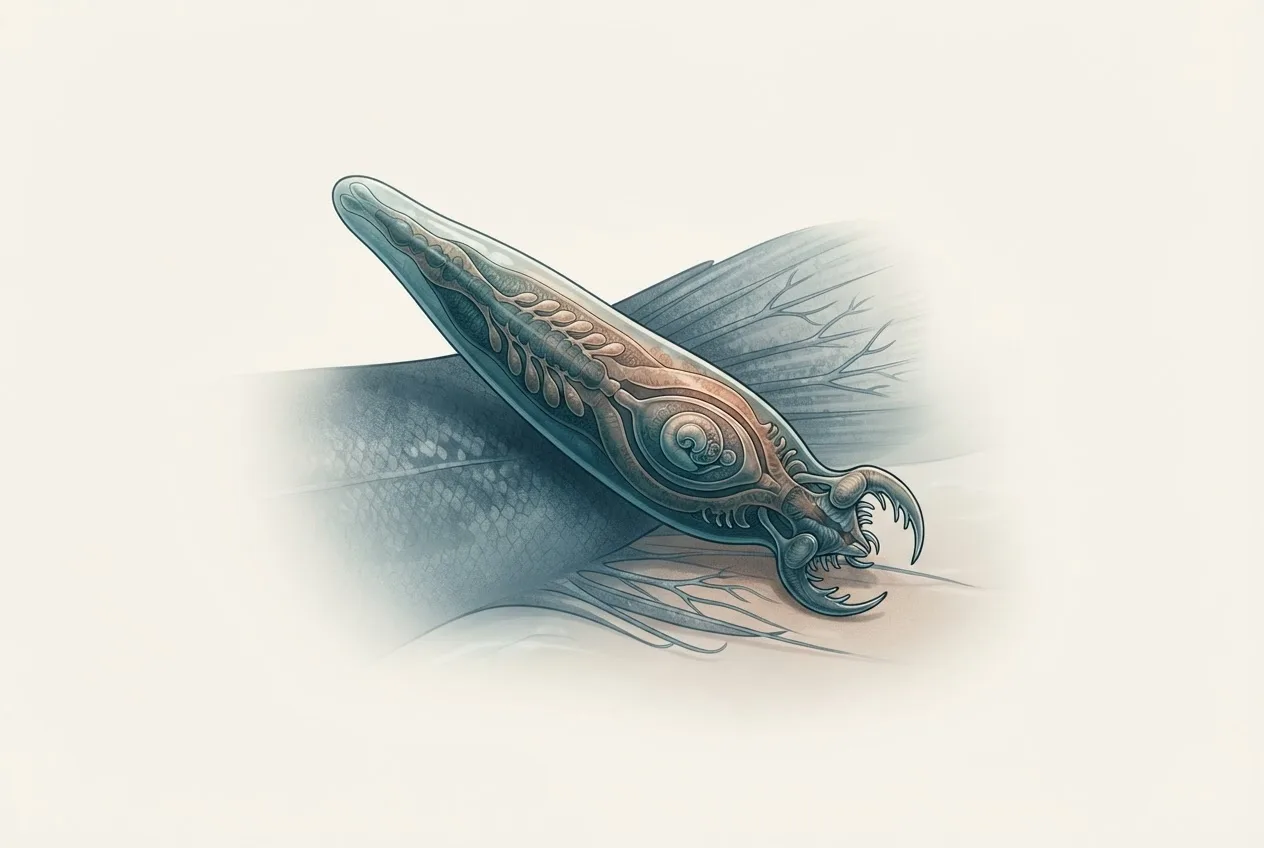
Gyrodactylus salaris is a small, elongate worm measuring 0.3-0.8 mm in length [<a href="#ref-8">8</a>]. The anterior end bears two pairs of cephalic lobes with adhesive gland openings. The posterior opisthaptor is armed with 16 marginal hooks and one pair of large anchor hooks, connected by a ventral bar. These sclerotised structures are critical for species identification [<a href="#ref-7">7</a>].
The life cycle is direct and viviparous. A single adult worm contains a developing embryo in utero, which in turn may contain a second-generation embryo, a phenomenon known as "telescoping" generations [<a href="#ref-9">9</a>]. The parasite attaches to the skin and fins of the host using the opisthaptor. Reproduction is continuous, with a generation time of approximately 3-5 days at optimal temperatures (10-15 °C) [<a href="#ref-9">9</a>, <a href="#ref-10">10</a>]. Transmission occurs via direct contact between infected and uninfected fish, but detached parasites can also survive in the water column for up to 24 hours, enabling downstream dispersal [<a href="#ref-11">11</a>]. The reproductive rate is temperature-dependent, with higher temperatures accelerating development but also increasing host mortality [<a href="#ref-10">10</a>].
graph TD
 A["Infected fish"] -->|"Direct contact"| B["Naive fish"]
 A -->|"Detached parasite in water"| C["Free-living stage"]
 C -->|"Attachment to new host"| B
 B -->|"Viviparous reproduction"| D["Population increase"]
 D -->|"Density-dependent regulation"| E["Host mortality"]
 E -->|"Reduced host density"| F["Parasite decline"]
 F -->|"Reservoir hosts"| A
 style A fill:#f9f,stroke:#333,stroke-width:2px
 style B fill:#bbf,stroke:#333,stroke-width:2px
 style C fill:#dfd,stroke:#333,stroke-width:2px
 style D fill:#ffd,stroke:#333,stroke-width:2px
 style E fill:#fdd,stroke:#333,stroke-width:2px
 style F fill:#eee,stroke:#333,stroke-width:2px
Host Range and Susceptibility
The primary susceptible host is Atlantic salmon (Salmo salar), but the parasite can infect multiple salmonid species, including rainbow trout (Oncorhynchus mykiss), Arctic charr (Salvelinus alpinus), brown trout (Salmo trutta), and grayling (Thymallus thymallus) [<a href="#ref-8">8</a>, <a href="#ref-12">12</a>, <a href="#ref-13">13</a>]. Host susceptibility varies significantly among species and populations, as summarised in Table 1.
**Table 1. Susceptibility of salmonid hosts to Gyrodactylus salaris infection**
| Host species | Susceptibility level | Key references |
|---|---|---|
| Salmo salar (Atlantic salmon) | High (high parasite burden, pathology) | [<a href="#ref-1">1</a>, <a href="#ref-9">9</a>] |
| Oncorhynchus mykiss (rainbow trout) | Moderate (supports replication, lower pathology) | [<a href="#ref-14">14</a>, <a href="#ref-15">15</a>] |
| Salvelinus alpinus (Arctic charr) | Moderate (asymptomatic carrier) | [<a href="#ref-13">13</a>, <a href="#ref-16">16</a>] |
| Salmo trutta (brown trout) | Low to moderate (seasonal variation) | [<a href="#ref-17">17</a>] |
| Thymallus thymallus (grayling) | Low (natural host for G. thymalli lineage) | [<a href="#ref-5">5</a>, <a href="#ref-6">6</a>] |
| Cottus poecilopus (alpine bullhead) | Very low (refuge host, mechanical transmission) | [<a href="#ref-18">18</a>] |
Hybrids between Atlantic salmon and brown trout can support G. salaris during winter, potentially acting as reservoirs [<a href="#ref-17">17</a>]. Arctic charr in northern Norwegian lakes show seasonality with peak prevalence in autumn [<a href="#ref-16">16</a>]. Rainbow trout populations in Italy have been reported as hosts [<a href="#ref-15">15</a>]. The parasite can also survive on non-salmonid hosts such as alpine bullhead, though reproduction is limited [<a href="#ref-18">18</a>]. Triploid Atlantic salmon exhibit higher infection rates than diploid counterparts [<a href="#ref-19">19</a>].
Pathogenesis and Clinical Signs
Infection with G. salaris causes osmoregulatory failure in Atlantic salmon due to extensive epidermal damage [<a href="#ref-20">20</a>]. The parasite feeds on epithelial cells and mucus, leading to hyperplasia, mucous cell depletion, and erosion of the epidermis [<a href="#ref-21">21</a>]. In heavy infestations, the skin becomes greyish, with excessive mucus production and focal haemorrhages. The gills may also be affected. Osmoregulatory disturbances are characterised by elevated plasma osmolality and ion imbalances, particularly in sodium and chloride levels [<a href="#ref-20">20</a>]. Mortality in naive Atlantic salmon populations can exceed 90% [<a href="#ref-1">1</a>, <a href="#ref-22">22</a>]. The parasite induces a strong immune response, including upregulation of major histocompatibility complex (MHC) class II and immunoglobulin genes, but the host fails to clear the infection [<a href="#ref-14">14</a>, <a href="#ref-21">21</a>]. In contrast, resistant hosts such as Baltic salmon populations show lower parasite burdens and reduced pathology [<a href="#ref-23">23</a>].
Epidemiology and Geographical Distribution
Gyrodactylus salaris is native to the Baltic Sea basin, where it co-evolved with Atlantic salmon populations that exhibit resistance [<a href="#ref-23">23</a>]. The parasite was introduced to Norwegian rivers through the translocation of infected fish, likely from Sweden, in the 1970s [<a href="#ref-1">1</a>]. Subsequent spread occurred through fish movements and natural dispersal. The current geographical distribution includes Norway, Sweden, Finland, Russia, Denmark, Germany, Poland, Spain, Portugal, Italy, and Romania [<a href="#ref-8">8</a>, <a href="#ref-15">15</a>, <a href="#ref-24">24</a>]. The parasite has been reported in North America, but those records are attributed to other Gyrodactylus species [<a href="#ref-8">8</a>].
In Norway, the parasite has infected over 50 rivers, leading to massive salmon population declines [<a href="#ref-1">1</a>]. The EFSA has assessed the risk of G. salaris under the Animal Health Law, categorising it as a high-impact pathogen with potential for spread through live fish trade and contaminated equipment [<a href="#ref-2">2</a>]. The parasite can survive in the free-living stage for up to 24 hours, facilitating inter-river dispersal [<a href="#ref-11">11</a>]. Reservoir hosts, particularly Arctic charr and brown trout, play a significant role in maintaining infection during eradication programmes [<a href="#ref-12">12</a>, <a href="#ref-25">25</a>].
Diagnosis
Morphological Identification
Traditional diagnosis relies on microscopic examination of wet mounts from skin and fin scrapings. The opisthaptoral hooks and marginal hooks are measured and compared with morphometric keys [<a href="#ref-7">7</a>]. However, morphological overlap with G. thymalli and other congeneric species requires molecular confirmation [<a href="#ref-4">4</a>, <a href="#ref-5">5</a>, <a href="#ref-7">7</a>].
Molecular Diagnostics
Molecular identification targets the ITS rDNA region, mitochondrial cytochrome c oxidase subunit I (COI), and microRNA sequences [<a href="#ref-4">4</a>, <a href="#ref-7">7</a>]. Multi-centre validation of PCR-based protocols has demonstrated high sensitivity and specificity when using species-specific primers [<a href="#ref-7">7</a>]. Real-time PCR assays are available for high-throughput screening. MicroRNA preparations from individual worms can be used for species-level identification, but extraction consistency varies among commercial kits [<a href="#ref-26">26</a>].
Environmental DNA (eDNA) Detection
Environmental DNA (eDNA) methods have been developed for detecting G. salaris in water samples. Rusch et al. [<a href="#ref-27">27</a>] demonstrated that eDNA can be used to detect the parasite and its hosts (Atlantic salmon and rainbow trout) simultaneously, offering a non-lethal surveillance tool. eDNA sampling is particularly useful for early detection in rivers and hatcheries where conventional methods may fail [<a href="#ref-27">27</a>].
Non-Lethal Surveillance
A hydrogen peroxide-based treatment has been developed for non-lethal sampling of G. salaris on trout farms [<a href="#ref-28">28</a>]. This method induces parasite detachment and allows collection of specimens for molecular analysis without killing the fish.
Control and Eradication Strategies
Control of G. salaris relies on a combination of chemical treatment, physical barriers, and host removal. The Norwegian eradication programme has used rotenone (CFT Legumin) to eliminate all fish in infected rivers, followed by restocking with resistant salmon [<a href="#ref-1">1</a>, <a href="#ref-25">25</a>]. Rotenone is effective against G. salaris but can be incomplete if fish hide in hypoxic refuges [<a href="#ref-25">25</a>]. Alternative disinfectants include sodium hypochlorite at low concentrations, which disrupts population dynamics [<a href="#ref-29">29</a>]. Heat and chemical disinfection of equipment (e.g., formalin, chloramine-T) are effective against detached parasites [<a href="#ref-30">30</a>]. Sulphonamide compounds have been investigated as potential therapeutics due to inhibition of the parasite's β-carbonic anhydrase (GsaCAβ), which is essential for pH regulation [<a href="#ref-3">3</a>, <a href="#ref-31">31</a>]. The recombinant enzyme has been cloned and characterised, and its inhibition by sulphonamides offers a promising drug target [<a href="#ref-3">3</a>, <a href="#ref-31">31</a>]. Reproductive trade-offs in warmer climates may reduce parasite population growth, but this is not a reliable control strategy [<a href="#ref-10">10</a>].
Eradication of G. salaris from wild salmon populations is challenging due to the presence of reservoir hosts [<a href="#ref-12">12</a>, <a href="#ref-13">13</a>]. Modelling studies suggest that natural recovery of Atlantic salmon populations after eradication is possible, but recovery times are highly variable [<a href="#ref-22">22</a>, <a href="#ref-32">32</a>].
Public Health and Regulatory Aspects
Gyrodactylus salaris is not zoonotic. It is a pathogen of fish only. However, its economic impact on salmon aquaculture and wild fisheries is substantial. The parasite is notifiable in the European Union and many other jurisdictions. The EFSA has provided a detailed assessment of the risk of entry, establishment, and spread of G. salaris under the Animal Health Law [<a href="#ref-2">2</a>]. International trade in live salmonids from infected areas is restricted.
FAQ
What is the primary host of Gyrodactylus salaris?
The primary host is Atlantic salmon (Salmo salar), but the parasite can also infect rainbow trout, Arctic charr, brown trout, and grayling [<a href="#ref-1">1</a>, <a href="#ref-8">8</a>, <a href="#ref-12">12</a>].
How is Gyrodactylus salaris transmitted?
Transmission occurs through direct contact between fish and through detached parasites that survive in the water column for up to 24 hours [<a href="#ref-11">11</a>].
What are the clinical signs of gyrodactylosis in salmon?
Clinical signs include greyish skin, excessive mucus, focal haemorrhages, osmoregulatory failure, and high mortality (up to 90% in naive populations) [<a href="#ref-1">1</a>, <a href="#ref-20">20</a>].
How is Gyrodactylus salaris diagnosed?
Diagnosis is based on morphological examination of opisthaptoral hooks and molecular methods such as PCR targeting ITS rDNA or COI, and eDNA analysis of water samples [<a href="#ref-7">7</a>, <a href="#ref-27">27</a>].
Can Gyrodactylus salaris be eradicated from infected rivers?
Eradication is possible using rotenone treatment to kill all fish, followed by restocking, but success is complicated by reservoir hosts and incomplete fish kills [<a href="#ref-1">1</a>, <a href="#ref-25">25</a>].
Is there a vaccine or drug treatment for Gyrodactylus salaris?
No commercial vaccine exists. Research is ongoing into β-carbonic anhydrase inhibitors as potential therapeutics [<a href="#ref-3">3</a>, <a href="#ref-31">31</a>]. Currently, chemical disinfection with rotenone or sodium hypochlorite is used for control [<a href="#ref-29">29</a>, <a href="#ref-30">30</a>].
What is the role of eDNA in Gyrodactylus salaris surveillance?
Environmental DNA detection allows non-invasive monitoring of parasite presence in water bodies, enabling early detection and management of outbreaks [<a href="#ref-27">27</a>].
Does Gyrodactylus salaris affect humans?
No, G. salaris is a fish-specific parasite and poses no direct human health risk.