Argulus (Fish Louse)
By Dr. Zubair Khalid, DVM, MS, PhD ·
Key Takeaways
- Argulus (fish louse) is an ectoparasitic crustacean within the subclass Branchiura, causing argulosis characterized by mechanical tissue damage, hematophagous feeding, and secondary bacterial infections, leading to significant economic losses in aquaculture.
- The direct life cycle involves free-swimming larval stages (nauplius, copepodid) that actively seek and attach to fish hosts, with rapid population expansion facilitated by favorable temperatures (30-60 days for completion).
- Pathogenesis involves epidermal erosion, hemorrhage, and inflammation at feeding sites due to the piercing stylet, leading to anemia, osmoregulatory dysfunction, and increased susceptibility to opportunistic bacterial pathogens like Aeromonas hydrophila.
- Diagnosis relies on visual inspection of adult parasites (5-10 mm), microscopic morphological identification, and advanced molecular methods such as PCR and mitochondrial gene sequencing (e.g., COI, mitogenome).
- Control strategies emphasize an integrated pest management (IPM) approach, including quarantine, environmental management, rotation of chemical treatments (organophosphates, pyrethroids, avermectins), and emerging phytochemical (e.g., azadirachtin, turmeric oil) and nanotherapeutic (e.g., silver, iron nanoparticles) agents.
- Vaccination is a promising long-term strategy, with immunoproteomic analysis identifying potential vaccine candidates from Argulus siamensis antigens.
Introduction
Argulus, commonly known as the fish louse, is a genus of ectoparasitic crustaceans within the subclass Branchiura that infests many freshwater and marine fish species [<a href="#ref-1">1</a>]. These obligate parasites are responsible for argulosis, a disease characterized by mechanical tissue damage, hematophagous feeding, secondary bacterial infections, and significant economic losses in both food fish and ornamental aquaculture sectors worldwide [<a href="#ref-1">1</a>, <a href="#ref-2">2</a>]. Argulus species exhibit a direct life cycle with multiple free-swimming larval stages, facilitating rapid population expansion under favorable environmental conditions [<a href="#ref-1">1</a>, <a href="#ref-3">3</a>]. The genus comprises over 130 described species, with Argulus japonicus, Argulus foliaceus, Argulus siamensis, and Argulus coregoni representing some of the most economically important taxa [<a href="#ref-1">1</a>, <a href="#ref-4">4</a>, <a href="#ref-5">5</a>]. Understanding the biophysical interactions between Argulus and its piscine hosts is critical for developing effective diagnostic, therapeutic, and management strategies.
Taxonomy and Morphology
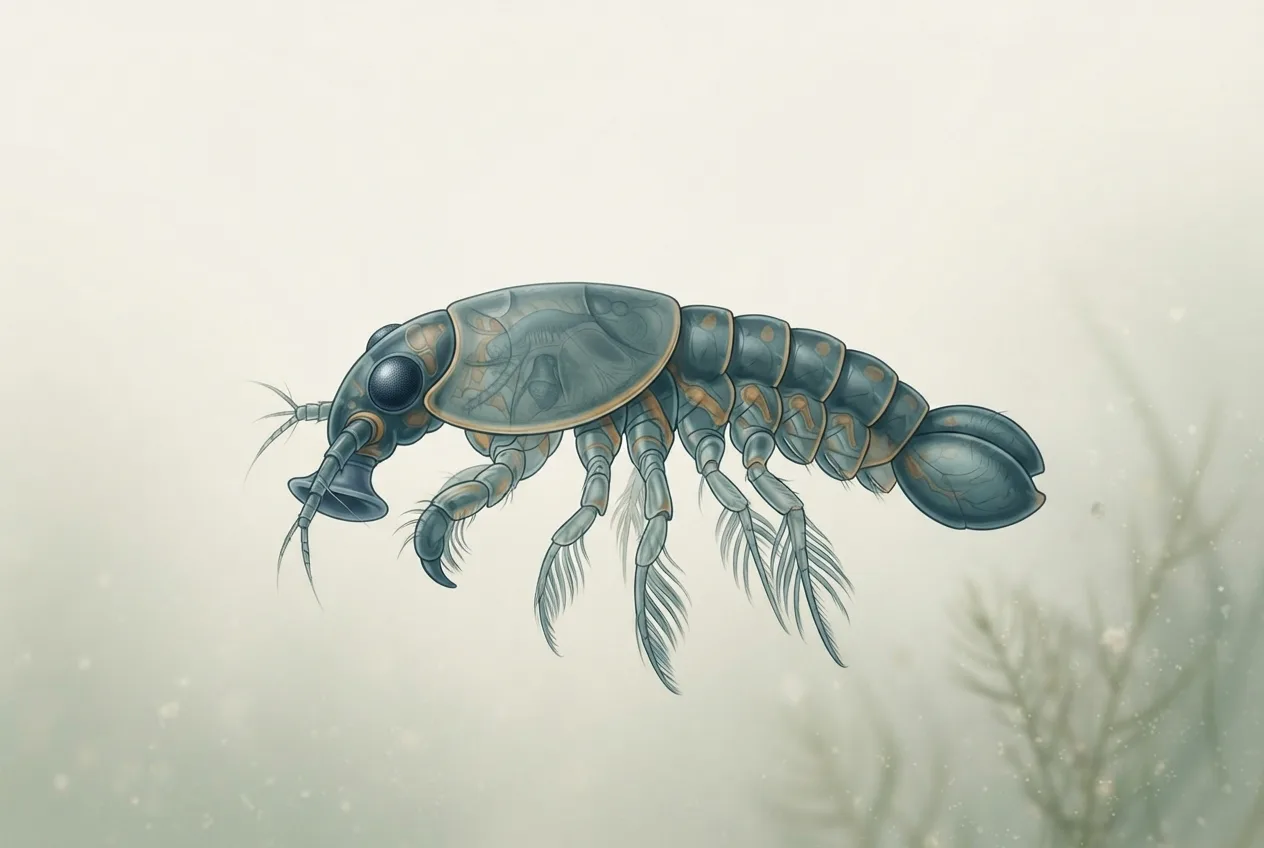
Argulus belongs to the phylum Arthropoda, subphylum Crustacea, class Maxillopoda, subclass Branchiura, and family Argulidae [<a href="#ref-1">1</a>]. The subclass Branchiura is distinguished from other crustacean ectoparasites by the presence of a specialized ventral sucker derived from the maxillae, a piercing mouthpart complex, and a flattened, dorsoventrally compressed body [<a href="#ref-1">1</a>, <a href="#ref-5">5</a>]. Scanning electron microscopic studies of Argulus coregoni have revealed detailed cuticular ornamentation, including scale-like structures, sensory setae, and the precise arrangement of the sucker apparatus [<a href="#ref-5">5</a>]. The adult body is divided into a broad, oval carapace covering the cephalothorax, a free thoracic segment, and a bilobed abdomen [<a href="#ref-5">5</a>]. The carapace encloses the compound eyes, the piercing stylet, and the maxillary suckers that facilitate firm attachment to the host epidermis [<a href="#ref-5">5</a>, <a href="#ref-6">6</a>]. The four pairs of biramous swimming legs are located on the ventral surface of the thorax and are used for free-swimming locomotion between hosts [<a href="#ref-1">1</a>]. Sexual dimorphism is evident in the morphology of the second and third pairs of legs, which are modified in males for copulation [<a href="#ref-1">1</a>]. The complete mitogenome of Argulus japonicus has been sequenced, providing a 14,975 bp circular molecule that supports phylogenetic placement within Branchiura and reveals conserved gene arrangements compared to other crustaceans [<a href="#ref-7">7</a>].
Geographic Distribution and Host Range
Argulus species exhibit a cosmopolitan distribution, with reports from every continent except Antarctica [<a href="#ref-1">1</a>, <a href="#ref-4">4</a>, <a href="#ref-8">8</a>, <a href="#ref-9">9</a>, <a href="#ref-10">10</a>]. Argulus japonicus has been documented in Hungary, Bangladesh, and numerous other regions, often associated with introduced ornamental fish populations [<a href="#ref-4">4</a>, <a href="#ref-9">9</a>, <a href="#ref-11">11</a>]. Argulus foliaceus infestations have been reported in common carp (Cyprinus carpio) from Indonesia and in Atlantic salmon (Salmo salar) systems [<a href="#ref-8">8</a>, <a href="#ref-12">12</a>]. In the Brazilian Amazon, studies on spatial distribution and host specificity have demonstrated that Branchiura species, including Argulus and the related genus Dolops, exhibit preferences for specific macrohabitat types and show variable degrees of host specificity across ten fish species [<a href="#ref-10">10</a>, <a href="#ref-13">13</a>]. The electric eel Electrophorus voltai has been documented as a host for Dolops discoidalis, expanding the known host range for branchiuran parasites [<a href="#ref-14">14</a>]. Argulus siamensis is a major pathogen in Indian aquaculture, particularly affecting Labeo rohita (rohu) [<a href="#ref-2">2</a>, <a href="#ref-15">15</a>, <a href="#ref-16">16</a>, <a href="#ref-17">17</a>, <a href="#ref-18">18</a>, <a href="#ref-19">19</a>, <a href="#ref-20">20</a>, <a href="#ref-21">21</a>]. The introduction of Argulus japonicus into new geographic regions, such as Hungary, has been linked to the international trade of koi carp and other ornamental fish, highlighting the role of anthropogenic movement in parasite dissemination [<a href="#ref-4">4</a>, <a href="#ref-11">11</a>].
Life Cycle and Developmental Biology
The life cycle of Argulus is direct, involving egg deposition, multiple free-swimming larval stages, and a series of molts leading to the adult reproductive stage [<a href="#ref-1">1</a>, <a href="#ref-3">3</a>]. Adult females detach from the host to deposit eggs in gelatinous masses on submerged substrates such as rocks, aquatic vegetation, or tank walls [<a href="#ref-1">1</a>]. Egg development and hatching are temperature-dependent, with higher temperatures accelerating embryogenesis [<a href="#ref-3">3</a>]. The first free-swimming stage is the nauplius, which is followed by several copepodid stages before the parasite becomes infective to fish [<a href="#ref-1">1</a>, <a href="#ref-22">22</a>]. The copepodid stage is the primary infective stage, during which the parasite must locate and attach to a suitable host to continue development [<a href="#ref-22">22</a>]. Once attached, the parasite undergoes successive molts through juvenile stages to reach sexual maturity [<a href="#ref-1">1</a>]. The entire life cycle can be completed in as few as 30 to 60 days under optimal thermal conditions, allowing for multiple generations per year in temperate and tropical aquaculture systems [<a href="#ref-1">1</a>, <a href="#ref-3">3</a>]. Diel variation in Argulus transcriptomes has been documented, with gene expression patterns reflecting daily rhythms in feeding, locomotion, and reproductive behavior [<a href="#ref-23">23</a>]. Additionally, behavioral studies have shown that Argulus fish lice exhibit daily patterns of activity, including diel vertical migration and host-seeking behavior, which are influenced by light intensity and host presence [<a href="#ref-6">6</a>]. In Argulus canadensis, a parasite of Atlantic salmon, bet-hedging strategies involving cold-temperature termination of diapause have been described, allowing eggs to overwinter and hatch synchronously with host availability in spring [<a href="#ref-24">24</a>].
Pathogenesis and Clinical Signs
Argulus infestation causes a multifactorial disease process involving mechanical trauma, blood loss, tissue inflammation, and secondary infections [<a href="#ref-1">1</a>, <a href="#ref-2">2</a>, <a href="#ref-25">25</a>]. The parasite uses its piercing stylet to penetrate the host epidermis and dermis, feeding on blood, mucus, and cellular debris [<a href="#ref-1">1</a>, <a href="#ref-6">6</a>]. Feeding sites are characterized by epidermal erosion, hemorrhage, and an intense inflammatory response [<a href="#ref-1">1</a>, <a href="#ref-2">2</a>]. Heavy infestations can lead to severe anemia, osmoregulatory dysfunction, and mortality, particularly in juvenile fish [<a href="#ref-1">1</a>, <a href="#ref-26">26</a>]. Primary stress responses in Labeo rohita experimentally parasitized with Argulus bengalensis include elevated plasma cortisol and glucose levels, indicative of a generalized stress response [<a href="#ref-26">26</a>]. Blood glucose profiling has been proposed as a rapid method for assessing health status in koi carp infested with ectoparasites, including Argulus [<a href="#ref-27">27</a>]. The biochemical profile of infested fish also shows alterations in serum proteins, electrolytes, and liver enzymes [<a href="#ref-26">26</a>].
Secondary bacterial infections are a common and serious complication of argulosis [<a href="#ref-1">1</a>, <a href="#ref-25">25</a>, <a href="#ref-28">28</a>]. The physical damage caused by Argulus feeding creates portals of entry for opportunistic pathogens such as Aeromonas hydrophila and Enterococcus faecalis [<a href="#ref-25">25</a>, <a href="#ref-28">28</a>]. Dual bacterial co-infections have been documented in Oscar fish (Astronotus ocellatus) co-infested with Argulus sp., Aeromonas hydrophila, and Enterococcus faecalis [<a href="#ref-28">28</a>]. Dose-dependent co-infection studies in goldfish have demonstrated that Argulus infestation modulates innate immune responses and antioxidative stress enzyme activities, with higher parasite burdens correlating with increased susceptibility to bacterial disease [<a href="#ref-25">25</a>]. Alterations in the gut microbiota composition and function of Labeo rohita infected with Argulus siamensis have also been reported, suggesting that systemic effects of parasitism extend beyond the local feeding site [<a href="#ref-19">19</a>].
Diagnosis
Diagnosis of argulosis is primarily based on visual inspection and microscopic identification of the parasite [<a href="#ref-1">1</a>]. Adult Argulus are visible to the naked eye, typically measuring 5 to 10 mm in total length, and can be observed moving on the skin, fins, and gill covers of infested fish [<a href="#ref-1">1</a>, <a href="#ref-5">5</a>]. Confirmation of species identification requires microscopic examination of morphological features, including carapace shape, sucker morphology, leg structure, and abdominal lobe characteristics [<a href="#ref-5">5</a>]. Scanning electron microscopy provides detailed ultrastructural information for definitive species identification [<a href="#ref-5">5</a>]. Molecular diagnostic methods, including PCR amplification and sequencing of mitochondrial genes such as cytochrome c oxidase subunit I (COI) and the complete mitogenome, offer high-resolution species identification and phylogenetic analysis [<a href="#ref-4">4</a>, <a href="#ref-7">7</a>]. An improved deep learning model has been developed for enhanced detection of Argulus and epizootic ulcerative syndrome in fish aquaculture, using convolutional neural networks to analyze digital images of fish for automated parasite detection [<a href="#ref-29">29</a>]. This computational approach has the potential to facilitate rapid, non-invasive screening of large fish populations.
Treatment and Control
Control of Argulus infestations requires an integrated approach combining chemical, biological, and management strategies [<a href="#ref-1">1</a>]. Traditional chemical treatments include organophosphates, pyrethroids, and avermectins, although concerns regarding environmental toxicity and the development of resistance have prompted the search for alternative therapies [<a href="#ref-1">1</a>, <a href="#ref-22">22</a>].
Phytochemical and Nanotherapeutic Approaches
A substantial body of recent research has focused on plant-derived compounds and green-synthesized nanoparticles as antiparasitic agents against Argulus [<a href="#ref-15">15</a>, <a href="#ref-16">16</a>, <a href="#ref-17">17</a>, <a href="#ref-22">22</a>, <a href="#ref-30">30</a>, <a href="#ref-31">31</a>, <a href="#ref-32">32</a>, <a href="#ref-33">33</a>, <a href="#ref-34">34</a>]. Azadirachtin, a limonoid from the neem tree (Azadirachta indica), has demonstrated broad-spectrum efficacy against ectoparasites infesting goldfish, including Argulus [<a href="#ref-30">30</a>]. Ethanol and methanol extracts of Azadirachta indica leaves have shown antiparasitic potential against eggs and copepodid stages of Argulus japonicus in vitro [<a href="#ref-22">22</a>]. Aqueous mahua oil cake extract has exhibited in vitro and in vivo antiparasitic efficacy against Argulus foliaceus infestations in Cyprinus carpio [<a href="#ref-31">31</a>]. Turmeric oil (Curcuma longa L.) has demonstrated in vitro and in vivo activity against Argulus spp. in goldfish [<a href="#ref-33">33</a>]. Dietary supplementation with white and common turmeric has been shown to improve resistance to Argulus siamensis in Labeo rohita, suggesting a role for immunonutrition in parasite management [<a href="#ref-17">17</a>]. Pellitorine, an alkamide, has been explored as an antiparasitic agent against Argulus, with impacts on antioxidant levels and immune responses in goldfish [<a href="#ref-32">32</a>]. Essential oils from Cymbopogon citratus (lemongrass) have been evaluated for lethal concentration values against Dolops discoidalis and Argulus sp. [<a href="#ref-34">34</a>].
Green-synthesized silver nanoparticles have been evaluated for antiparasitic efficacy and safety against Argulus siamensis in Labeo rohita, demonstrating significant parasite reduction with minimal host toxicity [<a href="#ref-15">15</a>]. Biogenic iron nanoparticles have also shown in vivo antiparasitic activity against Argulus siamensis, with additional effects on parasite ion channel gene expression, suggesting a molecular mechanism of action [<a href="#ref-16">16</a>].
Vaccination and Immunological Approaches
Vaccination represents a promising long-term strategy for argulosis control [<a href="#ref-20">20</a>, <a href="#ref-21">21</a>]. Immunoproteomic analysis of Argulus siamensis antigens has identified several immunogenic proteins that could serve as vaccine candidates [<a href="#ref-21">21</a>]. A vaccination approach to prevent Argulus siamensis infection has shown success in experimental trials, although challenges remain regarding antigen delivery, immune memory duration, and cross-species protection [<a href="#ref-20">20</a>]. Real-time PCR expression analysis of immune genes in the skin of Labeo rohita following argulosis has identified appropriate reference genes for normalization, facilitating future studies on host immune responses to infestation [<a href="#ref-18">18</a>].
Integrated Pest Management
Effective control of Argulus in aquaculture settings requires an integrated pest management (IPM) approach [<a href="#ref-1">1</a>]. Key components of IPM include:
- Quarantine protocols: New fish should be quarantined and inspected for Argulus before introduction to established populations [<a href="#ref-1">1</a>, <a href="#ref-11">11</a>].
- Environmental management: Reducing organic load, maintaining optimal water quality, and removing substrates that harbor Argulus eggs can reduce parasite populations [<a href="#ref-1">1</a>].
- Biological control: The use of cleaner fish or other biological agents has been explored but requires further validation [<a href="#ref-1">1</a>].
- Chemical rotation: Rotating between different classes of antiparasitic compounds can delay the development of resistance [<a href="#ref-1">1</a>].
- Monitoring and surveillance: Regular visual inspection and the use of molecular or computational diagnostic tools enable early detection and intervention [<a href="#ref-1">1</a>, <a href="#ref-29">29</a>].
The following Mermaid diagram illustrates a decision tree for the integrated management of Argulus infestations in aquaculture.
flowchart TD
 A["Detection of Argulus infestation"] --> B{"Parasite burden assessment"}
 B -->|"Low burden"| C["Enhanced monitoring and environmental management"]
 B -->|"Moderate burden"| D["Phytochemical or nanotherapeutic treatment"]
 B -->|"High burden"| E["Chemical treatment with rotation protocol"]
 C --> F["Regular surveillance"]
 D --> F
 E --> F
 F --> G{"Re-infestation detected?"}
 G -->|"Yes"| H["Review biosecurity and quarantine protocols"]
 G -->|"No"| I["Continue IPM program"]
 H --> B
Frequently Asked Questions
What is Argulus and why is it important in aquaculture?
Argulus, or fish louse, is a genus of ectoparasitic crustaceans that causes argulosis, a disease characterized by mechanical tissue damage, blood loss, and secondary bacterial infections, leading to significant economic losses in global aquaculture [<a href="#ref-1">1</a>].
How is Argulus transmitted between fish?
Argulus has a direct life cycle; adult females lay eggs on submerged surfaces, and free-swimming copepodid larvae actively seek and attach to new fish hosts [<a href="#ref-1">1</a>, <a href="#ref-22">22</a>].
What are the clinical signs of argulosis in fish?
Clinical signs include visible parasites on the skin and fins, erythema, hemorrhage, scale loss, lethargy, flashing behavior, anemia, and increased susceptibility to secondary bacterial infections such as those caused by Aeromonas hydrophila [<a href="#ref-1">1</a>, <a href="#ref-25">25</a>, <a href="#ref-28">28</a>].
How is Argulus diagnosed?
Diagnosis is based on visual observation of the parasite, microscopic morphological examination, and molecular methods such as PCR and mitochondrial gene sequencing [<a href="#ref-1">1</a>, <a href="#ref-4">4</a>, <a href="#ref-5">5</a>, <a href="#ref-7">7</a>]. Deep learning image analysis is an emerging diagnostic tool [<a href="#ref-29">29</a>].
What treatment options are available for Argulus infestations?
Treatment options include chemical antiparasitics, phytochemicals such as azadirachtin and turmeric oil, green-synthesized nanoparticles, and immunonutritional approaches [<a href="#ref-15">15</a>, <a href="#ref-16">16</a>, <a href="#ref-17">17</a>, <a href="#ref-22">22</a>, <a href="#ref-30">30</a>, <a href="#ref-31">31</a>, <a href="#ref-32">32</a>, <a href="#ref-33">33</a>, <a href="#ref-34">34</a>].
Can Argulus infestations be prevented?
Prevention relies on integrated pest management including quarantine of new fish, environmental management, regular monitoring, and vaccination where available [<a href="#ref-1">1</a>, <a href="#ref-20">20</a>].
What is the relationship between Argulus and bacterial co-infections?
Argulus feeding creates epidermal lesions that serve as portals of entry for opportunistic bacteria such as Aeromonas hydrophila and Enterococcus faecalis, leading to more severe disease outcomes [<a href="#ref-25">25</a>, <a href="#ref-28">28</a>].