Single-Channel vs. Multichannel Pipettes
By Dr. Zubair Khalid, DVM, MS, PhD ·

A single-channel pipette moves one volume through one tip at a time, while a multichannel pipette moves 8, 12, or more identical volumes in parallel through a row of tips spaced to match a microplate. The rule of thumb is simple. Reach for the single-channel pipette when every transfer needs its own volume, its own tube, or its own tip, and reach for the multichannel when you are filling or sampling rows and columns of a plate with the same volume, stroke after stroke.
That one-line difference between single-channel and multichannel pipettes hides most of the practical detail. The two formats share the same piston physics, the same tip library for common volumes, and the same calibration principles. What changes is the shape of the work each does well. A single-channel pipette is the precise, flexible generalist for tubes, gels, and small sample numbers. A multichannel pipette is a plate specialist that turns a 96-well filling job from nearly a hundred separate motions into eight or twelve.
This article compares the two formats on throughput, accuracy, ergonomics, error patterns, and upkeep, walks through pipetting technique for each, covers pipette calibration, and works through real protocols so you can decide which pipette a given step deserves.
What a Single-Channel Pipette Is
A single-channel pipette is a handheld piston instrument with one tip cone and one tip. In the air-displacement design used for most aqueous molecular biology work, a spring-loaded piston draws a column of air into a sealed cylinder, and that trapped air cushion pushes the liquid out. The piston never touches the liquid. The design is fast and covers an enormous volume range, but the air cushion is compressible and shifts with temperature, barometric pressure, and the vapor pressure of the liquid, which is why technique and calibration matter more than most beginners expect.
The alternative is a positive-displacement pipette, in which the piston sits inside a capillary and contacts the liquid directly. Positive displacement wins for viscous, volatile, or dense liquids such as glycerol-rich enzyme stocks, where an air cushion gives back an inaccurate volume.
Single-channel pipettes come in fixed-volume and variable-volume models, and variable volume dominates at the bench. A typical model family looks like this, with exact ranges varying by manufacturer:
- P2, roughly 0.2 to 2 microliters (µL, one millionth of a liter)
- P10, roughly 0.5 to 10 µL
- P20, roughly 2 to 20 µL
- P100, roughly 10 to 100 µL
- P200, roughly 20 to 200 µL
- P1000, roughly 100 to 1,000 µL
- P5000 and 10 mL models, for milliliter-scale reagents and buffers
Each model takes its own tip size, and the tip is part of the measurement system. Filter tips, which carry a hydrophobic plug that blocks aerosols, protect PCR and RNA work. Low-retention tips shed less liquid film and help at small volumes. A worn, bent, or poorly fitting tip ruins the calibration of the pipette behind it, no matter how recent that calibration was.
When to Use a Single-Channel Pipette
Choose the single-channel pipette when the job looks like any of these:
- Individual tubes and small sample counts. When you are setting up eight restriction digests, there is nothing for a second tip to do at the same moment as the first.
- Transfers that differ in volume. Loading 5 µL of dye into one lane, 12 µL of sample into the next, and 8 µL of marker into a third is single-channel work by definition.
- Protein gel loading. Sodium dodecyl sulfate polyacrylamide gels hold their wells in a single row with comb-dependent spacing, so a multichannel manifold rarely matches. Long, thin gel-loading tips let you reach into the cassette without touching the glass plates.
- Serial dilutions in tubes. A fold-dilution series for a standard curve is a rhythm of aspirate, dispense, mix, transfer, and change tip, done one tube at a time.
- Very small or very large volumes. The extremes of the volume ladder, from a P2 at 0.5 µL to a 10 mL pipette for buffer, belong to single-channel models.
- Precious or hazardous samples where one-tip-one-sample bookkeeping matters for traceability.
A useful habit when deciding between a single channel or multichannel pipette is to walk the protocol stroke by stroke and count how many consecutive, identical transfers appear in a row. Three or more in a row starts to favor the multichannel. One or two favors the single-channel.
What a Multichannel Pipette Is
A multichannel pipette stacks 8, 12, 16, 24, or more pistons side by side behind a common manifold, so one thumb stroke aspirates and dispenses every channel at once. The spacing of the tips, called the well pitch, matches standard microplate geometry. A 96-well plate is arranged as 8 rows by 12 columns with 9 millimeters between well centers, so an 8-channel pipette spans one full column and a 12-channel pipette spans one full row. A 384-well plate packs 16 rows by 24 columns at a 4.5 millimeter pitch, and 16- and 24-channel pipettes fill a column or a row per stroke.
Most manual multichannel pipettes are air-displacement instruments with variable volume per channel, commonly spanning ranges such as 2 to 20 µL, 20 to 200 µL, or 50 to 1,200 µL depending on the model. Electronic multichannel pipettes add motorized pistons and modes that earn their keep at the bench. A stepper or repeat mode aspirates once and dispenses the same volume repeatedly, which turns a single tip load into a whole plate of aliquots, meaning equal portions. Some electronic models add motorized adjustable tip spacing, letting one tool pick up a row from a plate and deposit the tips into individual tubes or a tube strip.
Because all channels share one plunger, one dispense, and usually one press onto a tip rack, the multichannel format wins on speed and on well-to-well consistency. It loses on flexibility, because every channel must do the same thing at the same time.
When to Use a Multichannel Pipette
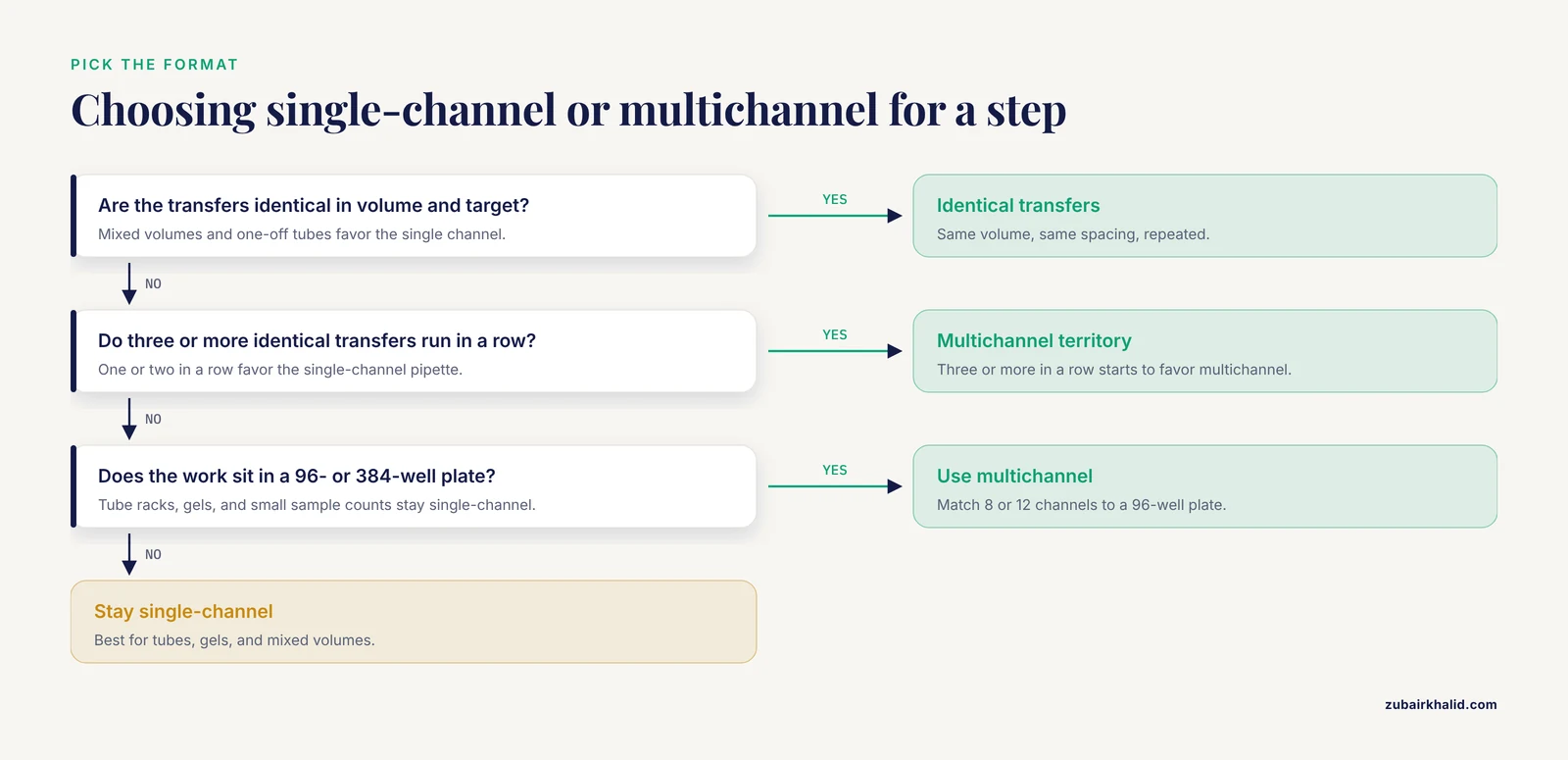
Reach for the multichannel pipette when the work lives in a plate:
- Immunoassays such as ELISA (enzyme-linked immunosorbent assay), a plate-based assay in which samples, antibodies, substrate, and stop solution are added across 96 wells and read as color in a plate reader.
- qPCR (quantitative polymerase chain reaction) setup, where a shared master mix, a precombined pool of primers, probe, buffer, and polymerase, is distributed down the plate before templates are added.
- Cell culture plating, feeding, and drug addition in multiwell plates.
- Plate-to-plate replication, titrations, and dilution series laid out in rows or columns.
- Any wash, substrate, or stop step that must hit every well quickly, because a reagent that lands in well A1 four minutes before well H12 builds a time gradient into your data.
The multichannel format also earns its place on fatigue grounds. The same plate that costs a single-channel pipette nearly a hundred separate cycles costs an 8-channel pipette a dozen.
Single-Channel vs. Multichannel Pipette: Side-by-Side Comparison
The table condenses the decision. Read it as a default, then let the specific protocol override it.
| Criterion | Single-channel pipette | Multichannel pipette |
|---|---|---|
| What one stroke moves | One volume through one tip | 8, 12, 16, 24, or more equal volumes in parallel |
| Typical channel counts | 1 | 8 and 12 for 96-well plates, 16 and 24 for 384-well plates |
| Common volume ranges | About 0.2 µL to 10 mL across the model family | About 2 to 20 µL up to 50 to 1,200 µL per channel, model dependent |
| Where it excels | Tube racks, gels, small sample numbers, mixed volumes | 96- and 384-well microplates, repeated identical transfers |
| Strokes for a full 96-well plate | 96 cycles | 12 with 8 channels, 8 with 12 channels |
| Accuracy profile | Reference standard across its range when used well | Close to single-channel per channel, with channel-to-channel uniformity as the extra spec |
| Typical failure pattern | Isolated to one transfer | Repeats across a row or column when alignment or one seal is off |
| Ergonomics | Nimble in racks, fatiguing on plates | Fewer strokes per plate, heavier tool, large reduction in repetitive motion |
| Consumables | Standard tips | Same tips for most 8- and 12-channel models, plus reagent reservoirs, matched-pitch tips for 384-well |
| Calibration burden | One channel | Every channel, often screened photometrically |
| Purchase price | Lower | Higher, rising with channel count |
Two rows deserve emphasis. The stroke count row is the throughput argument. The failure pattern row is the risk argument, because a multichannel pipette multiplies both your consistency and your mistakes across eight or twelve wells at a time.
Head-to-Head on the Criteria That Decide Real Choices
Throughput and Speed
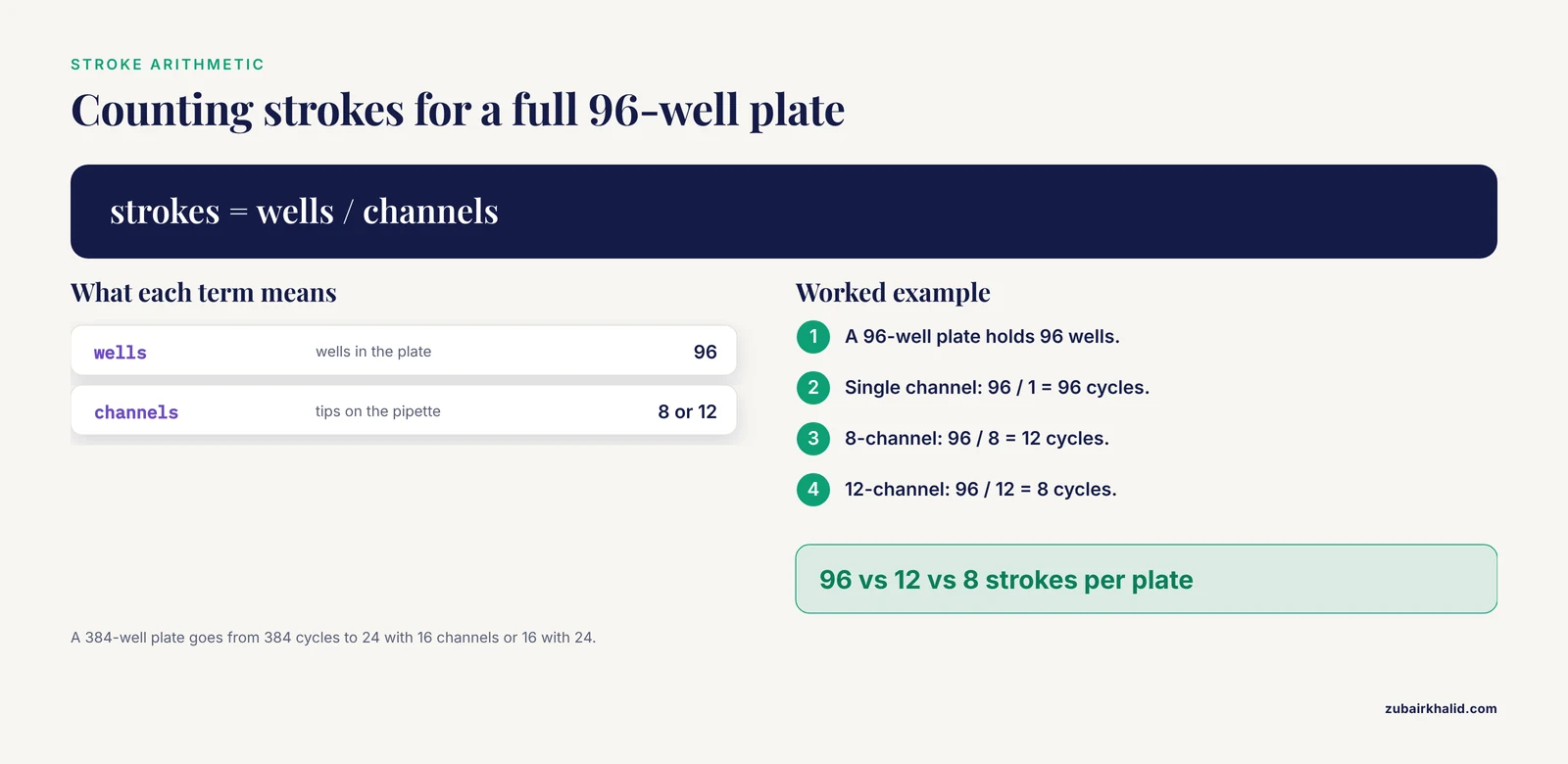
Do the arithmetic for your own plate formats. A 96-well plate filled with 200 µL per well takes 96 full aspiration and dispense cycles with a single-channel pipette, plus tip changes whenever the reagent cannot carry over. At a careful, accurate pace that is tens of minutes of continuous motion. The same plate takes 12 cycles with an 8-channel pipette and 8 cycles with a 12-channel pipette, which is a couple of minutes including tip loading. On a 384-well plate the gap widens further, from 384 single-channel cycles to 24 with a 16-channel pipette or 16 with a 24-channel pipette.
Speed is about more than raw time. Fewer strokes mean fewer chances to skip a well, fewer tip changes, and less drift in your own rhythm between the first well and the last. When a reagent addition must be fast across the whole plate, such as stopping a colorimetric reaction, the multichannel pipette is the only handheld way to keep well-to-well timing tight.
Accuracy and Precision
Accuracy is how close a delivered volume sits to the set volume. Precision is how tightly repeated deliveries cluster. A correctly used, well-calibrated single-channel pipette remains the reference standard for both, and it holds its accuracy across its adjustable range when you stay in the upper portion of that range. Accuracy degrades near the bottom of a variable span, which is why a P1000 set to 50 µL is a poor choice next to a P200 set to 50 µL.
A multichannel pipette has to hit the same targets, and it has to do it eight or twelve times at once. Modern designs hold per-channel tolerances close to single-channel specifications, but the failure modes differ. Each tip cone must seal on its own piston, the manifold must align with the well centers, and the tips must all seat evenly in the rack. A single weak seal quietly under-delivers one channel while the rest look perfect.
There is one place the multichannel format can beat the single-channel pipette on data quality. When every well of a row receives its volume with one identical stroke, well-to-well variation from hand fatigue and rhythm disappears within that row. In plate assays judged against standards on the same plate, that uniformity often matters as much as absolute accuracy.
Ergonomics and Repetitive Strain
Count thumb strokes. One 96-well plate by single-channel pipette is roughly 192 plunger movements plus 96 tip ejects. Repeat that for a stack of plates and the load lands on the thumb, wrist, and forearm, where repetitive strain injuries develop quietly over months. The same plate with an 8-channel pipette is about 24 plunger movements and 12 tip loads.
Multichannel pipettes are heavier and wider, and a fully loaded 12-tip manifold has real leverage, so lifting angle and posture matter. The net effect still favors the multichannel for plate work, and it favors the single-channel for anything spread across tube racks, where the narrower tool reaches between tubes without knocking neighbors over.
Error Patterns and Contamination Control
The two formats fail differently. A single-channel mistake is usually isolated. One well gets 180 µL instead of 200 µL, and the rest of the plate is clean. A multichannel mistake tends to be structural. If the manifold sits half a well off, every tip in that row touches the wall inconsistently. If one seal leaks, one column of data runs low all day. The upside is that multichannel errors repeat in visible patterns, so a row or column effect on a plate readout is a prompt to check the pipette rather than the samples.
Contamination control is similar for both formats. Filter tips are the default for PCR setup with either one. The multichannel format adds the reagent reservoir, a rectangular trough that holds enough liquid for repeated aspiration. Keep enough depth in the trough, tilt it to pool the last of the liquid, and never chase a nearly empty reservoir, because aspirating air into one channel of a loaded manifold is easy to miss.
Budget and Consumables
A multichannel pipette costs more to buy than the single-channel pipette it replaces, and the price climbs with channel count. It also pulls reagent reservoirs into the consumable budget. Tip costs are usually shared, because 8- and 12-channel manifolds accept the same standard tip sizes as the matching single-channel models, while 384-well-pitch pipettes and some low-volume designs need their own tip formats. Against that, one multichannel pipette can retire hours of single-channel plate work per week, which is the trade most plate-heavy labs make without hesitation.
Pipetting Technique for Each Format
Good pipetting technique is the biggest accuracy lever you own, bigger than the choice between formats. The fundamentals are shared. The details differ.
Technique That Applies to Both
- Match the pipette to the volume. Stay in the upper part of a variable range and never force the setting outside the printed limits, which damages the stop mechanism.
- Pre-wet the tip. Aspirate and dispense the working liquid two or three times before the real transfer. Pre-wetting equilibrates the air cushion humidity and coats the tip so the retained film is reproducible.
- Control immersion depth. A few millimeters for small volumes, deeper for large ones. Too deep and liquid clings to the outside of the tip, too shallow and you aspirate air as the level drops.
- Keep the pipette upright or near upright while aspirating. Angle changes the hydrostatic pressure and the volume drawn.
- Use the stops deliberately. Press to the first stop to aspirate, dispense fully against the receiving wall, then press the second stop to blow out the residual film. Reverse pipetting flips this sequence, aspirating to the second stop and dispensing to the first, which compensates for viscous or foamy liquids that leave film behind.
- Move the plunger at a consistent speed. Slow, smooth aspiration reduces aerosols and bubbles.
- Change tips whenever carryover would matter, and use filter tips for PCR and RNA work.
Single-Channel Technique
Tube work adds angles and rhythm. Rest the tip against the inside wall of the receiving tube at a consistent angle while dispensing, because the wall breaks surface tension and strips the liquid off the tip. For a serial dilution, dispense into the diluent and mix by aspirating and dispensing three times, then transfer the set volume to the next tube and change the tip when the dilution factor must be exact. For gel loading, use long gel-loading tips and steady both hands, because a jabbed tip punctures the well and the sample vanishes into the gel.
Multichannel Technique
Multichannel work is reservoir work. Fill the trough with enough depth to submerge every tip equally, and tilt the trough toward the tips as the volume drops so all channels see the same liquid level. Before the first stroke, press the manifold straight down onto a tip rack with even pressure, then pull back and sight along the line of tips to confirm they all seated at the same height. A tip hanging low or sitting crooked will aspirate a different volume from its neighbors.
Align the manifold over the target column or row, lower it so every tip enters its well, and dispense against the well walls where the assay allows. After dispensing, look back at the plate. A dry well in the middle of a wet row means one channel failed to deliver, and you want to catch that before the plate reaches the reader, not after.
Pipette Calibration and Maintenance
Why Pipettes Drift Out of Spec
An air-displacement pipette is a mechanical instrument with seals, O-rings, a piston, and a spring-loaded volume setting. Seal wear lets air leak past the piston. Vapor from aggressive solvents corrodes the assembly. A drop onto the bench bends the shaft or the tip cone. Each of these shifts the delivered volume, usually downward for aqueous liquids, and the drift is silent because the pipette still feels normal in the hand.
How Gravimetric Calibration Works
The reference method is gravimetric, meaning the pipette dispenses distilled water and a balance weighs it. The density of water at a known temperature converts mass to volume, with corrections for temperature, barometric pressure, and humidity as laid out in ISO 8655, the international standard for piston-operated volumetric instruments. The calibration compares the mean delivered volume against the set volume to quantify systematic error, which is accuracy, and the scatter of replicates to quantify random error, which is precision, often reported as a coefficient of variation (CV, the standard deviation divided by the mean). Testing at several points, typically near the nominal volume, the middle of the range, and the bottom of the range, exposes the volumes where a pipette falls outside the manufacturer's tolerance.
Most labs run a quick in-house check on a schedule and send pipettes for full calibration about once a year, or immediately after a drop, a jam, or exposure to corrosive reagents. Manufacturers publish tolerance tables for each model, and those tables are what your standard operating procedure should reference.
Verifying a Multichannel Pipette
Each channel of a multichannel pipette is verified on its own, because a single drifting channel poisons one column or row of every plate it touches. Gravimetric testing of 12 channels is slow, so many labs add a photometric method, dispensing a dye solution into a microplate and reading absorbance in a plate reader, which flags channel-to-channel imbalance quickly. The pass criterion includes both per-channel accuracy and the spread between channels, since a pipette whose channels disagree by a visible margin will stripe your data even if every channel sits close to nominal on average.
Checks You Can Run Between Calibrations
Three quick checks catch most problems. First, a leak test, aspirate a set volume of water, hold the pipette still for several seconds, and watch for a droplet forming at the tip or the meniscus falling. Second, a visual tip-seating check after every loading. Third, a dye check, dispense into a plate of water or buffer and look for one pale column in an evenly colored row. Any drop, any sticky plunger, or any suspicious row effect on a plate readout is a reason to pull the pipette from service and verify it before the next run.
Worked Scenarios
An ELISA in a 96-Well Plate
You are running an ELISA with standards in duplicate, 40 samples in duplicate, and substrate and stop steps. The layout is plate-shaped from the first dispense. Standards and samples go in with a multichannel pipette from a reservoir, working down columns with an 8-channel or across rows with a 12-channel, whichever matches your plate map. Substrate and stop solution go in with the multichannel pipette as fast as the plate allows, because the interval between substrate and stop is part of the assay. The single-channel moments are preparing stock standards in tubes and any cleanup step. This is the classic multichannel assignment.
qPCR Plate Setup
You are setting up a 96-well qPCR plate with a master mix and 94 samples plus controls. The master mix is one reagent into every well, so it goes down the plate with a multichannel pipette and filter tips, 12 strokes with an 8-channel. The samples are all different and many are at small volumes, so they go in one at a time with a single-channel pipette, tip changed at every well to stop template carryover. The combination is the norm, multichannel for the shared reagent, single-channel for the unique templates.
Protein Gel Loading
You are loading a 15-lane SDS-PAGE gel with 15 different samples at 15 µL each. A multichannel pipette cannot help, because the comb spacing rarely matches any manifold pitch. A single-channel pipette with gel-loading tips loads each lane, and a fresh tip per lane prevents cross-lane contamination. This is the clearest single-channel assignment in the molecular biology lab.
A Serial Dilution Standard Curve in a Plate
You need a 12-point twofold dilution series across one row of a 96-well plate. A 12-channel pipette runs the whole series in one pass, aspirating 100 µL from the top concentration, dispensing 50 µL into the next well, mixing three times, and moving on, with a fresh set of tips or a validated carryover plan depending on how exact the curve must be. The same series with a single-channel pipette works, but each well is a separate motion and the rhythm drifts as your hand tires. Because the standard curve anchors every sample on the plate, row-level consistency pays.
A 384-Well Assay
You are dispensing 25 µL into all 384 wells of a hard-shell plate. A 16-channel pipette at the 4.5 millimeter pitch does it in 24 strokes, a 24-channel does it in 16, and a 96-head electronic pipetting head does it in 4. The handheld multichannel formats are the realistic bench choice, and the single-channel pipette is reserved for preparing the reagent and troubleshooting individual wells.
Common Mix-Ups
- Using a big pipette at a tiny setting. A P1000 set to 50 µL delivers worse accuracy than a P200 set to 50 µL, because 50 µL sits at the bottom of the P1000 range.
- Assuming all channels of a multichannel pipette agree. They agree only if each one seals, seats, and holds calibration. Verify per channel.
- Loading a 12-tip manifold by jabbing it into the rack at an angle. Bent tips and uneven seating follow. Press straight down with even pressure.
- Running a dilution series with one tip when carryover matters. The residual film in a tip carries a fraction of the previous concentration into the next transfer.
- Confusing pipette channels with ion channels. The electrophysiology literature uses the same words for a different idea, covered in the next section.
- Chasing a nearly empty reservoir. The last aspiration pulls air into one or more channels, and the shortfall stays invisible until the data come back.
- Storing a pipette flat or with a tip on. Liquids creep into the nosecone, corrode the piston, and contaminate tomorrow's samples. Store upright on a stand, unloaded.
- Treating calibration as a one-channel event on a multichannel pipette. Twelve channels means twelve verifications.
- Forgetting that the tip is part of the instrument. A mismatched or degraded tip invalidates the calibration behind it.
When "Channel" Means Ion Channels, Not Pipette Channels
Search the words single channel and pipette together and you will land on electrophysiology papers rather than liquid handling guides. The collision is worth clearing up, because patch clamp work uses both words for a completely different distinction, and the patch pipette is itself a pipette.
In a patch clamp experiment, a glass capillary is pulled to a fine, polished tip, filled with a salt solution, and pressed against a cell membrane. Gentle suction draws a patch of membrane into the tip and forms a gigaohm seal, an electrical resistance in the billions of ohms that isolates the membrane under the tip from the rest of the cell. An amplifier then records the tiny currents that flow through ion channel proteins in that patch.
When the patch contains a single channel protein, the recording is called single-channel. Bountra and Martin made cell-attached recordings from zona-free mouse eggs, meaning eggs with the outer zona layer removed, and identified a 130 picosiemens (pS, a unit of electrical conductance) cation channel permeable to potassium, along with small inward currents of about 1 picoampere identified as calcium channels [1]. When a patch instead contains several channels, their openings superimpose into a multichannel record, and the same study used a binomial distribution to describe how often 0, 1, 2, or more channels were open at once in those recordings [1].
Pharmacology is often done on multichannel patches. Zahradníková and Zahradník applied the calcium channel blocker diltiazem to guinea pig ventricular myocytes and found that the drug reached the L-type calcium channels under the pipette by diffusing through the membrane, with an onset time constant of 60 seconds. The drug lowered opening frequency and increased the number of null records, sweeps with no openings at all, while leaving the amplitude of unitary currents unchanged [2].
Multichannel records need analysis to recover single-channel numbers. Reifarth, Weiser, and Bentrup studied the slow-activating vacuolar potassium channel in Chenopodium rubrum suspension cells and wrote an algorithm for PCLAMP software that extracted open probability, the fraction of time a channel spends open, along with open and closed time constants, from multichannel activity records [3]. Their patches sealed above 8 gigaohms, and the channel's open probability rose from 0.03 to 0.09 when cytosolic calcium was raised from 1 micromolar to 100 micromolar [3].
Resolution sets the limit of what a patch can tell you. O'Dell and Alger separated a small channel carrying about 13 picoamperes from a large dihydropyridine-sensitive channel of about 36 picosiemens in hippocampal neurons, and found the small openings harder to resolve when barium carried the current [4].
The takeaway for a pipette shopper is simple. In electrophysiology, single versus multichannel describes how many ion channels sat under one glass pipette, not how many tips the pipette holds. The pipette-versus-plate decision in this article belongs to liquid handling, and the two vocabularies should not be mixed.
Common Mistakes and Limitations
The costliest mistake is buying the wrong format for your dominant workload. A lab that lives in plates and buys only single-channel pipettes will spend years paying the throughput difference in labor and repetitive strain. A lab that buys a multichannel pipette and then uses it for everything will fight tube racks with a tool built for plates. Audit a week of actual work, count plate strokes versus tube strokes, and let those numbers pick the format.
The second mistake is treating a multichannel pipette as one calibrated unit. Twelve channels are twelve independent pistons, seals, and tip cones, and any one of them can drift alone. Build per-channel verification into the pipette calibration schedule and record channel-to-channel spread, because a striped plate is how a drifting channel announces itself.
The third mistake is letting technique slide because the multichannel pipette feels automatic. Pre-wetting, immersion depth, and plunger speed apply to every channel at once, so a technique shortcut is multiplied by eight or twelve.
A few limits bound this comparison. It covers manual handheld pipettes, while electronic pipettes and benchtop liquid handlers extend the same ideas to larger scales. Manufacturer tolerances and tip compatibility differ between models, so confirm both against the documentation for your specific pipettes. Every lab's workload is its own, so the final call should come from walking your own protocols and, for high-stakes assays, from a head-to-head validation run on your plate.
Frequently Asked Questions
Can I use a multichannel pipette for single tubes?
Yes, but it is usually the slower and clumsier choice. The wide manifold struggles in crowded tube racks, and you consume eight or twelve tips for one transfer. Keep a single-channel pipette at the bench for tube work and save the multichannel for plates.
Is a multichannel pipette less accurate than a single-channel pipette?
A well-maintained multichannel pipette is close to a single-channel pipette in accuracy, but it has more ways to fail. Every tip must seal, the manifold must align with the wells, and each channel must hold its own calibration, so verify channels individually.
How often does a pipette need calibration?
Run a quick in-house accuracy check on a schedule set by your lab's standard operating procedure and send pipettes for full gravimetric calibration about once a year. Calibrate sooner after any drop, jam, or exposure to corrosive reagents, and more often for high-use pipettes.
How many strokes does it take to fill a 96-well plate with an 8-channel pipette?
Twelve strokes, one per column, because the eight tips span the eight rows of a single column. A 12-channel pipette covers the same plate in eight strokes, one per row.
Can I pipette viscous liquids with either pipette?
Yes, with reverse pipetting, and a positive-displacement pipette is the better tool for thick, volatile, or foamy liquids. Reverse pipetting aspirates to the second stop and dispenses to the first, so the extra liquid compensates for the film left inside the tip.
Do single-channel and multichannel pipettes use the same tips?
Usually yes for standard volumes, because 8- and 12-channel manifolds accept the same tip sizes as the matching single-channel pipettes. Confirm the manufacturer's compatibility list, since 384-well-pitch pipettes and some low-volume models require specific tips.
Sources
- Single-channel currents from zona-free mouse eggs.
- Interaction of diltiazem with single L-type calcium channels in guinea-pig ventricular myocytes.
- Voltage- and Ca(2+)-dependence of the K+ channel in the vacuolar membrane of Chenopodium rubrum L. suspension cells.
- Single calcium channels in rat and guinea-pig hippocampal neurons.