Pipetting Volatile Solvents Without Evaporation Error
By Dr. Zubair Khalid, DVM, MS, PhD ·

Pipetting a volatile solvent means transferring a liquid that is actively trying to leave the pipette tip, the receiving tube, and your stock bottle during every second of the transfer. Solvents such as methanol, acetone, acetonitrile, dichloromethane, chloroform, hexane, and diethyl ether have boiling points between about 35 and 82 degrees Celsius, and all of them lose measurable mass to the air during a routine ten-second transfer. A standard pipetting technique calibrated against water will under-deliver these liquids, and the shortfall grows with every open vial, every warm tip, and every minute the sample sits uncapped.
This article gives the complete pipetting volatile solvents technique step by step, the reasoning behind each step, the controls that prove your volumes are correct, and the specific errors that most often ruin replicates. The workflow is designed so that a trained researcher can set it up in about 15 minutes of hands-on preparation. There is no fixed elapsed time beyond the assay itself, because the technique does not add incubation or waiting steps. It changes how you handle the liquid, not what you do with it afterward.
The payoff is volume delivery that you can defend on a balance, replicates that agree well enough for quantitative work, and stock solutions whose concentrations do not drift between the first aliquot and the last. The same habits matter downstream. Analytical chemists who work with these solvents routinely build dedicated equipment around the evaporation problem, from headspace gas chromatography methods for rapid volatile solvent determination [1] to temperature-controlled microextraction devices built specifically because solvent temperature shifts change what a volatile solvent workflow delivers [2]. You do not need that hardware to pipette correctly, but you do need the same discipline about open time, temperature, and saturation.
Why Volatile Solvents Defeat a Standard Pipetting Technique
A volatile solvent is a liquid with high vapor pressure at room temperature, meaning its molecules escape into the gas phase fast enough to produce measurable evaporation on the timescale of a pipetting step. Diethyl ether boils at about 35 degrees Celsius and visibly recedes in an open tube within a minute. Acetone boils at about 56 degrees Celsius. Even acetonitrile at about 82 degrees Celsius loses enough mass in an open autosampler vial to shift a quantitation over a working session.
Most bench pipettes are air-displacement pipettes. A piston inside the shaft moves through air, and a cushion of that air sits between the piston and the liquid column in the tip. The pipette was designed, and calibrated at the factory, assuming that cushion contains room air at a known temperature, pressure, and humidity, and that the liquid in the tip behaves like water, with a density near 1.00 gram per milliliter and moderate surface tension. A volatile solvent violates every one of those assumptions at once.
Three separate error mechanisms stack up:
- Cushion vapor exchange. When you aspirate solvent, solvent vapor floods into the air cushion. That vapor is at the solvent's saturation pressure. When you dispense, part of the vapor can escape past the tip or expand differently than the calibration assumed, and the liquid slug that leaves the tip is smaller than the dial says. The effect is largest with high-vapor-pressure solvents and small volumes.
- Evaporation from the liquid itself. Every free surface loses molecules. The meniscus inside the tip, the hanging drop on the tip exterior after aspiration, the wall film left after dispensing, and the surface of the receiving vial all lose mass continuously. A dispense that takes three seconds loses more than one that takes one second.
- Density and viscosity mismatch. Hexane has a density of about 0.66 grams per milliliter and low viscosity. Chloroform has a density of about 1.49 grams per milliliter. Both behave differently in an air-displacement system than water does, and both make a gravimetric check misleading if you convert mass to volume using the water density of roughly 1.00 gram per milliliter.
The analytical chemistry community treats this problem as serious enough to design entire methods around it. Headspace gas chromatography determines volatile solvents by measuring the vapor that escapes above the liquid rather than pretending the liquid stays put [1]. Microextraction workflows for volatile solvents are built with active temperature control precisely because uncontrolled temperature changes distort what the method recovers [2]. Preconcentration methods for volatile solutes are explicitly labeled nonevaporative so that the analyte does not ride out of the sample on the solvent vapor [3]. The lesson for the bench scientist is direct. Evaporation during handling is not a rounding error. It is a first-order source of error that the field engineers around, and a pipetting technique for volatile solvents has to do the same.
The Principle: Saturate, Displace, and Cap
Every effective pipetting volatile solvents technique tips is built from three levers. You can use one, two, or all three depending on the solvent and the volume.
Lever one, saturate the air cushion. Pre-wetting means aspirating and dispensing the solvent through the same tip several times before the first real transfer. The cushion air becomes saturated with solvent vapor, so the vapor no longer competes with the liquid during the transfer, and the inside of the tip carries a stable liquid film. Three to five pre-wet cycles at the full set volume are the standard habit taught in pipette manufacturer training.
Lever two, remove or bypass the air cushion. A positive-displacement pipette carries its piston down into a disposable capillary tip, so the piston pushes directly on the liquid. There is no compressible air pocket, so solvent vapor pressure, density, and viscosity have almost no effect on the delivered volume. This is the gold standard for volatile, viscous, or dense liquids and is essentially mandatory below about 10 microliters.
Lever three, cap the system and shrink the free surface. Reverse pipetting, chilled reagents, capped vials opened for seconds at a time, and a humidified chamber (a sealed box containing damp wipes that saturates the local air) all reduce the net loss of molecules from any exposed surface between aspiration and delivery. Reverse pipetting means aspirating more liquid than you need and dispensing only the set volume, leaving the excess in the tip. That excess keeps the meniscus under positive pressure and compensates for the film that clings to the tip interior, which is why it works for volatile and foamy liquids alike.
Materials and Reagents
| Item | Working specification | Purpose |
|---|---|---|
| , - | , - | , - |
| Air-displacement pipettes (for example P20, P200, P1000 class) | Clean shafts, fresh seals, current calibration | Transfers at 10 microliters and above after pre-wetting |
| Positive-displacement pipette | Disposable capillary pistons matched to the pipette model | Volumes below about 10 microliters and the most volatile solvents |
| Pipette tips | Low-retention polypropylene, solvent compatible | Resists swelling and keeps the delivery film small |
| Glass vials with PTFE-lined septa caps | 2 milliliter crimp or screw-cap autosampler vials | Capped transfer with seconds of open time per draw |
| Crimper or appropriate cap tool | Matched to vial format | Rapid resealing between draws |
| Analytical balance | 0.1 milligram readability, draft shield | Gravimetric verification of delivered volume |
| Chilled aluminum block or ice bucket | 0 to 4 degrees Celsius | Lowers vapor pressure of solvent and samples |
| Humidified chamber | Sealed box with damp lint-free wipes | Slows evaporation during open multi-well work |
| Solvents of interest | HPLC or ACS grade, stored per supplier label | Methanol, acetone, acetonitrile, chloroform, hexane, and so on |
| Nitrile gloves plus heavy-duty overgloves for chlorinated solvents | Change at any contact | Skin protection, since nitrile breaks through quickly against chloroform |
| Fume hood access | Sash at working height | Vapor capture during every open-vial step |
| Timer | Any bench timer | Enforces short open windows |
Safety note. All the solvents named here are flammable or toxic, and several are both. Diethyl ether and some hexane formulations form peroxides on storage, so check the supplier's dating before use. Chloroform and dichloroform-class solvents penetrate nitrile in minutes, so layer a laminate overglove or switch gloves immediately after any splash. The safety motivation for minimizing open handling is not only acute exposure. A liposome preparation study comparing a solvent-free heating method with conventional thin-film preparation found the conventional method, which uses chloroform and methanol, produced significant toxicity in a human bronchial epithelial cell line, which the authors attributed to trace residual solvent [4]. Solvent vapor in your samples and in your air is a real analytical and biological variable.
Pipetting Volatile Solvents Technique Step by Step
Each step lists the action and the reason it matters. Steps 1 through 4 are setup, steps 5 through 11 are the transfer cycle, and steps 12 through 14 are verification and housekeeping.
- Plan and label everything before touching solvent. Write vial labels, set pipette volumes, and lay out tube racks with caps loosened but seated. Reason: every second of open time is a loss event, and preparation done in advance costs zero open seconds.
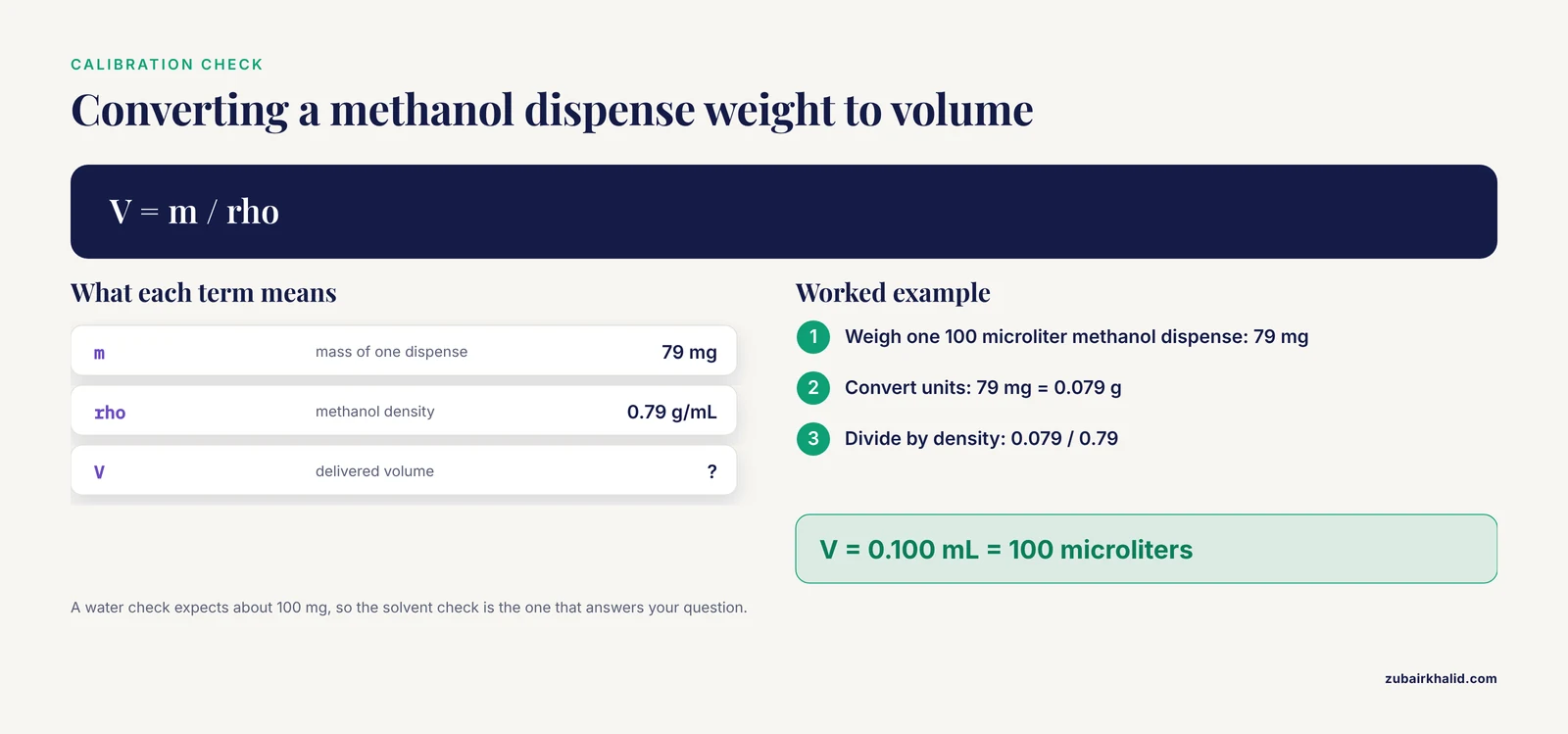
- Run a gravimetric calibration check with the actual solvent. Tare a capped glass vial on the balance, dispense ten replicates of your target volume into it with minimal opening, reweigh, and divide the mass of each replicate by the solvent density at the working temperature. For methanol at room temperature the density is about 0.79 grams per milliliter, so a correct 100 microliter dispense weighs about 79 milligrams, not 100 milligrams. Reason: pipette calibration is normally performed with water, and assuming that calibration transfers to chloroform or hexane guarantees a systematic error.
- Chill the solvent, the samples, the tips, and the receiving vials to 0 to 4 degrees Celsius on an aluminum block. Reason: vapor pressure rises steeply with temperature, and a chilled solvent evaporates several times more slowly than a bench-temperature one. Cold handling is standard practice in crystallization workflows that depend on volatile solvents, where protein crystals grown by dialysis in volatile solvents are cryocooled specifically to stabilize the solvent environment [5].
- Set up in a fume hood with the sash low, or in a cold room, and eliminate drafts across open vials. Reason: moving air strips the saturated boundary layer off a liquid surface and multiplies the evaporation rate, and it also carries solvent vapor toward your face.
- Pre-wet every fresh tip three to five times at the full set volume before the first real transfer. Aspirate, dispense back into the stock or waste, repeat. Reason: the dead-air cushion must reach solvent saturation before the first delivery, or the first aliquot from each tip is systematically low.
- Engage reverse pipetting, or add 20 to 30 percent to the aspiration setting and dispense only the target volume. For a 100 microliter target, aspirate about 120 to 130 microliters, press to the first stop to dispense the set volume, and leave the excess in the tip. Reason: the retained excess keeps the meniscus loaded and replaces the liquid film that would otherwise be subtracted from your dose.
- Aspire smoothly and hold the tip in the liquid for about one second after the plunger stops. Reason: volatile solvents wet plastic rapidly, and withdrawing early leaves a hanging drop on the tip exterior that is part of the volume you just drew and is about to evaporate or fall.
- Dispense into the receiving vial against the glass wall or into liquid below an existing meniscus, at a steady moderate speed. Reason: fast dispensing into empty air creates aerosol and splash, slow dispensing against a dry wall leaves a wall film that evaporates instead of joining the sample.
- Touch off the tip against the wall above the liquid, then cap the vial immediately. Reason: the touch-off removes the residual hanging film into the sample, and capping freezes the loss clock at the earliest possible moment.
- Keep the stock vial capped except for the second the tip is inside it, or work through a septum. Puncture the PTFE septum with the tip rather than fully opening a crimp vial. Reason: a stock bottle that sits open during a multi-minute dilution series loses solvent continuously, and because the most volatile components leave first, the concentration of anything dissolved in that solvent drifts upward.
- Work from a humidified chamber whenever tubes or plates must sit open between transfers. Put the damp wipes in the bottom of a sealed box and keep the racks inside with the lids off until you need them. Reason: local air at saturation pressure exerts no net evaporative pull on your samples.
- Switch to a positive-displacement pipette for any volume below about 10 microliters, or for the most volatile solvent in your set. Reason: below 10 microliters the air-cushion errors grow faster than the volume shrinks, and no amount of pre-wetting fully rescues an air-displacement pipette at that scale.
- Weigh one delivered replicate every 10 to 20 transfers as an in-process check. Reason: drift caused by a warming block, a failing seal, or an emptying vial shows up in a two-minute gravimetric spot check instead of in your data.
- Record solvent lot, working temperature, balance readings, and the time from opening each vial to capping. Reason: if a batch later disagrees with its siblings, the record tells you whether evaporation, calibration, or something else was the cause.
Safety note during the transfer cycle. Never pipette flammable solvents near an open flame or a hot block outside the hood, and never mouth-pipette or work outside a hood with chloroform. Vent the pipette shaft after a chlorinated solvent session, because solvent vapor that migrates into the body degrades the piston seal and shortens the interval between calibrations.
Controls and Calibration Checks
A pipetting volatile solvents technique without controls is a story. Three checks convert it into a measurement.
Solvent-matched gravimetric check. This is the primary control and the core of sound pipette calibration for nonaqueous work. Dispense ten replicates into a capped, pre-weighed vial, record the mass of each, and convert to volume using the solvent density. Under standard pipette calibration practice a pipette is verified against water, and a pipette that passes a water check can still fail a chloroform check because of cushion and density effects. The check with the actual solvent is the only check that answers the question you actually have.
Evaporation blank. Prepare a second capped vial identically, open it for the same number of seconds per replicate but dispense nothing, and weigh it before and after. The mass change is the evaporation baseline for your open-time pattern. Subtracting nothing is the point. If your blank loses measurable mass, your open windows are long enough to matter, and you shorten them until the blank is negligible. This simple distinction between delivery error and evaporative loss mirrors the logic of the nonevaporative preconcentration literature, where the whole design goal is separating the analyte from the escaping solvent [3].
Water recheck. After the solvent session, run the same replicate series with water. If the pipette passes with water but failed with the solvent, the pipette is fine and the solvent workflow needs adjustment. If it fails both, the pipette needs service or recalibration, and no handling trick will compensate.
Run all three checks at the start of a project, whenever a pipette is dropped or serviced, and whenever replicate scatter in real samples exceeds your history. A pipette calibration program that only ever tests water cannot certify performance with hexane or chloroform, because the failure modes are specific to those liquids.
Expected Results and How to Read Them
A well-executed run looks like this. The gravimetric check delivers replicate volumes within a small scatter around the set volume, the evaporation blank stays effectively flat over your open-time pattern, and the water recheck passes. During the actual experiment, serial dilutions made from the same stock read consistently from the first vial to the last, and a standard curve prepared at the beginning of the session still brackets samples prepared at the end.
The most useful diagnostic pattern is the direction of drift. If your gravimetric recoveries are low and improve when you repeat the sequence faster, colder, or with more pre-wet cycles, evaporation was stealing volume and the fixes are working. If recoveries are low by a constant fraction regardless of speed or temperature, the problem is systematic, which points to a density-corrected calibration offset, a worn seal, or a pipette set to the wrong mode. If recoveries are correct early in a session and drift low later, suspect the stock bottle losing solvent through repeated opening, or the chilled block warming as it sits out.
One caution on reading small volumes. At 1 microliter, hexane weighs about 0.66 milligrams, which is at the practical floor of many balance setups once vial handling noise is included. For sub-microliter work, trust a positive-displacement instrument and verify its performance with the manufacturer's gravimetric procedure rather than improvising a balance check at the noise floor.
Troubleshooting
| Symptom | Likely cause | Fix |
|---|---|---|
| , - | , - | , - |
| Delivered volumes read low and worsen over the session | Air cushion losing saturation between transfers, tips warming on the bench | Re-pre-wet each tip before each row, keep tips in a chilled rack, work faster per tip |
| Hanging drop persists on the tip after dispensing | Poor wetting or static on plastic, dry receiving wall | Touch off against the glass wall, dispense into existing liquid, use low-retention tips |
| Successive aliquots from one stock vial deliver progressively less | Stock evaporating through repeated opening, headspace enrichment | Cap between every draw, use septum vials, prepare a fresh intermediate stock |
| Undershoot appears only with freshly chilled solvent | Cold liquid condensing behavior and meniscus lag on a warm tip | Pre-chill tips and receiving vials, add pre-wet cycles until the blank stabilizes |
| Replicate scatter grows when the hood sash is raised | Cross-draft stripping the saturated layer off open vials | Lower the sash, shield the rack, move open-vial steps into the humidified chamber |
| Positive-displacement pipette also reads low | Capillary piston not fully extended or wrong piston size for the volume | Confirm the piston and tip pairing, prime the capillary, follow the manufacturer's reverse-dispense guidance |
| Balance readings wander between replicates | Air currents and a warming vial on the pan | Use the draft shield, let vials equilibrate seconds before reading, log the temperature |
| Tip swells, crazes, or turns cloudy | Solvent attacking the plastic | Use polypropylene tips, or deliver with a glass syringe for solvents that attack even polypropylene |
Common Mistakes and Limitations
The pipetting volatile solvents technique common mistakes below account for most failed sessions. Each one is specific and each one is fixable.
- Calibrating with water and assuming the result transfers. A pipette that delivers 100.0 microliters of water will not deliver 100.0 microliters of chloroform, whose density is about 1.49 grams per milliliter, or of hexane, at about 0.66. Verify with the solvent.
- Pre-wetting once and walking away. A tip that sits in dry air between rows of a plate loses its saturated cushion. Re-pre-wet every time a tip has been out of contact with solvent for more than a few seconds.
- Using polystyrene tubes or plates with chlorinated or aromatic solvents. Chloroform, dichloromethane, and toluene craze or dissolve polystyrene. Use polypropylene or glass.
- Opening the stock while walking to the balance. Carry a capped vial, open it only on the pan.
- Trusting cold alone. Chilled solvent in a warm pipette tip condenses and dribbles. Chill the tip and the receiver too, or accept a brief equilibration with the tip in the liquid.
- Letting solvent vapor live inside the pipette. Wipe the shaft, vent the body, and shorten the service interval after chlorinated solvent work. Contaminated seals cause creeping under-delivery that looks exactly like evaporation.
- Applying reverse pipetting logic to a positive-displacement pipette. Most positive-displacement instruments dispense their full capillary contents, so aspirating extra wastes reagent and can change the delivered dose. Follow the mode the manufacturer specifies.
- Reading the meniscus in glass for quantitation. Refraction and parallax are poor substitutes for a balance. Weigh.
- Forgetting that the sample itself is volatile. If your analyte or its solvent leave during a long open incubation, no pipetting technique can recover them. Seal the vessel or plan around the loss, as the downstream methods below do.
- Ignoring operator fatigue. Replicate scatter grows across a long session for humans as well as pipettes. Break long series into blocks with a gravimetric spot check between them.
The honest limitation is that perfect handling stops evaporation only during the transfer. It cannot stop evaporation during storage, incubation, or an open reaction. Those problems belong to vessel design and method choice, which is why the analytical literature built an entire set of workarounds, from headspace methods to solvent recovery devices, that accept volatility as a fact and measure or recover around it [6], [1], [2].
Variations and Related Workflows
Serial dilution series. Prepare a concentrated master stock in a crimp-sealed glass vial, chill it, and make each dilution in its own pre-labeled, pre-capped vial. Draw through the septum, dispense through the septum if the format allows, and pre-wet every tip at the dilution volume. A fresh pre-wetted tip per dilution avoids carryover, which matters more in volatile solvents because the retained film evaporates fast and concentrates nothing, but a wet carryover film still transfers mass.
Multi-well plates. Use a repeating or stepper dispenser if the format supports it, pre-wet the dispenser tip per the manufacturer's volatile-solvent guidance, and cover the plate between columns. Keep the plate on a chilled block inside the humidified chamber and lift the lid only over the well being filled.
Analysis rather than transfer. When the goal is measuring what is in the solvent, hand the volatility problem to methods built for it. Headspace gas chromatography quantifies volatile solvents by sampling the vapor phase directly [1]. Temperature-controlled headspace liquid-phase microextraction uses volatile solvents as extraction media under active temperature management [2]. Inductively coupled plasma work with volatile solvent samples employs an ultrasonic nebulizer with membrane desolvation to handle the solvent load [7], and molecular beam mass spectrometry has used volatile solvents deliberately as the ion-formation medium [8]. For thermally labile volatile compounds, thermal desorption analysis provides a route that avoids a liquid handling step altogether [9]. These methods exist because bench-scale open handling of such solvents is inherently lossy, and the same fact should shape your expectations for pipette-based transfers.
Solvent substitution. Sometimes the best fix for evaporation error is a solvent that does not evaporate. Deep eutectic solvents (DESs) are mixtures such as choline chloride with a hydrogen-bond donor that behave as liquids with very low volatility. Choline chloride-based DESs show strong absorption of volatile organic compounds such as toluene and acetaldehyde in both simulation and experiment, which is exactly the property that makes them useful capture media for vapors [10]. A volatile deep eutectic solvent technique has also been used to control crystal morphology of the drug savolitinib while preserving its polymorph, showing that even designer volatile systems are now engineered deliberately rather than tolerated [11]. In extraction work, DES-based in situ isolation combined with hexane polishing achieved recoveries of about 81.8 to 84.4 percent for terpenoid targets [12], and edible oils have been used as low-volatility bio-based solvents to extract volatile aroma compounds alongside nonvolatile antioxidants from rosemary [13]. If your application tolerates a substitution, moving out of the high-volatility regime removes the error class entirely.
Downstream recovery after loss. When solvent loss is acceptable or unavoidable, methods exist to recover what remains. Wick evaporation isolates soluble analytes from volatile solvents as the solvent departs, converting the evaporation problem into a concentration mechanism [6]. This inversion of the problem, letting the solvent go and keeping the analyte, is the conceptual opposite of the pipetting technique above, and knowing both lets you choose per experiment.
Storage and Stability Notes
Store stock solutions of volatile solvents in amber glass with PTFE-lined caps, filled to minimal headspace, at 4 degrees Celsius or colder if the solute tolerates it. Headspace volume is the enemy. A 2 milliliter vial holding 1.9 milliliters of solution loses a far smaller fraction of its solvent to the headspace between openings than a 20 milliliter vial holding 2 milliliters. Every freeze-thaw or open-close cycle shifts the concentration slightly upward as solvent escapes preferentially, so log cumulative open cycles and remaking working stocks on a schedule rather than trusting an old vial.
When you pull a chilled vial into room air, condensation can carry water into hygroscopic solvents such as methanol and acetonitrile. Let the vial warm inside a sealed secondary container, or work fast through the septum while cold. Discard working aliquots at the end of a session instead of returning them to the stock, because a contaminated or partially evaporated aliquot quietly becomes the standard everyone downstream trusts.
Safety Note on Vapor Exposure
Every open-vial step releases vapor into your breathing zone unless the hood captures it. Volatile solvent sensors built on amino-functionalized nanoparticle Love-wave platforms detect butanol at about 1 part per million, isopropanol at about 12, toluene at about 3, and xylene at about 0.5 [14]. Detection limits in that range exist because solvent vapors reach those concentrations readily in imperfectly ventilated spaces. A fume hood with a low sash, peroxide-former dating checks, solvent-appropriate gloves, and prompt disposal of solvent-wet tips are not optional accessories to this technique. They are part of it.
Frequently Asked Questions
Why is my pipette under-delivering volatile solvents?
Because the air cushion inside an air-displacement pipette saturates with solvent vapor and behaves differently from the calibration conditions, while the solvent itself evaporates from the tip and the receiving vessel during the transfer. Pre-wetting the tip, using reverse pipetting, and shortening open time remove most of the loss, and a positive-displacement pipette removes the cushion problem entirely.
Can I use a regular air-displacement pipette for volatile solvents?
Yes, for volumes of about 10 microliters and above, if you pre-wet the tip three to five times, use reverse pipetting, keep everything capped and chilled, and verify delivery gravimetrically with the actual solvent. Below that volume range, or with the most volatile solvents, switch to positive displacement.
What is reverse pipetting and when should I use it?
Reverse pipetting means aspirating more liquid than the set volume and dispensing only the set volume, leaving the excess in the tip. Use it for volatile solvents, foamy liquids, and viscous solutions, because the retained excess stabilizes the meniscus and replaces the liquid film that would otherwise be subtracted from the dose. Do not use reverse mode on a positive-displacement pipette unless its manual says to.
How do I verify pipette calibration for solvents other than water?
Dispense ten replicates into a capped, pre-weighed glass vial on an analytical balance, record the mass of each, and divide by the solvent density at the working temperature. For methanol at room temperature, a correct 100 microliter dispense weighs about 79 milligrams. A water-only calibration cannot certify performance with hexane or chloroform.
Do I need to pre-wet the tip every time?
Yes, for every fresh tip and again any time a tip has spent more than a few seconds in dry air. The saturated air cushion is what prevents the first aliquot from a tip from reading low, and saturation does not survive exposure to unsaturated air.
Which plastics are safe for organic solvents?
Polypropylene tolerates most common laboratory solvents including methanol, acetone, and acetonitrile. Polystyrene and other clear plastics craze or dissolve in chloroform, dichloromethane, and toluene. When in doubt, use glass vials and a glass syringe, or check the supplier's chemical compatibility chart before loading a plate.
How cold should I keep the solvent?
Keep solvent, samples, tips, and receiving vessels at 0 to 4 degrees Celsius on a chilled aluminum block or in ice. Lower temperature lowers vapor pressure sharply, which slows evaporation during every open second. Chill the tips and the receiving vessels as well, because warm plastic condenses and dribbles cold solvent.
When should I switch to positive displacement?
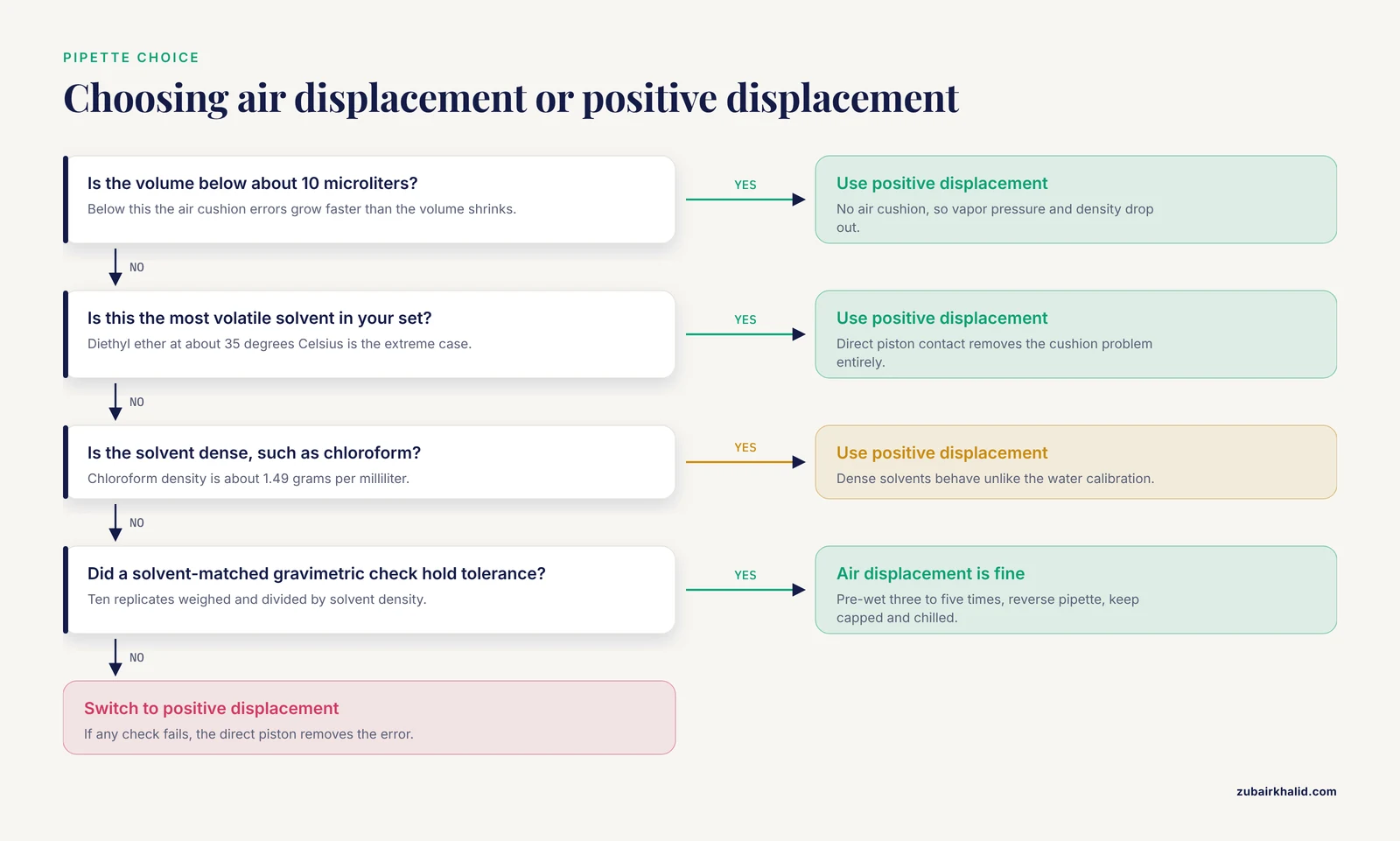
Switch for any volume below about 10 microliters, for the most volatile solvents in your set, for dense solvents such as chloroform, and whenever gravimetric checks show an air-displacement pipette cannot hold tolerance with the solvent of interest. The direct piston contact removes vapor pressure, density, and viscosity from the error budget.
Sources
- An improved chromatographic procedure for the rapid determination of volatile solvents via the headspace gas
- Temperature-controlled headspace liquid-phase microextraction device using volatile solvents.
- Nonevaporative preconcentration technique for volatile and semivolatile solutes in certain polar solvents
- Cytotoxicity evaluation of anionic nanoliposomes and nanolipoplexes prepared by the heating method without employing volatile solvents and detergents.
- A cryocooling technique for protein crystals grown by dialysis from volatile solvents
- Wick evaporation: a technique for the isolation of soluble analytes from volatile solvents
- Use of an ultrasonic nebulizer with membrane desolvation for analysis of volatile solvents by inductively coupled plasma atomic emission spectrometry
- Using volatile solvents for ion formation in liquid molecular beam expansion mass spectrometry.
- A Technique for Thermal Desorption Analyses Suitable for Thermally-Labile, Volatile Compounds
- Absorption of Volatile Organic Compounds Toluene and Acetaldehyde in Choline Chloride-Based Deep Eutectic Solvents.
- Morphological Control of Crystalline Savolitinib via the Volatile Deep Eutectic Solvent Technique
- Deep eutectic solvents based in situ isolation technique for extractive deterpenation of essential oils.
- Towards a Zero-Waste Biorefinery Using Edible Oils as Solvents for the Green Extraction of Volatile and Non-Volatile Bioactive Compounds from Rosemary
- Acoustic Sensors Based on Amino-Functionalized Nanoparticles to Detect Volatile Organic Solvents