Pipetting Volatile Liquids Accuracy: Step-by-Step Guide
By Dr. Zubair Khalid, DVM, MS, PhD ·

Pipetting volatile liquids accurately is a bench skill that keeps your delivered volumes within specification when the liquid itself works against you. Ethanol, methanol, acetone, chloroform, phenol:chloroform mixtures, acetonitrile, and many extraction reagents evaporate fast enough that a pipetting routine that works perfectly for water can deliver volumes several percent off target, and sometimes worse. This guide walks through the physics behind the problem, a step-by-step procedure built around reverse pipetting and positive displacement tools, a gravimetric check you can run in ten minutes, a troubleshooting table for the failures you will actually see at the bench, and the pipette calibration practices that keep the whole system trustworthy.
The procedure below applies whenever you dispense a liquid with meaningful vapor pressure at room temperature. That includes organic solvents used for nucleic acid extraction, volatile reagents used in chemical workflows, and strong acids such as concentrated hydrochloric or nitric acid. For a routine series of dispenses, the hands-on time is about 5 to 10 minutes for a typical 20 to 40 aliquot run once your materials are laid out. Expect about 15 minutes of total elapsed time including workspace setup, pre-wetting, and a quick gravimetric verification if you run one. A full calibration session on a single pipette adds roughly 20 to 30 minutes.
The Principle: Why Volatile Liquids Break Air Displacement Pipetting
Most bench pipettes are air displacement pipettes. A piston inside the body moves a set distance, and a cushion of air between the piston and the liquid meniscus transmits that motion to the sample. The volume the pipette delivers equals the piston travel, but only if the air cushion behaves exactly the way the manufacturer assumed when the instrument was calibrated, usually against water at around 20 °C.
Three properties of volatile liquids break that assumption.
First, evaporation competes with your dispensing. Every second the liquid sits in an open tip, molecules leave the liquid surface and enter the air cushion and the surrounding air. The liquid you deliver is measurably less than the liquid you aspirated. The faster the liquid evaporates and the longer the tip sits open, the larger the deficit.
Second, vapor pressure pushes back. A volatile liquid inside the tip generates vapor that adds pressure to the air cushion. On aspiration this can push liquid out of the tip prematurely, producing drips before you even move to the receiving vessel. On dispensing the expanded vapor can force extra liquid out, or it can leave the meniscus sitting at a different position than expected, corrupting the volume.
Third, temperature differences change the air cushion volume. If the liquid is colder than the pipette and the room, the air cushion cools and contracts after aspiration, pulling liquid back into the tip or drawing in air when you dispense. If the liquid is warmer, the opposite happens and you can over-deliver. With water, letting reagents equilibrate to room temperature solves most of this. With volatile liquids, equilibration helps but cannot eliminate evaporation, so you need technique changes on top of it.
The two corrective strategies are straightforward. Reverse pipetting aspirates an excess volume and dispenses only the set volume, so the liquid that evaporates or clings to the tip wall comes out of the excess, not out of your target volume. Positive displacement pipettes eliminate the air cushion entirely because the piston sits directly against the liquid in a disposable capillary, so vapor pressure and evaporation inside the tip have almost no path to change the delivered volume. Master both and you can handle almost any volatile reagent on the bench.
Materials and Reagents
| Item | Specification | Notes |
|---|---|---|
| Air displacement pipette | Single or multichannel, calibrated within the last 6 to 12 months | Use for aqueous miscible volatiles such as ethanol at moderate volumes |
| Positive displacement pipette | With matching disposable capillary pistons | Use for high vapor pressure liquids, viscous liquids, and concentrated acids |
| Capillary pistons | Correct size for the pipette and volume range | One piston per aspiration, never reused |
| Pipette tips | Low-retention polypropylene where available | Reduces cling on organic solvents that wet plastic aggressively |
| Sealed receiving vessels | Microcentrifuge tubes, screw-cap vials, or a lidded reservoir | Keep vessels capped except during the actual dispense |
| Source vessel | Original reagent bottle or a sealed secondary vial | Work from small sealed aliquots rather than repeatedly opening a large bottle |
| Analytical balance | Readability of 0.1 mg for volumes of 100 µL and above | Used for the gravimetric verification described below |
| Weighing vessel | Small beaker or vial with a cap or cover | Prevents evaporation loss during weighing |
| Personal protective equipment | Lab coat, safety glasses, nitrile gloves, fume hood access | Chloroform, phenol mixtures, and concentrated acids require a hood and appropriate gloves |
| Waste container | Certified flammable or chemical waste container per your institution | Never evaporate organic solvent waste down a sink or into room air |
Working concentrations are not an issue for this technique in the way they are for a reaction setup. What matters instead is the physical class of liquid. Pure organic solvents such as ethanol, methanol, acetone, and acetonitrile are strongly volatile. Mixtures such as phenol:chloroform:isoamyl alcohol are volatile and also corrosive and toxic. Concentrated mineral acids are volatile enough at their fuming concentrations that they behave like the solvents here. Water-saturated air in the tip slows evaporation slightly, which is one reason pre-wetting the tip with the liquid itself helps.
Safety Notes
Work with volatile organic solvents and phenol:chloroform inside a certified chemical fume hood. Vapors from these reagents are harmful when inhaled, and chloroform mixtures are toxic by skin contact as well as inhalation. Wear nitrile gloves and change them immediately if solvent touches them, because many organic solvents permeate nitrile quickly. Concentrated acids require a face shield or safety glasses, an apron, and acid-resistant gloves. Keep all flammable solvents away from open flame and store them in rated flammable cabinets. Cap every vessel as soon as the dispense is finished, both to protect accuracy and to limit your vapor exposure. Follow your institution's chemical hygiene plan for disposal.
Step-by-Step Procedure
The numbered procedure below is written for reverse pipetting with an air displacement pipette, which is the default approach for volatile liquids, with callouts for when to switch to positive displacement. Each step includes the reason it matters so you can adapt the routine to your own volumes and reagents.
1. Plan the liquid class and choose the tool
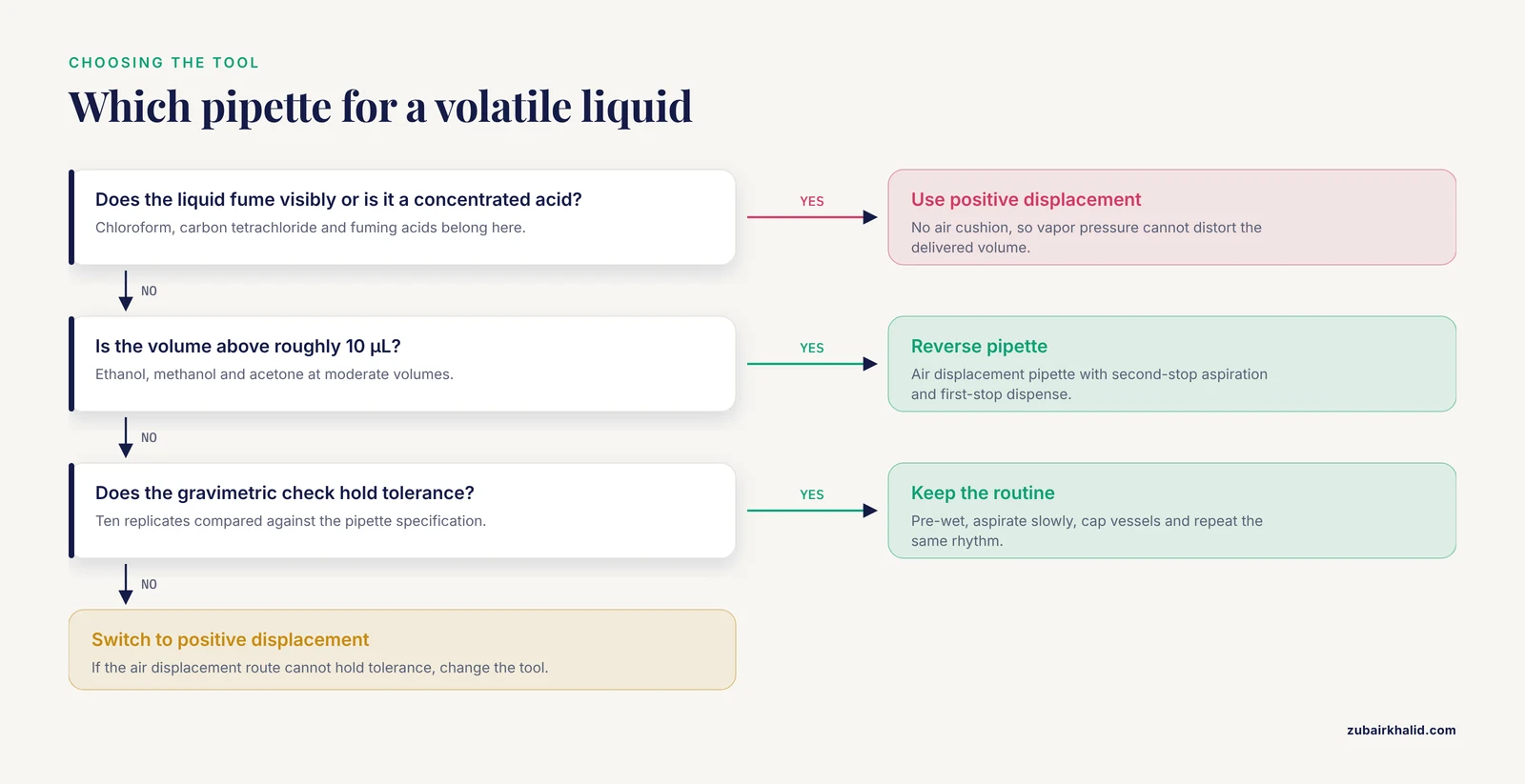
Decide before you start whether the liquid is moderately volatile or highly volatile. Ethanol at 70 percent or 100 percent, methanol, and acetone fall in the moderately volatile group for most bench purposes, and reverse pipetting with an air displacement pipette handles them well for volumes above roughly 10 µL. Chloroform, carbon tetrachloride, concentrated acids, and anything that visibly fumes belong in the highly volatile group, and a positive displacement pipette is the safer choice. The reason is that reverse pipetting reduces error but does not remove it, while positive displacement removes the air cushion where most of the error lives.
2. Equilibrate temperatures where practical
Bring the liquid, the tips, and the pipette to the same temperature, ideally room temperature around 20 to 25 °C. For a cold reagent straight out of a freezer or refrigerator, let the sealed bottle sit on the bench until condensation stops forming. The reason is the air cushion contraction problem described above. Equilibration does not slow evaporation, so do not leave an aliquot uncapped while it warms. Cap it and let the sealed container do the work.
3. Set up in a hood with capped vessels
In the fume hood, arrange a sealed source aliquot, your receiving vessels, and a waste container. Open only the vessel you are actively filling. The reason is twofold. Open liquid surfaces evaporate and change the concentration and the volume of your reagent over a run, and continuous vapor release is a safety exposure you do not need. For a long dispensing series, work from a small sealed vial rather than the stock bottle so the bulk reagent stays capped and stable.
4. Fit the correct tip and press it on firmly
Attach a fresh low-retention tip and seat it with a firm twisting press onto the pipette shaft. For positive displacement, attach the capillary piston according to the manufacturer's instructions. A loose tip leaks air on aspiration, and with a volatile liquid even a slow leak interacts badly with vapor pressure because the vapor escapes through the leak and the meniscus drifts. If your pipette uses a tip ejector collar or adapter for wide-bore tips, confirm it is locked before you begin.
5. Set the target volume
Dial the pipette to the volume you want to deliver. Do not compensate by setting a larger volume, because reverse pipetting handles the compensation for you through the excess aspirated volume. Setting a random oversized volume on an air displacement pipette can exceed the pipette's stated range, which damages the piston seal and voids the calibration relationship between dial position and delivered volume.
6. Pre-wet the tip with the volatile liquid
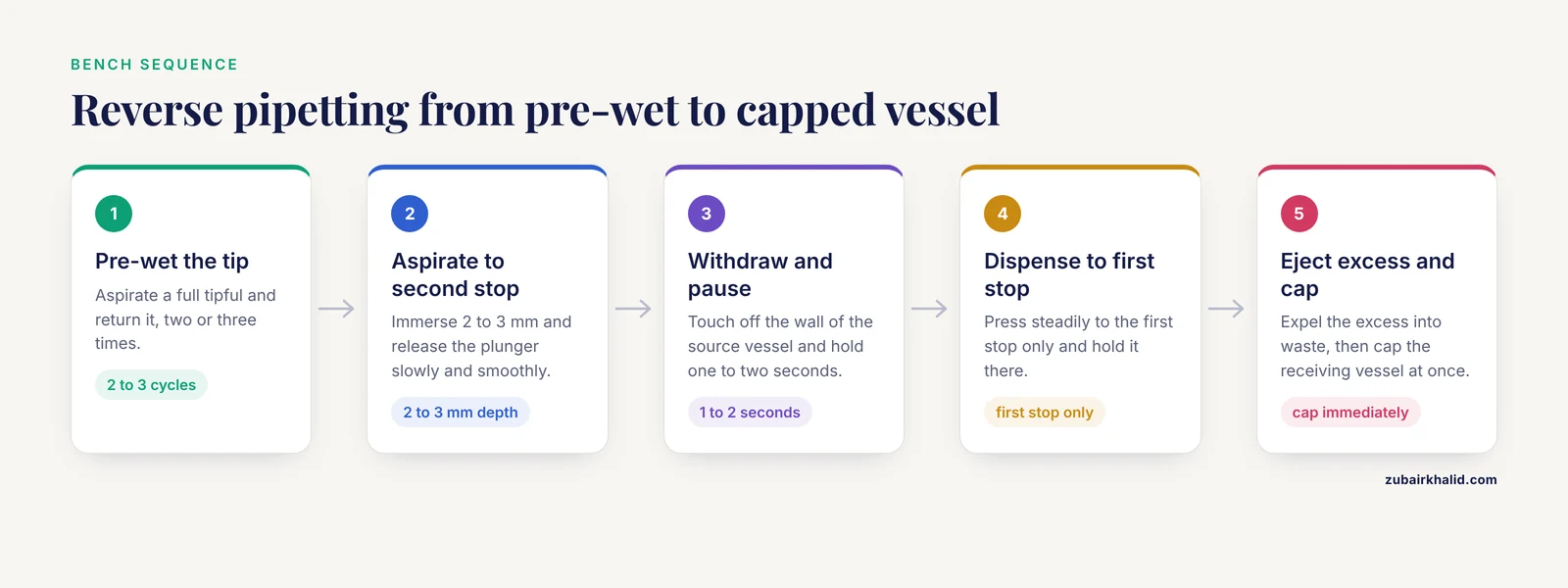
With reverse pipetting, press the plunger to the first stop, immerse the tip 2 to 3 mm into the liquid, aspirate a full tipful or at least the maximum volume the pipette takes, then dispense it back into the source vessel or waste. Do this two or three times. The reason is that pre-wetting does two jobs at once. It saturates the dead air space in the tip with vapor of the liquid, which stabilizes the meniscus, and it conditions the plastic so the liquid wets the wall consistently. Without pre-wetting, the first dispense from a fresh tip is usually the least accurate one, and with volatile liquids the difference between the first and later dispenses is larger because the cold, dry tip wall and dry air cushion both distort the first draw.
7. Aspirate the excess volume
Press the plunger all the way to the second stop, sometimes labeled the blow-out stop. Immerse the tip 2 to 3 mm into the source liquid. Release the plunger slowly and smoothly to aspirate. In reverse pipetting you now hold the set volume plus an excess inside the tip. Aspirate slowly. Fast aspiration with volatile liquids pulls vapor bubbles into the column, splashes liquid onto the tip walls above the meniscus, and gives the vapor pressure more surface area to act on. A slow, controlled release is one of the highest-yield pipetting technique habits you can build.
8. Withdraw and pause briefly
Withdraw the tip from the liquid, touching it against the inside wall of the source vessel for a moment to shed any clinging droplet on the outside. Pause one to two seconds before moving. The reason is that with a cold or freshly agitated volatile liquid, the meniscus can still be settling, and moving the pipette during that settling invites a drip. Keep the pipette close to vertical. Holding a pipette at a steep angle increases the liquid column pressure on the tip orifice and, with volatile liquids, promotes dripping.
9. Dispense to the first stop, not the second
Place the tip against the inside wall of the receiving vessel, just above the liquid surface or touching the wall just above the existing liquid meniscus. Press the plunger steadily to the first stop. Hold it there. The liquid that leaves the tip is now your set volume. The excess remains in the tip. Do not press to the second stop during the dispense. The reason is structural. Pressing to the second stop blows out the excess along with your target volume, which destroys the whole premise of reverse pipetting. The second stop is reserved for aspiration in this technique.
10. Eject the excess into waste
With the tip still in or over the receiving vessel area, move the tip to your waste container, then press the plunger to the second stop to expel the excess residual volume into waste. Alternatively, discard the tip with the excess inside it, which is the cleaner option for phenol:chloroform and concentrated acids because it minimizes contact with the residual. The reason for this final step is that leftover volatile liquid in a tip left in a tip box or on the bench keeps evaporating into your workspace and is a contamination and exposure hazard.
11. Cap the receiving vessel immediately
Screw the cap on or close the lid of the receiving vessel as soon as the dispense lands. The reason is evaporation from the receiving vessel itself. A 100 µL aliquot of chloroform left open for the two minutes it takes you to fill the next tube loses a measurable fraction of its volume, and for a subsequent volumetric step that loss becomes an inaccuracy in your downstream work, not just in the pipetting.
12. Repeat consistently, then close out
For a series of dispenses, repeat steps 7 through 11 with the same rhythm and the same timing. Consistency matters more than speed. When the run is finished, return the plunger to its resting position, eject the last tip into chemical waste, cap and store the reagent per its label, and record the run. Leaving a pipette with a compressed spring or a loaded volatile liquid in the tip is a calibration and safety problem in one.
13. Run a quick gravimetric verification
When you first establish a routine for a new volatile reagent, deliver 10 replicate aliquots of the target volume into a small tared vessel on an analytical balance, cap the vessel between deliveries if the liquid is strongly volatile, and record the mass readings. Multiply each mass in milligrams by the density of the liquid to get microliters delivered, calculate the mean and the spread, and compare against the pipette specification. Densities for common solvents are published values you can look up for the exact grade and temperature you use. This check converts your technique from a feeling into a number, and it is the same logic that underlies formal pipette calibration.
Controls and Expected Results
Treat this procedure like any bench method and build in verification.
A water reference control is the simplest one. Pipette the same set volume of deionized water with your normal forward pipetting technique and gravimetrically verify it against the pipette's own specification. If water passes and your volatile liquid fails with the same pipette and tips, the deficit is coming from the liquid class and the technique, not from a broken pipette. This single comparison, water versus volatile liquid on the same instrument, localizes the problem in one bench session.
A replicate series is your precision control. Ten replicate gravimetric readings give you both the mean delivered volume, which reflects accuracy, and the coefficient of variation, which reflects precision. A systematic shortfall in the mean points at evaporation or drip loss, which technique fixes. A wide spread with an accurate mean points at inconsistent aspiration speed, variable tip seating, or vapor bubble formation, which training and slower plunger movement fix.
Expected results depend on the liquid. With reverse pipetting on a healthy, recently calibrated air displacement pipette, moderately volatile liquids such as ethanol typically deliver within a small percentage of the set volume once the technique is consistent. Highly volatile liquids such as chloroform on an air displacement pipette remain the weak case, which is exactly why the recommendation for those liquids is positive displacement. If your gravimetric check on a highly volatile liquid shows a persistent shortfall of a few percent or more that pre-wetting and slower aspiration do not close, the fix is the tool, not more practice.
Reading the results is straightforward. Mean delivered volume below the set volume with acceptable precision means systematic loss, look to evaporation, drip, or residual cling. Mean on target but high variability means inconsistent technique, look to aspiration speed and tip immersion depth. Mean and precision both off means the pipette itself may be out of calibration, which the next section addresses.
Pipette Calibration
Pipette calibration is the scheduled verification and adjustment of the pipette against a traceable standard, and it is what makes every technique adjustment in this guide meaningful. A pipette that has drifted cannot be rescued by better reverse pipetting, because the volume the dial promises is no longer the volume the piston delivers.
Standard practice in most labs follows the principles of ISO 8655, the international standard for piston-operated volumetric apparatus. Calibration is gravimetric. The pipette delivers replicate volumes of deionized water into a tared vessel on an analytical balance, the mass of each delivery is converted to volume using the density of water at the test temperature with correction factors, and the results are compared with the manufacturer's accuracy and precision specifications for the volume tested. Testing covers multiple points across the pipette's range, typically a nominal maximum volume, around 10 percent of range, and one or two intermediate points, with about ten replicates per point.
Two calibration practices matter especially for volatile liquid work. First, calibrate at the volumes you actually use. A pipette verified at 1000 µL says nothing about its behavior at 20 µL, and error grows as a percentage as you approach the low end of the range. Second, respect the service interval. Most institutions verify pipettes every 6 to 12 months, and after any event that can disturb the seal or the piston, such as a drop onto the bench, autoclaving of non-autoclave-safe parts, or aspiration of a corrosive reagent that reached the shaft. If you routinely pipette concentrated acids or aggressive solvents and you smell or see residue inside the shaft, have the pipette serviced and recalibrated rather than waiting for the calendar.
Between formal calibrations, keep a simple in-house check in rotation. A monthly ten-replicate gravimetric spot check at your most-used volume, logged in a notebook or spreadsheet, catches drift months before it would appear as an experimental anomaly. This habit is cheap insurance for datasets that other people will read.
Troubleshooting
| Symptom | Likely Cause | Fix |
|---|---|---|
| Liquid drips from the tip before you dispense | Vapor pressure pushing liquid out of the tip, or liquid is warmer than the pipette | Switch to a positive displacement pipette. If staying with air displacement, pre-wet more thoroughly, keep the pipette vertical, minimize time between aspiration and dispense, and let the sealed reagent equilibrate to room temperature |
| Delivered volume is consistently below the set value | Evaporation during the open-tip interval, or cling and residual loss on the tip wall | Shorten the interval between aspiration and dispense, use low-retention tips, confirm you are reverse pipetting rather than forward pipetting, and keep the receiving vessel capped between dispenses |
| First aliquot of a series is off but later ones are fine | Tip not pre-wetted, so the cold dry tip and dry air cushion distort the first draw | Pre-wet two or three times with the actual liquid before the first real dispense, then discard the pre-wet volume into waste |
| Visible bubbles in the liquid column inside the tip | Aspiration too fast, or the tip orifice broke the surface and drew air | Aspire more slowly, keep immersion at 2 to 3 mm, and check that the tip is fully seated. Discard the bubble-drawn aliquot, never dispense it |
| Large scatter between replicate gravimetric readings | Inconsistent plunger speed, variable immersion depth, or operator fatigue | Slow down, keep a uniform rhythm, rest or swap operators on long runs, and verify with the water control to separate technique from instrument error |
| Delivered volume low even with correct reverse pipetting | Pipette out of calibration, degraded piston seal, or the liquid genuinely needs positive displacement | Run the water control. If water is also off, service and recalibrate the pipette. If water passes, move the volatile liquid to positive displacement |
| Meniscus inside the tip sits visibly wrong or the tip appears wet above the meniscus | Liquid wetted the tip wall during fast aspiration, or splash contamination above the meniscus | Aspire slowly at the correct immersion depth, use low-retention tips, and reject any aliquot with wall wetting above the meniscus |
| Concentration drifts across a long dispensing series | The source vessel or receiving vessels are open, so the reagent is concentrating as solvent evaporates | Work from a small sealed aliquot, cap everything between dispenses, and prepare a fresh aliquot if the run is long |
| Positive displacement capillary delivers inconsistent volumes | Reused capillary piston or the piston seal damaged on attachment | Use a fresh capillary piston for every aspiration and follow the manufacturer's attachment instructions exactly |
Variations
Forward pipetting with aggressive pre-wetting. For mildly volatile liquids at larger volumes, where the excess residual of reverse pipetting wastes expensive reagent, forward pipetting with a thorough pre-wet and fast transfer can be acceptable. Aspire to the first stop, dispense fully to the second stop to clear the tip, and accept that you must verify gravimetrically that the loss is within your tolerance. This variation trades a small reagent saving for a technique that sits closer to the edge of the error budget, so document the verification.
Positive displacement for everything volatile. Labs that handle chloroform, phenol mixtures, fuming acids, or radiochemical solvents daily often standardize on positive displacement pipettes for all such liquids. The capillary pistons cost more than tips, but the accuracy is stable across liquid classes, there is no air cushion to manage, and the aerosol and drip risk at the tip orifice is lower. If your workflow involves RNA work with phenol:chloroform, this is the variation worth the budget line.
Multichannel adaptation. Loading a 96-well plate with a volatile reagent, as in some ELISA stop or substrate steps or solvent back-extractions, follows the same logic with a multichannel pipette. Pre-wet all tips on the trough, work fast and rhythmically across the row, and use a lidded reagent reservoir that stays closed between row loads. Multichannel heads amplify inconsistency across channels, so the water control and replicate check are even more valuable here.
Repeater and stepper pipettes. For long series of identical volatile dispenses, a positive displacement repeater with a syringe barrel handles dozens of aliquots from one fill. Because the syringe is sealed against the piston, evaporation loss per dispense is small and consistency across the series is strong. Verify the first and last dispenses of a full barrel gravimetrically to confirm the series holds within specification end to end.
Temperature-controlled handling. Some workflows demand pipetting a volatile reagent cold, for example an ice-cold extraction solvent. In that case, pre-chill the tips and the metal reservoir along with the liquid, pre-wet with the cold liquid, and keep the open-air interval as short as possible. Expect somewhat more scatter than the room-temperature case and verify with replicates rather than single dispenses.
Storage and Stability Notes
Volatile reagents themselves carry storage requirements on their labels, and those requirements protect both safety and pipetting accuracy. Store flammable solvents in rated flammable cabinets, chloroform and phenol mixtures per your chemical hygiene plan in appropriate secondary containment, and concentrated acids in acid cabinets away from incompatibles. Keep working aliquots small and sealed so that each run starts from a container with minimal headspace and minimal accumulated evaporation loss. A working aliquot that has been opened repeatedly has already changed in volume and sometimes in concentration, particularly for aqueous organic mixtures where the more volatile component leaves faster.
Pipette storage affects accuracy too. Return the volume setting to the top of the range or to the released position before storage so the internal spring is not held under load, store pipettes upright on a rack rather than lying on the bench where residual liquid can run into the shaft, and hang or rack them away from heat sources. For positive displacement pipettes, store capillary pistons sealed in their original packaging and away from solvent vapors, because solvent-exposed plastics can warp and then seal poorly.
Do not store pipettes assembled with tips, and never store a pipette with volatile liquid inside the tip. Residual solvent vapor inside the shaft attacks piston seals and O-rings over time, which shows up later as calibration drift that no technique can fix.
Common Mistakes and Limitations
The most common mistake is applying the water routine unchanged. Forward pipetting with no pre-wet, an open receiving vessel, and a leisurely pace delivers water accurately and volatile liquids inaccurately, and the error is systematic in the low direction, which means every downstream calculation inherits it.
The second common mistake is treating reverse pipetting as optional or half-applying it. A frequent version is aspirating to the second stop correctly but then dispensing to the second stop as well, which expels the excess and delivers an over-volume. Another version is skipping the pre-wet because it wastes reagent, then wondering why the first several aliquots scatter. Reverse pipetting is a package. Second-stop aspiration, first-stop dispense, pre-wetting, and excess disposal all belong together.
The third is aspirating too fast. Speed feels efficient and feels safe because the tip is in the liquid for less time, but fast aspiration is the main driver of bubbles, splash contamination above the meniscus, and meniscus instability with volatile liquids. Slow, smooth plunger release is the single highest-value habit in this whole guide.
The fourth is ignoring the tool boundary. Reverse pipetting improves accuracy with volatile liquids but never equals positive displacement for the worst cases. Fighting chloroform with an air displacement pipette and ever more elaborate technique is a losing battle that the gravimetric check will expose in minutes. Match the tool to the liquid class.
The fifth is calibration neglect. A pipette dropped on the bench, used for acids without cleaning, or simply past its verification date can be silently off, and no pipetting technique compensates for an instrument that delivers the wrong volume even for water. If your water control fails, stop troubleshooting technique and calibrate.
Limitations to keep in view. Reverse pipetting wastes reagent because the excess is discarded, which matters for expensive reagents and argues for the positive displacement repeater variation at scale. Reverse pipetting also behaves differently with foaming liquids, where the excess volume can carry foam, and with liquids that must not contact the tip excess at all. The gravimetric verification described here is an in-house check, not a substitute for the formal calibration service that a metrology-traceable provider performs, and both have a place in a well-run lab. Individual experimental contexts, particularly regulated clinical work, carry their own documented validation requirements, and those local requirements govern over any general guide.
Frequently Asked Questions
Why does my pipette lose accuracy with ethanol but not water?
Because ethanol evaporates inside the tip and generates vapor pressure that distorts the air cushion an air displacement pipette relies on. Water is essentially nonvolatile, so the air cushion behaves as the manufacturer modeled it during calibration. The evaporation loss and vapor push that ethanol adds are exactly what reverse pipetting and positive displacement tools are designed to absorb.
What is reverse pipetting in one sentence?
You aspirate to the second stop to draw an excess volume, dispense to the first stop to deliver only the set volume, and discard the excess that stays in the tip. The excess is the buffer that absorbs evaporation loss and wall cling, so the delivered volume stays on target.
When should I switch to a positive displacement pipette?
Switch when the liquid fumes visibly at room temperature, when it is a concentrated acid, when it is viscous, or when your gravimetric check shows the air displacement route cannot hold tolerance. Positive displacement removes the air cushion, so vapor pressure and evaporation no longer distort the delivered volume.
Does pre-wetting the tip really matter that much?
Yes, because the first aspiration from a dry tip is the least accurate one. Pre-wetting saturates the dead air space with vapor and conditions the tip wall so the meniscus behaves consistently. Two or three pre-wet cycles with the actual liquid, discarded into waste, stabilize the rest of the series.
How often should pipette calibration be done?
Most laboratories verify pipettes on a 6 to 12 month cycle following the principles of ISO 8655, and immediately after any drop, autoclaving mishap, or exposure to corrosive reagents. A quick monthly gravimetric spot check at your working volume catches drift between formal services.
Can I pipette chloroform with a normal air displacement pipette?
You can, but it is the weakest case for that tool and the errors are real. Reverse pipetting with thorough pre-wetting and fast, consistent transfers reduces the error, and a gravimetric check will tell you whether that is enough for your tolerance. For routine chloroform and phenol:chloroform work, positive displacement is the recommended answer.
How do I check my own pipetting accuracy at the bench?
Pipette ten replicate aliquots of the set volume into a tared vessel on an analytical balance, convert each mass to volume using the liquid's density at the working temperature, and compare the mean against the pipette specification. Cap the vessel between deliveries for volatile liquids so evaporation does not corrupt the readings. Ten minutes gives you both accuracy and precision data.
Why should I keep receiving vessels capped during a dispensing series?
Because evaporation does not stop after the dispense. An open microcentrifuge tube of a volatile solvent loses volume continuously while you fill the next tubes, so your first aliquot and your tenth differ in actual volume. Capping between dispenses preserves both the delivered volumes and your reagent concentration, and it cuts your vapor exposure in the hood.