How to Pipette Viscous Liquids Like Glycerol and Serum
By Dr. Zubair Khalid, DVM, MS, PhD ·

Pipetting viscous liquids like glycerol and serum reliably requires a different technique than the one that works for water and simple buffers. A standard air-displacement pipette used with normal forward pipetting under-delivers thick liquids, sometimes by a large margin, and the error is systematic, meaning every aliquot is short in the same direction. This protocol gives you two dependable ways to move viscous liquids: reverse pipetting with a conventional air-displacement pipette, and direct displacement with a positive displacement pipette. It ends with a gravimetric check that confirms, by weight, that the volume you set is the volume you actually delivered.
Use this protocol whenever a liquid moves visibly slower than water, clings to the tip wall, or leaves a hanging drop after dispensing. Typical jobs include preparing bacterial glycerol stocks at 15 to 25 percent v/v glycerol, storing enzymes in 50 percent glycerol, dispensing neat glycerol into reaction mixes, and aliquoting thawed serum such as fetal bovine serum (FBS, the serum fraction used to supplement cell culture medium) or human serum into single-use volumes.
Hands-on time is 10 to 20 minutes for a typical session of 20 to 50 aliquots, plus about 10 minutes for the verification check. Elapsed time equals hands-on time, because there is no incubation step. Add preparation time for the liquid itself: 20 to 30 minutes on the bench to equilibrate refrigerated glycerol to room temperature, and several hours at 2 to 8°C (or less with gentle warming) to thaw frozen serum.
The sections below give the pipetting viscous liquids protocol step by step, the principle behind each step, practical tips used at the bench, the common mistakes behind most volume errors, and how to keep your pipettes calibrated and verified.
The Principle: Why Viscous Liquids Defeat Normal Pipetting
Viscosity is a liquid's resistance to flow, measured in millipascal-seconds (mPa·s, numerically identical to the older unit centipoise). Water has a viscosity of about 1 mPa·s at 20°C. Neat glycerol is about 1,400 mPa·s at the same temperature, more than a thousand times thicker. Serum sits much closer to water, only slightly more viscous, but its dissolved proteins make it foam readily and cling to plastic surfaces.
Most bench pipettes are air-displacement pipettes. A spring-loaded piston inside the body compresses a column of air, and that air cushion pushes the liquid. The liquid never touches the piston, and the instrument is factory-calibrated for water at room temperature.
Thick liquids defeat this design in two ways. First, a slow-moving liquid lets the air cushion expand and compress unevenly, so the volume of air pushed no longer matches the volume of liquid delivered. Second, viscous and proteinaceous liquids leave a film on the inside wall of the tip. With forward pipetting, that film stays behind after dispensing, so every aliquot is short by whatever the wall holds. A pendant drop can also hang from the orifice and refuse to join the delivered volume. Manufacturer application literature identifies viscosity, density, and surface behavior as the liquid properties that most affect pipetting accuracy, and recommends matching the instrument to the liquid.
Density matters for verification rather than delivery. Glycerol is about 26 percent denser than water at the same temperature. The pipette aspirates the same volume either way, but a mass-based check converts mass to volume differently for each liquid, which the verification step below handles.
Two solutions exist. A positive displacement pipette removes the air cushion entirely. Its piston sits inside a disposable capillary piston tip and pushes the liquid directly, wiping the capillary wall as it moves, so viscosity and wall film barely affect delivery. Reverse pipetting is the technique-based fix for a conventional pipette. You aspirate an excess by starting from the second stop, then dispense only to the first stop. The excess left in the tip compensates for the wall film, so the delivered volume matches the setting. Manufacturer pipetting guides specifically recommend reverse pipetting for viscous and foaming liquids.
Temperature changes everything. Glycerol viscosity drops by roughly a third between 20 and 25°C, and glycerol straight from a refrigerator is dramatically harder to move. Equilibrate liquids to a stable room temperature before you start, both for the liquid's sake and because temperature shifts also alter the behavior of the air cushion in an air-displacement pipette.
Choosing the Right Equipment for Glycerol and Serum
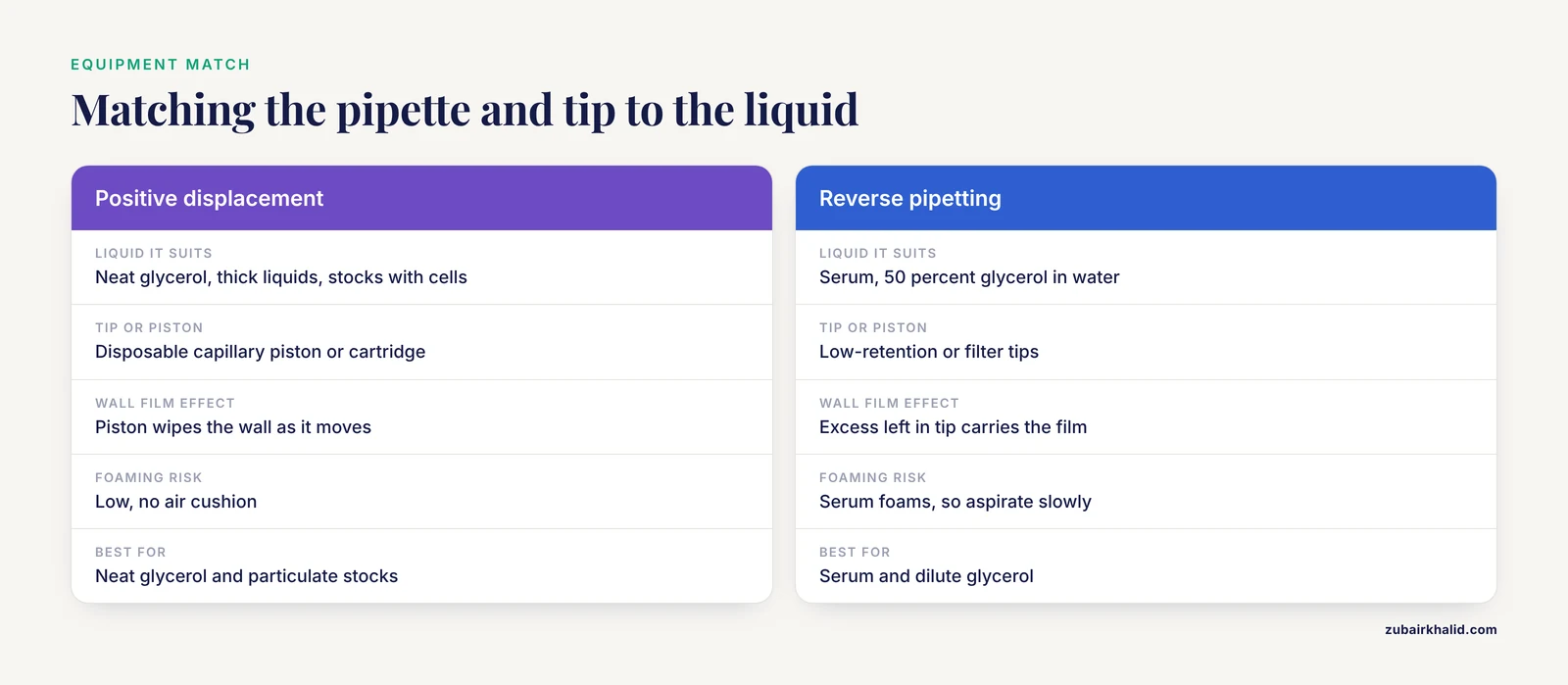
The quick reference below matches the method to the liquid.
| Liquid | Behavior | Recommended method |
|---|---|---|
| Water, buffers | Flows like water | Forward pipetting, standard technique |
| Serum (FBS, human serum) | Slightly above water, foams | Reverse pipetting with low-retention or filter tips |
| 50% v/v glycerol in water | Moderately thick | Reverse pipetting |
| Neat glycerol | Very thick, forms hanging drops | Positive displacement |
| Glycerol stock with cells or particulates | Thick plus solids | Positive displacement with a wide-bore tip |
Positive displacement pipettes are the first choice for neat glycerol and any liquid thick enough to drip slowly. Established examples include the Gilson Microman, which uses disposable capillary pistons, and the Eppendorf Multipette (repeater) with Combitips advanced cartridges. Both put the piston in direct contact with the liquid, so the delivered volume does not depend on how the liquid flows.
For serum and dilute glycerol solutions, a standard air-displacement pipette with reverse pipetting is accurate and faster to use. Serum's main problems are foaming and wall film, not viscosity, and both respond to slow aspiration and reverse pipetting.
Tip choice does real work. Low-retention tips have a surface treatment that binds less protein and holds less film, which helps with serum. Filter tips carry a hydrophobic barrier that blocks aerosols from entering the pipette barrel, protecting both the instrument and your samples from carryover. For viscous liquids containing cells or particulates, use wide-bore tips, or trim 2 to 3 mm from the end of a standard tip with a sterile blade to widen the orifice. Use tips matched to your pipette model, because tip geometry is part of the calibrated system.
For repetitive dispensing, a repeater pipette with positive displacement cartridges, or a bottle-top dispenser designed for viscous reagents, saves time and improves consistency across a long series.
Keep an analytical balance readable to 0.1 mg within reach (0.01 mg readability for volumes below 20 µL). Gravimetric verification, described below, is the only direct measurement of what a given pipette, tip, and liquid combination actually delivers.
Materials and Reagents
| Item | Typical specification or working concentration | Purpose and notes |
|---|---|---|
| Glycerol, molecular biology grade | ≥99% neat, or diluted to 10 to 50% v/v in sterile water | Enzyme stocks at 50% v/v, bacterial glycerol stocks at 15 to 25% v/v final |
| Serum (for example FBS or human serum) | Sterile, thawed once, kept at 2 to 8°C while aliquoting | Handle human serum under biosafety level 2 practices |
| Sterile water or PBS | As required | Diluent for glycerol, gravimetric checks with water |
| Positive displacement pipette | 10 to 1000 µL range as needed, with matching capillary pistons or cartridges | First choice for neat glycerol |
| Air-displacement pipettes | 10, 100, and 1000 µL | For reverse pipetting of serum and dilute glycerol |
| Low-retention and filter tips | Matched to the pipette model | Serum work and aerosol protection |
| Repeater pipette or bottle-top dispenser | Optional, rated for viscous liquids | Bulk dispensing of glycerol |
| Analytical balance | 0.1 mg readability (0.01 mg below 20 µL) | Gravimetric verification |
| Weigh boats | Clean, dry | Receiving vessels for gravimetric checks |
| 70% ethanol (v/v) | Surface disinfection | Flammable, keep away from flames |
| 10% bleach (1:10 dilution of household bleach, freshly prepared) | Surface decontamination | Corrosive, do not mix with other cleaners |
| PPE | Lab coat, nitrile gloves, safety glasses | Required for serum work |
Safety note: Treat all human serum as potentially infectious under standard biosafety practice. Wear a lab coat, nitrile gloves, and eye protection, use biosafety level 2 work practices (the containment level standard for human-derived blood products), disinfect surfaces afterward with freshly prepared 10 percent bleach, and dispose of serum waste as biohazard. Ethanol is flammable. Glycerol spills are slippery, so wipe them immediately.
Pipetting Viscous Liquids Protocol: Step-by-Step Procedure
Before You Start
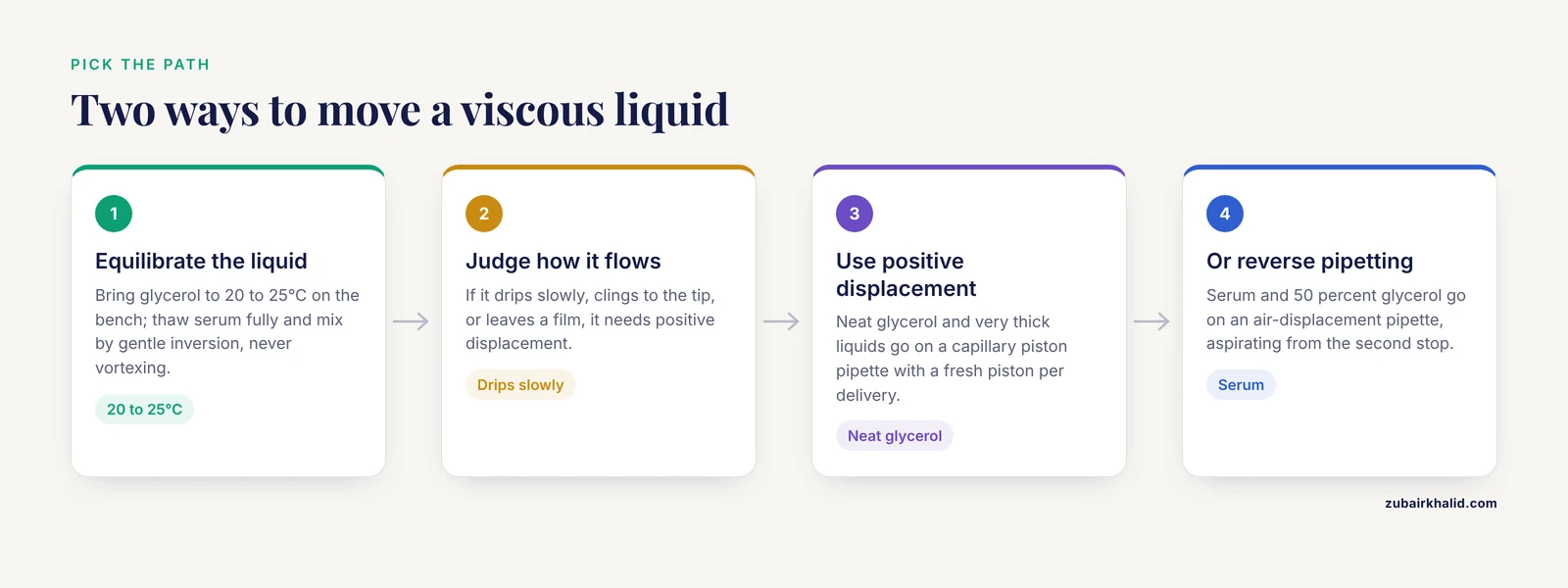
- Equilibrate the liquid to room temperature (20 to 25°C). Refrigerated glycerol needs 20 to 30 minutes on the bench. Thaw frozen serum completely and mix gently by inversion, never by vortexing. Why: viscosity falls steeply as temperature rises, so a cold liquid pipettes differently from the same liquid warm. Temperature shifts also change the air cushion inside an air-displacement pipette, which adds its own error.
- Pick the path by how the liquid behaves. If it drips slowly, clings to the tip, or leaves a visible film, use a positive displacement pipette (Path A). If it is only slightly thicker than water, such as serum or 50 percent glycerol, use an air-displacement pipette with reverse pipetting (Path B). Why: matching the tool to the liquid removes the main source of systematic error before the first tube is filled.
- Set up the workspace. Arrange labeled receiving tubes, tips, a waste container, and disinfectant before you pick up the pipette. Why: viscous-liquid work rewards a steady rhythm, and interruptions mid-series are where technique drifts.
Path A: Positive Displacement Pipette (Neat Glycerol and Very Thick Liquids)
- Attach a fresh capillary piston and set the volume. On these instruments the piston is part of the disposable tip, so there is no air cushion to condition. Why: a fresh piston guarantees a clean liquid path, which matters for glycerol stocks and serum alike.
- Skip the pre-rinse unless the manual asks for it. Most positive displacement models need no conditioning, because the piston wipes the capillary wall directly. Why: conditioning steps designed for air-displacement pipettes waste liquid and time here without improving accuracy.
- Aspirate smoothly. Press the plunger to the fill position, immerse the capillary 2 to 3 mm into the liquid, and release the plunger with a slow, even motion. Why: a smooth release keeps the liquid column continuous. Jerky aspiration pulls bubbles into thick liquids, and bubbles are nearly impossible to remove from glycerol.
- Pause, then withdraw. Hold 1 to 2 seconds at full draw, then lift the capillary out of the liquid. Why: thick liquid keeps creeping up the capillary for a moment after the piston stops. Withdrawing early leaves a growing drop at the orifice and inconsistent volumes.
- Dispense against the wall and purge completely. Press the plunger fully against the inside wall of the receiving tube, hold briefly, and purge the capillary as your model instructs. Eject the used piston into the appropriate waste container. Why: positive displacement delivers nearly quantitatively, but only if the capillary empties completely. The trace of glycerol or serum left inside is volume you did not deliver.
Path B: Reverse Pipetting with an Air-Displacement Pipette (Serum and Dilute Glycerol)
- Pre-rinse the tip. Aspirate and dispense the liquid 2 to 3 times before the first measured delivery, returning the rinse to the source only if it is a stock you are confident stays sterile, otherwise to waste. Why: the first delivery from a dry tip loses extra volume to wall film. Pre-rinsing saturates the wall so every later delivery behaves the same way.
- Aspirate from the second stop. Press the plunger to the second stop, immerse the tip 2 to 3 mm (up to about 5 mm is fine for a 1 mL tip), and aspirate slowly and smoothly. Why: starting at the second stop draws the set volume plus an excess that will remain in the tip. Slow aspiration keeps the air cushion predictable and keeps serum from foaming.
- Pause, then withdraw. Hold 1 to 3 seconds at full draw, then lift the tip out. Why: viscous liquid continues to rise in the tip after the piston stops, and a consistent pause is what makes replicate deliveries agree.
- Clear exterior drops without touching the orifice. Touch a pendant drop on the tip exterior against the inside wall of the source vessel, or wipe the tip body with a sterile wipe, keeping the orifice untouched. Why: an exterior drop is volume the tube or the balance will see but the pipette never measured.
- Dispense to the first stop only. Deliver against the inside wall of the receiving tube at a consistent angle, then touch the tip to the wall to pull off the hanging drop. Discard the residual excess to waste, or back into the source only if the source is a single-use aliquot. Why: the excess left in the tip carries the wall film with it. Dispensing to the first stop leaves that film behind, so the delivered volume matches the setting.
Safety note: Dispensing serum can generate aerosols. Keep the tip close to the tube wall, never blow out the residual, and keep caps closed on tubes you are not actively filling.
Verify the Delivered Volume
- Run a gravimetric check. Deliver 5 to 10 replicate volumes onto a tared weigh boat on an analytical balance, taring between deliveries. Convert mass to volume as volume in µL equals mass in mg divided by density in mg per µL. Use 1.26 mg per µL for glycerol at 20°C and 0.998 mg per µL for water at 20°C. Why: mass is the only direct measurement of what you delivered, and this is the same gravimetric logic professional calibration services use.
- Read the statistics. Calculate the mean delivered volume, the percent error versus the set volume, and the coefficient of variation (CV), which is the standard deviation divided by the mean, expressed as a percent. Compare both numbers with the pipette's accuracy and repeatability specifications for water. Why: the pattern localizes the fault. Water that meets specification alongside glycerol or serum that does not points to the liquid or the technique. Water that also fails points to the pipette.
- Log the result and schedule pipette calibration. Most laboratories calibrate pipettes at least once a year, run quick in-house gravimetric checks in between, and send a pipette for service immediately after a drop, an overload, or a failed check. Why: viscous liquids are exactly the liquids that hide a drifting pipette, because small volume errors look like normal liquid behavior.
Controls, Expected Results, and How to Read Them
Run three controls whenever you set up a new liquid, tip lot, or pipette.
Water control. Pipette water with the same instrument and technique you plan to use for the viscous liquid, and check it gravimetrically. Water should meet the manufacturer's accuracy specification easily. If water fails, the problem is the pipette or the operator, not the liquid.
Replicate gravimetric series. The 5 to 10 weighed deliveries from step 14 are your accuracy control. The mean tells you the systematic error, and the percent error tells you its direction. A negative percent error with forward pipetting means wall-film under-delivery. With reverse pipetting, expect a small, consistent offset in either direction. If that offset is stable across replicates, you can trim it by adjusting the volume setting for that liquid and re-verifying, which is standard practice when a liquid must be delivered at tight tolerance.
Precision readout. The CV describes repeatability. Clinical laboratory standards build their evaluation of quantitative methods on the same idea, replicate measurements summarized by mean and CV, as in the CLSI guideline EP05 for evaluating precision. For pipette work, compare your CV with the repeatability specification in the pipette manual. A CV that matches specification with a consistent mean means the system is working. A high CV with an accurate mean points to inconsistent rhythm, pause timing, angle, or temperature.
Expected results. With a positive displacement pipette, glycerol deliveries should land within the instrument's stated accuracy, with a tight CV. With reverse pipetting, serum and dilute glycerol deliveries should cluster tightly, foam minimally, and leave no bubbles in the tip. While you work, watch the liquid itself. A tip that drips during the series, a drop that hangs after dispensing, or foam climbing the tube wall each point to a specific fix in the troubleshooting table below.
Troubleshooting Viscous Pipetting
| Symptom | Likely cause | Fix |
|---|---|---|
| Delivered volume consistently below the setting with forward pipetting | Wall film retention, wrong technique for the liquid | Switch to reverse pipetting or positive displacement |
| Delivered volume low even with reverse pipetting | Aspirated from the first stop, or pause too short | Start at the second stop, hold 1 to 3 seconds at full draw |
| Drop hangs on the tip after dispensing | Viscous pendant drop at the orifice | Touch off against the tube wall, dispense against the wall, or use a wide-bore tip |
| Liquid drips from the tip during the series | Immersion too deep, or liquid creeping past the orifice | Keep immersion at 2 to 3 mm, withdraw promptly after the pause |
| Bubbles or foam in serum | Aspirating too fast, or dispensing into the liquid surface | Aspirate slowly, dispense against the wall above the liquid, use reverse pipetting |
| Air bubble in the tip | Tip not seated, or jerky aspiration | Re-seat the tip, aspirate smoothly, discard the faulty delivery |
| Replicate masses vary widely | Inconsistent pause, angle, or immersion depth, or temperature drift | Standardize your rhythm, work at stable room temperature, consider positive displacement |
| Mean volume drifts during a long series | Evaporation, operator fatigue, or pipette warming | Work in shorter batches, re-check with gravimetry mid-series |
| Piston feels stiff or sticky after glycerol work | Dried glycerol residue in the shaft | Clean and decontaminate per the manual, inspect seals |
| Tip leaks or falls off | Wrong tip brand or damaged cone | Use manufacturer-matched tips, inspect the cone |
| Balance readings drift | Static, drafts, or evaporation of small volumes | Use a draft shield, discharge static, weigh quickly, use covered boats |
| Serum aliquots differ in apparent volume | Particulates or fibrin, incomplete mixing | Mix gently before aliquoting, use wide-bore tips, keep serum uniformly thawed |
Variations on the Technique
Repeater dispensing for long series. When you need the same volume in 20 or more tubes, a repeater pipette with positive displacement cartridges dispenses repeatedly without re-aspirating. This is the fastest accurate way to fill glycerol stock tubes or serum aliquots.
Bottle-top dispensers for bulk glycerol. A bottle-top dispenser designed for viscous reagents mounts on the stock bottle and delivers set volumes with piston accuracy, which suits buffer and media preparation that use larger glycerol volumes.
Wide-bore tips. For viscous liquids carrying cells or particulates, trim 2 to 3 mm from the tip end with a sterile blade. The wider orifice reduces shear and clogging. Trimming slightly changes tip behavior, so re-verify gravimetrically after modifying tips.
Serological pipettes for milliliter-scale serum. Use to-deliver (TD) serological pipettes, which are calibrated to deliver their stated volume by gravity drain with a small controlled residual. Pre-rinse the pipette with the liquid, dispense slowly against the vessel wall, and touch off the final drop. Read the meniscus (the curved liquid surface) at its bottom, with the pipette vertical. Blow-out, forcing the residual out with the pipette controller, is only for pipettes marked as blow-out type, usually identified by a frosted band near the top.
Dilute when the application allows. A 50 percent v/v aqueous glycerol solution has a viscosity of about 6 mPa·s at 20°C, roughly 200-fold lower than neat glycerol, and is far more forgiving to pipette. Where downstream concentrations permit, keep a concentrated stock and dilute on delivery.
Automated liquid handlers. High-throughput serum banking and large glycerol stock campaigns justify automated dispensing. Validate any automated system with the same gravimetric approach, because dispensing performance is specific to the liquid.
Storage and Stability Notes
Neat glycerol. Chemically stable for years at room temperature. Glycerol is hygroscopic, meaning it absorbs water from the air, which shifts both its concentration and its viscosity. Keep the stock bottle tightly closed and pour a working aliquot rather than opening the main bottle repeatedly. Molecular biology grade glycerol and aqueous glycerol solutions tolerate autoclaving.
Sterile 50 percent glycerol. Keeps for months at room temperature or 2 to 8°C as long as it stays sterile. Label the concentration and date clearly.
Enzyme and reagent stocks. Enzymes stored in 50 percent glycerol at -20°C stay largely liquid, because glycerol depresses the freezing point. That is the point of the glycerol. The enzyme never freezes solid, so repeated access does not subject it to freeze-thaw damage.
Bacterial glycerol stocks. Stocks at 15 to 25 percent v/v final glycerol are frozen at -80°C. The glycerol slows ice crystal formation and protects cells during freezing and storage.
Serum. Aliquot serum at first thaw into single-use volumes and freeze at -80°C for long-term storage, or -20°C for shorter horizons. Thaw each aliquot once, keep it at 2 to 8°C, and use it within days to a few weeks. Avoid repeated freeze-thaw cycles, which damage proteins and cells. If heat inactivation is required (a one-time 56°C, 30-minute treatment that destroys complement activity), perform it before aliquoting, then freeze.
Pipettes. Store pipettes vertically on a stand. Glycerol residue that runs into the barrel is a common cause of stiff pistons and damaged seals, so wipe the shaft cone after viscous work and follow the manual's cleaning and decontamination schedule.
Common Mistakes and Limitations
Forward pipetting neat glycerol with an air-displacement pipette. This is the most common error and the most consequential. The under-delivery is systematic, so every aliquot is short, and the deficit grows with viscosity. Switch to