How to Fix Pipetting Errors Caused by Temperature Differences
By Dr. Zubair Khalid, DVM, MS, PhD ·

Temperature differences between a pipette, its tip, and the liquid being moved are one of the most common hidden sources of volume error at the molecular biology bench. The error is systematic, it scales with the size of the temperature gap, and it is large enough to shift qPCR efficiencies, throw off restriction digests, and inflate variability between replicates. The fix is procedural, not mechanical. You equilibrate reagents to a defined temperature, match your pipetting technique to the thermal situation, choose forward, reverse, or positive displacement pipetting deliberately, and then verify the result gravimetrically so you know the fix worked.
Use this protocol whenever you pipette liquid that is colder or warmer than the pipette and the room. The classic cases are master mixes and enzymes straight from a 4 °C refrigerator, solutions pulled from a minus 20 °C freezer stock, cold room work at 4 °C, and warm buffers taken from a 37 °C water bath. A full hands-on verification takes roughly 30 to 40 minutes once reagents are equilibrated. Equilibration itself adds 30 to 60 minutes of elapsed time depending on reagent volume and container size, and most of that runs unattended while you set up the rest of the bench.
The Principle: Why Temperature Moves Your Volume
Most laboratory pipettes are air displacement pipettes. A spring-loaded piston sits inside the shaft, and a pocket of air, called the air cushion, sits between the piston and the liquid held in the disposable tip. The pipette is calibrated so that the piston movement corresponds to a set volume when the air cushion behaves in a predictable way. Calibration is performed under defined reference conditions, near 20 °C, with room-temperature water, as specified in ISO 8655, the international standard for piston-operated volumetric apparatus.
The air cushion is the weak link. Gases expand when heated and contract when cooled, and the cushion is a relatively large pocket of air compared with the liquid volume it delivers. When the liquid is colder than the pipette, the cushion cools and contracts as liquid is drawn into the tip. A contracted cushion pulls in extra liquid, so the pipette aspirates more than the set volume. When the liquid is warmer than the pipette, the cushion expands and the pipette aspirates less than the set volume. Manufacturer technical documentation from major pipette makers, including Eppendorf and Gilson, describes these temperature effects and recommends matching technique to liquid conditions, because the resulting error can reach several percent of the set volume when the temperature gap is large.
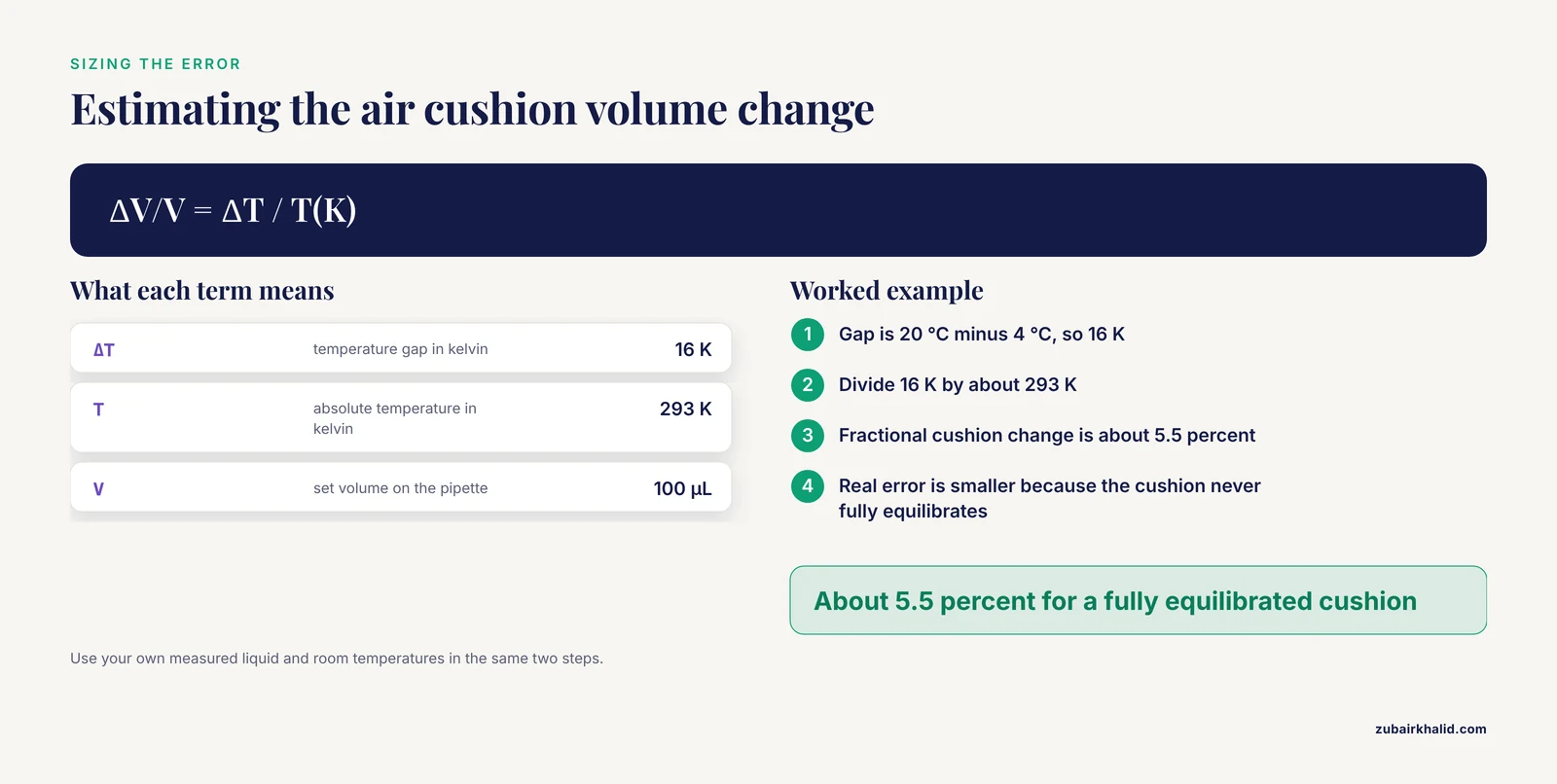
You can see the scale of the effect with a simple approximation from the ideal gas law. The fractional change in gas volume equals the temperature change divided by the absolute temperature in Kelvin. Suppose a pipette set to 100 µL is used with liquid at 4 °C while the pipette sits at 20 °C. The temperature gap is 16 K against roughly 293 K, so a fully equilibrated cushion would change volume by about 5.5 percent. The cushion is much larger than the set volume, and it never fully equilibrates during a quick aspiration, so the real delivered error is smaller than that number, but it lands in exactly the range that ruins quantitative work. A second, competing effect comes from viscosity. Cold aqueous solutions are more viscous, and viscous liquid drains more slowly from the tip wall, leaving a thicker residual film that inflates under-delivery. Temperature and viscosity therefore pull in opposite directions, and which one dominates depends on the liquid, the volume, and the technique. This is why the gravimetric verification later in this protocol is not optional. It tells you which effect is winning in your hands, with your reagents, on your bench.
Three other thermal effects matter in specific situations. Evaporation increases with warm liquids and lowers delivered volume by wetting and vapor loss. Thermal expansion of the liquid itself is a minor effect for aqueous buffers but becomes relevant for organic solvents. Finally, a tip stored at room temperature and plunged into a cold liquid acts as a small heat exchanger, warming the first few microliters it touches and losing a little liquid to the tip wall. Pre-rinsing the tip solves that last problem cleanly, which is one of the cheapest pipetting temperature errors fix tips available.
Materials and Reagents
| Item | Specification | Working preparation | Purpose |
|---|---|---|---|
| , - | , - | , - | , - |
| Air displacement pipettes | Calibrated single channel covering your working volumes | Verified within manufacturer tolerance at nominal volume | Routine liquid transfer |
| Positive displacement pipette | Micropiston style with matching capillary pistons | Optional but recommended for cold, viscous, or volatile liquids | Eliminates the air cushion entirely |
| Pipette tips | Certified, low-retention for viscous or sticky liquids | Room temperature unless pre-chilled deliberately | Holds the delivered volume |
| Gravimetric water | Distilled or deionized water, degassed if bubbling is observed | Equilibrated to room temperature, about 20 to 22 °C | Reference liquid for verification |
| Analytical balance | Readability to 0.1 mg, draft shield closed | Leveled and tared, warmed up per manufacturer instructions | Weighs dispensed aliquots |
| Tracer dye | Food coloring or bromophenol blue, 1 mg/mL in water | Dilute 1 to 100 into test liquid for visibility | Visual check of residual film and droplets |
| Viscous test solution | Glycerol, 50 percent v/v in water | Mix equal volumes glycerol and water, equilibrate to room temperature | Tests technique under viscosity stress |
| Ice bucket with water | Wet ice, not dry ice | Fill with crushed ice and enough water to cover | Holds reagents at about 4 °C |
| Water bath or heating block | Set to 37 °C or your working temperature | Pre-warmed 20 minutes before use | Holds warm reagents at set temperature |
| Digital thermometer | Probe type, readable to 0.1 °C | Probe placed in a dummy tube of matching volume | Measures actual liquid temperature |
| Timer | Any lab timer | Not applicable | Times equilibration and aspiration rhythm |
| Tube racks and weigh boats | Polypropylene racks, glass or plastic weigh boats | Weigh boat holds the liquid being weighed | Supports gravimetric dispensing |
Safety note. None of the reagents in this verification are hazardous at these working concentrations, but handle glycerol as a slippery spill risk on the balance, wear gloves and eye protection as standard lab practice, and dispose of dye solutions according to your institution's chemical waste rules. Never pipette by mouth under any circumstances.
Step-by-Step Procedure
The following steps describe the complete workflow for how to fix pipetting errors caused by temperature differences, from equilibration through verification. Each critical step includes the reason it matters.
- Measure the actual temperature gap. Place the probe thermometer in a dummy tube holding the same volume of reagent as your working aliquot, sitting in the same location on ice or in the bath. Record the liquid temperature and the room temperature. Why: you cannot manage an error you have not sized. A 2 to 3 °C gap is usually handled by equilibration and pre-rinsing alone, while a 15 to 20 °C gap, such as reagent straight from the freezer, demands reverse or positive displacement technique.
- Equilibrate reagents to the working temperature before pipetting whenever the reagent tolerates it. Move tubes from the refrigerator or ice to the bench 30 minutes before use for typical 0.5 to 2 mL aliquots, and allow up to 60 minutes for bottles or 50 mL conical tubes pulled from colder storage. Why: equilibration removes the temperature difference at its source and is the single most effective fix. Many enzymes and master mixes tolerate brief warming to room temperature, but check the manufacturer's datasheet before warming anything that specifies storage on ice, because some reagents lose activity or assemble nonspecific complexes at room temperature.
- Give the pipette itself time to reach the work temperature. If you are moving into a cold room, bring the pipettes in at least 20 to 30 minutes before pipetting, or store dedicated pipettes in the cold room. Why: the pipette, not just the liquid, is half of the temperature gap. A warm pipette in a cold room behaves differently from a cold pipette handling warm liquid, and matching both sides of the system shrinks the error from both directions.
- Pre-rinse the tip with the liquid you are about to pipette. Aspirate a full set volume, dispense it back into the source or into waste, and repeat two to three times before taking the real volume. Why: the pre-rinse coats the tip wall, brings the small air pocket inside the tip to liquid temperature, saturates the headspace with vapor, and conditions the plastic surface. This single step removes most of the residual-film error with cold or viscous liquids and is standard practice in manufacturer pipetting guides.
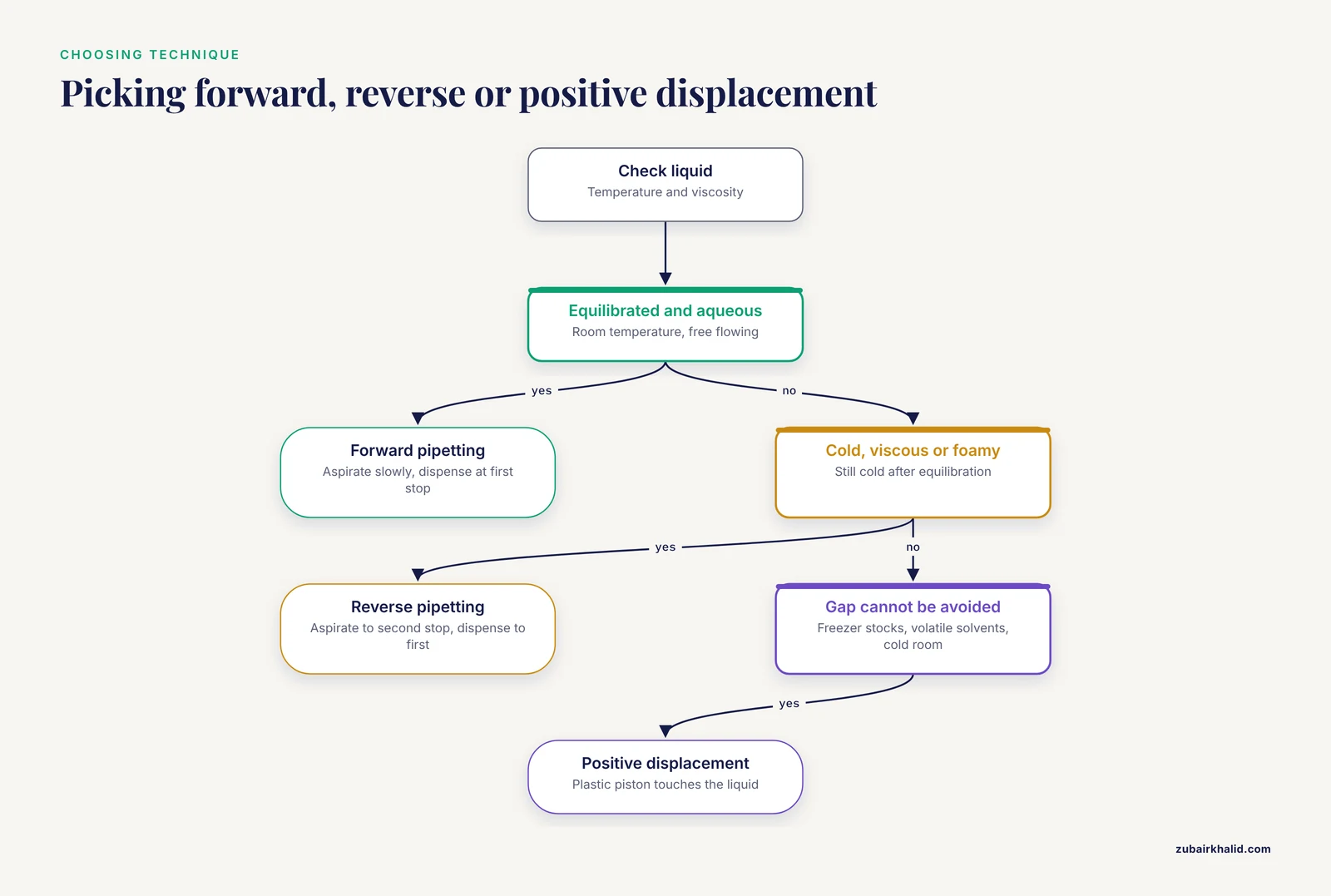
- Choose forward pipetting for equilibrated, aqueous, nonviscous liquids. Press the plunger to the first stop, immerse the tip 2 to 3 mm below the liquid surface, aspirate smoothly and slowly, hold for 1 second at full aspiration, then dispense against the receiving vessel wall at the first stop. Keep the pipette within about 20 degrees of vertical throughout. Why: slow aspiration gives the cushion time to behave predictably and prevents bubbles, and a consistent vertical angle keeps the hydrostatic pressure on the liquid the same for every aliquot.
- Switch to reverse pipetting for liquids that stay cold, viscous, or foamy. Press the plunger all the way to the second stop, aspirate slowly, then dispense only to the first stop, leaving the excess in the tip. Discard the excess into waste by pressing to the second stop. Why: reverse pipetting inverts the residual problem. The extra liquid in the tip compensates for the film that clings to the wall, so the delivered volume matches the set volume even when the liquid is thick or cold. This is the classic pipetting technique adjustment for glycerol-heavy enzyme stocks, protein solutions, and detergents.
- Use a positive displacement pipette when temperature differences cannot be avoided. Positive displacement designs put a plastic piston in direct contact with the liquid inside the tip, so there is no air cushion to expand or contract. Aspirate and dispense exactly as the manufacturer directs, changing the piston for each volume range. Why: this removes the thermal mechanism physically rather than compensating for it. It is the correct tool for reagents straight from the freezer, for volatile solvents, and for any quantitative dispensing in a cold room where equilibration fights your sample integrity.
- Keep tips at the temperature of the liquid when working cold. If you pipette cold reagent repeatedly, store a tip rack in the same ice bucket environment or pre-rinse each tip thoroughly so the tip wall reaches liquid temperature before the measured volume enters. Why: a room-temperature tip inserted into cold liquid immediately warms the liquid interface and adds a small transient volume error to the first aspiration.
- Verify the fix gravimetrically. Tare a weigh boat on the analytical balance, dispense 10 replicate aliquots of your actual liquid at your actual working temperature using your chosen technique, and record each mass. Convert mass to volume using the Z factor for water, which is about 1.003 µL per mg at 20 °C under typical barometric conditions. For liquids other than water, weigh them and interpret the numbers relative to a same-liquid control dispensed at matched temperature. Why: gravimetry is the bench-accessible gold standard for volume. Ten replicates let you compute a mean and a coefficient of variation, so you see both the systematic bias and the random scatter.
- Compare against acceptance criteria and act on the result. Calculate the percent error of the mean from the set volume and the coefficient of variation across the 10 dispenses. Compare both to the manufacturer's tolerance for your pipette model at that setting, which for most research-grade pipettes is on the order of 1 percent systematic error near nominal volume. If the bias disappears but scatter remains high, the problem is technique rhythm, not temperature. If a systematic bias persists with equilibrated liquid at room temperature, the pipette itself is out of tolerance and needs recalibration. Why: this decision point separates a technique problem, which you fix today, from a calibration problem, which you hand to a service provider.
Controls and Expected Results
Run three conditions whenever you characterize a temperature problem. First, a matched-temperature control, where pipette, tip, and liquid are all at room temperature, establishes your baseline performance and tells you what the pipette can do when temperature is not a variable. Second, an uncompensated test condition, where you pipette the cold or warm liquid with ordinary forward technique and no pre-rinse, reproduces the error you are trying to fix and gives you a before value. Third, a compensated test condition, where you apply the fix, whether equilibration, reverse pipetting, or positive displacement, gives you the after value.
Expected results look like this. The matched-temperature control should land within the manufacturer tolerance with a coefficient of variation of a few tenths of a percent if your rhythm is consistent. The uncompensated cold-liquid condition commonly shows a systematic bias of one to several percent of the set volume, with the direction depending on which effect dominates, cushion contraction or viscous film retention. The compensated condition should pull the mean back within tolerance and, with reverse pipetting, usually improves the coefficient of variation as well because the excess-in-tip approach damps small aspiration variability.
Read the results with this logic. A bias that flips sign between cold and warm liquid points to the air cushion. A bias that persists even at matched temperature points to technique or to pipette calibration. A bias that shrinks but does not vanish after pre-rinsing points to viscosity, and the answer is reverse pipetting or positive displacement rather than more equilibration.
Troubleshooting
| Symptom | Likely cause | Fix |
|---|---|---|
| , - | , - | , - |
| Cold liquid delivers consistently high volumes | Air cushion cools and contracts during aspiration, pulling in excess liquid | Equilibrate the liquid, or switch to positive displacement for cold reagents |
| Cold viscous liquid delivers consistently low volumes with droplets clinging to the tip | Viscous film retained on the tip wall after dispensing | Pre-rinse the tip 2 to 3 times and use reverse pipetting |
| Warm liquid from a 37 °C bath delivers low volumes | Cushion expands while handling warm liquid, reducing aspirated volume | Equilibrate the liquid toward room temperature if the reagent tolerates it, or pre-rinse and slow the aspiration |
| Volumes drift over a long pipetting session | Pipette and tips warming up in hand, or reagents warming on the bench | Standardize reagent temperature with a cooler rack, take hand-warming breaks, and re-verify mid-session |
| Bubbles form during aspiration of cold detergent-containing buffers | Slow drainage and surface effects at low temperature | Aspirate more slowly, pre-rinse, keep the tip immersion depth shallow, or reverse pipette |
| Replicate volumes scatter widely but the mean is correct | Inconsistent rhythm, angle, or immersion depth | Slow down, hold the pipette near vertical, and keep immersion depth at 2 to 3 mm for small volumes |
| First aliquot of a series is off, the rest are fine | Tip and first aspirate not thermally conditioned | Discard or re-add the first aliquot after using it to pre-rinse, or always discard the first draw |
| Bias persists with room-temperature water after all fixes | Pipette out of calibration, damaged seal, or worn tip cone | Send the pipette for professional calibration and inspect the nose cone and seals |
Variations for Specific Bench Situations
Cold room pipetting. Dedicated pipettes stored in the cold room remove the largest temperature gap at once. If you must carry pipettes in, give them 20 to 30 minutes to cool, pre-rinse tips, and expect positive displacement to outperform air displacement for anything quantitative. Keep reagent aliquots small so each one equilibrates to the room quickly and spends less time drifting between temperatures.
PCR and qPCR setup. Enzyme master mixes come from the freezer or the ice bucket at roughly 4 °C while primers, probes, and water often sit at room temperature. The clean fix is to thaw and mix everything, then equilibrate the complete master mix on ice for consistency and dispense it with a positive displacement or reverse-pipetting technique. The exception is any enzyme component whose datasheet forbids extended room temperature exposure. For those, aliquot quickly with reverse pipetting and return the stock to the cold immediately. Because qPCR quantitation depends directly on delivered volume, temperature-driven bias here converts straight into spread across your standard curve.
Viscous liquids. Glycerol stocks, concentrated protein solutions, and SDS-containing buffers drain slowly and punish forward pipetting regardless of temperature. Reverse pipetting is the first-line technique. If precision still falls short, positive displacement with low-retention tips is the definitive answer. Pre-rinse with the actual liquid whenever you can afford the volume.
Volatile liquids. Organic solvents and some phenol-containing mixes vaporize into the cushion and change its behavior within seconds of aspiration. Positive displacement is the only robust technique here, and pre-rinsing accelerates vapor saturation if you must use an air displacement pipette.
Small volumes below 10 µL. Temperature effects are proportionally larger at small set volumes because tip geometry and surface forces dominate. Use the smallest pipette that covers the volume, pre-rinse, dispense into liquid rather than onto a dry surface where a droplet can cling, and verify gravimetrically with a balance of adequate readability, which requires 0.1 mg readability for meaningful data at the microliter scale.
Multichannel pipettes. Each channel carries its own cushion and its own thermal history, so channels can disagree when one side of the head sits against an ice bucket. Keep the whole head at one temperature, verify channels individually during calibration, and avoid resting one side of the pipette on a cold or warm surface mid-session.
Pipette Calibration and Temperature
Pipette calibration anchors everything else in this protocol, so its temperature logic deserves attention. Calibration under ISO 8655 is performed at controlled reference conditions near 20 °C with distilled water, and the resulting tolerance applies to those conditions. A pipette calibrated at 20 °C will not read true against a 4 °C liquid no matter how recently it was serviced, which is precisely why technique and equilibration must carry the load when temperature differences are unavoidable.
Standard practice is to verify pipettes on a schedule, commonly every 12 months for typical use, with shorter intervals for high-usage or critical quantitative work, and an immediate check after any drop, any suspected misoperation, or any observed drift. Interim in-house verification, the 10-replicate gravimetric check in step 9, fits between professional calibrations and catches problems early. Keep a log of verification dates, settings tested, and results, because a pipette whose bias drifts across successive checks is telling you that its seals or piston are wearing.
Storage conditions also interact with calibration. Store pipettes hanging vertically on a stand or carousel rather than lying on the bench, because liquid that wicks into the shaft corrodes the piston and seal and changes the pipette's behavior between calibrations. Release the plunger to the rest position before storage so the spring is unloaded.
Storage and Stability Notes
Reagent stability interacts with temperature management. Store reagents exactly as their datasheets specify, usually minus 20 °C for enzymes and stocks, 4 °C for routine buffers, and room temperature for some dyes and salts. Aliquoting frozen stocks into single-use volumes prevents repeated freeze-thaw cycles and also shortens equilibration time, because a 200 µL aliquot reaches working temperature in minutes while a 50 mL bottle takes the better part of an hour. Label aliquots with date and passage number so old aliquots retire on schedule.
Never refreeze a thawed enzyme stock that the datasheet prohibits refreezing, and never leave protein solutions at room temperature longer than their stability window to save pipetting convenience. The correct priority order is reagent integrity first, temperature uniformity second, pipetting convenience third. If a reagent cannot be warmed, you compensate with technique and positive displacement rather than by letting it sit out.
Tips deserve their own note. Keep unopened tip racks sealed until use, because moisture on cold plastic attracts liquid films and worsens retention. If you pre-chill tips deliberately for cold work, keep them in a sealed container in the cold environment so they do not condense water when the door opens.
Common Mistakes and Limitations
The most common mistake is assuming the error always runs in one direction. Many pipetters learned that cold liquid under-delivers because of viscosity and never learned that cushion contraction can over-deliver. The two effects compete, the winning effect depends on the liquid and the volume, and the only way to know is to weigh actual dispenses under actual conditions.
A second mistake is relying on pipette calibration to solve a temperature problem. Calibration is performed at room temperature with room-temperature water, so a freshly calibrated pipette still misbehaves with ice-cold master mix. Treating calibration as the fix leads to wasted service fees and continued bias.
A third mistake is pre-rinsing with expensive reagents when a cheap proxy would do. For a precious enzyme stock, pre-rinse with its buffer matrix or with the master mix base lacking the enzyme, since the conditioning effect comes from wetting the plastic and setting the temperature, not from the enzyme itself.
A fourth mistake is pipetting warm reagent from a 37 °C water bath without recognizing that the first aliquot out of the tube differs from the last. Reagents in a tube sitting in a bath equilibrate from the outside in, so the liquid near the wall is warm while the core stays cool. Flick-mix the tube before each draw, or decant into a smaller vessel first.
A fifth mistake is chasing temperature errors that are actually technique errors. An inconsistent aspiration rhythm, an angled pipette, and varying immersion depth each produce scatter that mimics thermal instability. Fix rhythm and angle first, then re-verify, because a gravimetric check performed with sloppy technique will mislead you about the temperature contribution.
Two limitations belong in the open. First, gravimetric verification with a 0.1 mg balance becomes unreliable below a few microliters, so very small volume performance is better assessed with a ratiometric dye test or by sending the pipette for photometric calibration. Second, the numbers in this article describe typical magnitudes and standard reference conditions, and every lab should establish its own baseline values for its own instruments. Individual troubleshooting cases that resist these fixes need the pipette sent to a qualified calibration service rather than more bench adjustment.
Frequently Asked Questions
Why does my pipette deliver the wrong volume when the liquid is cold?
The air cushion inside an air displacement pipette contracts when it contacts cold liquid, so the pipette draws in more liquid than the set volume, while the thicker viscous film left in the tip simultaneously causes under-delivery. The net bias depends on which effect dominates, and the fix is equilibration, pre-rinsing, and reverse or positive displacement technique.
Can pipette calibration alone fix temperature errors?
No. Calibration is performed near 20 °C with room-temperature water under ISO 8655 reference conditions, so it tunes the pipette for matched-temperature work only. Temperature differences during actual use must be managed by equilibration and technique.
How long should reagents equilibrate before pipetting?
Small aliquots of 0.5 to 2 mL typically need about 30 minutes on the bench to reach room temperature, and larger bottles or tubes from the freezer need up to 60 minutes. Judge equilibration with a probe thermometer in a dummy tube rather than by guesswork.
Should I pre-rinse the pipette tip, and how many times?
Yes, pre-rinse two to three times with the liquid you are about to pipette. Pre-rinsing conditions the tip surface, warms the tip air pocket toward liquid temperature, and saturates the headspace with vapor, which together remove most residual-film and first-draw errors.
When should I use reverse pipetting instead of forward pipetting?
Use reverse pipetting for cold, viscous, or foamy liquids. You aspirate to the second stop and dispense to the first stop, leaving excess in the tip to compensate for the retained film. Use forward pipetting for equilibrated, free-flowing aqueous solutions.
What is a positive displacement pipette and when do I need one?
A positive displacement pipette places a plastic piston in direct contact with the liquid, eliminating the air cushion entirely. Use it when temperature differences cannot be avoided, for volatile solvents, and for high-precision dispensing of cold or viscous reagents.
How often should pipettes be calibrated?
Most laboratories follow a 12-month professional calibration interval for typical use, with shorter intervals for heavy or critical quantitative work and an immediate check after any drop or suspected malfunction. Interim 10-replicate gravimetric checks at the bench fill the gap between services.
How can I check my own pipette without sending it to a service?
Tare a weigh boat on an analytical balance readable to 0.1 mg, dispense 10 replicate aliquots of room-temperature water, and convert mass to volume using about 1.003 µL per mg at 20 °C. Compare the mean against the set volume and the scatter against the manufacturer tolerance for your model.