How Often Should You Retrain Your Lab Staff on Pipetting?
By Dr. Zubair Khalid, DVM, MS, PhD ·

The one-sentence difference is this: a retraining schedule fixes a date on the calendar, while a competency-based program fixes an evidence threshold, and only the second one adapts to what your staff actually do at the bench. The rule of thumb for choosing between them is simple. If your lab runs high-stakes quantitative assays, such as qPCR, digital PCR, or clinical molecular testing under a quality system, anchor retraining to observed competency checks and let the calendar serve as a backstop. If your lab runs routine, forgiving workflows, a fixed annual refresher tied to pipette calibration is usually enough. Most laboratories that get this right end up with a hybrid of the two, and this article shows you how to build one and how often to run each piece of it.
There is no single number that answers "how often should you retrain your lab staff on pipetting" for every laboratory. What the field agrees on is the shape of the answer: train fully at onboarding, verify competency early and often in the first months, verify on a defined schedule after that, and retrain immediately whenever an event shows that pipetting technique has drifted. The rest of this article turns that shape into concrete options, compares them on the criteria that decide real choices, and walks through worked scenarios you can adapt.
Why Pipetting Technique Drifts in the First Place
Before choosing a pipetting retraining frequency, it helps to know what you are retraining against. Pipetting is a fine motor skill layered on top of instrument knowledge, and both layers degrade in predictable ways.
Air displacement pipettes, the piston-driven instruments used for nearly all microliter work in molecular biology, depend on a consistent column of air between the piston and the liquid. Every element of pipetting technique that disturbs that column introduces error. When a operator holds the pipette at an angle instead of vertically during aspiration, the hydrostatic pressure on the tip changes and the drawn volume shifts. When a operator aspirates too fast, the liquid does not have time to reach equilibrium and the delivered volume runs low, an error that is largest at small volumes. When a operator dips the tip too deep or too shallow, residual film on the outside of the tip or a change in pressure offset moves the volume again. None of these are knowledge failures. They are posture and pacing failures, and they creep back silently after formal training ends.
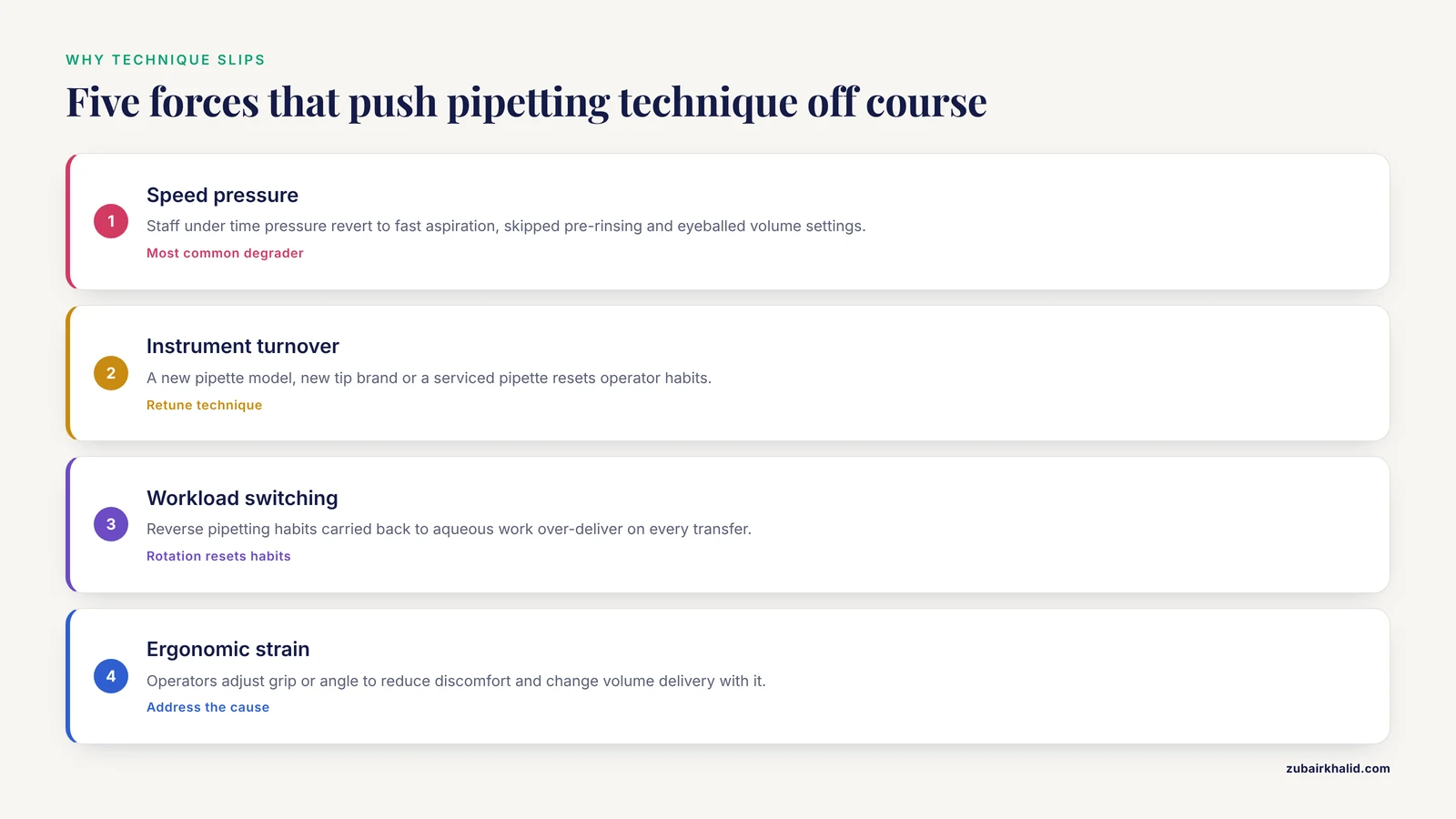
Several forces accelerate the drift:
- Speed pressure. Staff under time pressure revert to fast aspiration, skipped pre-rinsing, and eyeballed volume settings. Speed is the single most common technique degrader in busy labs.
- Instrument turnover. A new pipette model, new tip brand, or a pipette that has come back from calibration with different actuation forces resets operator habits. Technique that was tuned to one instrument family does not always transfer.
- Workload switching. An operator who spends three months on a viscous-sample workflow using reverse pipetting, then returns to aqueous work, will often carry the reverse-pipetting habit with them, over-delivering on every aqueous transfer.
- Ergonomic strain. Repetitive pipetting is a well-documented contributor to hand and shoulder strain, and operators who adjust their grip or angle to reduce discomfort often unknowingly change their volume delivery as well.
- Staff turnover and cross-training. People who pipette occasionally, rather than daily, lose the fine calibration of their motor memory faster than daily users.
The practical consequence is that pipetting technique is not a "train once" skill. It is closer to a perishable skill, like sterile technique or animal handling, that needs periodic verification to stay honest. That is the entire justification for thinking deliberately about retraining frequency rather than treating it as a formality.
Pipetting Retraining Frequency Options
There are five workable approaches to scheduling pipetting retraining. Each has distinct pipetting retraining frequency pros and cons, and the best pipetting retraining frequency for your lab is usually a blend of two of them. The table below is the core comparison of this article, and the sections after it examine each option on its own terms.
| Option | What it looks like | Pros | Cons | Best fit |
|---|---|---|---|---|
| Fixed calendar interval | Retrain everyone on a set schedule, commonly annually, often paired with annual pipette calibration | Simple to schedule, easy to document, satisfies auditors looking for a defined interval | Retrains competent staff unnecessarily and misses drift that develops between dates | Small labs, low-complexity workflows, labs that must show a documented interval to a quality system |
| Competency-based (evidence-triggered) | Verify pipetting performance on a defined testing plan, retrain only when results or observations fall below the lab's acceptance criteria | Targets training where it is needed, respects competent staff, catches drift directly | Requires a valid check method and someone willing to fail people, more record-keeping design up front | Quantitative molecular assays, clinical testing, any lab where small volume errors change results |
| Event-triggered | Retrain when a defined event occurs, such as a failed check, an out-of-range control, an instrument change, or a long absence | Cheap to run most of the time, responds to real causes of drift | Reactive only, does nothing about drift that no event has revealed yet | Used as a layer on top of one of the other options rather than alone |
| Continuous micro-training | Short, frequent touchpoints, such as quarterly technique huddles, peer observation, and posted technique reminders | Keeps technique salient, builds a culture where observation is normal, low cost per session | Easy to let slide without a champion, hard to document as formal training | High-throughput labs, labs with many occasional pipettors, teaching environments |
| Onboarding-heavy | Invest heavily in initial training with graded practice and sign-off, then rely on minimal scheduled refreshers | Produces strong fundamentals that degrade slowly | Assumes initial training holds, which it does not for staff who change workflows or instruments | New labs, labs with high retention and stable workflows |
Fixed calendar interval retraining
The fixed interval is the default answer most labs give. Everyone sits for a pipetting refresher once a year, frequently on the same day their pipettes go out for calibration service, since the two activities are natural partners. The interval itself is a local decision, and one year is the most common choice because it aligns with the annual recalibration cycle many labs use for air displacement pipettes under their quality systems and with the service intervals pipette manufacturers describe in their documentation.
The strength of the fixed interval is administrative. It requires no acceptance criteria, no testing plan, and no difficult conversations. It produces a clean training record that any auditor can read in seconds. Its weakness is precision. A calendar cannot see the operator who developed a fast-aspiration habit in March and has been quietly under-delivering on 2 µL transfers since April. It also spends training hours on operators whose technique never drifted, which breeds the quiet resentment that makes staff treat annual training as a box to tick.
A fixed interval works best when it is honest about what it is, a scheduled refresher and documentation point, and when it is paired with at least a light competency check so the calendar date is not the only signal the lab receives.
Competency-based retraining
Competency-based scheduling flips the logic. Instead of asking "how long since the last training," it asks "does the operator currently meet the lab's defined acceptance criteria for pipetting performance and technique." The mechanism is a testing plan. In gravimetric testing, the standard approach described in pipette calibration and verification practice, the operator dispenses a defined volume repeatedly onto a balance, and the results are evaluated for accuracy (how close the mean is to the target) and precision (how tightly the replicates cluster). In molecular biology labs without routine access to an analytical balance, a functional equivalent is running the operator's dilution series through a quantitative readout and comparing against expected values.
The lab defines, in writing, what constitutes a pass. When an operator passes, no retraining occurs and the next check is scheduled. When an operator fails, retraining happens immediately, targeted at the specific fault the check revealed, and the operator is rechecked. This is the approach that quality frameworks in laboratory medicine generally favor, because it ties training resources to demonstrated performance rather than to elapsed time.
The pros are real: training goes where it is needed, competent staff are left alone, and the check itself produces data the lab can trend. The cons are equally real. Someone has to design the check, someone has to be willing to tell a senior scientist they failed a pipetting assessment, and the program collapses if the acceptance criteria are vague or the checks are always waved through. A competency program with no teeth is worse than a fixed interval, because it creates the appearance of oversight without the substance.
Event-triggered retraining
Event-triggered retraining specifies, in advance, the events that force a retraining session regardless of where the operator sits in any other schedule. The list of triggers is usually written into the lab's training standard operating procedure. Common triggers include:
- A failed competency check or an out-of-range result traced to manual pipetting.
- Transfer to a new pipette model, a new tip brand, or a new assay platform.
- Return from an extended absence, such as leave longer than a couple of months, after which motor memory and instrument familiarity have lapsed.
- Observation of a specific technique fault by a supervisor or peer, such as reverse pipetting into an aqueous matrix or angling the pipette during aspiration.
- A change in the lab's acceptance criteria or assay design that changes what "good technique" means.
Event-triggered retraining is almost never sufficient on its own, because it only responds to drift after the drift has produced a detectable consequence. Used as a layer over a fixed interval or a competency program, it is one of the highest-value components of the whole system.
Continuous micro-training
Continuous approaches spread retraining across many small touchpoints. A quarterly fifteen-minute technique huddle where the group walks through one element, such as tip immersion depth or pre-rinsing, a rotating peer-observation pair, a laminated technique card at each pipetting station, or a "pipette of the month" calibration spotlight all count. The pedagogical logic is that motor skills respond better to frequent light reinforcement than to rare heavy correction.
The pros are cultural and practical. Technique stays in daily conversation, new staff absorb standards by osmosis, and the cost per contact is near zero. The cons are that micro-training is easy to deprioritize without a named champion, and many auditors and quality systems will not accept informal touchpoints as formal retraining, so it supplements rather than replaces a documented schedule.
Onboarding-heavy training
The onboarding-heavy approach concentrates effort at hire. A structured initial program might include a didactic session on air displacement pipette mechanics, demonstration of forward and reverse pipetting, supervised graded practice across the volume range the operator will actually use, and a formal sign-off requiring demonstrated competence before independent work. Done well, this produces fundamentals that resist drift.
The failure mode is the assumption that a strong start ends the matter. Operators change workflows, instruments, and hands change with age and strain, and the initial investment decays. Onboarding-heavy scheduling is best understood as the foundation the other options build on, not a complete pipetting retraining frequency strategy by itself.
Choosing the Best Pipetting Retraining Frequency: The Criteria That Decide Real Choices
With the options on the table, the choice comes down to five criteria. Work through them in order for your own lab and the right blend usually becomes obvious.
Criterion 1: How much does a small volume error change your results? Quantitative PCR with tight fold-change thresholds, digital PCR counting, nucleic acid quantification, and any assay reported with numeric patient or experimental values punish pipetting error directly. Error is proportionally largest at small volumes, where a fraction of a microliter is a large fraction of the target, so labs working routinely at 10 µL and below carry the highest stakes. Those labs should weight toward competency-based retraining with frequent early checks. Labs doing mostly forgiving work, such as large-volume buffer transfers or qualitative presence-or-absence assays, can accept longer intervals.
Criterion 2: What does your quality system require? Labs operating under a formal quality management system, or pursuing accreditation, need a defined, documented retraining schedule regardless of the technical argument. The fixed-interval option exists largely to satisfy this need. Check what your own quality manual or the accreditation body governing your lab requires before designing anything, because a competency-based program must still document when each person was last verified and when the next check falls due.
Criterion 3: How often does the workflow change under the operator's feet? An operator running the same extraction and PCR setup for years drifts slowly. An operator rotated across sample types, instruments, and assay platforms drifts quickly, because each transition resets habits. Rotation-heavy labs need shorter verification cycles or broader event triggers tied to rotation itself.
Criterion 4: How many people pipette, and how often? A lab with four full-time pipettors can competency-check everyone monthly without strain. A lab with forty pipettors, many of whom pipette occasionally, cannot, and should lean on continuous micro-training for breadth plus targeted competency checks for the small-volume, high-stakes roles.
Criterion 5: Who is available to do the checking? Every competency check requires a trained checker. If no one on staff can credibly evaluate technique and run a gravimetric or functional check, a fixed interval delivered by an external trainer or a senior designate may be the only sustainable option, and recognizing that constraint is better than designing a program that dies in six months.
Worked Scenarios
Abstract options become concrete with examples. These four scenarios cover the situations most molecular biology labs face.
Scenario 1: A clinical molecular diagnostics lab under accreditation. The lab runs quantitative viral load assays with results reported to clinicians, volumes mostly in the 2 to 20 µL range, and a quality system that requires documented competency. The best pipetting retraining frequency here is competency-based with a fixed-interval backstop. Each operator gets a formal pipetting competency check at onboarding, again within their first weeks of independent work, and then on a defined schedule, commonly annually, with the check documented alongside annual pipette calibration. Event triggers add retraining after any failed assay investigation implicating manual pipetting, any pipette fleet change, and any extended absence. Continuous micro-training runs in the background as quarterly huddles.
Scenario 2: A university research lab with rotating students. Graduate students join, learn pipetting from whoever trained them, rotate through projects, and leave. Technique heterogeneity is the baseline condition. Fixed annual intervals are nearly meaningless here because population turns over faster than the calendar. The right blend is onboarding-heavy training with a hard sign-off before independent bench work, event-triggered retraining at each rotation change, and peer observation built into the lab culture. A faculty member or senior research technician should own a short technique standard that every incoming student is trained against, so the lab is not calibrating each newcomer against a different senior student's habits.
Scenario 3: A high-throughput genomics core. Dozens of operators, or automation with humans loading plates, and volume errors propagate into expensive sequencing runs. Daily pipetting keeps motor skills sharp but also embeds speed-driven habits and accumulates repetitive strain. Competency-based checks on a frequent schedule, for example quarterly for operators handling lowest-volume critical steps, plus ergonomic attention, plus event triggers whenever the liquid-handling platform or consumable supplier changes, fit this environment. Continuous micro-training has high leverage here because the population is large and the per-contact cost must stay low.
Scenario 4: A small two-person lab doing occasional PCR. Low stakes, low turnover, forgiving readouts. Here the fixed annual interval paired with annual pipette calibration is genuinely adequate. The annual session doubles as a check: the pair pipettes a mid-range volume together, compares volumes against the pipette's calibration certificate, and refreshes the technique points that matter. Adding more machinery would produce documentation theater, not better science.
Pipette Calibration and Retraining: Partners, Not Substitutes
The most common conceptual mistake in this area is treating pipette calibration as if it solves the same problem as retraining. It does not, and understanding the division of labor between them is central to setting a sensible pipetting retraining frequency.
Pipette calibration is the process of verifying, and if needed adjusting, the instrument itself so that the volume it claims to deliver is the volume it actually delivers. It is conventionally done gravimetrically: the pipette dispenses repeatedly onto a calibrated balance, the delivered masses are converted to volumes using the density of water with corrections for temperature and evaporation, and the results are compared against the manufacturer's accuracy and precision specifications for that nominal volume. Standard practice in pipette calibration and verification, as described in international standards for piston-operated volumetric apparatus and in manufacturer technical documentation, is to test at multiple points across the volume range, commonly at the nominal (maximum) volume, and at points near the bottom of the range where relative error grows largest. Calibration intervals vary by usage and risk tolerance, and one year is a widely adopted default, with more frequent checks for high-use or small-volume-critical instruments.
Operator retraining addresses a different source of error entirely. A perfectly calibrated pipette in careless hands still delivers wrong volumes, because aspiration speed, angle, immersion depth, tip seating, pre-rinsing, and plunger operation are all operator-controlled variables. Symmetrically, a perfectly trained operator with an uncalibrated pipette also delivers wrong volumes. Neither activity substitutes for the other.
This is why the two belong on the same operational rhythm. The cleanest structure is:
- Pipettes go out for external calibration on their defined interval, and a documented in-house verification, a quick gravimetric spot check at one or two volumes, runs between external services.
- Operator competency checks are scheduled around the same time, and ideally performed with a freshly verified pipette, so that any inaccuracy observed during the check can be attributed to the operator rather than to instrument uncertainty.
- When a competency check fails, the first diagnostic question is whether the instrument or the operator is at fault. Running the same volume gravimetrically with a known-good reference pipette, then with the operator's pipette, separates the two causes in minutes.
A second reason the partnership matters is that calibration events are themselves retraining triggers. A pipette returning from service may have different plunger forces or a rebuilt seal, and operators should be told explicitly when an instrument has been serviced. Many labs tag serviced pipettes and ask operators to run a few familiar volumes against a verified reference before trusting them on critical work. That verification pass is a micro-retraining session in all but name.
The elements of pipetting technique that retraining should reinforce are stable and well described in manufacturer training materials and standard laboratory practice. They are worth listing because a retraining session without specific content is a meeting, not training:
- Seat the tip with a slight twist so the seal is airtight, since a leaking seal is a leading cause of under-delivery.
- Pre-rinse the tip by aspirating and dispensing the working volume two or three times before the analytical transfer, which conditions the air cushion humidity and improves delivery consistency, particularly for volatile or small volumes.
- Hold the pipette as close to vertical as practical during aspiration, and dispense against the wall of the receiving vessel at an angle, wiping the tip on the wall as you finish.
- Aspirate smoothly and slowly, especially at small volumes, and pause briefly at the stop before withdrawing from the liquid.
- Use forward pipetting for aqueous solutions and reserve reverse pipetting, in which the operator aspirates an extra volume and dispenses only down to the first stop, for viscous, foaming, or low-surface-tension liquids where complete delivery is hard to guarantee.
- Match the pipette size to the volume: a P20 working near its 2 µL floor outperforms a P200 operating near its own floor for the same target volume, because operating near a pipette's maximum is where its relative accuracy is best.
- Never rotate the volume setting beyond the stated range, never leave a pipette standing loaded with liquid in the tip, and store pipettes at their maximum setting or hung upright as the manufacturer directs.
A retraining session that walks an operator through this list against their own observed habits, with the operator pipetting water on a balance or into a quantitative readout so they see their own numbers, converts abstract instruction into felt correction, which is what changes behavior.
Building Your Retraining Program: A Practical Sequence
If you are designing or overhauling a program, the following sequence gets a defensible system running without overengineering it.
- Inventory the risk. List the pipetting steps in your lab, mark which ones are volume-critical, note the volumes involved, and identify who performs each. This tells you where retraining resources should concentrate.
- Write a technique standard. One page, the technique points above, signed by whoever owns lab training. Every check and every retraining session evaluates against this document, not against individual checker preferences.
- Choose your base option. Fixed interval, competency-based, or hybrid, using the five criteria above. Write the choice into the training SOP with the interval or acceptance criteria spelled out.
- Define the check. Decide what a competency check consists of in your lab: gravimetric testing at one or two volumes if a balance is available, a functional quantitative check if not, plus direct observation against the technique standard. Define pass criteria in writing before the first check is ever run.
- Set event triggers. Write the trigger list into the SOP so retraining after an instrument change, absence, or observed fault is a rule rather than a judgment call.
- Layer in continuous micro-training. Quarterly huddles, peer observation, station cards. Cheap, high leverage, and it makes formal checks feel routine instead of punitive.
- Document everything. For each operator: onboarding sign-off date, every check with pass or fail, every retraining with its trigger and content, and the next due date. Auditors and incident investigations both read this record.
- Review annually. When pipettes go for calibration and the annual refresher runs, also ask whether the retraining frequency itself is right. A string of passed checks argues for stretching intervals. Any failed check or assay investigation implicating pipetting argues for tightening them.
Common Mistakes and Limitations
These are the failure patterns that show up repeatedly when labs implement pipetting retraining programs, along with the honest limits of what any schedule can do.
Treating calibration as retraining. Sending pipettes out for annual service while never observing a live operator is the single most common gap. Calibration certifies the instrument. Only a check of the person certifies the pipetting technique.
Retraining the whole group for one person's fault. When a competency check or investigation implicates one operator, the targeted fix is retraining that operator on the specific fault. Making everyone sit a generic refresher wastes time and dilutes the message for the person who actually needs it.
Checks that cannot fail. A competency program in which everyone always passes, with no recorded failures ever, is not a monitoring system. Either the acceptance criteria are too loose, the checker is not looking, or the records are aspirational. A program needs defined pass criteria and a checker empowered to apply them.
Ignoring the small-volume end. Relative pipetting error grows as target volume shrinks, so an operator who is acceptable at 200 µL can be materially off at 5 µL. Competency checks should include the lowest volumes the operator actually uses, not only comfortable mid-range volumes.
No trigger for instrument or consumable change. Switching pipette brands, tip brands, or plate formats changes aspiration behavior, and labs that retrain only on the calendar miss this entirely. Instrument and consumable changes belong on the written trigger list.
Over-retraining competent staff. The mirror-image error. Forcing frequent formal retraining on operators with years of passing checks breeds tick-box behavior and consumes checker hours that could go to at-risk staff. Evidence of sustained competence is a reason to lengthen intervals, and a well-designed program says so.
Confusing observation with measurement. Watching someone pipette catches gross faults, angles, speed, tip handling, but not consistent small systematic errors that only a gravimetric or quantitative check reveals. The two methods answer different questions and both belong in the toolkit.
Skipping ergonomic context. If an operator changed technique to reduce pain, correcting the technique without addressing the ergonomic cause, pipette choice, workstation setup, workload distribution, will fail, because the operator will drift back to the comfortable habit. Retraining that ignores why a habit formed does not stick.
A limitation stated plainly. Any retraining frequency, however well designed, verifies performance at moments in time. Between checks, technique can drift silently, and no schedule eliminates that residual risk entirely. Frequency choices are about managing that risk proportionately to the stakes, not about achieving certainty. Individual staffing situations, physical capabilities, and local quality requirements vary enough that each laboratory must set its own criteria with its own quality and supervisory staff rather than copying another lab's interval uncritically.
Frequently Asked Questions
How often should a new hire be retrained on pipetting?
Check new hires against the technique standard during onboarding and again after their first weeks of independent work, since that is when unsupervised habits first form. After that, move them onto the lab's standard schedule, with extra early checks for anyone working at small volumes or on quantitative assays.
Does pipette calibration replace operator retraining?
No. Calibration verifies the instrument, retraining verifies the person, and errors arise from both sources independently. The two should run on coordinated schedules, ideally with competency checks performed using a freshly calibrated pipette so operator faults can be isolated.
What events should trigger retraining between scheduled sessions?
At minimum: a failed competency check or assay investigation implicating manual pipetting, a change of pipette model, tip brand, or assay platform, return from an extended absence, and any observed technique fault such as reverse pipetting into aqueous samples. Write the trigger list into the training SOP so responses are automatic.
How long does a pipetting competency check take?
A focused check combining direct observation against a written technique standard with gravimetric or functional testing at one or two volumes typically fits within a single short session, often well under an hour per operator. The design work behind the check, defining acceptance criteria in advance, is what takes real time, and it is done once.
Can retraining be done too often?
Yes. Frequent mandatory retraining of operators with consistent passing checks wastes checker hours, disrupts bench work, and teaches staff that training is a formality, which weakens attention when it genuinely matters. A sound program lengthens intervals for operators with sustained passing evidence and concentrates resources on those whose checks show drift.
What should a pipetting competency check include?
A written technique standard to check against, direct observation of forward and reverse pipetting including tip seating, pre-rinsing, angle, immersion depth, and aspiration speed, and a quantitative element such as gravimetric dispensing at a balance or a functional dilution through a quantitative readout, all evaluated against pass criteria defined before the check is run.